Chapter 17
Stabilization in an Integrated World Economy
◼ Overview
This chapter begins with an examination of active versus passive policymaking. The natural rate of
unemployment and departures from this rate are examined in relation to long-run macroeconomic
equilibrium. The impact of expansionary policy on the level of real national output and employment is
also discussed. The Phillips curve is introduced, and the relationship between inflation and unemployment
◼ Learning Objectives
After studying this chapter, students should be able to:
• 17.1 Explain why the actual unemployment rate might depart from the natural rate of unemployment
• 17.2 Describe why there may be an inverse relationship between the inflation rate and the
◼ Outline
I. Active versus Passive Policymaking and the Natural Rate of Unemployment: Active
(discretionary) policymaking is all actions on the part of monetary and fiscal policymakers that are
undertaken in response to or in anticipation of some change in the economy. Passive
(nondiscretionary) policymaking is policy based on a rule and is, therefore, not a response to an
actual or potential change in overall economic activity.
A. The Natural Rate of Unemployment:
1. The Role of Structural Unemployment: The rate consists of two parts: (1) frictional
unemployment, which exists due to individuals taking time to search for the best job
opportunities and (2) structural unemployment due to rigidities in the economic system.
256 Miller • Economics Today, Nineteenth Edition
B. Departures from the Natural Rate of Unemployment: Deviations of the actual unemployment
rate from the natural rate are due to cyclical unemployment. This results from business
recessions that occur when aggregate demand is insufficient to create full employment.
1. The Impact of Expansionary Policy: Unanticipated fiscal or monetary policy to stimulate
the economy when it is in long-run equilibrium causes the price level and real GDP to rise
2. The Consequences of Contractionary Policy: An unanticipated reduction in aggregate
II. The Phillips Curve: A Rationale for Active Policymaking? A curve showing the relationship
between the unemployment rate and changes in wages or prices. It was long thought that the Phillips
curve depicted a trade-off between unemployment and inflation. If there is an unexpected increase in
aggregate demand, greater inflation and lower unemployment results. An unexpected decrease in
aggregate demand results in greater deflation and higher unemployment. (See Figure 17-4.)
A. The Negative Short-Run Relationship between Inflation and Unemployment: Looking at
B. Is There a Trade-Off? The negative relationship between the inflation rate and the unemployment
rate has come to be called the Phillips curve. It turned out not to be that simple.
C. The Importance of Expectations: If wage offers to unemployed workers are unexpectedly
1. The Effects of an Unanticipated Policy: If the Fed attempts to reduce the unemployment
2. Adjusting Expectations and a Shifting Phillips Curve: If the Fed increases the money
3. An Example: Once workers expect the higher inflation rate, the rising nominal wage will
no longer be sufficient to entice them out of unemployment, and the unemployment rate
4. Implications for the Phillips Curve: Policymakers cannot choose a permanently lower
III. Rational Expectations, the Policy Irrelevance Proposition, and Real Business Cycles: Rational
expectations is a theory that states that people combine the effects of past policy changes on important
economic variables with their own judgment about the future effects of current and future policy
A. Flexible Wages and Prices, Rational Expectations, and Policy Irrelevance: An increase in
the money supply can raise output and lower unemployment in the short run, but it has no effect
on either in the long run. (See Figure 17-6.)
1. Anticipated Policy and the Policy Irrelevance Proposition: Under the assumption
of rational expectations, anticipated monetary policy is irrelevant in determining the
B. Another Challenge to Policy Activism: Real Business Cycles
1. The Distinction between Real and Monetary Shocks: Real business cycle theorists argue
that real forces help explain economic fluctuations. A real shock affects long-run and short-
run aggregate supply, not aggregate demand. A rise in the price level due to a real shock
IV. Modern Approaches to Justifying Active Policymaking: Followers of Keynes, called New
Keynesians, drop the assumptions of pure competition and flexible prices. It emphasizes the
possibility that optimal performance by an economy may require activist intervention by relevant
fiscal and monetary authorities because of “sticky” wages and prices assumed by Keynes.
A. Small Menu Costs and Sticky Prices: The idea that it is costly for firms to change prices in
B. Real GDP and the Price Level in a Sticky-Price Economy: According to the New Keynesians,
1. New Keynesian Inflation Dynamics: Sticky prices imply a horizontal aggregate supply
curve in the short run. Thus changes in aggregate demand will result in similar changes in
2. Why Active Policymaking Can Pay Off When Prices Are Sticky: Active policymaking
C. Is There a New Keynesian Phillips Curve? If there is a rationale for activist policymaking,
1. The U.S. Experience with the Phillips Curve: Studies by Milton Friedman and Edmond
2. The New Keynesian Phillips Curve: New Keynesians are not interested in the apparent
lack of a long-term relationship between the rate of inflation and the unemployment rate.
They look instead for a short-term relationship so that appropriate activist policies can
dampen cyclical fluctuations.
b. Just How Exploitable Is the New Keynesian Phillips Curve? The major issue is how
often firms adjust their prices. If the New Keynesian view is that the average interval
V. Behavioral Economics and Macroeconomic Policymaking: Bounded rationality is the hypothesis
that people are limited in their ability to consider every conceivable choice available to them.
People with bounded rationality rely upon simple rules of thumb to choose among the set of options
that they happen to identify.
A. Habit Formation, Real Consumption, and Policy Effects on Aggregate Demand: Habit
formation is an inclination for household choices, such as decisions to purchase goods and
B. Rational Inattention, Infrequent Information, and Aggregate Supply: People with rational
Chapter 17 Stabilization in an Integrated World Economy 259
◼ Points to Emphasize
The Natural Rate of Unemployment
The natural rate of unemployment includes (at least) the following:
1. Frictional unemployment
2. Price-wage rigidities in the economic system, such as:
a. minimum-wage laws
b. powerful unions that restrict entry and/or increase wages more rapidly than productivity
The Rational Expectations Hypothesis
The Phillips curve analysis presented in this chapter is based on the rational expectations hypothesis.
Workers will eventually recognize what is happening and will devote more resources to inflation
forecasting or Fed watching. Eventually, the Fed will not be able to affect even short-run trade-offs
systematically. To get the concept of rational expectations across, the following examples are useful.
Discuss food surpluses in the United States that result from agricultural price supports. When the
government purchases surpluses, it cannot sell those surpluses in domestic markets because prices would
fall. Why would it matter since the farmers already have their higher prices? It turns out that the government
The Effectiveness of Active Policy Debate
An important implication of the rational expectations hypothesis is the Policy Ineffectiveness Proposition
that states that monetary policy is only effective either when the policy is unexpected or when economic
260 Miller • Economics Today, Nineteenth Edition
◼ For Those Who Wish to Stress Theory
The Phillips Curve
According to the rational expectations hypothesis, the Phillips curve “trade–off” involves only frictional
unemployment in the short run. When the Fed unexpectedly and “permanently” increases the rate of
growth of the stock of money, workers are fooled into shortening their average duration of frictional
Some Criticisms of the Rational Expectations Model and Its Application
Two basic criticisms of the rational expectations model as it is applied can be made. The first relates to
the assumption of perfect price flexibility. This assumption means that all prices always adjust so that
they are never different from expected prices. As the text points out, many contract prices do not instantly
Chapter 17 Stabilization in an Integrated World Economy 261
◼ Further Questions for Class Discussion
1. In the Great Recession, stories surfaced about homeowners who had lost their jobs but found that
they could not afford to move to other parts of the country because they could not sell their homes.
2. Suppose that the Fed engages in an expansionary monetary policy. Is it certain that market interest
3. Why does the New Keynesian model require sticky wages and prices for active policymaking? If
4. If the analysis of real business cycles is correct and a simultaneous recession and inflation occurred
caused by real factors, what effect would active policymaking by the Fed have on the rate of
5. The Great Recession was dated by the National Bureau of Research as having begun at the end
of 2007. Real GDP fell for five of the next six quarters in 2008 and 2009 and rose from the third
quarter of 2009 to the second quarter of 2010. The GDP Price Index rose in every quarter
between the first quarter of 2008 and the second quarter of 2010, except for the fourth quarters
of 2008 and 2009. Finally, the unemployment rate increased in every month but three between
6. Can the unemployment rate ever be “too low” if price stability is a macroeconomic goal? The
7. Could the Phillips curve showing a trade-off between the rate of inflation and unemployment be a
valid economic model for active monetary policy if the rational expectations hypothesis was true?
◼ Answers to Questions for Critical Analysis
Policy Uncertainty and Reduced Total Planned Expenditures (p. 378)
Why do you suppose that uncertainty about tax rates is a key element of Baker, Bloom, and Davis’s
policy-uncertainty index?
What Policy-Relevant Inflation Rate Should the Public Try to Predict? (p. 388)
Why might Fed policymakers, in turn, experience difficulties determining which of the public’s
inflation expectations are the best signals of inflationary pressures in the economy?
Do Distorted Beliefs Influence Real GDP and the Unemployment Rate? (p. 389)
Why might it be the case that even if distorted beliefs alter real GDP and the unemployment rate
today, such beliefs might be unlikely to arise among households and firms again in the future?
Explain your reasoning.
◼ You Are There
Are National Inflation Rates Mysteriously “Too Low”? (pp. 390–391)
1. How might low inflation expectations on the part of the public help to hold down actual
inflation? Explain.
2. According to the quantity equation, how else besides using interest-rate-based policies
might central banks be able to generate higher inflation if they really wished to do so?
◼ Issues and Applications
Does the Usual Phillips Curve Consider the Wrong Unemployment Rate?
(pp. 391–392)
1. Would a U6 version of the natural unemployment rate likely be higher or lower than the
traditional natural unemployment rate? Explain your reasoning?
2. Why would using the U6 unemployment rate instead of the traditional unemployment rate
almost certainly yield difference “appropriate” activist macroeconomic policies?
◼ Research Project
◼ Answers to Problems
17-1. Suppose that the government altered the computation of the unemployment rate by
including people in the military as part of the labor force.
a. How would this affect the actual unemployment rate?
b. How would such a change affect estimates of the natural rate of unemployment?
c. If this computational change were made, would it in any way affect the logic of the
short-run and long-run Phillips curve analysis and its implications for policymaking?
Why might the government wish to make such a change?
17-2. The natural rate of unemployment depends on factors that affect the behavior of both
workers and firms. Make lists of possible factors affecting workers and firms that you
believe are likely to influence the natural rate of unemployment.
For both workers and firms, these include access to information and the degree of competition in
17-3. Suppose that more unemployed people who are classified as part of frictional
unemployment decide to stop looking for work and start their own businesses instead. What
is likely to happen to each of the following, other things being equal?
a. The natural unemployment rate
b. The economy’s Phillips curve
17-4. Suppose that people who previously had held jobs become cyclically unemployed at the
same time the inflation rate declines. Would the result be a movement along or a shift of the
short-run Phillips curve? Explain your reasoning.
17-5. Suppose that people who previously had held jobs become structurally unemployed due to
establishment of new government regulations during a period in which the inflation rate
remains unchanged. Would the result be a movement along or a shift of the short-run
Phillips curve? Explain your reasoning.
17-6. Suppose that the greater availability of online job placement services generates a reduction
in frictional unemployment during an interval in which the inflation rate remains
unchanged. Would the result be a movement along or a shift of the short-run Phillips
curve? Explain your reasoning.
17-7. Consider a situation in which a future president has appointed Federal Reserve leaders who
conduct monetary policy much more erratically than in past years. The consequence is that
the quantity of money in circulation varies in a much more unsystematic and, hence, hard–
to-predict manner. According to the policy irrelevance proposition, is it more or less likely
that the Fed’s policy actions will cause real GDP to change in the short run? Explain.
17-8. People called “Fed watchers” earn their living by trying to forecast what policies the
Federal Reserve will implement within the next few weeks and months. Suppose that Fed
watchers discover that the current group of Fed officials is following very systematic and
predictable policies intended to reduce the unemployment rate. The Fed watchers then sell
this information to firms, unions, and others in the private sector. If pure competition
prevails, prices and wages are flexible, and people form rational expectations, are the Fed’s
policies enacted after the information sale likely to have their intended effects on the
unemployment rate?
17-9. Suppose that economists were able to use U.S. economic data to demonstrate that the
rational expectations hypothesis is true. Would this be sufficient to demonstrate the validity
of the policy irrelevance proposition?
17-10. Evaluate the following statement: “In an important sense, the term policy irrelevance
proposition is misleading because even if the rational expectations hypothesis is valid,
economic policy actions can have significant effects on real GDP and the unemployment
rate.”
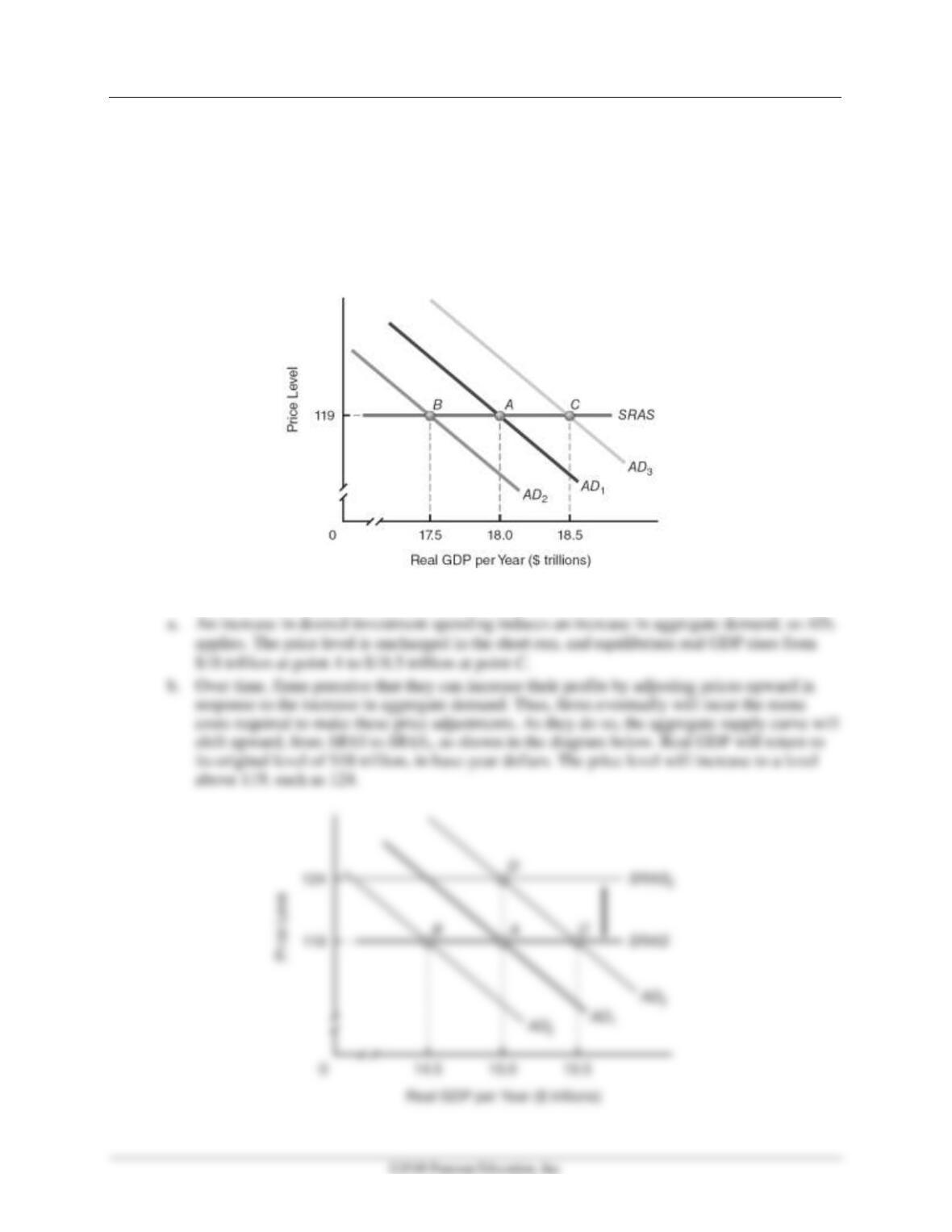
17-11. Consider the diagram below, which is drawn under the assumption that the new Keynesian
sticky-price theory of aggregate supply applies. Assume that at present, the economy is in
long-run equilibrium at point A. Answer the following questions.
266 Miller • Economics Today, Nineteenth Edition
a. Suppose that there is a sudden increase in desired investment expenditures. Which of
the alternative aggregate demand curves—AD2 or AD3—will apply after this event
occurs? Other things being equal, what will happen to the equilibrium price level and to
equilibrium real GDP in the short run? Explain.
b. Other things being equal, after the event and adjustments discussed in part (a) have
taken place, what will happen to the equilibrium price level and to equilibrium real
GDP in the long run? Explain.
17-12. Both the traditional Keynesian theory discussed in Chapter 11 and the new Keynesian
theory considered in this chapter indicate that the short-run aggregate supply curve is
horizontal.
a. In terms of their short-run implications for the price level and real GDP, is there any
difference between the two approaches?
b. In terms of their long-run implications for the price level and real GDP, is there any
difference between the two approaches?
17-13. The real-business-cycle approach attributes even short-run increases in real GDP largely to
aggregate supply shocks. Rightward shifts in aggregate supply tend to push down the
equilibrium price level. How could the real-business-cycle perspective explain the low but
persistent inflation that the United States experienced until 2007?
17-14. Normally, when aggregate demand increases, firms find it more profitable to raise prices
than to leave prices unchanged. The idea behind the small-menu-cost explanation for price
stickiness is that firms will leave their prices unchanged if their profit gain from adjusting
prices is less than the menu costs they would incur if they change prices. If firms anticipate
that a rise in demand is likely to last for a long time, does this make them more or less
likely to adjust their prices when they face small menu costs? (Hint: Profits are a flow
that firms earn from week to week and month to month, but small menu costs are a
one-time expense.)
17-15. The policy relevance of new Keynesian inflation dynamics based on the theory of small
menu costs and sticky prices depends on the exploitability of the implied relationship
between inflation and real GDP. Explain in your own words why the average time between
price adjustments by firms is a crucial determinant of whether policymakers can actively
exploit this relationship to try to stabilize real GDP.
17-16. Take a look at Figure 17-1. What is the most recent approximate interval during which the
cyclical unemployment rate has been positive? During what most recent approximate
interval was the cyclical unemployment rate negative? Explain briefly.
17-17. Consider Figure 17-2. Explain whether the cyclical unemployment rate is positive, zero, or
negative at point E2, after the shift in the aggregate demand curve from AD1 to AD2. In
addition, explain whether the cyclical unemployment rate is positive, zero, or negative at
point E3, following the shift in the short-run aggregate supply curve from SRAS1 to SRAS2.
17-18. Take a look at Figure 17-3. Explain whether the cyclical unemployment rate is positive,
zero, or negative at point E2, after the shift in the aggregate demand curve from AD1 to AD2.
In addition, explain whether the cyclical unemployment rate is positive, zero, or negative at
point E3, following the shift in the short-run aggregate supply curve from SRAS1 to SRAS2.
17-19. Consider Figure 17-4, and suppose that the economy initially operates at point A, at which
the inflation rate is 0 percent and the unemployment rate is 6 percent, which is the natural
rate of unemployment. Then the inflation rate decreases to −1 percent. Does additional
cyclical, frictional, or structural unemployment account for the resulting rise in the
unemployment rate at point C? Explain briefly.
17-20. Take a look at Figure 17-4, and suppose that the economy initially operates at point A, at
which the inflation rate is 0 percent and the unemployment rate is 6 percent, which is the
natural rate of unemployment. Then the inflation rate increases to 3 percent. Does reduced
cyclical, frictional, or structural unemployment account for the resulting decrease in the
unemployment rate at point B? Explain briefly.
17-21. Consider Figure 17-5, and suppose that the economy initially operates at point A, at which
the inflation rate is 0 percent and the unemployment rate is 6 percent, which is the natural
rate of unemployment. In the long run, will an increase in the inflation rate to 3 percent
result in the economy operating at point B or at point F1? Explain your reasoning.
◼ Selected References
Barro, R.J., “A Capital Market in an Equilibrium Business Cycle Model,” Econometrica, Vol. 48,
September 1980, pp. 1393–1417.
Friedman, Milton, “The Optimum Quantity of Money,” in The Optimum Quantity of Money and Other
Essays, Chicago: Aldin, 1969.
Friedman, Milton, A Program for Monetary Stability, New York: Fordham University Press, 1960.
Friedman, Milton, “Nobel Lecture: Inflation and Unemployment,” Journal of Political Economy,
Vol. 85, 1977.
Miller, Roger LeRoy and Raburn M. Williams, Unemployment and Inflation: The New Economics of the
Wage-Price Spiral, St. Paul, MN: West Publishing Company, 1974.
Miller, Roger L. and David D. VanHoose, Modern Money and Banking, New York: McGraw-Hill, 1993.