Chapter 17: Multinational Financial Management
Integrated Case
495
2. To avoid political and regulatory hurdles. The most prominent
3. To broaden markets. Coca–Cola and McDonald’s have expanded
4. To seek raw materials and new technology. U.S. oil companies
have searched around the world for years for new sources of
oil. It is not surprising that a large company like Chevron has
5. To protect the secrecy of their processes and products. Firms
sometimes invest abroad rather than license local foreign firms
6. To diversify. By establishing worldwide production facilities
7. To retain customers. It makes good business sense to follow
customers abroad to retain the business. Large U.S. banks,
such as Citibank and Chase, initially expanded abroad to supply
banking services to their long-time customers, although they
quickly capitalized on their global network to develop new
customer relationships.
B. What are the five major factors that distinguish multinational
financial management from financial management as practiced by a
purely domestic firm?
Answer: [Show S17-5 here.]
1. Different currency denominations. Cash flows in various parts
of multinational corporate systems will be denominated in
2. Political risk. Nations exercise sovereign rights over their
people and property. Thus, a government can seize the assets
3. Economic and legal ramifications. Each country in which a firm
operates will have its own unique political and economic
institutions, and institutional differences can cause significant
Chapter 17: Multinational Financial Management
Integrated Case
497
4. Role of governments. Except for certain industries, the role of
government in the U.S. is to create an environment that
5. Language and cultural differences. The ability to communicate is
critical in all business matters, and U.S. business men and women
have been notoriously poor in learning other languages. In
effect, it is easier for foreign firms to invade our markets than for
us to invade theirs. It is interesting to note, though, that English
498
Integrated Case
Chapter 17: Multinational Financial Management
its Frito–Lay subsidiary. At first, Frito-Lay marketed popular
American products such as Ruffles potato chips and Doritos corn
C. Consider the following illustrative exchange rates:
U.S. Dollars Required to Buy
One Unit of Foreign Currency
Japanese yen 0.009
Australian dollar 0.650
(1) Are these currency prices direct quotations or indirect quotations?
Answer: [Show S17-6 here.] Since they are the prices of foreign currencies
C. (2) Calculate the indirect quotations for yen and Australian dollars.
Answer: [Show S17-7 here.] Indirect quotations, which are the number of
units of foreign currency that can be purchased with one U.S. dollar,
are merely the reciprocal of the direct quotation. Here, the table is
repeated with the indirect quotations added:
Direct Quotation: Indirect Quotation:
U.S. Dollars Required Number of Units of
to Buy One Unit of Foreign Currency per
Foreign Currency U.S. Dollar
Japanese yen 0.009 111.1111

Chapter 17: Multinational Financial Management
Integrated Case
499
C. (3) What is a cross rate? Calculate the two cross rates between yen
and Australian dollars.
Answer: [Show S17-8 here.] The exchange rate between any two currencies
that does not involve U.S. dollars is a cross rate. Here are the two
cross rates between yen and Australian dollars:
Cross rate =
dollar Australian
dollar U.S.
dollar U.S.
Yen
C. (4) Assume that Citrus Products can produce a liter of orange juice and
ship it to Japan for $1.75. If the firm wants a 50% markup on the
product, what should the orange juice sell for in Japan?
Answer: [Show S17-9 here.] There are 111.1111 yen to the U.S. dollar, so
C. (5) Now assume that Citrus Products begins producing the same liter of
orange juice in Japan. The product costs 250 yen to produce and
ship to Australia, where it can be sold for 6 Australian dollars. What
is the U.S. dollar profit on the sale?
500
Integrated Case
Chapter 17: Multinational Financial Management
Answer: [Show S17–10 here.] 250 yen are equal to 250(0.0138) = 3.45
Australian dollars, so the profit on the sale in Australia is 6 – 3.45 =
$1.66.
C. (6) What is exchange rate risk?
Answer: [Show S17-11 here.] The volatility inherent in a floating exchange
rate system increases the uncertainty of cash flows that must be
translated from one currency into another. This increase in
D. Briefly describe the current international monetary system. What
are the different types of exchange rate systems?
Answer: [Show S17-12 through S17-15 here.] Every nation has a monetary
system and a monetary authority. Moreover, if countries are to
Chapter 17: Multinational Financial Management
Integrated Case
501
The two main currency exchange rate systems are floating and
fixed. The subgroups of these two systems are as follows:
Floating Exchange Rate System:
1. Freely Floating. Occurs when the exchange rate is determined by
supply and demand for the currency.
2. Managed Floating. Occurs when there is significant government
Fixed Exchange Rate System:
1. No local currency. The most extreme position is for the country
2. Currency Board Arrangement. Occurs when a country has its
own currency but commits to exchange it for a specified foreign
3. Fixed Peg Arrangement. Occurs when a country locks its

502
Integrated Case
Chapter 17: Multinational Financial Management
E. What is the difference between spot rates and forward rates?
When is the forward rate at a premium to the spot rate? When is it
at a discount?
Answer: [Show S17-16 and S17-17 here.] Spot rates are the rates paid to
buy currency for immediate delivery (actually, two days after the
date of the trade). Forward rates are the rates paid to buy currency
for delivery at some agreed-upon date in the future (say, 90 days).
F. What is interest rate parity? Currently, you can exchange 1 yen for
0.0095 U.S. dollar in the 30-day forward market, and the risk–free
rate on 30-day securities is 4% in both Japan and the United
States. Does interest rate parity hold? If not, which securities offer
the highest expected return?
Chapter 17: Multinational Financial Management
Integrated Case
503
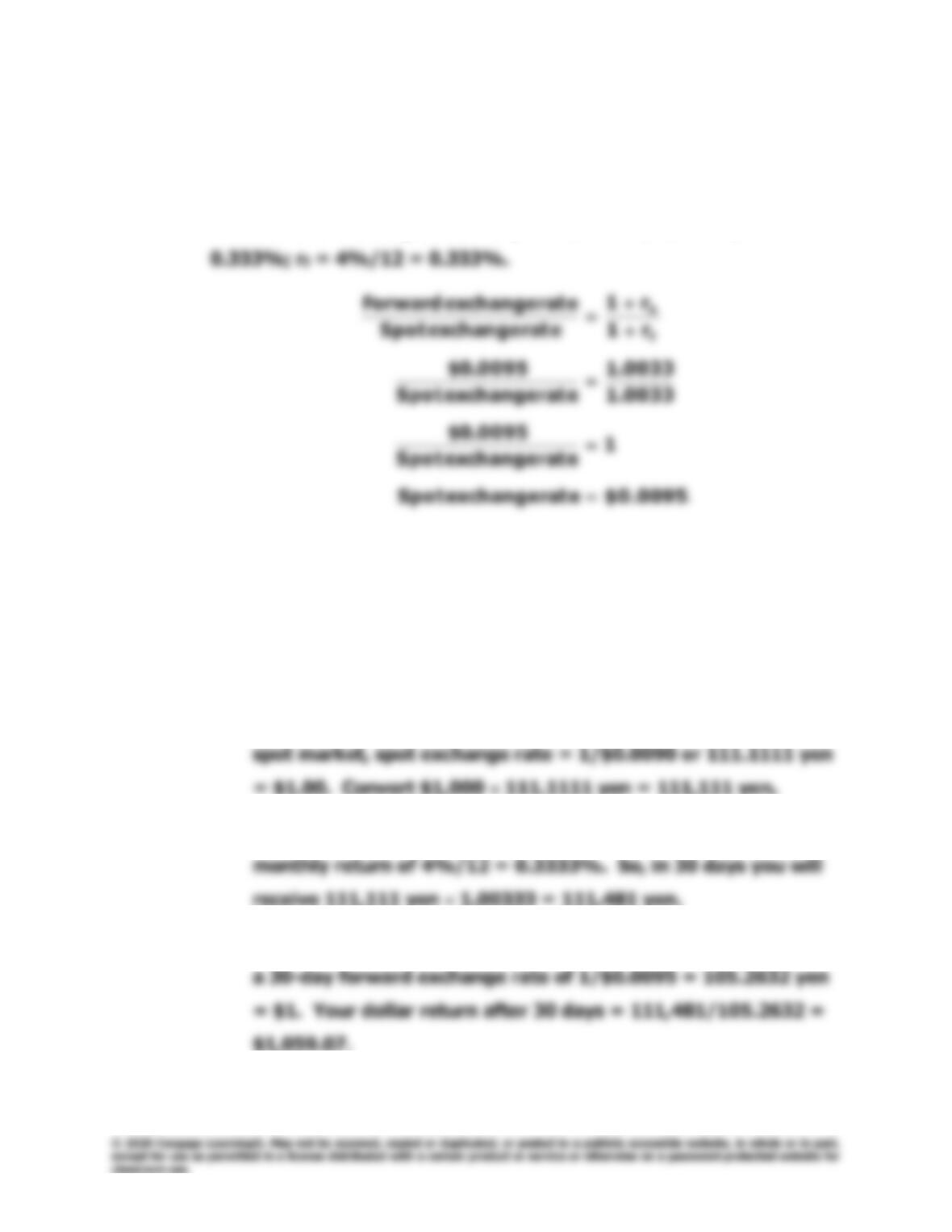
Answer: [Show S17-18 through S17-21 here.] Interest rate parity holds
that investors should expect to earn the same return in all countries
after adjusting for risk.
Forward exchange rate = 1 yen = $0.0095; rh = 4%/12 =
If interest rate parity held, then the spot exchange rate = $0.0095;
however, the spot exchange rate = $0.0090. (See table given in
part C.)
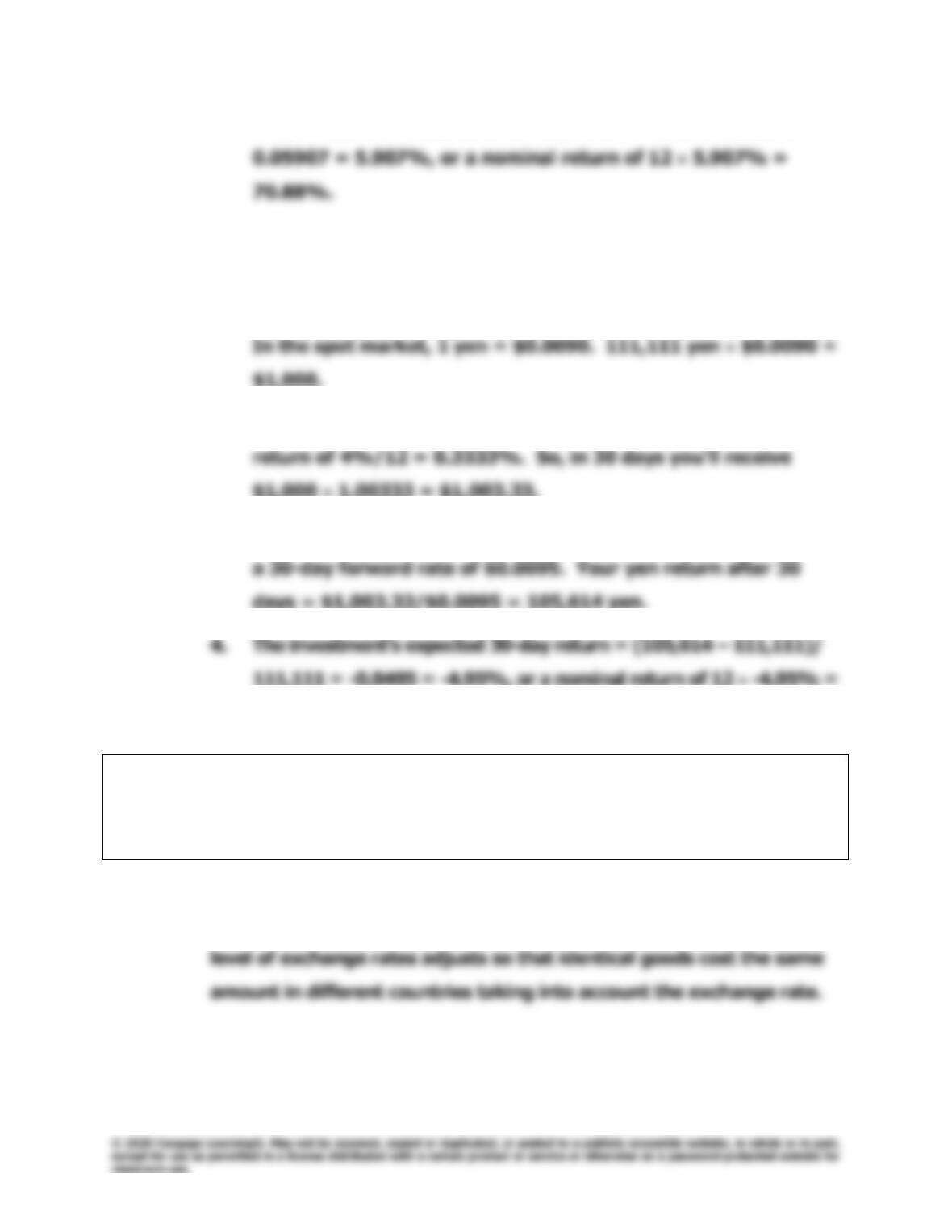
The Japanese securities offer the highest return as calculated
below:
1. Assume you convert $1,000 to yen in the spot market. In the
2. Invest 111,111 yen in a 30-day Japanese security that offers a
3. Agree today to exchange the 111,481 yen 30 days from now at
504
Integrated Case
Chapter 17: Multinational Financial Management
4. The investment’s expected 30-day return = $59.07/$1,000 =
If you assumed that you started with yen you would calculate the
following return:
1. Assume you convert 111,111 yen to dollars in the spot market.
2. Invest $1,000 in a 30-day U.S. security that offers a monthly
3. Agree today to exchange the $1,003.33 thirty days from now at
–59.37%.
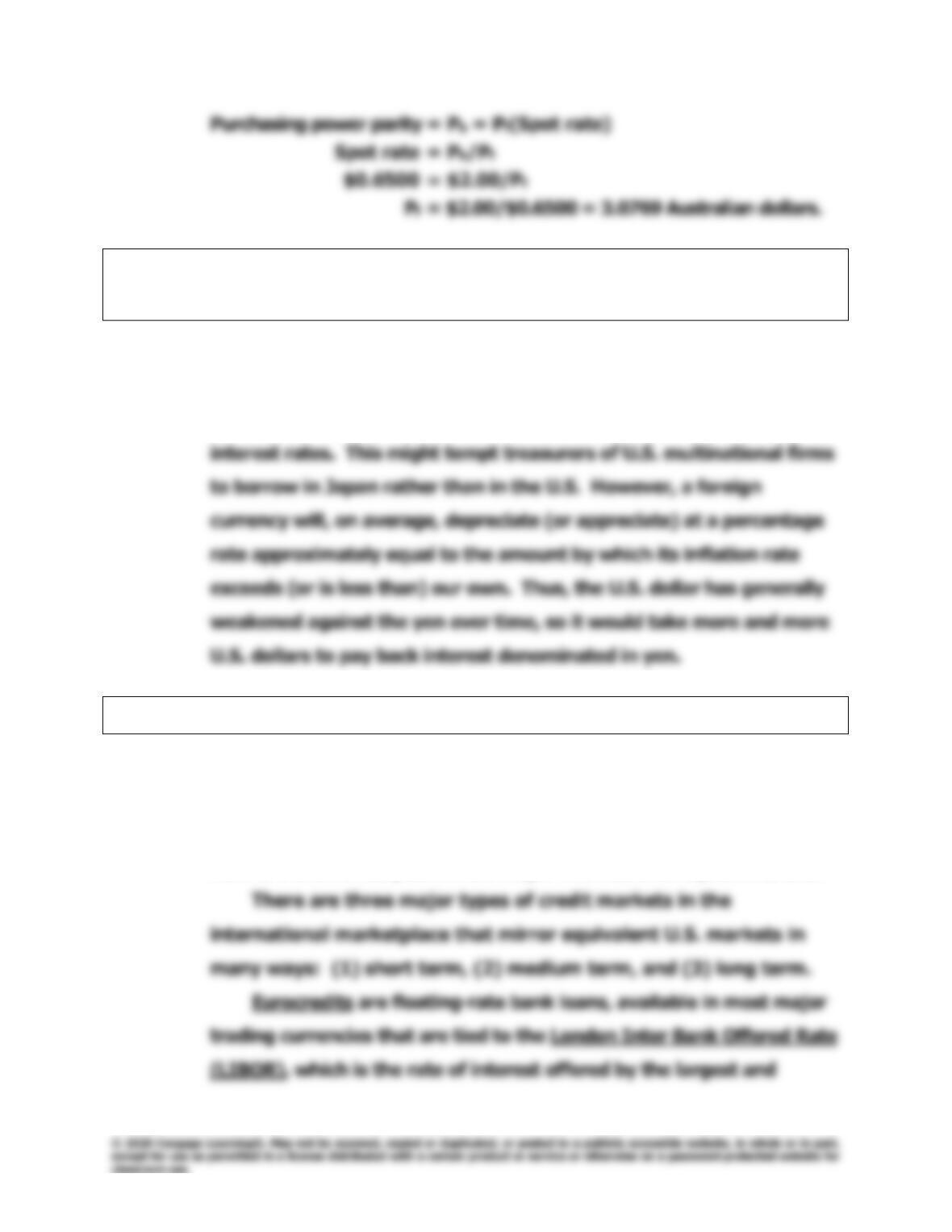
G. What is purchasing power parity (PPP)? If grapefruit juice costs
$2.00 a liter in the United States and purchasing power parity
holds, what should be the price of grapefruit juice in Australia?
Answer: [Show S17-22 and S17–23 here.] Purchasing power parity,
sometimes referred to as the law of one price (LOP), implies that the
Chapter 17: Multinational Financial Management
Integrated Case
505
H. What effect does relative inflation have on interest rates and
exchange rates?
Answer: [Show S17-24 here.] To illustrate, consider the situation between
Japan and the U.S. Japan has generally had a lower inflation rate
than the U.S., so Japanese interest rates have been lower than U.S.
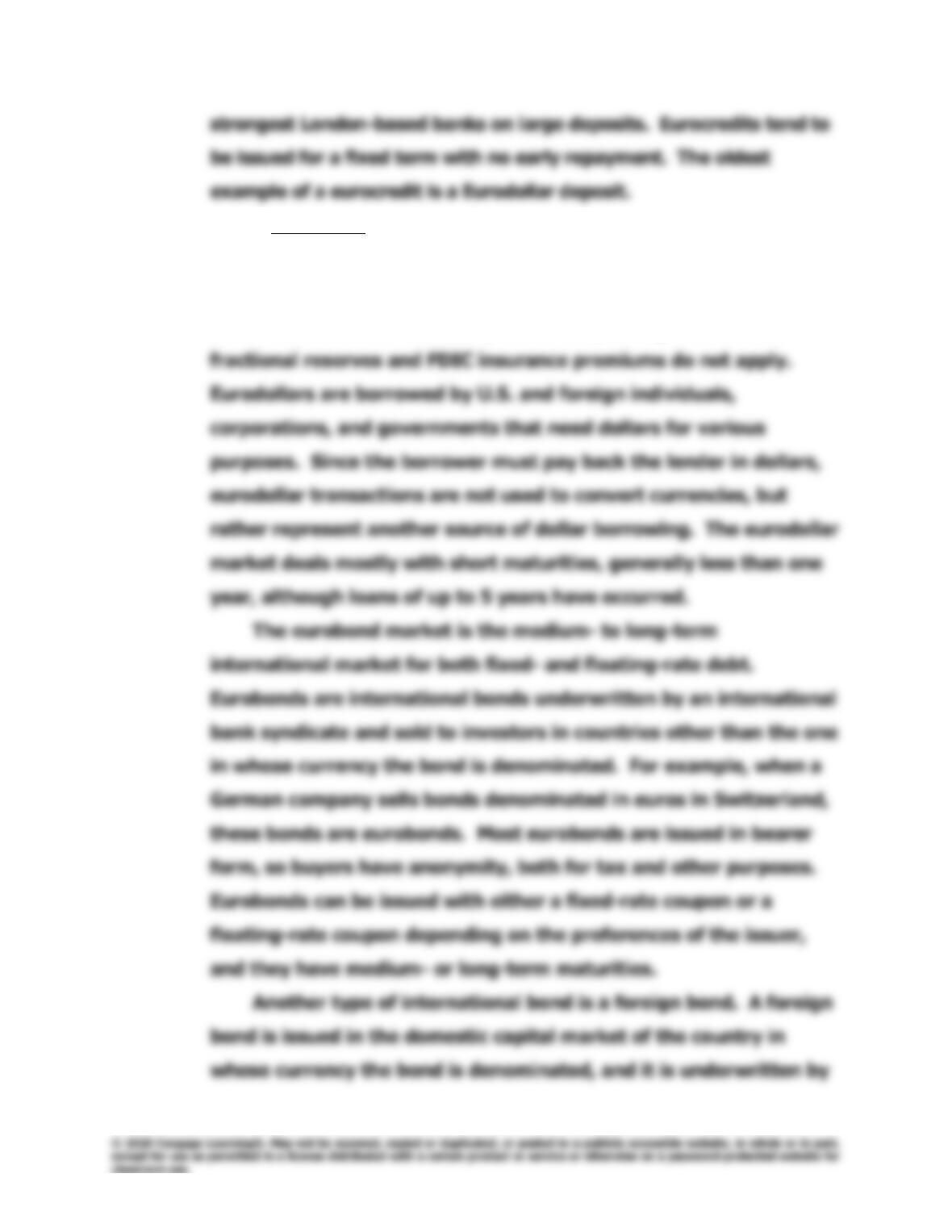
I. (1) Briefly explain the three major types of international credit markets.
Answer: [Show S17-25 and S17–26 here.] Individuals buy securities issued by
foreign governments and firms, and U.S. firms issue securities abroad.
These transactions take place in the international capital markets.
Here is a brief description of the major international capital markets.
506
Integrated Case
Chapter 17: Multinational Financial Management
A eurodollar is a U.S. dollar deposited in a bank outside the
United States. The major difference between a “regular” dollar and
a eurodollar is its location. This places eurodollars outside the
direct control of U.S. monetary authorities, so regulations such as
Chapter 17: Multinational Financial Management
Integrated Case
507
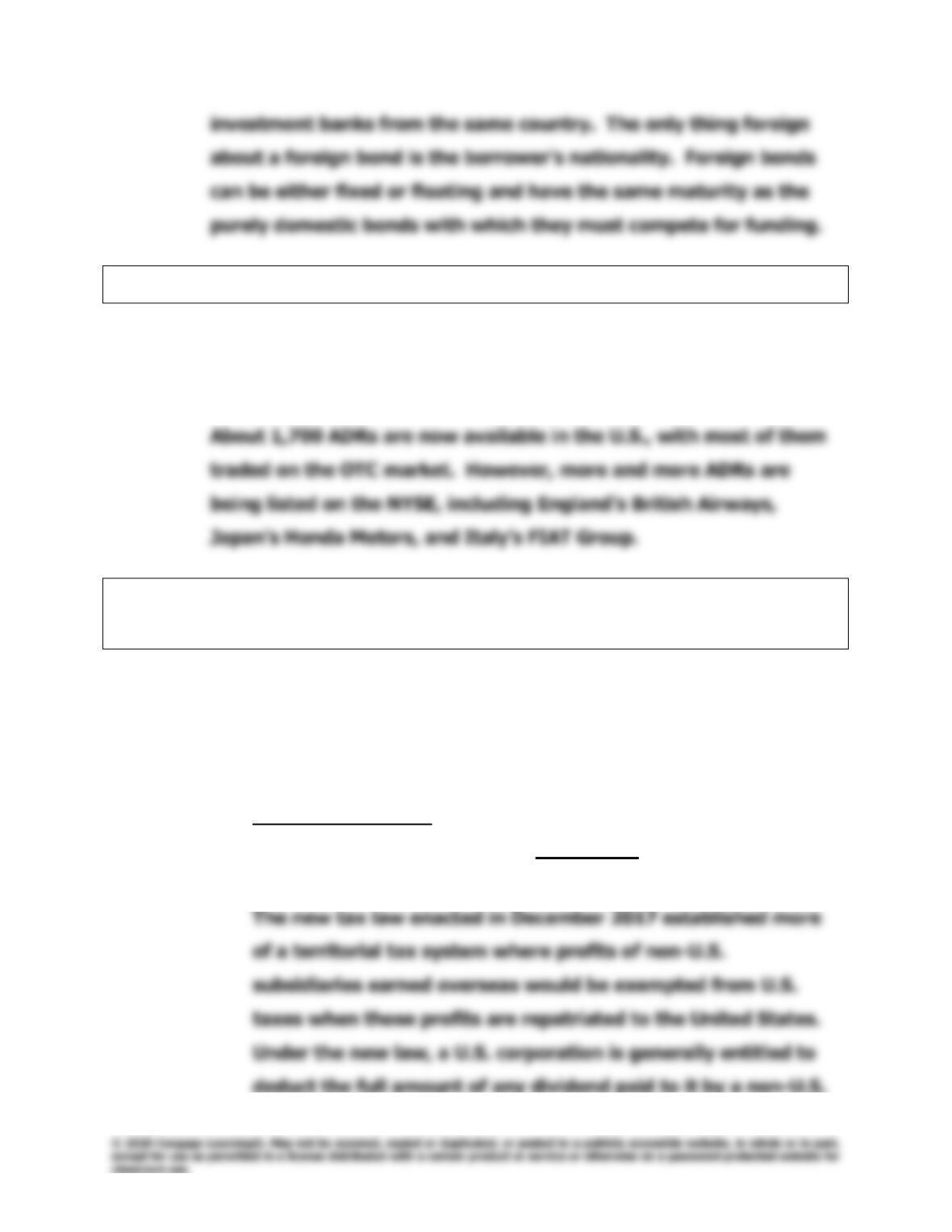
I. (2) Briefly explain how ADRs work.
Answer: [Show S17-27 here.] U.S. investors can invest in foreign companies
through American Depository Receipts (ADRs). ADRs are
certificates representing ownership of foreign stock held in trust.
J. What is the effect of multinational operations on capital budgeting
decisions?
Answer: [Show S17-28 and S17-29 here.] The same general principles that
apply to domestic capital budgeting also apply to foreign capital
budgeting. However, foreign capital budgeting is complicated by
the following three primary factors:
1. Tax law differences. Foreign operations are usually taxed at
the local level, and then funds repatriated, or returned, to the
parent corporation may be subject to additional U.S. taxes.
508
Integrated Case
Chapter 17: Multinational Financial Management
company at least 10% of whose shares are owned by the U.S.
2. Political risk. Foreign governments have the right to restrict
3. Exchange rate risk. Funds repatriated from foreign operations
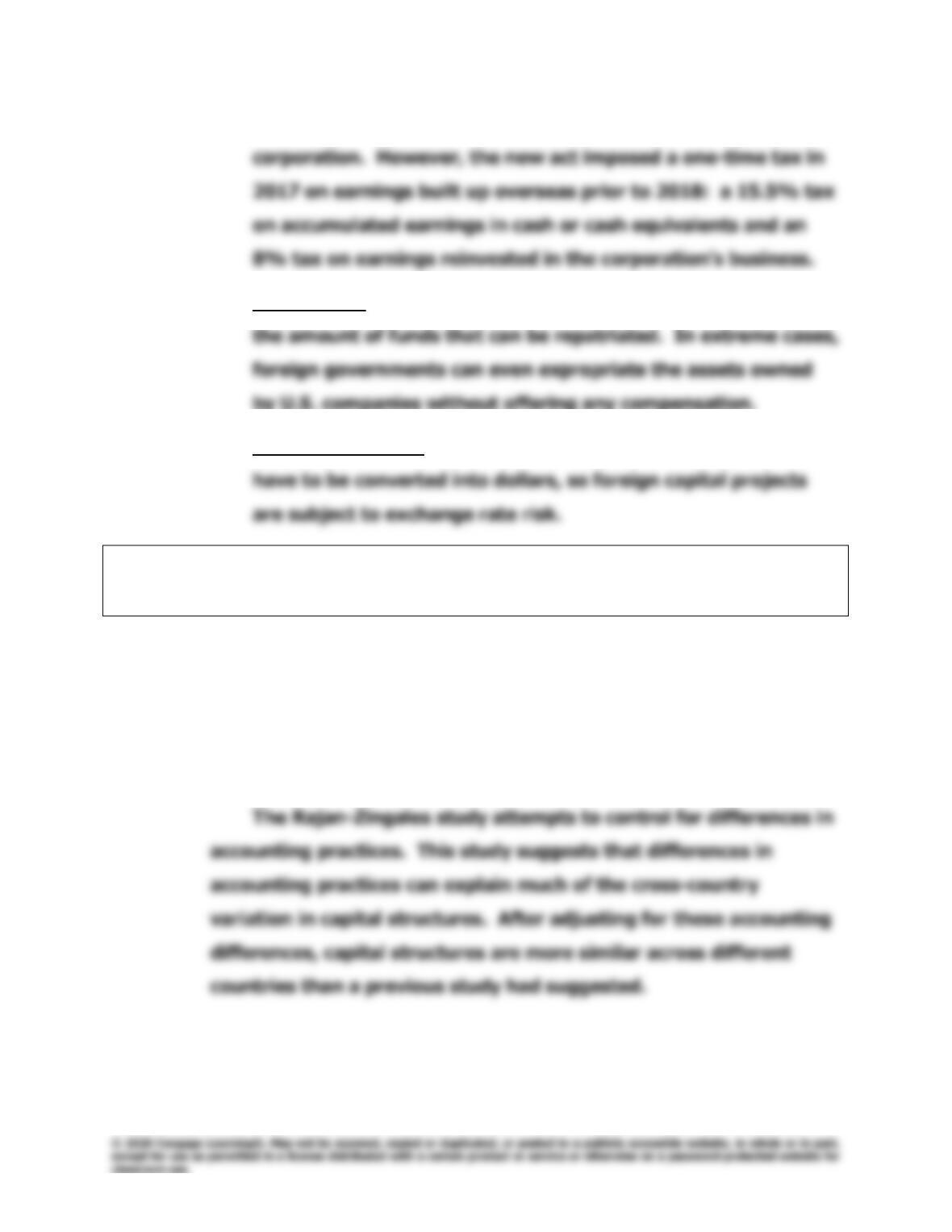
K. To what extent do average capital structures vary across different
countries?
Answer: There is some evidence that average capital structures vary among
the large industrial countries. One problem, however, when
interpreting these numbers is that different countries often use
very different accounting conventions, which makes it difficult to
compare capital structures.