17 Case model 12/9/2018
PART C
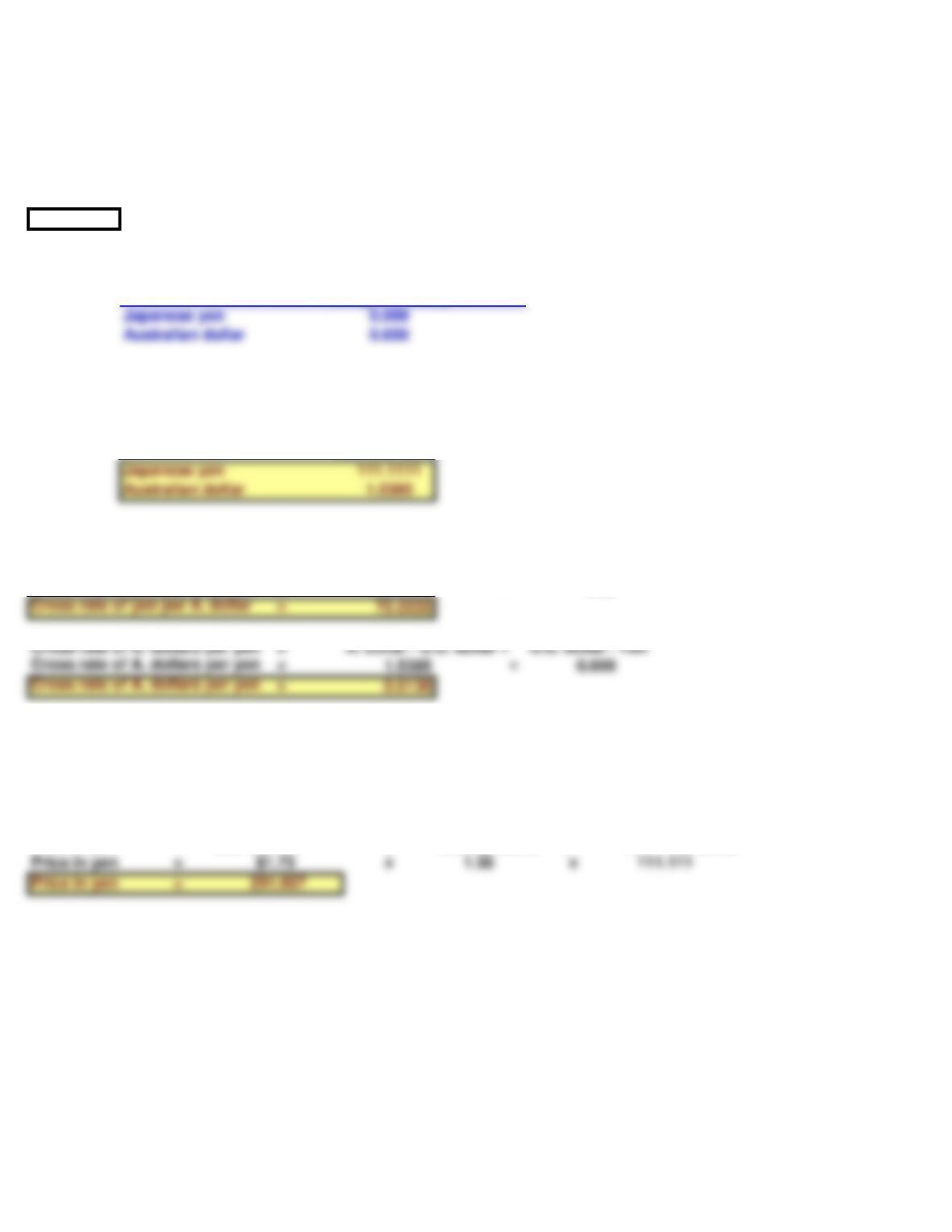
Consider the following illustrative exchange rates.
U.S. dollars required
to buy one unit of
foreign currency
(2) Calculate the indirect quotations for yen and Australian dollars.
Units of foreign currency
required to buy
one U.S. dollar
(3) Calculate the two cross rates between yen and Australian dollars.
Cross rate of yen per A. dollar =Yen / U.S. dollar ×U.S. dollar / A. dollar
Cross rate of yen per A. dollar =111.1111 ×0.65
Cross rate of A. dollars per yen =A. dollar / U.S. dollar ×U.S. dollar / Yen
Cross rate of A. dollars per yen =1.5385 ×0.009
U.S. $ price $1.75
Markup 50%
Price in yen = U.S. $ price x Markup factor x Yen / U.S. dollar
Price in yen = 291.667
(4) Assume that Citrus Products can produce a liter of orange juice and ship it to Japan for $1.75. If the
firm wants a 50% markup on the product, what should the orange juice sell for in Japan?
Chapter 17. Multinational Financial Management
9/12/2022 17:24
This spreadsheet model is designed to be used in conjunction with the chapter’s integrated case and the
related PowerPoint slide presentation.
Cost (yen) 250
Sales price (A. dollars) 6
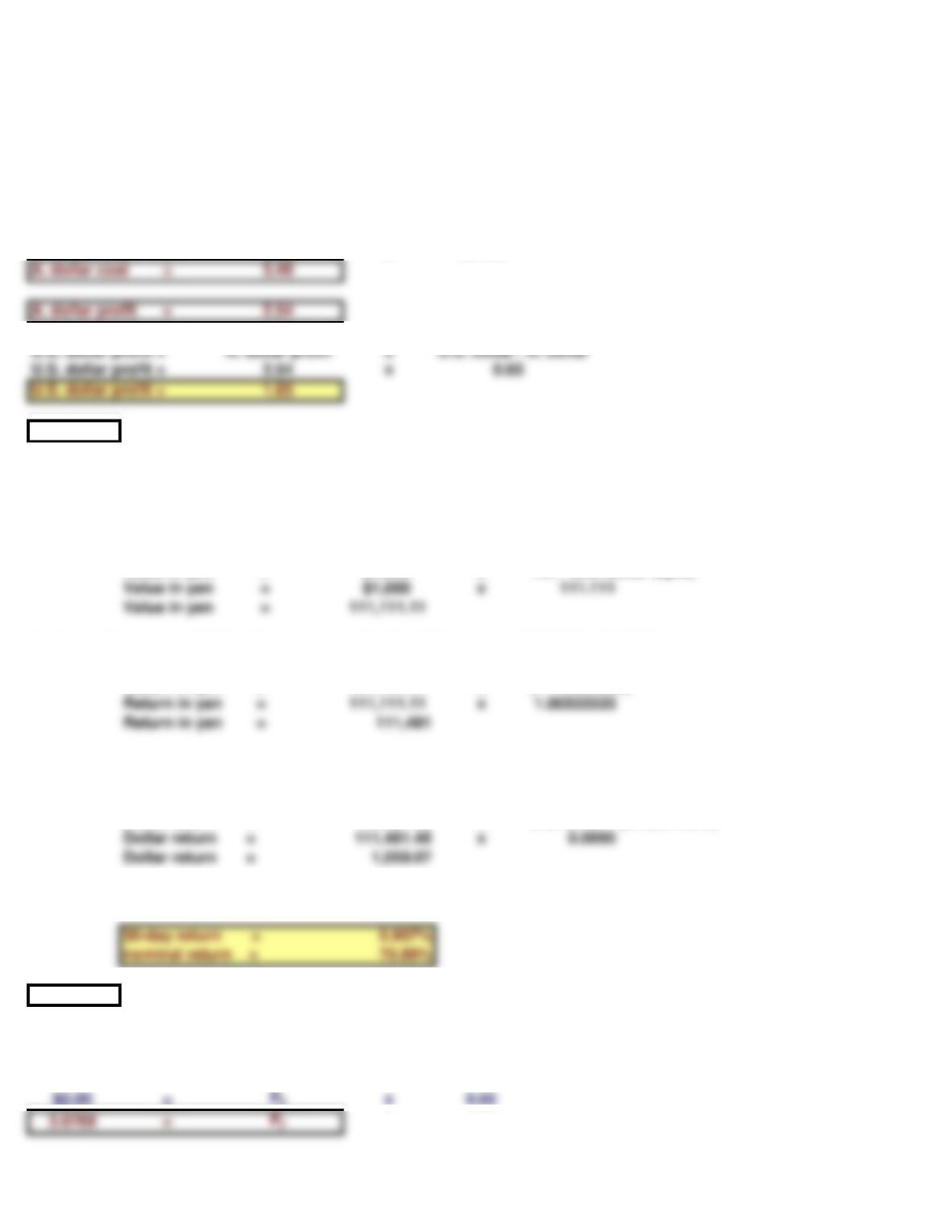
A. dollar cost = Cost (yen) x A. dollar / Yen
A. dollar cost = 250 x0.0138
U.S. dollar profit = A. dollar profit x U.S. dollar / A. dollar
U.S. dollar profit = 2.54 x0.65
PART F
1. Assume you convert $1,000 to yen in the spot market.
Value in yen = $1,000 x Yen / U.S. dollar (spot)
Value in yen = $1,000 x111.111
Value in yen = 111,111.11
2. Invest the yen in a 30-day Japanese security (monthly return of 0.3333%). In 30 days, you receive:
Return in yen = 111,111.11 x (1 + 0.003333)
Return in yen = 111,111.11 x1.00333333
Return in yen = 111,481
3. Agree today to exchange the 111,481 yen 30 days from now at a 30-day forward exchange rate of
1/$0.0095 = 105.2632 yen = $1. Your dollar return after 30 days is:
Dollar return = 111,481.48 x U.S. dollar / yen (forward)
Dollar return = 111,481.48 x0.0095
Dollar return = 1,059.07
4. The investment’s expected 30-day and annual nominal returns are:
PART G
PH= PFx e0
(5) Now assume that Citrus Products begins producing the same liter of orange juice in Japan. The
product costs 250 yen to produce and ship to Australia, where it can be sold for 6 Australian dollars. What
is the U.S. dollar profit on the sale?
If grapefruit juice costs $2.00 a liter in the United States and purchasing power parity holds, what should
be the price of grapefruit juice in Australia?
Currently, you can exchange 1 yen for 0.0095 U.S. dollar in the 30-day forward market, and the risk-free
rate on 30-day securities is 4% in both Japan and the United States. Does interest rate parity hold? If not,
which securities offer the highest expected return?