Chapter 17 – Asymmetric Information, Voting, and Public Choice
17-1
Chapter 17 Asymmetric Information, Voting, and Public Choice
QUESTIONS
1. Because medical records are private, an individual applying for health insurance will know
more about his own health conditions than will the insurance companies to which he is applying
for coverage. Is this likely to increase or decrease the insurance premium that he will be offered?
Why? LO1
Answer: This will likely increase the insurance premium because the buyers of the
insurance policy have more information about their health status than the sellers (the
2. Why is it in the interest of new homebuyers and builders of new homes to have government
building codes and building inspectors? LO1
Answer: The reason is related to the lack of information and education on the part of
most new homebuyers and builders with regard to every aspect of home construction. To
3. Place an “M” beside the items in the following list that describe a moral hazard problem and an
“A” beside those that describe an adverse selection problem. LO1
a. A person with a terminal illness buys several life insurance policies through the mail.
b. A person drives carelessly because he or she has automobile insurance.
c. A person who intends to “torch” his warehouse takes out a large fire insurance policy.
d. A professional athlete who has a guaranteed contract fails to stay in shape during the
off‐season.
e. A woman who anticipates having a large family takes a job with a firm that offers exceptional
childcare benefits.
Answer:
(a) This is an adverse selection problem. The buyer of the insurance policy has more
Chapter 17 – Asymmetric Information, Voting, and Public Choice
17-2
4. Explain how affirmative and negative majority votes can sometimes lead to inefficient
allocations of resources to public goods. Is this problem likely to be greater under a
benefits‐received or an ability‐to‐pay tax system? Use the information in Figures 17.1a and 17.1b
to show how society might be better off if Adams were allowed to buy votes. LO2
Answer: The problem arises because the one-person one-vote rule does not allow voters
to register the strength of their preferences. In the text’s example, three people—Adams,
Benson, and Conrad—have preferences with regard to the benefits of national defense as
Chapter 17 – Asymmetric Information, Voting, and Public Choice
17-3
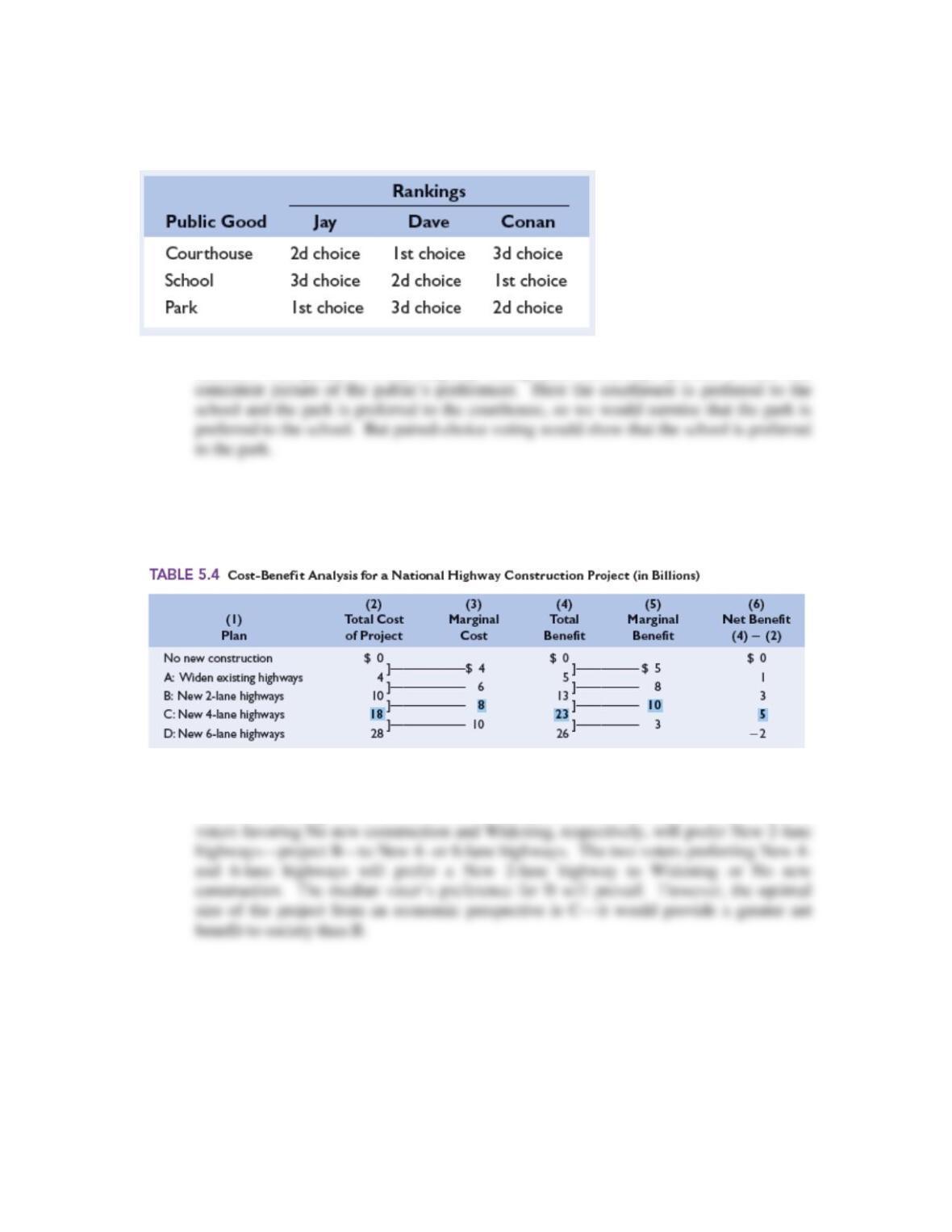
5. Explain the paradox of voting through reference to the accompanying table, which shows the
ranking of three public goods by voters Jay, Dave, and Conan: LO2
Answer: The paradox is that majority voting does not always provide a clear and
6. Suppose there are only five people in a society and each favors one of the five highway
construction options listed in Table 5.4 (“No new construction” is one of the five options).
Explain which of these highway options will be selected using a majority paired‐choice vote. Will
this option be the optimal size of the project from an economic perspective? LO2
Answer: Project B (New 2-lane highway wins) using a paired-choice vote. There is no
“paradox of voting” problem here and B is the preference of the median voter. The two
7. Jean Baptiste Colbert was the Minister of Finance under King Louis XIV of France. He
famously observed that, “The art of taxation consists in so plucking the goose as to obtain the
largest possible amount of feathers with the smallest possible amount of hissing.” How does his
comment relate to special interests and the collective action problem? LO3
Chapter 17 – Asymmetric Information, Voting, and Public Choice
17-4
Answer: The logic above applies to special interests and collective action as well. In the
8. What is rent seeking and how does it differ from the kinds of profit maximization and profit
seeking that we discussed in previous chapters? Provide an actual or a hypothetical example of
rent seeking by firms in an industry. By a union. By a professional association (for example,
physicians, school teachers, or lawyers). Why do elected officials often accommodate
rent‐seeking behavior, particularly by firms, unions, and professional groups located in their
home states? LO3
Answer: Rent-seeking is an appeal to the government for special benefits at taxpayers or
someone else’s expense. The term ‘rent’ refers to any payment is excess of the minimum
amount that is necessary to keep the resource employed in its current use.
9. How does the problem of limited and bundled choice in the public sector relate to economic
efficiency? Why are public bureaucracies possibly less efficient than business firms? LO3
Answer: Limited and bundled choice in the political process tends to reduce economic
efficiency because blocks of public goods and social programs are provided. That is,
instead of evaluating each public good and social program on its respective costs and
Chapter 17 – Asymmetric Information, Voting, and Public Choice
17-5
10. Explain: “Politicians would make more rational economic decisions if they weren’t running
for reelection every few years.” LO3
Answer: Because political officeholders must seek voter support every few years, they
favor programs with immediate and clear-cut benefits and with vague or deferred costs.
11. LAST WORD How do the concepts of pork‐barrel politics and logrolling relate to the items
listed in the Last Word?
Answer: Both of these political techniques are examples of special interest effects.
“Pork–barrel” politics refers to the practice that congressional representatives follow
PROBLEMS
1. Consider a used car market with asymmetric information. Owners of used cars know what their
vehicles are worth but have no way of credibly demonstrating those values to potential buyers.
Thus, potential buyers must always worry that the used car they are being offered may be a
low‐quality “lemon.” LO1
a. Suppose that there are equal numbers of good and bad used cars in the market and that good
used cars are worth $13,000 while bad used cars are worth $5,000. What is the average value of a
used car?
b. By how much does the average value exceed the value of a bad used car? By how much does
the value of a good used car exceed the average value?
c. Would a potential seller of a good used car be willing to accept the average value as payment
for her vehicle?
d. If a buyer negotiates with a seller to purchase the seller’s used car for a price equal to the
average value, is the car more likely to be good or bad?
e. Will the used car market come to feature mostly—if not exclusively—lemons? How much will
used cars end up costing if that all the good cars are withdrawn?
Chapter 17 – Asymmetric Information, Voting, and Public Choice
17-6
Feedback: Consider the following example for the different parts below.
Part a:
Suppose that there are equal numbers of good and bad used cars in the market and that
good used cars are worth $13,000 while bad used cars are worth $5,000. What is the
average value of a used car?
Since there are an equal number of good and bad used cars in the market the likelihood of
Part b:
By how much does the average value exceed the value of a bad used car? By how much
does the value of a good used car exceed the average value?
The average value of a used car exceeds the value of a bad used car by $4,000 (=$9,000-
$5,000).
Part c:
No, the typical buyer would NOT be willing to pay the average value as there is a one-
half chance that he will overpay for the car.
Part d:
If a buyer negotiates with a seller to purchase the seller’s used car for a price equal to the
Part e:
Will the used car market come to feature mostly—if not exclusively—lemons? How
much will used cars end up costing if that all the good cars are withdrawn?
2. Domestic sugar producers in the United States have convinced the Federal government to
impose price supports and import quotas that keep the domestic price of sugar at more than
double the world price of sugar. This costs domestic sugar consumers about $2 billion each year
in higher sugar costs. Taxpayers also provide $150 million of subsidies each year directly to sugar
growers. LO2
a. There are about 300 million people living in the United States. How much on average does the
$2 billion in higher sugar prices cost Americans each year? What about the $150 million paid
directly to sugar growers? What is the combined average cost per person for these two items?
b. About half the $150 million per year in subsidies goes to growers of sugar cane, the other half
to growers of sugar beets. But there are about 13,000 beet growers compared to only 1500 cane
growers. How much on average does a beet grower receive? How much on average does a cane
grower receive?
Chapter 17 – Asymmetric Information, Voting, and Public Choice
17-7
c. For both cane and beets, a relatively few big producers garner most of the subsidies. About
2000 beet farms receive about half the subsidies flowing to beet farmers. But cane is even more
concentrated, with only 20 cane farms receiving about half of all cane sugar subsidies. About how
much on average do the 2000 beet farms receive in subsidies? What about the 20 cane farms?
d. Look back at your answers to parts a and c. Compare the combined average cost per person of
the sugar subsidies with the average amount of subsidy received by the 20 largest cane sugar
producers. How many people would you have to mobilize to oppose sugar subsidies so that their
combined personal losses exceed the money going to just one of the 20 largest cane farms?
Feedback: Consider the following example problem: Domestic sugar producers in the
United States have convinced the Federal government to impose price supports and
import quotas that keep the domestic price of sugar at more than double the world price
of sugar. This costs domestic sugar consumers about $2 billion each year in higher sugar
costs. Taxpayers also provide $150 million of subsidies each year directly to sugar
growers.
Part a:
There are about 300 million people living in the United States. How much on average
does the $2 billion in higher sugar prices cost Americans each year? What about the $150
million paid directly to sugar growers? What is the combined average cost per person for
these two items?
The $2 billion comes out to about $6.67 per person (= $2 billion/300 million people)
Part b:
About half the $150 million per year in subsidies goes to growers of sugar cane, the other
half to growers of sugar beets. But there are about 13,000 beet growers compared to only
1500 cane growers. How much on average does a beet grower receive? How much on
average does a cane grower receive?
This implies that sugar cane farmers receive $75 million in subsidies and sugar beet
Part c:
For both cane and beets, a relatively few big producers garner most of the subsidies.
About 2000 beet farms receive about half the subsidies flowing to beet farmers. But cane
is even more concentrated, with only 20 cane farms receiving about half of all cane sugar
subsidies. About how much on average do the 2000 beet farms receive in subsidies?
What about the 20 cane farms?
Chapter 17 – Asymmetric Information, Voting, and Public Choice
17-8
The 2000 beet farmers receive $37.5 million, which is half of the $75 million total
Part d:
Look back at your answers to parts a and c. Compare the combined average cost per
person of the sugar subsidies with the average amount of subsidy received by the 20
largest cane sugar producers. How many people would you have to mobilize to oppose
sugar subsidies so that their combined personal losses exceed the money going to just one
of the 20 largest cane farms?
The total cost of the sugar subsidies to the individual on average is $7.17. This is the