
Chapter 17
CAPITAL BUDGETING
QUESTIONS AND ANSWERS
Q17.1 “The decision to start your own firm and go into business can be thought of as a capital
budgeting decision. You only go ahead if projected returns look attractive on a personal
and financial basis.” Discuss this statement.
Q17.1 ANSWER
The decision to start your own firm and go into business can indeed be thought of as a
capital budgeting decision. You only go for it if projected returns look attractive on a
personal and financial basis. Formally, capital budgeting is described as the process of
Q17.2 What major steps are involved in the capital budgeting process?
Q17.2 ANSWER
Conceptually, the capital budgeting process involves six logical steps. First, the cost of
the project must be determined. This is similar to finding the price that must be paid for

Capital Budgeting 533
Q17.3 OIBDA is an abbreviation for “operating income before depreciation and amortization.”
Like its predecessor EBITDA (“earnings before interest, taxes, depreciation and
amortization”), OIBDA is used to analyze profitability before non-cash charges tied to
plant and equipment investments. Can you see any advantages or disadvantages
stemming from the use of OIBDA instead of net income as a measure of investment
project attractiveness?
Q17.3 ANSWER
Because it eliminates the effects of financing and non-cash accounting decisions,
OIBDA can provide a relatively good “apples–to-apples” comparison of profitability
between companies and industries. For example, OIBDA as a percent of sales can be
Q17.4 Toyota Motor Corp., like most major multinational corporations, enjoys easy access to
world financial markets. Explain why the NPV approach is the most appropriate tool
for Toyota’s investment project selection process.
Q17.4 ANSWER

534 Chapter 17
An investment project is attractive and should be pursued so long as the discounted net
present value of cash inflows is greater than the discounted net present value of the
investment requirement, or net cash outlay. Because the attractiveness of individual
Q17.5 Level 3 Communications, Inc., like many emerging telecom carriers, has only limited
and infrequent access to domestic debt and equity markets. Explain the attractiveness of
a “benefit–cost ratio” approach in capital budgeting for Level 3, and illustrate why the
NPV, PI, and IRR capital budgeting decision rules sometimes provide different rank
orderings of investment project alternatives.
Q17.5 ANSWER
Smaller companies often have only limited and infrequent access to domestic debt and
equity markets. In such circumstances, “capital rationing” is in effect and a “benefit–

Capital Budgeting 535
Q17.6 How is a crossover discount rate calculated, and how does it affect capital budgeting
decisions?
Q17.6 ANSWER
A reversal of project rankings occurs at the crossover discount rate, where NPV is equal
for two or more investment alternatives. The ranking reversal problem is typical of
situations where investment projects differ greatly in terms of their underlying NPV

536 Chapter 17
Q17.7 An efficient firm employs inputs in such proportions that the marginal product/price
ratios for all inputs are equal. In terms of capital budgeting, this implies that the
marginal cost of debt should equal the marginal cost of equity in the optimal capital
structure. In practice, firms often issue debt at interest rates substantially below the
yield that investors require on the firm’s equity shares. Does this mean that many firms
are not operating with optimal capital structures? Explain.
Q17.7 ANSWER
No, the phenomenon of lower observed yields for debt versus equity instruments does
not imply suboptimal capital structures. The explanation lies in the less directly
Q17.8 Suppose that Black & Decker’s interest rate on newly–issued debt is 7.5% and the firm’s
marginal federal-plus-state income tax rate is 40%. This implies a 4.5% after-tax
component cost of debt. Also assume that the firm has decided to finance next year’s
projects by selling debt. Does this mean that next year’s investment projects have a
4.5% cost of capital?
Q17.8 ANSWER

The answer is no, at least not usually. In financing a particular set of projects with debt,
the firm typically uses some of its potential for obtaining further low-cost debt financing.
Q17.9 Research in financial economics concludes that stockholders of target firms in takeover
battles “win” (earn abnormal returns) and that stockholders of successful bidders do
not lose subsequent to takeovers, even though takeovers usually occur at substantial
premiums over pre-bid market prices. Is this observation consistent with capital market
efficiency?
Q17.9 ANSWER
Q17.10 “Risky projects are accepted for investment on the basis of favorable expectations
concerning profitability. In the post-audit process, they must not be unfairly criticized
for failing to meet those expectations.” Discuss this statement.
Q17.10 ANSWER
It is a simple fact that some investment projects undertaken on the basis of favorable
expectations of profit fail to work out. The purchase of automobile insurance is not a

538 Chapter 17
SELF-TEST PROBLEMS AND SOLUTIONS
ST17.1 NPV and Payback Period Analysis. Suppose that your college roommate has
approached you with an opportunity to lend $25,000 to her fledgling home healthcare
business. The business, called Home Health Care, Inc., plans to offer home infusion
therapy and monitored in-the-home healthcare services to surgery patients in the
Birmingham, Alabama, area. Funds would be used to lease a delivery vehicle, purchase
supplies, and provide working capital. Terms of the proposal are that you would receive
$5,000 at the end of each year in interest with the full $25,000 to be repaid at the end of
a ten-year period.
A. Assuming a 10% required rate of return, calculate the present value of cash flows
and the net present value of the proposed investment.
B. Based on this same interest rate assumption, calculate the cumulative cash flow of
the proposed investment for each period in both nominal and present-value terms.
C. What is the payback period in both nominal and present-value terms?
D. What is the difference between the nominal and present-value payback period?
Can the present-value payback period ever be shorter than the nominal payback
period?
ST17.1 SOLUTION
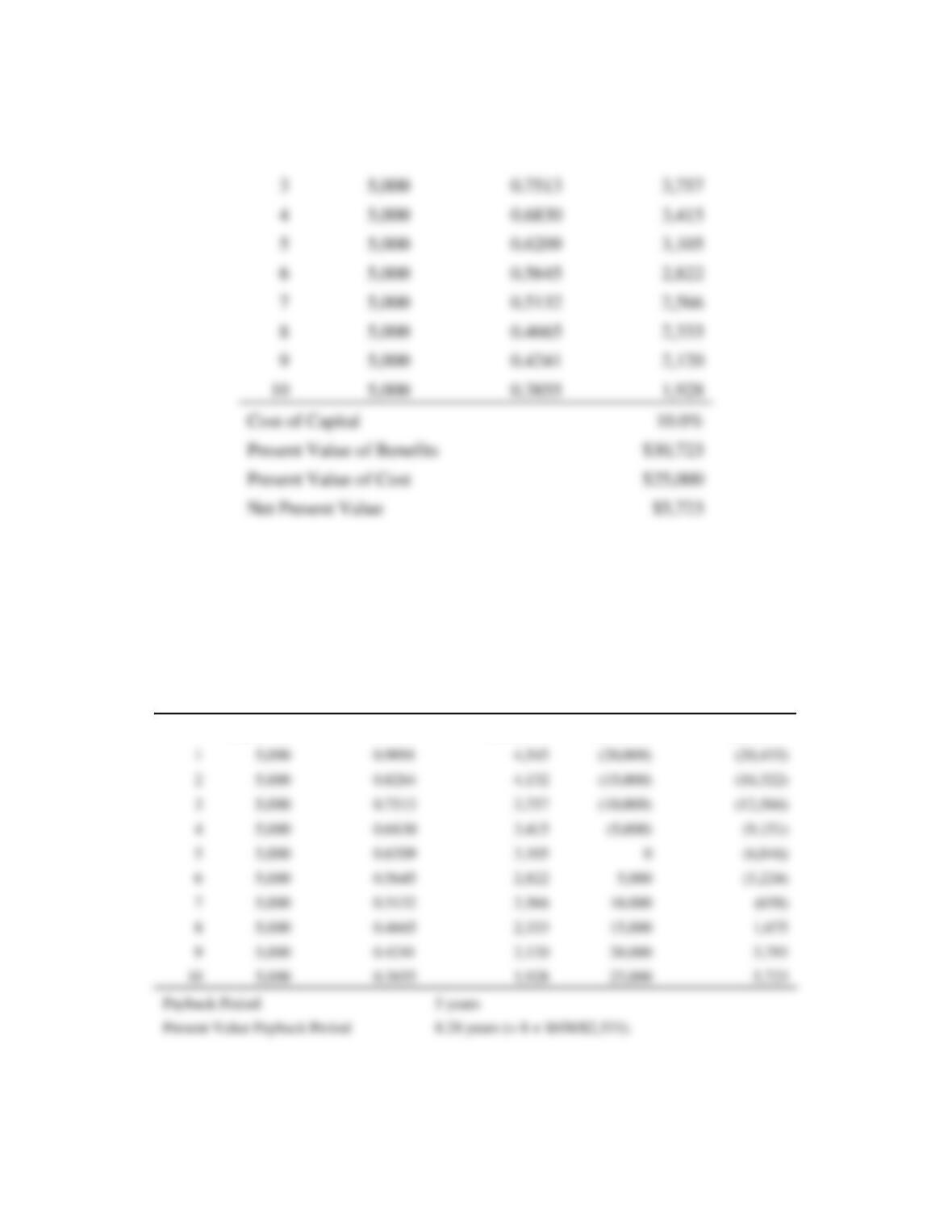
A. The present value of cash flows and the net present value of the proposed investment can
be calculated as follows:
Year
Cash Flow
Present Value
Interest Factor
Present Value
Cash Flow
Capital Budgeting 539
B. The cumulative cash flow of the proposed investment for each period in both nominal
and present-value terms is:
Year
Cash
Flow
Present Value
Interest Factor
Present Value
Cash Flow
Cumulative
Cash Flow
Cumulative
PV Cash Flow
0
($25,000)
1.0000
($25,000)
($25,000)
($25,000)
0.6209
0.4665

540 Chapter 17
C. Based on the information provided in part B, it is clear that the cumulative cash flow in
ST17.2 Decision Rule Conflict. Bob Sponge has been retained to analyze two proposed capital
investment projects, projects X and Y, by Square Pants, Inc., a local specialty retailer.
Project X is a sophisticated working capital and inventory control system based upon a
powerful personal computer, called a system server, and PC software specifically
designed for inventory processing and control in the retailing business. Project Y is a
similarly sophisticated working capital and inventory control system based upon a
powerful personal computer and general- purpose PC software. Each project has a cost
of $10,000, and the cost of capital for both projects is 12%. The projects’ expected net
cash flows are as follows:
Expected Net Cash Flow
Year
Project X
Project Y
0
($10,000)
($10,000)
1
6,500
3,500
2
3,000
3,500
3
3,000
3,500
4
1,000
3,500
A. Calculate each project’s nominal payback period, net present value (NPV),
internal rate of return (IRR), and profitability index (PI).

Capital Budgeting 541
(Hint: Plot the NPV profiles for each project to find the crossover discount rate
k.)
E. Why does a conflict exist between NPV and IRR rankings?
ST17.2 SOLUTION
A. Payback:
To determine the nominal payback period, construct the cumulative cash flows for
each project:
Cumulative Cash Flow
Year
Project X
Project Y
Internal Rate of Return (IRR):


B. Using all methods, project X is preferred over project Y. Because both projects are
D. To determine the effects of changing the cost of capital, plot the NPV profiles of each
Then find the IRR of Project Δ:

544 Chapter 17
Square Pants Crossover Rate
$4,000
$4,500
$5,000
NPV Project Y
PROBLEMS AND SOLUTIONS
P17.1 Cost of Capital. Identify each of the following statements as true or false, and explain
your answers.
A. Information costs both increase the marginal cost of capital and reduce the
internal rate of return on investment projects.
B. Depreciation expenses involve no direct cash outlay and can be safely ignored in
investment-project evaluation.
C. The marginal cost of capital will be less elastic for larger firms than for smaller
firms.
D. In practice, the component costs of debt and equity are jointly rather than
independently determined.
E. Investments necessary to replace worn-out or damaged equipment tend to have
low levels of risk.
P17.1 SOLUTION

Capital Budgeting 545
A. True. The need to gather information concerning the creditworthiness of borrowers
increases the interest rates charged by creditors. Similarly, the task of information
P17.2 Decision Rule Criteria. The net present value (NPV), profitability index (PI), and
internal rate of return (IRR) methods are often employed in project valuation. Identify
each of the following statements as true or false, and explain your answers.
A. The IRR method can tend to understate the relative attractiveness of superior
investment projects when the opportunity cost of cash flows is below the IRR.
B. A PI = 1 describes a project with an NPV = 0.
C. Selection solely according to the NPV criterion will tend to favor larger rather
than smaller investment projects.
D. When NPV = 0, the IRR exceeds the cost of capital.
E. Use of the PI criterion is especially appropriate for larger firms with easy access
to capital markets.
P17.2 SOLUTION
A. False. The IRR method implicitly assumes reinvestment of net cash flows during the life
of the project at the IRR and will overstate the relative attractiveness of superior

546 Chapter 17
P17.3 Cost of Capital. Indicate whether each of the following would increase or decrease the
cost of capital that should be used by the firm in investment project evaluation. Explain.
A. Interest rates rise because the Federal Reserve System tightens the money supply.
B. The stock market suffers a sharp decline, as does the company’s stock price,
without (in management’s opinion) any decline in the company’s earnings
potential.
C. The company’s home state eliminates the corporate income tax in an effort to keep
or attract valued employers.
D. In an effort to reduce the federal deficit, Congress raises corporate income tax
rates.
E. A merger with a leading competitor increases the company’s stock price
substantially.
P17.3 SOLUTION
A. Increase. A general rise in interest rates will increase the cost of debt, and increase the
weighted average cost of capital used in investment project evaluation.

Capital Budgeting 547
Of course, average state tax rates are fairly modest compared with federal tax
rates, and the effect of changing state tax rates on the weighted average cost of capital
can be expected to be similarly modest. Still, on balance and holding all else equal, we
would expect the weighted average cost of capital to be marginally less for firms
headquartered in Florida (a no tax state) versus Wisconsin (a relatively high tax state).
P17.4 Present Value. New York City licenses taxicabs in two classes: (1) for operation by
companies with fleets and (2) for operation by independent driver-owners having only
one cab. Strict limits are imposed on the number of taxicabs by restricting the number
of licenses, or medallions, that are issued to provide service on the streets of New York
City. This medallion system dates from a Depression-era city law designed to address
an overabundance of taxis that depressed driver earnings and congested city streets. In
1937, the city slapped a moratorium on the issuance of new taxicab licenses. The
number of cabs, which peaked at 21,000 in 1931, fell from 13,500 in 1937 to 11,787 in
May 1996, when the city broke a 59-year cap and issued an additional 400 licenses.
However, because the city has failed to allow sufficient expansion, taxicab medallions
have developed a trading value in the open market. After decades of often-explosive
medallion price increases, fleet license prices rose to $600,000 in 2007.
A. Discuss the factors determining the value of a license. To make your answer
B. What factors would determine whether a change in the fare fixed by the city would
raise or lower the value of a medallion?

548 Chapter 17
C. Cab drivers, whether hired by companies or as owners of their own cabs, seem
unanimous in opposing any increase in the number of cabs licensed. They argue
that an increase in the number of cabs would increase competition for customers
and drive down what they regard as an already unduly low return to drivers. Is
their economic analysis correct? Who would gain and who would lose from an
expansion in the number of licenses issued at a nominal fee?
P17.4 SOLUTION
A. The price of a medallion will be determined by the above-normal or economic profits
B. The effect of fare changes on medallion values depends on the price elasticity of demand
P17.5 NPV and PI. Suppose the Pacific Princess luxury cruise line is contemplating leasing
an additional cruise ship to expand service from the Hawaiian Islands to Long Beach or
San Diego. A financial analysis by staff personnel resulted in the following projections
for a five-year planning horizon:
Long Beach
San Diego
Cost
$2,000,000
$3,000,00
PV of expected cash flow @ k = 15%
2,500,000
3,600,000

Capital Budgeting 549
A. Calculate the net present value for each service. Which is more desirable
according to the NPV criterion?
P17.5 SOLUTION
A. Long Beach
San Diego
B. Long Beach