426 CHAPTER 17 | Inflation, Unemployment, and Federal Reserve Policy
Answer
a. Quantitative easing is a central bank policy that attempts to stimulate the economy by buying
long term securities.
b. Quantitative easing, along with an exceptionally low federal funds rate, pushed interest rates to
very low levels. Seeking higher returns, investors, banks, and pension funds undertook
investments with higher risk.
c. If these riskier investments default or become even more risky, then the value of the pension
funds will fall.
Extra Economics in Your Life:
Would Your Job Be at Risk as a Result of an Expansionary Monetary Policy?
Question: Suppose you have rational expectations about future inflation. According to an article in the
Wall Street Journal, the Fed has decided to pursue an expansionary monetary policy. How would the
Fed’s decision affect the rate of unemployment? Do you have to worry about losing your job?
Answer: If you and other workers have rational expectations, an expansionary monetary policy will
Extra AN INSIDE LOOK News Article to Use in Class
CHAPTER 17 | Inflation, Unemployment, and Federal Reserve Policy 427
Solutions to End-of-Chapter Exercises
17.1
The Discovery of the Short-Run Trade-off between Unemployment and
Inflation
Learning Objective: Describe the Phillips curve and the nature of the short-run trade-off
between unemployment and inflation.
Review Questions
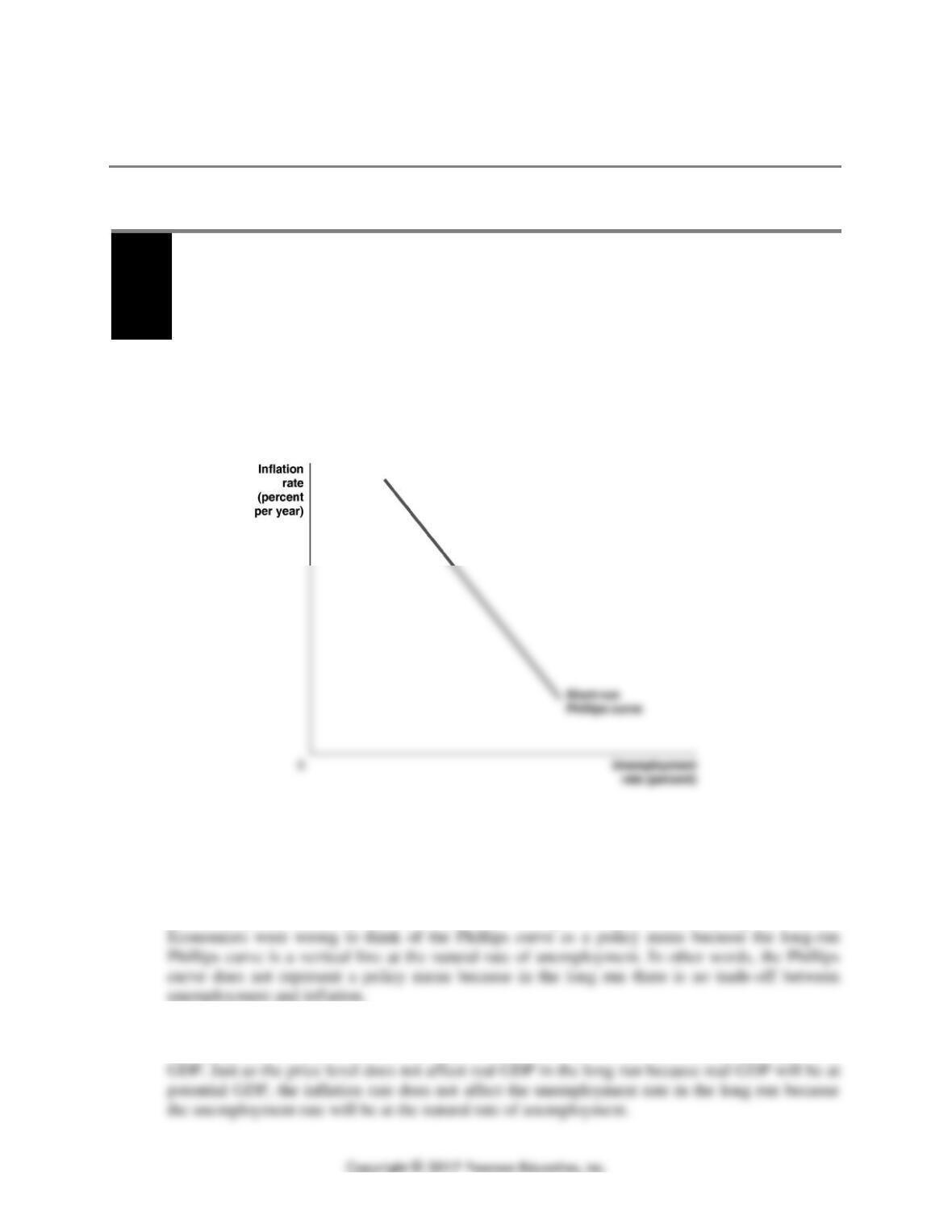
1.1 The Phillips curve is a curve showing the short-run relationship between the unemployment rate
and the inflation rate.
1.2 The Fed would undertake an expansionary monetary policy, which would increase aggregate
demand, causing both real GDP and the price level to increase. An increase in real GDP will
increase employment, lowering the unemployment rate.
1.3 The Phillips curve during the 1960s had been stable, so it appeared that policymakers could
permanently reduce unemployment if they were willing to accept permanently higher inflation.
1.4 Friedman argued that in the long run the unemployment rate would equal the natural rate of
unemployment, which is the unemployment rate that exists when the economy is at potential
428 CHAPTER 17 | Inflation, Unemployment, and Federal Reserve Policy
Problems and Applications
1.5 a. Point E on the Phillips curve graph best represents the same economic situation as point B on
the aggregate demand and aggregate supply graph because the smaller increase in aggregate
1.6 The aggregate demand and aggregate supply model and the Phillips curve provide two different
1.7 In the 1960s, the Phillips curve was widely viewed as a stable relationship representing a menu of
1.8 Negotiations between a union such as the UAW and Ford, or any other company, usually take
considerable amounts of time. Annual negotiations would impose a much greater time
commitment on both partiers than is required for three-year contracts. Multi-year contracts also
1.9 If prices rise faster than nominal wages, then real wages fall. Everything else equal, a fall in real
wages will reduce unemployment.
1.10 If inflation is lower than households and firms had expected then real wages will be higher than
expected. The higher real wage will cause employment to be lower in the short run than it would
be with a lower real wage.
CHAPTER 17 | Inflation, Unemployment, and Federal Reserve Policy 429
b. An “unfavorable foreign exchange translation” refers to the decline in Goodyear’s revenue
after earnings the firm received in foreign currencies were converted into dollars.
17.2
The Short-Run and Long-Run Phillips Curves
Learning Objective: Explain the relationship between the short-run and long-run Phillips
curves.
Review Questions
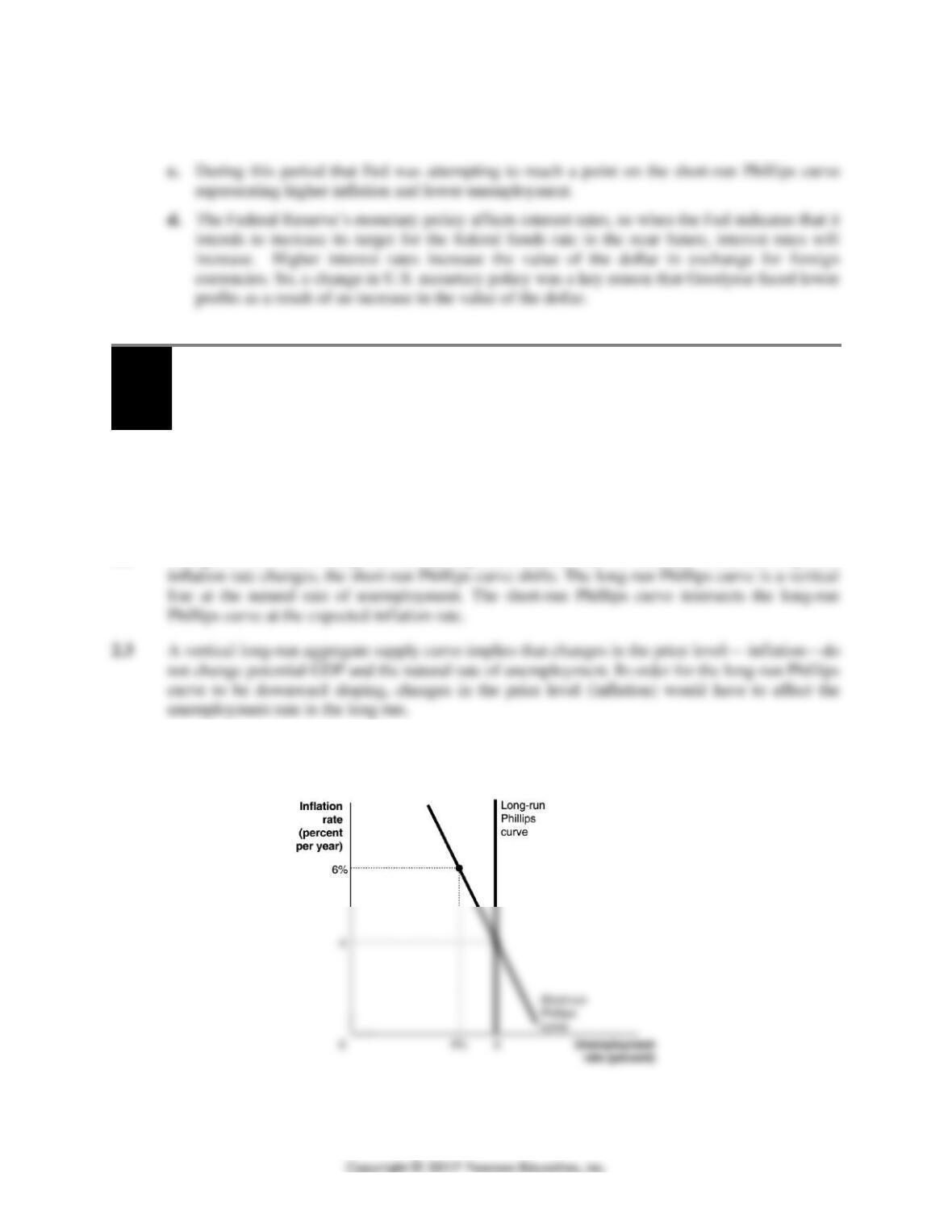
2.1 The short-run Phillips curve would shift up such that it intersects the long-run Phillips curve at a
6 percent inflation rate.
2.2 Along the short-run Phillips curve, the expected inflation rate is constant. When the expected
Problems and Applications
2.4
430 CHAPTER 17 | Inflation, Unemployment, and Federal Reserve Policy
2.5 A movement from point A to point B would be caused by a decline in aggregate demand—this
2.6 Because there is no trade-off in the long run between unemployment and inflation, Herbert
2.7 a. Graph 3 matches because a decrease in the proportion of younger and less-skilled workers in
the labor force decreases the natural rate of unemployment, shifting the long-run and short–
run Phillips curves to the left.
2.8 a. The article cites “changes in population growth and population composition—in particular
the aging of the population” as reasons why FOMC members believed that the natural rate of
2.9 a. NAIRU estimates can vary for a number of reasons including: (a) changes in unemployment
benefits or Social Security disability benefits, which may cause some people to remain
unemployed for longer periods; (b) changes in the amount of structural and frictional
unemployment due to the effects of technological change or globalization on the creation and
2.10 Workers and firms’ expectations of inflation affect the wages firms are willing to pay and that
workers are willing to accept and the prices firms decide to charge for the products they sell. For
CHAPTER 17 | Inflation, Unemployment, and Federal Reserve Policy 431
2.11 a. The NAIRU is the nonaccelerating inflation rate of unemployment.
b. If it is true that the U.S. economy had reached the NAIRU in 2015, the Fed should have
2.12 In the late 1960s, the Fed seemed to have believed that there was a stable long-run trade-off
between unemployment and inflation. The “current environment” refers to the situation in the
17.3
Expectations of the Inflation Rate and Monetary Policy
Learning Objective: Discuss how expectations of the inflation rate affect monetary
policy.
Review Questions
3.1 Workers, firms, banks, and investors care about real, inflation-adjusted values. The future
inflation rate affects real wages, real profits, and real interest rates. During periods of moderate
3.2 Rational expectations mean that workers and firms form current expectations using not only
3.3 With rational expectations, workers and firms may correctly anticipate any change in the inflation
rate caused by monetary policy. If the actual inflation rate equals the expected inflation rate, then
Problems and Applications
3.4 Rational expectations are likely to give the more accurate forecasts. When inflation is increasing
432 CHAPTER 17 | Inflation, Unemployment, and Federal Reserve Policy
3.5 The economic framework that Lucas’s arguments changed was that workers and firms formed
their expectations adaptively, without taking into account the likely effects of monetary policy.
3.6 People have adaptive expectations of inflation, for example, if they assume that future rates of
inflation will follow the pattern of inflation rates of the recent past. People have rational
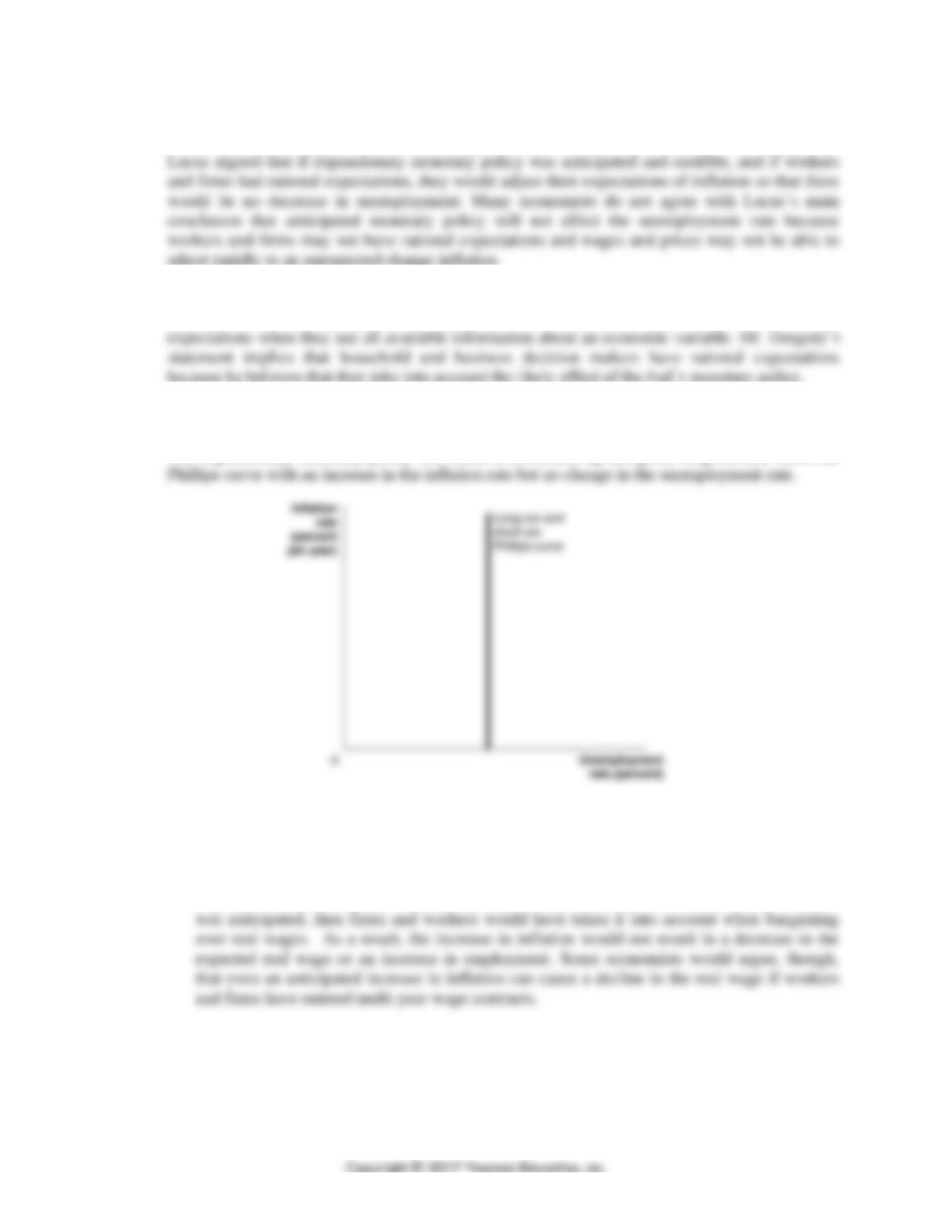
3.7 If both the short-run and long-run Phillips curves are vertical, an expansionary monetary policy
will have no effect on the unemployment rate, but will lead to an increase in the inflation rate.
The expansionary monetary policy will cause a movement up along the long-run and short-run
3.8 a. The reasoning is that an unanticipated increase in inflation will lower the real wage below its
expected level. As a result, firms will hire more workers and increase output. Therefore, an
unanticipated increase in inflation will have led to economic growth.
b. If the increase in inflation is unanticipated, then the actual real wage will be below its
expected level and employment and output are likely to increase. If the increase in inflation
CHAPTER 17 | Inflation, Unemployment, and Federal Reserve Policy 433
17.4
Federal Reserve Policy from the 1970s to the Present
Learning Objective: Use a Phillips curve graph to show how the Federal Reserve can
permanently lower the inflation rate.
Review Questions
4.1 The “Volcker disinflation” refers to the reduction in the inflation rate from about 11 percent in
4.2 A provision in the Dodd-Frank Act revised Section 13(3) to restrict the ability of the Fed to make
discount loans to firms other than commercial banks. The Fed will no longer be allowed to make
4.3 The main reason to keep a country’s central bank independent of the rest of the government is to
avoid inflation. Whenever a government is spending more than it is collecting in taxes, it must
borrow the difference by selling bonds. The governments of many developing countries have
Problems and Applications
4.4 Disinflation in the 1980s is generally believed to be a good thing because the U.S. economy had
suffered from high rates of inflation in the late 1970s and early 1980s. The prospect of
4.5 Not according to the usual definition of disinflation. There was deflation in 1933 because the
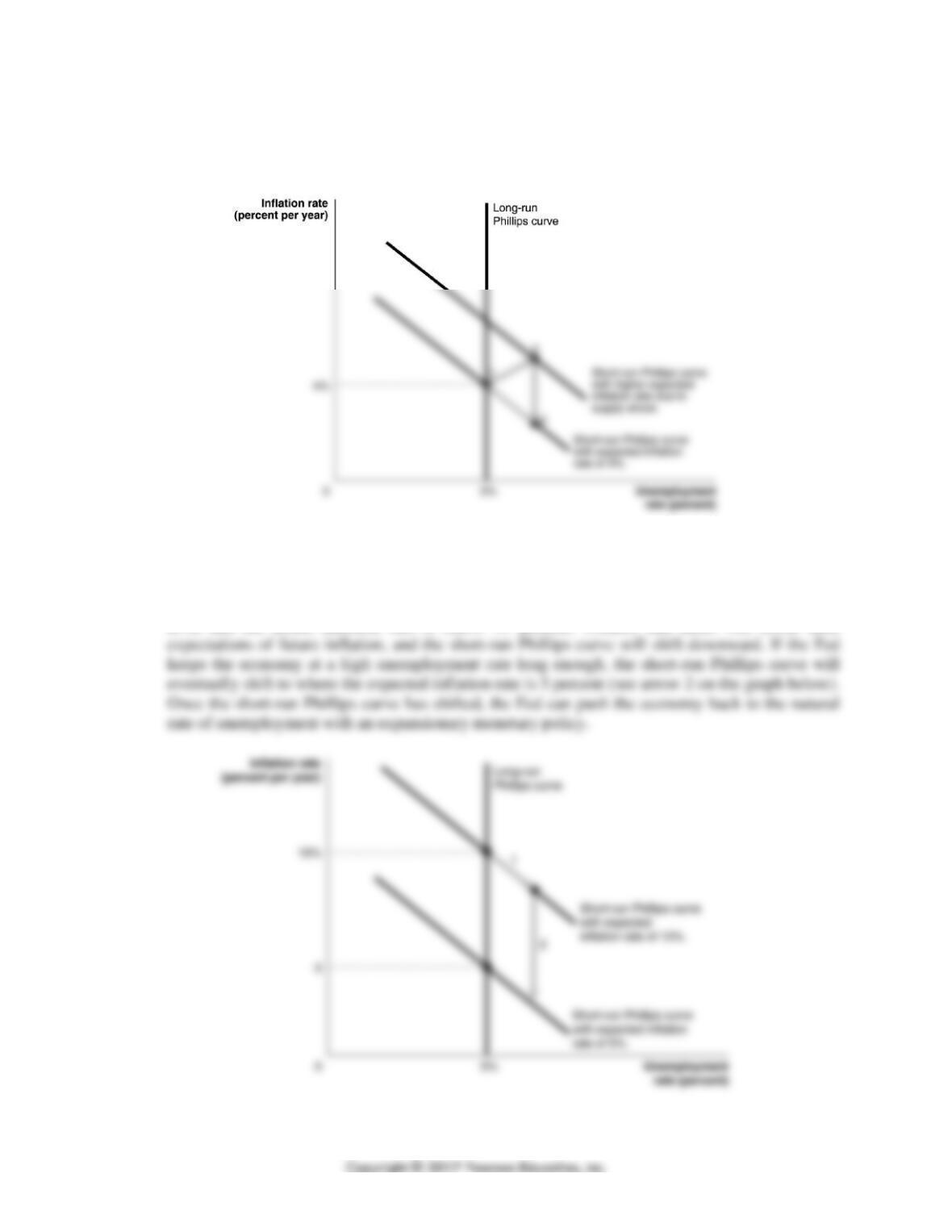
4.6 The (negative) supply shock will shift the short-run Phillips curve up as both the actual inflation
rate and the unemployment rate increase (shown by the movement from Point 1 to Point 2 on the
graph). If the Fed keeps monetary policy unchanged, the increase in unemployment will put
434 CHAPTER 17 | Inflation, Unemployment, and Federal Reserve Policy
(shown by the movement from Point 2 to Point 3 on the graph). Eventually, the unemployment
rate will return to the natural rate of 5 percent (shown by the movement from Point 3 to Point 1
on the graph).
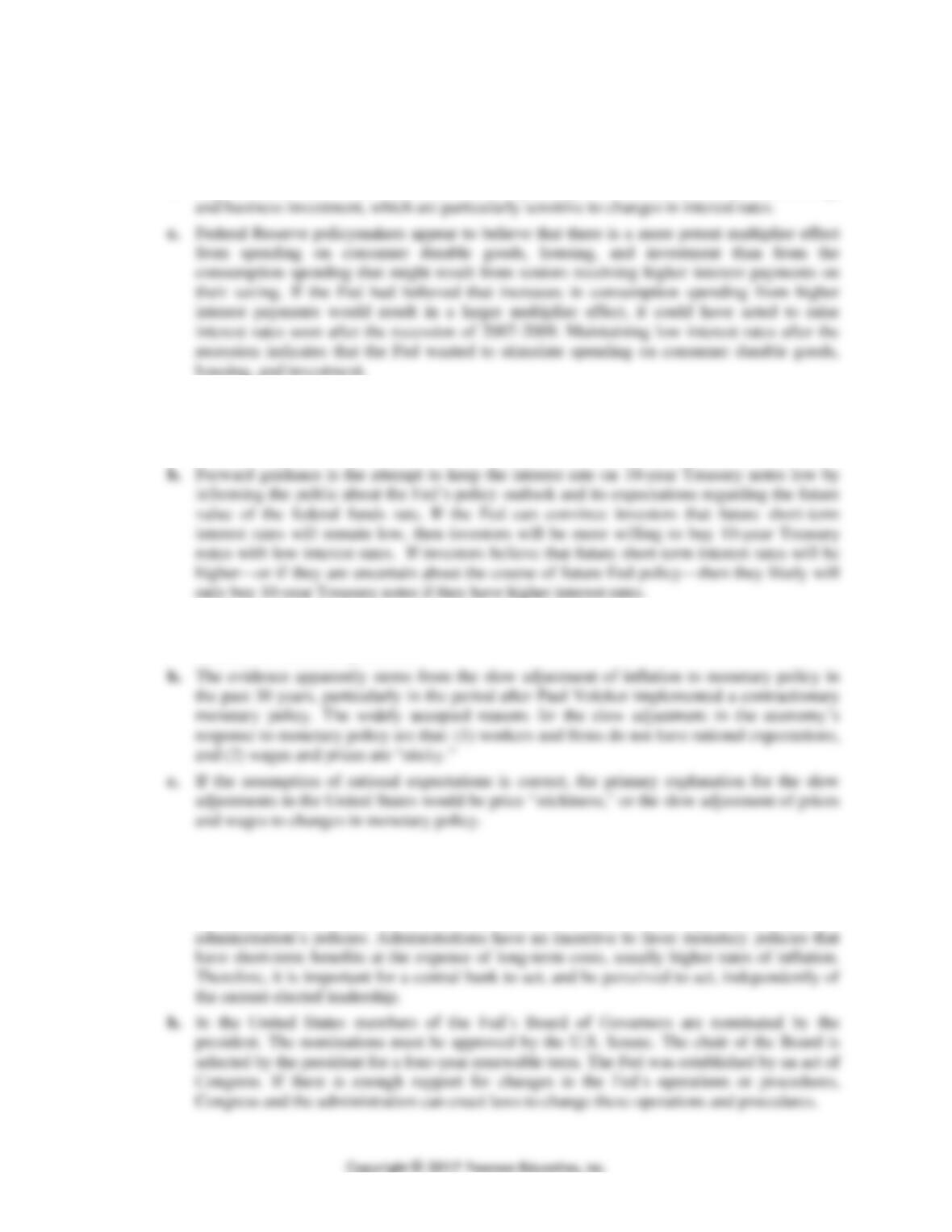
4.7 To reduce the inflation rate significantly, the Fed will have to raise its target for the federal funds
rate. Higher interest rates will reduce aggregate demand, raise unemployment, and cause a
movement down the initial short-run Phillips curve, where the expected inflation rate is 15
percent (see arrow 1 on the graph below). As unemployment stays above the full-employment
level and the actual inflation rate is below 15 percent, workers and firms will lower their
CHAPTER 17 | Inflation, Unemployment, and Federal Reserve Policy 435
4.8 a. Schwab was referring to an increase in consumption spending that he believes would have
occurred if the income of seniors had been higher because they were receiving higher interest
payments on their saving,.
b. Higher interest rates would have led to lower spending on consumer durable goods, housing,
4.9 a. The chair of the Federal Reserve’s Board of Governors, Janet Yellen, uses the term “forward
guidance” to describe the attempt to lower long-term interest rates by shaping expectations
regarding monetary policy decisions.
4.10 a. The monetary theory that Lucas referred to is a vertical short-run Phillips curve as the
outcome of rational expectations.
4.11 a. History has shown that in order for monetary policy to be effective workers, firms and
investors must believe that the Fed’s actions and its announcements regarding its policies are
credible. Federal government departments, such as the Department of Agriculture, are part of
the current administration and it makes sense that the actions of these departments reflect the
436 CHAPTER 17 | Inflation, Unemployment, and Federal Reserve Policy
4.12 a. A “rules–based policy” would link the Fed’s federal funds rate target to certain economic
variables. Using the Taylor rule, for example, to target the federal funds rate would be a
rules-based policy.
b. We can tell whether a monetary policy has worked by the state of the economy. The Fed’s
Real-Time Data Exercises
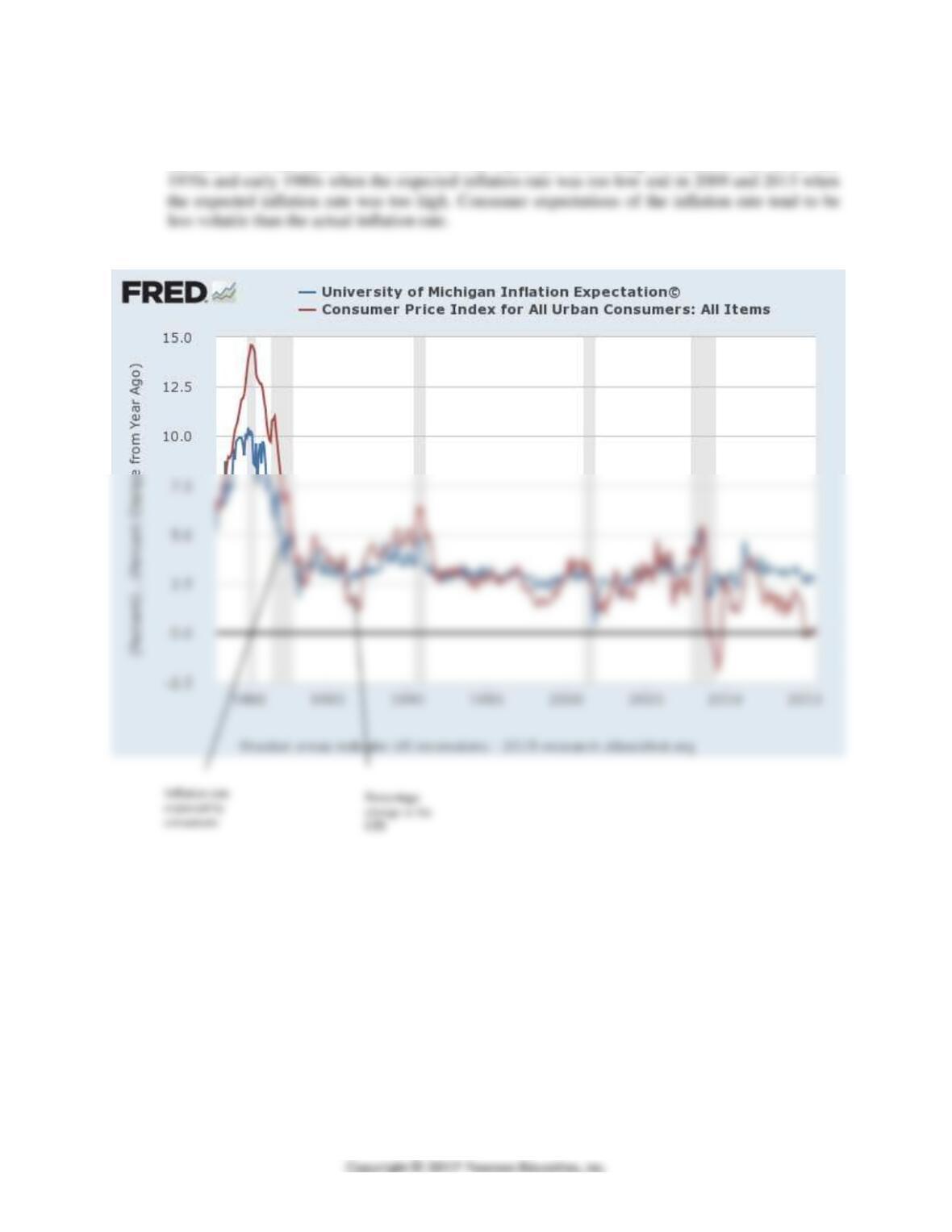
D17.1 See the plot below of the annual unemployment rate and the annual inflation rate since 1962.
a. For the 1966–1969 period, the unemployment rate declined and the inflation rate rose, which
implies a movement up along the short-run Phillips curve.
b. For the 1973–1975 period, both the unemployment rate and the inflation rate rose, which
implies that the short-run Phillips curve shifted upward.
CHAPTER 17 | Inflation, Unemployment, and Federal Reserve Policy 437
D17.2 See the plot below of consumers’ expectations of the inflation rate and the actual inflation rate as
measured by the consumer price index. Consumers did a good job forecasting the inflation rate in
the mid-1990s and mid-2000s. Consumers did a poor job forecasting the inflation rate in the late