Chapter 17
Exchange Rates and International Economic Policy
◼ Chapter Outline, Overview, and Teaching Tips
Chapter Outline
Foreign Exchange Market and Exchange Rates
Foreign Exchange Rates
The Distinction Between Real and Nominal Exchange Rates
Macroeconomics in the News: Foreign Exchange Rates
Exchange Rates in the Long Run
Law of One Price
Theory of Purchasing Power Parity
Exchange Rates in the Short Run
Supply Curve for Domestic Assets
Application: The Global Financial Crisis and the Dollar
Application: Why Are Exchange Rates So Volatile?
Exchange Rates and Aggregate Demand and Supply Analysis
Intervention in the Foreign Exchange Market
Foreign Exchange Intervention
Intervention and the Exchange Rate
Fixed Exchange Rate Regimes
Fixed Exchange Rate Regime Dynamics
Chapter 17 Exchange Rates and International Economic Policy 191
Chapter 17 Web Appendix: The Interest Parity Condition
Chapter 17 Web Appendix: Speculative Attacks and Foreign Exchange Crises
Chapter Overview and Teaching Tips
Chapter 17 discusses policy issues related to the exchange rate and the international economy. This
chapter is self-contained, and for instructors who have less of an international orientation to their courses,
this chapter can be skipped without loss of continuity. The chapter focuses on three basic questions: How
do swings in the exchange rate affect economic activity? What determines fluctuations in the exchange
rate? How do fluctuations in exchange rate affect macroeconomic policy?
Chapter 17 explains behavior in the foreign exchange market by using a modern asset-market approach to
exchange rate determination. This asset-market approach is now the dominant method of analyzing
The asset-market approach is developed in several steps. First, the long-run determinants of the exchange
rate are laid out, and then the information about the long-run determinants is embedded in a model of the
short-run determination of exchange rates. The key idea that must be transmitted to the student is that the
demand for domestic currency (say, dollar) assets is determined by the relative expected return on these
assets. To help students achieve an intuitive grasp of how the relative expected return on domestic assets,
and hence the demand curve shifts, tell them to put themselves in the shoes of an investor who is thinking
about putting his or her money into foreign or domestic assets. When a factor changes, have them ask
themselves whether at the same exchange rate, they would earn a higher expected return on domestic
assets—if so, the demand curve has shifted to the right. This kind of thinking will help them manipulate
the demand curve, so they can predict which way the exchange rate changes.
The rest of the chapter shows how international financial transactions have important implications for the
conduct of monetary policy. It explains how foreign exchange market intervention affects the exchange
rate, a country’s international reserves, liquidity in the economy, and interest rates. It also explains how
192 Mishkin • Macroeconomics: Policy and Practice, Second Edition
of students because huge profits were made during these crises and because government intervention in the
markets was massive. These applications also give students further practice with the model of the foreign
exchange market developed in Chapter 17.
◼ Answers to End of Chapter Review Questions and Problems
Answers to Review Questions
Foreign Exchange Market and Exchange Rates
1. Currencies and bank deposits denominated in particular currencies are traded in the foreign exchange
market. These transactions determine foreign exchange rates—the price of one currency in terms of
2. The nominal exchange rate tells you how many euros you can buy with your dollars. The real
exchange rate tells you how cheap or expensive U.S. goods and services are relative to European
goods and services. Because of sticky prices in the short run, nominal and real exchange rates move
Exchange Rates in the Long Run
3. The law of one price says that if two countries produce an identical good and transportation costs and
trade barriers are low, the price of the good should be identical in both countries, no matter which
currency is used to pay for it. This means that the real exchange rate will be 1.0, and the nominal
the goods and services they produce are not traded with other countries.
Exchange Rates in the Short Run
4. If the foreign exchange rate Et is above its equilibrium value E*, there is excess supply of dollar
assets in the foreign exchange market. More people want to sell dollar assets than want to buy them,
Chapter 17 Exchange Rates and International Economic Policy 193
and the value of the dollar falls. As it does so, the expected appreciation of the dollar relative to its
expected future value Eet+1 rises, which increases the expected return on holding dollar assets,
Analysis of Changes in Exchange Rates
5. The exchange rate for a currency will rise if the domestic real interest rate increases, if the foreign
Aggregate Demand and Supply Analysis of Exchange Rate Effects
6. Because appreciation of the domestic currency increases the real as well as the nominal exchange rate
in the short run, it makes exports more expensive and imports less expensive. This causes net exports
Intervention in the Foreign Exchange Market
7. Central banks intervene in foreign exchange markets to adjust their holdings of international reserves
(foreign-currency denominated assets), influence exchange rates, or both. When a central bank buys
assets denominated in the domestic currency, it is selling some of its foreign-currency denominated
Fixed Exchange Rate Regimes
8. In a fixed exchange rate regime, the value of one currency is pegged to another currency (called the
anchor currency), and central banks intervene in foreign exchange markets to keep the exchange rate
9. A currency is overvalued relative to another currency if the fixed exchange rate (par value of the
currency) is higher than the equilibrium exchange rate between the two currencies in the foreign
exchange market. To keep the exchange rate from falling to the equilibrium value, the central bank
194 Mishkin • Macroeconomics: Policy and Practice, Second Edition
10. The policy trilemma is the reality that a country or monetary union cannot simultaneously have free
To Peg or Not to Peg
11. Exchange-rate pegging helps keep inflation low and anchors inflation expectations in the pegging
country to those in the anchor country. It replaces the pegging country’s monetary policy, which may
not have done a good job in the past of stabilizing the economy, with that of the anchor country.
Answers to Problems
Foreign Exchange Market and Exchange Rates
1. a. The real exchange rate is: (16 0.75)/10 = 1.2, which means that U.S. wine is more expensive
that French wine (i.e., the real exchange rate is higher than 1).
Exchange Rates in the Long Run
2. a. For the law of one price to hold, the nominal exchange rate should be 5 yuan per dollar, so that
an individual holding $2 can buy the same coffee priced at 10 yuan in China.
3. a. In the case of sugar, trade restrictions prevent the law of one price from holding. The United
States imposes significant trade restrictions, mostly in the form of quotas. This makes sugar more
expensive in the United States. This is an example of a tradable good, but subject to
transportation costs and trade restrictions, both of which do not allow the law of one price to
Chapter 17 Exchange Rates and International Economic Policy 195
Analysis of Changes in Exchange Rates
4. a. An expected reduction in the size of asset purchases would lead to an increase in expected future
interest rates, which would increase the demand for dollar denominated assets, and hence an
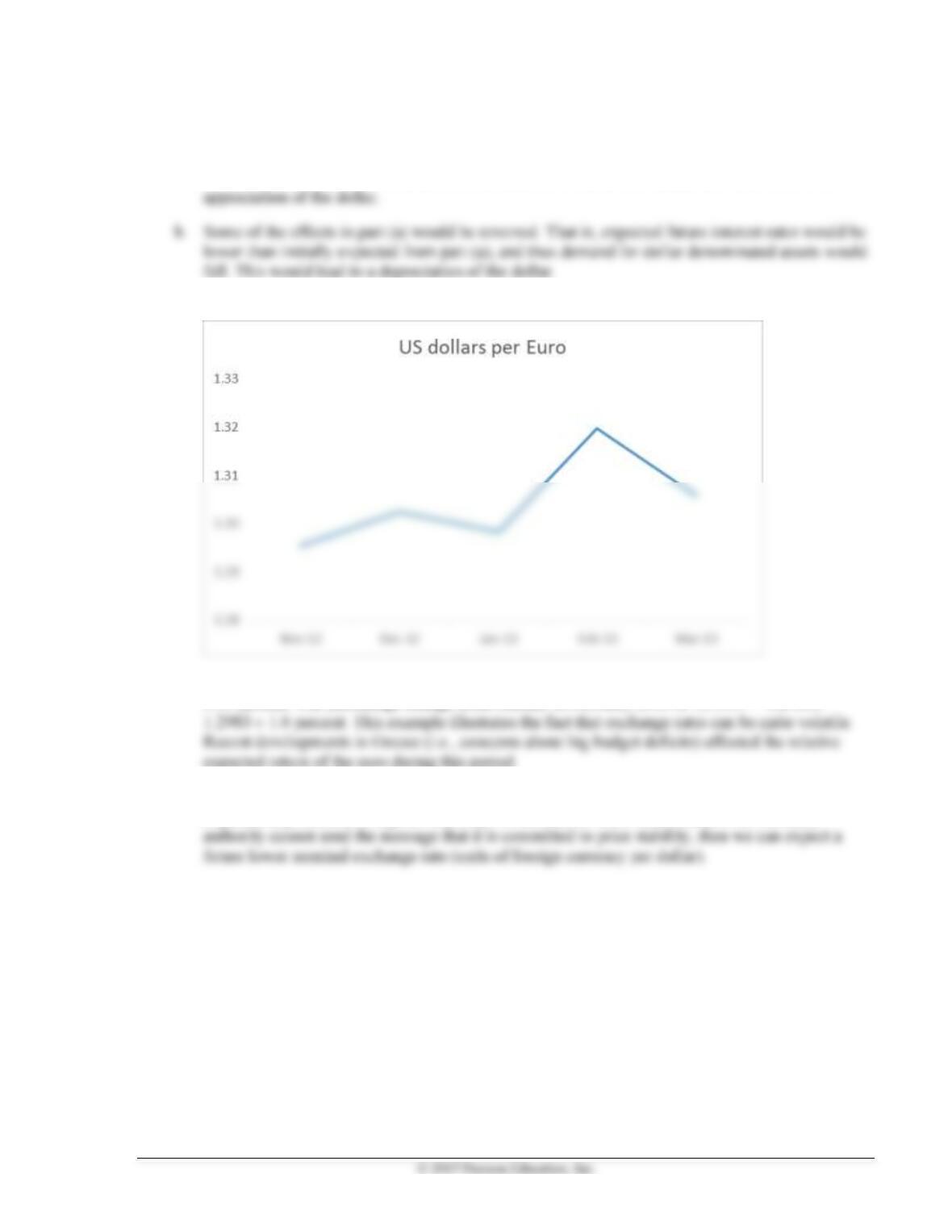
5. a.
b. The percentage change from November to December 2012 is: (1.3095–1.2953) / 1.2953 =
0.55 percent. The percentage change from January to February 2013 is: (1.3197 – 1.2983) /
expected return of the euro during this period.
6. a. According to the purchasing power parity theory, high expected inflation rates result in an
expected depreciation of a given currency. In the case of the United States, if its monetary
196 Mishkin • Macroeconomics: Policy and Practice, Second Edition
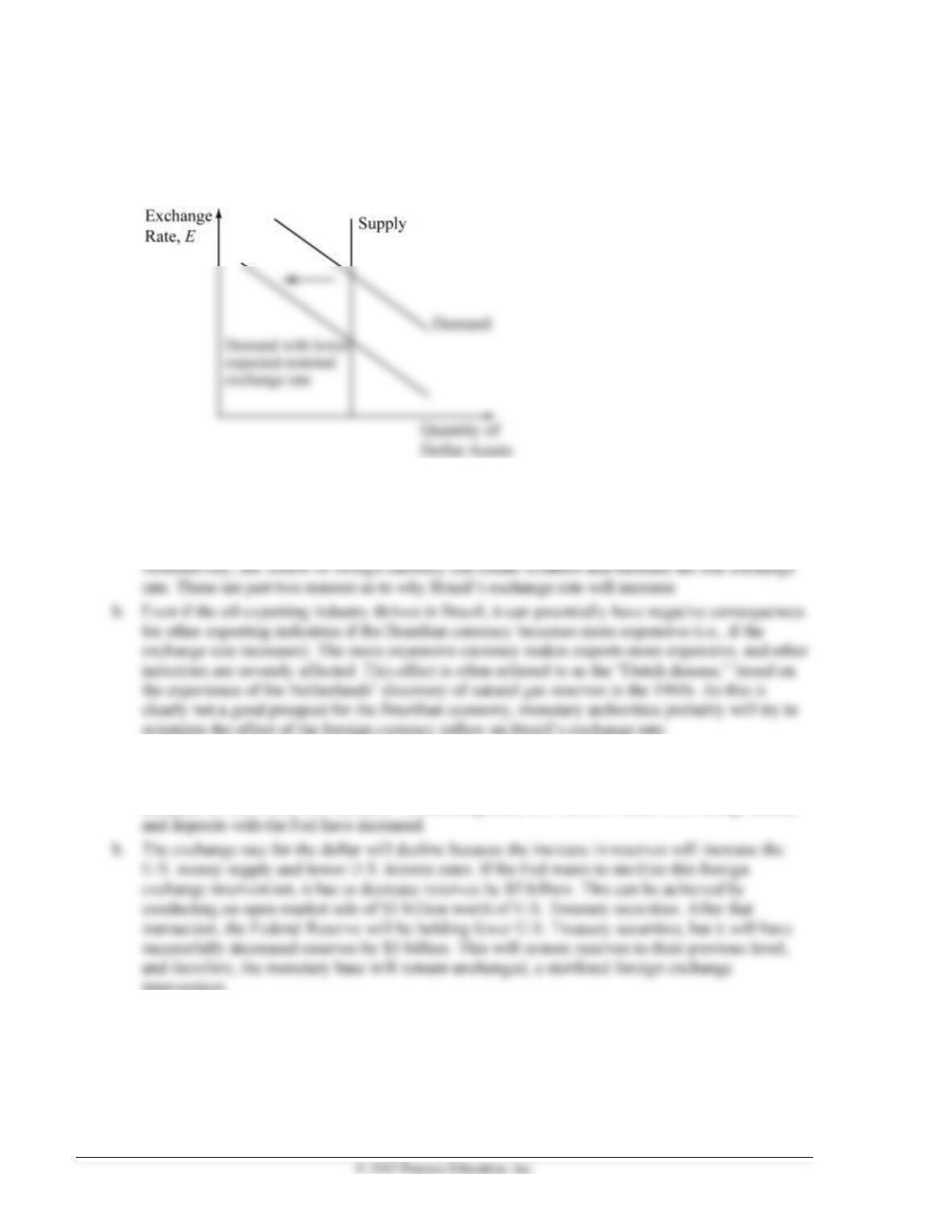
b. A future lower value of the nominal exchange rate decreases the relative expected return of U.S.
dollar-denominated assets. Graphically, the demand curve shifts to the left and the spot exchange
rate decreases. Intuitively, if investors expect the dollar to depreciate in the future, they will not
be as willing to hold U.S. dollar-denominated assets today.
Aggregate Demand and Supply Analysis of the Effects of Exchange Rates
7. a. An increase in Brazilian net exports will result in an inflow of foreign currency. If the central
bank of Brazil does not want to accumulate foreign assets, it will sell them and get Brazilian reals
in exchange. This reduces Brazil’s money supply and increases domestic interest rates.
minimize the effect of the foreign currency inflow on Brazil’s exchange rate.
Intervention in the Foreign Exchange Market
8. a. The Federal Reserve exchanged U.S. dollars for foreign assets (i.e., the Fed bought foreign assets
and paid for them with U.S. dollars). As a consequence, the Fed now holds more foreign assets,
intervention.
Fixed Exchange Rate Regimes
9. Even if a central bank adheres to a floating exchange rate regime (i.e., to allow its currency to
respond to supply and demand conditions in the foreign exchange market), it might still have
incentives to intervene in the foreign exchange market. An excessive appreciation of its currency will
hurt that country’s exports, as exports will become more expensive in terms of the foreign currency.
Chapter 17 Exchange Rates and International Economic Policy 197
To Peg or Not to Peg
10. a. An increase in the interest rate of the anchor country results in an overvaluation of the pegging
currency. In addition to fears of a speculative attack, an overvalued currency reduces net exports
by making exports more expensive. Importing firms will benefit from a stronger currency, and
◼ Answers to Data Analysis Problems
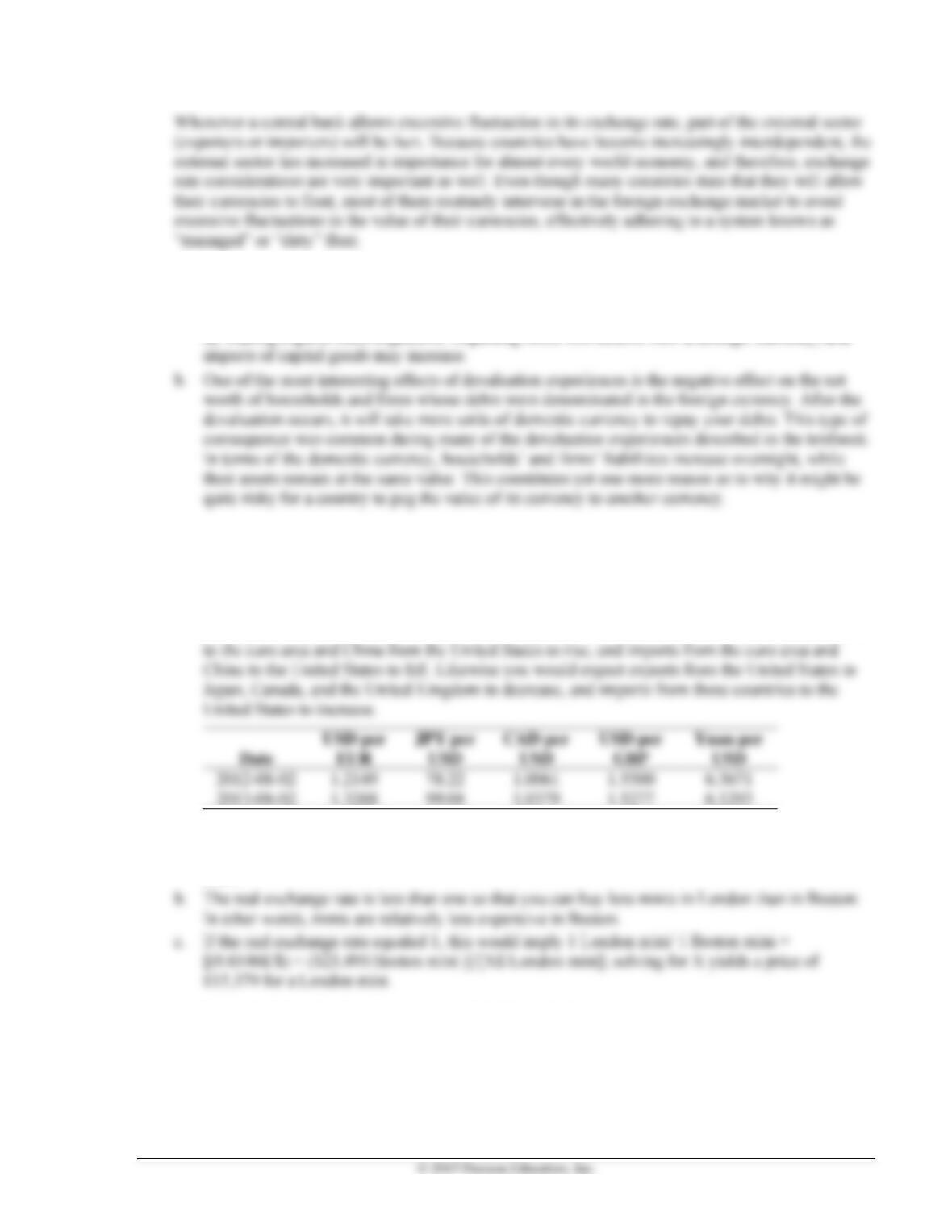
1. a. See table below for August 2, 2012 and 2013.
b. The euro (EUR) and Chinese yuan appreciated against the dollar. The yen (JPY), Canadian dollar
(CAD), and British pound (GBP) depreciated against the dollar. Thus, you would expect exports
2. a. The exchange rate for August 2, 2013 was $1.5277/£ or 0.6546£/$. The real exchange rate is then
[(0.6546£/$) × ($23,495/Boston mini )]/[£17,865/London mini] = 0.86 London mini/Boston
mini.
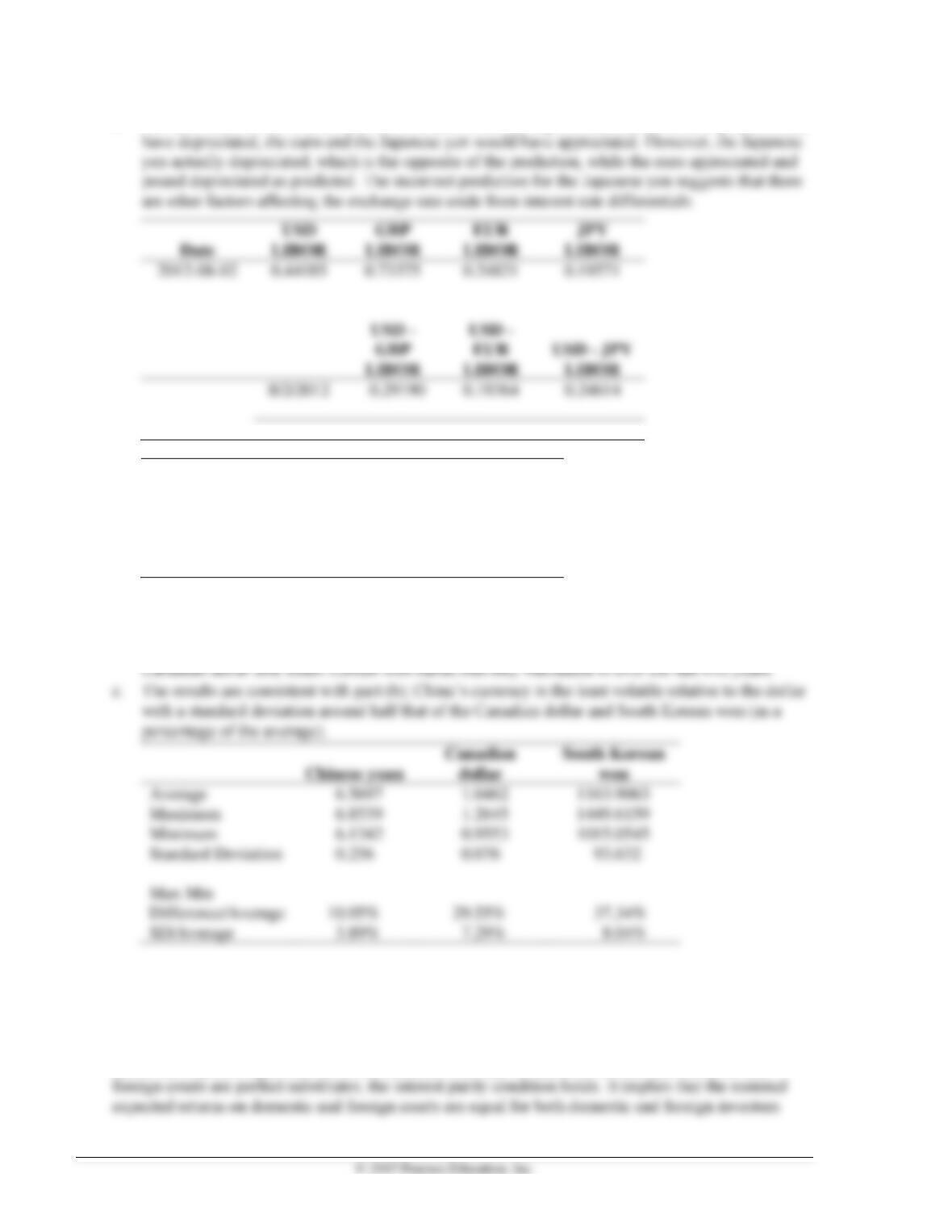
3. a See table below for data from August 2, 2012 and 2013.
b. The British LIBOR rate decreased against the dollar LIBOR rate, thus you would expect the
British pound to depreciate relative to the dollar. The euro and yen LIBOR rates both increased
relative to the dollar LIBOR rate; thus, you would expect the euro and yen to appreciate relative
to the dollar.
198 Mishkin • Macroeconomics: Policy and Practice, Second Edition
c. See table below. The interest rate differentials would have predicted that the British pound would
Date
USD per
GBP
USD per
EUR
JPY per
USD
2012-08-02
1.5500
1.2149
78.22
2013-08-02
1.5277
1.3268
99.04
GBP
depreciated
EUR
appreciated
JPY
depreciated
dollar
10.95%
4. a. See table below for July 2008 to July 2013.
b. See table below. The Chinese yuan has a much smaller band that it moves in relative to the
average value; at only 11 percent of the average, this is three to four times smaller than the
◼ Answers to Review Questions and Problems in Web Appendix,
“The Interest Parity Condition”
1. The interest parity condition holds that the domestic interest rate equals the foreign interest rate
minus the expected appreciation of the domestic currency. If capital is mobile and domestic and
2. a The expected return of dollar assets in terms of Japanese yen would be 4 percent higher than the
interest rate paid by the dollar-denominated asset. In addition to the 2 percent earned in dollars,
an investor will earn 4 percent due to the appreciation of the dollar. The expected return of
3. As long as the interest rate on the domestic asset is lower than the interest rate on the foreign asset,
the interest parity condition implies an expected appreciation of the domestic currency. This happens
4. Rumors about a future depreciation of the domestic currency lower the expected appreciation of the
domestic currency by (everything else the same) lowering the value of the expected future exchange
rate (foreign currency per domestic currency). This results in an increase in the righthand side of the
5. According to the interest parity condition, the dollar is expected to depreciate by 1 percent: 4% = 3%
6. According to the interest parity condition, if a government decides to peg the value of its currency to
◼ Answers to Review Questions and Problems in Web Appendix,
“Speculative Attacks and Foreign Exchange Crises”
1. Speculators attack a currency when they believe it is overvalued and that the government is near to
exhausting its international reserves or its willingness to use them to continue intervening in the
200 Mishkin • Macroeconomics: Policy and Practice, Second Edition
2. The countries in the ERM faced difficulties when the German Bundesbank sharply increased interest
rates to deal with the jump in inflation that accompanied German reunification in the early 1990s
because they would have to raise their interest rates also to keep the exchange rates for their
3. If a country’s fiscal policy decisions result in budget deficits that it cannot finance by selling
government bonds, its money supply will rise because it will have to either simply print money to
4. Problems in the banking sector can lead to a currency crisis in a couple of different ways. If a
country’s banking system is weakening and there is a financial crisis leading to a slowdown in the
5. a. The central bank of the overvalued currency should intervene in the foreign exchange market and
buy its own currency (paying with international reserves) in order to increase the value of its
domestic currency. Doing so will result in a shift to the right of the demand curve for domestic
assets to D2 (where the currency is not overvalued anymore).
b. If this country does not have enough international reserves to support its own currency, then it
will not be possible to buy its own currency and solve this situation. The stage for a speculative
Chapter 17 Exchange Rates and International Economic Policy 201
◼ Data Sources, Related Articles, and Discussion Questions
A. For Information About Application: The Subprime Financial Crisis and the
Dollar
Data Source
Federal Reserve Bank of St. Louis database (FRED):
value of the U.S. dollar. You can edit the graph to see data from 2006 to 2010 to see the value of the U.S.
dollar as described in the Application.
Related Article
Colvin, Geoff, “What’s Sinking the Dollar?” (11/13/2007):
article, you can find some arguments for the decrease in the value of the U.S. dollar during the first stages
of the financial crisis. Later, the dollar would appreciate, as noted in the Application.
Discussion Question
By mid-2010, Greece experienced financial problems, mostly related to the size of its budget deficits.
Country members of the European Union debated how to support Greece, as rumors of other countries
being in the same situation circulated. How do you think these events affected the exchange rate between
the euro and the U.S. dollar?
Answer: Greece’s announcement about its huge budget deficits, linked to rumors of default of other
B. For Information About Application: Why Are Exchange Rates So Volatile?
Data Source
Federal Reserve Bank of St. Louis database (FRED):
change the data range to one year to see daily fluctuations even more clearly.)
Related Article
Aghion, Philippe et al., “Exchange Rate Volatility and Productivity Growth: The Role of Financial
Discussion Question
Suppose that during the same day that the United States announces extremely high productivity growth
rates, Mexico’s monthly inflation rate increases above 10 percent, and the European Central Bank
announces a rescue plan for Ireland, Portugal, and Spain. Which would be the consequence of these events
for the value of these currencies? Conclude by discussing the implied volatility of exchange rates.
Answer: News about increased productivity growth in the United States will increase the expected value of
202 Mishkin • Macroeconomics: Policy and Practice, Second Edition
D. For Information About Application: How Did China Accumulate Over $3
Trillion of International Reserves?
Data Source
Federal Reserve Bank of St. Louis database (FRED):
China/U.S. foreign exchange. Note how recent efforts by the United States and other countries forced
China to allow an appreciation (a decline in this series) of the Chinese currency.
Related Article
Seo, EunKyung (Bloomberg, 09/28/2010), “G–20 Officials Seek Currency Policy Compromise”:
cheapening-currencies.html. This article shows how difficult it is for governments to agree on an exchange
rate policy. Note in particular the pressure exerted over the Chinese currency policy by many countries.
Discussion Question
Describe the effect on the value of the U.S. dollar of a sell-off of U.S. Treasury bonds and purchase of
euro denominated assets by the Chinese government.
Answer: If the Chinese government decides to use its holdings of U.S. Treasury bonds to buy euro-
D. For Information About Policy and Practice: Will the Euro Survive?
Data Source
Federal Reserve Bank of St. Louis database (FRED):
2000 to the latest data available. Here you can find data about unit labor costs in Spain, and note that
because Spain cannot devalue its currency (it is a member of the euro zone), the way around that
“straitjacket” is “internal” devaluation, which amounts to a significant decrease in unit labor costs.
Related Article
greatly strengthened. Note the use of the terms “internal devaluation” on the last subtitle “Restoring
Growth in Euroland.”
Discussion Question
Why do you think that Eurozone member countries that suffered from their inability to set their own
monetary policy did not simply exit the Eurozone and came back to using their own currency?
Chapter 17 Exchange Rates and International Economic Policy 203
Answer: Although it was clear that the inability to set their own monetary policy did not help countries
that were in trouble during the recent crisis in Europe, it is also important to note that the establishment of
E. For Information About Policy and Practice: The Collapse of the Argentine
Currency Board
Data Source
peso” as target currency and then select 2000 to 2002 for the data range).
Related Article
announcements about the Argentinean default. Note the expected effects on its currency, expressed in the
third paragraph: “currency uncertainty.”
Discussion Question
Which are the main consequences on monetary policy flexibility of establishing a currency board?
Answer: By definition, when a country establishes a currency board, it forgoes its ability to conduct
F. For Information About Application: The Foreign Exchange Crisis of
September 1992
Data Source
The University of British Columbia (Pacific Exchange Rate Service): http://fx.sauder.ubc.ca/data.html.
Use this application to access data about the British pound/German mark exchange rate (select “British
pound” as base currency and “German mark” as target currency and then select 1992 to 1993 for the data
range). Check what happened to that exchange rate in the aftermath of Wednesday, September 16, 1992.
Related Article
The New York Times, “When Soros Decided to ‘Go for the Jugular’:
Soros’ role in the events of the September 1992 crisis are detailed.
Discussion Question
In light of the events of September 1992, what do you think the most important peril of engaging in a
system of fixed exchange rates when cooperation among countries is difficult to achieve is?
204 Mishkin • Macroeconomics: Policy and Practice, Second Edition
Answer: The events of September 1992 clearly illustrated the idea that a system of fixed exchange rates
G. For Information About Application: Foreign Exchange Crises in Emerging
Market Countries: Mexico 1994; East Asia 1997; Brazil 1999 and Argentina
2002
The University of British Columbia (Pacific Exchange Rate Service): http://fx.sauder.ubc.ca/data.html.
Use this application to access data about the Mexican peso/U.S. dollar exchange rate (select “Mexican
pesos” as target currency and then select 1994 to 1995 for the data range). Note the evolution of the
exchange rate beginning in December 19, 1994.
Related Article
Mishkin.pdf. In this paper, the author of the textbook identifies the most important differences between
financial crises in emerging and industrialized countries and draws conclusions about how to deal with
financial crises in emerging market economies.
Discussion Question
Suppose that in 2001 you bought an apartment in Buenos Aires, Argentina, valued at $100,000
Argentinean pesos. For that purpose, you took a mortgage loan for $80,000 U.S. dollars. What do you
think happened to the value of your loan in Argentinean pesos after the Argentinean peso was devalued by
more than 50 percent on January 2002?
Answer: In 2001, the exchange rate between the Argentinean peso and the U.S. dollar was 1. This meant