S-239
interactive activity
Chapter 16
Externalities
1. What type of externality (positive or negative) is present in each of the following
examples? Is the marginal social benefit of the activity greater than or equal to
the marginal benefit to the individual? Is the marginal social cost of the activ-
ity greater than or equal to the marginal cost to the individual? Without inter-
vention, will there be too little or too much (relative to what would be socially
optimal) of this activity?
1. a. This is a positive externality: since other people enjoy looking at Mr. Chau’s
flowers, the marginal social benefit of looking at the flowers is greater than
the marginal benefit to Mr. Chau of looking at them. As a result, fewer flowers
will be planted than is socially optimal.
b. This is a negative externality: an external cost, the risk that your house will
catch fire from the sparks from your neighbor’s bonfire, is imposed on you.
2. Many dairy farmers in California are adopting a new technology that allows
them to produce their own electricity from methane gas captured from animal
waste. (One cow can produce up to 2 kilowatts a day.) This practice reduces the
amount of methane gas released into the atmosphere. In addition to reducing
their own utility bills, the farmers are allowed to sell any electricity they produce
at favorable rates.
a. Explain how the ability to earn money from capturing and transforming
Solution
2. a. Without the new technology, dairy farmers will release methane gas until the
marginal social benefit of emissions is zero. With the new technology, there
b. Farmers who have a lower cost of capturing methane will generate more profit
from transformation of their methane than farmers who have a higher cost.
3. Voluntary environmental programs were extremely popular in the United States,
Europe, and Japan in the 1990s. Part of their popularity stems from the fact
that these programs do not require legislative authority, which is often hard
to obtain. The 33/50 program started by the Environmental Protection Agency
a. As in Figure 16–3, draw marginal benefit curves for pollution generated by two
plants, A and B, in 1988. Assume that without government intervention, each
plant emits the same amount of pollution, but that at all levels of pollution less
b. Do you expect the total quantity of pollution before the program was put in place
to have been less than or more than the optimal quantity of pollution? Why?
c. Suppose the plants whose marginal benefit curves you depicted in part a were
participants in the 33/50 program. In a replica of your graph from part a,
mark targeted levels of pollution in 1995 for the two plants. Which plant was
required to reduce emissions more? Was this solution necessarily efficient?
d. What kind of environmental policy does the 33/50 program most closely
resemble? What is the main shortcoming of such a policy? Compare it to two
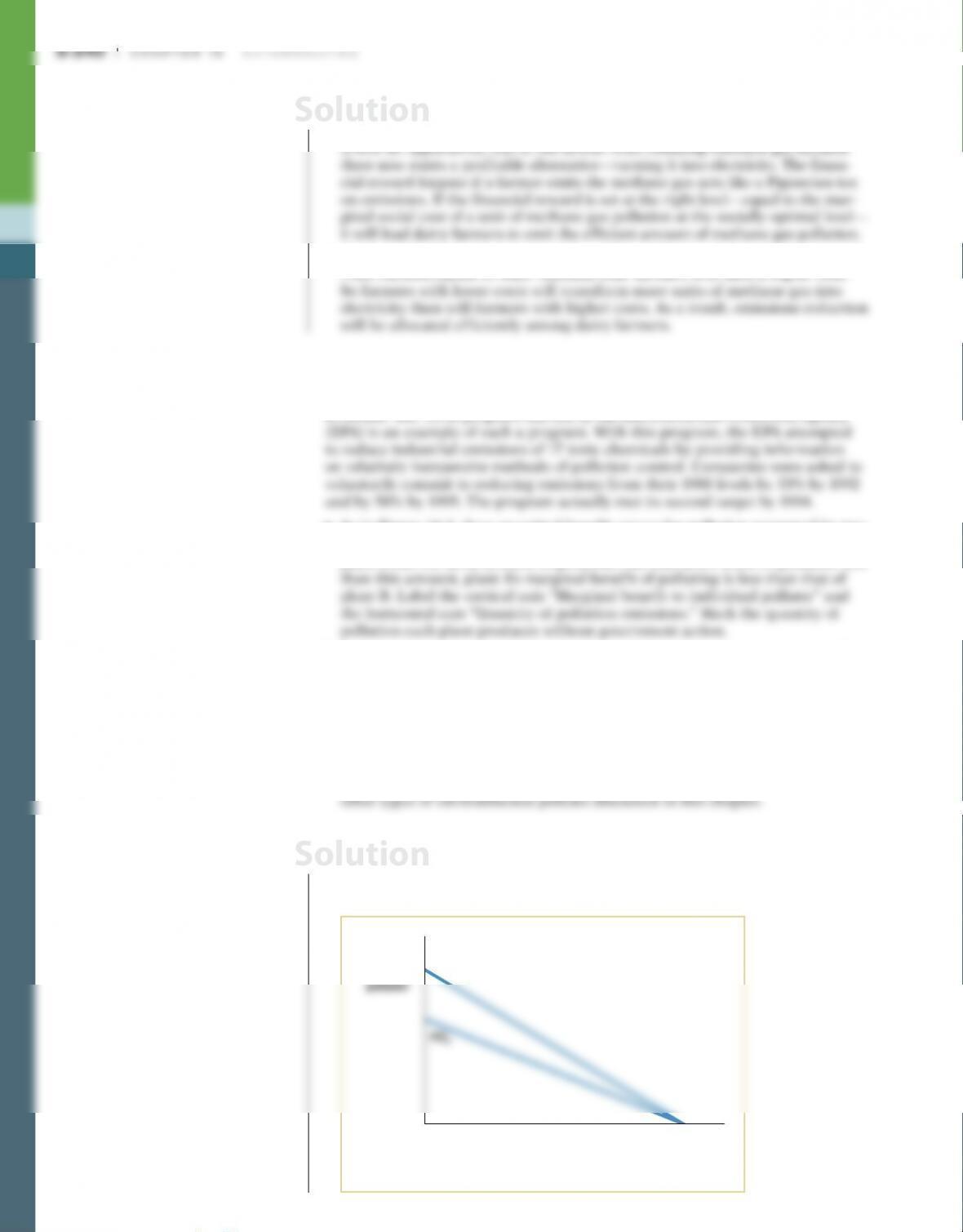
3. a. The accompanying diagram shows the marginal benefit curve for plant A,
MBA, and the marginal benefit curve for plant B, MBB. Without government
intervention, both plants produce QMKT pollution.
QMKT
Marginal
benefit to
individual
Quantity of
pollution
emissions
MBB
Solution
Solution
Chapter 16 ExtErnalitiEs S-241
b. We should expect that the total quantity of pollution before the plan was
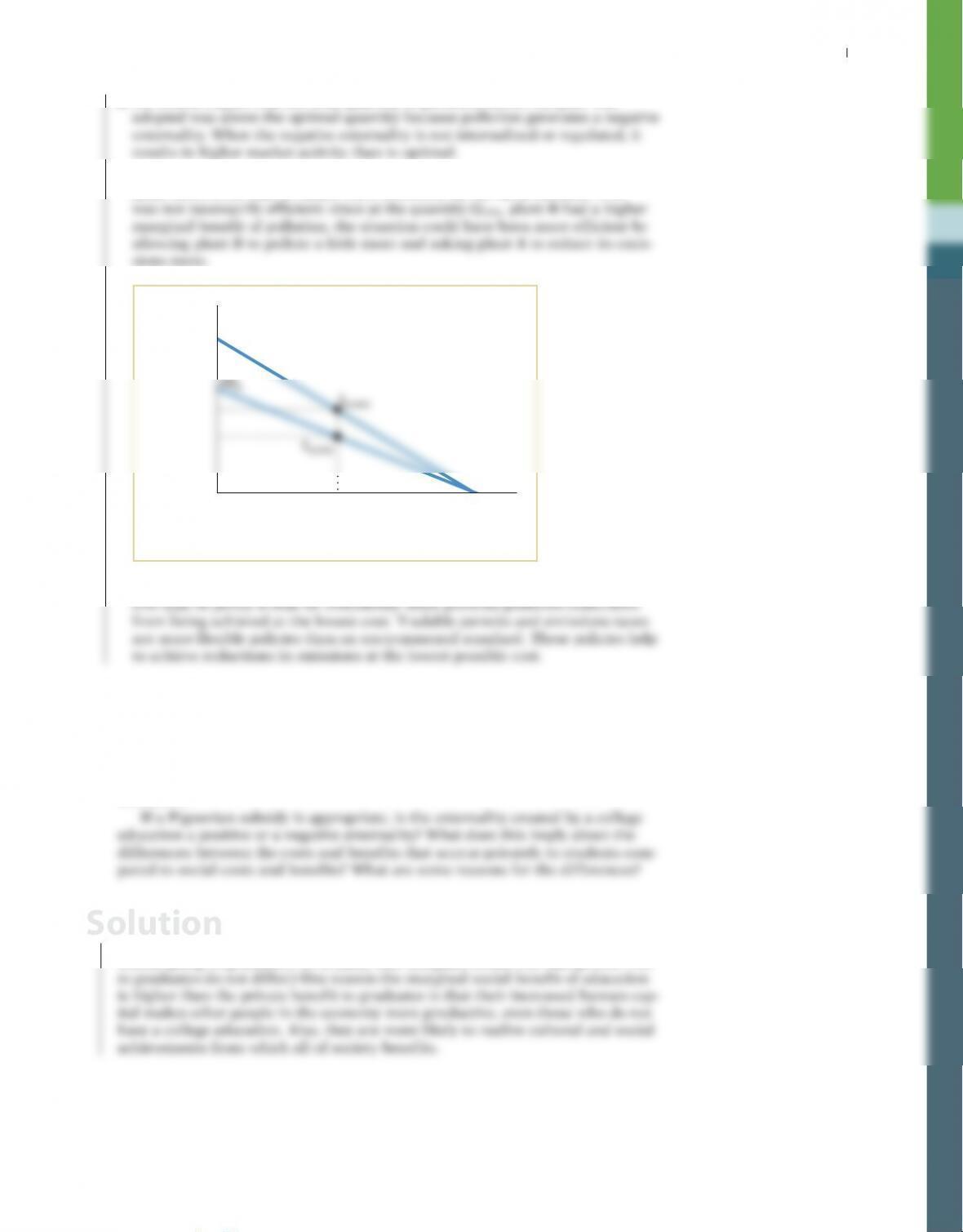
c. The accompanying diagram shows the targeted level of emissions in 1995,
Q1995. Both firms had to reduce their emissions by the same amount. This
QMKT
Q1995
Marginal
benefit to
individual
polluter
Quantity of
pollution
emissions
MBB
d. The 33/50 program set an environmental standard. The main shortcoming of
4. According to a report from the U.S. Census Bureau, “the average [lifetime] earn-
ings of a full-time, year round worker with a high school education are about
$1.2 million compared with $2.1 million for a college graduate.” This indicates
that there is a considerable benefit to a graduate from investing in his or her
own education. Tuition at most state universities covers only about two-thirds
to three–quarters of the cost, so the state applies a Pigouvian subsidy to college
education.
4. If a Pigouvian subsidy is appropriate, the externality is a positive one. This
means that the marginal social benefit of education is higher than the private
benefit going to graduates. (It is likely that marginal social cost and private cost
Solution
S-242 Chapter 16 ExtErnalitiEs
5. The city of Falls Church, Virginia, subsidizes the planting of trees in homeowners’
front yards when they are within 15 feet of the street.
5. a. Trees planted near the street provide external benefits. They provide shade and
so keep streets and sidewalks cooler, which makes activities such as walking
and bicycling more pleasant for all citizens. They also beautify neighborhoods
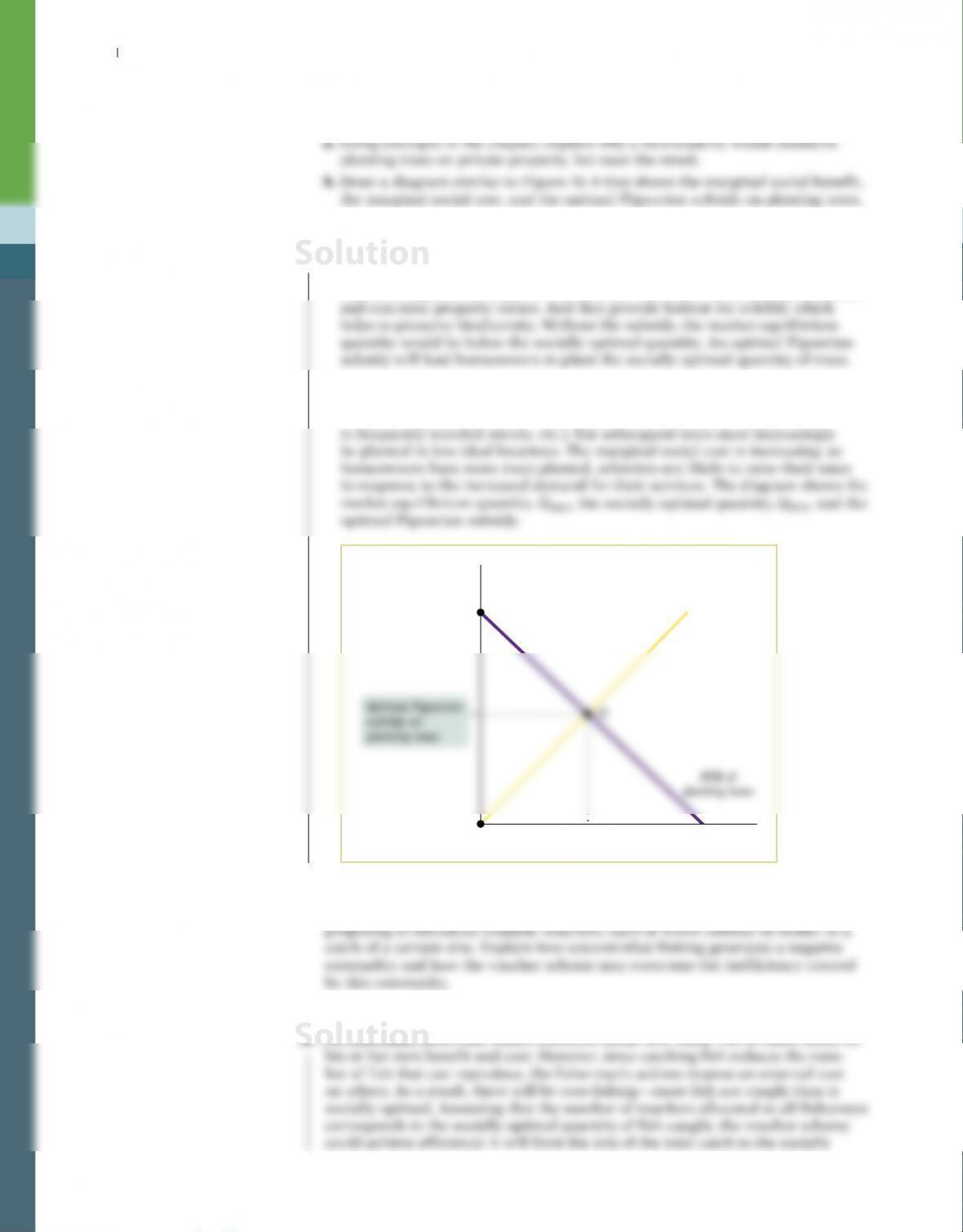
b. The accompanying diagram shows the marginal social benefit (MSB) and
the marginal social cost (MSC) of planting trees. The marginal social benefit
is decreasing: the first trees are planted in the most ideal locations (close
Marginal social
cost, marginal
social benefit
Quantity of trees
Q
OPT
Q
MKT
MSC of
planting trees
MSB of
planting trees
O
Optimal Pigouvian
subsidy on
planting trees
6. Fishing for sablefish has been so intensive that sablefish were threatened with
extinction. After several years of banning such fishing, the government is now
Solution

7. The two dry-cleaning companies in Collegetown, College Cleaners and Big
Green Cleaners, are a major source of air pollution. Together they currently
produce 350 units of air pollution, which the town wants to reduce to 200 units.
The accompanying table shows the current pollution level produced by each
company and each company’s marginal cost of reducing its pollution. The mar–
ginal cost is constant.
Marginal cost of
Initial pollution reducing pollution
Companies level (units) (per unit)
College Cleaners 230 $5
Big Green Cleaners 120 $2
b. How much is each pollution voucher worth to College Cleaners? To Big Green
Cleaners? (That is, how much would each company, at most, be willing to pay
for one more voucher?)
c. Who will sell vouchers and who will buy them? How many vouchers will be
traded?
7. a . College Cleaners would have to reduce its pollution level by 130 units, costing
b. One pollution voucher is worth $5 to College Cleaners and $2 to Big Green
Cleaners. To see why, consider this: if College Cleaners can obtain one more
c. Each voucher is worth more to College Cleaners than to Big Green Cleaners,
so Big Green Cleaners will sell all of its 100 vouchers to College Cleaners (for a
price between $2 and $5).
d. Big Green Cleaners will reduce its output of pollution to zero, which will cost
it 120 × $2 = $240. College Cleaners will now have 200 vouchers and can emit
200 units of pollution, 30 fewer than before. This will cost College Cleaners
8. a. EAuction and EMarketplace are two competing internet auction sites, where
buyers and sellers transact goods. Each auction site earns money by charging
Solution
S-244 Chapter 16 ExtErnalitiEs
b. EMarketplace complained to the Justice Department that EAuction’s prac–
tice of eliminating fees for new sellers was anti-competitive and would lead
to monopolization of the internet auction industry. Is EMarketplace correct?
How should the Justice Department respond?
c. EAuction stopped its practice of eliminating fees for new sellers. But since it
provided much better technical service than its rival, EMarketplace, buyers
and sellers came to prefer EAuction. Eventually, EMarketplace closed down,
leaving EAuction as a monopolist. Should the Justice Department intervene to
break EAuction into two companies? Explain.
8. a. Internet auction sites are characterized by network externalities: more sellers
will want to list their items on the site that more buyers visit, and more buyers
will visit a site on which more sellers list items for sale. So it is a good strategy
for EAuction to eliminate its fees to first-time sellers. As a result, more sell-
ers will come to EAuction than to EMarketplace, also drawing more buyers to
EAuction than to EMarketplace.
b. EMarketplace is correct: due to the network externality, EAuction’s practice is
anti-competitive and likely to eventually drive EMarketplace out of business.
9. Which of the following are characterized by network externalities? Which are
not? Explain.
Solution

10. The loud music coming from the sorority next to your dorm is a negative
externality that can be directly quantified. The accompanying table shows
the marginal social benefit and the marginal social cost per decibel (dB, a
measure of volume) of music.
Volume of
music (dB)
Marginal social
benefit of dB
Marginal social
cost of dB
90
$36 $0
91
30 2
92
a. Draw the marginal social benefit curve and the marginal social cost curve.
Use your diagram to determine the socially optimal volume of music.
b. Only the members of the sorority benefit from the music, and they bear
none of the cost. Which volume of music will they choose?
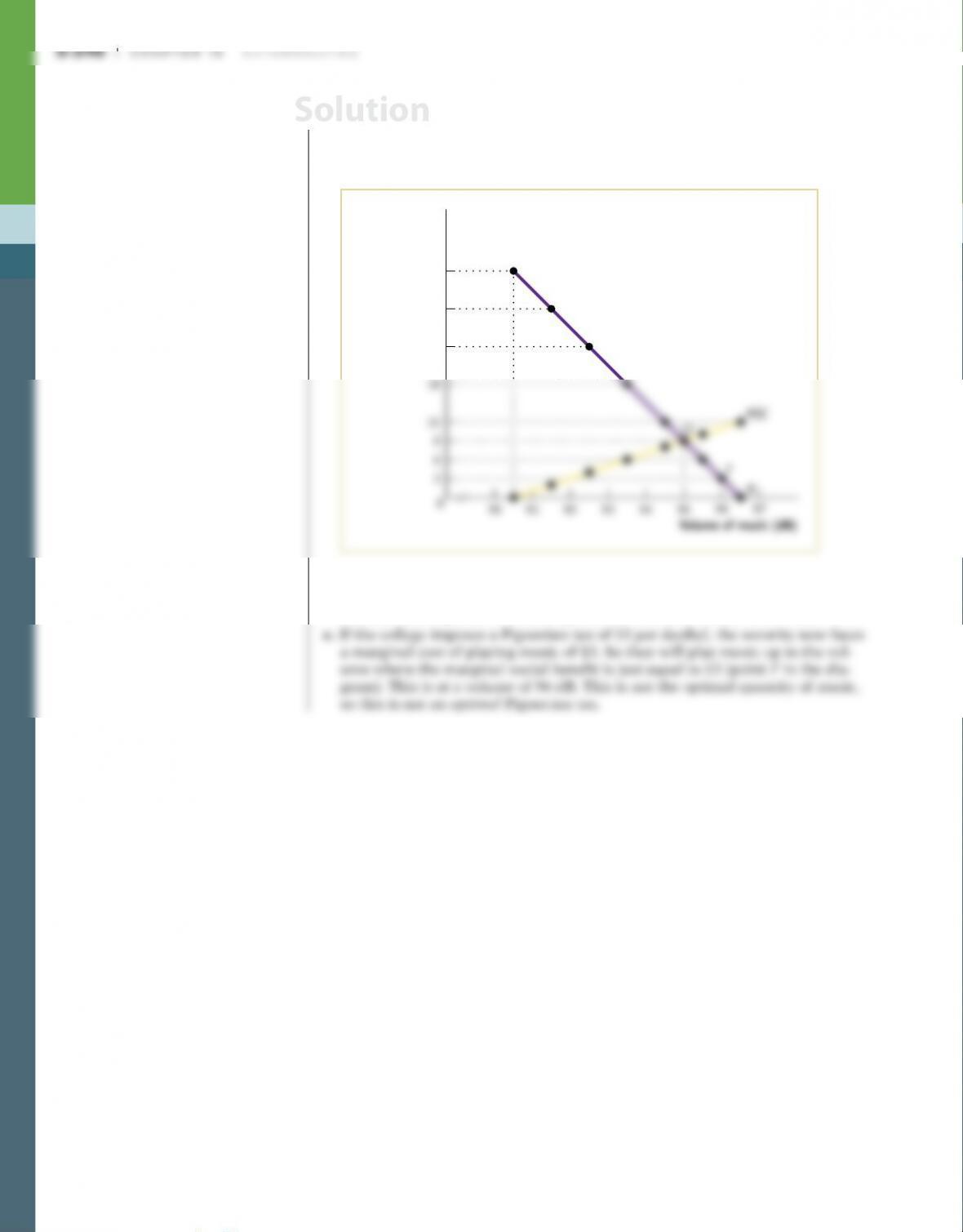
10. a. The accompanying diagram shows the marginal social cost curve and the
marginal social benefit curve of music. The socially optimal volume of music
is the volume at which marginal social benefit and marginal social cost are
equal (point O in the diagram). This is the case at a volume of 95 dB.
Marginal social
cost, marginal
social benefit
of dB
Volume of music (dB)
MSB
$36
30
24
b. Since the members of the sorority do not bear any of the social cost of playing
loud music, they will play music up to the volume where the marginal social
benefit is zero (point M in the diagram). This is at a volume of 96.5 dB.
Solution