Chapter 16
RISK ANALYSIS
QUESTIONS AND ANSWERS
Q16.1 In economic terms, what is the difference between risk and uncertainty?
Q16.1 ANSWER
Economic risk is the chance of loss because all possible outcomes and their probability
of happening are unknown. Actions taken in such a decision environment are purely
Q16.2 Domestic investors sometimes miss out on better investment opportunities available to
global investors. At the same time, global investors face special risks. Discuss some of
the special risks faced by global investors.
Q16.2 ANSWER
Cultural risk is borne by companies that pursue a global investment strategy. Product
market differences due to distinctive social customs make it difficult to predict which
Risk Analysis 497
Q16.3 The standard deviation measure of risk implicitly gives equal weight to variations on
both sides of the expected value. Can you see any potential limitations of this
treatment?
Q16.3 ANSWER
Q16.4 Confronted with a choice between $50 today or $100 one year from now, economic
experiments suggest that the vast majority of people will take will take the $50 today. At
the same time, economic experiments show that most people will opt to take $100 in ten
years over $50 in nine years. Is such behavior rational? Explain why or why not.
Q16.4 ANSWER
498 Chapter 16
Q16.5 State-run lotteries commonly pay out 50 percent of total lottery ticket sales in the form
of jackpots and prizes. Use the certainty equivalent concept to quantify the minimum
value placed on each risky dollar of expected return by lottery ticket buyers. Why are
such lotteries so popular?
Q16.5 ANSWER
Any expected risky amount can be converted to an equivalent certain sum using the
certainty equivalent adjustment factor, α, calculated as the ratio of a certain sum divided
by an expected risky amount, where both dollar values provide the same level of utility.
Q16.6 Graph the relation between money and its utility for an individual who buys both
household fire insurance and state lottery tickets.
Q16.6 ANSWER
In buying household fire insurance, individuals display risk averse behavior when faced
with the small probability of a catastrophic loss. This implies a concave-to-the-origin
Risk Analysis 499
Q16.7 When the basic valuation model is adjusted using the risk-free rate, i, what economic
factor is being explicitly accounted for?
Q16.7 ANSWER
Q16.8 If the expected net present value of returns from an investment project is $50,000, what
is the maximum price that a risk-neutral investor would pay for it? Explain.
Q16.8 ANSWER
Q16.9 “Market estimates of investors’ reactions to risk cannot be measured precisely, so it is
impossible to set risk-adjusted discount rates for various classes of investment with a
high degree of precision.” Discuss this statement.
500 Chapter 16
Q16.9 ANSWER
This statement has considerable validity. It is impossible to precisely measure an
individual’s attitude to risk, and the problem is further compounded by the conceptual
Q16.10 What is the value of decision trees in managerial decision making?
Q16.10 ANSWER
SELF-TEST PROBLEMS AND SOLUTIONS
ST16.1 Certainty Equivalent Method. Courtney-Cox, Inc., is a Texas-based manufacturer and
distributor of components and replacement parts for the auto, machinery, farm, and
construction equipment industries. The company is presently funding a program of
capital investment that is necessary to reduce production costs and thereby meet an
onslaught of competition from low-cost suppliers located in Mexico and throughout
Latin America. Courtney-Cox has a limited amount of capital available and must
carefully weigh both the risks and potential rewards associated with alternative
investments. In particular, the company seeks to weigh the advantages and
disadvantages of a new investment project, project X, in light of two other recently
adopted investment projects, project Y and project Z:
Expected Cash Flows After Tax (CFAT)
Per Year
Risk Analysis 501
Year
Project X
Project Y
Project Z
2009
$10,000
$20,000
$0
2010
10,000
18,000
2,500
2011
10,000
16,000
5,000
A. Using a 5 percent risk-free rate, calculate the present value of expected cash flows
after tax (CFAT) for the ten-year life of project X.
B. Calculate the minimum certainty equivalent adjustment factor for each project’s
CFAT that would justify investment in each project.
D. If the company would not have been willing to invest more than $60,000 in project
Y nor more than $50,000 in project Z, should project X be undertaken?
ST16.1 SOLUTION
A. Using a 5 percent risk-free rate, the present value of expected cash flows after tax
2012
10,000
14,000
7,500
2013
10,000
12,000
2014
10,000
10,000
2016
10,000
2017
10,000
2018
10,000
$91,131
502 Chapter 16
Year
Project X
PV of $1
at 5
percent
PV of CFAT
at 5 percent
2009
$10,000
0.9524
$9,524
B. To justify each investment alternative, the company must have a certainty equivalent
Project X
Risk Analysis 503
C. Given managerial risk aversion, project X is the least attractive investment because it has
ST16.2 Project Valuation. The Central Perk Coffee House, Inc., is engaged in an aggressive
store refurbishing program and is contemplating expansion of its in-store baking
facilities. This investment project is to be evaluated using the certainty equivalent
adjustment factor method and the risk-adjusted discount rate method. If the project has
In-store Baking Facilities
Investment Project
Time
Period
(Years)
Alpha
Project
E(CFAT)
504 Chapter 16
In-store Baking Facilities
Investment Project
Time
Period
(Years)
Alpha
Project
E(CFAT)
At the present time, an 8 percent annual rate of return can be obtained on short-term
U.S. government securities; the company uses this rate as an estimate of the risk-free
rate of return.
A. Use the 8 percent risk-free rate to calculate the present value of the investment
project.
B. Using this present value as a basis, use the certainty equivalent adjustment factor
information given previously to determine the risk-adjusted present value of the
project.
ST16.2 SOLUTION
A. The present value of this investment project can be calculated easily using a hand-held
calculator with typical financial function capabilities or by using the tables found in
Risk Analysis 505
Hot Food Carryout Counter Investment Project
Time
Period
(Years)
Present Value
of $1 at 8 percent
Project
E(CFAT)
Present Value
of E(CFAT)
at 8 percent
B. Using the present value given in part A as a basis, the certainty equivalent adjustment
factor information given previously can be employed to determine the risk-adjusted
present value of the project:
In-store Baking Facilities Investment Project
Time
Period
(Years)
Present Value
of $1 at 8
percent
Project
E(CFAT)
Present Value
of E(CFAT)
at 8 percent
Alpha
Risk-Adjusted
Value
C. An alternative risk-adjusted discount rate method of project valuation based on a 15
percent rate of return gives the following project valuation:
In-store Baking Facilities Investment Project
Time
Period
(Years)
Present Value
of $1 at 15 percent
Project
E(CFAT)
Present Value of
E(CFAT) at 15
506 Chapter 16
In-store Baking Facilities Investment Project
Time
Period
(Years)
Present Value
of $1 at 15 percent
Project
E(CFAT)
Present Value of
E(CFAT) at 15
percent
D. The answers to parts B and C are fully compatible; both suggest a positive risk-adjusted
present value for the project. In part B, the certainty equivalent adjustment factor
PROBLEMS AND SOLUTIONS
P16.1 Risk Preferences. Identify each of the following as being consistent with risk-averse,
risk-neutral, or risk-seeking behavior in investment project selection. Explain your
answers.
A. Larger risk premiums for riskier projects
B. Preference for smaller, as opposed to larger, coefficients of variation
C. Valuing certain sums and expected risky sums of equal dollar amounts equally
D. Having an increasing marginal utility of money
E. Ignoring the risk levels of investment alternatives
P16.1 SOLUTION
A. Risk-averse investors demand higher risk premiums as project risk levels increase.
Risk Analysis 507
B. Risk-averse investors place a relatively low value on small probabilities of a high payoff.
P16.2 Certainty Equivalents. The certainty equivalent concept can be widely employed in the
analysis of personal and business decision making. Indicate whether each of the
following statements is true or false and explain why:
A. The appropriate certainty equivalent adjustment factor, α, indicates the minimum
P16.2 SOLUTION
A. False. The certainty equivalent adjustment factor α indicates the maximum price in
certain dollars that an individual is willing to pay per risky dollar of expected return.
P16.3 Expected Value. Perry Chandler, a broker with Caveat Emptor, Ltd., offers free
investment seminars to local PTA groups. On average, Chandler expects 1 percent of
seminar participants to purchase $25,000 in tax-sheltered investments and 5 percent to
purchase $5,000 in stocks and bonds. Chandler earns a 4 percent net commission on
tax shelters and a 1 percent commission on stocks and bonds. Calculate Chandler’s
expected net commissions per seminar if attendance averages ten persons.
P16.3 SOLUTION
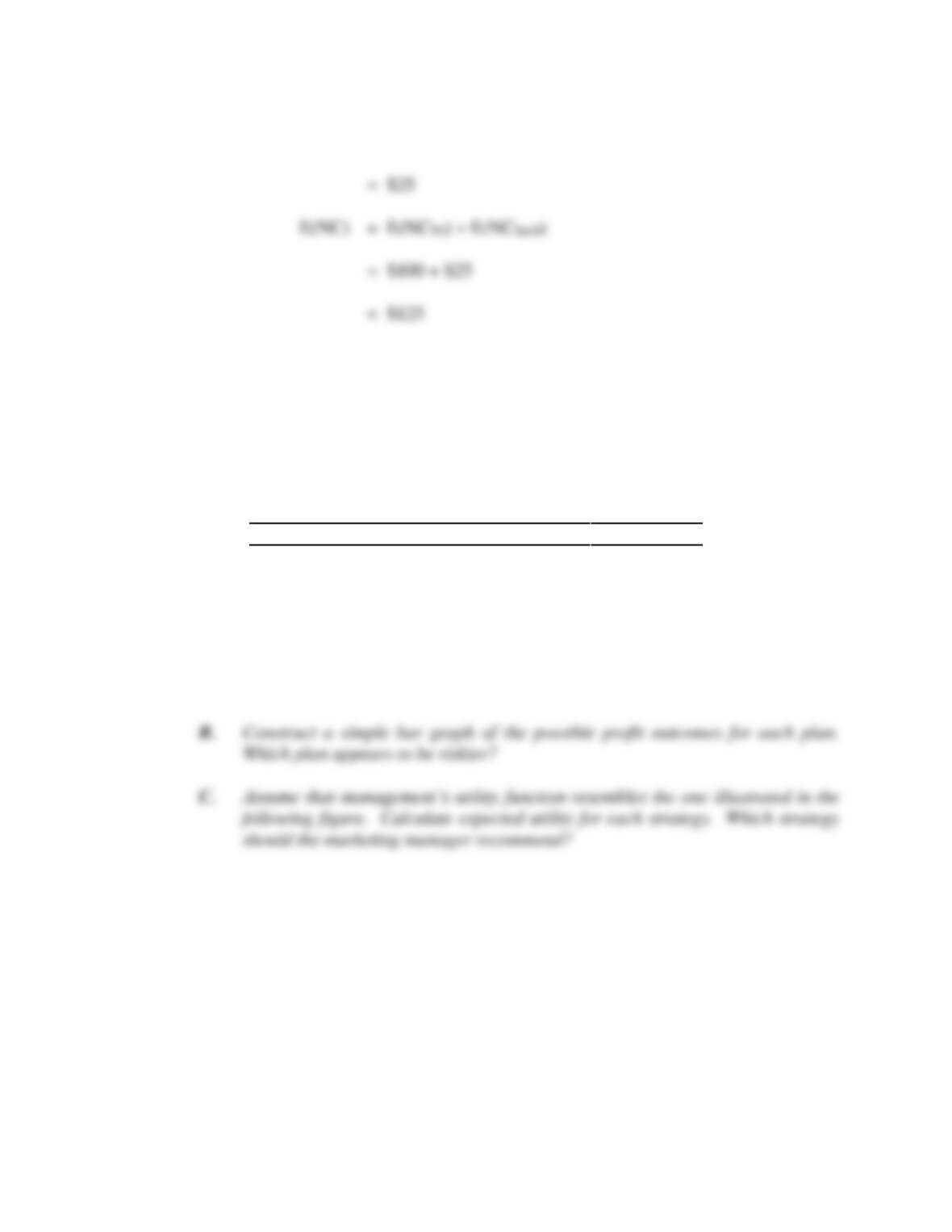
Expected net commissions will be the sum of net commissions on tax shelters (TS) and
stocks and bonds (S&B).
Risk Analysis 509
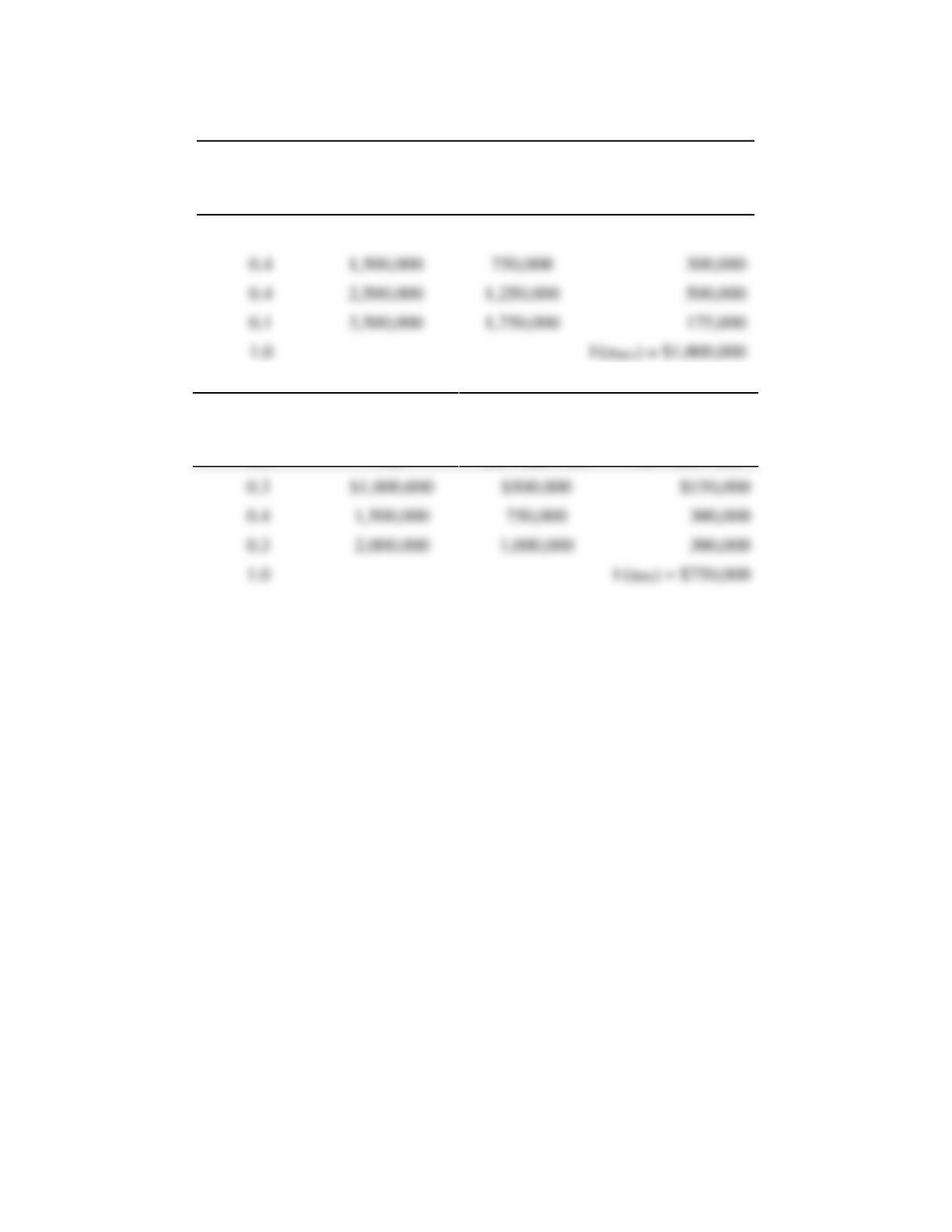
P16.4 Probability Concepts. Firefly Products, Inc., has just completed development of a new
line of skin-care products. Preliminary market research indicate two feasible marketing
strategies: (1) creating general consumer acceptance through media advertising or (2)
creating distributor acceptance through intensive personal selling. Sales estimates for
under each marketing alternative are:
Media Advertising
Strategy
Personal Selling
Strategy
Probability
Sales
Probability
Sales
0.1
$500,000
0.3
$1,000,000
0.4
1,500,000
0.4
1,500,000
0.4
2,500,000
0.3
2,000,000
0.1
3,500,000
A. Assume that the company has a 50 percent profit margin on sales (that is, profits
equal one-half of sales revenue). Calculate expected profits for each plan.
P16.4 SOLUTION
A.
Media Advertising Strategy
Probability
(1)
Sales
(2)
Profit
(3) = (2) × 0.5
(4) = (3) × (1)
0.1
$500,000
$250,000
$25,000
Personal Selling Strategy
Probability
(1)
Sales
(2)
Profit
(3) = (2) × 0.5
(4) = (3) × (1)
$1,000,000
Risk Analysis 511
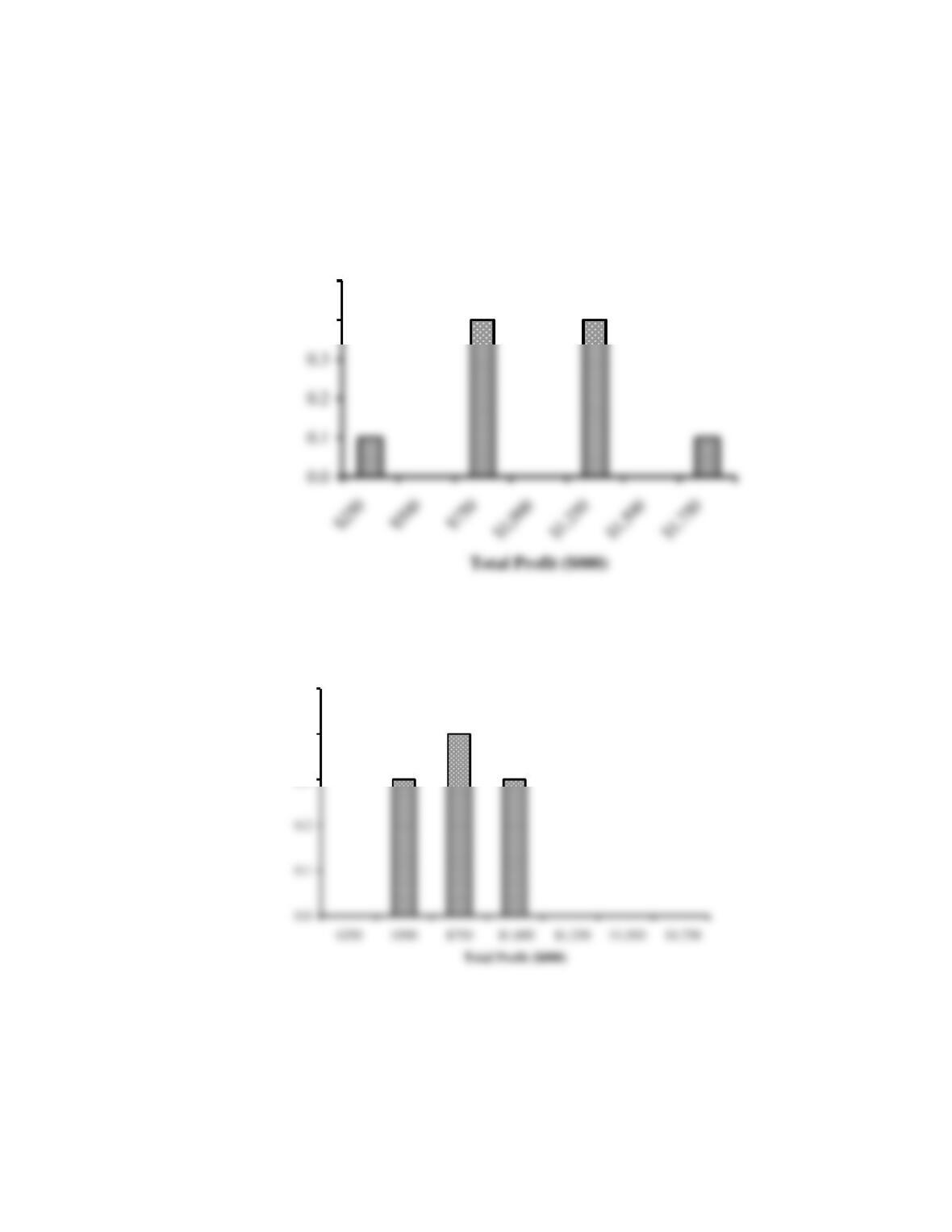
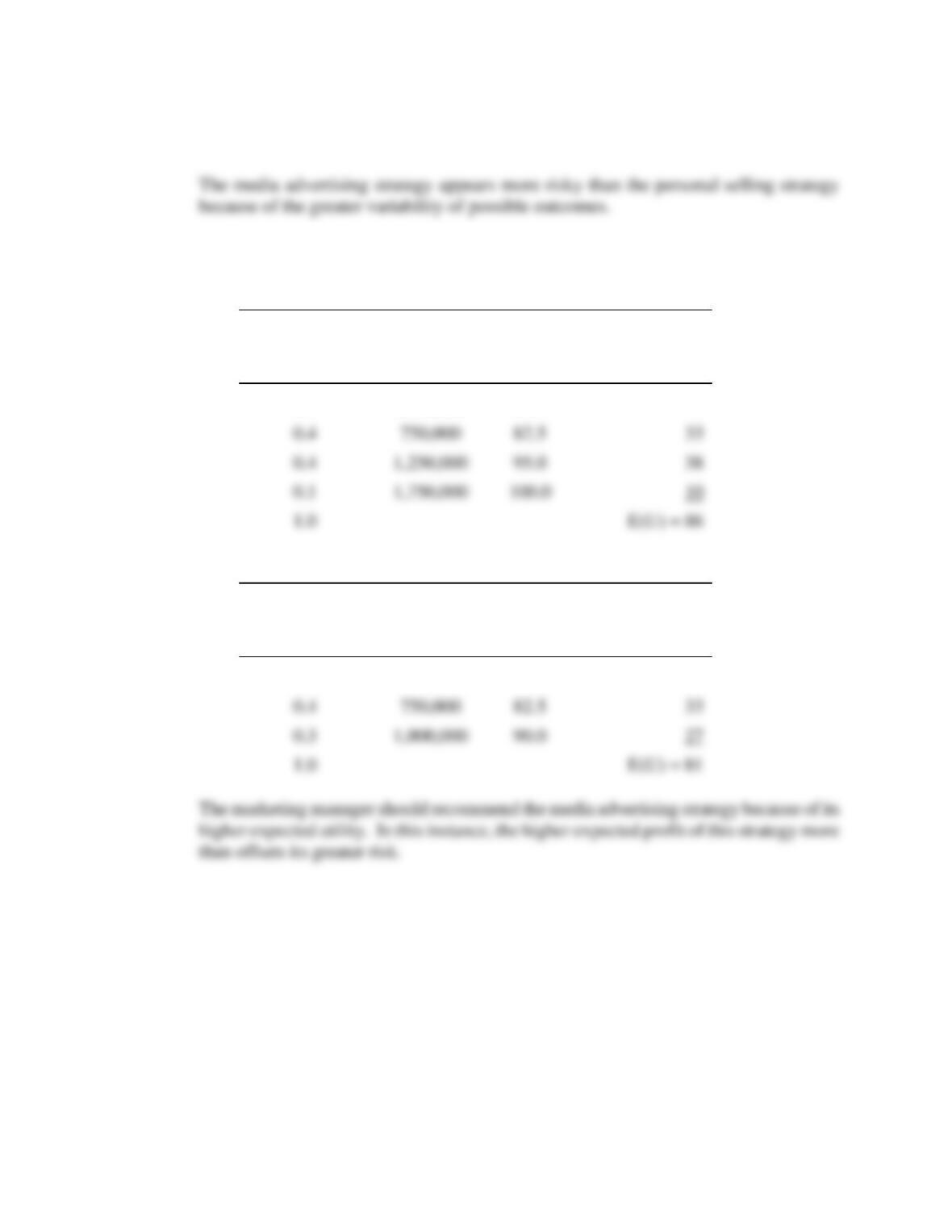
B.
Strategy 1: Media Advertising Strategy
0.4
0.5
Probability
(Pr)
Strategy 2: Personal Selling Strategy
0.3
0.4
0.5
Probability (Pr)
512 Chapter 16
C.
Media Advertising Strategy
Probability
(1)
Profits
(2)
Utils
(3)
(4) = (3) × (1)
0.1
$250,000
50.0
5
Personal Selling Strategy
Probability
(1)
Profits
(2)
Utils
(3)
(4) = (3) × (1)
0.3
$500,000
70.0
21
P16.5 Probability Concepts. Narcissism Records, Inc., has just completed an agreement to re-
release a recording of “The Boss’s Greatest Hits.” The Boss had a number of hits on
the rock and roll charts during the early 1980s. Preliminary market research indicates
two feasible marketing strategies: (1) concentration on developing general consumer
acceptance by advertising on late-night television or (2) concentration on developing
distributor acceptance through intensive sales calls by company representatives.
Estimates for sales under each alternative plan and payoff matrices according to an
assessment of the likelihood of product acceptance under each plan are as follows:
Strategy 1
Strategy 2
Risk Analysis 513
Consumer Television Promotion
Distributor Oriented Promotion
Probability
Outcome (Sales)
Probability
Outcome (Sales)
0.32
$250,000
0.125
$250,000
A. Assuming that the company has a 50 percent profit margin on sales, calculate the
expected profits for each plan.
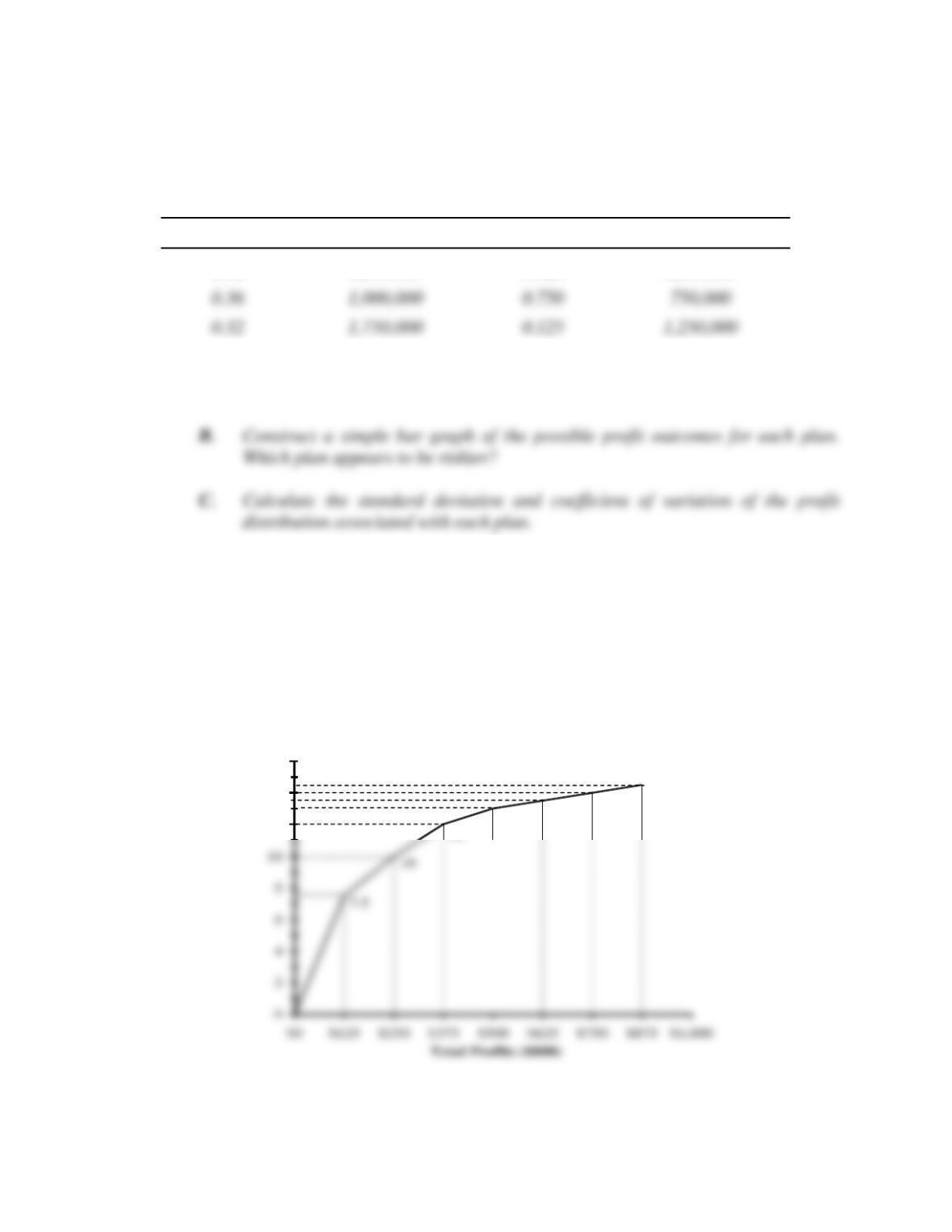
D. Assume that the management of Narcissism has a utility function like the one
illustrated in the following figure. Which marketing strategy is best?
P16.5 SOLUTION
Relation Between Total Utility
and Profit for Narcissism Records, Inc.
7.5
12
13
13.5
14
14.5
12
14
16
Utility of
Profits (Utils)
Total Utility