Chapter 16
Fiscal Policy and the Government Budget
◼ Chapter Outline, Overview, and Teaching Tips
Chapter Outline
The Government Budget
Government Spending
Size of the Government Debt
Growth of U.S. Government Debt Over Time
Policy and Practice: The Entitlements Debate: Social Security and Medicare/Medicaid
International Comparison: The Size of Government Debt
Sovereign Debt Crises
Why Government Debt Is a Burden
Policy and Practice: Tax Smoothing
Fiscal Policy and the Economy in the Short Run
Aggregate Demand and Fiscal Policy
Expenditure and Tax Multipliers
Policy and Practice: The 2009 Debate Over Tax-Based Versus Spending-Based Fiscal Stimulus
Fiscal Multipliers at the Zero Lower Bound
Chapter 16 Fiscal Policy and the Government Budget 175
Budget Deficits and Ricardian Equivalence
Implications of Ricardian Equivalence
Policy and Practice: The Bush Tax Cuts and Ricardian Equivalence
Chapter 16 Web Appendix: Other Measures of the Government Budget Deficit
Chapter Overview and Teaching Tips
In this part of the book, we continue with our discussion of macroeconomic policy: first fiscal policy and
then international economic policy. Chapter 16 focuses on the long-run and short-run effects of fiscal
policy and addresses questions such as: Do budget deficits burden future generations? Are budget deficits
inflationary? Does expansionary fiscal policy create jobs and increase economic activity? Given the huge
federal budget deficits in recent years, students really want to know the answers to these questions.
To get students to understand what government budgets look like, it is worth starting with a discussion of
Table 16.1 in class, which shows the different spending and revenue items in government budgets in the
The chapter then provides analysis of the impact of fiscal policy on the economy in the long run and
discusses the debate over whether government debt is a burden on future generations. The Policy and
Practice case on tax smoothing raises an interesting policy issue for students, that it does not always make
sense to balance the budget as some politicians seem to suggest because it is worth running large budget
deficits temporarily in order to smooth taxes when there are temporary surges in government spending as
during war time.
The chapter next describes the dynamic of sovereign debt crises, which have become a much bigger
problem in the aftermath of the global financial crisis that has weakened government finances throughout
the world. The Policy and Practice case on the European sovereign debt crisis is particularly worth
covering in class because, not only has it been much in the news lately, it illustrates that the United States
Although standard Keynesian analysis suggests that shrinking budget deficits is contractionary, the chapter
indicates that this may not always be true, with the Policy and Practice case, “Two Expansionary Fiscal
Contractions: Denmark and Ireland,” providing two examples where shrinking government budget deficits
176 Mishkin • Macroeconomics: Policy and Practice, Second Edition
may have been expansionary. Another Policy and Practice case, “The Debate Over Fiscal Austerity in
Europe,” can be used to stage a debate in class over whether fiscal austerity is the right answer for Europe.
◼ Answers to End of Chapter Review Questions and Problems
Answers to Review Questions
The Government Budget
1. The four main components of government spending are expenditures to purchase goods and services,
which can be subdivided into government investment spending on capital goods such as highways
and schools and government consumption spending on such things as operating national parks and
2. A government budget deficit means that government spending over some time period is greater than
the revenues government has collected over that period. According to government’s budget constraint,
Size of the Government Debt
3. Heavy government borrowing (deficit spending) during World War II caused the debt–to-GDP ratio
to increase sharply. Rapid real GDP growth and inflation both contributed to the ratio falling just as
Fiscal Policy and the Economy in the Long Run
4. Government debt will not burden the future generations that must repay it if it is used to finance
investments in government and human capital that increase their productivity (and income) and if those
repaying the debt also hold the government bonds (in which case they are simply paying themselves). A
number of counterarguments, however, support a less rosy assessment of the burden of the debt: Budget
Chapter 16 Fiscal Policy and the Government Budget 177
Fiscal Policy and the Economy in the Short Run
5. Government can increase the quantity of aggregate output demanded by increasing government
spending or by cutting taxes. Both changes increase planned spending at any given rate of inflation
and shift the aggregate demand curve to the right. Both also produce a change in equilibrium output
6. An analysis based on aggregate demand generally concludes that a tax cut increases aggregate demand,
shifts the aggregate demand curve to the right, and increases both aggregate output and inflation in
the short run but only inflation in the long run. Supply-side analysis argues that tax cuts that are
7. Not necessarily. Efforts to reduce the budget deficit by reducing government spending or raising taxes
shift the aggregate demand curve to the left but can also lower expected future taxes and motivate
8. Fiscal multipliers are higher when the zero lower bound occurs because expansionary fiscal policy
not only adds to aggregate demand directly but also raises inflation. The higher inflation rate at the
Budget Deficits and Inflation
9. Whether budget deficits lead to inflation in the long run depends on how they are financed. As long
as they are financed by issuing new bonds, they will not be inflationary if the monetary authorities
focus on price stability and can employ contractionary policies to offset the impacts of the budget
178 Mishkin • Macroeconomics: Policy and Practice, Second Edition
Budget Deficits and Ricardian Equivalence
10. The traditional view, based largely on Keynesian economics, holds that tax cuts increase aggregate
demand, result in higher inflation, and reduce national saving, which leads to an increased burden on
future generations resulting from lower private investment spending or lower net exports and greater
indebtedness to foreigners. The Ricardian equivalence view holds that tax cuts have no effect on
Answers to Problems
The Government Budget
1. a. The government deficit is: Deficit = 2.5 + 1 + 0.5 − 3 = $1 trillion.
2. a. A decrease in the number of employed people results (holding Social Security tax rates constant)
in a decrease in contributions for social insurance. This decreases tax revenue and, therefore,
3. There seems to be no definite consensus about the definition of the government deficit. This example
illustrates many possible approaches to labeling expenditures and receipts. If Social Security contributions
were considered a loan to the government, to be repaid later (plus interest) in the form of benefits,
Size of the Government Debt
4. The prevalence of chronic diseases like diabetes increases the cost of health care in the future. Even if
the dependency ratio is considered to remain constant, this will mean either fewer benefits for individuals
in need of health care, or an increase in Social Security taxes, for the deficit to remain unchanged.
Chapter 16 Fiscal Policy and the Government Budget 179
Fiscal Policy and the Economy in the Long Run
5. a. This particular type of spending should be considered government investment because it is aimed
at increasing productivity in the future.
b. If this type of investment is successful in increasing workers’ productivity, we should expect an
6. a. An increase in Treasury note interest rates represents an increase in net interest payments for the
U.S. government and therefore increases the deficit.
b. Although it is not plausible to happen in the near future, there could be some trouble ahead for
Fiscal Policy and the Economy in the Short Run
7. a. According to the estimates of the expenditure and tax multipliers, one should recommend
conducting expansionary fiscal policy by increasing government expenditures, as this will have a
bigger effect on aggregate demand. In this case, government expenditures should be wisely directed
to productive uses, with the potential to improve infrastructure and increase productivity in the
long run.
b. If there is some crowding-out effect, the original increase in government expenditure (or
8. a. The prospect of a government committed to long-run fiscal discipline increases both types of
autonomous expenditure. Usually a commitment to long-run fiscal discipline is one of many
characteristics of a government committed to long-run economic growth. It is quite possible
that such an administration will promote free trade, secure property rights, and encourage
180 Mishkin • Macroeconomics: Policy and Practice, Second Edition
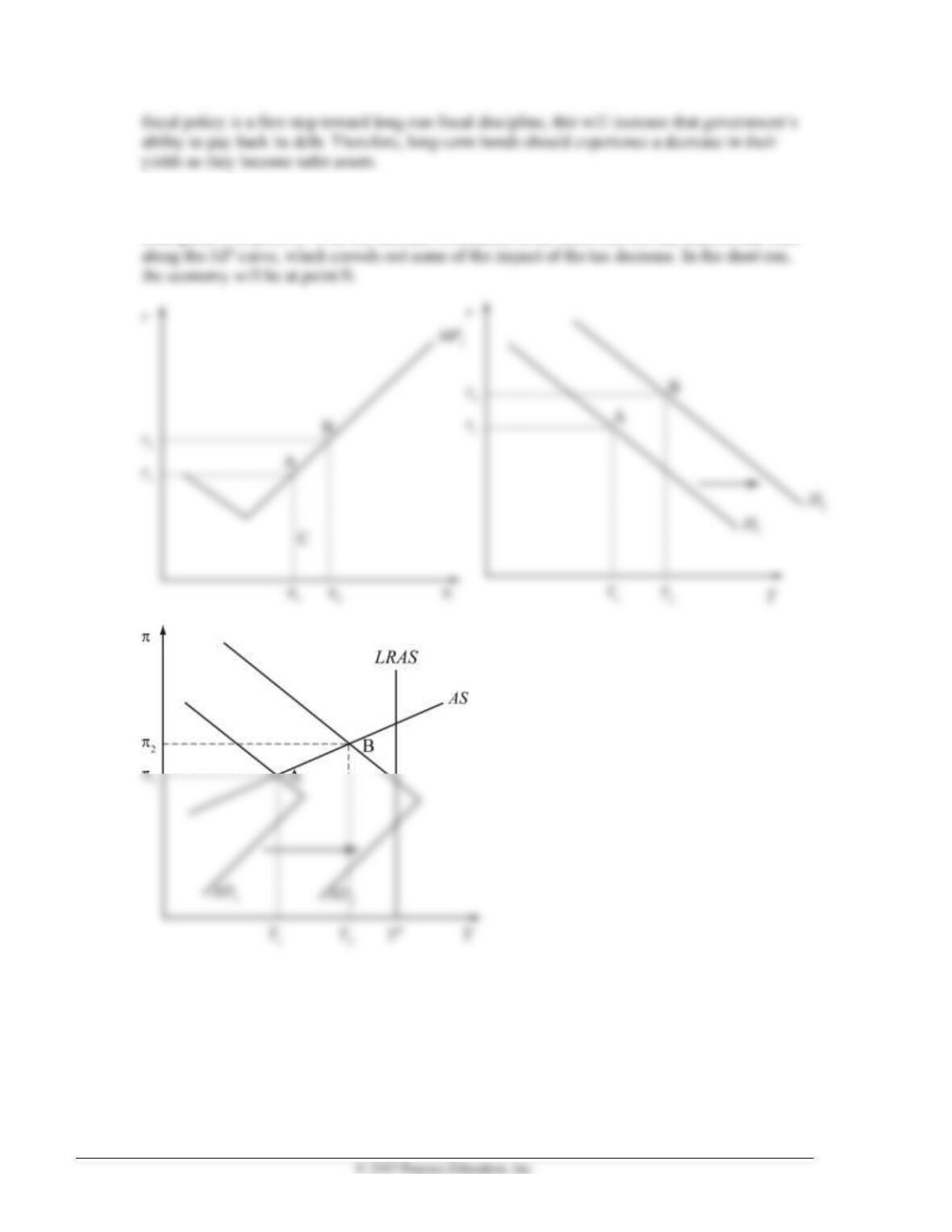
9. a. A decrease in taxes shifts the IS and the AD curves to the right, resulting in an increase in output
and inflation in the short run. As inflation increases, the real interest rate increases along MP1
from point A to point B. With the increase in inflation in the short run, the real interest rate rises
Chapter 16 Fiscal Policy and the Government Budget 181
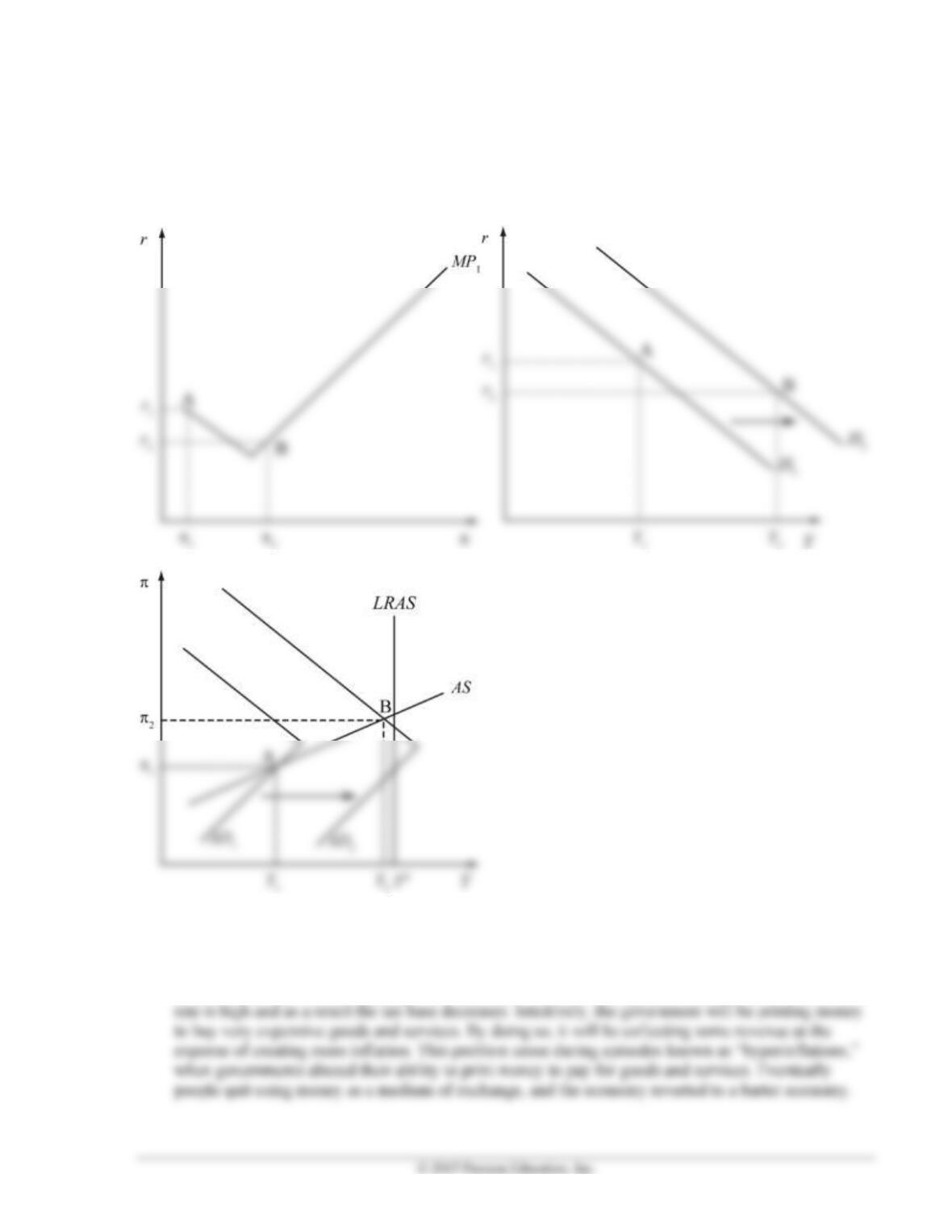
b. A decrease in taxes of equal magnitude shifts the IS and AD curves rightward by the same
amount as in part (a) above. However, if the economy is below the zero lower bound, the
expansionary effect resulting in higher inflation results in a decline in the real interest rate.
Because no crowding out takes place, the impact on investment, and hence output, is larger than
in part (a), indicating a bigger fiscal multiplier under the zero lower bound condition.
Budget Deficits and Inflation
10. If the inflation rate is very high, the tax size (i.e., the inflation rate) will be high, but the tax base (i.e.,
the real money supply) will be really low and decreasing, as the price level keeps increasing. As a
result, the revenue from seignorage will eventually decrease, as happens with any tax when the tax
182 Mishkin • Macroeconomics: Policy and Practice, Second Edition
Budget Deficits and Ricardian Equivalence
11. a. Even if individuals are forward looking and decide to save in advance to pay higher future taxes,
an underdeveloped financial system might not allow them to do so. One of the characteristics of
an underdeveloped financial system is its reduced supply of financial instruments. Usually
◼ Answers to Data Analysis Problems
1. a. For 2013:Q1, debt to GDP was 101.6 percent; in 2012:Q1 it was 97.3 percent, and in 2008:Q1 it
was 64.3 percent. The last time it reached a peak was in 1995:Q2, when it was 65.1 percent; this
is considerably lower than the current value of 101.6 percent.
b. Over the last year, debt to GDP has increased 101.6 percent – 97.3 percent = 4.3 percentage
points; over the last five years, it has increased 101.6 percent – 64.3 percent = 37.3 percentage
Chapter 16 Fiscal Policy and the Government Budget 183
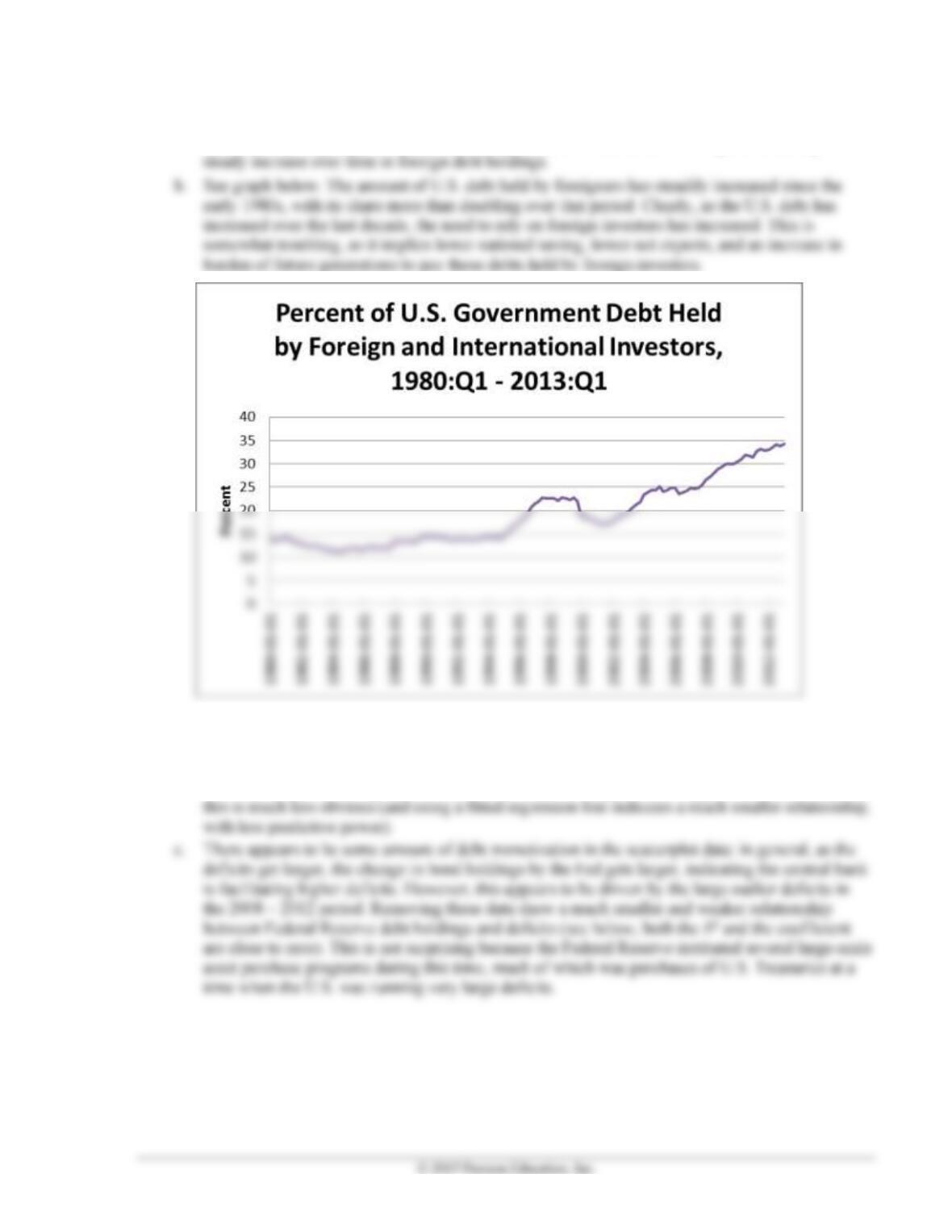
2. a. In 2013:Q1, foreign and international investors held 34.3 percent of all U.S. government debt.
This is a relatively high number and, as seen below, is in fact an all-time high considering the
3. a. See the figure on the next page. Not surprisingly, from 1980 to 2012, there appears to be a very
strong relationship between deficits and the change in bond holdings by the public, as the fitted
line is very steep (and has a high R2 if using a regression line).
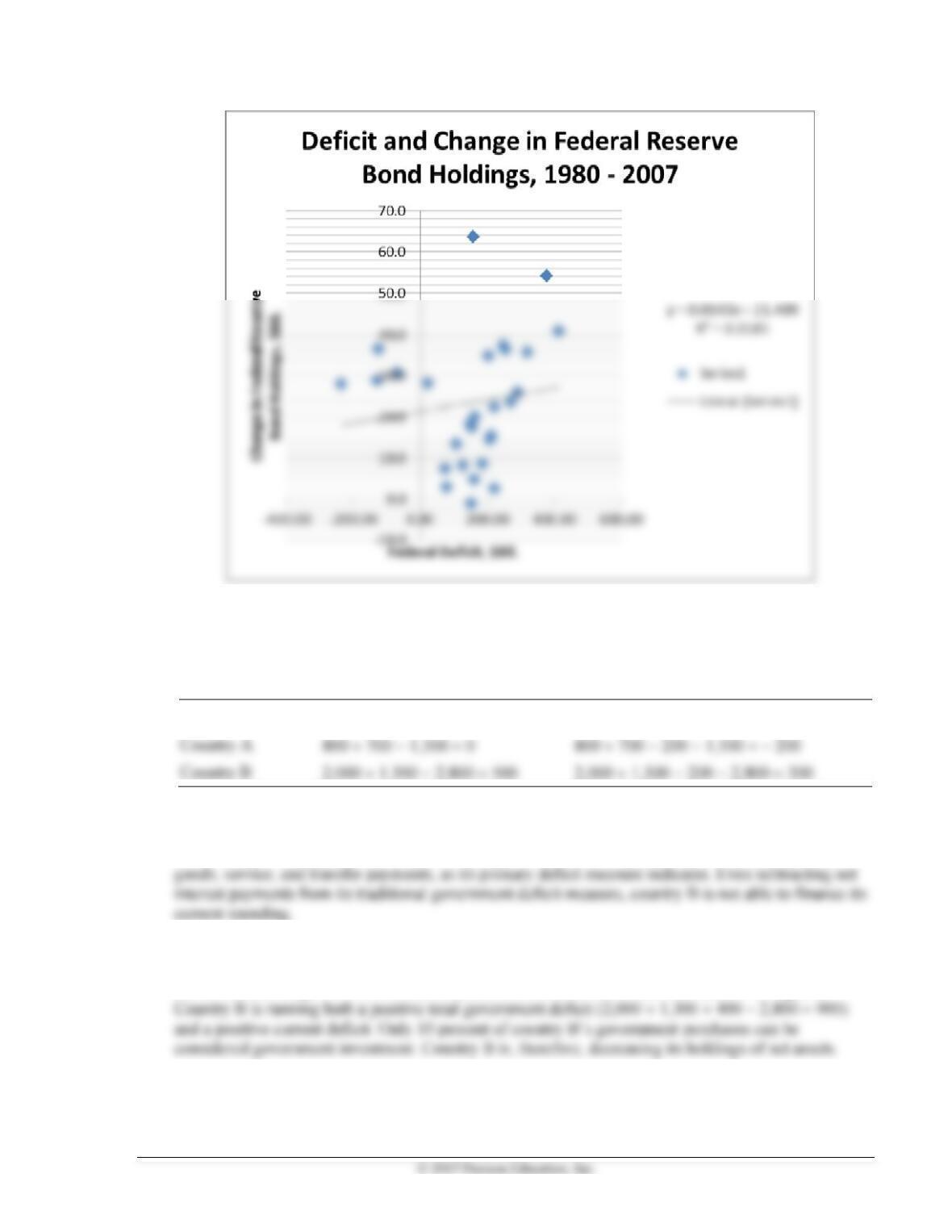
b. For the change in holdings by the Federal Reserve, there appears to be a positive relationship, but
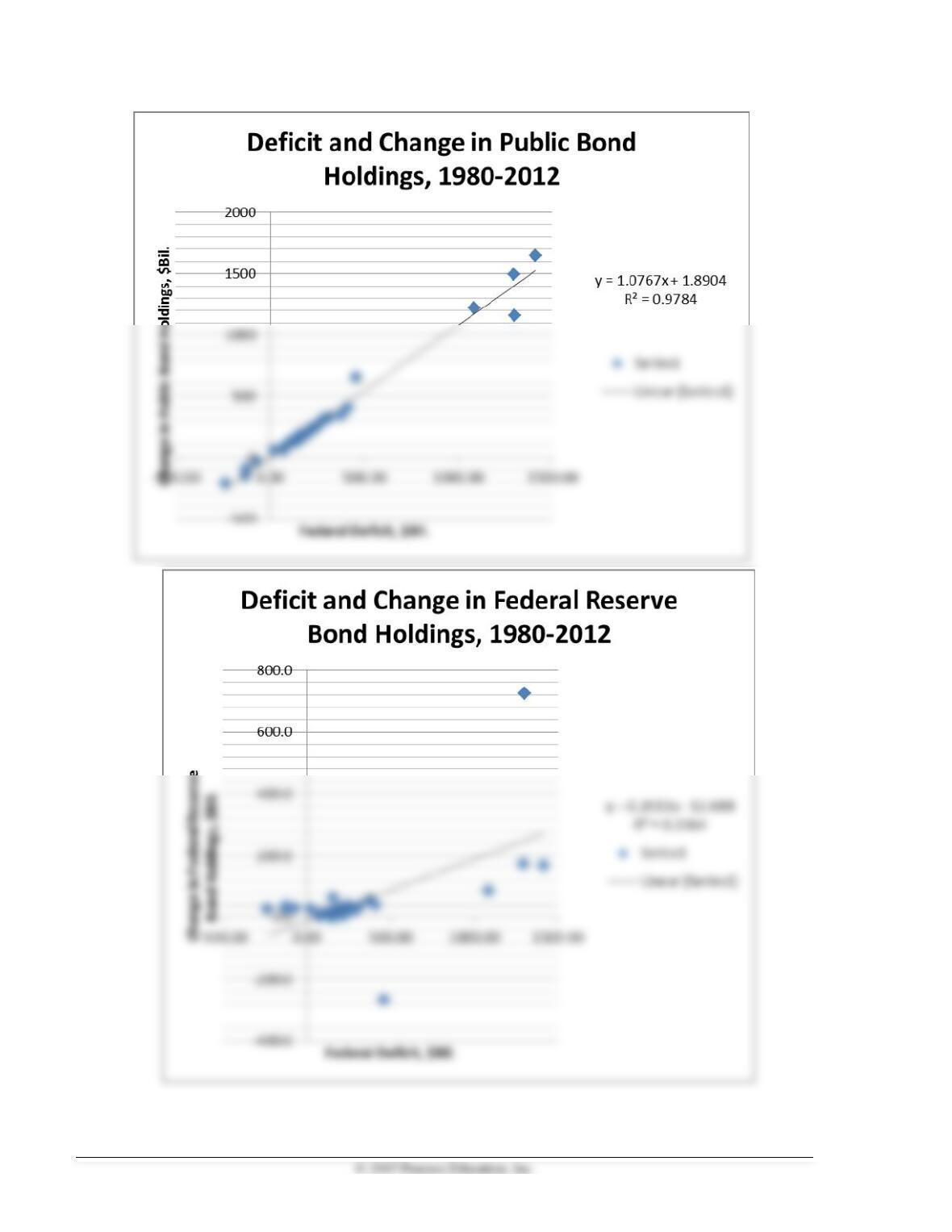
184 Mishkin • Macroeconomics: Policy and Practice, Second Edition
Chapter 16 Fiscal Policy and the Government Budget 185
◼ Answers to Review Questions and Problems in Web Appendix,
“Other Measures of the Government Budget Deficit”
1. a. and b.
Primary Deficit
Current Deficit
2. According to data, country A is able to pay for its current purchases of goods, services, and transfer
payments. Although the traditional measure of government deficit is positive (800 + 700 + 220 − 1,500 =
220), country A’s primary deficit is zero. Country B is not able to pay for its current purchases of
3. According to the current deficit measure, country A is increasing its holdings of net assets (i.e., negative
current deficit). Although country A is running a total government deficit, 25 percent of its purchases
can be considered government investment, and therefore, its current deficit measure is negative.
4. The inflation-adjusted deficit for country A is: $100 billion = 0 (primary deficit) + 0.02 5,000.
Accounting for the real value of net interest payments, the government of country A has a $100
186 Mishkin • Macroeconomics: Policy and Practice, Second Edition
◼ Data Sources, Related Articles, and Discussion Questions
A. For Information About Policy and Practice: The Entitlements Debate: Social
Security and Medicare/Medicaid
Data Source
Congressional Budget Office: Social Security Disability Insurance: Participation Trends and Their Fiscal
the Congressional Budget Office about the impact of social security disability insurance.
Related Article
U.S. Census Bureau, “Aging Boomers Will Increase Dependency Ratio, Census Bureau Projects”:
Discussion Question
Considering that the “baby boom” phenomenon also happened in Europe, how do you think the burden of
social security programs will affect the government deficits of European countries in the future?
Answer: As the “baby boom” generation ages and retires, social security programs will increase the pressure
on European countries’ government transfers. In an effort to reduce future government transfers, the French
B. For Information About Policy and Practice: The European Sovereign Debt
Crisis
Data Source
Federal Reserve Bank of St. Louis database (FRED):
Related Article
European Central Bank, “Speech by Mario Draghi, President of the European Central Bank at the Global
Discussion Question
Why do you think that the sovereign debt crisis spread to countries like Ireland, Spain, and Italy but not to
others?
Answer: When rumors about Greece’s ability to honor its debt increased, individuals started to closely
monitor other countries’ debt–to-GDP ratios to assess their ability to honor their debts. Although the debt-
Chapter 16 Fiscal Policy and the Government Budget 187
that had smaller debt-to-GDP ratios.
C. For Information About Policy and Practice: Tax Smoothing
Data Source
Federal Reserve Bank of St. Louis database (FRED):
Related Article
Ferguson, Nial, “Reasons to Worry” (June 11, 2006):
Discussion Question
Considering current and future generations, which is the relevant tradeoff to consider when a government
engages in tax smoothing? Do you think it is ethical to impose a burden on future generations (considering
they cannot vote and therefore agree to them)?
Answer: The relevant tradeoff is between increasing expenditures today and pay for current expenditures,
D. For Information About Policy and Practice: The 2009 Debate Over Tax-
Based Versus Spending-Based Fiscal Stimulus
Data Source
Congressional Budget Office, “Estimated Impact of the American Recovery and Reinvestment Act on
Employment and Economic Output From July 2010 Through September 2010”:
expenditure multipliers in page 14 of the PDF version.
Related Article
Leduc, Sylvain, “Fighting Downturns with Fiscal Policy”:
Discussion Question
Why is the debate about a stimulus package based on the size of tax and expenditure multipliers?
Answer: Usually statistical offices and independent researchers try to estimate the magnitude of tax cuts
188 Mishkin • Macroeconomics: Policy and Practice, Second Edition
E. For Information About Policy and Practice: Two Expansionary Fiscal
Contractions: Denmark and Ireland
Data Source
Related Article
Bergman, U. Michael and Michael M. Hutchison, “Expansionary Fiscal Contractions: Re-Evaluating the
Discussion Question
In the aftermath of the “lost decade” (the 1980s), many Latin American countries engaged in fiscal
contractions. According to the text, which would be the expected consequences of such programs?
Answer: After these programs were enacted, one would expect government deficits to decrease and remain
F. For Information About Policy and Practice: The Debate Over Fiscal
Austerity in Europe
Data Source
Organization for Economic Co-operation and Development, “Responding to the crisis: What are
OECD countries doing to strengthen their public finances?”:
Related Article
debt-crisis-fast-facts/. This Webpage shows in detail the most important events related to the
European debt crisis. Note the events between December 2009 and March 2010, when major protests
arose in response to austerity measures.
Discussion Question
The implementation of austerity plans in many European countries implied that government funding
for research was drastically reduced. What do you think will be the long-term effect of such policies
on economic growth?
Answer: The drastic drop in research programs funding meant that many scholars decided to move to other
countries where they could continue their research. It also meant that the pace of technological
Chapter 16 Fiscal Policy and the Government Budget 189
G. For Information About Policy and Practice: The Bush Tax Cuts and
Ricardian Equivalence
Data Source
Related Article
Discussion Question
Suppose that a fifty-year-old couple cares a lot about their two children. They also consider the possibility
that they will not be able to maintain their current lifestyle when they retire (probably due to cuts in Social
Security benefits). Which are the implications of these two elements for the Ricardian equivalence result
(e.g., how will this household respond to a tax cut)?
Answer: These two considerations have opposing effects on the decision of this couple as to how to