CHAPTER 16
MACRO POLICY DEBATE: ACTIVE OR PASSIVE?
In this chapter, you will find:
Learning Outcomes
Chapter Outline with PowerPoint Script
Chapter Summary
Teaching Points (as on Prep Card)
Solutions to Problems Appendix
Experiential Assignments
INTRODUCTION
This chapter reduces the policy issues of macroeconomics to a single question: Is the economy inherently
stable and self-correcting, or is it unstable and unable to right itself when thrown off course? Proponents of
LEARNING OUTCOMES
16-1 Outline the difference between active policy and passive policy, and explain how the two ap-
proaches differ in their assumptions about how well the economy works on its own.
Advocates of active policy view the private sector— particularly fluctuations in investment—as the
primary source of economic instability in the economy. Activists argue that achieving potential output
16-2 Describe how expectations can influence the effectiveness of discretionary policy.
The effect of particular government policies on the economy depends on what people come to expect.
16-3 Summarize why some economists prefer that policy be shaped by predictable rules rather than
by the discretion of policy makers.
The active approach views the economy as unstable and in need of discretionary policy to eliminate
Chapter 17 Macro Policy Debate: Active or Passive? 234
16-4 Explain the shape of the short-run Phillips curve and the long-run Phillips curve.
At one time, public officials thought they faced a stable trade-off between higher unemployment and
higher inflation. More recent research suggests that if there is a trade-off, it exists only in the short
CHAPTER OUTLINE WITH POWERPOINT SCRIPT
USE POWERPOINT SLIDE 2 FOR THE FOLLOWING SECTION
Active Policy Versus Passive Policy
• Active approach: Discretionary fiscal or monetary policy can reduce the costs of an unstable
USE POWERPOINT SLIDES 3-5 FOR THE FOLLOWING SECTION
Closing a Recessionary Gap: Short-run equilibrium is below potential output.
• Passive approach: Assumes that the economy is inherently stable.
• High unemployment causes:
– Wages to fall
• Active approach: Monetary policy, fiscal policy, or a mix can be used to:
– Increase aggregate demand.
USE POWERPOINT SLIDES 6-8 FOR THE FOLLOWING SECTION
Closing an Expansionary Gap: Short–run equilibrium output exceeds the economy’s potential. The actual
price level exceeds the expected price level.
• Passive approach: Assumes that natural market forces:
– Prompt firms and workers to negotiate higher wages
USE POWERPOINT SLIDE 9 FOR THE FOLLOWING SECTION
Problems with Active Policy:
Chapter 17 Macro Policy Debate: Active or Passive? 235
• Difficult to identify the economy’s potential output level and the natural rate of unemployment.
USE POWERPOINT SLIDES 10-11 FOR THE FOLLOWING SECTION
The Problem of Lags: Lags occur because of the time required to implement policy. Passive policy
advocates view these lags as a reason to avoid discretionary policy.
• Recognition lag: The length of time it takes to identify a problem
• Decision-making lag: The length of time required to decide what to do
USE POWERPOINT SLIDES 12-15 FOR THE FOLLOWING SECTION
The Role of Expectations
• The effectiveness of a particular governmental policy depends in part on what people expect.
• Rational expectations: People form expectations on the basis of all available information.
Monetary Policy and Inflation Expectations
USE POWERPOINT SLIDES 16-19 FOR THE FOLLOWING SECTION
Anticipating Monetary Policy
• When workers fully expect expansionary monetary policy and inflation, such a policy has no effect on
Policy Credibility: Necessary if the Fed is to pursue a policy consistent with a constant price level.
USE POWERPOINT SLIDES 20-22 FOR THE FOLLOWING SECTION
Policy Rules Versus Discretion
The passive approach argues for rules to guide actions of policy makers, for example, allowing the money
supply to grow at a predetermined rate.
Chapter 17 Macro Policy Debate: Active or Passive? 236
USE POWERPOINT SLIDES 23-34 FOR THE FOLLOWING SECTION
The Phillips Curve: Shows possible combinations of the inflation rate and the unemployment rate.
The Phillips Framework: Dilemma of 1970s led to reexamination of the Phillips curve.
• The Short-Run Phillips Curve: Assumes a given expected inflation rate; exhibits an inverse
CHAPTER SUMMARY
Advocates of active policy view the private sector—particularly fluctuations in investment—as the
primary source of economic instability in the economy. Activists argue that achieving potential output
through natural market forces can be slow and painful, so the Fed or Congress should stimulate aggregate
demand when actual output falls below potential.
The passive approach suggests that the government should follow clear and predictable policies and avoid
discretionary intervention to stimulate or dampen aggregate demand over the business cycle. Passive
policies are reflected in automatic fiscal stabilizers and in explicit monetary rules, such as keeping
inflation below a certain rate.
TEACHING POINTS
1. Because this chapter examines the state of debate in macroeconomics today, it has the potential for
leaving students wondering why the course went through all this material when no clear consensus
exists as to whether such policies can work or should even be tried. Therefore, it is vital to stress at
the outset the fact that economics is a social rather than a natural science.
Chapter 17 Macro Policy Debate: Active or Passive? 237
2. A basic problem underlying the active–passive debate concerns the question of whether the lags in
implementing discretionary policy are shorter than the natural adjustment period of aggregate supply.
3. The latter part of this chapter considers the issue of the Phillips curve. Carefully examine Exhibit 6
in this chapter of the text before developing your lecture on this subject. However, that diagram does
not treat the dynamic nature of the adjustment process. You may want to begin the discussion by go-
4. If inflationary expectations develop, self-correction speeds up. With the aggregate supply curve
shifting more rapidly, output will return to potential GDP unless aggregate demand is shifted more
rapidly. The Phillips curve shifts upward, and the result is that lower unemployment requires an ever-
5. Rational expectations have become an important feature of modern macroeconomics. This chapter
explores the basic concept of rational expectations and shows its relevance to the question of policy
SOLUTIONS TO PROBLEMS APPENDIX
1. (Active Versus Passive Policy) Discuss the role each of the following plays in the debate
between the active and passive approaches:
Chapter 17 Macro Policy Debate: Active or Passive? 238
a. The speed of adjustment of the nominal wage
b. The speed of adjustment of expectations about inflation
c. The existence of lags in policy creation and implementation
d. Variability in the natural rate of unemployment over time
This question addresses the effectiveness of discretionary policy. Recall that the issue largely
comes down to the speed of self-correction forces, the speed (and accuracy) of expectations
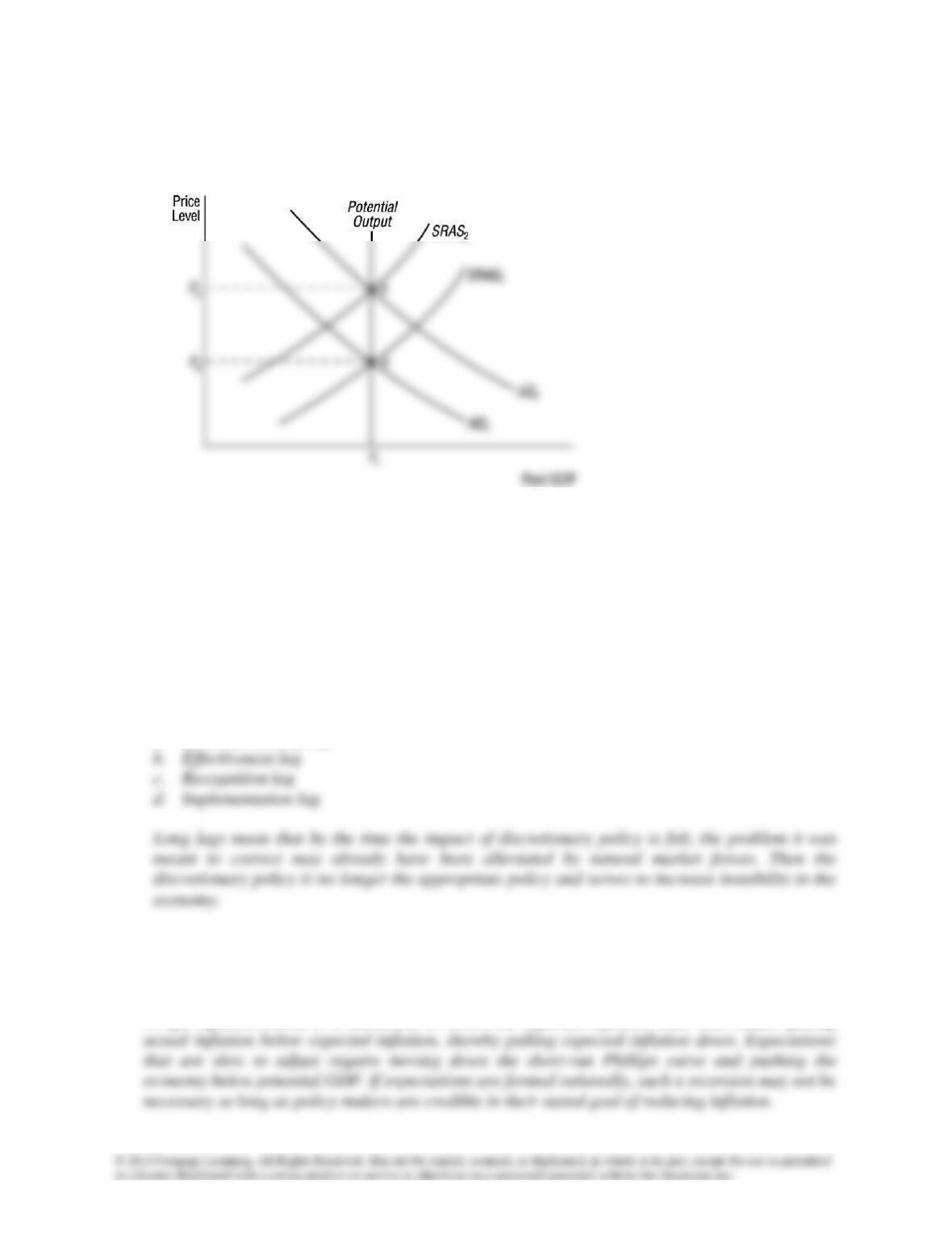
2. (Problems with Active Policy) Use an AD-AS diagram to illustrate and explain the short-run and
long-run effects on the economy of the following situation: Both the natural rate of
unemployment and the actual rate of unemployment are 5 percent. However, the government
believes that the natural rate of unemployment is 6 percent and that the economy is overheating.
Therefore, it introduces a policy to reduce aggregate demand.
Suppose that the economy is initially producing real GDP level Ya with price level Pa. The
government policy reduces aggregate demand from AD to AD*. In the short run, the economy
Chapter 17 Macro Policy Debate: Active or Passive? 239
3. (Rational Expectations) Using an AD–AS diagram, illustrate the short-run effects on prices, out-
put, and employment of an increase in the money supply that is correctly anticipated by the pub-
lic. Assume that the economy is initially at potential output.
4. (Policy Lags) What lag in discretionary policy is described in each of the following statements?
Why do long lags make discretionary policy less effective?
a. The time from when the government determines that the economy is in recession until a tax
cut is approved to reduce unemployment
b. The time from when the money supply is increased until the resulting effect on the economy
is felt
c. The time from the start of a recession until the government identifies the existence and
severity of the recession
d. The time from when the Fed decides to reduce the money supply until the money supply
actually declines
a. Decision-making lag
5. (Long-Run Phillips Curve) Suppose the economy is at point d on the long-run Phillips curve
shown in Exhibit 6. If that inflation rate is unacceptably high, how can policy makers get the in-
flation rate down? Would rational expectations help or hinder their efforts?
To get inflation down, it is necessary to lower the expected inflation rate. This means getting
Chapter 17 Macro Policy Debate: Active or Passive? 240
Experiential Assignment
1. The Federal Reserve Bank of Minneapolis’s The Region, at
prominent U.S. policy makers. Ask students to choose a Fed governor or a regional Reserve Bank
president and try to determine whether that person leans more toward an active or a passive policy
view. What specific policy views does that person advocate?
2. The Bank for International Settlements maintains a list of links to central banks around the world at
3. A good source for the latest information regarding macroeconomic policy is the “Economy” col-