interactive activity
Chapter 16
Inflation, Disinflation,
and Deflation
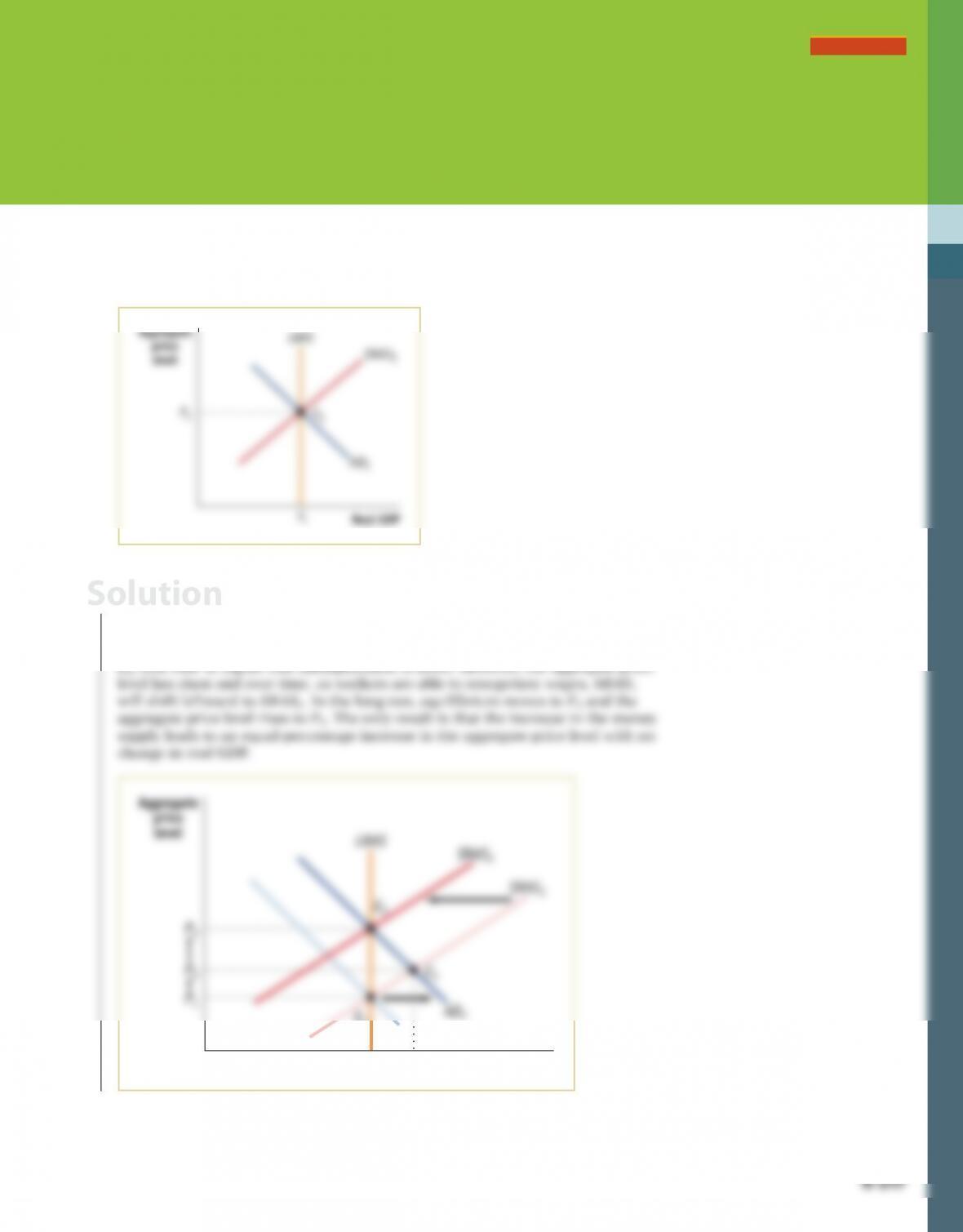
1. In the economy of Scottopia, policy makers want to lower the unemployment
rate and raise real GDP by using monetary policy. Using the accompanying
diagram, show why this policy will ultimately result in a higher aggregate price
level but no change in real GDP.
Real GDP
Aggregate
price
level
Y1
LRAS
SRAS1
P1
AD1
E1
1. In the accompanying diagram, the economy of Scottopia is in long-run macro–
economic equilibrium at E1. If policy makers want to lower the unemployment
rate and raise real GDP, they will engage in expansionary monetary policy,
which will shift AD1 rightward to AD2. In the short run, equilibrium moves to
E2; real GDP is higher and unemployment is lower. However, the aggregate price
Y2
Y1Real GDP
P3
Aggregate
price
level
E3
E1
AD1
SRAS2
SRAS1
LRAS
Solution
S-218 Chapter 16 InflatIon, DIsInflatIon, anD DeflatIon
2. In the following examples, would the classical model of the price level be a use–
ful model for analyzing how the economy behaves?
2. a. The classical model of the price level would not work well in analyzing an
economy with high unemployment and no history of inflation. Increases
in aggregate output can occur without an immediate change in the aggre–
gate price level because it takes some time for workers and firms to react to
3. Access the Discovering Data exercise for Chapter 16 online to answer
the following questions.
a. How much did the monetary base change in the last year?
b. How did the change in the monetary base help in the government’s efforts to
finance its deficit?
c. Why is it important for the central bank to be independent of government
policy makers?
3. Answers to this Discovering Data exercise can be found online.
4. Answer the following questions about the (real) inflation tax, assuming that the
price level starts at 1.
a. Maria Moneybags keeps $1,000 in her sock drawer for a year. Over the year, the
inflation rate is 10%. What is the real inflation tax paid by Maria for this year?
b. Maria continues to keep the $1,000 in her drawer for a second year. What is
the real value of this $1,000 at the beginning of the second year? Over the year,
the inflation rate is again 10%. What is the real inflation tax paid by Maria
for the second year?
c. For a third year, Maria keeps the $1,000 in the drawer. What is the real value of
this $1,000 at the beginning of the third year? Over the year, the inflation rate is
again 10%. What is the real inflation tax paid by Maria for the third year?
d. After three years, what is the cumulative real inflation tax paid?
e. Redo parts a through d with an inflation rate of 25%. Why is high inflation
such a problem?
Solution
Solution
4. a. The real inflation tax paid is $1,000 × 0.10 = $100.
b. The price level at the end of the first year will be 1 × 1.10 = 1.10. The real value
of $1,000 at the beginning of the second year is $1,000/1.10 = $909.09. So the
real inflation tax paid for the second year is $909.09 × 0.10 = $90.91.
d. The cumulative real inflation tax paid for the three years is $100 + $90.91 +
$82.65 = $273.56.
e. If the inflation rate is 25% and the aggregate price level equals 1 in year 1, the
real inflation tax paid for the first year is $1,000 × 0.25 = $250. At the begin-
ning of the second year, the real value of $1,000 is $1,000/1.25 = $800. For the
5. The inflation tax is often used as a significant source of revenue in developing
a. Use the numbers in the accompanying table to calculate the inflation tax in
the United States and India (Rp = rupees).
Inflation
in 2015
Money supply
in 2015
(billions)
Central government
receipts in 2015
(billions)
Data from: Bureau of Economic Analysis; Controller General of Accounts
(India); Reserve Bank of India; International Monetary Fund; The World Bank.
b. How large is the inflation tax for the two countries when calculated as a per-
centage of government receipts?
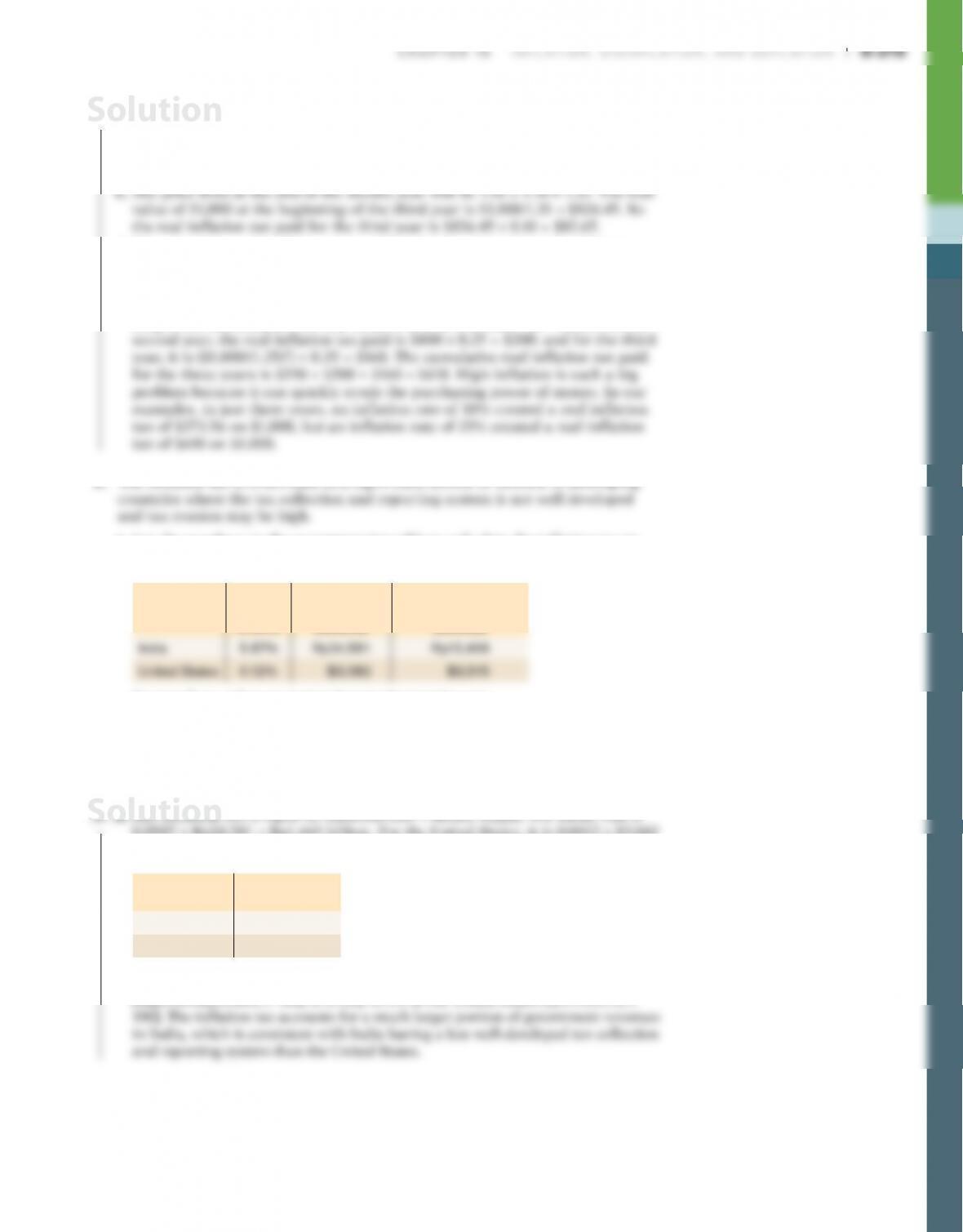
5. a. The inflation tax is equal to: Inflation rate × Money supply. For India, this is
0.0587 × Rp24,581 = Rp1,443 billion. For the United States, it is 0.0012 × $3,082
billion = $3.7 billion, as shown in the accompanying table.
Inflation tax
(billions)
India Rp1,443
United States $3.7
b. The inflation tax as a percentage of government receipts is 11.6% in India
[(Rp1,443/Rp12,409) × 100]. It is only 0.11% in the United States [($3.7/$3,515) ×
Solution
Solution
6. Concerned about the crowding-out effects of government borrowing on private
investment spending, a candidate for president argues that the United States
should just print money to cover the government’s budget deficit. What are the
advantages and disadvantages of such a plan?
6. The main advantage to printing money to cover the deficit is to avoid the
crowding-out effect—the reduction in private investment spending that occurs
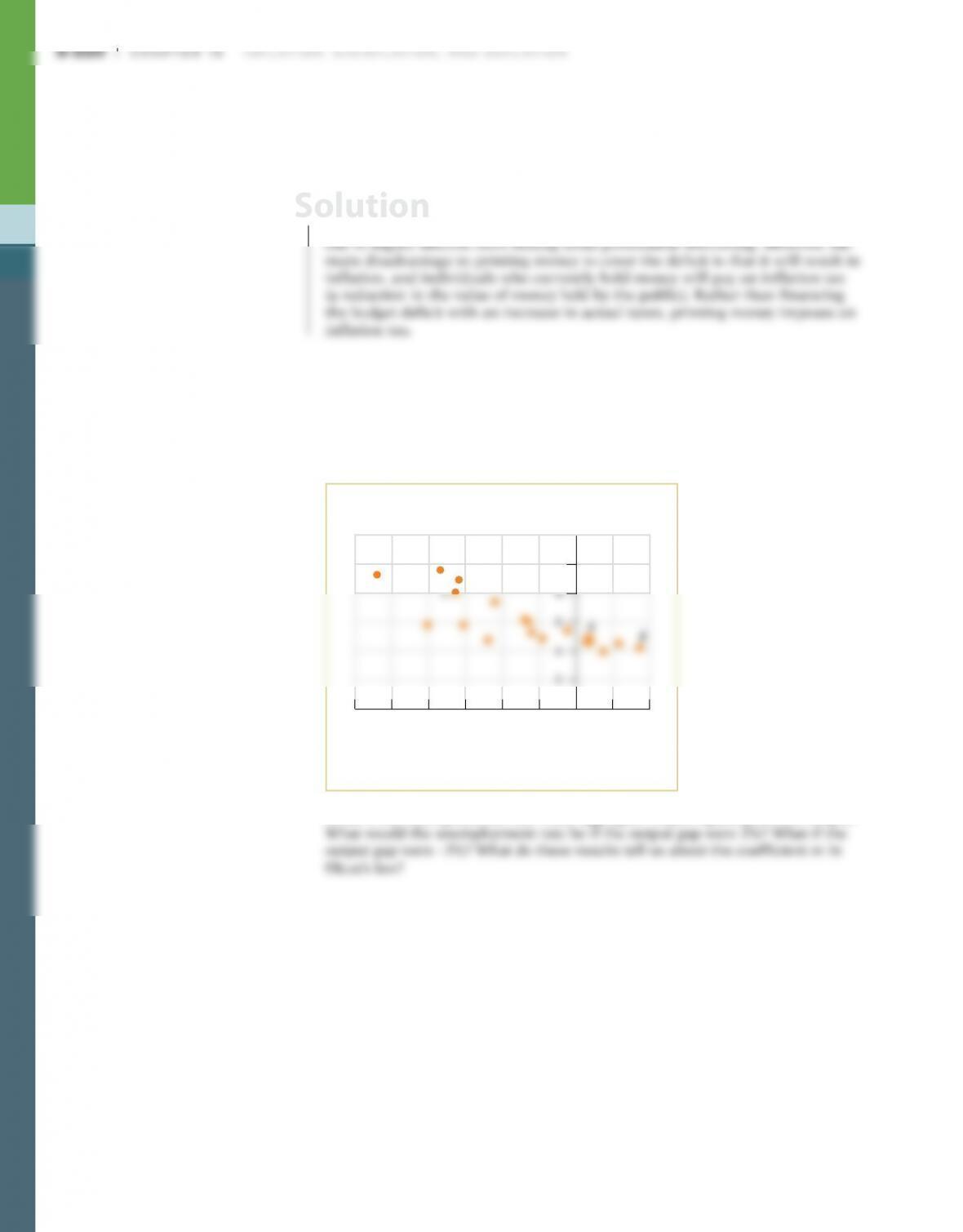
7. The accompanying scatter diagram shows the relationship between the unem-
ployment rate and the output gap in the United States from 1996 to 2016. Draw a
straight line through the scatter of dots in the figure. Assume that this line rep–
resents Okun’s law:
Unemployment rate = b − (m × Output gap)
where b is the vertical intercept and −m is the slope
–6
02%
Output gap
Unemployment
rate
2
4
6
8
10%
–4 –2
–5 –3 –1 1
Data from: Federal Reserve Bank of St. Louis.
B
A
C
What is the unemployment rate when aggregate output equals potential output?
Solution
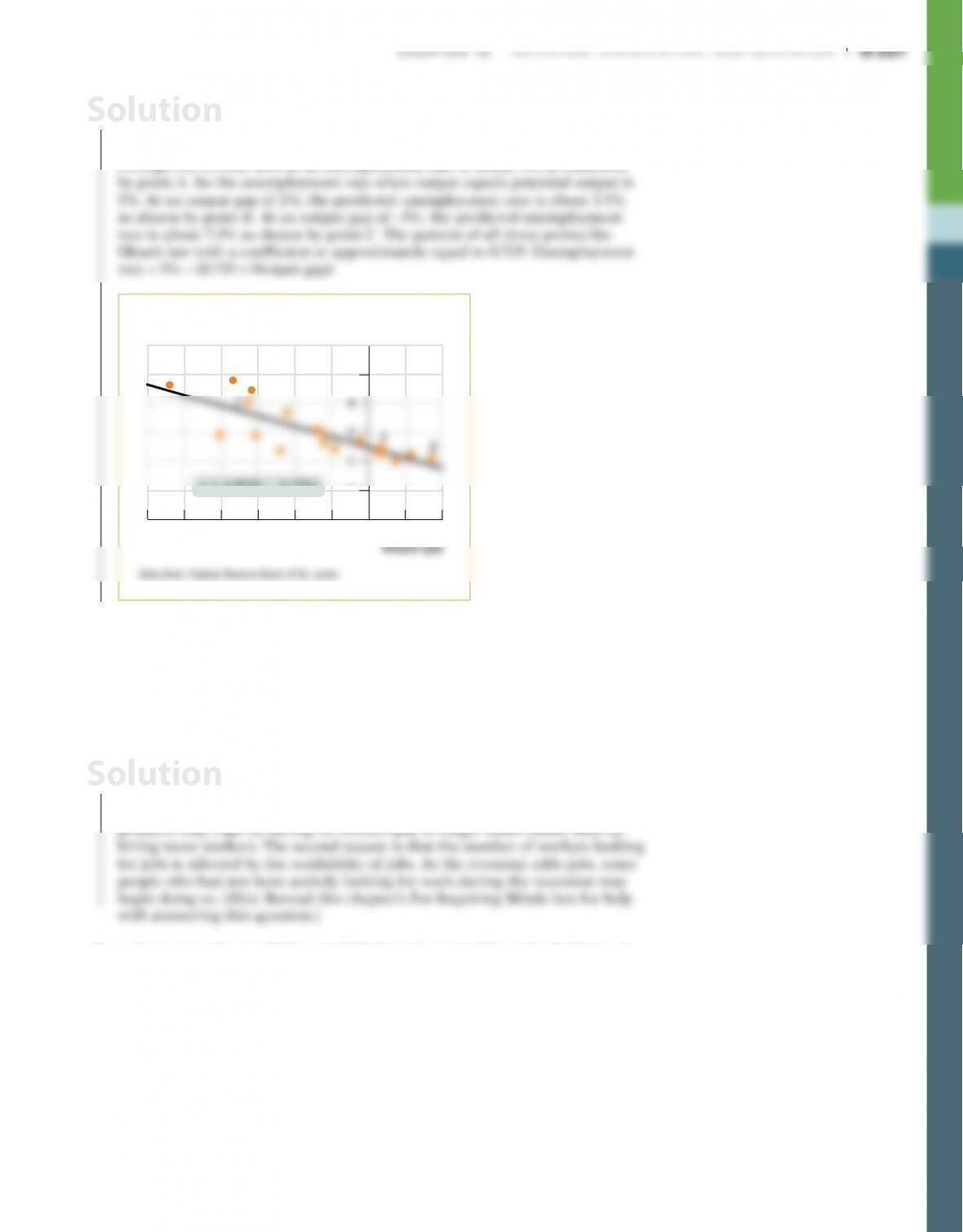
7. The accompanying figure shows a line drawn through the dots relating the
unemployment rate and the output gap for the United States from 1996 to 2016.
Your line may be slightly different from the one drawn here. The line passes
through the vertical axis at an unemployment rate of about 5%, as indicated
–6 02%
Unemployment
rate
2
4
6
8
10%
–4 –2
–5 –3 –1 1
Data from: Federal Reserve Bank of St. Louis.
B
A
C
y 5 4.9536 2 0.725x
8. After experiencing a recession for the past two years, the residents of Albernia
were looking forward to a decrease in the unemployment rate. Yet after six
months of strong positive economic growth, the unemployment rate has fallen
only slightly below what it was at the end of the recession. How can you explain
why the unemployment rate did not fall as much although the economy was
experiencing strong economic growth?
8. There are two primary reasons why Albernia is experiencing a jobless recovery,
a recovery in which the unemployment rate falls only slowly, if at all. The first
reason is that a company that experiences a sudden increase in demand for its
9. a. Go to www.bls.gov. Click on link “Subjects”; on the left, under “Inflation &
Prices,” click on the link “Consumer Price Index,” then “CPI Tables,” and then
“Archived CPI Detailed Report Tables.” Download the zip file for 2009 and
open file cpid09av.pdf. What is the value of the percent change in the CPI from
2008 to 2009?
Solution
Solution
S-222 Chapter 16 InflatIon, DIsInflatIon, anD DeflatIon
b. Now go to www.treasury.gov and click on “Resource Center.” From there, click
on “Data and Charts Center.” Under the heading “Interest Rates,” select “Daily
Treasury Bill Rates” and select “2009” under “Select Time Period.” Examine
the data in “4 Weeks Bank Discount.” What is the maximum? The minimum?
c. How would you characterize the change in the U.S. economy from 2007 to 2009?
What were the implications for the effectiveness of monetary policy?
2009. Given that the rates in 2007 were well above zero, one should expect that
the 2007 inflation rate was also above zero. Indeed, it was, at 2.8%.
10. The economy of Brittania has been suffering from high inflation with an unem-
ployment rate equal to its natural rate. Policy makers would like to disinflate the
economy with the lowest economic cost possible. Assume that the state of the
economy is not the result of a negative supply shock. How can they try to mini-
mize the unemployment cost of disinflation? Is it possible for there to be no cost
of disinflation?
10. A major obstacle to achieving disinflation is that the public has come to expect
continuing inflation. To reduce inflation, it is often necessary to keep the unem-
ployment rate above the natural rate for an extended period of time so that the
public can adjust its expectations to a lower inflation rate. The harder it is to
change the public’s expectations, the higher the unemployment cost associated
with disinflation. To minimize the cost of disinflation, the public must believe
Solution
Solution
Solution
11. Who are the winners and losers when a mortgage company lends $100,000 to
the Miller family to buy a house worth $105,000 and during the first year prices
unexpectedly fall by 10%? What would you expect to happen if the deflation con-
tinued over the next few years? How would continuing deflation affect borrowers
and lenders throughout the economy as a whole?
11. Over the first year, as prices fall 10%, the value of the Millers’ house will fall from
$105,000 to $94,500. Since they borrowed $100,000 to buy it, the value of the house
is now less than the amount they owe. If they sold the house, they would not be
able to pay off their mortgage. The Millers are worse off. The mortgage company
is better off because as the Millers pay off their mortgage, the mortgage company
will be able to lend to more potential homeowners. As the deflation continues, it
will become harder and harder for the Millers to pay off their mortgage. Assum–
ing wages are falling with deflation, the Millers will have to work more hours to
WORK IT OUT Interactive step-by-step help with solving this
problem can be found online.
12. Due to historical differences, countries often differ in how quickly a change
in actual inflation is incorporated into a change in expected inflation. In a
country such as Japan, which has had very little inflation in recent memory,
it will take longer for a change in the actual inflation rate to be reflected
12. Countries such as Japan will find that they can sustain an unemployment rate
lower than the NAIRU for longer periods of time before the expected rate of
inflation increases than can countries such as Zimbabwe. So Japanese mon-
etary and fiscal policy will be more effective than Zimbabwean monetary and
fiscal policy in reducing unemployment below the NAIRU. However, given a
sufficiently long period of higher-than-expected inflation, the Japanese people