Study Prob lems
1. The princi ple of diminishing marginal utility
suggests that the consumer will get a lower mar–
ginal utility from the second pizza than from the
first. It follows that the consumer wouldn’t be
consumed. Therefore, in equilibrium,
x
4
=30
6
=5x=20
The consumer would have to get 20 utils of utility
from the last pound of trail mix in order to be in
equilibrium.
3.
Total Marginal Total Marginal
Number Utility Utility Number Utility Utility
of of of of of of
Cookies Cookies Cookies Pretzels Pretzels Pretzels
0 .0 .25 .0 .0 .10
1 .25 .15 .1 .10 .8
decide between the first cookie and the first pret-
zel. Because the first cookie gives higher marginal
utility per dollar spent (25/1 “ 25) than the first
pretzel (10/1 “ 10), the consumer will choose to
spend $1 and consume a cookie. By the same
logic, the consumer will choose to spend another
$1 and consume the second cookie because it
Questions for Review
1. Because utility numbers are specific to each
individual, it doesn’t have to be the case
thattwo people assign the same level of util-
ityto an event that they enjoyed the same
Hints and Common Errors: One corollary
to this concept is that two people don’t
necessarily like an item the same amount just
because they assign the same utility number to
consuming the item.
2. Total utility is a mea sure of the happiness
derivedfrom consuming all units of a par tic u-
laritem. In contrast, marginal utility represents
the additional happiness (i.e., utility)
derivedfrom consuming the last unit of an
item.
Hints and Common Errors: One could
also think of marginal utility as the additional
happiness derived from consuming one
and higher prices decrease the marginal util-
ityper dollar spent on an item, it must be the
case that the marginal utility of a good
decreases as an individual consumes more
unitsof the good.
Hints and Common Errors: The marginal
Solutions to Chapterfi16 Text Prob lems
consume less of both coffee and muffins. Overall,
the consumer will definitely purchase less coffee.
The effect on the number of muffins purchased is
ambiguous because the substitution and income
stitution effect in that it encourages the con-
sumer to substitute away from a trip to Cabo San
Lucas to a trip to Cancun. This is because the trip
to Cancun became relatively less expensive. In
addition, there is a real- income effect pre sent
because the consumer is effectively richer when
the price of the Cancun trip decreases (at least if
she or he chooses the Cancun trip!). That said,
this real- income effect prob ably won’t make the
for every meal, you will get tired of it pretty soon.
In economic terms, this is diminishing marginal
utility: additional satisfaction from consuming
one more shrimp decreases the more you eat
shrimp. In other words, you can’t have more of
the same thing and stay happy, as stated in the
quote.
14. From the prob lem information, we know that
MUmilk
utils worth of benefit for every dollar she spends,
whereas whenever she eats cereal, she’s getting
12.5 utils worth of benefit for every dollar she
spends. Gina is getting more benefit bang for the
buck from cereal than from milk.
consumed three cookies and one pretzel. The
fourth cookie yields 5 utils per dollar, and this is
less than the utility per dollar of both the second
(8) and third (6) pretzels, so the consumer will
pretzels.
5. At the start, the consumer has $8 and has to
decide between the first cookie and the first pret-
zel. Because the first cookie gives higher marginal
utility per dollar spent (25/1.5 “ 16.67) than the
first pretzel (10/1 “ 10), the consumer will choose
to spend $1 and consume a cookie. The second
cookie (15/1.5) and first pretzel (10/1) each bring
10 utils per dollar spent, so our consumer buys
6. An individual will choose to stop consuming an
item when the marginal utility received from
consuming no longer justifies the price paid for
additional units of the item. If slices of pizza cost
$2 each, the consumer will stop when the mar-
ginal utility received no longer makes the $2
expenditure worth it. If the slices of pizza don’t
cost anything on the margin (which is the case in
the all- you– can- eat situation), then the consumer
sume less coffee and more muffins. The
real- income effect, however, implies that the con-
sumer has less purchasing power when the price
of coffee increases, and this will cause her to
consumer’s bud get increases, he or she can afford
every thing that that was afforded before, but the
consumer can also purchase additional items that
provide additional utility.
3. An economic good is an item that confers posi-
tive utility on the individual consuming it (i.e.,
makes the consumer better off). An economic bad
is an item that confers negative utility on the
individual consuming it (i.e., makes the con-
sumer worse off).
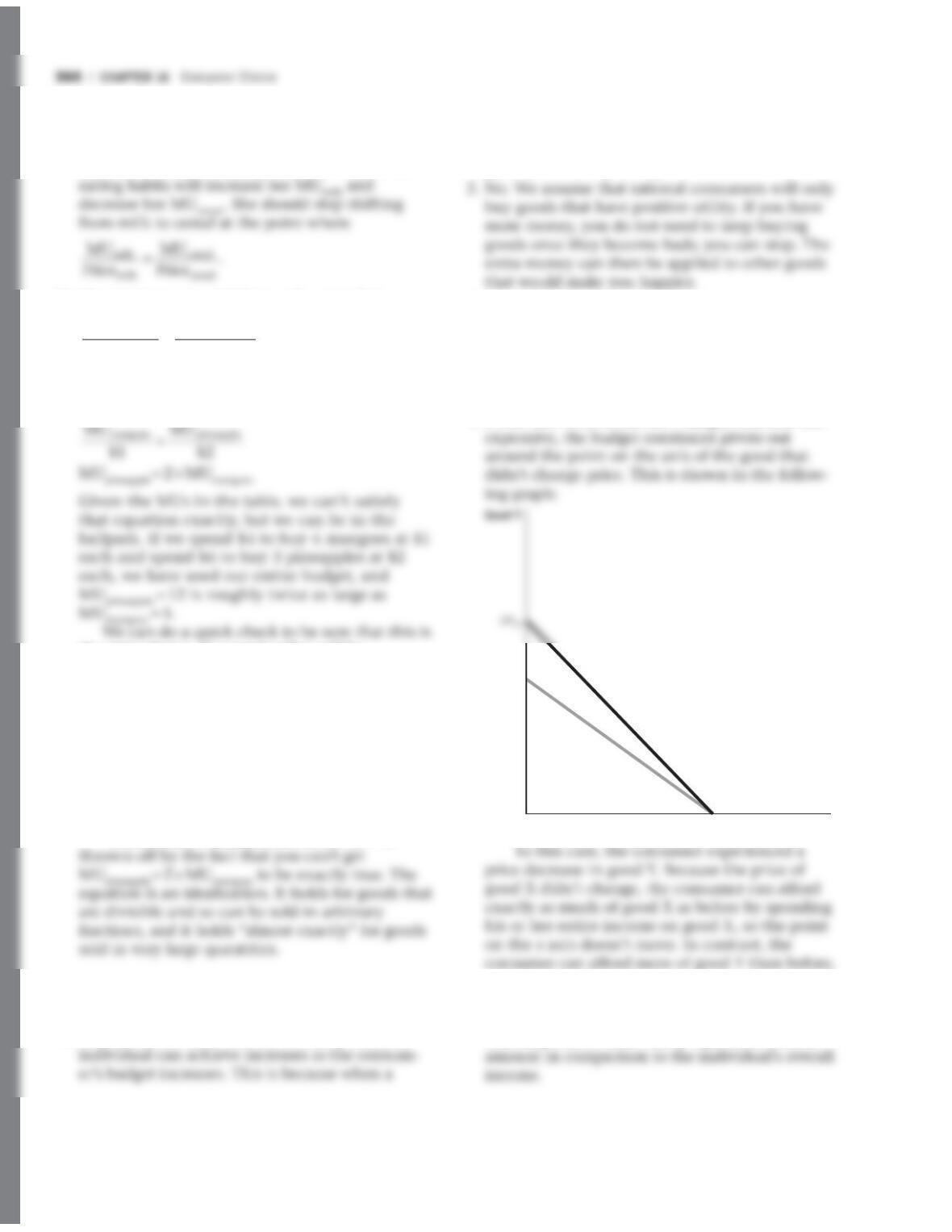
4. If one item in a consumer’s bud get becomes less
Good X
BC2
I/PX
I/PY1
BC1
so the point on the y axis moves up.
5. The substitution effect is more likely to be signifi-
cant, as a 10% discount on part of an individual’s
consumption of coffee likely represents a small
Therefore, Gina should prob ably eat more
cereal and drink less milk. If, like most people,
she experiences diminishing marginal utility as
she increases her consumption, this shift in her
15. The goal is to spend $10in such a way that
MUmangoes
Pricemangoes
=MUpineapple
Pricepineapple
.
Given what we know about the prices, this means we
are looking for
the right choice. Our total utility will be
20 15 10 5 “ 50 utils from the mangoes plus
24 18 12 “ 54 utils from the pineapples, or 104
utils all together. An alternative that also used
the entire bud get would be to buy one more
pineapple and two fewer mangoes. Our total
utility would then be 24 18 12 6 “ 60 from the
pineapples and 20 15 “ 35 utils from the
mangoes, or 95 utils all together. Four mangoes
and 3 pineapples is better.
Hints and Common Errors: Don’t be
Appendix Questions for Review
1. In general, the total amount of utility that an
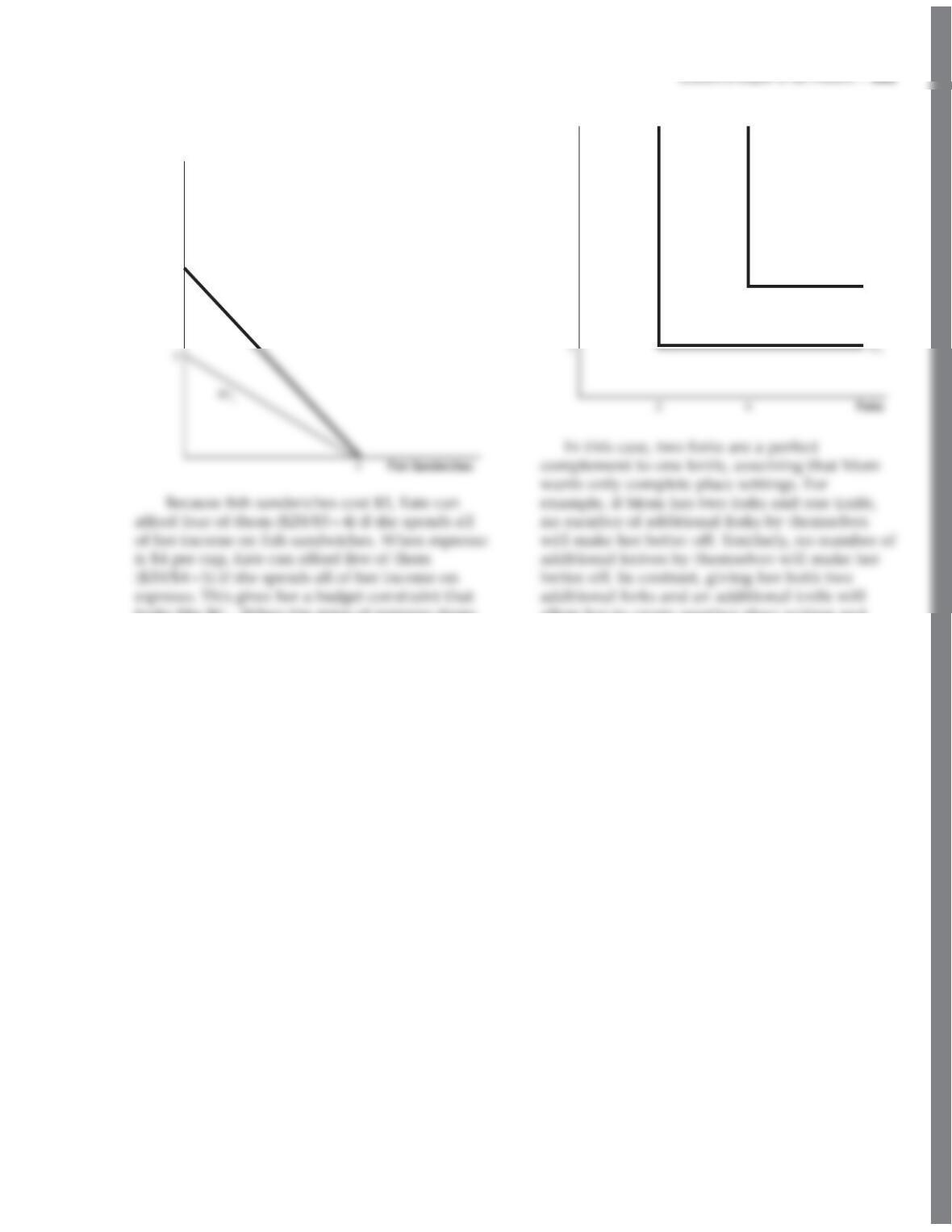
2.
Knives
2IC2
allow her to create another place setting and
thus make her better off (i.e., put her on a
higher indifference curve).
Appendix Study Prob lems
1. Kate’s bud get constraints look as follows:
BC2
Espresso
10
looks like BC1. When the price of espresso drops
to $2 per cup, Kate can now afford 10 of them
($20/$2 “ 10) if she spends all of her income on
espresso. This gives her a bud get constraint that
looks like BC2.