Chapter 16
Domestic and International Dimensions
of Monetary Policy
◼ Overview
This chapter begins with a discussion of the demand for money. The transactions demand, precautionary
demand, and asset demand are identified and discussed. Next, the demand for a money curve is presented and
explained. Then, the direct and indirect effects of an increase in the money supply are examined. The conduct
of monetary policy in the real world, i.e., the use of open market operations, changes in the discount rate, and
reserve requirements to implement expansionary and contractionary policy are examined. An important
concept, the relationship between bond prices and interest rates, is explained. Monetary policy during periods
of under-utilization of resources, and then inflation, are analyzed. Open-economy transmission of monetary
◼ Learning Objectives
After studying this chapter, students should be able to:
• 16.1 Identify key factors that influence the quantity of money that people desire to hold
• 16.2 Describe how Federal Reserve monetary policy actions influence market interest rates
◼ Outline
I. The Demand for Money: Because money is used as a medium of exchange, it follows that to use
money, one must hold money.
A. The Demand for Money: What People Wish to Hold: The demand for money can be broken
down into three components.
2. The Precautionary Demand: Holding money to meet unplanned expenditures and
3. The Asset Demand: Holding money as a store of value as opposed to having other assets,
such as small CDs, corporate bonds, and stocks.
B. The Demand for Money Curve: If the amount of money demanded for transactions is fixed
II. How the Fed Influences Interest Rates: The Fed uses one of three tools as part of its
policymaking action to alter consumption, investment, and aggregate demand.
A. Open Market Operations: The Fed changes the amount of reserves by purchases and sales of
government bonds. Starting from an equilibrium level, if the Fed wants to conduct open market
1. Graphing the Sale of Bonds: When the Fed wishes to increase its sales of government
bonds, it lowers bond prices. (See Figure 16-2(a).)
2. The Fed’s Purchase of Bonds: When the Fed wishes to purchase government bonds, it
raises bond prices. (See Figure 16-2(b).)
B. Relationship between the Price of Existing Bonds and the Rate of Interest: The market
III. Effects of an Increase in the Money Supply: If a large sum of money were distributed arbitrarily
to people, they would have too much money relative to other things that they owned. This “new”
money can be disposed of in a variety of ways.
A. Direct Effect of an Increase in the Money Supply: Excess money would cause aggregate
demand to rise because an increase in the money supply at any given price level would cause
people to want to purchase more output of real goods and services.
B. Indirect Effect of an Increase in the Money Supply: When there is excess money, some
people would deposit it in banks. The recipient banks would have excess reserves.
1. Banks’ Lending Responses and Aggregate Demand: To induce people to borrow more
2. Low Interest Rates and Quantitative Easing: If interest rates fall close to zero, monetary
C. Graphing the Effects of an Expansionary Monetary Policy: The direct and indirect effects
240 Miller • Economics Today, Nineteenth Edition
E. Open Economy Transmission of Monetary Policy: In an open economy, international trade
and purchase/sale of all assets and currencies must be considered.
1. The Net Export Effect of Expansionary Monetary Policy: Expansionary monetary
policy causes interest rates to fall. Foreigners will demand fewer dollars for financial assets
2. The Net Export Effect of Contractionary Monetary Policy: Contractionary monetary
IV. Monetary Policy and Inflation: Studies show a relatively stable relationship between excessive
growth in the money supply in circulation and inflation in the long run. If the supply of money
rises relative to the demand for money, it takes more units of money to purchase goods and
services.
A. The Equation of Exchange and the Quantity Theory: The equation of exchange says that the
number of monetary units (Ms) times the number of times each unit is spent on final goods and
services (V) is identical to the price level (P) times real GDP (Y) or MsV = PY. This equation
shows the relationship between changes in the quantity of money in circulation and the price
level.
1. The Equation of Exchange as an Identity: It is true by definition and is called an
2. The Quantity Theory of Money and Prices: By making assumptions about variables in
V. Monetary Policy Transmission and Credit Policy at Today’s Fed
A. An Interest-Rate-Based Transmission Mechanism: This theory asserts that the main effect
of monetary policy is through changes in the interest rate. Money supply changes cause
changes in the interest rate. This changes planned investment, which in turn causes changes in
income and employment. (See Figures 16-6 and 16-7.)
1. Targeting the Federal Funds Rate: The Fed announces interest rate targets. If it says it is
a. The Federal Funds Rate: The interest rate banks pay when they borrow reserves
Chapter 16 Domestic and International Dimensions of Monetary Policy 241
c. The Interest Rate on Reserves: In 2008, the Fed was given the authority to pay
interest on required and excess reserves and since late in that year has paid the same
rate on each.
i. Establishing the Fed Policy Strategy: The Fed uses open market operations to
2. The Taylor Rule: An equation that specifies a federal funds rate target based on an
estimated long-run real interest rate, the current deviation of the actual inflation rate from
the Federal Reserve’s inflation objective, and the gap between actual real GDP and a
measure of potential real GDP.
a. Plotting the Taylor Rule on a Graph: The Federal Reserve Bank of St. Louis tracks
B. Credit Policy at Today’s Fed: Since the late 2000s, the Fed has pursued credit policy, which
involves direct lending to financial and nonfinancial firms.
1. The Credit Policy Approach in Practice: During the financial crisis of 2008, the Fed
auctioned funds to banking institutions facing illiquidity or bankruptcy and bought many
2. How the Fed Finances the Credit It Extends: Like a private bank, the Fed finances the
3. Arguments in Favor of the Fed’s Credit Policy: Supporters of the Fed’s credit policy
have offered three supporting arguments.
a. Giving Banks Time to Recover from the Financial Meltdown: During 2008 and
b. Making Financial Markets and Institutions More Liquid and Solvent: The Fed’s
4. Arguments against the Fed’s Credit Policy: Critics of the Fed’s credit policy have
offered three arguments against it.
a. Providing an Incentive for Institutions to Operate Less Efficiently: The Fed’s
credit policy encourages institutions to which it directs credit to operate with less
◼ Points to Emphasize
Money and Its Relationship to Aggregate Demand
Modern theories of money lead to the conclusion that changes in the money supply lead to changes in
aggregate demand. By one means or another, an increase in the money supply leads to an increase in AD,
while a decrease in the money supply leads to a decrease in AD. The various models associated with
different approaches to monetary theory all show that when people have larger money balances, desired
and actual spending increase (the only exception is the Keynesian Liquidity Trap). The mechanism
differs, but the effect on AD is the same.
An Open Economy and Monetary Policy
Because international effects of some actions are rarely obvious to most students, it is often helpful to
stress that economic policy actually takes place in a global environment. The effect of changes in
monetary policy on aggregate demand is discussed in terms of the net export effect. The mechanism for
the change in AD is by the effect of changes in the money supply on the interest rate and exchange rate.
The mechanism is as follows:
◼ For Those Who Wish to Stress Theory
Present Value, Interest Rates, and Bond Prices
To get a better understanding of the inverse relationship between bond prices and interest rates, the concept
of present value can be introduced. For a bond with a face value of $1,000 that pays $100 per year forever
the calculation of its current price is
Chapter 16 Domestic and International Dimensions of Monetary Policy 243
Change interest rates to i1 = 20 percent, and then to i2 = 5 percent; the equation indicates that the present
value of the bond changes to $500 and $2,000, respectively. There is such a thing as a perpetual bond,
it is worth now because the denominator gets larger.
The price of a bond is no more than the discounted present value of the future stream of income from that
bond. In the example above, if a bond that matured in three years were paying the $100 per year, then the
price of the bond now would be
The Classical System: Money’s Role
According to the classical economists, money determined the price level only. Real output was
determined by the production function and the demand and supply of labor under conditions of wage-
price flexibility and was at full-employment levels. Thus, the aggregate supply curve was vertical. Any
◼ Further Questions for Class Discussion
1. What would be the effect of inflation on the present value of a future stream of earnings? The
2. In 2007 and 2008, the Fed cut the federal funds rate as the economy began to experience
conditions that appeared to be leading to recession. In the second quarter of 2008, when many
believed that the economy had gone into a recession, growth figures for real GDP were a positive
3 percent. Could the net export effect explain this unexpected result? Yes. Cutting the federal
3. In countries with high inflation rates, nominal interest rates are also high. Why should nominal
interest rates be higher when a country experiences inflation? Nominal interest rates are higher
4. The business press often reports that when the economy appears to be going into a recession the
goal of the Federal Reserve is to halt it by decreasing interest rates but not to decrease interest
rates to levels that will cause the rate of inflation to increase. In terms of the aggregate demand
and aggregate supply model, what does this mean? It means that the Fed should choose an
5. Why does velocity have to be constant for the quantity theory of money and prices to predict that
price level changes are proportional to changes in the money supply even if real GDP is constant?
◼ Milton Friedman—1912–2006—Economist
Milton Friedman was America’s leading conservative economist until his death in 2006. A controversial
figure, he saw his views embraced by the libertarian right and dismissed as nonsense by Keynesian
liberals. The left damned him for his opposition to social welfare programs and for his purported advisory
role to a military dictatorship of Chile. For many years as an outsider to the Keynesian orthodoxy,
Friedman, who won the Nobel Prize in 1976 for his monetary theories, gained so much influence among
Chapter 16 Domestic and International Dimensions of Monetary Policy 245
Friedman’s monumental work, entitled A Monetary History of the United States (written with Anna J.
Schwartz), demonstrated quite impressively that monetary policy, rather than being ineffective during
the Great Depression, caused the Great Depression. He pointed out that the money supply was reduced
dramatically by the Fed during that period, and that reason and that reason alone caused a serious
◼ Answers to Questions for Critical Analysis
Interest Rate Movements and U.S. Companies’ Cash Holdings (p. 352)
Why do you suppose that corporate cash holdings have decreased slightly since 2015?
Can Behavioral Economics Explain the Federal Reserve’s Bad Forecasts? (p. 359)
Why might the fact that private economic forecasters complete to sell their services help to
constrain behavioral tendencies for too much optimism in projections of real GDP growth? Explain
your reasoning.
◼ You Are There
A Member of Congress Seeks a Fed Policy Rule, Irrespective of the Rule’s Name
(p. 365)
1. What do you suppose might be gained–and by whom–if the Fed were to follow an easily
understood rule as a guide for conducting monetary policy? Explain.
2. What do you think might be lost–and by whom–if the Fed were to follow an easily
understood rule as a guide for conducting monetary policy? Explain.
246 Miller • Economics Today, Nineteenth Edition
◼ Issues and Applications
Do Federal Open Market Committee “Dot Plots” Chart Confusion? (pp. 365–366)
1. Why do you think that many people pay so much attention to likely future movements in
the federal funds rate?
2. If the FOMC were to aim to attain targets for M1 or M2 instead of the federal funds rate,
would people be as concerned with trying to anticipate future federal funds rate changes?
Explain.
◼ Research Project
1. To access all documents released to the public by the FOMC, including a tabular presentation of its
◼ Appendix E—Monetary Policy: A Keynesian Perspective
The Keynesian approach to monetary policy states that changes in the money supply can only affect
aggregate demand by changing the interest rate. Changes in the interest rate only cause changes in
aggregate demand by changing planned real investment spending, which shifts the planned investment
curve up or down and thus the total aggregate expenditures up or down. Also, in some circumstances
increases in the money supply may have little or no effect on aggregate demand.
I. Increasing the Money Supply: Increases in the money supply decreases interest rates causing
II. Decreasing the Money Supply: Decreases in the money supply increases interest rates, causing
III. Arguments against Monetary Policy: Keynesians have argued that monetary policy is not very
Chapter 16 Domestic and International Dimensions of Monetary Policy 247
◼ Answers to Problems
16-1. Let’s denote the price of a nonmaturing bond (called a consol) as Pb. The equation that
indicates this price is Pb = I/r, where I is the annual net income the bond generates and r is
the nominal market interest rate.
a. Suppose that a bond promises the holder $500 per year forever. If the nominal market
interest rate is 5 percent, what is the bond’s current price?
b. What happens to the bond’s price if the market interest rate rises to 10 percent?
16-2. On the basis of Problem 16-1, imagine that initially the market interest rate is 5 percent and
at this interest rate you have decided to hold half of your financial wealth as bonds and half
as holdings of non-interest-bearing money. You notice that the market interest rate is
starting to rise, however, and you become convinced that it will ultimately rise to 10 percent.
a. In what direction do you expect the value of your bond holdings to go when the interest
rate rises?
b. If you wish to prevent the value of your financial wealth from declining in the future,
how should you adjust the way you split your wealth between bonds and money? What
does this imply about the demand for money?
16-3. You learned in an earlier chapter that if there is an inflationary gap in the short run, then
in the long run a new equilibrium arises when input prices and expectations adjust upward,
causing the short-run aggregate supply curve to shift upward and to the left and pushing
equilibrium real GDP per year back to its long-run value. In this chapter, however, you
learned that the Federal Reserve can eliminate an inflationary gap in the short run by
undertaking a policy action that reduces aggregate demand.
a. Propose one monetary policy action that could eliminate an inflationary gap in the short
run.
b. In what way might society gain if the Fed implements the policy you have proposed
instead of simply permitting long-run adjustments to take place?
16-4. You learned in an earlier chapter that if a recessionary gap occurs in the short run, then in
the long run a new equilibrium arises when input prices and expectations adjust downward,
causing the short-run aggregate supply curve to shift downward and to the right and
pushing equilibrium real GDP per year back to its long-run value. In this chapter, you
learned that the Federal Reserve can eliminate a recessionary gap in the short run by
undertaking a policy action that increases aggregate demand.
248 Miller • Economics Today, Nineteenth Edition
a. Propose one monetary policy action that could eliminate the recessionary gap in the
short run.
b. In what way might society gain if the Fed implements the policy you have proposed
instead of simply permitting long-run adjustments to take place?
16-5. Suppose that the economy currently is in long-run equilibrium. Explain the short-and long-
run adjustments that will take place in an aggregate demand-aggregate supply diagram if
the Fed expands the quantity of money in circulation.
The short-run effect is an upward movement along the short-run aggregate supply curve generated
16-6. Explain why the net export effect of a contractionary monetary policy reinforces the usual
impact that monetary policy has on equilibrium real GDP per year in the short run.
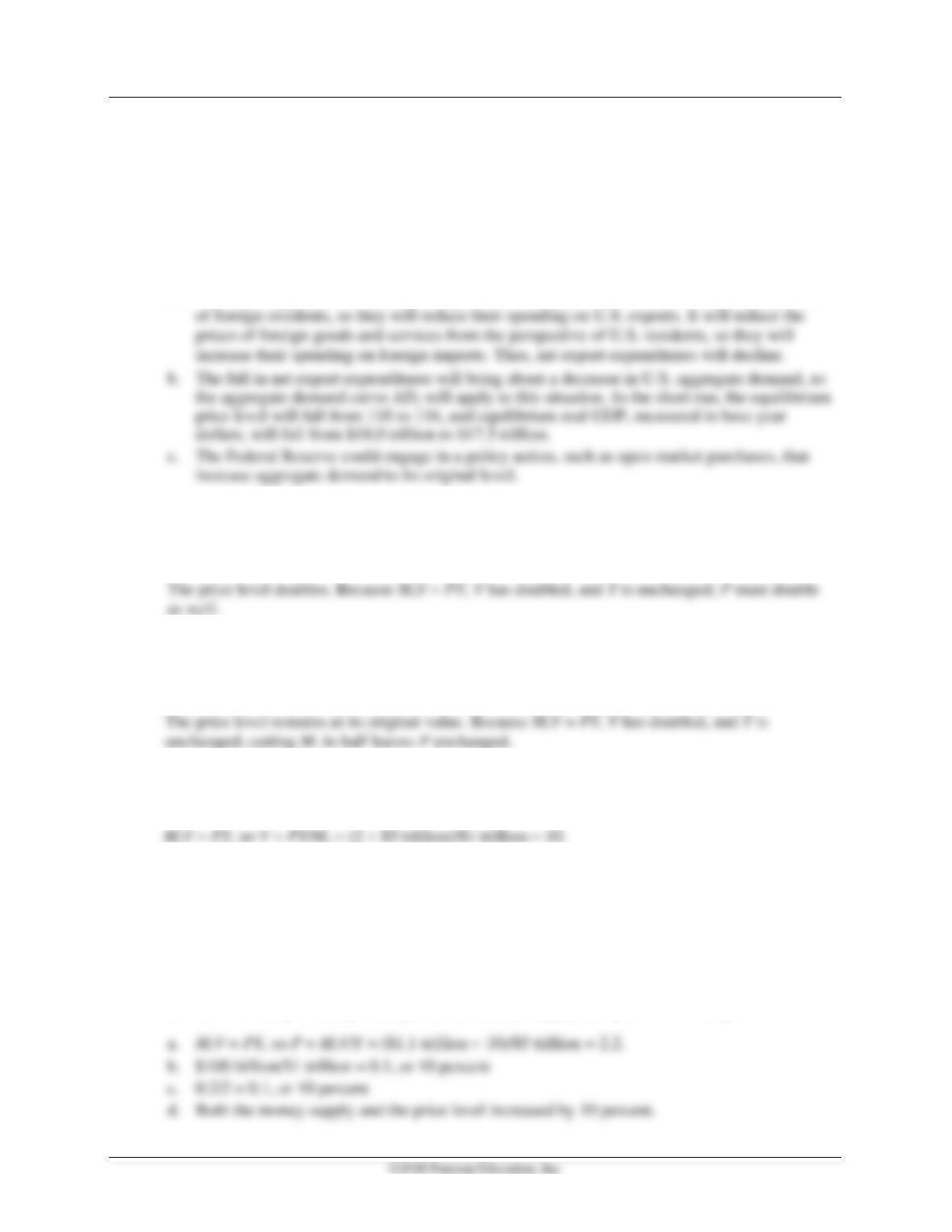
16-7. Suppose that, initially, the U.S. economy was in an aggregate demand-aggregate supply
equilibrium at point A along the aggregate demand curve AD in the diagram below. Now,
however, the value of the U.S. dollar suddenly appreciates relative to foreign currencies.
This appreciation happens to have no measurable effects on either the short-run or the
long-run aggregate supply curve in the United States. It does, however, influence U.S.
aggregate demand.
Chapter 16 Domestic and International Dimensions of Monetary Policy 249
a. Explain in your own words how the dollar appreciation will affect net export
expenditures in the United States.
b. Of the alternative aggregate demand curves depicted in the figure—AD1 versus
AD2— which could represent the aggregate demand effect of the U.S. dollar’s
appreciation? What effects does the appreciation have on real GDP and the price level?
c. What policy action might the Federal Reserve take to prevent the dollar’s appreciation
from affecting equilibrium real GDP in the short run?
a. The dollar appreciation will raise the prices of U.S. goods and services from the perspective
16-8. Suppose that the quantity of money in circulation is fixed but the income velocity of money
doubles. If real GDP remains at its long-run potential level, what happens to the
equilibrium price level?
16-9. Suppose that following adjustment to the events in Problem 16-8, the Fed cuts the money
supply in half. How does the price level now compare with its value before the income
velocity and the money supply changed?
16-10. Consider the following data: The money supply is $1 trillion, the price level equals 2, and
real GDP is $5 trillion in base-year dollars. What is the income velocity of money?
16-11. Consider the data in Problem 16-10. Suppose that the money supply increases by $100
billion and real GDP and the income velocity remain unchanged.
a. According to the quantity theory of money and prices, what is the new equilibrium
price level after full adjustment to the increase in the money supply?
b. What is the percentage increase in the money supply?
c. What is the percentage change in the price level?
d. How do the percentage changes in the money supply and price level compare?
16-12. Assuming that the Fed judges inflation to be the most significant problem in the economy
and that it wishes to employ all of its policy instruments except interest on reserves, what
should the Fed do with its three policy tools?
16-13. Suppose that the Fed implements each of the policy changes you discussed in Problem
16-12. Now explain how the net export effect resulting from these monetary policy actions
will reinforce their effects that operate through interest rate changes.
16-14. Imagine working at the Trading Desk at the New York Fed. Explain whether you would
conduct open market purchases or sales in response to each of the following events. Justify
your recommendation.
a. The latest FOMC Directive calls for an increase in the target value of the federal funds
rate.
b. For a reason unrelated to monetary policy, the Fed’s Board of Governors has decided to
raise the differential between the discount rate and the federal funds rate. Nevertheless,
the FOMC Directive calls for maintaining the present federal funds rate target.
16-15. To implement a credit policy intended to expand liquidity of the banking system, the Fed
desires to increase its assets by lending to a substantial number of banks. How might the
Fed adjust the interest rate that it pays banks on reserves in order to induce them to hold
the reserves required for funding this credit policy action? What will happen to the Fed’s
liabilities if it implements this policy action?
16-16. Suppose that to finance its credit policy, the Fed pays an annual interest rate of 0.5 percent
on bank reserves. During the course of the current year, banks hold $1 trillion in reserves.
What is the total amount of interest the Fed pays banks during the year?
16-17. During an interval between mid-2010 and early 2011, the Federal Reserve embarked
on a policy it termed “quantitative easing.” Total reserves in the banking system increased.
Hence, the Federal Reserve’s liabilities to banks increased, and at the same time its assets
rose as it purchased more assets—many of which were securities with private market values
that had dropped considerably. The money multiplier declined, so the net increase in the
money supply was negligible. Indeed, during a portion of the period, the money supply
actually declined before rising near its previous value. Evaluate whether the Fed’s
“quantitative easing” was a monetary policy or credit policy action.
16-18. Consider the two panels of Figure 16-2. Suppose that instructions in the latest FOMC
Directive call for a monetary policy action aimed at pushing down the rate of interest
prevailing in the economy. Use the appropriate panel of the figure to assist in explaining
whether officials at the Federal Reserve Bank of New York’s Trading Desk should buy or
sell existing bonds.
16-19. Take a look at the two panels of Figure 16-2, and also consider Figure 16-1. Suppose that
instructions in the latest FOMC Directive call for a monetary policy action aimed at
inducing individuals and businesses to demand a smaller quantity of money. Use the
appropriate panel of Figure 16-2 to assist in explaining whether officials at the Federal
Reserve Bank of New York’s Trading Desk should buy or sell bonds.
16-20. Take a look at Figure 16-3. Discuss a policy action that the Trading Desk at the Federal
Reserve Bank of New York could undertake in order to bring about the increase in
aggregate demand displayed in this figure.
16-21. Consider Figure 16-3. Discuss a policy action that the Trading Desk at the Federal Reserve
Bank of New York could undertake in order to generate the decrease in aggregate demand
displayed in this figure.
16-22. Take a look at Figure 16-6. Suppose that a multiple reduction in real GDP is the final
outcome that the Fed desires in the last box in the figure. Explain the required directions
of effects—that is, increase or decrease—that must occur in the preceding boxes in the
figure in order to yield this desired decrease in real GDP.
16-23. Consider Figure 16-7. Discuss a specific monetary policy action that the Fed’s Trading Desk
could implement in order to induce the effects traced out by this figure.
Appendix E
E-1. Suppose that each 0.1-percentage-point decrease in the equilibrium interest rate induces a
$10 billion increase in real planned investment spending by businesses. In addition, the
investment multiplier is equal to 5, and the money multiplier is equal to 4. Furthermore,
every $20 billion increase in the money supply brings about a 0.1-percentage-point
reduction in the equilibrium interest rate. Use this information to answer the following
questions under the assumption that all other things are equal.
a. How much must real planned investment increase if the Federal Reserve desires to
bring about a $100 billion increase in equilibrium real GDP?
b. How much must the money supply change for the Fed to induce the change in real
planned investment calculated in part (a)?
c. What dollar amount of open market operations must the Fed undertake to bring about
the money supply change calculated in part (b)?
E-2. Suppose that each 0.1-percentage-point increase in the equilibrium interest rate induces a
$5 billion decrease in real planned investment spending by businesses. In addition, the
investment multiplier is equal to 4, and the money multiplier is equal to 3. Furthermore,
every $9 billion decrease in the money supply brings about a 0.1-percentage-point increase
in the equilibrium interest rate. Use this information to answer the following questions
under the assumption that all other things are equal.
a. How much must real planned investment decrease if the Federal Reserve desires to
bring about an $80 billion decrease in equilibrium real GDP?
b. How much must the money supply change for the Fed to induce the change in real
planned investment calculated in part (a)?
c. What dollar amount of open market operations must the Fed undertake to bring about
the money supply change calculated in part (b)?
E-3. Assume that the following conditions exist:
a. All banks are fully loaned up—there are no excess reserves, and desired excess reserves
are always zero.
b. The money multiplier is 3.
c. The planned investment schedule is such that at a 6 percent rate of interest, investment
is $1,200 billion; at 5 percent, investment is $1,225 billion.
d. The investment multiplier is 3.
e. The initial equilibrium level of real GDP is $18 trillion.
f. The equilibrium rate of interest is 6 percent. Now the Fed engages in expansionary
monetary policy. It buys $1 billion worth of bonds, which increases the money supply, which
in turn lowers the market rate of interest by 1 percentage point. Determine how much the
money supply must have increased, and then trace out the numerical consequences of the
associated reduction in interest rates on all the other variables mentioned.
E-4. Assume that the following conditions exist:
a. All banks are fully loaned up—there are no excess reserves, and desired excess reserves
are always zero.
b. The money multiplier is 4.
c. The planned investment schedule is such that at a 4 percent rate of interest, investment
is $1,400 billion. At 5 percent, investment is $1,380 billion.
d. The investment multiplier is 5.
e. The initial equilibrium level of real GDP is $19 trillion.
f. The equilibrium rate of interest is 4 percent. Now the Fed engages in contractionary
monetary policy. It sells $2 billion worth of bonds, which reduces the money supply,
which in turn raises the market rate of interest by 1 percentage point. Determine how
much the money supply must have decreased, and then trace out the numerical
consequences of the associated increase in interest rates on all the other variables
mentioned.
◼ Selected References
Barro, Robert J., Macroeconomics, New York: John Wiley and Sons, 1984.
Barro, Robert J., The Cato Journal, Vol. 6, No. 2, Fall 1986, devotes an entire issue to “Money, Politics,
and the Business Cycle.”
Dillard, Dudley, “The Theory of a Monetary Economy,” in Kenneth K. Kurihara, ed., Post Keynesian
Economics, New Brunswick, NJ: Rutgers University Press, 1954.
Friedman, Milton, “The Role of Monetary Policy,” American Economic Review, Vol. 58, March 1968,
pp. 1–17.