Chapter 16 – Public Finance: Expenditures and Taxes
16-1
Chapter 16 Public Finance: Expenditures and Taxes
QUESTIONS
1. Use a circular flow diagram to show how the allocation of resources and the distribution of
income are affected by each of the following government actions. LO1
a. The construction of a new high school.
b. A 2‐percentage‐point reduction of the corporate income tax.
c. An expansion of preschool programs for disadvantaged children.
d. The levying of an excise tax on polluters.
Answer:
a. The construction of a new high school.
In building the school, the effect would be an increase in government expenditures to the
product market (5) and an increase in business revenues (3). The owners of the resources
Chapter 16 – Public Finance: Expenditures and Taxes
16-2
2. What do economists mean when they say government purchases are “exhaustive” expenditures
whereas government transfer payments are “non–exhaustive” expenditures? Cite an example of a
government purchase and a government transfer payment. LO1
Answer: Exhaustive expenditures are for products that directly absorb resources and are
part of domestic output – they “exhaust” or use resources. Non-exhaustive expenditures
3. What is the most important source of revenue and the major type of expenditure at the Federal
level? At the state level? At the local level? LO1
Answer: At the Federal level, the most important source of revenue is the personal
income tax. The main expenditure is for income security.
4. Distinguish between the benefits‐received and the ability‐to‐pay principles of taxation. Which
philosophy is more evident in our present tax structure? Justify your answer. To which principle
of taxation do you subscribe? Why? LO2
Answer: The benefits-received principle holds that governments should supply public
goods and services in much the same manner as does private business. Those who make
Chapter 16 – Public Finance: Expenditures and Taxes
16-3
5. What is meant by a progressive tax? A regressive tax? A proportional tax? Comment on the
progressivity or regressivity of each of the following taxes, indicating in each case where you
think the tax incidence lies: (a) the Federal personal income tax; (b) a 4 percent state general sales
tax; (c) a Federal excise tax on automobile tires; (d) a municipal property tax on real estate; (e)
the Federal corporate income tax; (f) the portion of the payroll tax levied on employers. LO3
Answer: A progressive tax is one whose average rate increases as income increases. One
pays in tax a larger proportion of one’s income as income increases.
Chapter 16 – Public Finance: Expenditures and Taxes
16-4
6. What is the tax incidence of an excise tax when demand is highly inelastic? Highly elastic?
What effect does the elasticity of supply have on the incidence of an excise tax? What is the
efficiency loss of a tax, and how does it relate to elasticity of demand and supply? LO3
Answer: The incidence of an excise tax is likely to be primarily on consumers when
demand is highly inelastic and primarily on producers when demand is elastic. The more
7. Given the inelasticity of cigarette demand, discuss an excise tax on cigarettes in terms of
efficiency loss and tax incidence. LO3
Answer: Since cigarette demand is relatively inelastic the slope of the (inverse) demand
Chapter 16 – Public Finance: Expenditures and Taxes
16-5
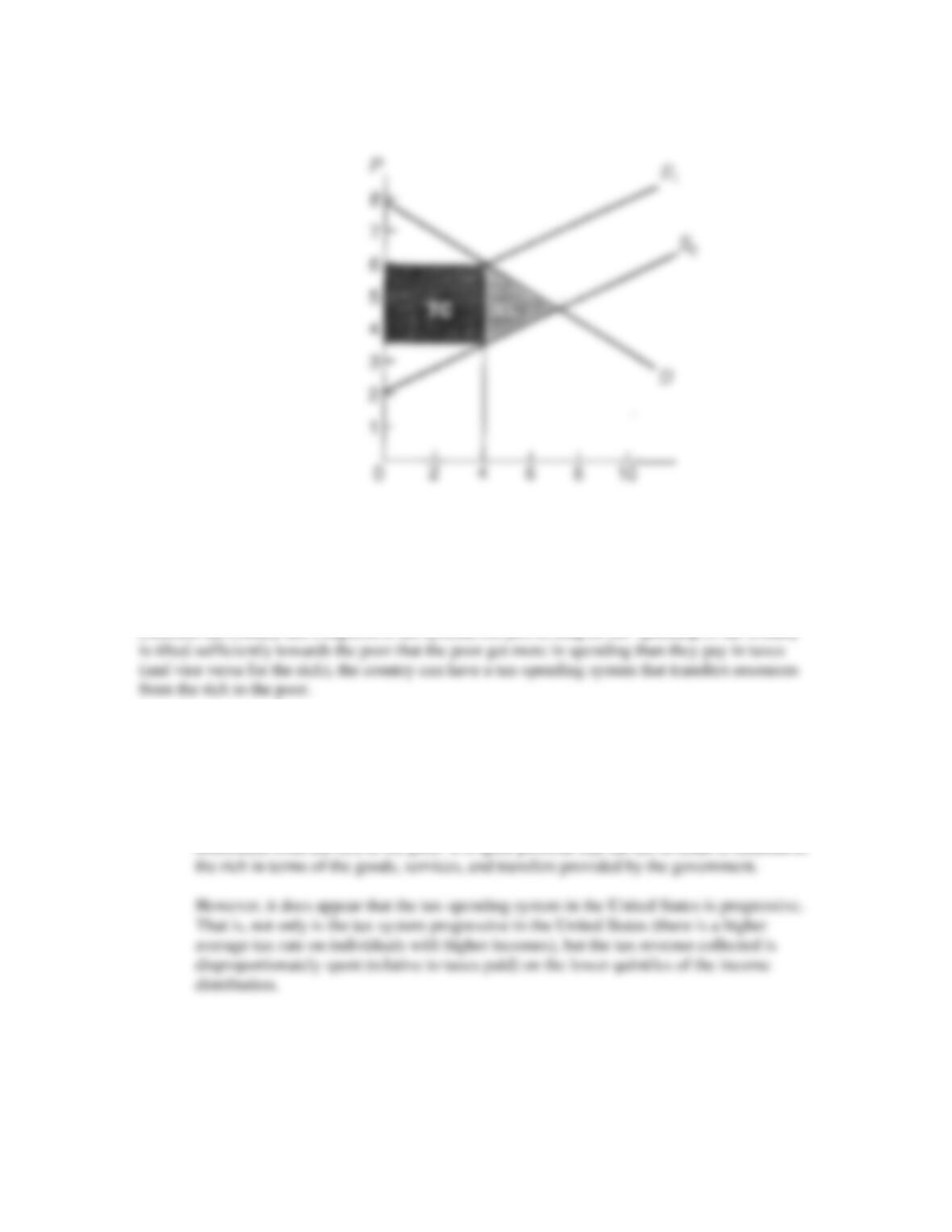
8. ADVANCED ANALYSIS Suppose the equation for the demand curve for some product X is
P = 8 ‐ .6Q and the supply curve is P = 2 + .4Q. What are the equilibrium price and quantity?
Now suppose an excise tax is imposed on X such that the new supply equation is P = 4 + .4Q.
How much tax revenue will this excise tax yield the government? Graph the curves, and label the
area of the graph that represents the tax collection “TC” and the area that represents the efficiency
loss of the tax “EL.” Briefly explain why area EL is the efficiency loss of the tax but TC is not.
LO3
Answer: To determine the equilibrium quantity we equate the supply schedule with the
demand schedule (in equilibrium the price must be the same for both schedules).
Chapter 16 – Public Finance: Expenditures and Taxes
16-6
9. Is it possible for a country with a regressive tax system to have a tax‐spending system that
transfers resources from the rich to the poor? LO4
Answer: Yes. The rich may be paying a lower fraction of their incomes in taxes
(because the country has a regressive tax system) but just as long as the spending of the country
10. LAST WORD Does a progressive tax system by itself guarantee that resources will be
redistributed from the rich to the poor? Explain. Is the tax system in the United States
progressive, regressive, or proportional? Does the tax-spending system in the United States
redistribute resources from higher income earners to lower income earners?
Answer: No, a progressive tax system by itself does not guarantee that resources will be
Chapter 16 – Public Finance: Expenditures and Taxes
16-7
PROBLEMS
1. Suppose a tax is such that an individual with an income of $10,000 pays $2000 of tax, a person
with an income of $20,000 pays $3000 of tax, a person with an income of $30,000 pays $4000 of
tax. What is each person’s average tax rate? Is this tax regressive, proportional, or progressive?
LO3
Feedback: Consider the following example. Suppose a tax is such that an individual with
an income of $10,000 pays $2000 of tax, a person with an income of $20,000 pays $3000
of tax, a person with an income of $30,000 pays $4000 of tax.
2. Suppose in Fiscalville there is no tax on the first $10,000 of income, but a 20 percent tax on
earnings between $10,000 and $20,000 and a 30 percent tax on income between $20,000 and
$30,000. Any income above $30,000 is taxed at 40 percent. If your income is $50,000, how much
will you pay in taxes? Determine your marginal and average tax rates. Is this a progressive tax?
LO3
Feedback: Consider the following example. Suppose in Fiscalville there is no tax on the
first $10,000 of income, but a 20 percent tax on earnings between $10,000 and $20,000
and a 30 percent tax on income between $20,000 and $30,000. Any income above
$30,000 is taxed at 40 percent. If your income is $50,000, how much will you pay in
taxes? Determine your marginal and average tax rates. Is this a progressive tax?
Since the individual has an income of $50,000 we must calculate the taxes paid over each

Chapter 16 – Public Finance: Expenditures and Taxes
16-8
3. For tax purposes, “gross income” is all the money a person receives in a given year from any
source. But income taxes are levied on “taxable income” rather than gross income. The difference
between the two is the result of many exemptions and deductions. To see how they work, suppose
you made $50,000 last year in wages, $10,000 from investments, and were given $5000 as a gift
by your grandmother. Also assume that you are a single parent with one small child living with
you. LO3
a. What is your gross income?
b. Gifts up to $13,000 per year are not counted as taxable income. Also, the “personal exemption”
allows you to reduce your taxable income by $3650 for each member of your household. Given
these exemptions, what is your taxable income?
c. Next, assume you paid $700 in interest on your student loans last year, put $2000 into a health
savings account (HSA), and deposited $4000 into an individual retirement account (IRA). These
expenditures are all tax exempt, meaning that any money spent on them reduces taxable income
dollar-for-dollar. Knowing that fact, what is now your taxable income?
d. Next, you can either take the so‐called standard deduction or apply for itemized deductions
(which involve a lot of tedious paperwork). You opt for the standard deduction that allows you as
head of your household to exempt another $8500 from your taxable income. Taking that into
account, what is your taxable income?
e. Apply the tax rates shown in Table 16.1 to your taxable income. How much Federal tax will
you owe? What is the marginal tax rate that applies to your last dollar of taxable income?
f. As the parent of a dependent child, you qualify for the government’s $1000 per-child “tax
credit.” Like all tax credits, this $1000 credit “pays” for $1000 of whatever amount of tax you
owe. Given this credit, how much money will you actually have to pay in taxes? Using that actual
amount, what is your average tax rate relative to your taxable income? What about your average
tax rate relative to your gross income?
Chapter 16 – Public Finance: Expenditures and Taxes
16-9
Feedback: Consider the following example. Suppose you made $50,000 last year in
wages, $10,000 from investments, and were given $5000 as a gift by your grandmother.
Also assume that you are a single parent with one small child living with you.
Part a:
What is your gross income?
To calculate gross income, add up income from the different sources. You made $50,000
Part b:
Gifts up to $13,000 per year are not counted as taxable income. Also, the “personal
exemption” allows you to reduce your taxable income by $3650 for each member of your
household. Given these exemptions, what is your taxable income?
Your taxable income equals your gross income minus any gifts up to $12,000 minus the
Part c:
Next, assume you paid $700 in interest on your student loans last year, put $2000 into a
health savings account (HSA), and deposited $4000 into an individual retirement account
(IRA). Since these expenditures are all exempt from taxation, what is now your taxable
income?
Part d:
Next, you can either take the so‐called standard deduction or apply for itemized
deductions (which involve a lot of tedious paperwork). You opt for the standard
deduction that allows you as head of your household to exempt another $8500 from your
taxable income. Taking that into account, what is your taxable income?
Part e:
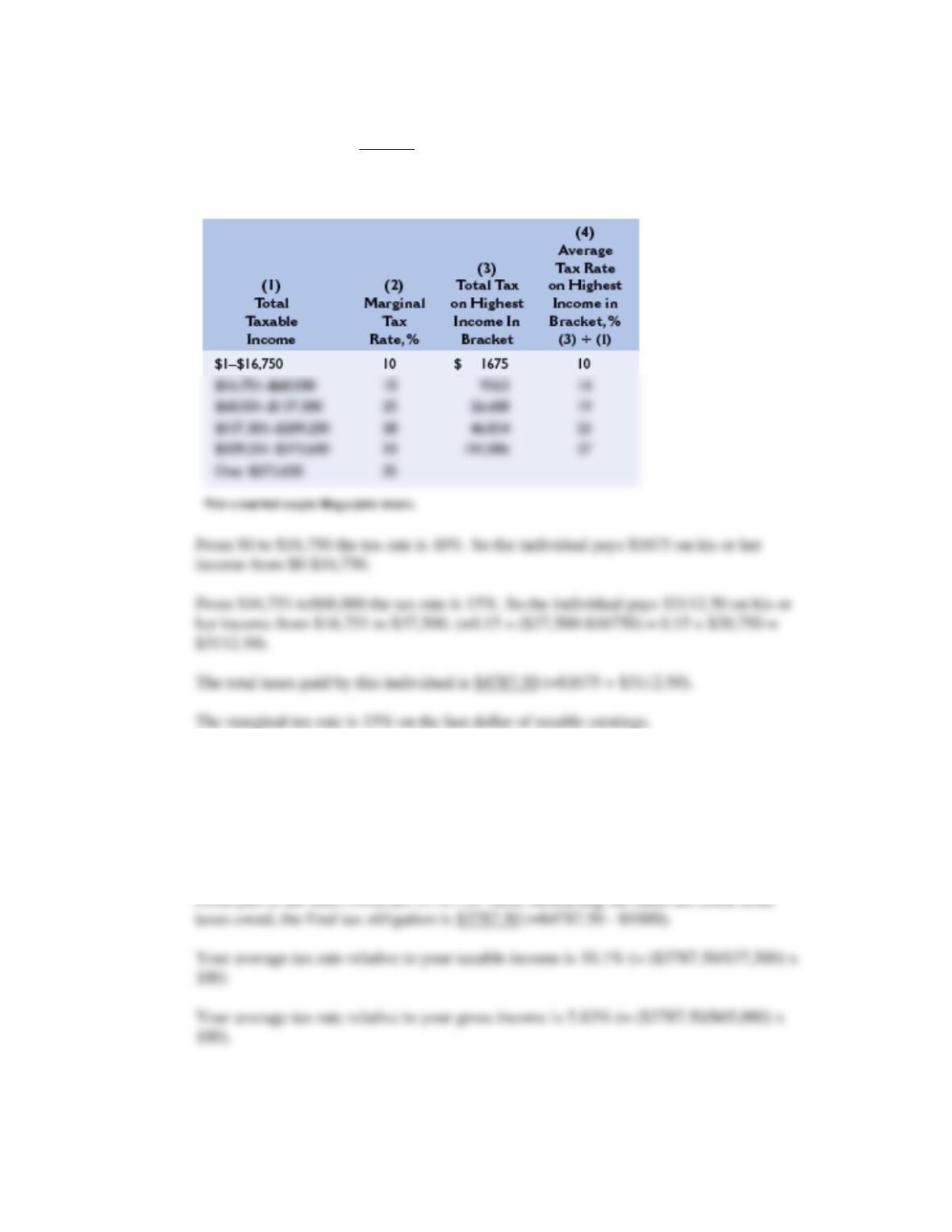
Apply the tax rates shown in Table 16.1 to your taxable income. How much Federal tax
will you owe? What is the marginal tax rate that applies to your last dollar of taxable
income?
Chapter 16 – Public Finance: Expenditures and Taxes
16–10
Your taxable income is $37,500.
The tax schedule is:
Part f:
As the parent of a dependent child, you qualify for the government’s $1000 per–child “tax
credit.” Like all tax credits, this $1000 credit “pays” for $1000 of whatever amount of tax
you owe. Given this credit, how much money will you actually have to pay in taxes?
Using that actual amount, what is your average tax rate relative to your taxable income?
What about your average tax rate relative to your gross income?