CHAPTER 16 | Fiscal Policy
Brief Chapter Summary and Learning Objectives
The authors use the dynamic aggregate demand-aggregate supply model to discuss fiscal policy in
section 16.3 of this chapter. This section is self-contained so you can omit it without any loss of
continuity in your discussion of fiscal policy.
16.1 What Is Fiscal Policy? (pages 940–944)
Define fiscal policy.
16.2 The Effects of Fiscal Policy on Real GDP and the Price Level
(pages 945–947)
Explain how fiscal policy affects aggregate demand and how the government can use
16.3 Fiscal Policy in the Dynamic Aggregate Demand and Aggregate Supply
Model (pages 947–948)
16.4 The Government Purchases and Tax Multipliers (pages 949–953)
16.5 The Limits to Using Fiscal Policy to Stabilize the Economy (pages 953–963)
Discuss the difficulties that can arise in implementing fiscal policy.
382 CHAPTER 16 | Fiscal Policy
16.6 Deficits, Surpluses, and Federal Government Debt (pages 963–968)
Define federal budget deficit and federal government debt and explain how the federal
16.7 The Effects of Fiscal Policy in the Long Run (pages 968–971)
Discuss the effects of fiscal policy in the long run.
Appendix: A Closer Look at the Multiplier (pages 979–983)
Apply the multiplier formula.
Key Terms
Automatic stabilizers, p. 940. Government
spending and taxes that automatically increase
or decrease along with the business cycle.
Cyclically adjusted budget deficit or surplus,
p. 964. The deficit or surplus in the federal
government’s budget if the economy were at
Chapter Outline
Does Government Spending Create Jobs?
Doyle Drive, a 1.6 mile stretch of Highway 101 and the main approach to the Golden Gate Bridge in San
Francisco, was in need of reconstruction. In early 2009, President Barack Obama and Congress enacted
CHAPTER 16 | Fiscal Policy 383
16.1
What Is Fiscal Policy? (pages 940–944)
Learning Objective: Define fiscal policy.
Fiscal policy refers to changes in federal taxes and purchases that are intended to achieve macroeconomic
policy goals.
A. What Fiscal Policy Is and What It Isn’t
State and local governments sometimes change their taxing and spending policies to aid their local
B. Automatic Stabilizers versus Discretionary Fiscal Policy
Automatic stabilizers are government spending and taxes that automatically increase or decrease along
C. An Overview of Government Spending and Taxes
Before the Great Depression, most government spending took place at the state and local levels. Since
World War II, the federal government’s share of total government expenditures has been between two-
Extra Solved Problem 16.1
Fiscal Policy and Deficits
Fiscal policy refers to changes in federal taxes and spending that are intended to achieve macroeconomic
policy objectives. One implication of fiscal policy is that the federal government’s budget should not
always be balanced. For example, in a recession a budget deficit will stimulate spending and employment
because federal government spending exceeds tax revenue. But some economists express concern that the
384 CHAPTER 16 | Fiscal Policy
The federal government’s budget deficit in fiscal year 2015 was about $439 billion. The budget for
national defense in fiscal year 2015 was about $610 billion.
Discuss whether the defense budget should be cut in order to reduce the deficit and promote future
productivity growth.
Solving the Problem
Step 1: Review the chapter material.
This problem is about the definition of fiscal policy, so you may want to review the section
“What is Fiscal Policy?” which begins on page 940 of the textbook.
Step 2: Discuss whether the defense budget should be cut in order to reduce the deficit and
promote future productivity growth.
Critics of government spending can find examples of wasteful spending in most programs,
including national defense. But as the textbook notes, not all government decisions regarding
Teaching Tips
The end of the chapter in the main text includes a special category of exercises titled Real-Time Data
16.2
The Effects of Fiscal Policy on Real GDP and the Price Level
(pages 945–947)
Learning Objective: Explain how fiscal policy affects aggregate demand and how the
government can use fiscal policy to stabilize the economy.
The federal government uses macroeconomic policies to offset the effects of the business cycle on the
economy. When the economy is in recession, increases in government purchases or decreases in taxes
increase aggregate demand. Decreasing government purchases or raising taxes slow the growth of
aggregate demand and reduce the inflation rate.
A. Expansionary and Contractionary Fiscal Policy
Expansionary fiscal policy involves increasing government purchases or decreasing taxes. An increase in
CHAPTER 16 | Fiscal Policy 385
Contractionary fiscal policy involves decreasing government purchases or increasing taxes. Policymakers use
contractionary fiscal policy to reduce increases in aggregate demand that seem likely to lead to inflation.
B. A Summary of How Fiscal Policy Affects Aggregate Demand
The impact of fiscal policy assumes that monetary policy and all other factors affecting the variables
Extra Making
the
Connection
Can the United States Continue to Finance Its Debt?
Dramatic increases in the federal government’s deficit as a result of expansionary fiscal policy and the
2007–2009 recession caused concern about the government’s ability to finance its debt. James Dean and
1. By selling Treasury bonds to the Federal Reserve. “This puts zero upward pressure on interest
rates …But it does increase the money supply…If this money is not re-absorbed when full
employment is restored, we will witness inflation…”
2. By selling Treasury bonds to foreign buyers. Despite foreign buyers already holding large
4. By selling Treasury bonds to firms and households. Though crowding out could result, because of
the recession, firms were sitting on large cash reserves, and consumers had increased their
savings. Dean and Lipsey concluded that fears of crowding out, while the U.S. economy
continued to have substantial unemployed resources, were unfounded.
16.3
Fiscal Policy in the Dynamic Aggregate Demand and Aggregate Supply
Model (pages 947–948)
Learning Objective: Use the dynamic aggregate demand and aggregate supply model
to analyze fiscal policy.
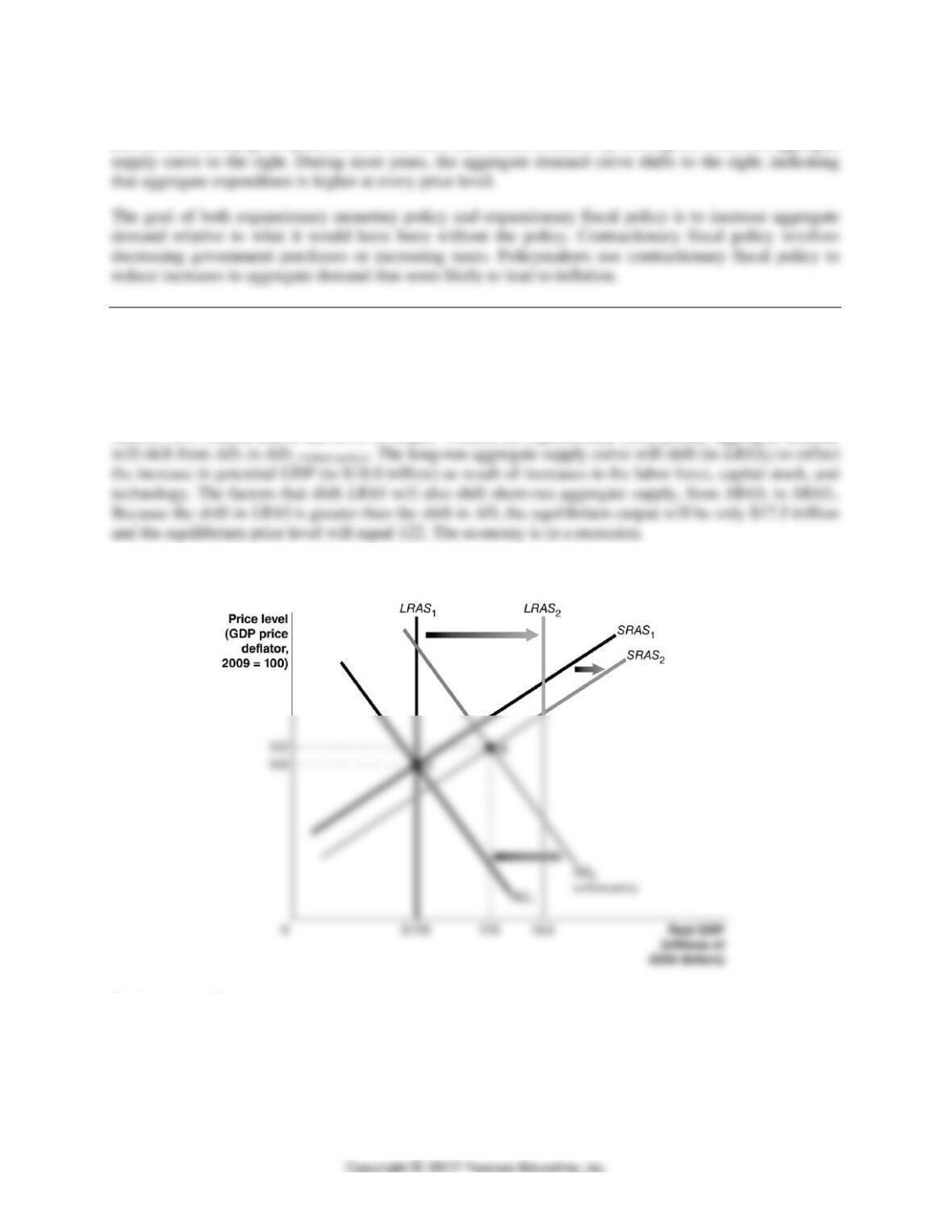
The overview of fiscal policy in the previous section ignores two facts about the economy: (1) The
economy experiences continuing inflation, with the price level rising every year, and (2) the economy
experiences long-run growth, with the long-run aggregate supply curve shifting to the right every year.
386 CHAPTER 16 | Fiscal Policy
The factors that cause the long-run aggregate supply curve to shift also cause firms to supply more goods
and services at any given price level in the short run, which is shown by shifting the short-run aggregate
Extra Solved Problem 16.3
Fiscal Policy in a Dynamic Aggregate Demand and Aggregate Demand Model
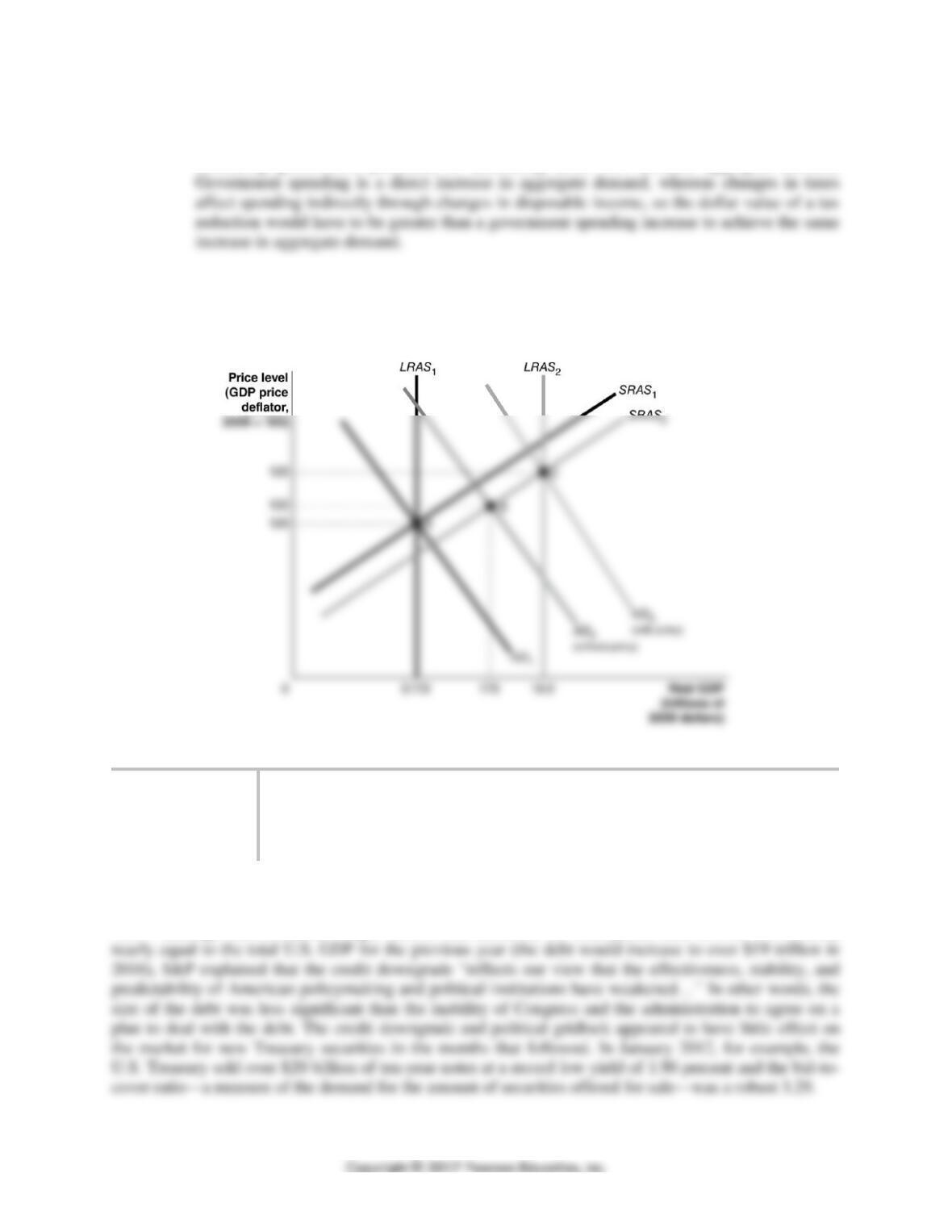
The following graph illustrates the dynamic version of an aggregate demand and aggregate supply model
for an economy with a potential GDP equal to $17.0 trillion. The initial long-run aggregate supply curve
(LRAS1) is a vertical line at this level of output. Without an expansionary fiscal policy, aggregate demand
a. How can fiscal policy be used so that the economy reaches equilibrium at potential GDP?
b. Draw a graph that illustrates the effect of this fiscal policy.
Solving the Problem
Step 1: Review the chapter material.
This problem is about the use of fiscal policy, so you may want to review the section “Fiscal
Policy in the Dynamic Aggregate Demand and Aggregate Supply Model” which begins on
page 947 in the textbook.
CHAPTER 16 | Fiscal Policy 387
Step 2: Explain how fiscal policy can be used so that the economy reaches equilibrium at
potential GDP.
Increasing government purchases or decreasing taxes will increase aggregate demand.
Step 3: Draw a graph that illustrates the effect of this fiscal policy.
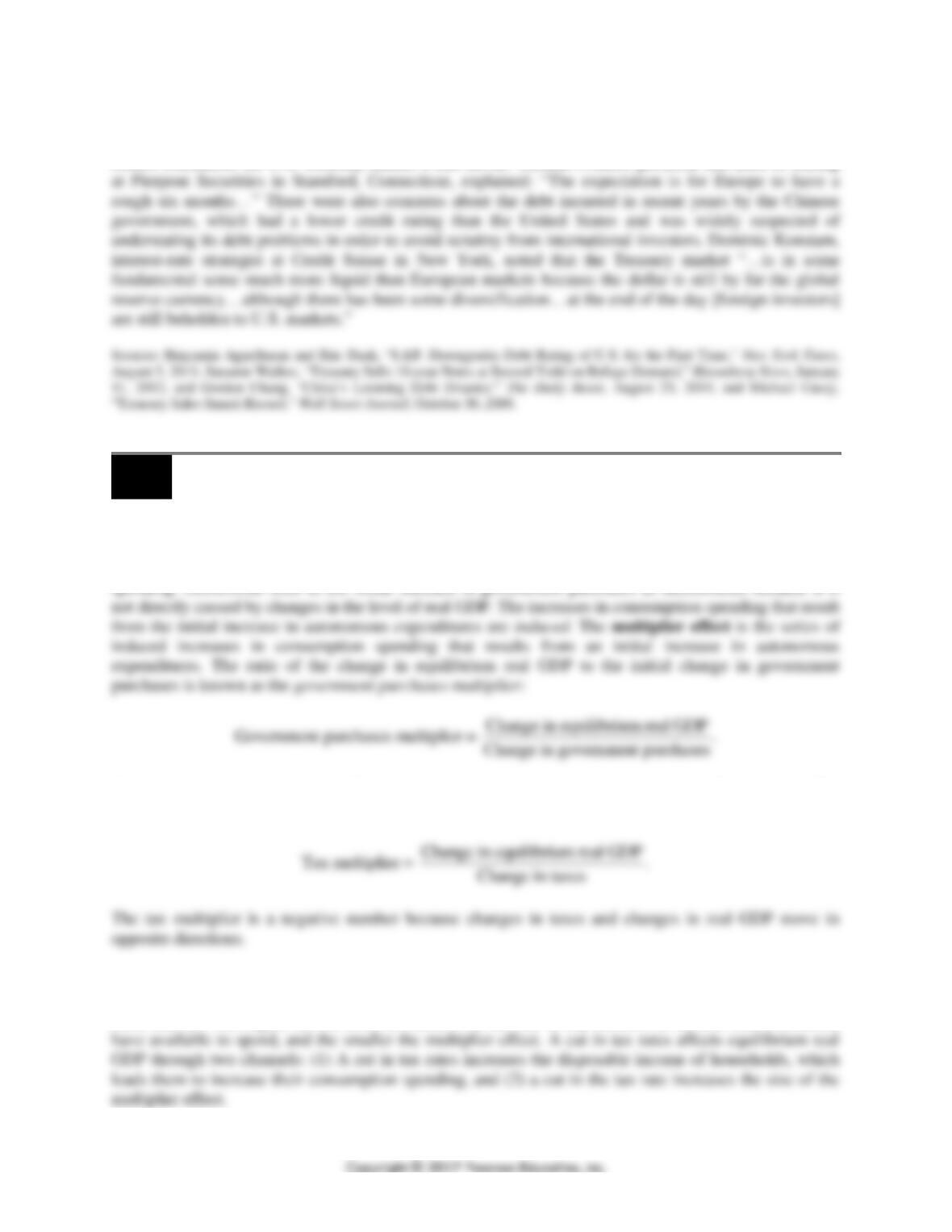
The following graph shows the effect of a change in spending or taxes that shifts aggregate
demand from to AD2 (without policy) to AD3 (with policy). The increase in aggregate demand increases
the price level from 122 to 125 and increases real GDP from $17.5 trillion to $18.0 trillion.
Extra Making
the
Connection
Despite Credit Downgrade, U.S. Treasury Securities Offer
Investors a Safe Haven
Standard & Poor’s (S&P), Moody’s, and Fitch issue credit ratings for public and private debt. In August
2011, S&P lowered the rating of the long-term debt of the U.S. government from its top grade of AAA to
AA+. Although record federal budget deficits had increased the total public debt to over $14 trillion,
388 CHAPTER 16 | Fiscal Policy
An important reason for the continuing strong demand for Treasury debt was the lack of other good
alternatives for investors’ cash. The European debt crisis made traders nervous throughout 2011, so
traders considered the U.S. Treasury market a safe haven. Thomas Connor, president and head of trading
16.4
The Government Purchases and Tax Multipliers (pages 949–953)
Learning Objective: Explain how the government purchases and tax multipliers work.
If the federal government decides to use discretionary fiscal policy to increase aggregate demand by, for
example, spending $100 billion via the ARRA on reconstructing Doyle Drive in San Francisco and
similar projects, the initial increase in aggregate demand should lead to additional increases in income and
spending. Economists refer to the initial increase in government purchases as autonomous because it is
Tax cuts also have a multiplier effect because they increase the disposable income of households. The
expression for the tax multiplier is:
A. The Effect of Changes in the Tax Rate
A change in the tax rate has a more complicated effect on equilibrium real GDP than does a tax cut of a
fixed amount. The higher the tax rate, the smaller the amount of any increase in income that households
CHAPTER 16 | Fiscal Policy 389
B. Taking into Account the Effects of Aggregate Supply
We know that when the AD curve shifts to the right, the price level will rise. As a result of the rise in the
C. The Multipliers Work in Both Directions
Increases in government purchases and cuts in taxes have a positive multiplier effect on equilibrium real
16.5
The Limits to Using Fiscal Policy to Stabilize the Economy
(pages 953–963)
Learning Objective: Discuss the difficulties that can arise in implementing fiscal policy.
Poorly timed fiscal policy, like poorly timed monetary policy, can do more harm than good. Getting the
A. Does Government Spending Reduce Private Spending?
Using government purchases to increase aggregate demand poses another problem. The size of the
multiplier effect may be limited if the increase in government purchases causes consumption, investment,
or net exports to fall. Crowding out is a decline in private expenditures as a result of an increase in
government purchases.
B. Crowding Out in the Short Run
The greater the sensitivity of consumption, investment, and net exports to changes in interest rates, the
C. Crowding Out in the Long Run
Most economists agree that in the short run, an increase in government spending results in partial
crowding out. In the long run, the decline in investment, consumption, and net exports exactly offsets the
increase in government purchases, and aggregate demand remains unchanged.
D. Fiscal Policy in Action: Did the Stimulus Package of 2009 Succeed?
In early 2008, economists advising President Bush believed that the housing crisis and rising oil prices
were pushing the economy into a recession. These economists proposed cutting taxes. Congress enacted a
390 CHAPTER 16 | Fiscal Policy
form of government expenditures, and one-third took the form of tax cuts. At the time the stimulus
package was passed, administration economists estimated that the increase in aggregate demand resulting
from the package would increase real GDP by 3.5 percent and increase employment by 3.5 million by the
end of 2010. In fact, between 2009 and the end of 2010, real GDP increased by 4.0 percent, while
employment declined by 3.3 million. Isolating the effects of the stimulus package from other factors is
difficult, which is why economists differ in their views about how effective the stimulus package was.
Extra Solved Problem 16.5
Fiscal Policy Lags
The Obama administration and Congress passed the American Recovery and Reinvestment Act of 2009 in
response to the severity of the 2007–2009 recession. In recent years, fiscal policy measures such as this
have become less important than automatic stabilizers—spending and taxes that change automatically
during the business cycle—and monetary policy in stabilizing the economy. The main reason for the
diminished importance of discretionary fiscal policy is the difficulty government officials have in
recognizing and reacting to business cycle movements. Carl Walsh has described the long lags involved
in changing fiscal policy in the United States:
Most postwar recessions have been short, lasting on average just under 11 months. By the
Discretionary fiscal policy is often associated with Keynesian Economics. John Maynard Keynes advocated
discretionary fiscal policy as a response to a severe recession, such as the Great Depression of the 1930s.
CHAPTER 16 | Fiscal Policy 391
Solving the Problem
Step 1: Review the chapter material.
This problem is about the limitations of fiscal policy, so you may want to review the section
“The Limits to Using Fiscal Policy to Stabilize the Economy,” which begins on page 953 of
the textbook.
Step 2: Explain why discretionary fiscal policies might be more effective during the Great
Depression or the 2007–2009 recession than during other recessions of the post–
World War II era.
In the United States, the Great Depression refers to the period following a business cycle
peak that occurred in August 1929. The following contraction lasted for 43 months, from
August 1929 to March 1933. Although a recovery followed this contraction, the economy
operated well below its potential throughout the 1930s. Even with lags in recognizing and
reacting to a severe contraction such as the Great Depression, fiscal policy could have
Teaching Tips
Because macroeconomic statistics were not yet available in the 1930s, John Maynard Keynes was unable
to provide more than a rough estimate (10) of the value of the multiplier (The General Theory of
16.6
Deficits, Surpluses, and Federal Government Debt (pages 963–968)
Learning Objective: Define federal budget deficit and federal government debt and
explain how the federal budget can serve as an automatic stabilizer.
A budget deficit is the situation in which the government’s expenditures are greater than its tax revenue.
A budget surplus is the situation in which the government’s expenditures are less than its tax revenue.
392 CHAPTER 16 | Fiscal Policy
A. How the Federal Budget Can Serve as an Automatic Stabilizer
Most of the increase in the deficit during a typical recession takes place without the president and
Congress taking any action. Deficits occur automatically during recessions for two reasons: First, during a
B. Should the Federal Budget Always Be Balanced?
Few economists believe that the federal government should have a balanced budget every year. Some
C. The Federal Government Debt
When the federal government runs a budget deficit, the Treasury must borrow funds from investors by
D. Is Government Debt a Problem?
The federal government is in no danger of defaulting on its debt. The government can raise the funds it
Extra Solved Problem 16.6
The Effect of Economic Fluctuations on the Budget Deficit
The federal government’s budget deficit was $379.5 billion in 2004 and $283.0 billion in 2005. A student
comments: “The government must have acted during 2005 to raise taxes or cut spending or both.” Do you
agree? Briefly explain.
Solving the Problem
Step 1: Review the chapter material.
This problem is about the federal budget as an automatic stabilizer, so you may want to
CHAPTER 16 | Fiscal Policy 393
Step 2: Explain how changes in the budget deficit can occur without Congress and the
president acting.
If Congress and the president take action to raise taxes or cut spending, the federal budget
Extra Credit: Although you don’t have to know it to solve this problem, GDP did increase from
$12.3 trillion in 2004 to $13.1 trillion in 2005.
Question
The federal government’s budget surplus was $236.2 billion in 2000 and $128.2 billion in 2001. What does
this information tell us about fiscal policy actions that Congress and the president took during those years?
Answer
This information seems to indicate that Congress and the president must have increased government
16.7
The Effects of Fiscal Policy in the Long Run (pages 968–971)
Learning Objective: Discuss the effects of fiscal policy in the long run.
Some policy actions are intended to have long-run effects by expanding the productive capacity of the
economy and increasing the rate of economic growth. Policy actions that affect aggregate supply rather
than aggregate demand are called supply-side economics.
A. The Long-Run Effects of Tax Policy
The tax wedge is the difference between the pretax and posttax return to an economic activity. The tax
wedge is determined by the marginal tax rate, which is the fraction of each additional dollar of income
that must be paid in taxes. Here is how tax cuts affect aggregate supply:
• Individual income tax. Reducing marginal tax rates on individual income will reduce the tax
394 CHAPTER 16 | Fiscal Policy
B. Tax Simplification
If the tax code were greatly simplified, the economic resources currently used by the tax preparation
C. The Economic Effect of Tax Reform
If tax reduction and simplification are effective, the economy will experience increases in labor supply,
D. How Large Are Supply-Side Effects?
Most economists agree that there are supply-side effects to reducing taxes: Decreasing marginal income
Extra Solved Problem 16.7
Are Foreign Countries Holding Too Much U.S. Debt?
As the public debt of the United States climbed to over $19 trillion in 2016, budget hawks were
concerned with a related problem: the growing amount of debt held by foreign investors, including
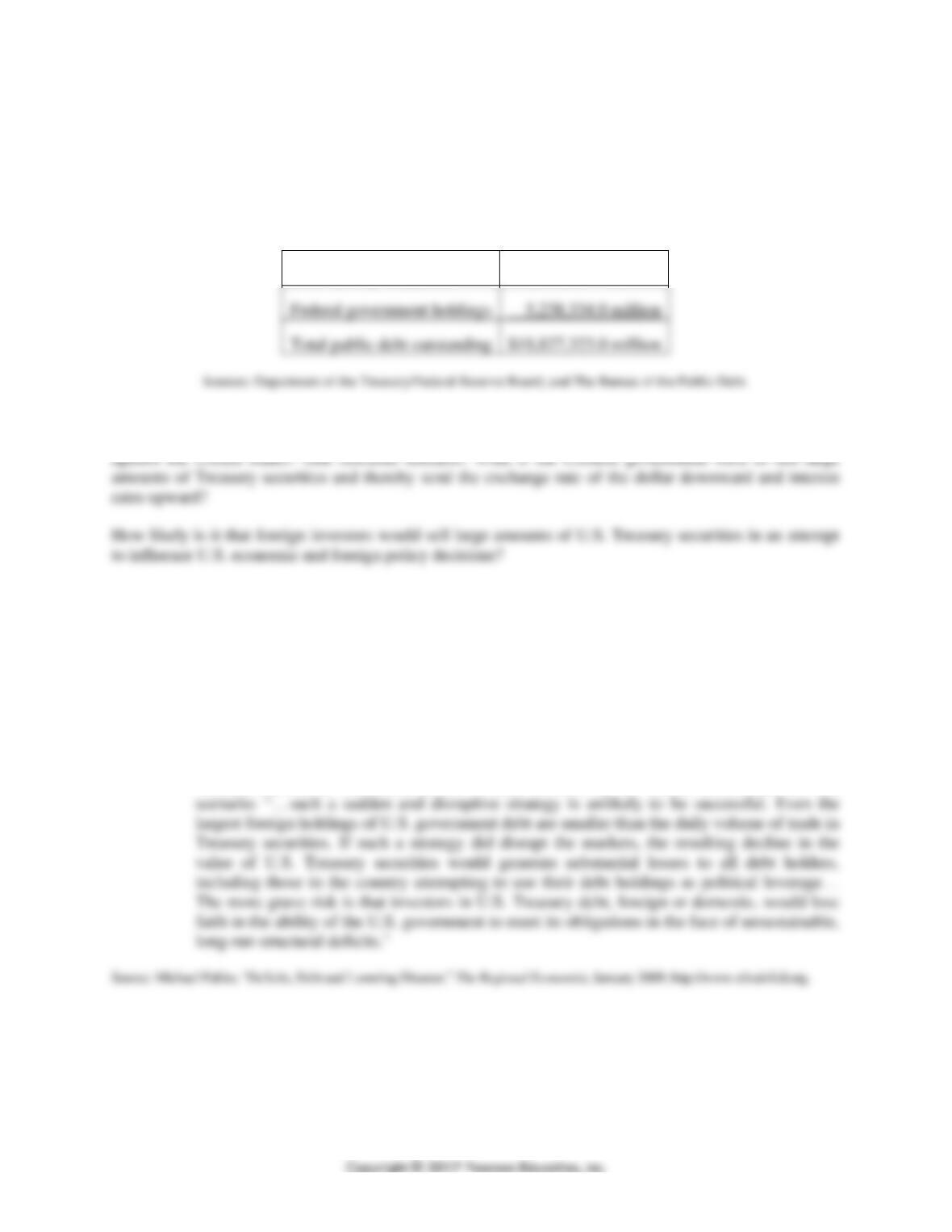
foreign governments. The following table shows that as of November 2015, foreign holdings of U.S.
Treasury securities totaled $6,125.7 billion, or over $6.1 trillion.
Foreign Holdings of U.S. Treasury Securities
November 2015
China
$1,264.5 billion
Caribbean banking centers
Brazil
Ireland
Total
$6,125.7 billion
CHAPTER 16 | Fiscal Policy 395
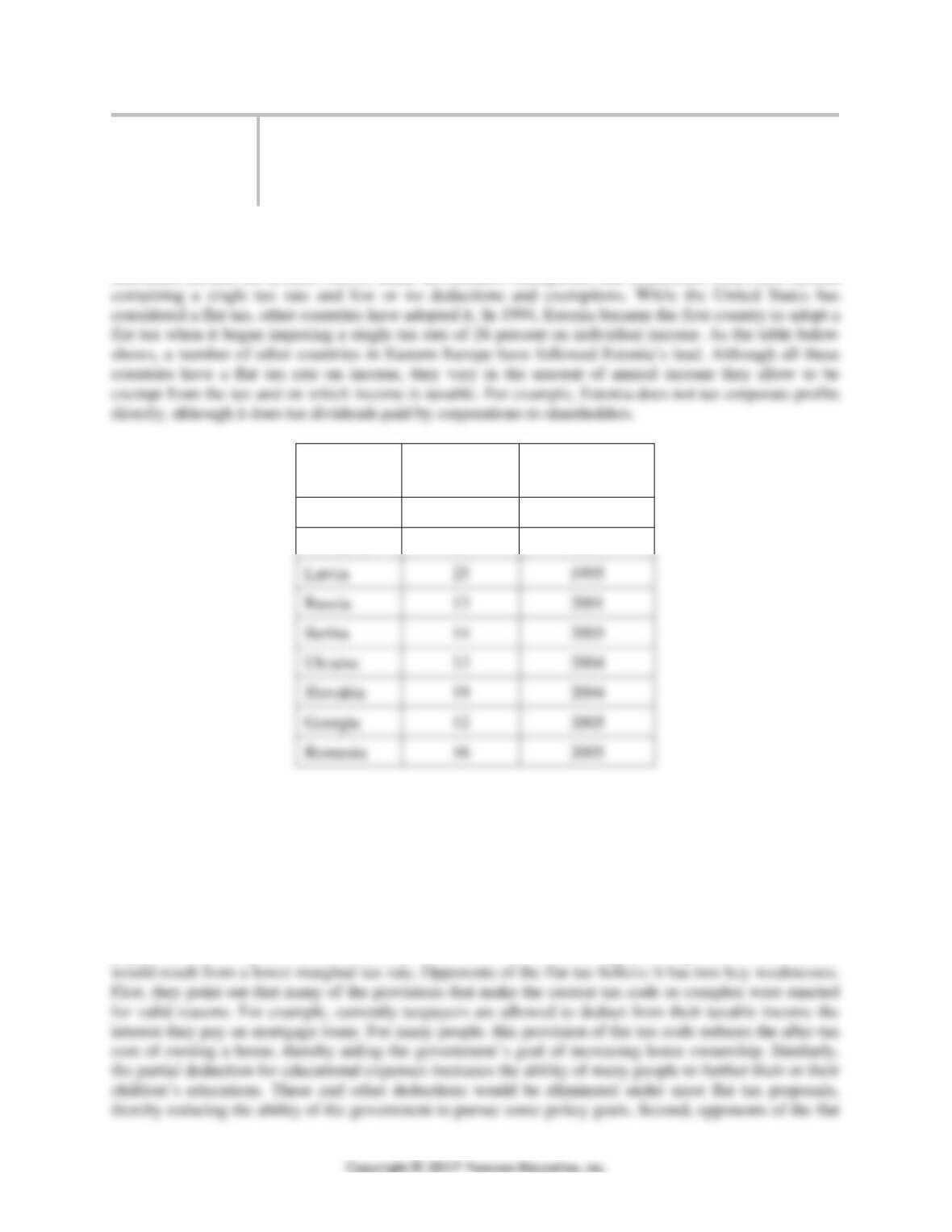
The following table shows the total debt that month reached nearly $19 trillion, about $5.3 trillion of
which was held in the Social Security trust fund and other federal government accounts. Foreign holdings
of debt amounted to about 45 percent of the debt held by the public.
Total Public Debt of the United States
November 2015
Debt held by the public
$13,588,989.0 million
Total public debt outstanding
$18,827,323.0 million
Selling Treasury debt to foreign investors keeps interest rates lower than they would be if all the debt had
to be financed in the United States. But what if foreign investors used their creditor positions as leverage
Solving the Problem
Step 1: Review the chapter material.
This problem is about the long-run effects of fiscal policy, so you may want to review the
sections “Deficits, Surpluses, and Federal Government Debt” and “The Effects of Fiscal
Policy in the Long Run,” which begin on page 963 in the textbook.
Step 2: How likely is it that foreign investors would sell large amounts of U.S. Treasury
securities in an attempt to influence U.S. economic and foreign policy decisions?
Michael Pakko, an economist at the Federal Reserve of St. Louis, commented on this
396 CHAPTER 16 | Fiscal Policy
Extra Making
the
Connection
Should the United States Adopt a “Flat Tax”?
In thinking about fundamental tax reform, some economists and policymakers have advocated
simplifying the individual income tax by adopting a “flat tax.” A flat tax would replace the current
individual income tax system, with its many tax brackets, exemptions, and deductions, with a new system
Country
Flat Tax Rate
Year Flat Tax
Was Introduced
Estonia
26%
1994
Lithuania
33
1994
Latvia
25
1995
Russia
13
2001
Ukraine
13
2004
Slovakia
19
2004
Georgia
12
2005
Romania
16
2005
Governments in Eastern Europe are attracted by the simplicity of the flat tax. It is easy for taxpayers to
understand and easy for the government to administer. The result has been greater compliance with the
tax code. A study of the effects of Russia moving to a flat tax found that, before tax reform, Russians
whose incomes had placed them in the two highest tax brackets had, on average, been reporting only
52 percent of their income to the government. In 2001, with the new single 13 percent tax bracket in
place, these high-income groups on average reported 68 percent of their income to the government.
In the United States and Western Europe, proponents of the flat tax have focused on the reduction in
paperwork and compliance costs and the potential increases in labor supply, saving, and investment that
CHAPTER 16 | Fiscal Policy 397
tax believe that it would make the distribution of income more unequal by reducing the marginal tax rate
on high-income taxpayers. Because high-income taxpayers now can use the intricacies of the tax code to
shelter some of their income from taxes, it is unclear whether the amount of taxes paid by high-income
people actually would decrease under a flat tax.
Extra Economics in Your Life:
Does a Cut in My Income Tax Rate Lower Government Revenue?
Question: Suppose that the government decides to cut income taxes. Does this reduction in your income
tax rate necessarily reduce the government’s tax revenues?
Answer: One effect of a cut in tax rates is a reduction in tax collections from the same amount of
Extra AN INSIDE LOOK News Article to Use in Class