480 Chapter 15
The profit contribution earned by the company is:
Wholesale
Retail
Pricing Practices 481
P15.9 Consumer Surplus. The Heritage Club at Harbor Town offers elegant accommodations
for discriminating vacationers on Hilton Head Island, South Carolina. Like many
vacation resorts, Heritage Club has discovered the advantages of offering its services on
an annual membership or “time–sharing” basis. To illustrate, assume that an individual
vacationer’s weekly demand and marginal revenue curves can be written:
P = $6,500 – $1,250Q,
MR = ∂TR/∂Q = $6,500 – $2,500Q,
where P is the price of a single week of vacation time, and Q is the number of weeks of
vacation time purchased during a given year. For simplicity, assume that the resort’s
marginal cost for a week of vacation time is $1,500, and that fixed costs are nil. This
gives the following total and marginal cost relations:
TC = $1,500Q,
MC = ∂TC/∂Q = $1,500.
A. Calculate the profit-maximizing price, output, profit, and consumer surplus
assuming a uniform per unit price is charged each customer.
B. Calculate the profit-maximizing price, output and profit assuming a two-part
pricing strategy is adopted for each customer.
C. Now assume that fixed costs of $4 million per year are incurred, and that 500
time-share customers (“owners”) are attracted when an optimal two-part pricing
strategy is adopted. Calculate total annual profits.
P15.9 SOLUTION
482 Chapter 15
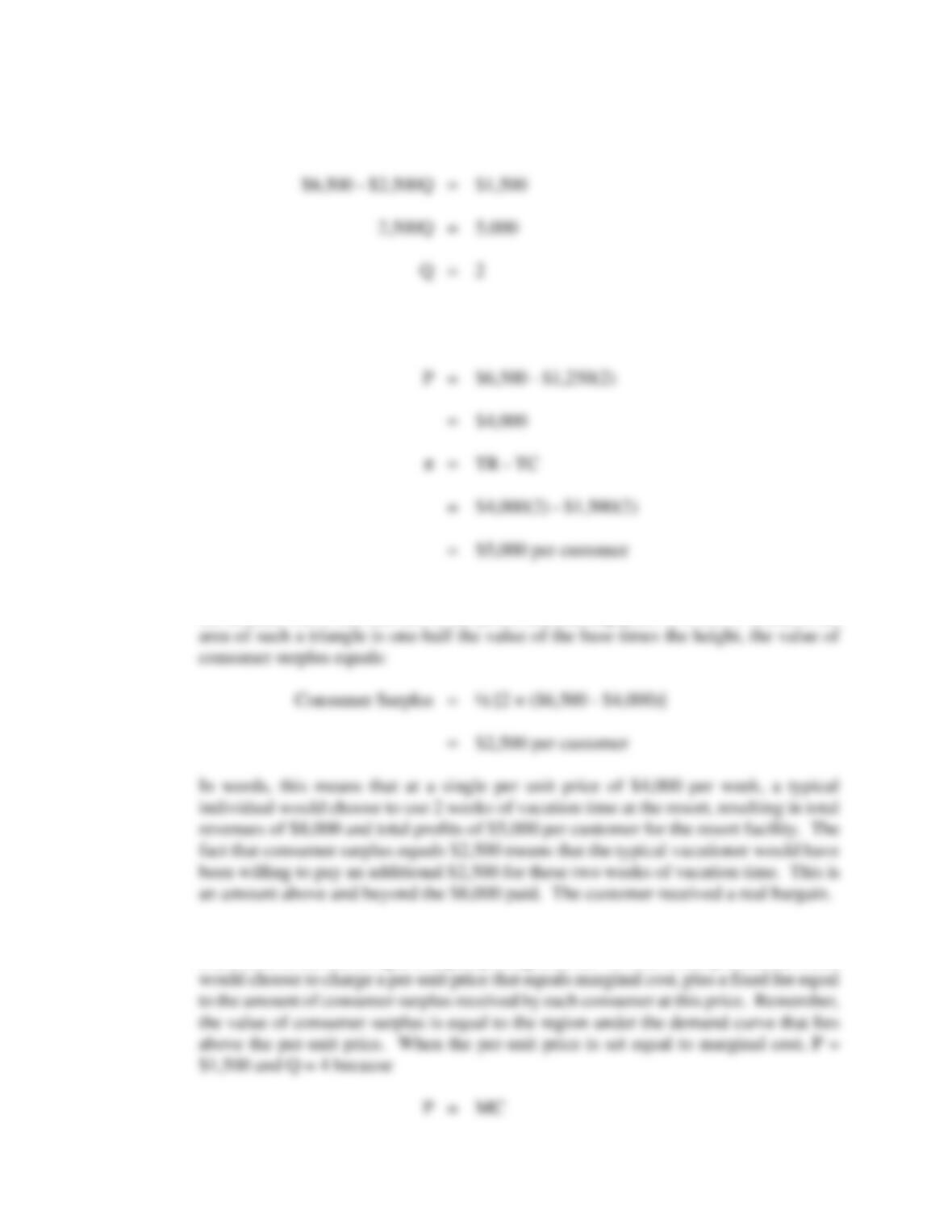
At the profit-maximizing quantity of 2, the optimal single unit price is $4,000 and total
profits equal $5,000 per customer because:
The value of consumer surplus at a standard per unit price is equal to the region under
the demand curve that lies above the profit-maximizing price of $4,000. Because the
B. As an alternative to charging a single-unit price of $4,000 per week, consider the profits
that could be earned using a two-part pricing scheme. To maximize profits, the resort
Pricing Practices 483
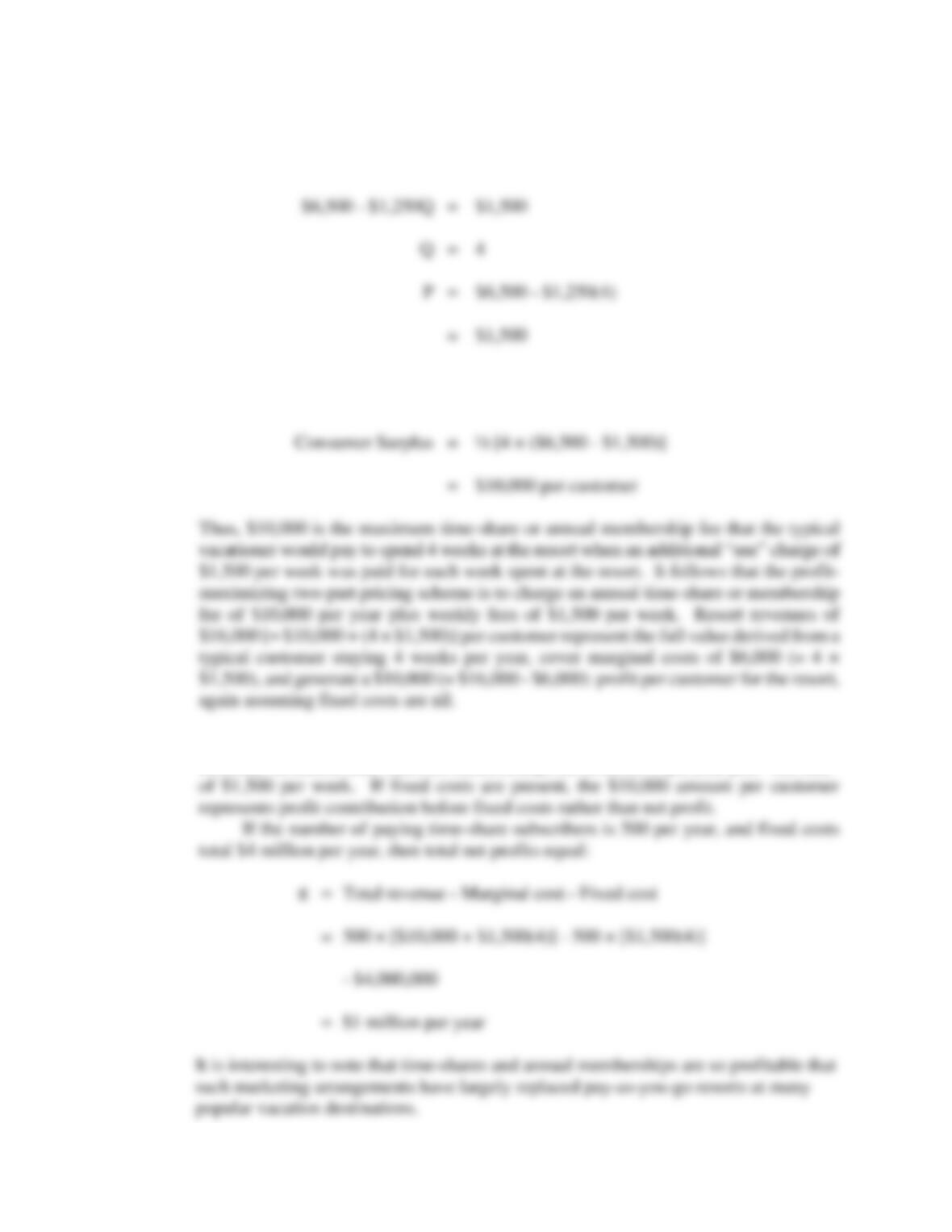
At the unit price of $1,500 and output level of 4, the value of consumer surplus before
imposition of fixed fees would be:
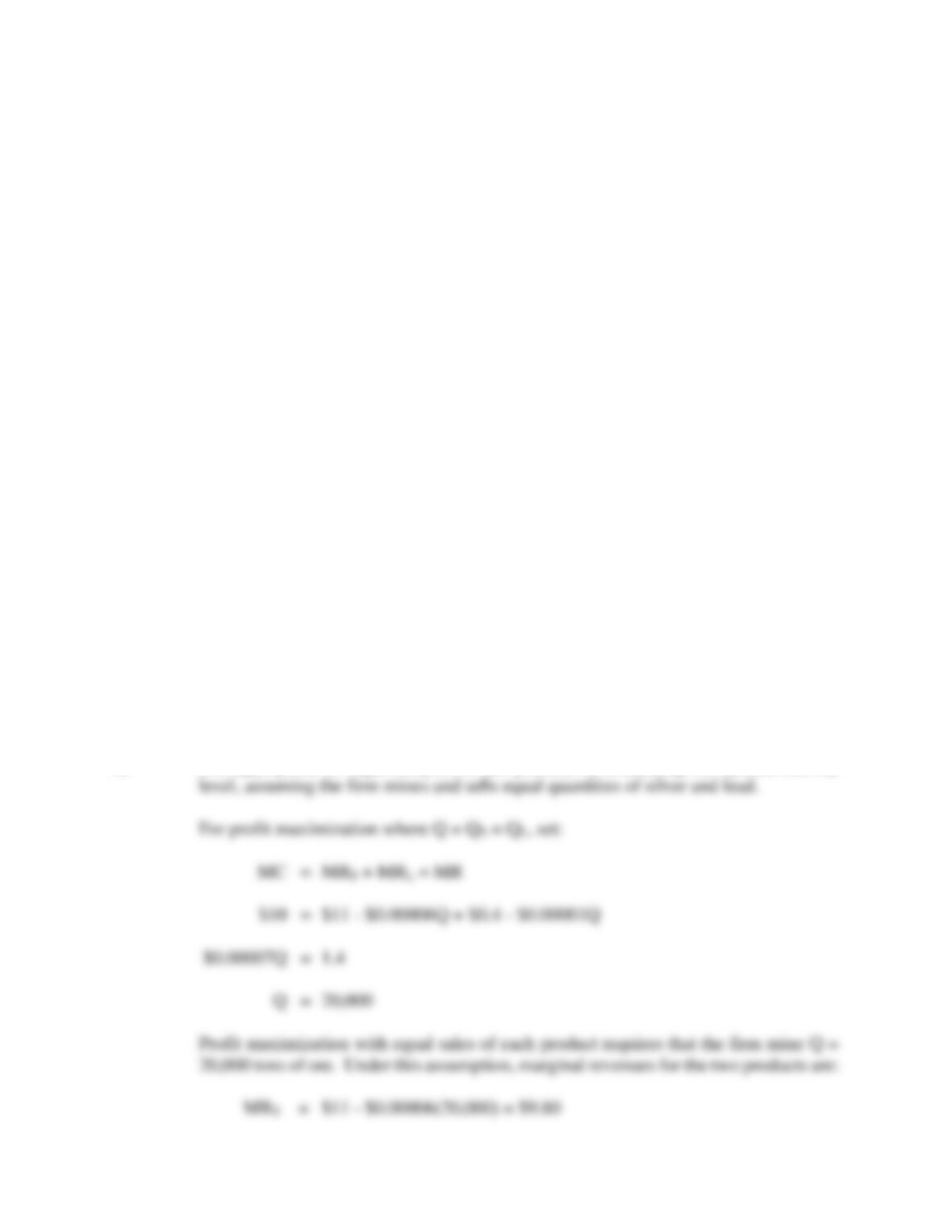
C. As shown in part B, the profit-maximizing two-part pricing scheme is to charge each
customer an annual time-share (or membership) fee of $10,000 per year plus “use fees”
484 Chapter 15
P15.10 Joint Product Pricing. Each ton of ore mined from the Baby Doe Mine in Leadville,
Colorado, produces one ounce of silver and one pound of lead in a fixed 1:1 ratio.
Marginal costs are $10 per ton of ore mined.
The demand and marginal revenue curves for silver are
PS = $11 – $0.00003QS
MRS = ∂TRS/∂QS = $11 – $0.00006QS
and the demand and marginal revenue curve for lead are
PL = $0.4 – $0.000005QL
MRL = ∂TRL/∂QL = $0.4 – $0.00001QL
where QS is ounces of silver and QL is pounds of lead.
A. Calculate profit-maximizing sales quantities and prices for silver and lead.
B. Now assume that wild speculation in the silver market has created a fivefold (or
500%) increase in silver demand. Calculate optimal sales quantities and prices
for both silver and lead under these conditions.
P15.10 SOLUTION
A. It is appropriate to begin analysis of this problem by examining the optimal activity
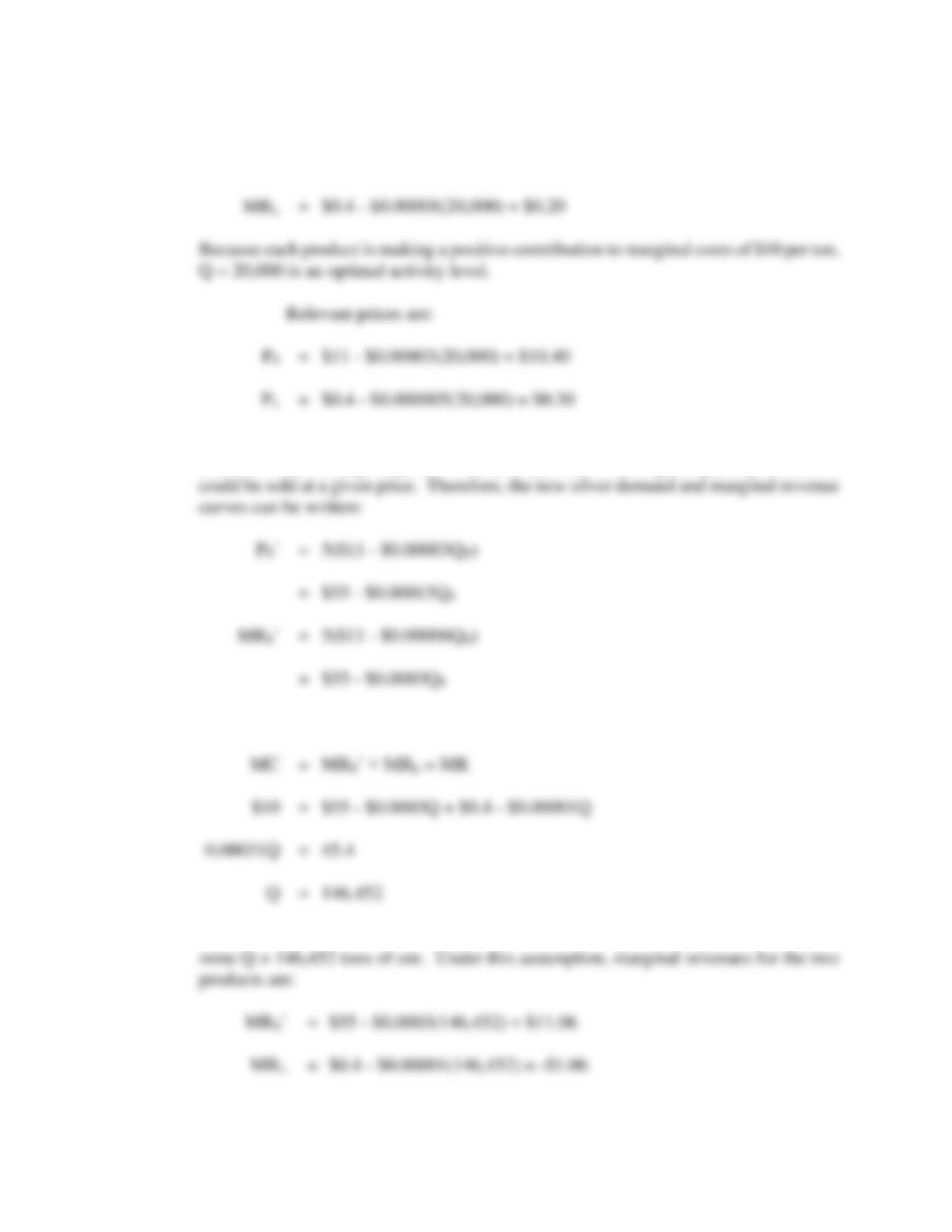
Pricing Practices 485
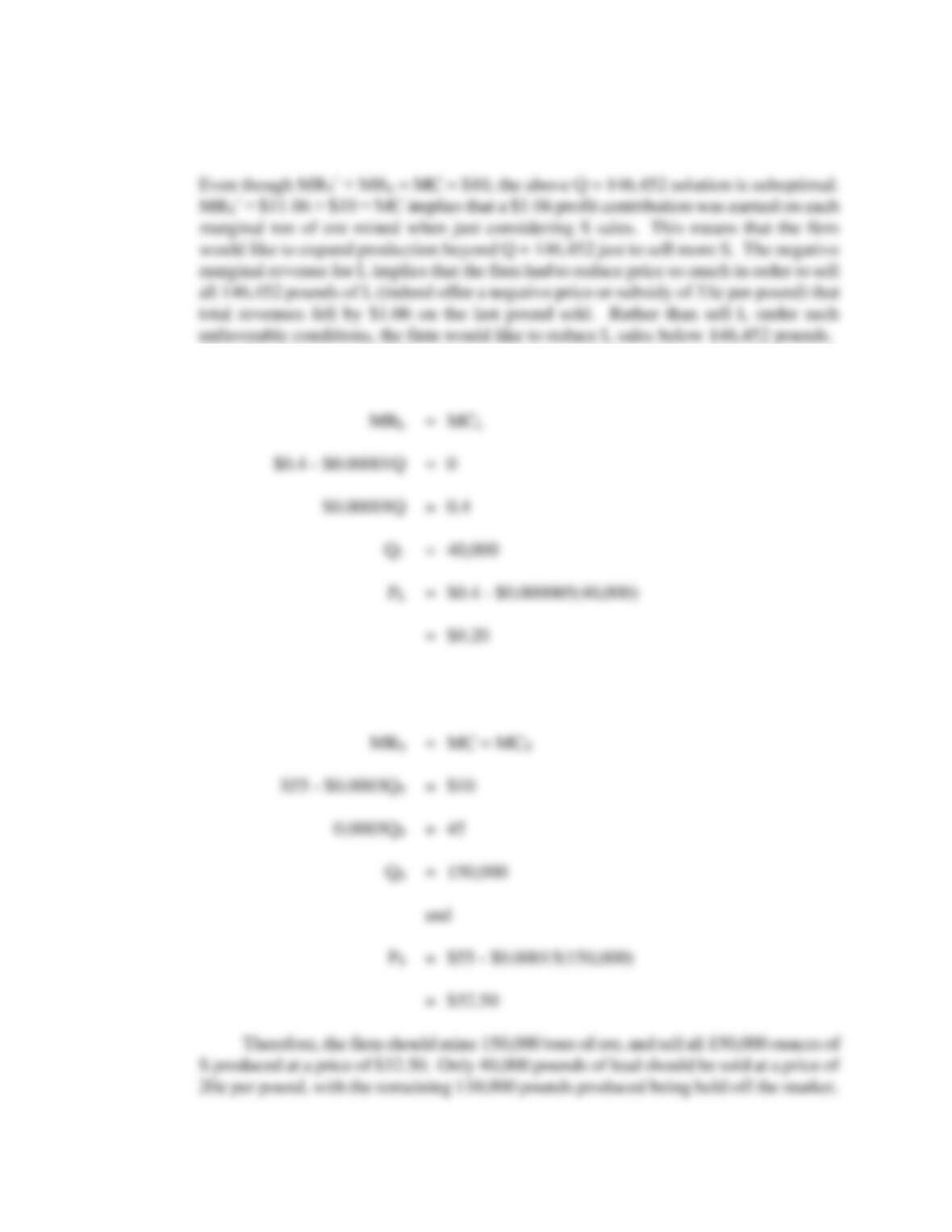
B. A five-fold (or 500%) increase in silver demand means that a given quantity could be
sold at 5 times the original price. Alternatively, 5 times the original quantity demanded
Now, assuming all output is sold,
Thus, profit maximization with equal sales of each product requires that the firm
486 Chapter 15
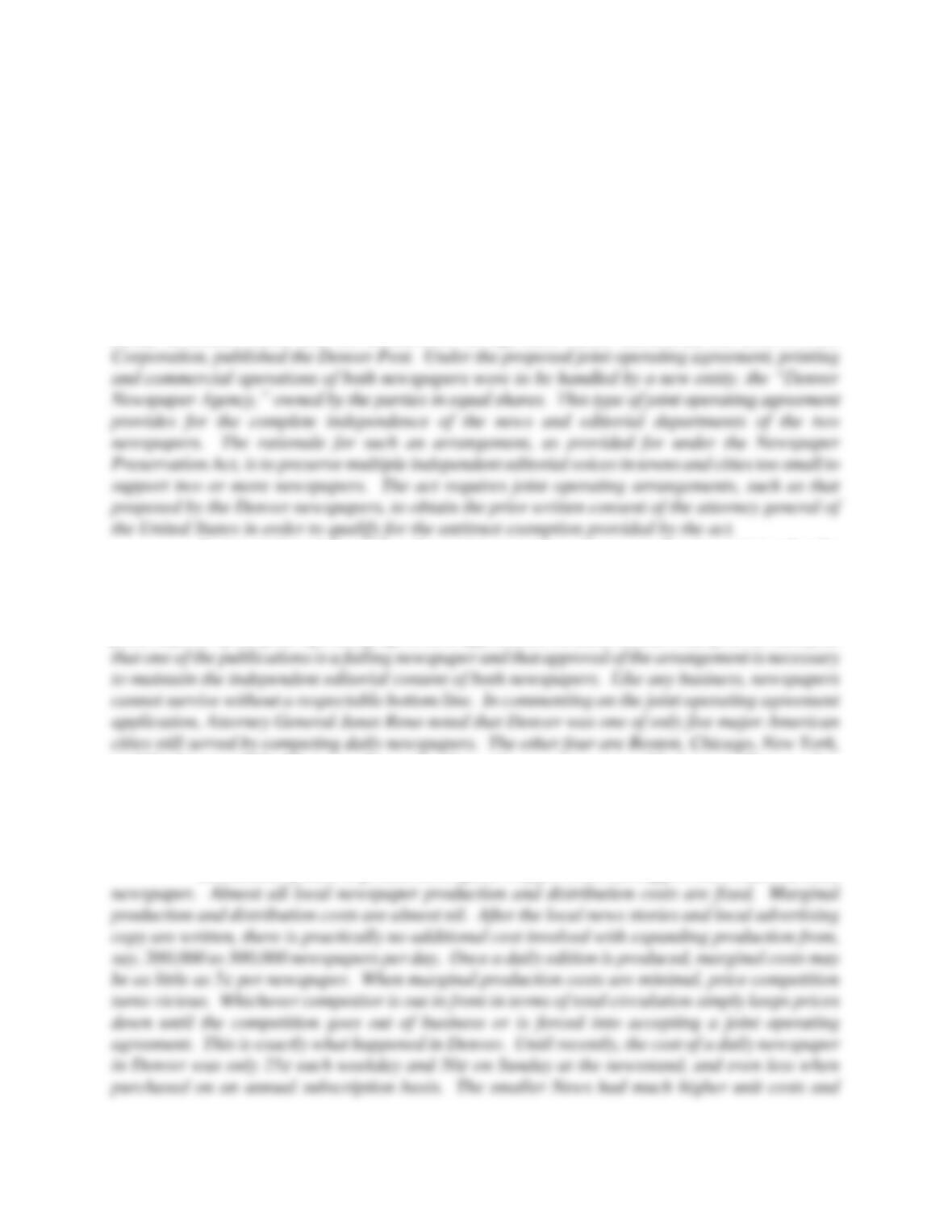
The firm would sell L only up to the point where MRL = 0 because, given
additional production to sell S, the marginal cost of L is zero. Set,
The optimal production and sales level of S is found by setting MRS = MC,
because S is the only product sold from the marginal ton of ore being mined.

Pricing Practices 487
488 Chapter 15
CASE STUDY FOR CHAPTER 15
Pricing Practices in the Denver, Colorado, Newspaper Market
On May 12, 2000, the two daily newspapers in Denver, Colorado, filed an application with the U.S.
Department of Justice for approval of a joint operating arrangement. The application was filed by
The E.W. Scripps Company, whose subsidiary, the Denver Publishing Company, published the
Rocky Mountain News, and the MediaNews Group, Inc., whose subsidiary, the Denver Post
Scripps initiated discussions for a joint operating agreement after determining that the
News would probably fail without such an arrangement. In their petition to the Justice Department,
the newspapers argued that the News had sustained $123 million in net operating losses while the
financially stronger Post had reaped $200 million in profits during the 1990s. This was a crucial
point in favor of the joint operating agreement application because the attorney general must find
and Washington, DC. Of course, these other four cities are not comparable in size to Denver; they
are much bigger. None of those four cities can lay claim to two newspapers that are more or less
equally matched and strive for the same audience. In fact, that there is not a single city in the
United States that still supports two independently owned and evenly matched, high-quality
newspapers that vie for the same broad base of readership.
Economies of scale in production explain why few cities can support more than one local
Pricing Practices 489
simply could not afford to compete with the Post at such ruinously low prices. This is why the
production of local newspapers is often described as a classic example of natural monopoly.
On Friday, January 5, 2001, the Justice Department gave the green light to a 50-year
joint operating agreement between the News and its longtime rival, the Post. Starting January 22,
2001, the publishing operations of the News and the Post were consolidated. The Denver
A. Use your knowledge of monopoly pricing practices to explain why advertising rates and
newspaper circulation prices were likely to increase and jobs were likely to be lost,
following adoption of this joint operating agreement. Use company information to
support your argument (see http://www.denverpost.com and
http://www.rockymountainnews.com/).
B. Classified ads to sell real estate in a local newspaper can cost five to ten times as much
C. Widely differing fares for business and vacation travelers on the same flight have led
some to accuse the airlines of price discrimination. Do airline fare differences or local
newspaper classified-ad rate differences provide stronger evidence of price
discrimination?
CASE STUDY SOLUTION
A. At the time the joint operating agreement was formed, neither news organization would
490 Chapter 15
B. Local newspapers have a formidable niche in the provision of regional news and
classified advertising. If readers want stock quotes or general business news, they can
find that information on the Internet or from a host of national providers, like The Wall
C. The airline industry provides an interesting basis for discussing price discrimination.
Ticket prices vary dramatically between business customers, whose travel plans change
Pricing Practices 491
On the other hand, there is absolutely no difference in the cost of providing a
three-line ten-day want-ad for a bicycle versus a personal residence. Both types of ads
require the same amount of labor and raw materials to produce, sell and deliver to
newspaper customers. Because the costs of providing consumer and commercial want
492 Chapter 15
Appendix 15A
TRANSFER PRICING
PROBLEM & SOLUTION
P15A.1 Transfer Pricing. Simpson Flanders, Inc., is a Motor City-based manufacturer and
distributor of valves used in nuclear power plants. Currently, all output is sold to North
American customers. Demand and marginal revenue curves for the firm are as follows:
P = $1,000 – $0.015Q
MR = ∂TR/∂Q = $1,000 – $0.03Q
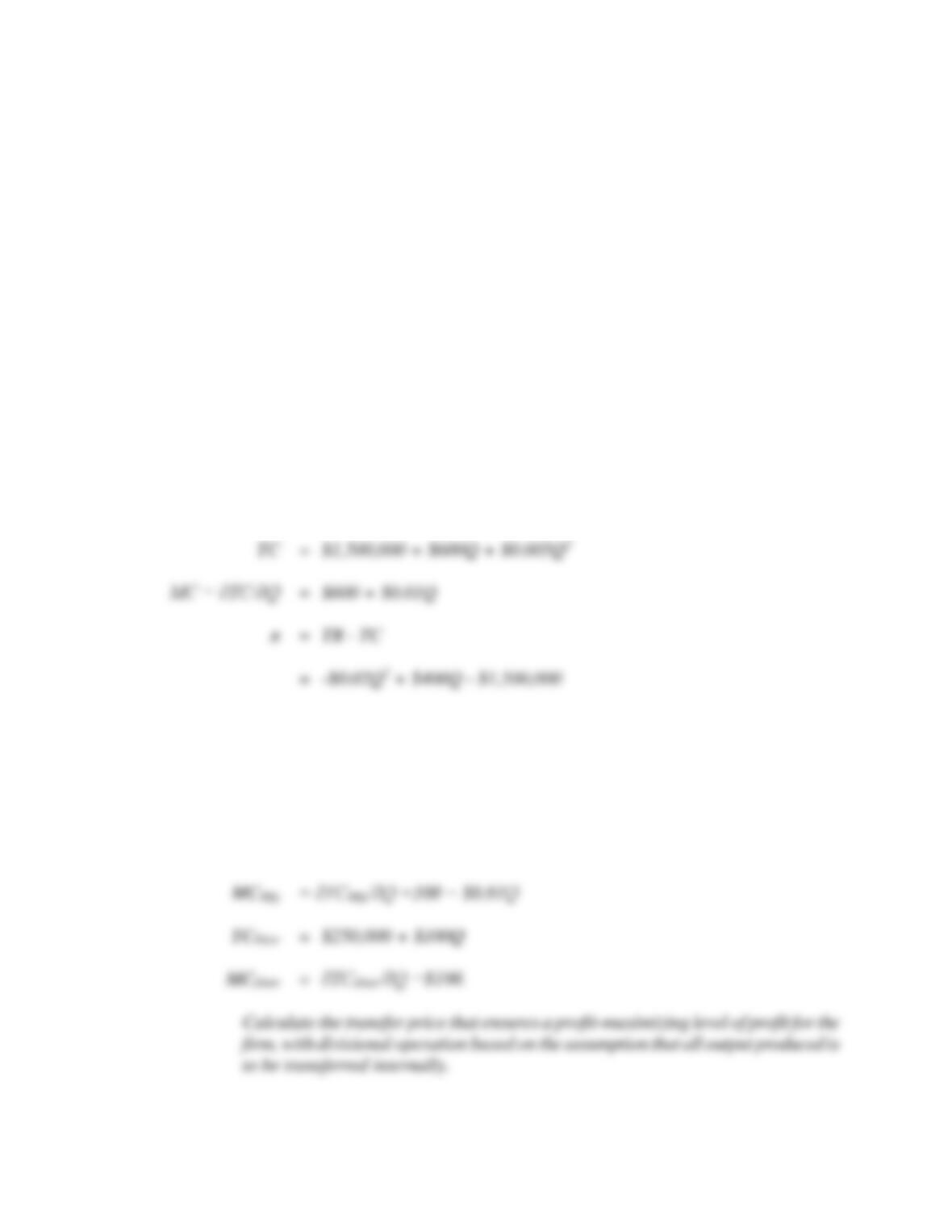
Relevant total cost, marginal cost, and profit functions are
A. Calculate the profit-maximizing activity level for Simpson Flanders when the firm
is operated as an integrated unit.
B. Assume that the company is reorganized into two independent profit centers with
the following cost conditions:
TCMfg = $1,250,000 + $500Q + $0.005Q2
Pricing Practices 493
C. Now assume that a major distributor in the European market offers to buy as
many valves as Simpson Flanders wishes to offer at a price of $645. No impact on
demand from the company’s North American customers is expected, and current
facilities can be used to supply both markets. Calculate the company’s optimal
price(s), output(s), and profits in this situation.
P15A.1 SOLUTION
A. Profit maximization occurs at the point where MR = MC, so the optimal output level is:
This implies:
B. To derive an appropriate transfer price when no external market is present, the net
494 Chapter 15
movement along its marginal revenue curve, and the manufacturing division supplies
output along its marginal cost curve, then the market clearing transfer price is the price
At a transfer price of $600, the quantity supplied by the manufacturing division equals
At a transfer price PT > $600, the distribution division will accept fewer units of output
C. If a perfectly competitive external market exists for the transferred product, the optimal
transfer price equals the external market price. Because the new European customer is
Pricing Practices 495
In this instance of excess internal supply, the distribution division will purchase
The manufacturing division will offer an additional QE = 6,000 units to new customers
in the European market at a price of PE = $645.
Maximum total profits are:
= $635,000
The offer from the European distributor should be accepted as it results in a