
interactive activity
Chapter 15
Monopolistic Competition
and Product Differentiation
1. Use the three conditions for monopolistic competition discussed in the chapter to
decide which of the following firms are likely to be operating as monopolistic
competitors. If they are not monopolistically competitive firms, are they
monopolists, oligopolists, or perfectly competitive firms?
1. The three conditions for monopolistic competition are (1) a large number of
producers, (2) differentiated products, and (3) free entry and exit.
a. There are many bands that play at weddings, parties, and so on. There are no
significant barriers to entry or exit. And products are differentiated by quality
b. The industry for individual-serving juice boxes is dominated by a few very
large firms (for example, Minute Maid, Welch’s, and Kool Aid), and there are
c. There are a large number of dry cleaners, and each produces a product dif-
ferentiated by location: customers are likely to prefer to use the dry cleaner
d. There are a large number of soybean farmers, and there is free entry and exit
in this industry. However, soybeans are not differentiated from each other—
2. You are thinking of setting up a coffee shop. The market structure for coffee
shops is monopolistic competition. There are three Starbucks shops and two
Solution
S-232 Chapter 15 Monopolistic coMpetition and product differentiation
But you could further differentiate your product by style (for example, you
3. The market structure of the local gas station industry is monopolistic competi-
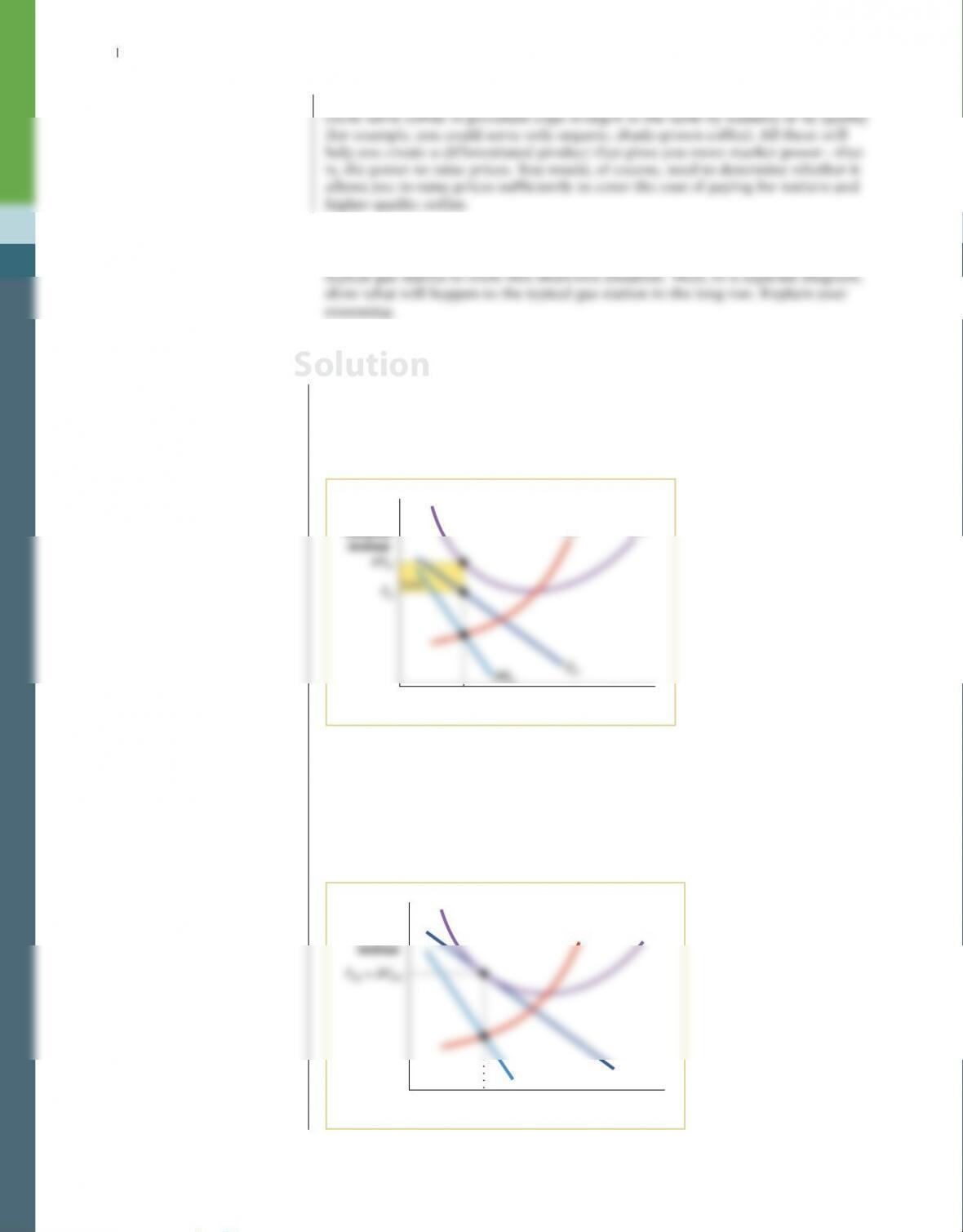
tion. Suppose that currently each gas station incurs a loss. Draw a diagram for a
3. Each gas station will produce the output, and so charge the price, that maxi-
mizes its profit or minimizes its loss. That is, it will produce quantity QU, where
marginal cost equals marginal revenue, and so charge price PU. Since the price
PU is lower than average total cost at the quantity QU, ATCU, each gas station
incurs a loss. That is, the situation for the typical gas station looks like the
accompanying diagram.
MC
MRU
DU
ATC
QUQuantity
Price,
cost,
mar
ginal
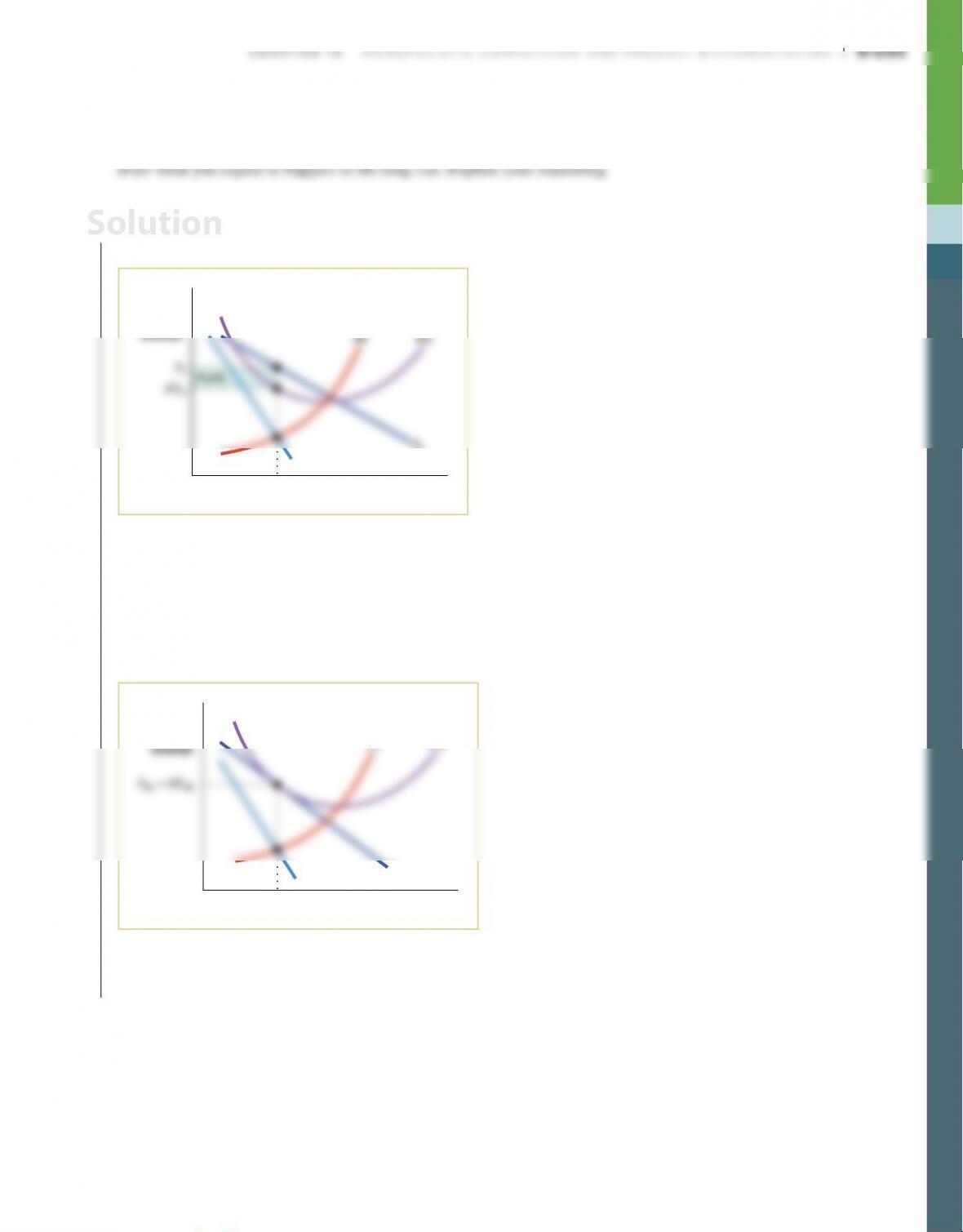
Since gas stations are incurring losses, in the long run some will exit the indus–
try. This shifts the demand and marginal revenue curves for each of the remain-
ing gas stations rightward. Exit continues until each remaining gas station
makes zero profit. This is the long-run equilibrium. The situation for the typi-
cal gas station in this equilibrium is illustrated in the accompanying diagram.
Demand has increased to the level at which this gas station makes zero profit at
a price of PMC and a quantity of QMC.
MC
MRMC
DMC
ATC
QMC Quantity
P
MC = ATCMC
Price,
cost,
marginal
Solution
4. The local hairdresser industry has the market structure of monopolistic compe–
tition. Your hairdresser boasts that he is making a profit and that if he continues
to do so, he will be able to retire in five years. Use a diagram to illustrate your
hairdresser’s current situation. Do you expect this to last? In a separate diagram,
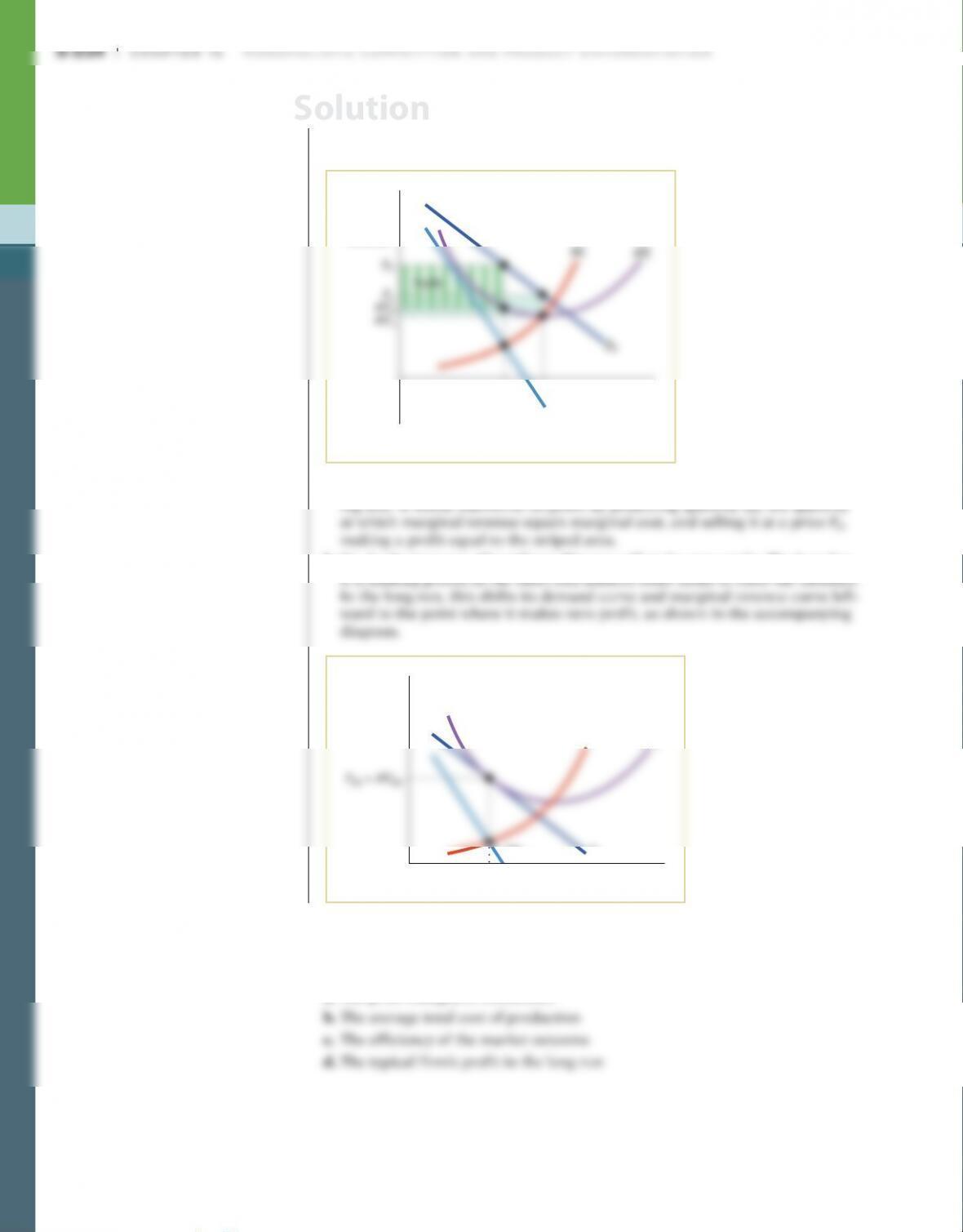
4. Your hairdresser currently makes a profit. His demand, marginal revenue, mar–
ginal cost, and average total cost curves are shown in the accompanying diagram.
QP
MRP
DP
Quantity
ATCP
PP
Price,
cost,
mar
ginal
Since this hairdresser (and all other hairdressers) makes a profit equal to the
shaded rectangle by producing quantity QP at a price PP, there will be entry
into this industry. As more hairdressers open shops in town, demand for the
typical existing hairdresser will fall—the demand curve and marginal revenue
curve shift leftward. This will continue to the point at which no hairdresser
makes positive profit. This eliminates the incentive for further entry into the
industry, and long-run equilibrium is reached. The situation is illustrated in
the accompanying diagram.
QMC
MC
MRMC
DMC
ATC
Quantity
P
MC = ATCMC
Price,
cost,
marginal
The best the typical hairdresser can do is to produce quantity QMC at a price of
PMC. Since price equals average total cost at this quantity, each hairdresser will
make exactly zero profit.
5. Magnificent Blooms is a florist in a monopolistically competitive industry. It is
a successful operation, producing the quantity that minimizes its average total
cost and making a profit. The owner also says that at its current level of output,
its marginal cost is above marginal revenue. Illustrate the current situation of
Magnificent Blooms in a diagram. Answer the following questions by illustrating
with a diagram.
a. In the short run, could Magnificent Blooms increase its profit?
b. In the long run, could Magnificent Blooms increase its profit?
Solution
5. The current situation of Magnificent Blooms is illustrated in the accompanying
diagram. It produces quantity Q1 at the minimum point of its average total cost
curve, and it charges price P1, making profit equal to the shaded rectangular area.
QPQ1
MRP
DP
Quantity
P1
ATC1
ATCP
Price,
cost,
mar
ginal
revenue
a. Yes, Magnificent Blooms could increase its profit in the short run by produc-
ing less. It would maximize its profit by producing quantity QP, the quantity
b. No. In the long run, Magnificent Blooms will make zero profit. The fact that
QMC
MC
MRMC DMC
ATC
Quantity
Price,
cost,
marginal
revenue
P
MC = ATCMC
6. “In the long run, there is no difference between monopolistic competition and
perfect competition.” Discuss whether this statement is true, false, or ambiguous
with respect to the following criteria.
a. The price charged to consumers
Solution

6. a. According to this criterion, the statement is false. The price charged to con-
sumers is higher in monopolistic competition than it is in perfect competi-
b. According to this criterion, the statement is false. The average total cost of
production is higher for a monopolistically competitive firm than for a per-
fectly competitive firm. For a perfectly competitive firm in the long run, there
c. According to this criterion, the statement is ambiguous. The market outcome
under perfect competition is clearly efficient: price equals marginal cost, so
no firm wants to produce more output at a price at which consumers want
to buy more output. That is, no mutually beneficial trades between consum–
ers and producers go unexploited. The efficiency of monopolistic competition,
d. According to this criterion, the statement is true. Both perfectly competitive
firms and monopolistically competitive firms earn zero profits in the long run,
7. “In both the short run and in the long run, the typical firm in monopolistic com-
petition and a monopolist each make a profit.” Do you agree with this statement?
Explain your reasoning.
7. In the short run, a monopolist makes positive profit. Whether a firm in monopo–
listic competition makes a profit depends on how many firms there are in the
industry. If there are “too few” firms in the industry (relative to the long-run
equilibrium number of firms), then a typical firm in monopolistic competition
8. The market for clothes has the structure of monopolistic competition. What
impact will fewer firms in this industry have on you as a consumer? Address the
following issues.
Solution
Solution
S-236 Chapter 15 Monopolistic coMpetition and product differentiation
8. a. In monopolistic competition, firms seek to differentiate themselves by, among
other things, the type of clothes they sell. And to you, as a customer, there is
b. Monopolistically competitive firms also seek to differentiate themselves
through the quality of service they offer. There will be stores that take your
c. If there are fewer firms in this industry, each firm will sell a greater quantity
9. For each of the following situations, decide whether advertising is directly infor-
mative about the product or simply an indirect signal of its quality. Explain your
reasoning.
9. a. This commercial is not directly informative about the product since every
car manufacturer can claim that its car is better than any other; this is not a
statement that can be easily verified by the purchaser before purchase. How-
ever, Peyton Manning commands a very high fee for advertising. What the
10. In each of the following cases, explain how the advertisement functions as a
signal to a potential buyer. Explain what information the buyer lacks that is
being supplied by the advertisement and how the information supplied by the
Solution
Solution
10. a. The seller here is the job-seeker, who is selling his or her labor to a potential
employer. The potential employer lacks information on how good an employee
the job-seeker is—how dependable, diligent, and so on. By being willing to
b. The potential buyer lacks information on how good the merchandise is. By
11. The accompanying table shows the Herfindahl–Hirschman Index (HHI) for the
restaurant, cereal, movie studio, and laundry detergent industries as well as the
advertising expenditures of the top 10 firms in each industry. Use the informa-
tion in the table to answer the following questions.
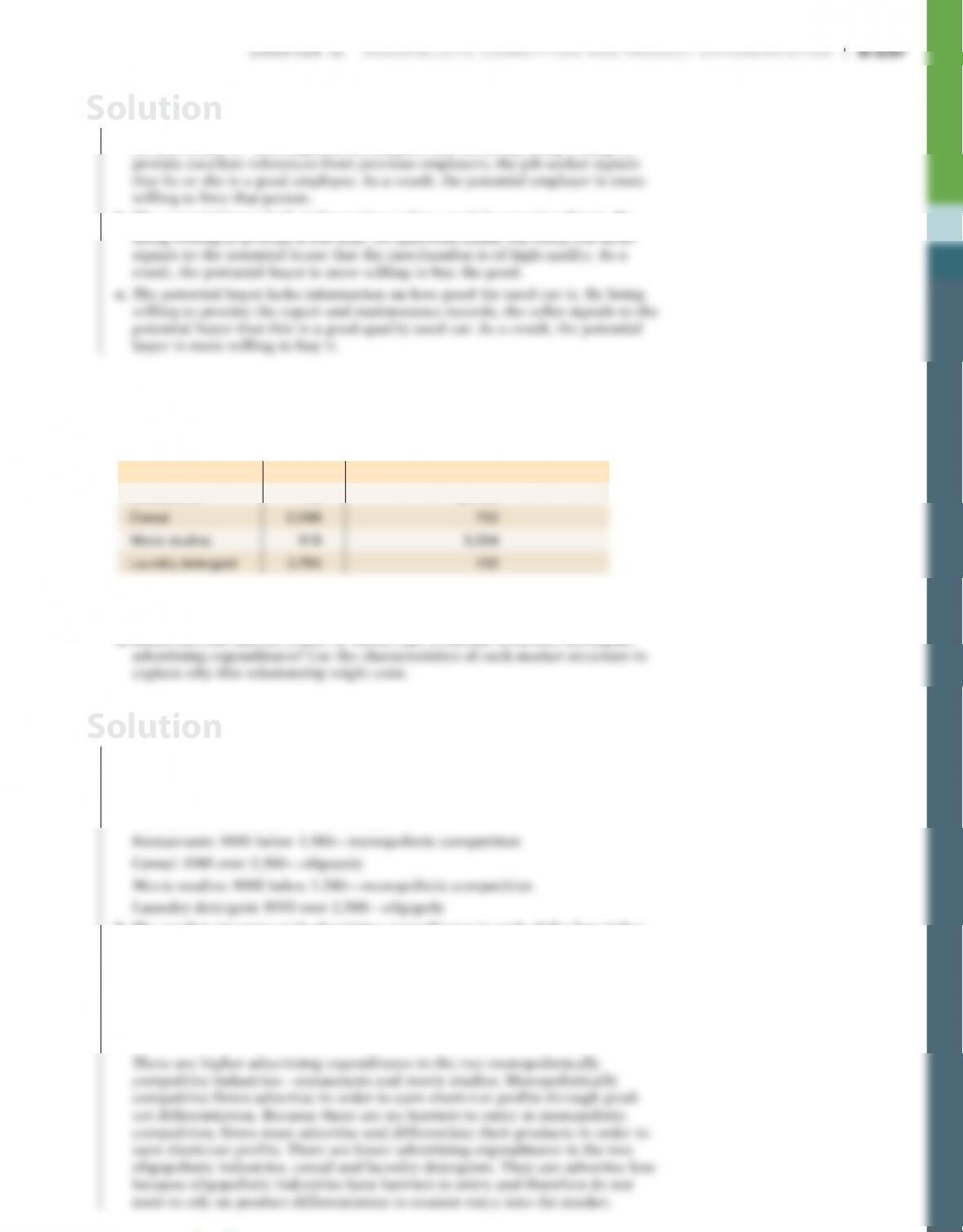
Industry HHI Advertising expenditures (millions)
Restaurants 179 $1,784
a. Which market structure—oligopoly or monopolistic competition—best
characterizes each of the industries?
b. Based on your answer to part a, which type of market structure has higher
11. a. Recall from Chapter 14 that according to Justice Department guidelines, an
HHI below 1,500 indicates a strongly competitive market, an HHI between
1,500 and 2,500 indicates a somewhat competitive market, and an HHI over
2,500 indicates an oligopoly. So you should expect monopolistically competi-
tive industries to have an HHI below 1,500 and oligopolies to have an HHI
above 2,500. So the four industries are:
b. The market structure and advertising expenditures in each of the four indus-
tries correlate as follows:
Restaurants: monopolistic competition and high advertising expenditures
Cereal: oligopoly and medium advertising expenditures
Movie studios: monopolistic competition and high advertising expenditures
Laundry detergent: oligopoly and low advertising expenditures
Solution
Solution
12. McDonald’s spends millions of dollars each year on legal protection of its brand
12. The fast-food industry is a monopolistically competitive one, and companies
attempt to differentiate their product from that of other firms. McDonald’s
invests money in maintaining its brand name, which differentiates it from other
WORK IT OUT Interactive step-by-step help with solving this
problem can be found online.
13. The restaurant business in town is a monopolistically competitive industry
in long-run equilibrium. One restaurant owner asks for your advice. She
tells you that, each night, not all tables in her restaurant are full. She also
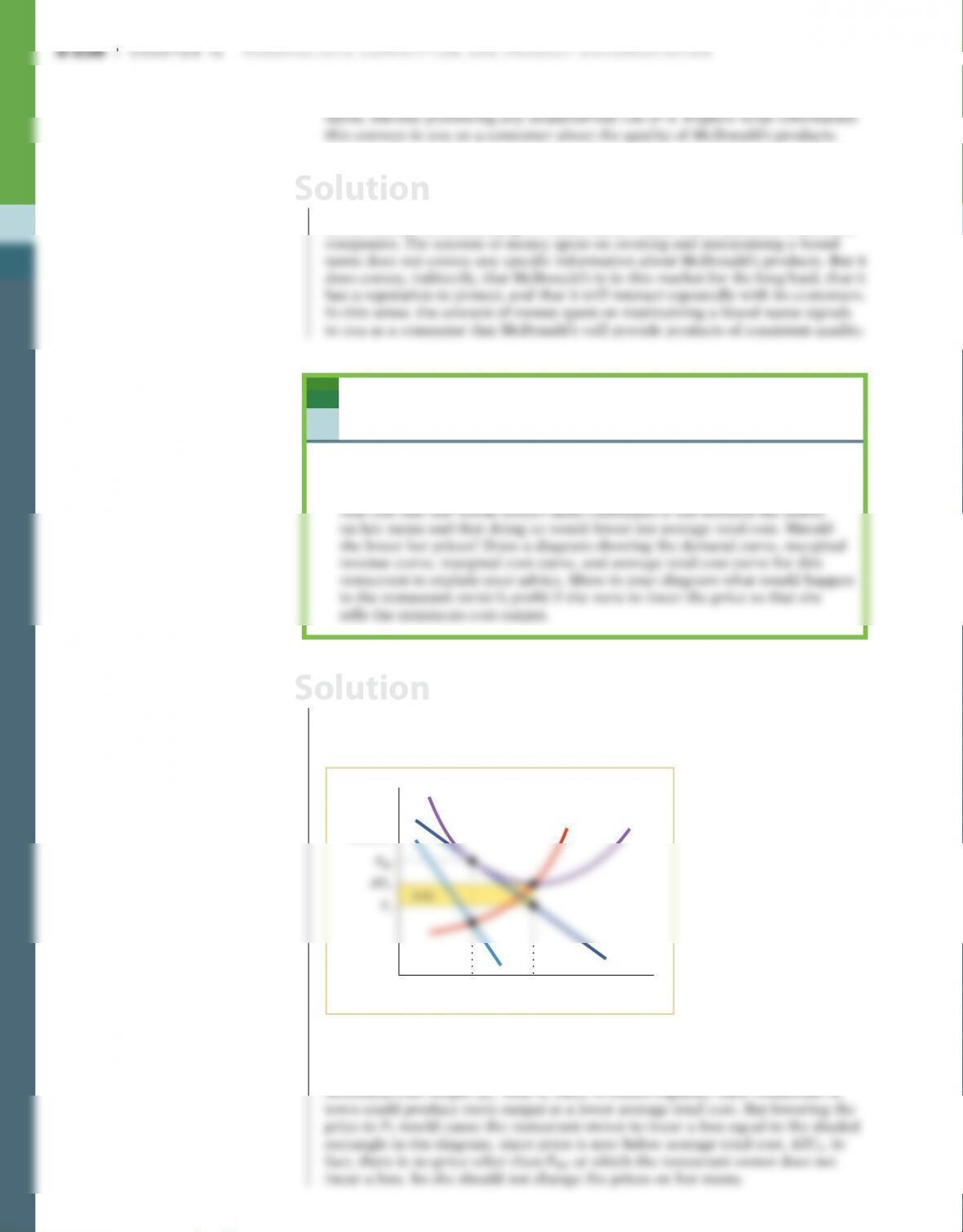
13. She should not lower her price. Since the industry is in long-run equilibrium,
each restaurant makes zero profit. That is, the restaurant’s demand, marginal
revenue, marginal cost, and average total cost curves are as shown in the
accompanying diagram.
MC
MRMC
DMC
ATC
Q
1
Q
MC
Price,
cost,
mar
ginal
revenue
Quantity
P1
The restaurant owner produces output (the number of tables served) QMC at a
price of PMC
. The price is equal to average total cost, so she makes zero profit. If
she were to lower the price to P1, she would attract more customers and sell the
Solution
Solution