Chapter 15
Financial Crises and the Economy
◼ Chapter Outline, Overview, and Teaching Tips
Chapter Outline
Asymmetric Information and Financial Crises
Asymmetric Information Problems
What Is a Financial Crisis?
Dynamics of Financial Crises
Stage One: Initiation of Financial Crisis
Application: The Mother of All Financial Crises: The Great Depression
Stock Market Crash
Bank Panics
Application: The Global Financial Crisis of 2007–2009
Causes of the 2007–2009 Financial Crisis
Policy and Practice: Was the Fed to Blame for the Housing Price Bubble?
Height of the 2007–2009 Financial Crisis
Why the 2007–2009 Financial Crisis Did Not Lead to a Depression
Aggressive Federal Reserve Actions
Policy and Practice: The Federal Reserve’s Nonconventional Monetary Policy and Quantitative Easing
During the Global Financial Crisis
Liquidity Provision
Chapter 15 Financial Crises and the Economy 163
Policy Response to Asset-Price Bubbles
Types of Asset-Price Bubbles
Regulatory Policy Responses to Asset Bubbles
Chapter Overview and Teaching Tips
Financial crises are inherently interesting because they are so dramatic. This has become even more the case
with the recent worldwide financial crisis, which has had such devastating consequences for not only the U.S.
economy but for Europe as well. Indeed, teaching this material on the financial crises has engaged students’
After defining the basic asymmetric information concepts, the chapter outlines the dynamics of financial
crises in advanced economics by separating crises into three phases: the initial phase in which financial
innovation or liberalization occurs but is deeply flawed; the second phase of a banking crisis; and the third
phase, which only occurs in the worst financial crises, of debt-deflation, in which a decline in the price
level causes a further deterioration in household and businesses balance sheets. Figure 15.1 is particularly
useful to get students to see the sequence of events and dynamics of financial crises, and going through all
the stages in the figure helps students get the big picture of what is happening during financial crises.
Figure 15.2 links the analysis of financial crises to the aggregate demand and supply analysis of earlier
The chapter ends by discussing the policy response to asset-price bubbles. It provides an analytic
framework by differentiating between different types of bubbles and then in the Policy and Practice case,
“Debate Over Central Bank Response to Bubbles,” shows how this framework can be used to clarify the
very active debate in policy circles that is currently taking place over what central banks should do about
potential bubbles.
164 Mishkin • Macroeconomics: Policy and Practice, Second Edition
◼ Answers to End of Chapter Review Questions and Problems
Answers to Review Questions
Asymmetric Information and Financial Crises
1. Asymmetric information problems (adverse selection and moral hazard) are always present in
Dynamics of Financial Crises
2. The financial system moves funds from savers to households and business firms who borrow funds to
finance productive investment opportunities such as building new homes and purchasing equipment.
3. Financial crises can be started by mismanagement of financial liberalization, the bursting of asset-price
bubbles, and increases in uncertainty that accompany major financial institution failures. Relaxing
restrictions on the activities of financial institutions and innovating new financial products may lead
financial institution managers to engage in new activities and expose them to risks for which they
4. Bank panics are an artifact of asymmetric information. When the risk that some banks may fail
increases, depositors do not have the information to determine whether their bank is a “safe” one or is
one of the banks at greater risk to fail. They have incentive to withdraw their deposits before their
Chapter 15 Financial Crises and the Economy 165
5. Debt contracts are expressed in nominal terms, so an unanticipated decline in the price level raises the
value of borrowers’ liabilities in real terms but does not increase the real value of their assets. When
The Mother of All Financial Crises: The Great Depression
6. Credit spreads measure the difference between interest rates on corporate bonds and Treasury bonds
of similar maturity that have no default risk. The rise of credit spreads during a financial crisis (as
The 2007–2009 Financial Crisis
7. Advances in information technology and new statistical techniques lowered the cost of evaluating the
risk of mortgages to subprime borrowers who did not meet the standards for traditional mortgage
loans. Borrowers, for example, could get mortgage loans with little or no money down and could
borrow more money relative to the value of the house they were buying and relative to their incomes
8. A principal–agent problem exists when agents’ actions further their own best interests rather than those
of the principals who hire them. This situation arose in mortgage lending because many mortgage
loans were originated by mortgage brokers (agents) who did not plan to hold the loans but instead
Why the 2007–2009 Financial Crisis Did Not Lead to a Depression
9. Aggressive actions taken by the Federal Reserve and the $700 billion bank bailout bill passed by
Congress helped prevent the financial crisis of 2007–2009 from becoming a depression. In August
2007, the Fed began lowering the federal funds rate target, despite a strong economy and rising
inflation, reducing it from 5.25 percent to a range of 0 to 0.25 percent by December 2008. Having
166 Mishkin • Macroeconomics: Policy and Practice, Second Edition
Policy Response to Asset-Price Bubbles
10. Asset-price bubbles that push the market prices of assets such as houses and stocks far beyond their
fundamental economic values can result from credit booms or from overly optimistic expectations.
Credit-driven bubbles pose the bigger threat to the financial system because of their self-reinforcing
11. There is much debate on this topic, and the position one takes on it may depend on whether the
bubble is caused by a credit boom or by irrational exuberance. Many people argue central banks
should not do anything in response to bubbles caused by excessive optimism because such bubbles
are difficult to identify and the government officials who would be charged with doing so are no
Answers to Problems
Asymmetric Information and Financial Crises
1. a. This example illustrates an adverse selection problem. One party does not have enough information
about the transaction before the transaction takes place. This example is not significantly different
from the one encountered by a potential investor deciding which bond to buy. Usually bond ratings
guide investors’ decisions by providing information about bonds’ default risk.
Dynamics of Financial Crises
2. Gross issuance of MBS in the United States grew at a fast pace from 2001 until mid-2007. (In March
Chapter 15 Financial Crises and the Economy 167
3. During the 2007–2009 crisis, the Federal Reserve received a lot of criticism. Some critics argued that
it failed to act as a proper financial system regulator, and as a consequence, many firms were allowed
to accept too much risk and had to be “rescued” later. Because asymmetric information problems
characterize virtually every transaction in the financial system, it is of the utmost importance that
4. As the boom in the real estate market reached its peak (by Fall 2006), home sales started to decline in
many regions. Some of these regions observed a steeper decline in home sales and home prices,
5. a. Subprime mortgages were loans made to borrowers with lower credit scores and overall lower
probability of paying back their loans. Not surprisingly, more subprime borrowers defaulted on
their payments than prime borrowers when real estate market conditions deteriorated.
b. The ratio of adjustable-rate mortgages to fixed-rate mortgages considered delinquent is close to 3
Why the 2007–2009 Financial Crisis Did Not Lead to a Depression
6. Section 13.3 of the Federal Reserve Act (Powers of Federal Reserve Banks) was designed to give the
Federal Reserve the opportunity to lend (by discounting securities) to individuals or corporations
under unusual circumstances. This is exactly what the Federal Reserve did during 2008 and 2009, by
7. According to aggregate demand and supply analysis, low levels of interest rates might stimulate
aggregate demand and create inflation. If the Federal Reserve keeps its policy instrument (i.e., the
federal funds rate) at low levels while the output gap is positive, it will be effectively shifting the
168 Mishkin • Macroeconomics: Policy and Practice, Second Edition
Policy Response to Asset-Price Bubbles
8. a. This example can be characterized as a credit-driven asset-price bubble.
b. The central bank could try to burst this bubble, as it can potentially have a deeper negative effect
9. Using monetary policy to burst an asset-price bubble would imply raising interest rates, hoping asset
prices would decline. As aggregate supply and demand analysis suggests, this always imposes some
hardship in the economy. Access to funds is now more difficult, and we should expect investment and
10. The process of financial innovation is good for the economy: Its goal is to create new financial
instruments as a response to the ever-changing preferences of financial system participants. One of its
most beneficial effects is to increase the efficiency of the financial system. This process also can be
11. There is no easy answer to this question. As implied by most central banks’ position (including
Bernanke’s Federal Reserve), the worst mistake would be to burst a bubble when it was not
necessary. Most central banks are quite conservative with respect to taking actions against asset-price
Chapter 15 Financial Crises and the Economy 169
◼ Answers to Data Analysis Problems
1. a. See table below. From the most recent available data from 2012:Q2 to 2013:Q1, all four data
series are showing healthy gains and are sensibly related to each other. Because homeowner’s
c. The most current data overall shows modest growth in these household indicators compared to
the pre-crisis period in 2005, although home price growth and net wealth are close to the pre-
crisis growth rates. However, they are growing from relatively low levels, so is probably not
reflective of a bubble in the current data. The current data are significantly better than the crisis
period.
Consumption
Growth Rate
S&P 500 Stock
Price Growth
Case-Shiller
Home Price
Growth
Household
Net Wealth
Growth
2012:Q2 to 2013:Q1
3.1
11.9
9.2
9.3
2. a. See the table on the next page. The most recent four quarters available, from 2012:Q2 to 2013:Q1
indicates that financial frictions as measured by the stress index have fallen and corporate net
worth is growing at 7.3 percent; both of these factors have led to an improving lending and
investment environment, with investment growing at nearly 4 percent during this time.
b. See the table on the next page. During the pre-crisis period in 2005, financial frictions increased
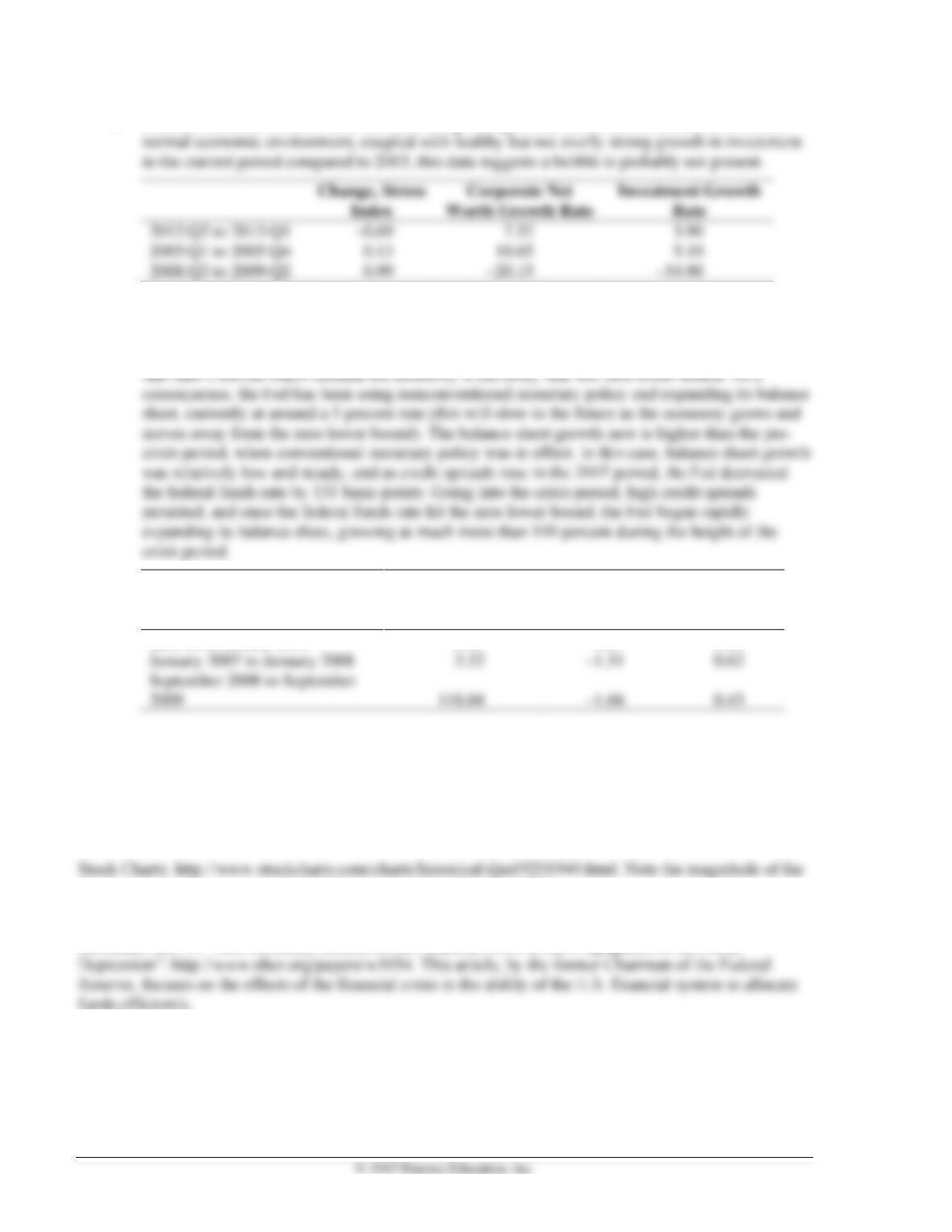
2008:Q3 to 2009:Q2
170 Mishkin • Macroeconomics: Policy and Practice, Second Edition
c. Because financial frictions have been lowering during the last year, this is indicative of a more
3. a. See table below.
b. See table below.
c. During the most recent period, credit spreads have been relatively small, and the federal funds
Average YOY
Growth Rate, Fed
Assets
Change from
Previous
Year, FFR
Average
Credit
Spread
June 2012 to June 2013
5.13
–0.07
0.09
2009
–1.66
0.43
◼ Data Sources, Related Articles, and Discussion Questions
A. For Information About Application: The Mother of All Financial Crises: The
Great Depression
Data Source
decrease in the Dow Jones Industrial Average index in October 1929.
Related Article
Bernanke, Ben S., “Non–Monetary Effects of the Financial Crisis in the Propagation of the Great
funds efficiently.
Discussion Question
By the 1930s the international financial system was not as interconnected as it was at the end of the 20th
century. Which was the main channel by which financial crises affected foreign countries (i.e., other than
the country where it originated)?
Chapter 15 Financial Crises and the Economy 171
Answer: As true with previous financial crises (i.e., in the 1800s), the most important transmission channel
B. For Information About Application: The 2007–2009 Financial Crisis
Data Source
S&P/Case-Shiller home prices index:
Related Article
The Federal Reserve System, “Monetary Policy Report to the Congress, July 2008”:
Discussion Question
What are the lessons from the 2007–2009 financial crisis about the process of financial innovation?
Answer: The 2007–2009 financial crisis left many lessons for both financial market participants and policy
C. For Information About Policy and Practice: Was the Fed to Blame for the
Housing Price Bubble?
Data Source
Federal Reserve Bank of St. Louis database (FRED):
Related Article
Bernanke, Ben S., “Monetary Policy and the Housing Bubble”:
172 Mishkin • Macroeconomics: Policy and Practice, Second Edition
Discussion Question
Explain why the unusually low target for the federal funds rate (0 to ¼ percent) set after the 2007–2009
crsis did not create an asset-price bubble.
Answer: The fundamental reason why the exceptionally low level of the federal funds rate did not create
D. For Information About Policy and Practice: The Federal Reserve’s
Nonconventional Monetary Policies and Quantitative Easing During the
Global Financial Crisis
Data Source
Federal Reserve System (FOMC statement, November 3, 2010):
period.”
Related Article
(paragraph 3) formally gives the Fed the power to provide liquidity to “individual, partnership or
corporation.” The interpretation of this piece of legislation was the subject of intense debate during 2008.
Discussion Question
Suppose that in the next FOMC statement the Fed does not include the phrase “exceptionally low levels
for the federal funds rate for an extended period.” How do you think market participants will interpret
that?
E. For Information About Policy and Practice: Japan’s Lost Decade, 1992–
2002
Data Source
characteristics of the Japanese stagnation in the 1990s and an interesting approach: Authors claim that it
was not caused by problems in the financial sector but rather to low productivity (TFP) growth.
Chapter 15 Financial Crises and the Economy 173
Related Article
Discussion Question
One of the characteristics of Japan’s lost decade was a decrease in the overall price index: a deflation.
During the 2007–2009 financial crisis in the United States, deflation was a concern for policy makers,
especially at the Fed. What are the consequences of deflation?
F. For Information About Policy and Practice: Debate Over Central Bank
Response to Bubbles
Data Source
market during the 1950s (referenced by the article on footnote 9) cannot be characterized as a bubble (i.e.,
it did not end in a drastic correction or market crash).
Related Article
Dudley, William C., “Asset Bubbles and the Implications for Central Bank Policy”:
Discussion Question
Describe the consequences of a central bank-engineered increase in interest rates to avoid an asset-price
bubble if it turns out that the asset-price bubble did not exist (i.e., the increase in the asset price could be
explained by market fundamentals).
Answer: If a central bank decides to increase interest rates to avoid a nonexistent asset-price bubble, the