Chapter 15
Government Spending and Its Financing
◼ Learning Objectives
I. Goals of Chapter 15
A. Use the measures of government outlays and taxes to measure government surpluses and deficits
(Sec. 15.1)
II. Notes to Eighth Edition Users
A. We introduce the Laffer curve in discussing supply-side economics; this modifies the old
366 Abel/Bernanke/Croushore • Macroeconomics, Ninth Edition
◼ Teaching Notes
I. The Government Budget: Some Facts and Figures (Sec. 15.1)
A. Government outlays
1. Three categories of government expenditures
a. Government purchases (G)
(1) Government investment, which is about 1/6 of total government purchases, consists
c. Net interest payments (INT)
(1) Interest paid to holders of government bonds less interest received by the government
(2) Government makes loans to students, farmers, small businesses
d. Subsidies less surpluses of government enterprises; relatively small, so we ignore it
2. Total (Federal, state, and local) government outlays are about 39% of GDP
(text Figure 15.1)
a. Government purchases increased enormously in World War II
(1) Government purchases rose in other wars as well
b. Transfer payments have been rising steadily
(1) They averaged about 12% of GDP in the 2000s before the financial crisis and 15% of
B. Taxes
1. Total tax collections increased from about 16% of GDP in 1940 to about 29% in 2000, then
declined to about 25% in 2011, then rose again to about 27% in 2014 (text Figure 15.2)
2. Four principal categories
Chapter 15 Government Spending and Its Financing 367
(3) Personal taxes have risen steadily over time, except for the Kennedy-Johnson tax cut
of 1964, the Reagan tax cut of 1981, and the Bush tax cuts in the early 2000s
3. The composition of outlays and taxes: the Federal government versus state and local
governments
a. To see the overall picture of government spending, we usually combine Federal, state,
and local government spending
b. But the composition of the Federal government budget is quite different from state
and local government budgets (text Table 15.2)
(1) Consumption expenditures
(a) About 2/3 of state and local current expenditures are purchases of goods
Analytical Problem 1 looks at the reasons for grants-in–aid.
(4) Net interest paid
(a) Net interest is significant and positive for the Federal government
C. Deficits and Surpluses
1. When outlays exceed revenues, there is a deficit; when revenues exceed outlays, there is a
368 Abel/Bernanke/Croushore • Macroeconomics, Ninth Edition
3. Another useful deficit definition is the primary government budget deficit, which excludes
net interest payments:
Numerical Problems 1, 2, 6, and 7, and Analytical Problem 3, deal with various aspects of the
deficit and primary deficit.
4. The separation of government purchases into government investment and government
consumption expenditures introduces another set of deficit concepts
Data Application
You might think that the current deficit would be smaller than the deficit, since the current deficit
is the deficit minus government investment. But the concept of government investment used here
is government net investment, which equals gross investment (spending on new capital goods)
minus depreciation. In 2014, for example, the federal government’s gross investment was less
than depreciation, so its net investment was negative. Thus the current deficit in 2014 exceeded
the deficit.
5. The current deficit and primary current deficit usually move together over time
(text Figure 15.4)
II. Government Spending, Taxes, and the Macroeconomy (Sec. 15.2)
A. Fiscal policy and aggregate demand
1. An increase in government purchases increases aggregate demand by shifting the IS curve up
2. The effect of tax changes depends on the economic model
a. Classical economists accept the Ricardian equivalence proposition that lump-sum tax
Chapter 15 Government Spending and Its Financing 369
4. Automatic stabilizers and the full-employment deficit
a. Automatic stabilizers cause fiscal policy to be countercyclical by changing government
spending or taxes automatically
b. One example is unemployment insurance, which causes transfers to rise in recessions
Numerical Problem 3 looks at how automatic stabilizers affect the budget deficit over the
business cycle.
B. Government capital formation
1. Fiscal policy affects the economy through the formation of government capital—long-lived
C. Incentive effects of fiscal policy
1. Average versus marginal tax rates
a. Average tax rate = total taxes/pretax income
b. Marginal tax rate = taxes due from an additional dollar of income
370 Abel/Bernanke/Croushore • Macroeconomics, Ninth Edition
(5) Someone earning $100,000 would pay ($100,000 − $10,000) .25 = $22,500 in
taxes, so he or she would have an average tax rate of 22.5%
d. The distinction between average and marginal tax rates affects people’s decisions about
how much labor to supply
(1) If the average tax rate increases, with the marginal tax rate held constant, a person
will increase labor supply
Numerical Problem 4 and Analytical Problem 2 look at the effects of tax rates on labor supply.
3. Application: Supply-side economics
a. Congress reduced tax rates twice in the 1980s
(1) At the beginning of the decade the highest marginal tax rate on labor income was 50%
b. Supply-side economists promoted the tax rate reductions, arguing that labor supply,
saving, and investment would all increase substantially
c. If tax cuts caused labor supply to increase enough, tax revenues might rise, rather than
declining
(1) The Laffer curve (text Figure 15.6) shows that as tax rates rise beyond level, tax
revenues will decline
to rise
Policy Application
Four articles evaluating the results of the Tax Reform Act of 1986 are presented in a symposium
in the Winter 1992 issue of the Journal of Economic Perspectives.
4. Tax-induced distortions and tax rate smoothing
a. In the absence of taxes, the free market works efficiently
(1) Taxes change economic behavior, reducing welfare
Chapter 15 Government Spending and Its Financing 371
Policy Application
Joel Slemrod thinks we need to focus more research on tax collection, understanding that
collecting taxes is costly. Collection costs affect the choice of tax instruments as well as the
degree of tax evasion. See Slemrod’s article “Optimal Taxation and Optimal Tax Systems,”
Journal of Economic Perspectives, Winter 1990, pp. 157–178.
e. It’s better to keep the tax rate constant over time than to raise it and lower it, because the
higher tax rate has a higher distortion
Theoretical Application
Robert Barro introduced the idea of tax smoothing in relation to the government debt in his
article “On the Determination of Public Debt,” Journal of Political Economy, October 1979,
pp. 940–971.
Numerical Problem 5 and Analytical Problem 4 look at tax smoothing and labor supply.
III. Government Deficits and Debt (Sec. 15.3)
A. The growth of the government debt
1. The deficit is the difference between expenditures and revenues in any fiscal year
2. The debt is the total value of outstanding government bonds on a given date
372 Abel/Bernanke/Croushore • Macroeconomics, Ninth Edition
Data Application
In my article “How Big Is Your Share of Government Debt?” Federal Reserve Bank of
5. Change in debt–GDP ratio = deficit/nominal GDP − [(total debt/nominal GDP) growth rate
of nominal GDP] (15.4)
a. So two things cause the debt–GDP ratio to rise
(1) A high deficit relative to GDP
Theoretical Application
Andy Abel asks the question, “Can the Government Roll Over Its Debt Forever?” in the
Data Application
Robert Eisner argues that government debt isn’t all that big once you adjust for inflation and take
account of government’s assets. See his book How Is the Federal Deficit? New York: The Free
Press, 1986.
B. Application: Social Security: How can it be fixed?
1. The Social Security system may not be able to pay future promised benefits
2. The system is mostly pay as you go, so that most taxes collected today go to paying benefits
c. Reduce benefits by increasing retirement age
Chapter 15 Government Spending and Its Financing 373
C. The burden of the government debt on future generations
1. People worry that their children will have to pay back the debt that past generations
have accumulated
2. To the extent that U.S. citizens own government bonds, future generations will just be paying
Policy Application
Many points of view about the government budget deficit are presented in a symposium in the
Journal of Economic Perspectives, Spring 1989. There are articles by Edward M. Gramlich, who
finds that the budget deficits of the 1980s clearly reduced national saving; Robert J. Barro, who
supports the Ricardian equivalence proposition and cites empirical evidence in support of it;
B. Douglas Bernheim, who dismisses Ricardian equivalence in favor of a neoclassical paradigm
that suggests deficits have real effects; and Robert Eisner, who focuses on the market value of the
government debt relative of GDP and finds it declining in the late 1980s.
D. Budget deficits and national saving: Ricardian equivalence revisited
1. When will a government deficit reduce national saving?
a. It almost certainly does when government spending rises
b. But it may not for a cut in taxes or increase in transfers
2. Ricardian equivalence: an example
374 Abel/Bernanke/Croushore • Macroeconomics, Ninth Edition
(1) After all, if people wanted to consume at their children’s expense, they could have
lowered their planned bequests
(2) So why should the fact that the government gives people a tax cut cause them to
consume at their children’s expense?
Theoretical Application
The classic article on bequests and Ricardian equivalence is Robert J. Barro, “Are Government
E. Departures from Ricardian equivalence
1. The data show that Ricardian equivalence holds sometimes, but not always
a. It certainly didn’t hold in the United States in the 1980s, when high government deficits
2. What are the main reasons Ricardian equivalence may fail?
a. Borrowing constraints
(1) If people can’t borrow as much as they would like, a tax cut financed by higher future
taxes essentially lets them borrow from the government
b. Shortsightedness
(2) However, a tax cut won’t necessarily lead to an increase in consumption in this case
F. In touch: Measuring the impact of government purchases on the economy
1. The stimulus package of 2009 increased federal government spending by about $500 billion
and reduced taxes by almost $300 billion, leading economists to debate its impact
2. Temporary increases in government purchases lead to higher output in both Keynesian and
Chapter 15 Government Spending and Its Financing 375
Policy Application
If the government has a large debt, and if Ricardian equivalence doesn’t hold, then the manner
in which the government handles the debt is important. For example, should it borrow long
IV. Deficits and Inflation (Sec. 15.4)
A. The deficit and the money supply
1. Inflation results when aggregate demand rises more quickly than aggregate supply
2. Budget deficits could be related to inflation, but we usually think of expansionary fiscal
4. Can government deficits lead to ongoing increases in the money supply?
a. Yes, if spending is financed by printing money
b. The revenue that a government raises by printing money is called seignorage
c. Usually, governments don’t just buy things directly with newly printed money, they do
so indirectly
(1) The Treasury borrows by issuing government bonds
5. Why would governments use money creation to finance deficits, knowing that it causes
inflation?
a. Developed countries rarely use seignorage, because it doesn’t raise much revenue
Policy Application
If the government runs persistent budget deficits, can monetary policymakers keep inflation low?
No, according to Thomas J. Sargent and Neil Wallace in their article “Some Unpleasant
376 Abel/Bernanke/Croushore • Macroeconomics, Ninth Edition
B. Real seignorage collection and inflation
1. The real revenue the government gets from seignorage is closely related to the inflation rate
2. Consider an all-currency economy with a fixed level of real output and a fixed real interest
rate, plus constant rates of money growth and inflation
3. Seignorage is called the inflation tax, because the government’s seignorage revenue equals
the inflation rate times real money balances
4. Will a rise in money growth increase seignorage revenue?
a. As the money growth rate rises, inflation rises, but people may hold less real balances
Chapter 15 Government Spending and Its Financing 377
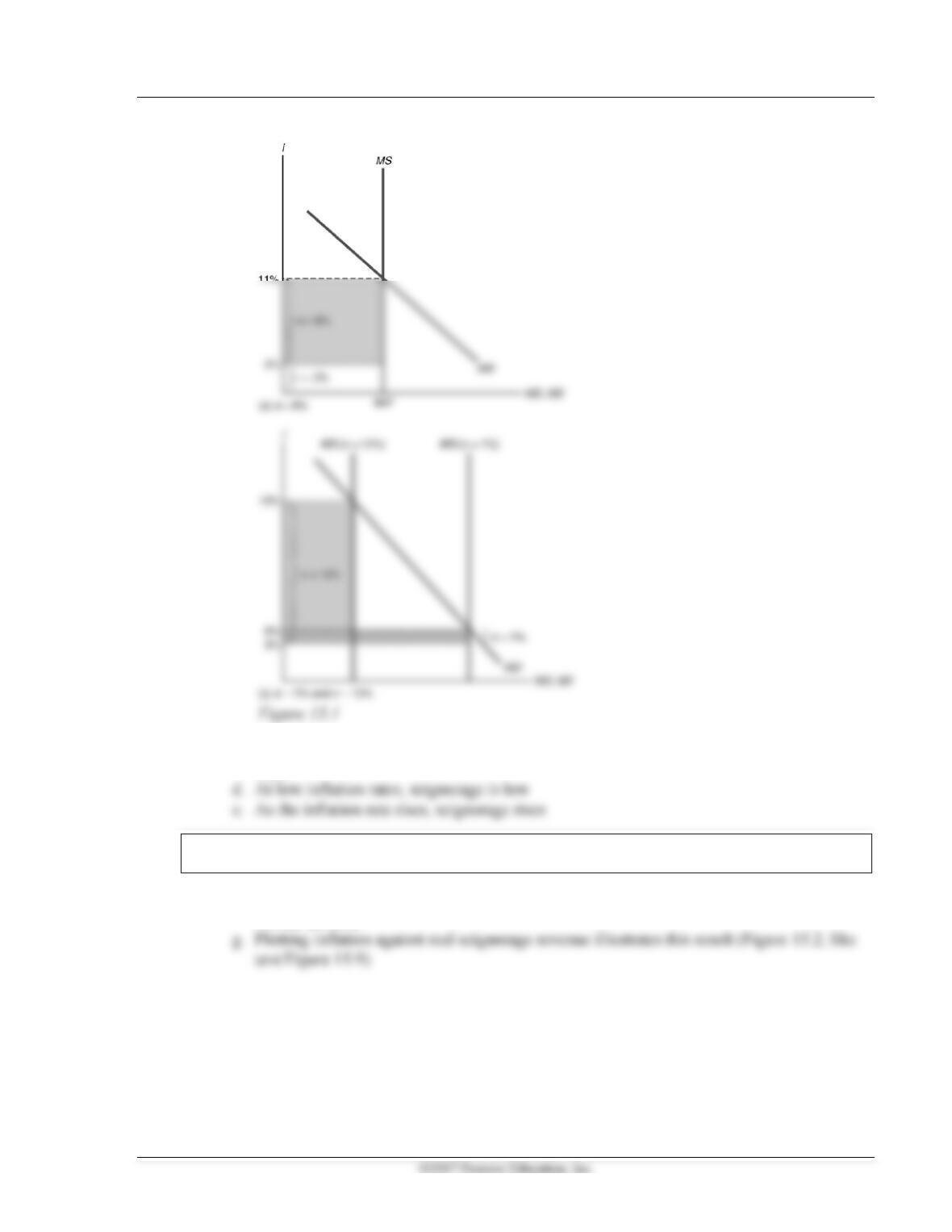
c. Real seignorage revenue is shown by the shaded rectangles in the figures, which represent
M/P
Numerical Problems 8 and 9 look at seignorage.
f. But at some inflation rate, seignorage begins to decline because of the decline in real
money demand