Chapter 15
PRICING PRACTICES
QUESTIONS AND ANSWERS
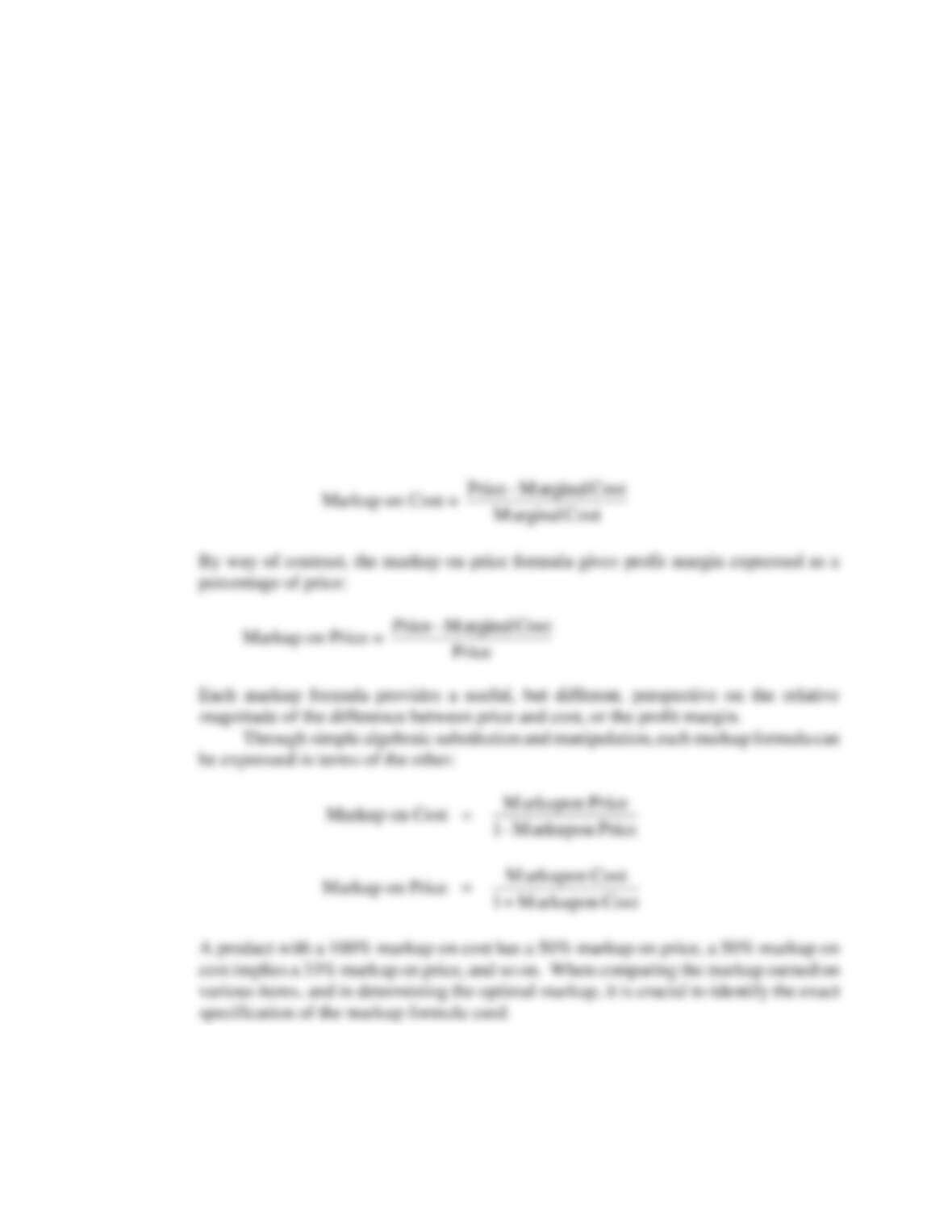
Q15.1 Express the markup on cost formula in terms of the markup on price, and use this
relation to explain why a 100% markup implies a 50% markup on price.
Q15.1 ANSWER
The markup on cost, or cost plus, formula gives profit margin expressed as a percentage
of cost:
Q15.2 Explain why successful firms that employ markup pricing use fully allocated costs under
normal conditions, but typically offer price discounts or accept lower margins during
off-peak periods when excess capacity is available.
464 Chapter 15
Q15.2 ANSWER
Fully allocated costs can be appropriate when a firm is operating at full capacity. During
peak periods, when facilities are fully utilized, expansion is required to increase
production. Under such conditions, an increase in production requires an increase in all
plant, equipment, labor, materials, and other expenditures. However, if a firm has
Q15.3 Discuss how seasonal factors influence supply and demand, and why markups on fresh
fruits and vegetable are at their highest during the peak of season.
Q15.3 ANSWER
It is interesting to see how seasonal factors affect markups for grocery items, like fruits
and vegetables. When a fruit or vegetable is in season, spoilage and transportation costs
Pricing Practices 465
Q15.4 Why does The Wall Street Journal offer bargain rates to students but not to business
executives?
Q15.4 ANSWER
The Wall Street Journal offers bargain rates to students but not to business executives. It
is surely not because it costs less to deliver the Journal to students, and it’s not out of
Q15.5 “One of the least practical suggestions that economists have offered to managers is that
they set marginal revenues equal to marginal costs.” Discuss this statement.
Q15.5 ANSWER
Profit-maximizing pricing practices can be effectively employed with scant direct
reference to marginal analysis. Although profit maximization requires that prices be set
466 Chapter 15
Q15.6 “Marginal cost pricing, as well as the use of incremental analysis, is looked upon with
favor by economists, especially those on the staffs of regulatory agencies. With this
encouragement, regulated industries do indeed employ these rational techniques quite
frequently. Unregulated firms, on the other hand, use marginal or incremental cost
pricing much less frequently, sticking to cost-plus, or full-cost, pricing except under
unusual circumstances. In my opinion, this goes a long way toward explaining the
problems of the regulated firms vis-à-vis unregulated industry.” Discuss this statement.
Q15.6 ANSWER
This statement is typical of managers who feel that if you don’t cover “full costs” on
each and every item sold, you are not covering your costs of producing a given product
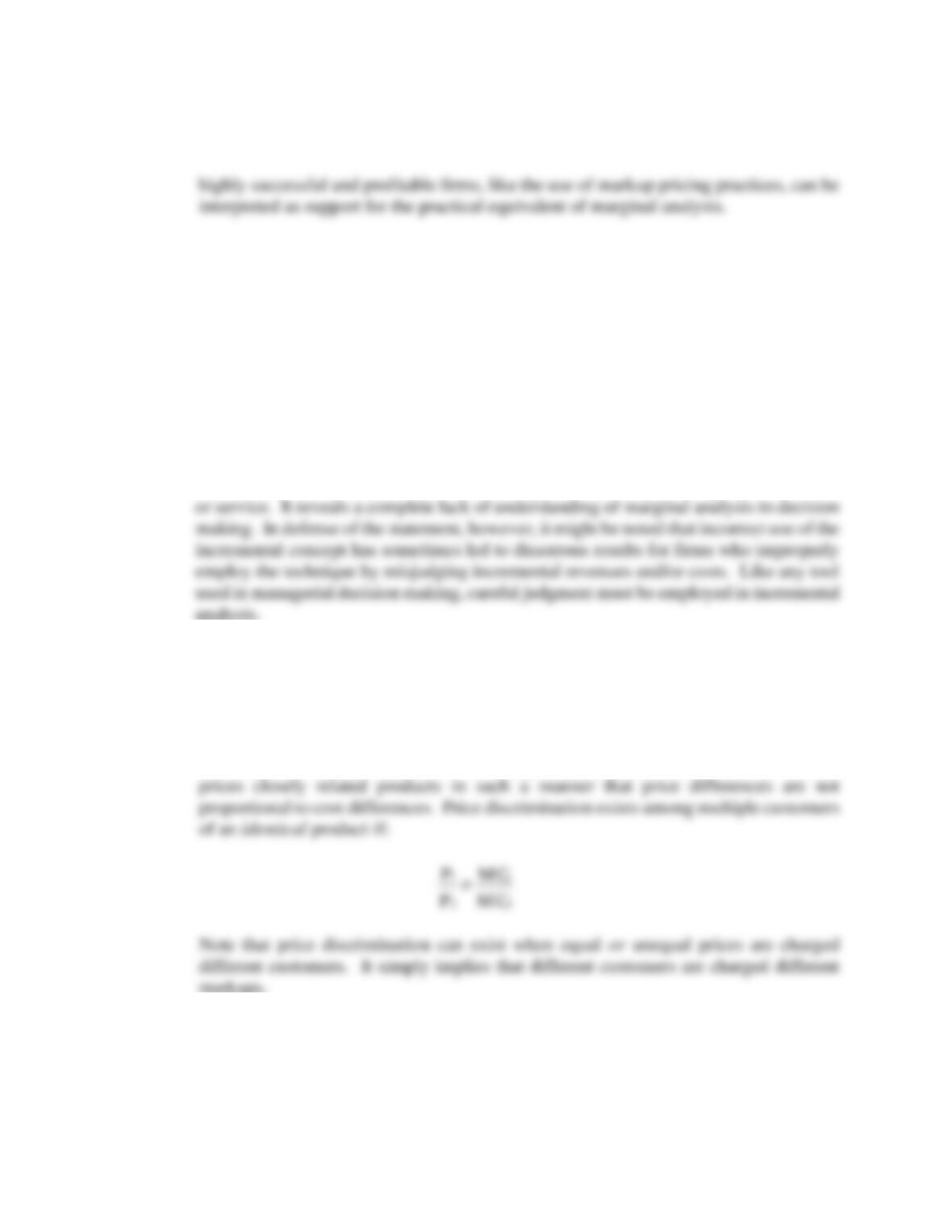
Q15.7 What is price discrimination?
Q15.7 ANSWER
Price discrimination is the practice of charging different markups for the same product.
Price discrimination can result if a firm charges different prices for the same product or
Q15.8 What conditions are necessary before price discrimination is both possible and
profitable? Why does price discrimination result in higher profits?
Pricing Practices 467
Q15.8 ANSWER
The primary requirement for price discrimination is an ability to segment the market by
Q15.9 Discuss the role of common costs in pricing practice.
Q15.9 ANSWER
Common costs are expenses that are necessary for manufacture of a joint product.
Common costs of production—raw material and equipment costs, management expenses,
Q15.10 Why is it possible to determine the marginal costs of joint products produced in variable
proportions but not those of joint products produced in fixed proportions?
Q15.10 ANSWER
It is possible to estimate the marginal costs of joint products where output proportions
SELF-TEST PROBLEMS AND SOLUTIONS
ST15.1 George Constanza is a project coordinator at Kramer-Seinfeld & Associates, Ltd., a
large Brooklyn-based painting contractor. Constanza has asked you to complete an
analysis of profit margins earned on a number of recent projects. Unfortunately, your
predecessor on this project got an abrupt transfer, and left you with only sketchy
information on the firm’s pricing practices.
468 Chapter 15
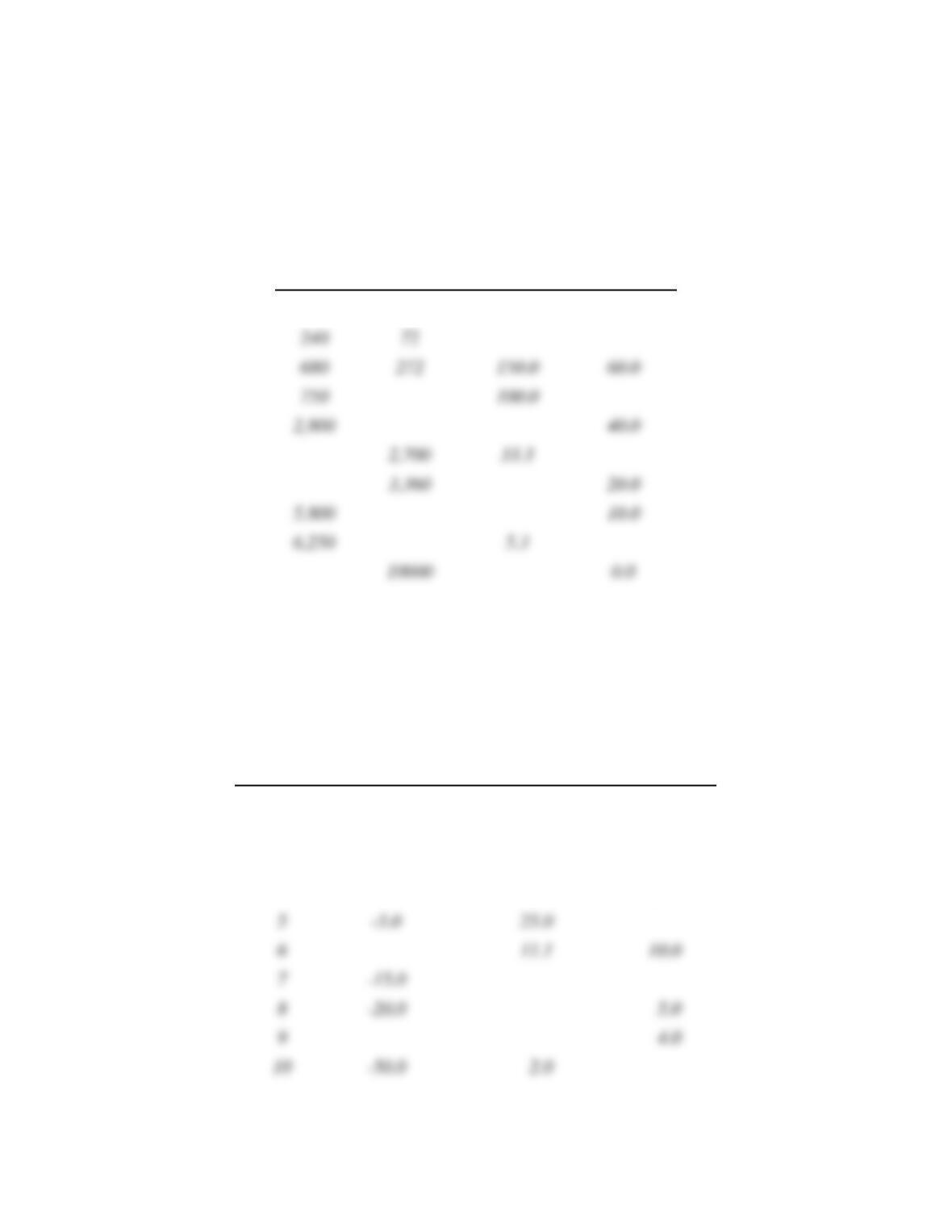
A. Use the available data to complete the following table:
Price
Marginal
Cost
Markup
on Cost
(%)
Markup
on Price
(%)
$100
$25
300.0
75.0
B. Calculate the missing data for each of the following proposed projects, based on
the available estimates of the point price elasticity of demand, optimal markup on
cost, and optimal markup on price:
Project
Price
Elasticity
Optimal
Markup
on Cost
(%)
Optimal
Markup
on Price
(%)
1
-1.5
200.0
66.7
2
-2.0
3
66.7
4
25.0
6
11.1
10.0
7
-15.0
8
-20.0
9
272
150.0
60.0
40.0
20.0
10.0
5.3
10000
0.0
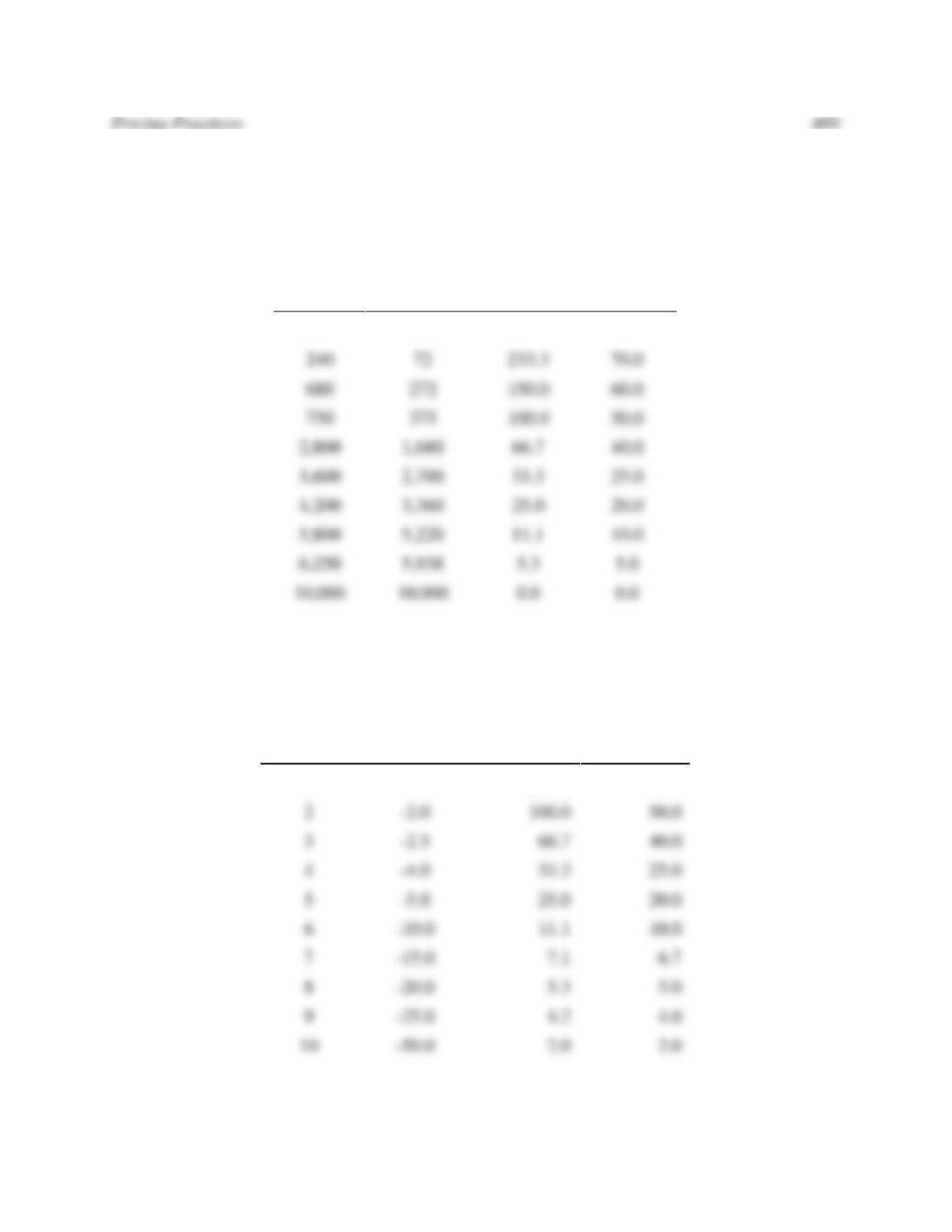
ST15.1 SOLUTION
A.
Price
Marginal
Cost
Markup
on Cost
(%)
Markup
on Price
(%)
$100
$25
300.0
75.0
233.3
70.0
375
100.0
50.0
66.7
40.0
33.3
25.0
25.0
20.0
11.1
10.0
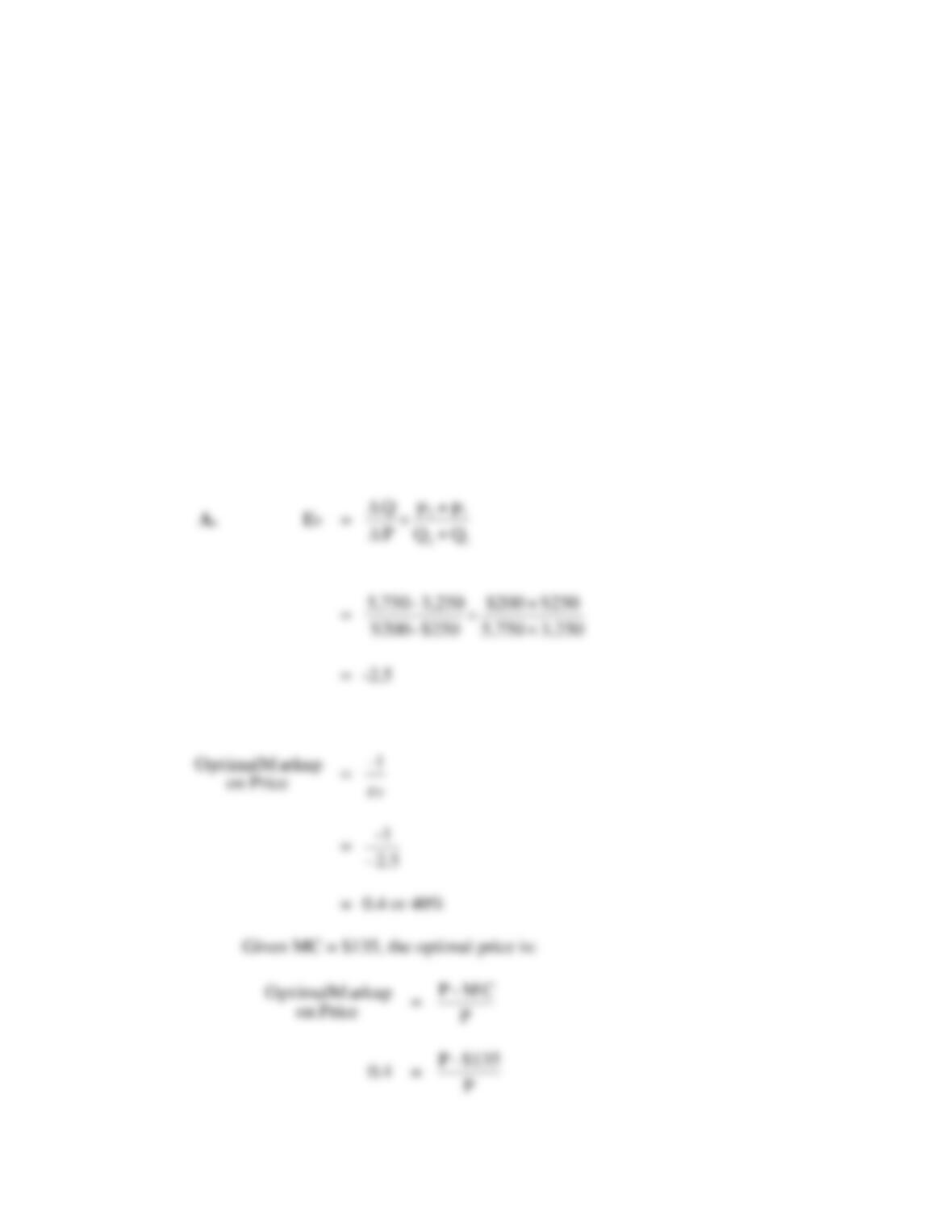
B.
Project
Price
Elasticity
Optimal
Markup
on Cost
(%)
Optimal
Markup
on Price
(%)
1
-1.5
200.0
66.7
2
-2.0
100.0
50.0
3
-2.5
40.0
4
-4.0
25.0
5
-5.0
20.0
6
10.0
7
8
9
470 Chapter 15
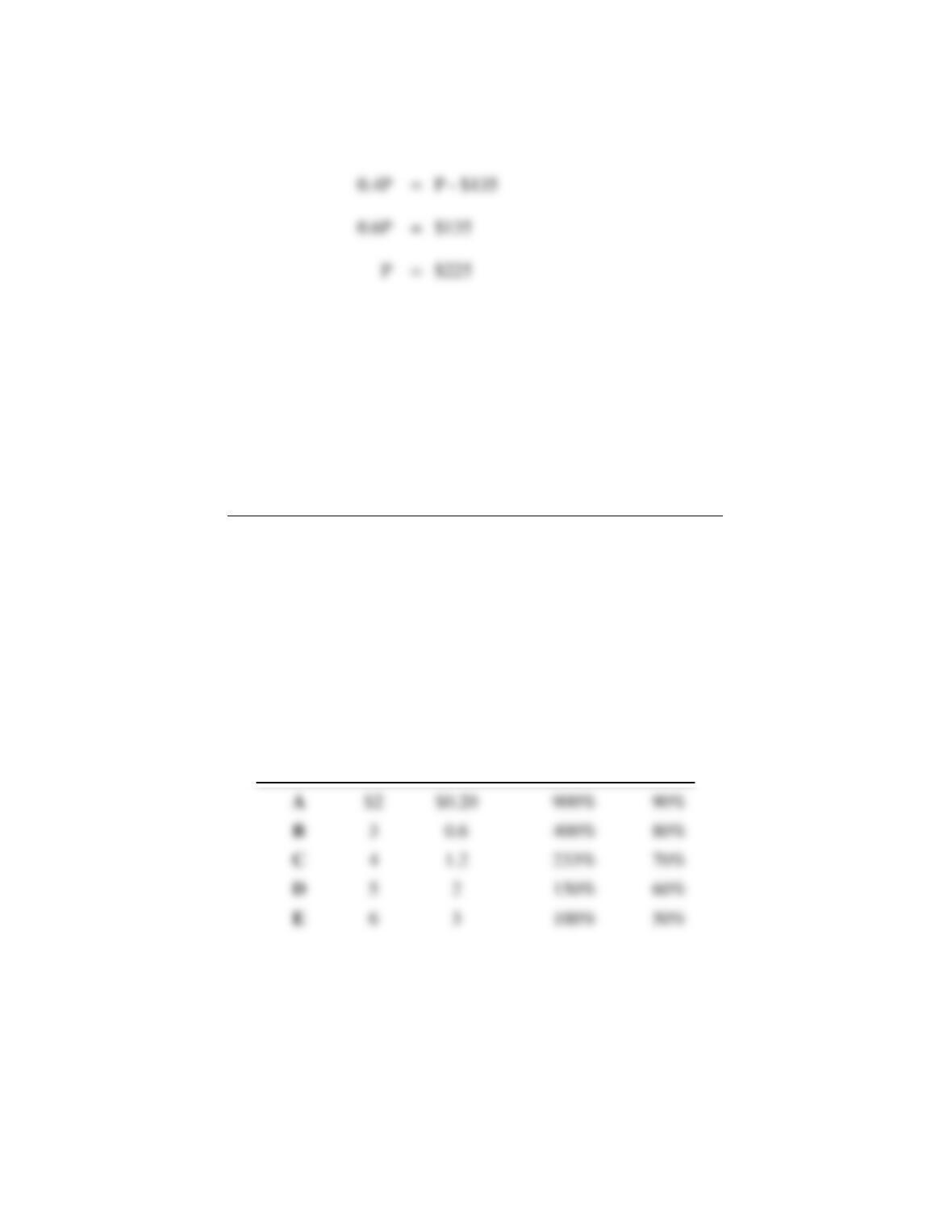
ST15.2 Optimal Markup on Price. TLC Lawncare, Inc., provides fertilizer and weed control
lawn services to residential customers. Its seasonal service package, regularly priced at
$250, includes several chemical spray treatments. As part of an effort to expand its
customer base, TLC offered $50 off its regular price to customers in the Dallas area.
Response was enthusiastic, with sales rising to 5,750 units (packages) from the 3,250
units sold in the same period last year.
A. Calculate the arc price elasticity of demand for TLC service.
B. Assume that the arc price elasticity (from Part A) is the best available estimate of
the point price elasticity of demand. If marginal cost is $135 per unit for labor
and materials, calculate TLC’s optimal markup on price and its optimal price.
ST15.2 SOLUTION
B. Given εP = EP = -2.5, the optimal TLC markup on price is:
Pricing Practices 471
PROBLEMS AND SOLUTIONS
P15.1 Markup Calculation. Controller Elliot Reid has asked you to review the pricing
practices of Hollywood Medical, Inc. Use the following data to calculate the relevant
markup on cost and markup on price for the following disposable items:
Product
Price
Marginal
Cost
Markup
on Cost
(%)
Markup
on Price
(%)
A
$2
$0.20
B
3
0.6
C
4
1.2
D
5
2
E
6
3
P15.1 SOLUTION
Product
Price
Marginal
Cost
Markup
on Cost
(%)
Markup
on Price
(%)
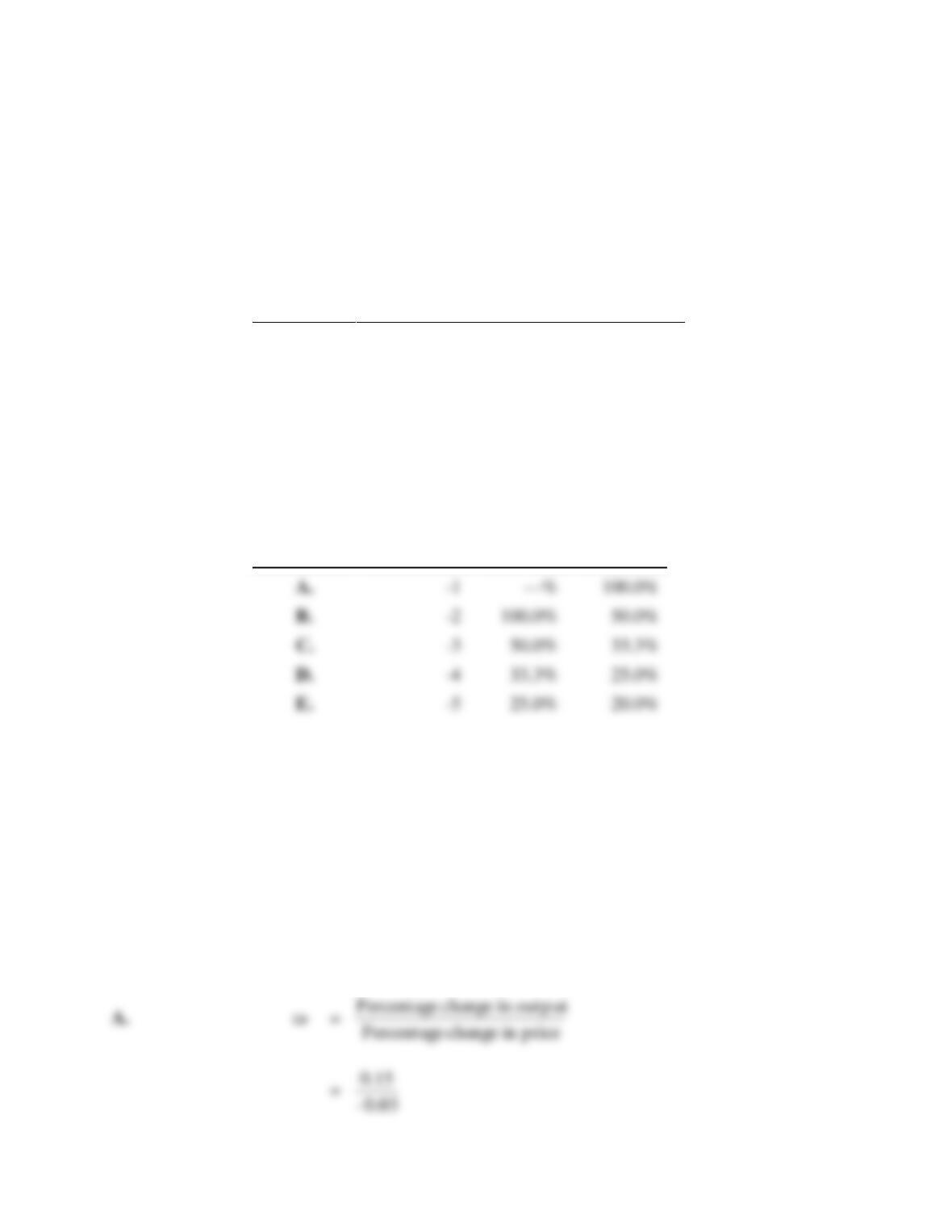
P15.2 Optimal Markup. Dr. John Dorian, chief of staff at the Northern Medical Center, has
asked you to propose an appropriate markup pricing policy for various medical
procedures performed in the hospital’s emergency room. To help in this regard, you
consult a trade industry publication that provides data about the price elasticity of
demand for medical procedures. Unfortunately, the abrasive Dr. Dorian failed to
mention whether he wanted you to calculate the optimal markup as a percentage of
472 Chapter 15
price or as a percentage of cost. To be safe, calculate the optimal markup on price and
optimal markup on cost for each of the following procedures:
Procedure
Price
Elasticity
Optimal
Markup
on Cost
Optimal
Markup
on Price
A.
-1
B.
-2
C.
-3
D.
-4
E.
-5
P15.2 SOLUTION
Procedure
Price
Elasticity
Optimal
Markup
on Cost
Optimal
Markup
on Price
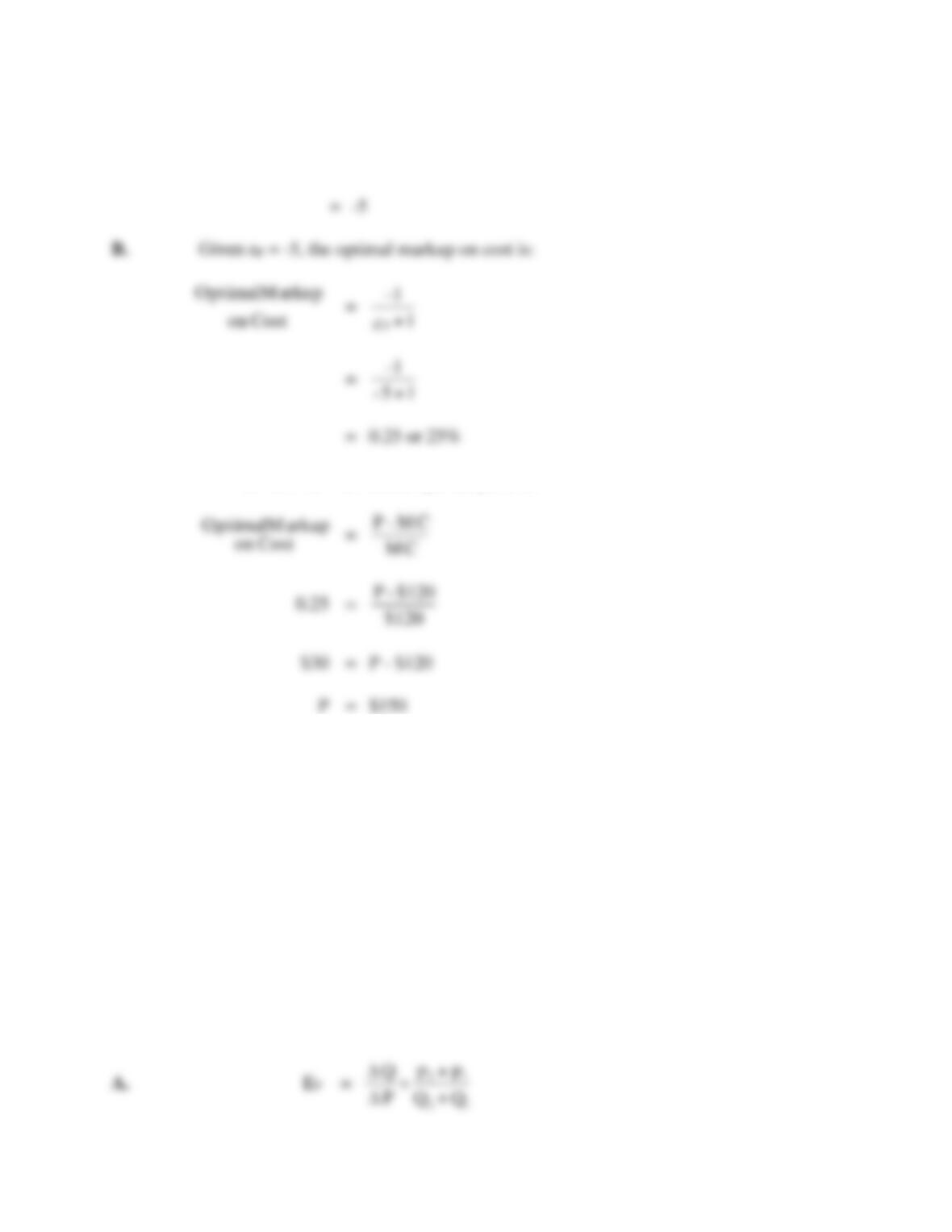
P15.3 Markup on Cost. Brake-Checkup, Inc., offers automobile brake analysis and repair at a
number of outlets in the Philadelphia area. The company recently initiated a policy of
matching the lowest advertised competitor price. As a result, Brake-Checkup has been
forced to reduce the average price for brake jobs by 3%, but it has enjoyed a 15% increase
in customer traffic. Meanwhile, marginal costs have held steady at $120 per brake job.
A. Calculate the point price elasticity of demand for brake jobs.
B. Calculate Brake-Checkup’s optimal price and markup on cost.
P15.3 SOLUTION
Pricing Practices 473
Given MC = $120, the optimal price is:
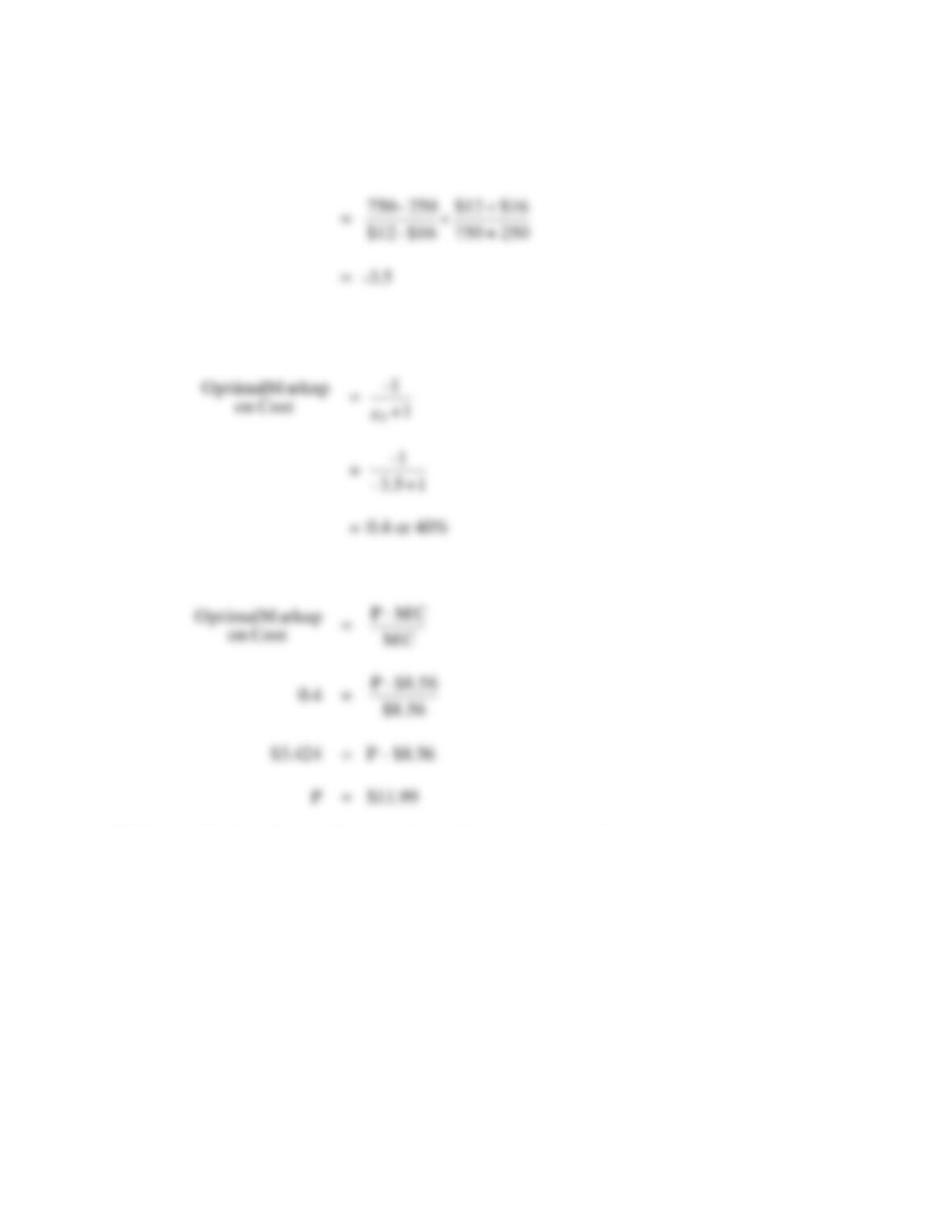
P15.4 Optimal Markup on Cost. The Bristol, Inc. is an elegant dining establishment that
features French cuisine at dinner six nights per week, and brunch on weekends. In an
effort to boost traffic from shoppers during the Christmas season, the Bristol offered
Saturday customers $4 off its $16 regular price for brunch. The promotion proved
successful, with brunch sales rising from 250 to 750 units per day.
A. Calculate the arc price elasticity of demand for brunch at the Bristol.
B. Assume that the arc price elasticity (from part A) is the best available estimate of
the point price elasticity of demand. If marginal cost is $8.56 per unit for labor
and materials, calculate the Bristol’s optimal markup on cost and its optimal
price.
P15.4 SOLUTION
474 Chapter 15
B. Given εP = EP = -3.5, the optimal markup on cost for Saturday brunch at the Bristol
during this time frame is:
Given MC = $8.56, the optimal price is:
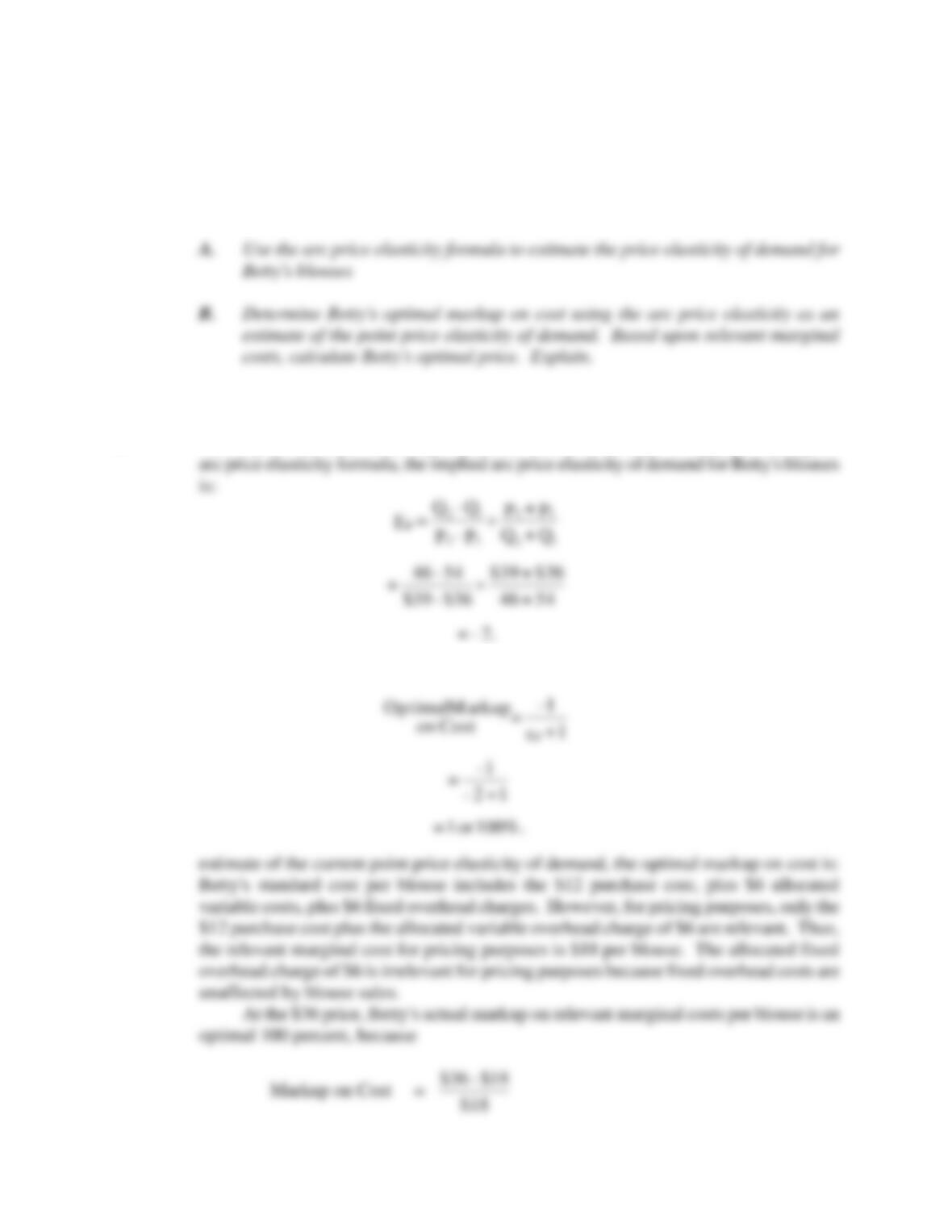
P15.5 Markup Pricing Practice. Betty’s Boutique is a small specialty retailer located in a
suburban shopping mall. In setting the regular $36 price for a new spring line of
blouses, Betty’s added a 50 percent markup on cost. Costs were estimated at $24 each:
the $12 purchase price of each blouse, plus $6 in allocated variable overhead costs, plus
an allocated fixed overhead charge of $6. Customer response was so strong that when
Betty’s raised prices from $36 to $39 per blouse, sales fell only from 54 to 46 blouses
per week.
At first blush, Betty’s pricing policy seems clearly inappropriate. It is always
improper to consider allocated fixed costs in setting prices for any good or service; only
marginal or incremental costs should be included. However, by adjusting the amount of
markup on cost employed, Betty’s can implicitly compensate for the inappropriate use of
fully allocated costs. It is necessary to carefully analyze both the cost categories
Pricing Practices 475
included and the markup percentages chosen before judging the appropriateness of a
given pricing practice.
P15.5 SOLUTION
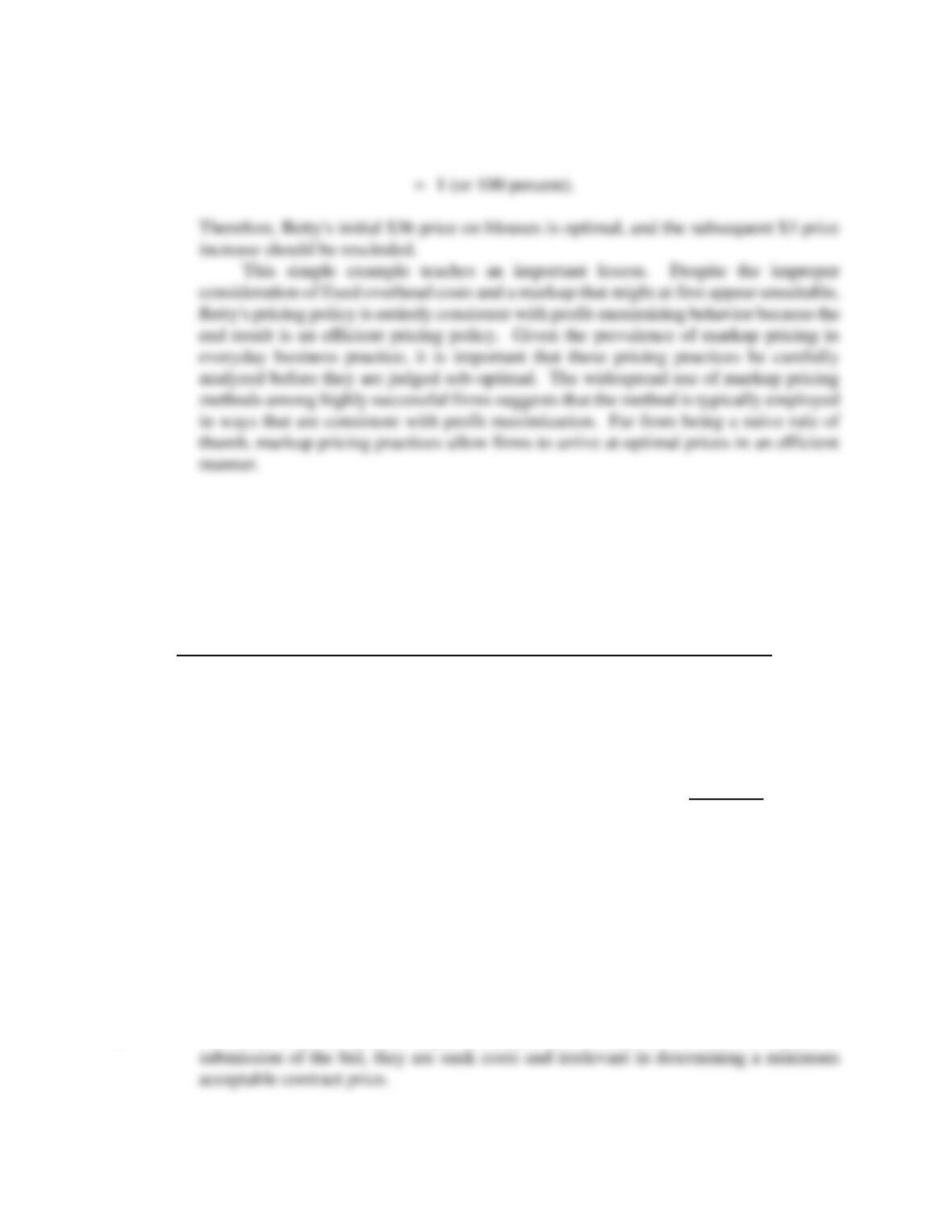
A. The $3 price increase to $39 represents a moderate 7.7 percent rise in price. Using the
B. If it can be assumed that this arc price elasticity of demand EP = -2 is the best available
476 Chapter 15
P15.6 Peak/Off-Peak Pricing. Nash Bridges Construction Company is a building contractor
serving the Gulf Coast region. The company recently bid on a Gulf-front causeway
improvement in Biloxi, Mississippi. Nash Bridges has incurred bid development and job
cost-out expenses of $25,000 prior to submission of the bid. The bid was based on the
following projected costs:
Cost Category
Amount
Bid development and job cost-out expenses
$25,000
Materials
881,000
Labor (50,000 hours @ $26)
1,300,000
Variable overhead (40% of direct labor)
520,000
Allocated fixed overhead (6% of total costs)
174,000
Total costs
$2,900,000
A. What is Nash Bridges’ minimum acceptable (breakeven) contract price, assuming
that the company is operating at peak capacity?
B. What is the Nash Bridges’ minimum acceptable contract price if an economic
downturn has left the company with substantial excess capacity?
P15.6 SOLUTION
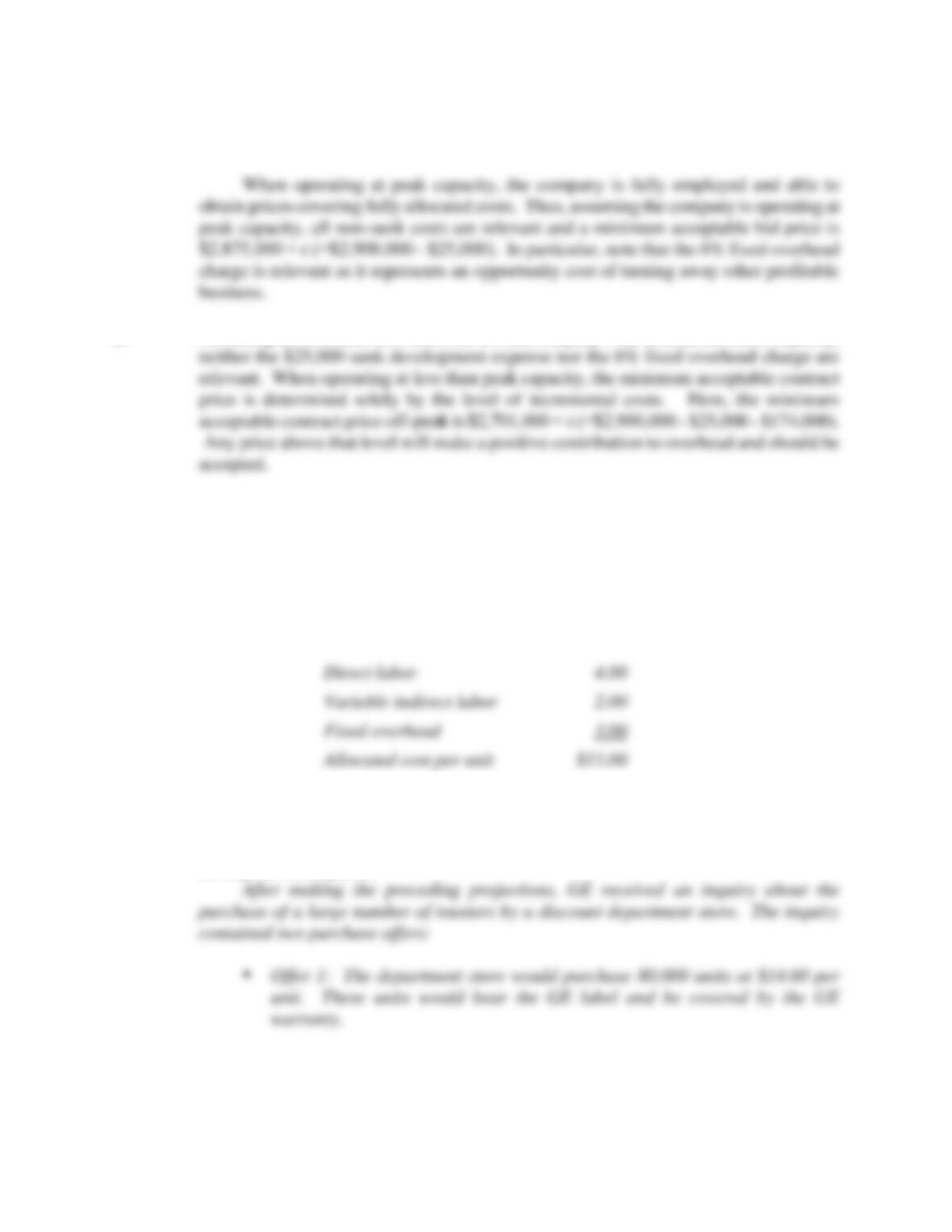
A. Because the $25,000 bid development and job cost-out expenses were incurred prior to
Pricing Practices 477
B. Assuming an economic downturn has left the company with substantial excess capacity,
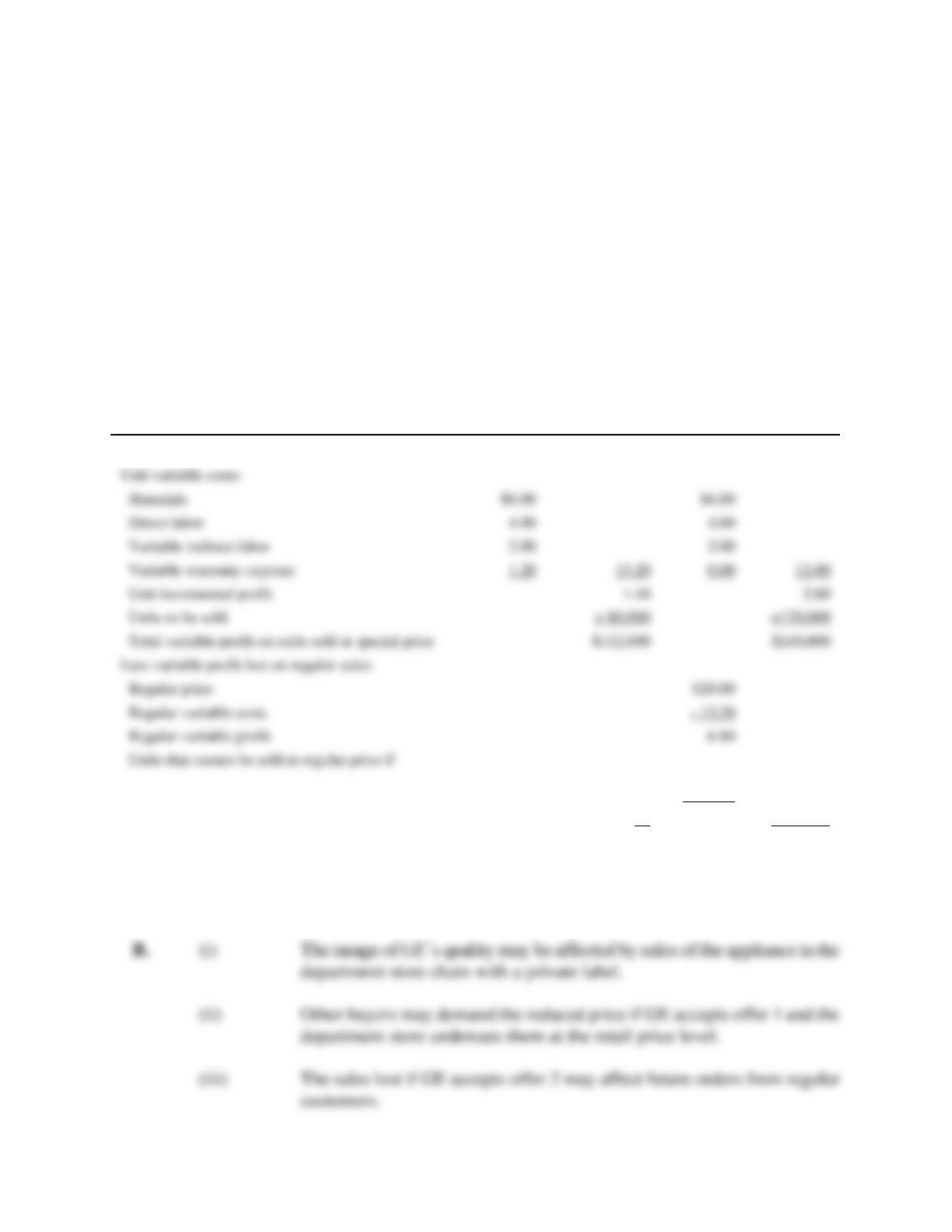
P15.7 Incremental Pricing Analysis. The General Eclectic Company manufactures an electric
toaster. Sales of the toaster have increased steadily during the previous five years, and,
because of a recently completed expansion program, annual capacity is now 500,000
units. Production and sales during the upcoming year are forecast to be 400,000 units,
and standard production costs are estimated as follows:
Materials
$6.00
In addition to production costs, GE incurs fixed selling expenses of $1.50 per unit and
variable warranty repair expenses of $1.20 per unit. GE currently receives $20 per unit
from its customers (primarily retail department stores), and it expects this price to hold
during the coming year.
▪ Offer 2: The department store would purchase 120,000 units at $14.00 per
unit. These units would be sold under the buyer’s private label, and GE would
not provide warranty service.
478 Chapter 15
A. Evaluate the incremental net income potential of each offer.
B. What other factors should GE consider when deciding which offer to accept?
C. Which offer (if either) should GE accept? Why?
P15.7 SOLUTION
A. The incremental net income from these offers can be determined as follows:
Offer 1
Offer 2
Unit price
$14.60
$14.00
Offer 2 is accepted
×20,000
Opportunity cost of lost regular sales
$0
$136,000
Incremental profit
$112,000
$104,000
Both offers involve a substantial incremental profit, but offer 1 appears to be the more
attractive on a simple dollar basis.
Materials
Direct labor
Variable indirect labor
Variable warranty expense
Unit incremental profit
Regular variable costs
Regular variable profit
Pricing Practices 479
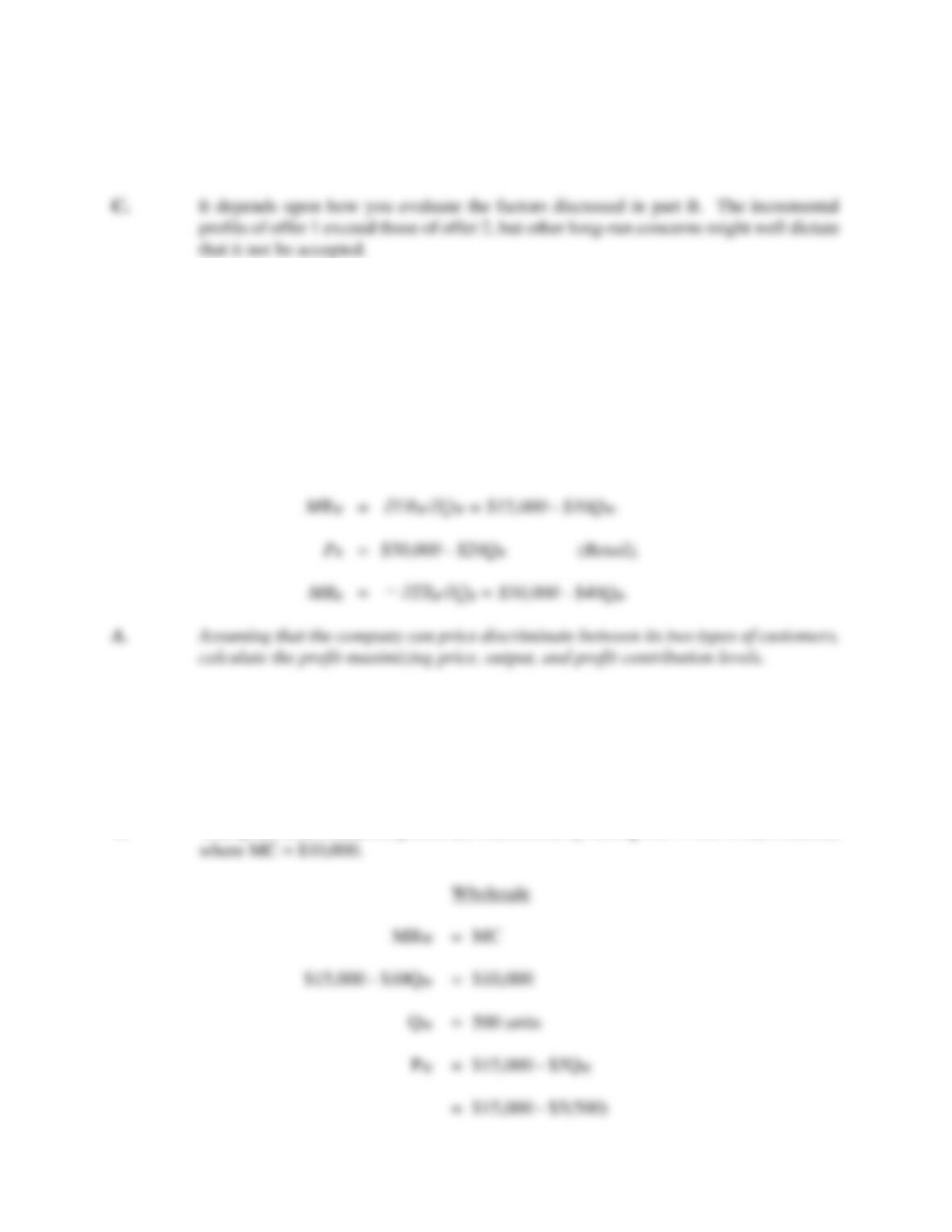
P15.8 Price Discrimination. Coach Industries, Inc., is a leading manufacturer of recreational
vehicle products. Its products include travel trailers, fifth-wheel trailers (towed behind
pick-up trucks), and van campers, as well as parts and accessories. Coach offers its
fifth-wheel trailers to both dealers (wholesale) and retail customers. Ernie Pantusso,
Coach’s controller, estimates that each fifth-wheel trailer costs the company $10,000 in
variable labor and material expenses. Demand and marginal revenue relations for fifth-
wheel trailers are
PW = $15,000 – $5QW (Wholesale),
B. Calculate point price elasticity for each customer type at the activity levels identified in
part A. Are the differences in these elasticity consistent with your recommended price
differences in part A? Why or why not?
P15.8 SOLUTION
A. With price discrimination, profits are maximized by setting MR = MC in each market,