300 Chapter 15
b. But war-torn or developed countries are unable to raise
sufficient tax revenue to cover government spending and may
not be able to borrow from the public
6. With an independent central bank, how is seignorage revenue
determined?
a. The government and central bank may engage in a game of
‘chicken’
Policy Application
If the government runs persistent budget deficits, can monetary policymakers keep
inflation low? No, according to Thomas J. Sargent and Nell Wallace in their article
“Some Unpleasant Monetarist Arithmetic,” Federal Reserve Bank of Minneapolis
Quarterly Review, Fail 1981, pp. 1–17. Monetary policymakers lose control over inflation
if government debt grows faster than the economy does. for then some of the
government’s deficit must eventually be financed by seignorage.
B. Real seignorage collection and inflation
1. The real revenue the government gets from seignorage is closely
related to the inflation rate
2. Consider an all-currency economy with a fixed level of real output and
a fixed real interest rate, plus constant rates of money growth and
3. Seignorage is called the inflation tax, because the government’s
seignorage revenue equals the inflation rate times real money
4. Will a rise in money growth increase seignorage revenue?
a. As the money growth rate rises, inflation rises, but people may
hold less real balances
Government Spending and Its Financing 301
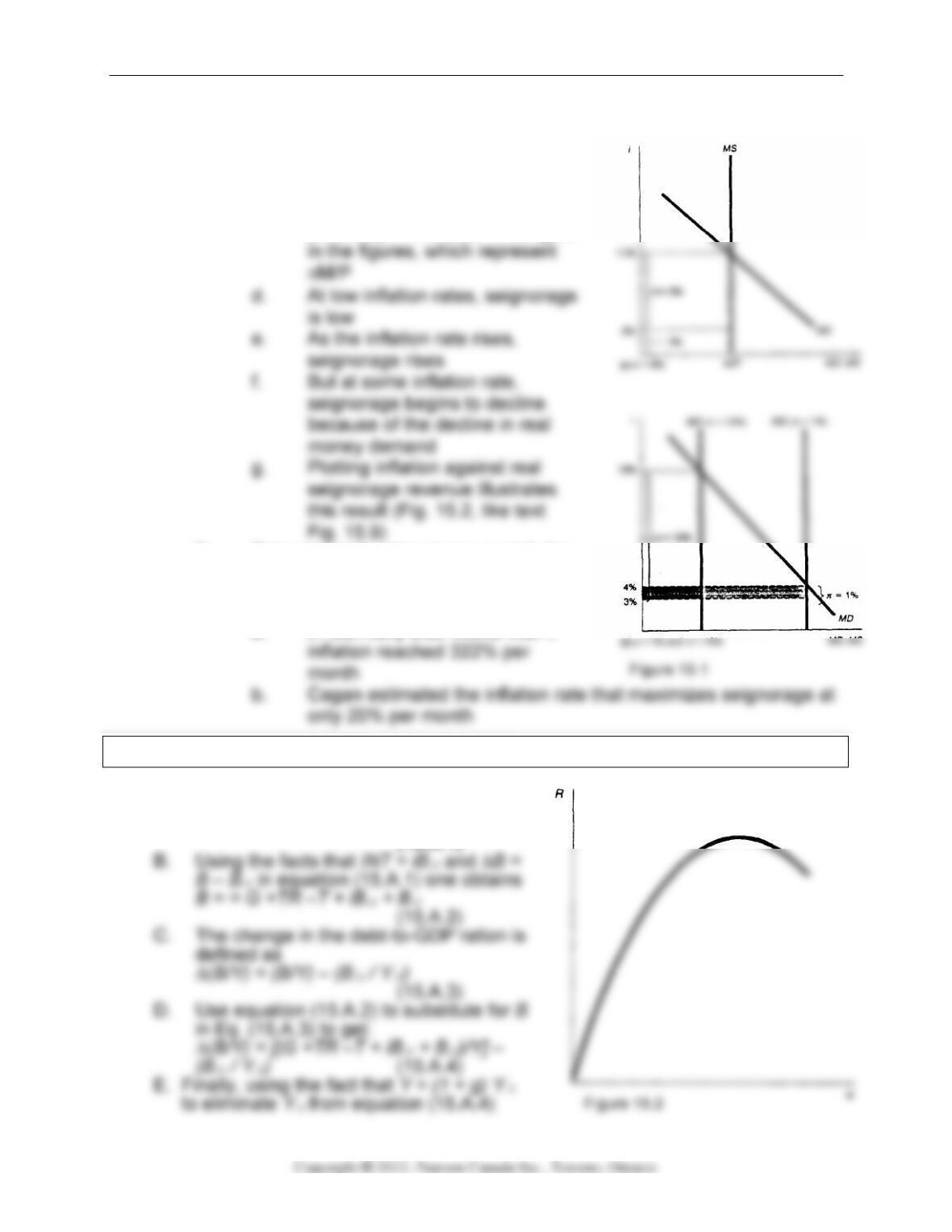
b. Whether seignorage rises or falls depends on whether inflation
rises more or less than the
decline in real money holdings
(Fig. 15.1, like text Fig. 15.8)
c. Real seignorage revenue is
shown by the shaded rectangles
5. If governments raise money supply too
rapidly, they may cause hyperinflation,
but get less seignorage revenue than
they would get with less money growth
a. In Germany after World War I,
Numerical Problems 9 and 10 look at seignorage.
V. Appendix 15.A: The Debt-GDP Ratio
A. The government deficit is given by
ΔB = G +TR – T +INT
302 Chapter 15
ADDITIONAL ISSUES FOR CLASSROOM DISCUSSION
1. How Has Government Spending Changed Over Time?
Government spending is an important part of total spending. Does it change over the
business cycle? How has government spending changed since 1960?
Government spending can be divided into three areas—purchases, transfers, and
services. Purchases include general administration and the work of various government
2. What is the Proper Role for Government?
What is the appropriate role for government to play in the economy?
A nation through its political process decides what government will do. In some
countries government is a major player in sectors such as communications and health
care. In other nations, government has a much more limited role. For example, in the
United Kingdom, the government provides some television stations, which are paid for
3. Does the Source of Government Revenues Make a Difference?
How taxes are levied can make a difference in the effect they have on economic output.
Currently, of total revenue to all levels of government in Canada, about 58 percent is
made up of direct taxes on persons, another 20% comes from indirect taxes, and only
Government Spending and Its Financing 303
ANSWERS TO TEXTBOOK PROBLEMS
Review Questions
1. The major sources of government expenditures are government purchases,
transfer payments, and net interest payments. The major sources of government
revenues are direct taxes on persons and enterprises, indirect taxes, and
2. The overall budget surplus equals the primary budget surplus minus net interest.
3. The government deficit is the change in the government debt. A high growth rate of
the debt-GDP ratio can be caused by: (1) high primary deficits, (2) a high nominal
interest rate on government debt, and (3) a low growth rate of nominal GDP.
4. Fiscal policy affects the macroeconomy in three ways: (1) aggregate demand
effects, (2) government capital formation, and (3) incentive effects.
The aggregate demand channel affects the macroeconomy because expansionary
fiscal policy shifts the IS curve upward and to the right, causing the AD curve to
shift to the right as well. Both classicals and Keynesians agree that an increase in
304 Chapter 15
5. An automatic stabilizer is a provision in the budget that causes government
spending to rise or taxes to fall automatically (without legislative action) when GDP
6. An example would be no tax on income below $15 000, then a tax at 20% on
7. Increasing the tax rate increases distortions by more than reducing the tax rate (by
8. Government debt is a potential burden on future generations in two ways. First, if
tax rates must be raised in the future to pay off the debt, then the economy wilt
operate less efficiently in the future because of the increased distortions from the
9. Ricardian equivalence might not hold if people face borrowing constraints, if they
are shortsighted, if they fail to leave bequests, or if taxes aren’t lump-sum.
10. The inflation tax, or seignorage, arises when the government raises revenue by
printing money. The inflation tax is equal to the inflation rate times the real money
supply in an all-currency economy in which the money multiplier equals 1. (More
generally, the inflation tax collected by the government equals the inflation rate
Government Spending and Its Financing 305
Numerical Problems
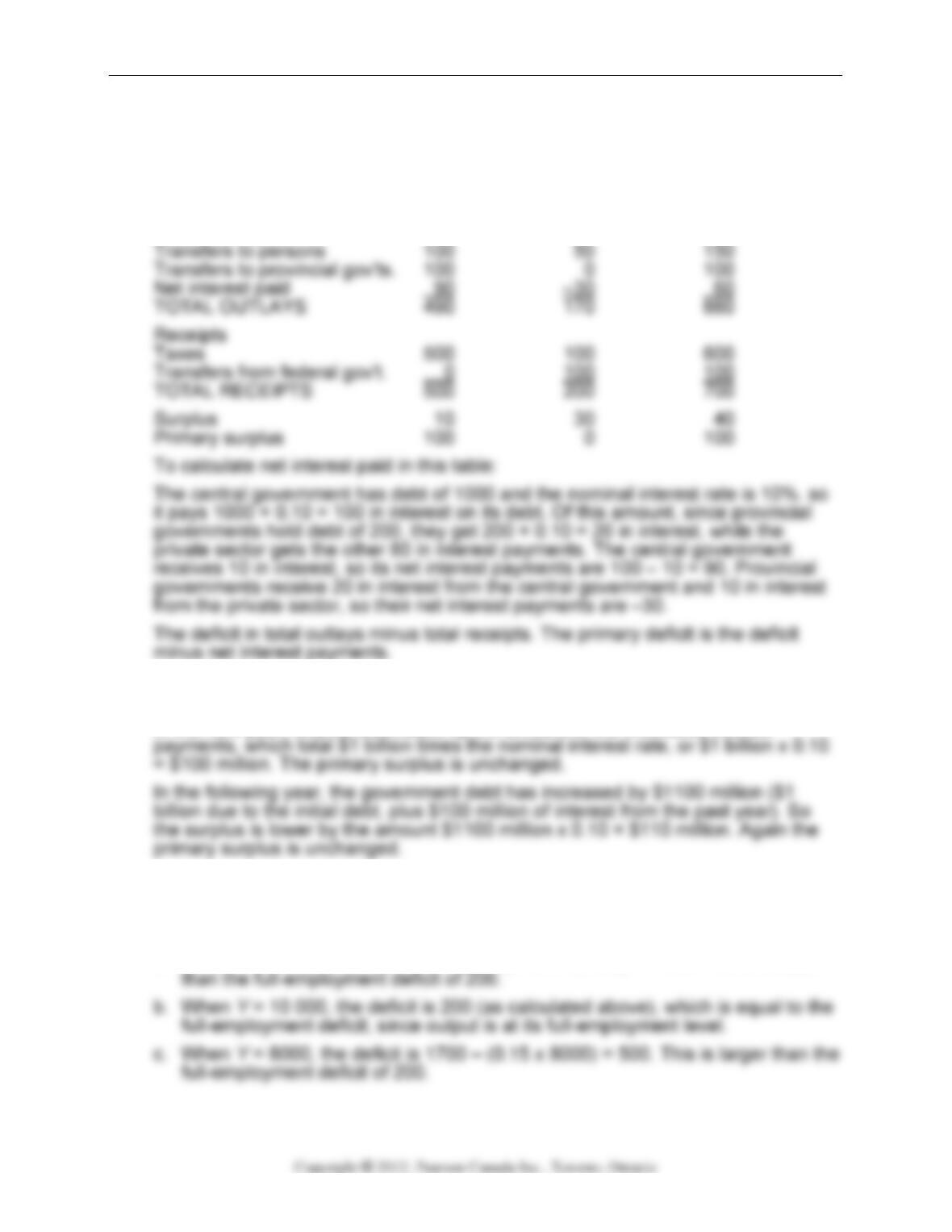
1. The following table shows the categories of the budget:
Central Provincial Combined
Outlays Government Governments Governments
Purchases of goods
and services 200 150 350
2. In the year in which the transfer is made, both the surplus and the primary surplus
decrease by $1 billion.
In the next year, surplus decreases by the amount of the increased interest
3. Deficit = G + TR + INT – T = 1800 + (800 – 0.05Y) + 100 – (1000 + 0.1Y) = 1700 –
0.15Y. The full-employment budget deficit is the deficit that would occur if the
economy were at full employment. Full-employment output is 10 000, so the full-
employment deficit is 1700 – (0.15 × 10 000) = 200.
a. When Y = 12 000, the deficit is 1700 – (0.15 x 12 000) = –100. This is smaller
306 Chapter 15
4. a. In this situation, someone earning income Y between $8000 and $20 000 pays
a total tax of T = 0.25(Y – $8000), while someone earning between $20 000
the marginal tax rate is 30%.
b. In this situation, someone earning income Y between $6000 and $20 000 pays
a total tax of T = 0.20(Y – $6000), while someone earning between $20 000
and $30 000 pays tax of T = $2800 +.30(Y – $20 000).
c. The person making $16 000 has the same average tax rate, but a lower
marginal tax rate, so there’s no income effect, just a substitution effect toward
5. If workers value their leisure at 90 goods per day, then 90 goods per day must be
the equilibrium value of the after-tax real wage.
a. Setting the real wage equal to the marginal product of labour gives 90 = 250 –
N, or N: 160. Output is Y = 250N – 0.5N2 = (250 x 160) – (0.5 x 1602) = 27 200.
6. From Eq. (15.1), we know that
surplus = primary surplus – INT
where INT = net interest payments on debt. Interest payments on debt are given
by the interest rate times the debt outstanding. In this case, INT = $35 billion.
Government Spending and Its Financing 307
7. a. From Eq. (15.6) we know that
b. Now we are told that Y = 1000, B-1 = 500, i = 0.05 and g = 0.07. Using these
8. This is not necessarily true. The answer depends on the size of the interest rate
paid on outstanding government debt (i) and the growth rate of GDP (g). If i > g,
then the debt–to-GDP ratio can only be reduced if there is a primary surplus. If, on
the other hand, i < g, a primary surplus is not required to cause a fall in the debt-to–
GDP ratio. In fact, if i > g, then the debt-to-GDP ratio can be reduced even if there
is a primary deficit.
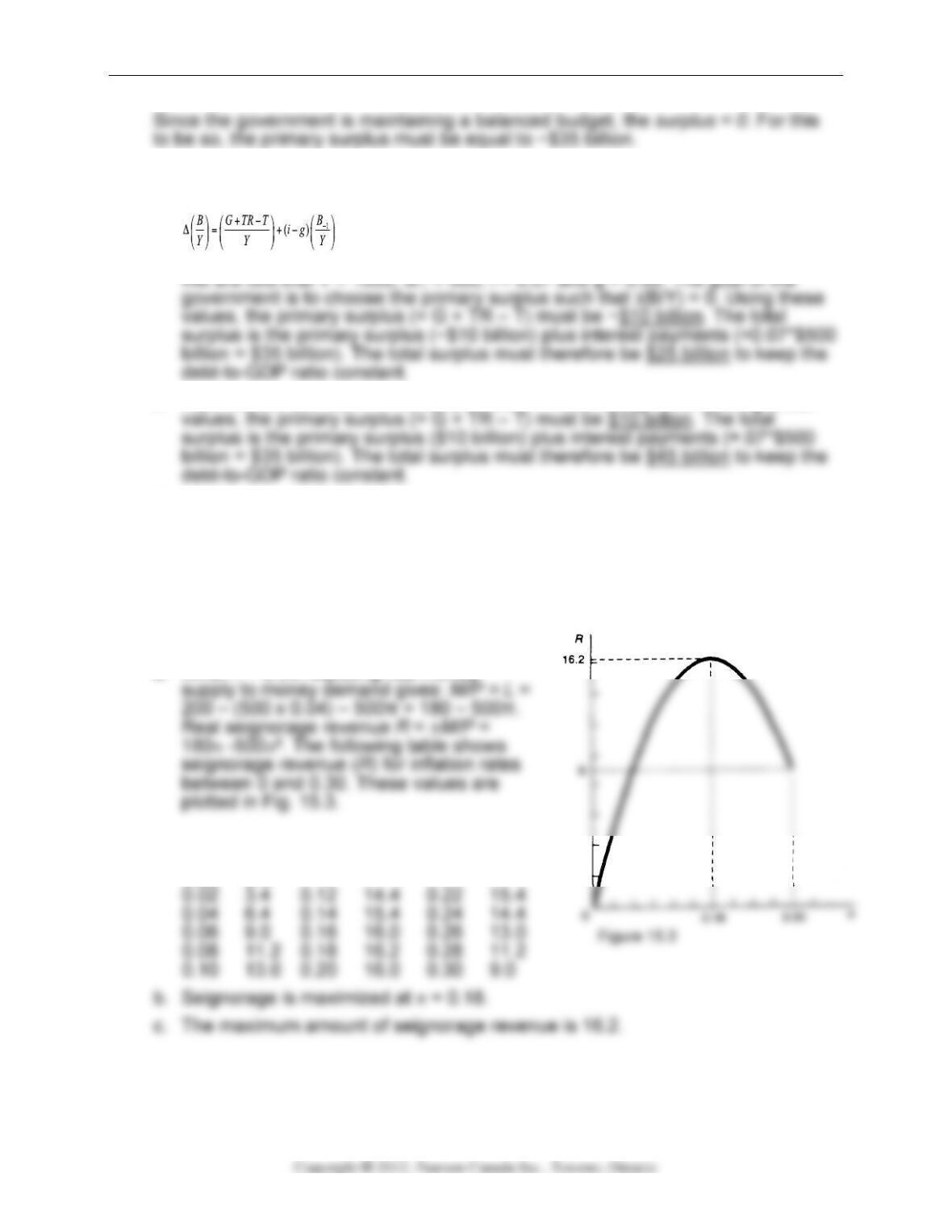
9. L = 0.2Y – 500i = 0.2Y – 500r – 500π. With Y
= 1000, L = 200 – 500r – 500π.
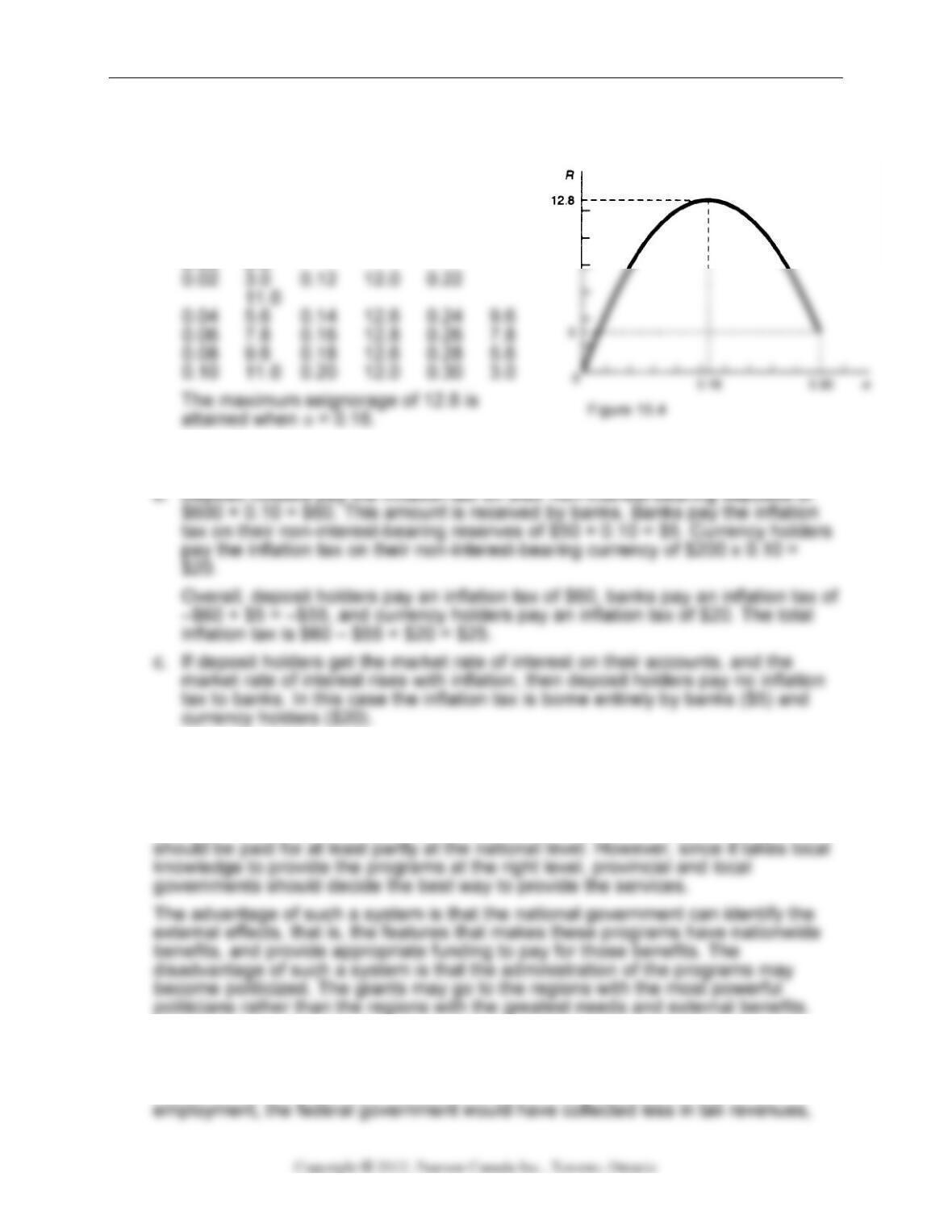
a. When r = 0.04, equating real money
π R π R π R
0.00 0.0
308 Chapter 15
d. When r = 0.08, equating real money supply to money demand gives: M/P = L =
200 – (500 × 0.08) – 500π = 160 – 500π. Real seignorage revenue R = πM/P =
160π – 500π². The following table shows
seignorage revenue (R) for inflation rates
between 0 and 0.30. These values are
plotted in Fig. 15.4.
π R π R π R
0.00 0.0
10. a. The monetary base is growing at a 10% rate, so it increases by 0.01 × $250 =
$25. The nominal value of seignorage over the year is $25.
Analytical Problems
1. The main reason for having a system of transfers from the federal government to
provincial and local governments is that there are nationwide benefits to education,
health, and welfare programs, but these programs are most efficiently administered
at the provincial and local level. Since the benefits are nationwide, the programs
2. In 1988, both the actual and the cyclically-adjusted budget balance were negative,
indicating budget deficits. The cyclically-adjusted deficit in that year was larger
than the actual budget deficit. This indicates that the economy was operating at
more than full employment. That is, had the economy been operating at full
Government Spending and Its Financing 309
3. This program has very bad incentive effects. For income (y) below $10 000, a
person gets a transfer equal to $10 000 – y. So for every dollar of income a person
earns, he or she loses a dollar of transfers. This is tike having a marginal tax rate
of 100%! The program makes it unlikely that a person with low income
opportunities would want to work at all.
4. Begin with equation (15.6) which can also be written as:
Growth rate of debt-GDP ratio = primary deficit/B + i – growth rate of nominal GDP.
First, note that the debt-GDP ratio is the same in nominal terms or real terms, as is
5. A balanced-budget amendment might prove useful if the government otherwise
had a tendency to run a perpetual budget deficit. The amendment would provide a
mechanism for fiscal discipline, forcing policymakers to balance the budget. But
there could be significant disadvantages, since fiscal policy wouldn’t be as flexible.
a. In particular, automatic stabilizers kick in during a recession to increase
spending and reduce taxes, creating a budget deficit but stimulating the

310 Chapter 15