CHAPTER 15
MONETARY THEORY AND POLICY
In this chapter, you will find:
Learning Outcomes
Chapter Outline with PowerPoint Script
Chapter Summary
Teaching Points (as on Prep Card)
Solutions to Problems Appendix
Experiential Assignments
INTRODUCTION
This chapter first introduces the indirect channel of money influence on economic activity, concentrating on
LEARNING OUTCOMES
15-1 Explain how the demand and supply of money determine the market interest rate.
The opportunity cost of holding money is the higher interest forgone by not holding other financial assets
15-2 Outline the steps between an increase in the money supply and an increase in equilibrium output.
The Fed determines the supply of money, which is assumed to be independent of the interest rate. The
15-3 Describe the relevance of velocity’s stability on monetary policy.
The long-run approach focuses on the role of money through the equation of exchange, which states that
15-4 Summarize the specific policies the Fed pursued during and after the Great Recession.
Between World War II and October 1979, the Fed tried to maintain stable interest rates as a way of pro-
moting a stable investment environment. During the 1980s and early 1990s, the Fed paid more attention
Chapter 16 Monetary Theory and Policy 220
CHAPTER OUTLINE WITH POWERPOINT SCRIPT
USE POWERPOINT SLIDES 2-5 FOR THE FOLLOWING SECTION
The Demand and Supply of Money
The distinction between the stock of money and the flow of income
The Demand for Money: Relationship between the interest rate and how much money people want to hold.
• People demand money to pay for purchases.
interest rate; the opportunity cost of holding money.
USE POWERPOINT SLIDES 6-9 FOR THE FOLLOWING SECTION
The Supply of Money and the Equilibrium Interest Rate
• A vertical supply curve implies that the quantity of money supplied is independent of the interest rate.
USE POWERPOINT SLIDES 10-13 FOR THE FOLLOWING SECTION
Money and Aggregate Demand in the Short Run: In the short run, money affects the economy
through changes in the interest rate.
Changes in the supply of money affect the market rate of interest, which affects investment, a component of
aggregate demand.
Interest Rates and Planned Investment
• Effect of an increase in the money supply, M
M → i → I → AD→ Y
– The Fed increases the money supply, M, by buying U.S. government bonds in the open market.
USE POWERPOINT SLIDES 14-16 FOR THE FOLLOWING SECTION
Adding Short-Run Aggregate Supply: For a given shift of the aggregate demand curve, the steeper the short-
run aggregate supply curve:
• The smaller the increase in real GDP
• The larger the increase in the price level
USE POWERPOINT SLIDES 17-19 FOR THE FOLLOWING SECTION
Chapter 16 Monetary Theory and Policy 221
Money and Aggregate Demand in the Long Run: An increase in the supply of money increases
aggregate demand which leads to a higher price level since the economy’s potential output is fixed in the long
run.
The Equation of Exchange: M
V = P
Y – Total spending always equals total receipts
USE POWERPOINT SLIDES 20-23 FOR THE FOLLOWING SECTION
What Determines the Velocity of Money?
• The customs and conventions of commerce
• Commercial innovations that (ATMs, debit cards) have facilitated exchange
USE POWERPOINT SLIDES 23-29 FOR THE FOLLOWING SECTION
Targets for Monetary Policy
• In the short run, monetary policy affects the economy by influencing interest rates.
• In the long run, changes in the money supply affect the price level.
Contrasting Policies:
investment which may add instability to the economy.
Targets Before 1982: The Fed attempted to stabilize interest rates until 1979.
• 1979, Paul Volcker targeted growth in the money supply:
– Interest rates fluctuated
Targets After 1982:
• In 1987, Greenspan said there wasn’t a close enough link between the money supply and nominal income
Other Fed Actions and Concerns
During 2007-2009 recession:
Chapter 16 Monetary Theory and Policy 222
USE POWERPOINT SLIDE 30 FOR THE FOLLOWING SECTION
International Considerations: As national economies grow more interdependent, the Fed has become more
sensitive to the global implications of its action: what happens in the U.S. often affects markets overseas and
vice versa.
CHAPTER SUMMARY
The opportunity cost of holding money is the higher interest forgone by not holding other financial assets
instead. Along a given money demand curve, the quantity of money demanded relates inversely to the interest
rate. The demand for money curve shifts rightward as a result of an increase in the price level and increase in
real GDP, or an increase in both.
Between World War II and October 1979, the Fed tried to maintain stable interest rates as a way of promoting
a stable investment environment. During the 1980s and early 1990s, the Fed paid more attention to growth in
money aggregates, first M1 and then M2. But the velocity of M1 and M2 became so unstable that the Fed
shifted focus back to interest rates, particularly the federal funds rate. To pursue its main goals of price
stability and sustainable economic growth, the Fed adjusts the federal funds rate, raising the rate to prevent
higher inflation and lowering the rate to stimulate economic growth.
TEACHING POINTS
2. Early in your discussion you should distinguish between income (a flow) and money (a stock). Most
students will not clearly see the difference because income is measured in dollars and money is used as
the medium of exchange.
Chapter 16 Monetary Theory and Policy 223
3. The next problem in teaching this material is presenting the concept of the demand for money. It is im-
4. The demand for money will shift whenever there are increases in (a) the price level, (b) wealth, or (c)
income.
SOLUTIONS TO PROBLEMS APPENDIX
1. (Money Demand) Suppose that you never carry cash. Your paycheck of $1,000 per month is
deposited directly into your checking account, and you spend your money at a constant rate so that at
the end of each month your checking account balance is zero.
a. What is your average money balance during the pay period?
b. How would each of the following changes affect your average monthly balance?
i. You are paid $500 twice monthly rather than $1,000 each month.
ii. You are uncertain about your total spending each month.
iii. You spend a lot in the beginning of the month (e.g., for rent) and little at the end of the
month.
iv. Your monthly income increases.
a. Your average balance is $500.
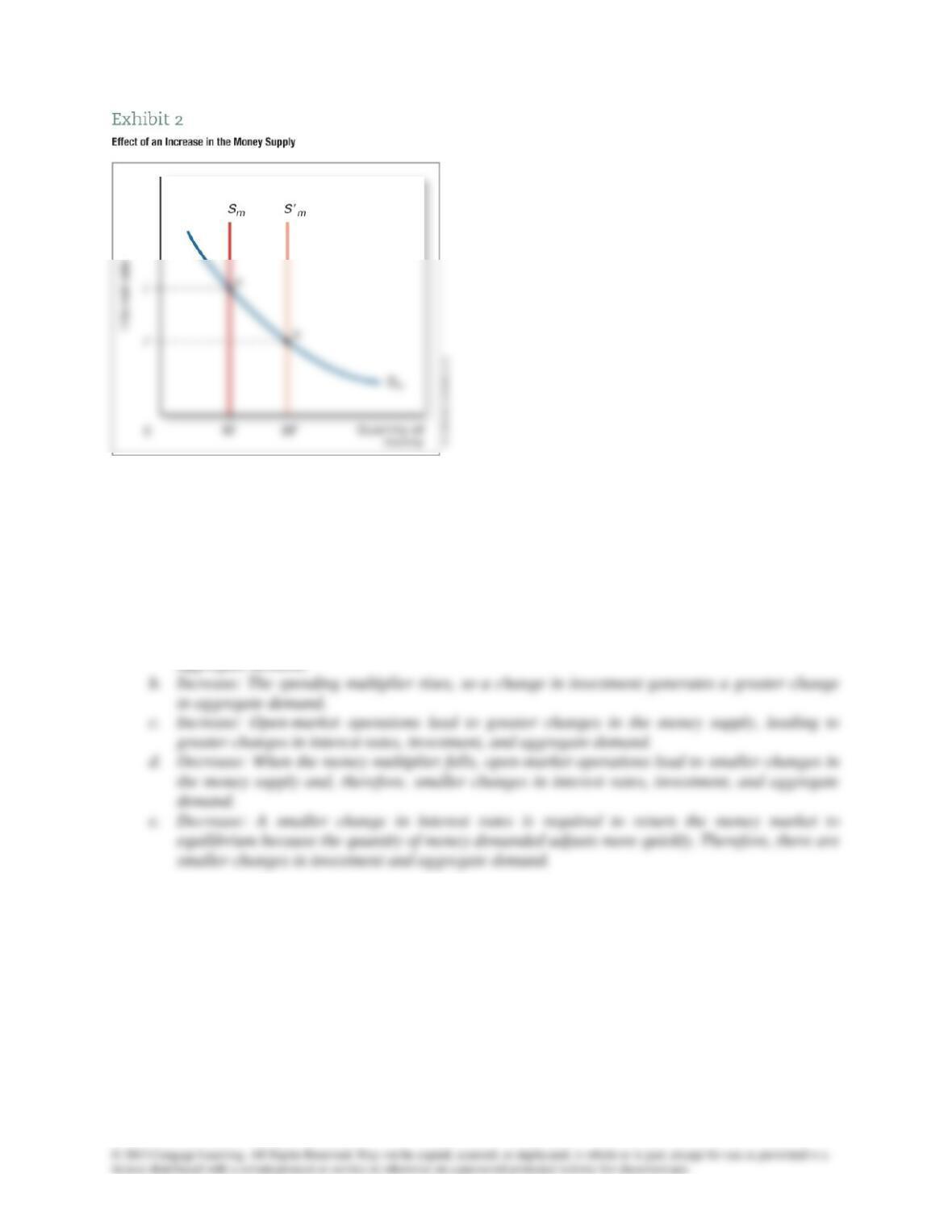
2. (Market Interest Rate) With a diagram, show how the supply of money and the demand for money
determine the rate of interest? Explain the shapes of the supply curve and the demand curve.
The money demand curve, Dm , slopes downward. As the interest rate falls, other things constant,
Chapter 16 Monetary Theory and Policy 224
3. (Money and Aggregate Demand) Would each of the following increase, decrease, or have no impact
on the ability of open-market operations to affect aggregate demand? Explain your answer.
a. Investment demand becomes less sensitive to changes in the interest rate.
b. The marginal propensity to consume rises.
c. The money multiplier rises.
d. Banks decide to hold additional excess reserves.
e. The demand for money becomes more sensitive to changes in the interest rate.
a. Decrease: Investment demand changes by smaller amounts, leading to smaller changes in
aggregate demand.
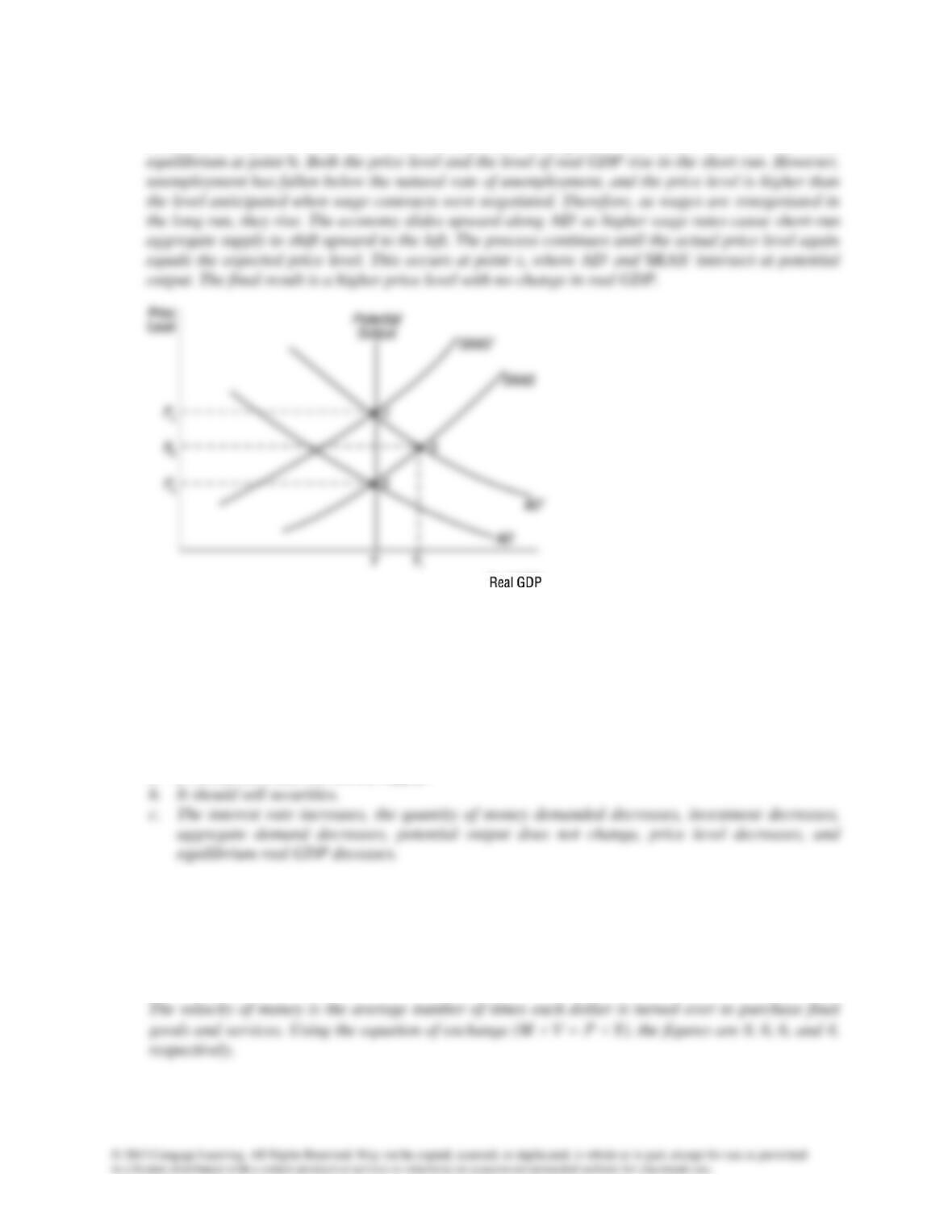
4. (Monetary Policy and Aggregate Supply) Assume that the economy is initially in long-run
equilibrium. Using an AD-AS diagram, illustrate and explain the short-run and long-run impacts of
an increase in the money supply.
Chapter 16 Monetary Theory and Policy 225
The economy is initially in equilibrium at point a. Increasing the money supply shifts the aggregate
demand curve from AD to AD’. The economy moves along the SRAS curve to a new short-run
5. (Monetary Policy and an Expansionary Gap) Suppose the Fed wishes to use monetary policy to
close an expansionary gap.
a. Should the Fed increase or decrease the money supply?
b. If the Fed uses open-market operations, should it buy or sell government securities?
c. Determine whether each of the following increases, decreases, or remains unchanged in the
short run: the market interest rate, the quantity of money demanded, investment spending,
aggregate demand, potential output, the price level, and equilibrium real GDP.
a. It should decrease the money supply.
6. (Equation of Exchange) Calculate the velocity of money if real GDP is 3,000 units, the average
price level is $4 per unit, and the quantity of money in the economy is $1,500. What happens to
velocity if the average price level drops to $3 per unit? What happens to velocity if the average price
level remains at $4 per unit but the money supply rises to $2,000? What happens to velocity if the
average price level falls to $2 per unit, the money supply is $2,000, and real GDP is 4,000 units?
Chapter 16 Monetary Theory and Policy 226
7. (Quantity Theory of Money) What basic assumption about the velocity of money transforms the
equation of exchange into the quantity theory of money? Also:
a. According to the quantity theory, what will happen to nominal GDP if the money supply
increases by 5 percent and velocity does not change?
b. What will happen to nominal GDP if, instead, the money supply decreases by 8 percent and
velocity does not change?
c. What will happen to nominal GDP if, instead, the money supply increases by 5 percent and
velocity decreases by 5 percent?
d. What happens to the price level in the short run in each of these three situations?
The quantity theory of money assumes that velocity is relatively stable and that any changes are
predictable.
8. (Great Recession) How did the Fed try to bring the economy back during and after the Great
Recession? What specific policies did it pursue?
Between World War II and October 1979, the Fed tried to maintain stable interest rates as a way
of promoting a stable investment environment. During the 1980s and early 1990s, the Fed paid
9. (Money Supply Versus Interest Rate Targets) Assume that the economy’s real GDP is growing.
a. What will happen to money demand over time?
b. If the Fed leaves the money supply unchanged, what will happen to the interest rate over time?
c. If the Fed changes the money supply to match the change in money demand, what will happen
to the interest rate over time?
d. What would be the effect of the policy described in part (c) on the economy’s stability over the
business cycle?
Chapter 16 Monetary Theory and Policy 227
a. Money demand will increase.
10. (Quantitative Easing) What’s the difference between ordinary open market purchases and quanti-
tative easing?
Ordinary open market purchases is Fed purchases of government securities to increase the mon-
11. (Quantitative easing) Because of quantitative easing, the Fed purchased more than two trillion
dollars of financial assets. Why did the Fed do this? How are these purchases reflected on the
Fed’s balance sheet? And why hasn’t this increased the rate of inflation, at least not as of Decem-
ber 2013?
The Fed typically changes the federal funds rate by buying or selling short-term government se-
Experiential Assignments
1. A favorite activity of many macroeconomists is Fed watching. Send students to the Federal Reserve
Board’s Web site to look for the most recent Congressional testimony of Janet Yellen, the new
targeting interest rates, the money supply, or something else?
2. The Federal Reserve Bank of Cleveland’s monthly publication Economic Trends is available online at
3. The Federal Reserve Report appears in each Friday’s Wall Street Journal in the Money and Investing
section. In addition to the weekly report, a monthly chart shows the recent performance of money supply