378 Abel/Bernanke/Croushore • Macroeconomics, Ninth Edition
5. If governments raise money supply too rapidly, they may cause hyperinflation, but get less
seignorage revenue than they would get with less money growth
C. Application: Quantitative easing and inflation
1. Quantitative easing increases the monetary base and finances the government budget
deficit, but will it lead to inflation?
2. Quantitative easing occurred in the United States, United Kingdom, Europe, and Japan
a. All were at or near the zero lower bound
3. Will future inflation rise as the economies return to normal and raise interest rates above
zero?
4. Financial markets seem to believe that inflation will remain low
a. Long-term interest rates remain low
Chapter 15 Government Spending and Its Financing 379
◼ Additional Issues for Classroom Discussion
1. Should the Tax System Be Reformed?
People spend a huge amount of resources both paying taxes and preparing tax returns. Should the U.S. tax
system be fundamentally reformed? If so, how?
To organize the discussion of this issue, you may want to ask your students to think about the following
issues:
(1) Should we move toward a consumption tax and away from an income tax to encourage saving
and investment?
(2) Should we continue with efforts begun in the Reagan and Bush administrations to “broaden the base
and flatten the rates”? Proposals include eliminating many deductions, such as the one for mortgage
2. Should the Social Security System Invest in the Stock Market?
One solution to the coming crisis in the Social Security system is to allow the trust fund to invest in the
stock market, which has a higher return, on average, than the government bonds that the fund currently
buys. Should we allow the fund to invest in stocks?
380 Abel/Bernanke/Croushore • Macroeconomics, Ninth Edition
◼ Answers to Textbook Problems
Review Questions
1. The major sources of government outlays are government purchases, transfer payments, and net
interest payments. The major sources of government revenues are personal taxes, contributions for
social insurance, indirect business taxes, and corporate taxes. The federal government’s outlays and
2. The overall budget deficit equals the primary budget deficit plus net interest payments. Both concepts
are useful. The overall deficit tells how much the government must borrow currently to pay for its
outlays. The primary deficit tells whether current revenues are sufficient to pay for current programs.
3. The government deficit is the change in the government debt. A large change in the debt-GDP ratio
can be caused by: (1) a high deficit relative to GDP, and (2) a slow growth rate of nominal GDP.
4. Fiscal policy affects the macroeconomy in three ways: (1) aggregate demand effects, (2) government
capital formation, and (3) incentive effects.
The aggregate demand channel affects the macroeconomy because expansionary fiscal policy
shifts the IS curve up and to the right, causing the AD curve to shift up and to the right as well.
Chapter 15 Government Spending and Its Financing 381
5. An automatic stabilizer is a provision in the budget that causes government spending to rise or taxes
6. An example would be no tax on income below $15,000, then a tax at 20% on income above $15,000.
7. Increasing the tax rate increases distortions by more than reducing the tax rate (by the same amount)
8. Government debt is a potential burden on future generations in two ways. First, if tax rates must be
raised in the future to pay off the debt, then the economy will operate less efficiently in the future
because of the increased distortions from the higher tax rates. Second, government deficits may
9. Ricardian equivalence might not hold if people face borrowing constraints, if they are shortsighted,
if they fail to leave bequests, or if taxes aren’t lump sum.
10. The inflation tax, or seignorage, arises when the government raises revenue by printing money.
The inflation tax is equal to the inflation rate times the real money supply in an all-currency economy
in which the money multiplier equals 1. (More generally, the inflation tax collected by the
382 Abel/Bernanke/Croushore • Macroeconomics, Ninth Edition
Numerical Problems
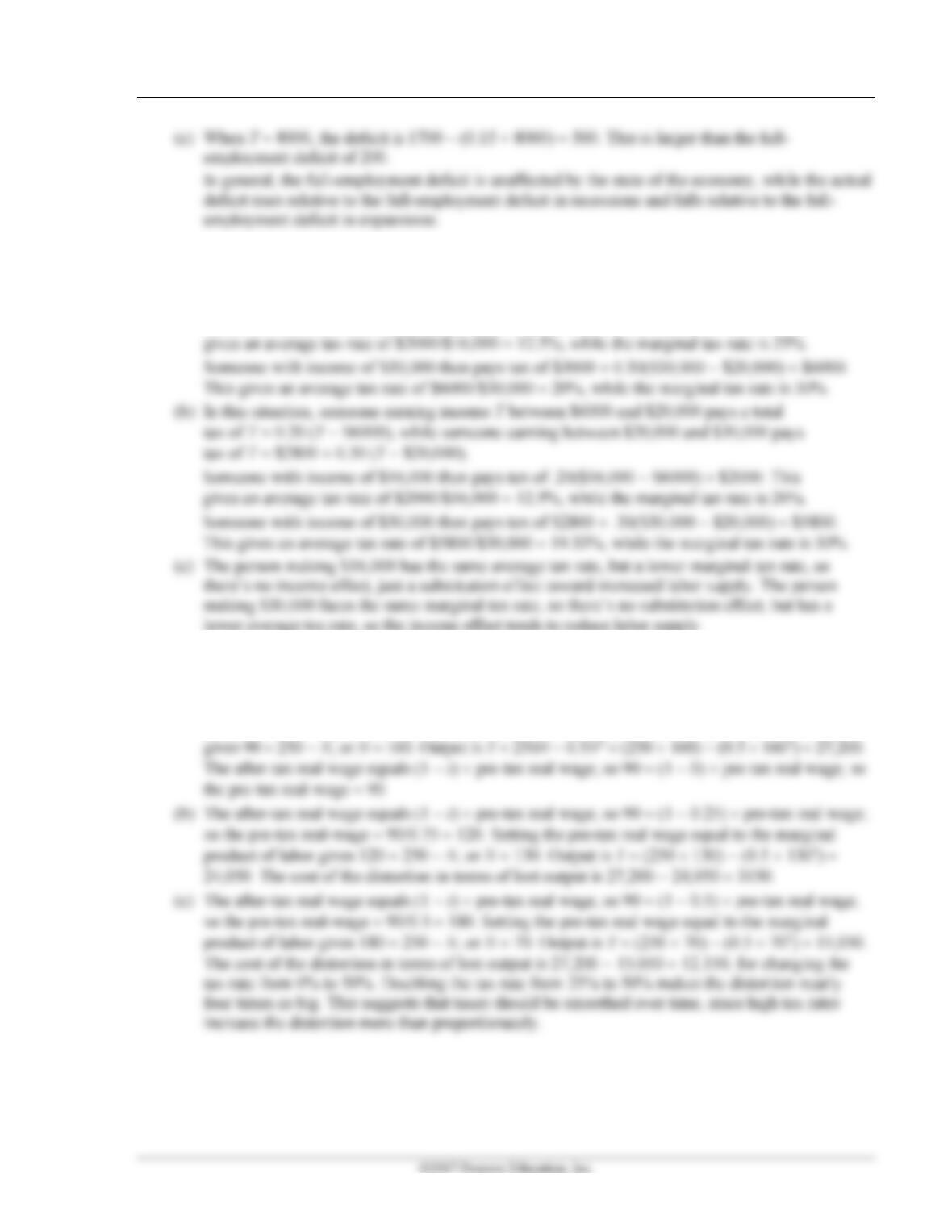
1. The following table shows the categories of the budget:
Outlays
Central
Government
Provincial
Governments
Combined
Governments
Purchases of goods
and services
200
150
350
Transfer payments
100
50
150
Grants in aid
100
100
Net interest paid
Grants in aid
To calculate net interest paid in this table:
The central government has debt of 1000 and the nominal interest rate is 10%, so it pays 1000
2. In the year in which the transfer is made, both the deficit and the primary deficit increase by $1 billion.
In the next year, the deficit increases by the amount of the increased interest payments, which total
$1 billion times the nominal interest rate, or $1 billion 0.10 = $100 million. The primary deficit is
3. Deficit = G + TR + INT − T = 1800 + (800 − 0.05Y) + 100 − (1000 + 0.1Y) = 1700 − 0.15Y.
The full-employment budget deficit is the deficit that would occur if the economy were
at full employment. Full-employment output is 10,000, so the full-employment deficit is
Chapter 15 Government Spending and Its Financing 383
4. (a) In this situation, someone earning income Y between $8000 and $20,000 pays a total
tax of T = 0.25 (Y − $8000), while someone earning between $20,000 and $30,000 pays
tax of T = $3000 + 0.30 (Y − $20,000).
Someone with income of $16,000 then pays tax of 0.25($16,000 − $8000) = $2000. This
5. If workers value their leisure at 90 goods per day, then 90 goods per day must be the equilibrium
value of the after-tax real wage.
(a) The after-tax real wage equals (1 − t) pre-tax real wage; so 90 = (1 − 0) pre-tax real wage; so
the pre-tax real-wage = 90. Setting the pre-tax real wage equal to the marginal product of labor
384 Abel/Bernanke/Croushore • Macroeconomics, Ninth Edition
6. (a) To find the largest nominal deficit that the government can run without raising the debt-GDP
ratio, use Eq. (15.4) and set the change in the debt-GDP ratio equal to zero. The equation is:
Change in debt–GDP ratio = deficit/nominal GDP − [(total debt/nominal GDP) growth rate of
nominal GDP]. Plugging in the values of the known variables and setting the change in the debt-
7. (a) The debt-GDP ratio is .10 at the start. After n years it is .10(1.07/1.05)n. After one year it is .102,
after two years it is .104, after five years it is .110, and after ten years it is .121.
If after n years the debt-GDP ratio is 10, we want to find n such that .10(1.07/1.05)n 10. Taking
8. L = 0.2Y − 500i = 0.2Y − 500r − 500
. With Y = 1000, L = 200 − 500r − 500
.
(a) When r = 0.04, equating real money supply to money demand gives: M/P = L = 200 − (500 0.04)
− 500
= 180 − 500
. Real seignorage revenue R =
M/P = 180
− 500
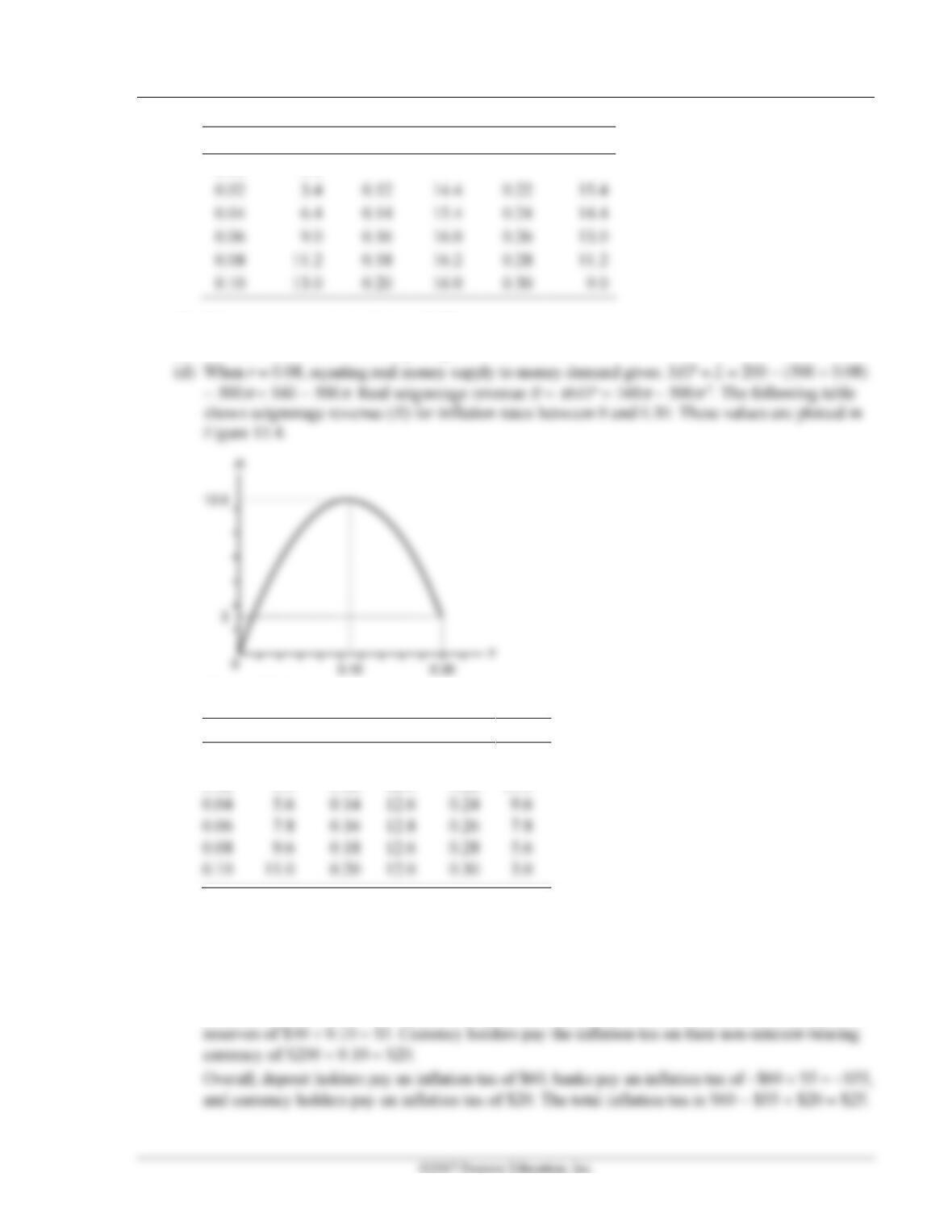
2. The following table
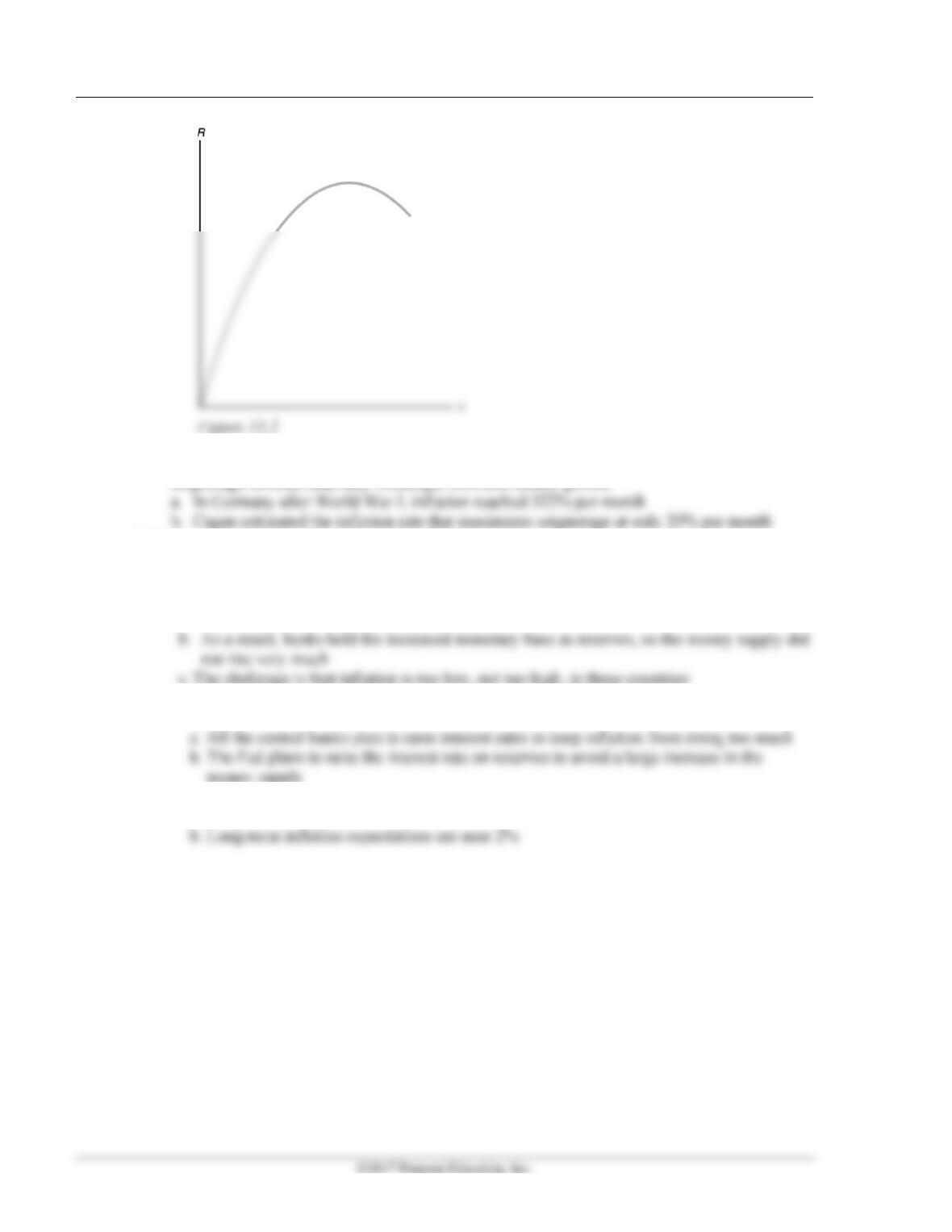
shows seignorage revenue (R) for inflation rates between 0 and 0.30. These values are plotted in
Figure 15.3.
Chapter 15 Government Spending and Its Financing 385
R
R
R
0.00
0.0
0.02
3.4
0.04
6.4
0.06
9.0
0.08
(b) Seignorage is maximized at
= 0.18.
(c) The maximum amount of seignorage revenue is 16.2.
Figure 15.4
R
R
R
0.00
0.0
0.02
3.0
0.12
12.0
0.22
11.0
0.04
5.6
0.14
12.6
0.24
9.6
0.06
7.8
0.16
12.8
0.26
7.8
0.08
9.6
0.18
12.6
0.28
5.6
The maximum seignorage of 12.8 is attained when
= 0.16.
9. (a) The monetary base is growing at a 10% rate, so it increases by 0.1 $250 = $25. The nominal
value of seignorage over the year is $25.
(b) Deposit holders pay the inflation tax on their non-interest-bearing deposits of $600 0.10 = $60.
This amount is received by banks. Banks pay the inflation tax on their non-interest-bearing

386 Abel/Bernanke/Croushore • Macroeconomics, Ninth Edition
(c) If deposit holders get the market rate of interest on their accounts, and the market rate of interest
rises with inflation, then deposit holders pay no inflation tax to banks. In this case the inflation
tax is borne entirely by banks ($5) and currency holders ($20).
Chapter 15 Government Spending and Its Financing 387
Analytical Problems
1. The main reason for having a system of grants in aid from the federal government to state and local
governments is that there are nationwide benefits to education, transportation, and welfare programs,
but these programs are most efficiently administered at the state and local level. Since the benefits are
2. This program has very bad incentive effects. For income (y) below $10,000, a person gets a transfer
equal to $10,000 − y. So for every dollar of income a person earns, he or she loses a dollar of
transfers. This is like having a marginal tax rate of 100%! The program makes it unlikely that a
person with low-income opportunities would want to work at all.
3. (a) Begin with Eq. (15.4): Change in debt–GDP ratio = deficit/nominal GDP − [(total debt/nominal
GDP) growth rate of nominal GDP]. To make things easier, replace the words with symbols,
where the debt-GDP ratio = B/PY, with debt = B, nominal GDP = PY, let i = nominal interest
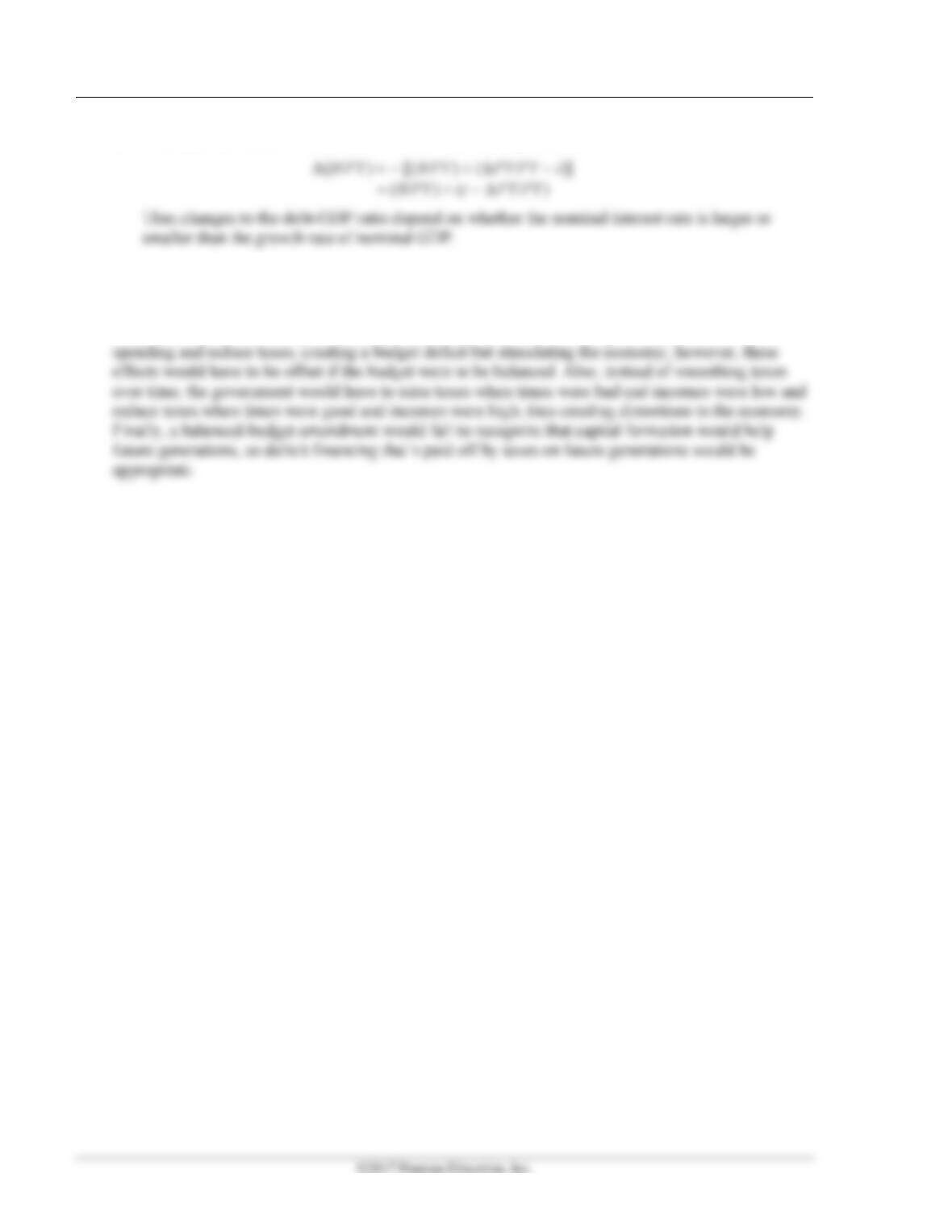
388 Abel/Bernanke/Croushore • Macroeconomics, Ninth Edition
(b) If the primary deficit is zero, then Bp/PY = 0, so the equation above is:
4. A balanced-budget amendment might prove useful if the government otherwise had a tendency to run
a perpetual budget deficit. The amendment would provide a mechanism for fiscal discipline, forcing
policymakers to balance the budget. But there could be significant disadvantages, since fiscal policy
wouldn’t be as flexible. In particular, automatic stabilizers kick in during a recession to increase
Chapter 15 Government Spending and Its Financing 389
Working with Macroeconomic Data
1. State and local government spending and taxes have generally grown faster than federal
2. In recessions, the budget surpluses of both federal and state & local governments generally
3. In 2015, projected deficits and full-employment deficits for the coming five years were similar to,
but slightly below, the average historical deficit.
390 Abel/Bernanke/Croushore • Macroeconomics, Ninth Edition
Hyperinflation in the United States
Although extreme inflations have not occurred for a very long time in the United States, they are not
completely absent from U.S. history. Before declaring independence from Great Britain, the British
colonies that would eventually become the United States issued their own money. In the first half of the
eighteenth century, several colonies (including South Carolina and the New England colonies as a group)
experienced very significant inflations.
Another severe inflationary episode (on what is now American soil, although not involving the
government of the United States) occurred in the Confederacy during the Civil War.1 The Confederacy
found it very difficult to collect taxes, due to lack of cooperation from the individual Confederate states,
the inroads of the invading Union forces, and a lack of experienced and reliable tax collectors. (In one