CHAPTER 15 | Monetary Policy 367
Extra Economics in Your Life:
Should You Hold Bonds or Savings/Checking Accounts?
Question: Suppose most of your savings are in bonds and, according to an article in the Wall Street
Journal, the Fed announces that it will carry out a contractionary monetary policy. What should you do?
Should you continue to hold your bonds or should you move your funds into bank accounts?
Answer: Holding bonds has several advantages. Their prices may rise. In addition, they pay interest that
Extra AN INSIDE LOOK News Article to Use in Class
368 CHAPTER 15 | Monetary Policy
Solutions to End-of-Chapter Exercises
15.1
What Is Monetary Policy?
Learning Objective: Define monetary policy and describe the Federal Reserve’s
monetary policy goals.
Review Questions
1.1 When Congress established the Fed in 1913, the main responsibility of the Fed was to prevent
bank panics by making discount loans to banks. Congress broadened the Fed’s responsibilities in
response to the Great Depression in the 1930s.
Problems and Applications
1.5 A bank panic occurs when large numbers of depositors simultaneously make withdrawals from
many banks. When the Fed was founded, its primary responsibility was to deal with bank panics
by making discount loans to banks. The failure of a single large bank can lead to a bank panic as
1.6 a. Maximum sustainable unemployment does not mean zero percent unemployment. When the
economy is at “full employment,” there will still be some amount of frictional and structural
1.7 Nominal interest rates tend to be lower when inflation is low, and they tend to be higher when
inflation is high. (The nominal interest rate equals the real interest rate plus the expected inflation
rate.) Therefore, if the Fed achieves price stability, long-term interest rates are likely to be low.
CHAPTER 15 | Monetary Policy 369
1.8 If the Fed decided not to raise the federal funds rate, it would be promoting the goals of
15.2
The Money Market and the Fed’s Choice of Monetary Policy Targets
Learning Objective: Describe the Federal Reserve’s monetary policy targets and
explain how expansionary and contractionary monetary policies affect the interest
rate.
Review Questions
2.1 A monetary policy target is a variable that the Fed can affect directly and that, in turn, affects
2.2 The demand for money refers to the amount of money, as measured by M1 or M2 that households
and firms desire to hold at different nominal interest rates. The advantage of holding money (the
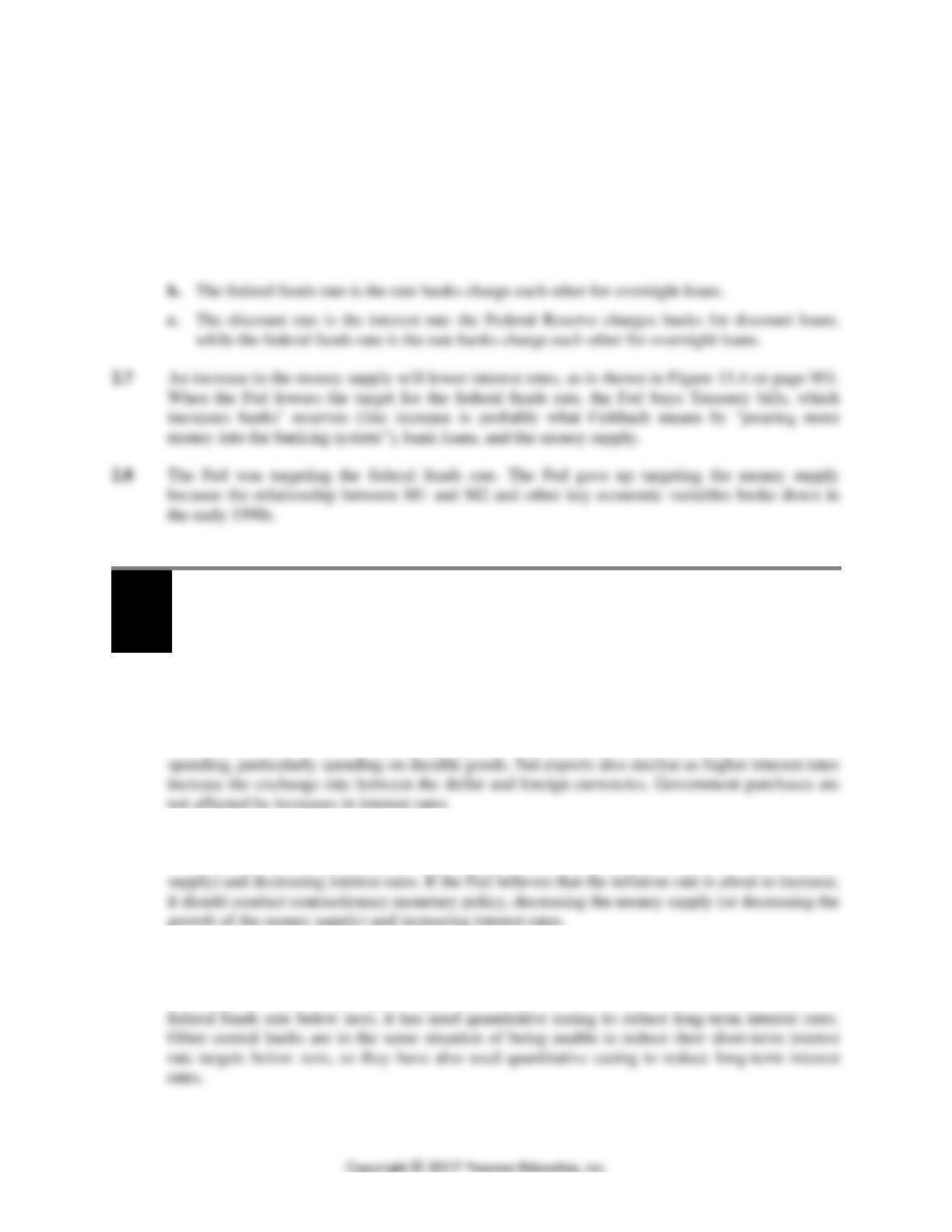
2.3 To lower the equilibrium interest rate, the Fed would increase the money supply. The following
graph shows the money supply curve shifting to the right from MS1 to MS2, which causes the
equilibrium interest rate to fall from i1 to i2.
370 CHAPTER 15 | Monetary Policy
Problems and Applications
2.5 A decrease in the money supply from MS1 to MS2 could be caused by the Federal Reserve selling
U.S. government securities, raising the discount rate, or raising the required reserve ratio. An
increase in money demand from MD1 to MD2 could be caused by an increase in the price level or
an increase in real GDP.
2.6 a. The target interest rate is called the federal funds rate.
15.3
Monetary Policy and Economic Activity
Learning Objective: Use aggregate demand and aggregate supply graphs to show the
effects of monetary policy on real GDP and the price level.
Review Questions
3.1 An increase in interest rates decreases three of the four components of aggregate demand. Higher
interest rates decrease investment spending, including spending on new homes, and consumption
3.2 If the Fed believes the economy is headed for a recession, it should conduct expansionary
monetary policy, increasing the money supply (or increasing the rate of growth of the money
3.3 Quantitative easing refers to the buying of securities (such as 10-year Treasury notes and
mortgage-backed securities) with longer maturities than short-term Treasury securities (Treasury
bills) that the Fed usually buys in open market operations. Because the Fed cannot reduce the
CHAPTER 15 | Monetary Policy 371
Problems and Applications
3.4 The Fed typically uses contractionary monetary policy in situations where it believes that real
GDP has increased beyond potential GDP, resulting in an increase in the inflation rate. Real GDP
3.5 Apparently, banks in Japan were not lending out the new reserves being created by the Bank of
Japan’s expansionary monetary policy. For an expansionary monetary policy to be successful,
3.6 a. “Pushing up the value of the currency” means increasing the exchange rate between the dollar
and other currencies. In other words, causing the dollar to exchange for more units of foreign
currencies (or other currencies to exchange for fewer dollars).
3.7 a. To reduce the rate of inflation the Brazilian central bank would use contractionary monetary
policy tools. For example, increasing reserve requirements and selling government bonds
3.8 William McChesney Martin meant that if real GDP exceeds potential GDP (“the party is getting
going”) and the inflation rate begins to increase, the Fed needs to take steps to restrain aggregate
3.9 a. Rounds of quantitative easing (QE) by the Fed, the European Central Bank, and other central
banks around the world had driven long-term interest rates to very low levels. Eventually,
investors bid up the prices of some long-term government bonds in Germany and a few other
372 CHAPTER 15 | Monetary Policy
b. As the chapter explains: “With interest rates on many corporate bonds and on bank deposits
3.10 a. The federal funds rate is the short-term interest rate that the Fed manages. Changes in the
federal funds rate change other short-term nominal interest rates and, to a lesser extent, long–
term real interest rates, which affect consumption spending, investment spending, and net
3.11 a. Economic growth was negative. Real GDP declined from 2007 to 2008 (by 0.20 percent) and
declined in 2009 (by 2.78 percent).
3.12 Policymakers at the Fed believe that, although it is not perfect, active monetary policy is still able
3.13 You should disagree because the statement is incorrect. An increase in the money supply does not
affect real GDP directly, and certainly not dollar-for-dollar. An increase in the money supply
3.14 Answers may vary, but a strong case could be made for the chair of the Federal Reserve as the
nation’s most important economic policy-making position because of the influence the Fed chair
CHAPTER 15 | Monetary Policy 373
15.4
Monetary Policy in the Dynamic Aggregate Demand and Aggregate
Supply Model
Learning Objective: Use the dynamic aggregate demand and aggregate supply model
to analyze monetary policy.
Review Questions
4.1 In the basic aggregate demand and aggregate supply model, an expansionary monetary policy is
illustrated by the aggregate demand curve shifting to the right, while neither the short-run
4.2 In the basic aggregate demand and aggregate supply model, a contractionary monetary policy is
illustrated by the aggregate demand curve shifting to the left, while neither the short-run
aggregate supply curve nor the long-run aggregate supply curve shifts. In the dynamic model, the
Problems and Applications
4.3 You should disagree with this argument. Although in the basic aggregate demand and aggregate
supply model, a contractionary monetary policy causes the price level to fall, in the more accurate
dynamic AD–AS model, a contractionary monetary policy causes the price level to rise by less
4.4 a. Without policy action, aggregate demand will shift from AD2018 to AD2019(without policy). Real GDP
increases from $17.9 trillion to $18.5 trillion, and the price level increases from 114 to 118.
b. Because real GDP is greater than potential GDP in 2019, the Fed should use a contractionary
374 CHAPTER 15 | Monetary Policy
c. If the Fed takes no policy action, the price level will increase from 114 in 2018 to 118 in
2019. The rate of inflation would be equal to [(118 – 114)/114] × 100 = 3.5 percent. If the
4.5 a. The information in the table tells us that without monetary policy, real GDP will be less than
potential GDP in 2019. To keep real GDP at its potential level, the Fed must undertake an
expansionary policy. To implement an expansionary policy, the Fed’s trading desk needs to
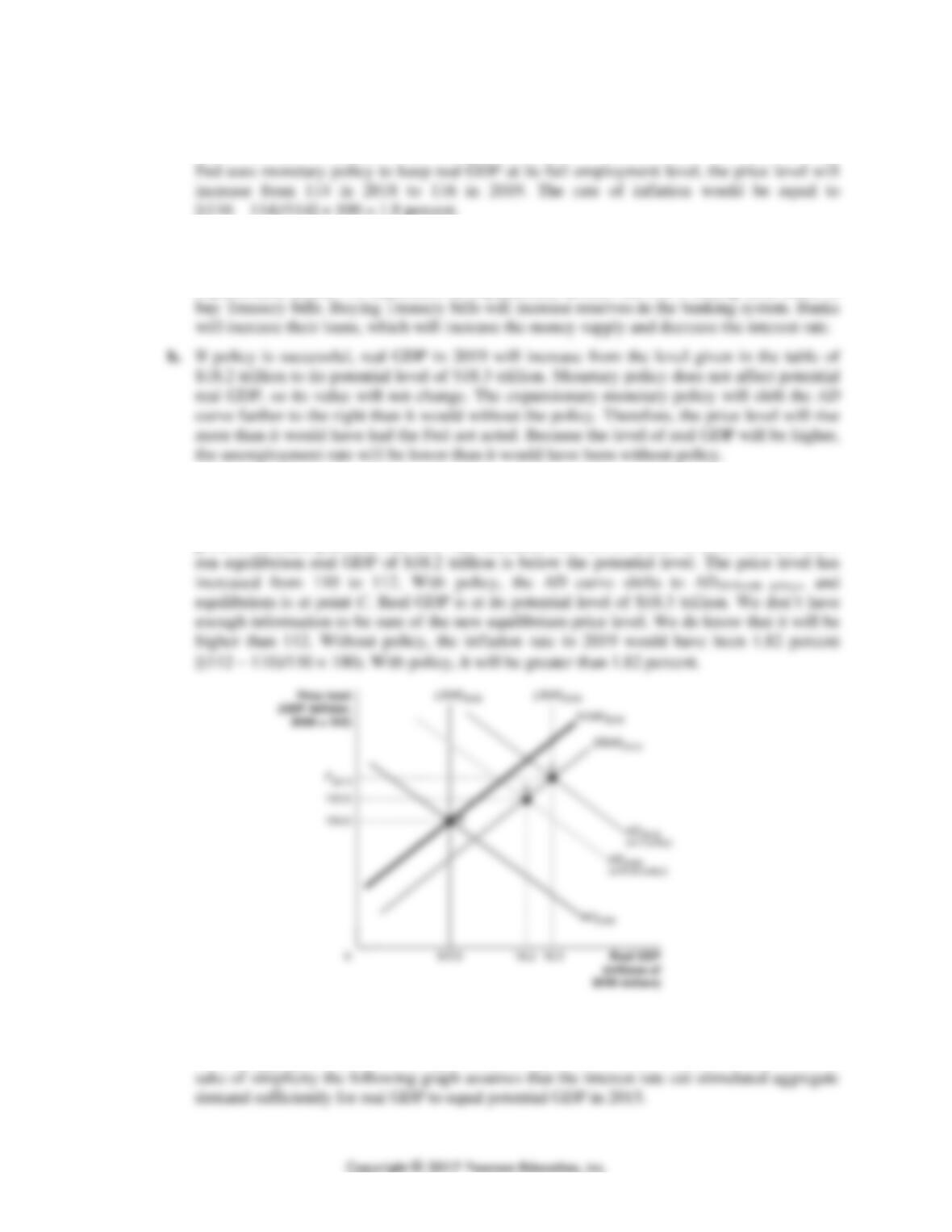
c. Equilibrium in 2018 is at point A, with the AD and SRAS curves intersecting along the LRAS
curve. Real GDP is at its potential level of $17.9 trillion, and the price level is 110. Without
monetary policy, the AD curve shifts to AD2019(without policy), and short-run equilibrium occurs at
point B. Because potential real GDP has increased from $17.9 trillion to $18.3 trillion, short-
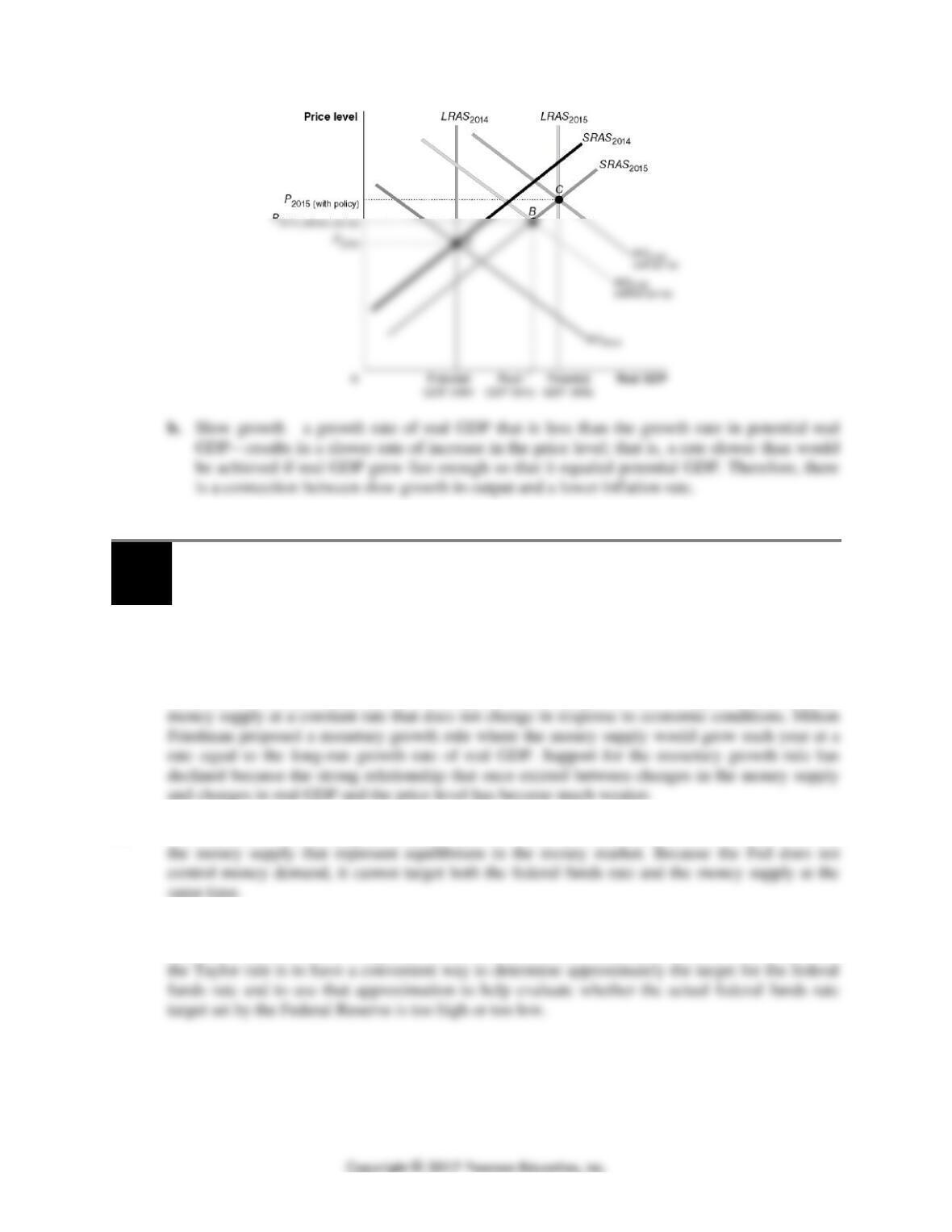
4.6 a. The Reserve Bank of India expected real GDP in 2015 to be below potential GDP without the
interest rate cut. The Reserve Bank was trying to stimulate spending with the interest rate cut,
shifting aggregate demand to the right and pushing real GDP closer to potential GDP. For the
CHAPTER 15 | Monetary Policy 375
15.5
A Closer Look at the Fed’s Setting of Monetary Policy Targets
Learning Objective: Describe the Fed’s setting of monetary policy targets.
Review Questions
5.1 With a monetary rule, monetary policy follows a set rule rather than being determined at the
discretion of Fed policymakers. For example, a monetary growth rule is a plan to increase the
5.2 The Fed can’t hit both targets because it can achieve only combinations of the interest rate and
5.3 The Taylor rule is a rule developed by John Taylor, an economist at Stanford University, which
links the Federal Reserve’s target for the federal funds rate to economic variables. The purpose of
376 CHAPTER 15 | Monetary Policy
Problems and Applications
5.4 The Federal Reserve can affect the money supply but not the demand for money. The Fed
currently targets interest rates, but while Paul Volcker was chairman of the Federal Reserve
Board it chose to reduce the growth of the money supply in order to reduce the rate of inflation,
5.6 a. The federal funds rate would be lower during a recession. The higher coefficient of 1, rather
than 0.5, on the output gap, which would be negative during a recession, would push the
federal funds rate lower.
5.7 If an estimate of potential GDP is inaccurate, then the output gap in the Taylor rule’s estimate of
the target federal funds rate will be inaccurate as well.
5.8 The benefits from an explicit inflation target include: (1) the Fed’s better communication with the
5.9 a. The PCE includes all goods and services that are in the consumption component of GDP,
while the CPI includes only goods that are in the market basket of goods and services that the
BLS uses in calculating that index. The core PCE does not measure food and energy prices,
which are measured by the CPI. Because food and energy prices tend to be volatile, the core
CHAPTER 15 | Monetary Policy 377
15.6
Fed Policies during the 2007–2009 Recession
Describe the policies the Federal Reserve used during the 2007–2009 recession.
Review Questions
6.1 A mortgage is a loan a borrower takes out to buy a house. (Technically, a residential mortgage is
a loan that uses a house or residence as collateral for the loan, while a commercial mortgage is a
loan that uses a commercial building as collateral for the loan.) Prior to 1970, mortgages were not
considered securities—financial assets that are bought and sold in secondary markets. After 1970,
6.2 Among the actions taken by the Fed and Treasury were the following:
In March 2008:
• The Fed announced it would temporarily make discount loans to primary dealers–firms
that participate in open market transactions with the Fed.
In September 2008:
• The Treasury moved to have the federal government take control of Fannie Mae and
Freddie Mac. Fannie Mae and Freddie Mac were each provided with up to $100 billion in
exchange for 80 percent ownership of the firms.
In October 2008:
• Congress passed the Troubled Asset Relief Program (TARP), under which the Treasury
attempted to stabilize the commercial banking system by providing funds to banks in
exchange for stock.
378 CHAPTER 15 | Monetary Policy
Problems and Applications
6.3 By the fall of 2007, the housing bubble had collapsed and sales of new homes declined
6.4 The establishment of Fannie Mae and Freddie Mac by Congress spurred the development of a
secondary market in mortgage-backed securities. The existence of a secondary market, in turn,
greatly expanded the sources of funding for mortgages. These developments meant that borrowers
have been able to choose from a greater variety of lenders and small local banks face greater
6.5 In hindsight, one can state that the U.S. economy was far from “turning the corner in terms of
financial disruption” in April 2008. It may have seemed to be a reasonable analysis at the time if
6.6 a. AIG was the largest insurance company in the United States and had large amounts of
insurance contracts (credit default swaps) that required AIG to make payments when there
were defaults on mortgage-backed securities. With the adverse reaction in financial markets
to the Lehman Brothers bankruptcy being stronger than the Fed and the Treasury expected,
6.7 A “subprime mortgage” is a mortgage granted to a borrower with a poor credit history who makes
a small down payment or otherwise represents a higher than average risk of default. A deeper
CHAPTER 15 | Monetary Policy 379
6.8 a. The following are the key events that many economists believe led to the financial crisis
were:
• The increased securitization of mortgage loans
• The increased availability of mortgage loans to subprime and Alt-A borrowers
6.9 Case I (20 percent down payment)
0.20 × $150,000 = $30,000 down payment
Real-Time Data Exercises
D15.1 a. In its press release of September 17, 2015 FOMC did not change the target for the federal
funds rate. It “…reaffirmed its view that the current 0 to 1/4 percent target range remains
appropriate.”
380 CHAPTER 15 | Monetary Policy
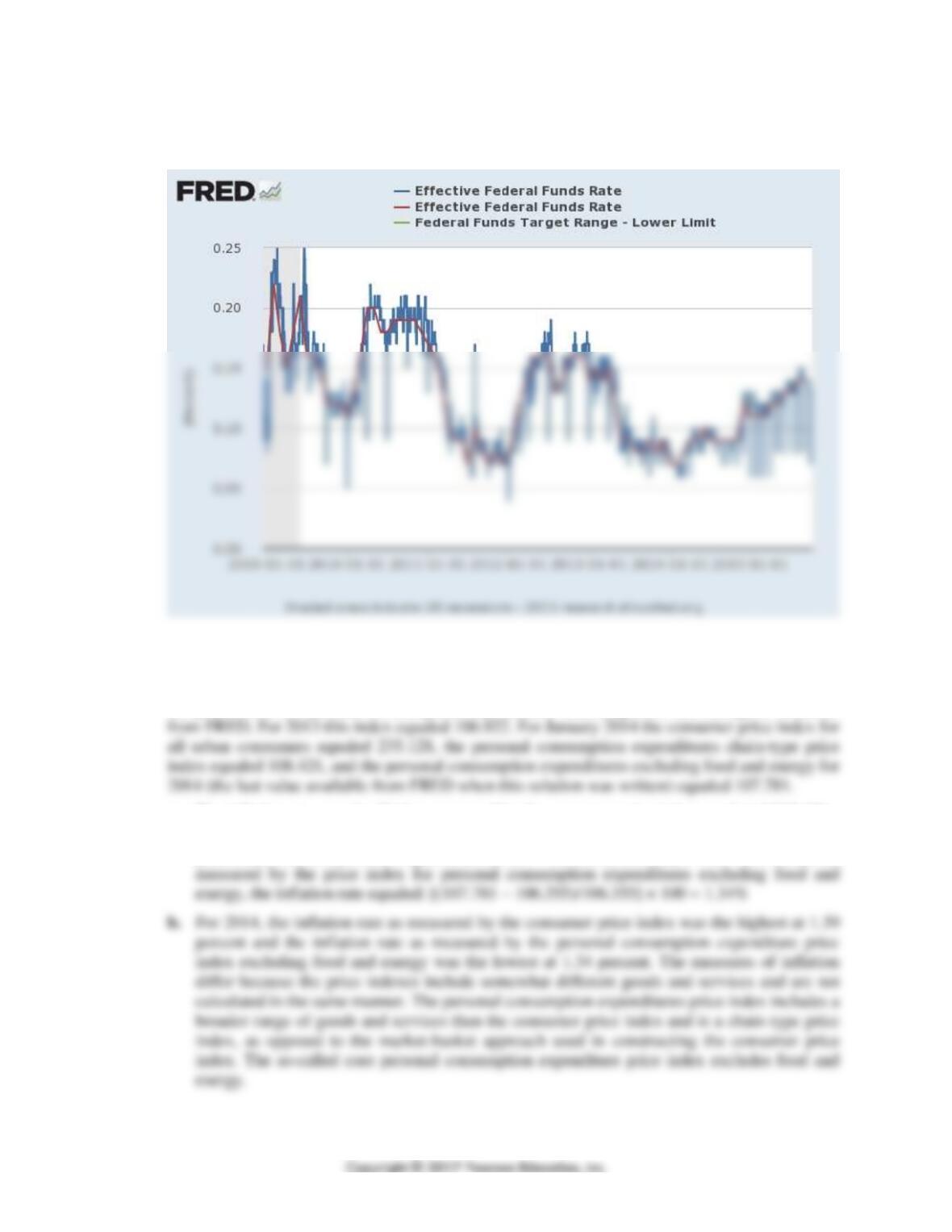
D15.2 As shown in the figure below, the Fed over this period has been able to keep the effective federal
funds rate within the target range.
D15.3 For January 2013 the consumer price index for all urban consumers equaled 231.444 and the
personal consumption expenditures chain-type price index equaled 106.922. Only annual data for
the price index for personal consumption expenditures excluding food and energy is available
a. The inflation rate over for 2014 as measured by the consumer price index equaled: [(235.128 –
231.444)/231.444] × 100 = 1.59%; as measured by the personal consumption expenditure
price index, the inflation rate equaled: [(108.421 – 106.922)/106.922] × 100 = 1.40%; and as