interactive activity
Chapter 15
Monetary Policy
1. Access the Discovering Data exercise for Chapter 15 Problem 1 online to
answer the following questions.
a. What is the target federal funds rate?
b. Is the target federal funds rate different from the target federal funds rate in
the previous FOMC statement? If yes, by how much does it differ?
2. How will the following events affect the demand for money? In each case,
specify whether there is a shift of the demand curve or a movement along the
demand curve and its direction.
a. There is a fall in the interest rate from 12% to 10%.
2. a. Any decrease in the interest rate will lead to an increase in the quantity of
money demanded (a movement down the money demand curve) but no shift in
the money demand curve.
b. When the holiday shopping season starts, consumers anticipate an increase
in expenditures and so, at each income level, increase the demand for money.
The money demand curve shifts to the right.
3. a. Go to www.treasurydirect.gov. Under “Individuals,” go to “Treasury Securi-
ties & Programs.” Click on “Treasury bills.” Under “at a glance,” click on “rates
in recent auctions.” What is the investment rate for the most recently issued
52-week T–bills?
b. Go to the website of your favorite bank. What is the interest rate for one-year
Solution
4. Go to www.treasurydirect.gov. Under “Individuals,” go to “Treasury Securities &
a. What are the interest rates on 2-year and 10-year notes?
b. How do the interest rates on the 2-year and 10-year notes relate to each other?
4. a. Answers will vary. On June 15, 2017, the interest rate on the most recently
issued 2-year note was 1.250% and the interest rate on the most recently
issued 10-year note was 2.375%.
b. The interest rate on the 10-year note is higher than the interest rate on the
2-year note. Long-term interest rates reflect the average expectation in the
market about what’s going to happen in the future to rates that have a shorter
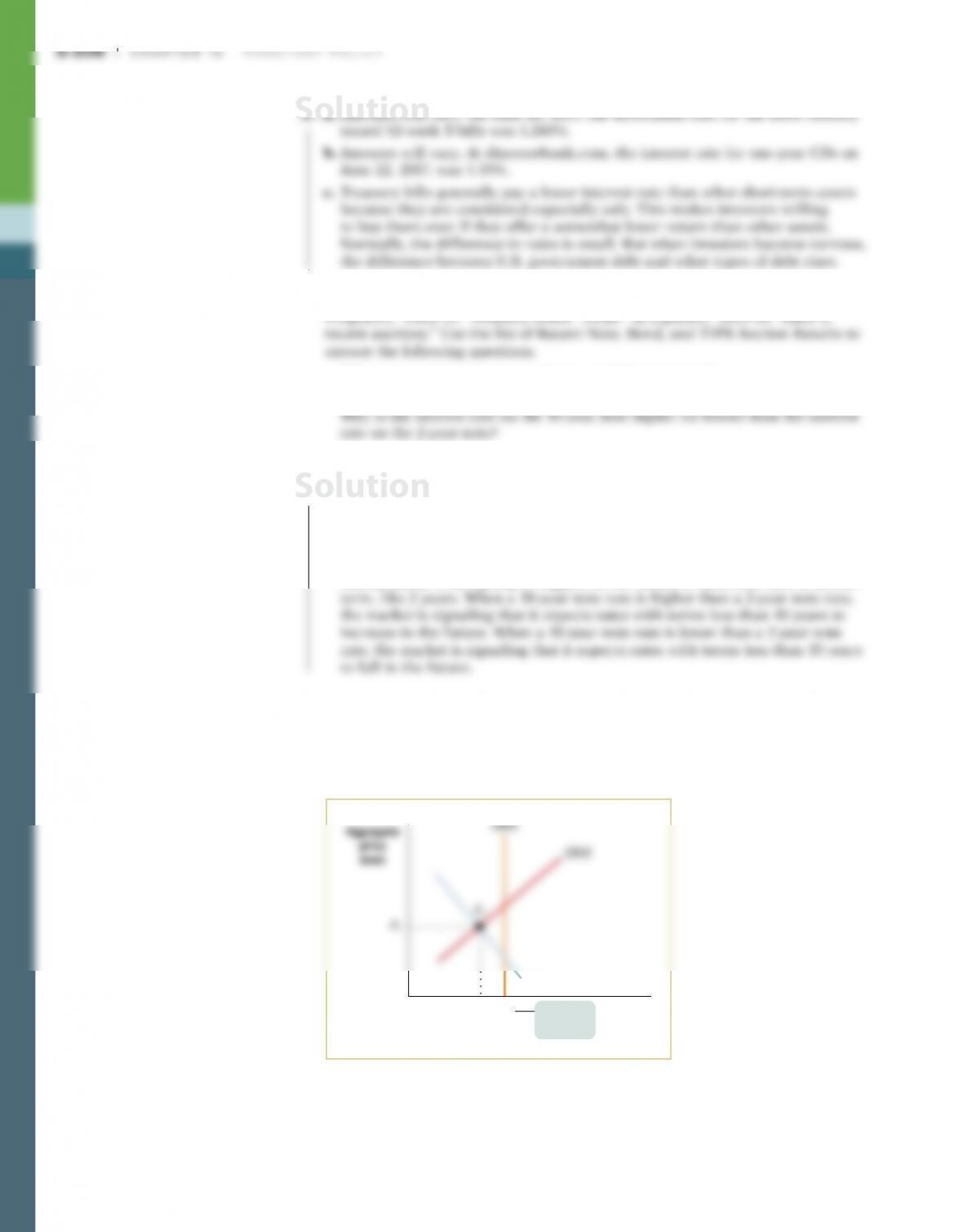
5. An economy is facing the recessionary gap shown in the accompanying diagram.
To eliminate the gap, should the central bank use expansionary or contraction-
ary monetary policy? How will the interest rate, investment spending, consumer
spending, real GDP, and the aggregate price level change as monetary policy
closes the recessionary gap?
Real GD
P
A
ggregate
price
level
Y1YP
LRAS
SRAS
P1
AD1
Potential
output
Solution
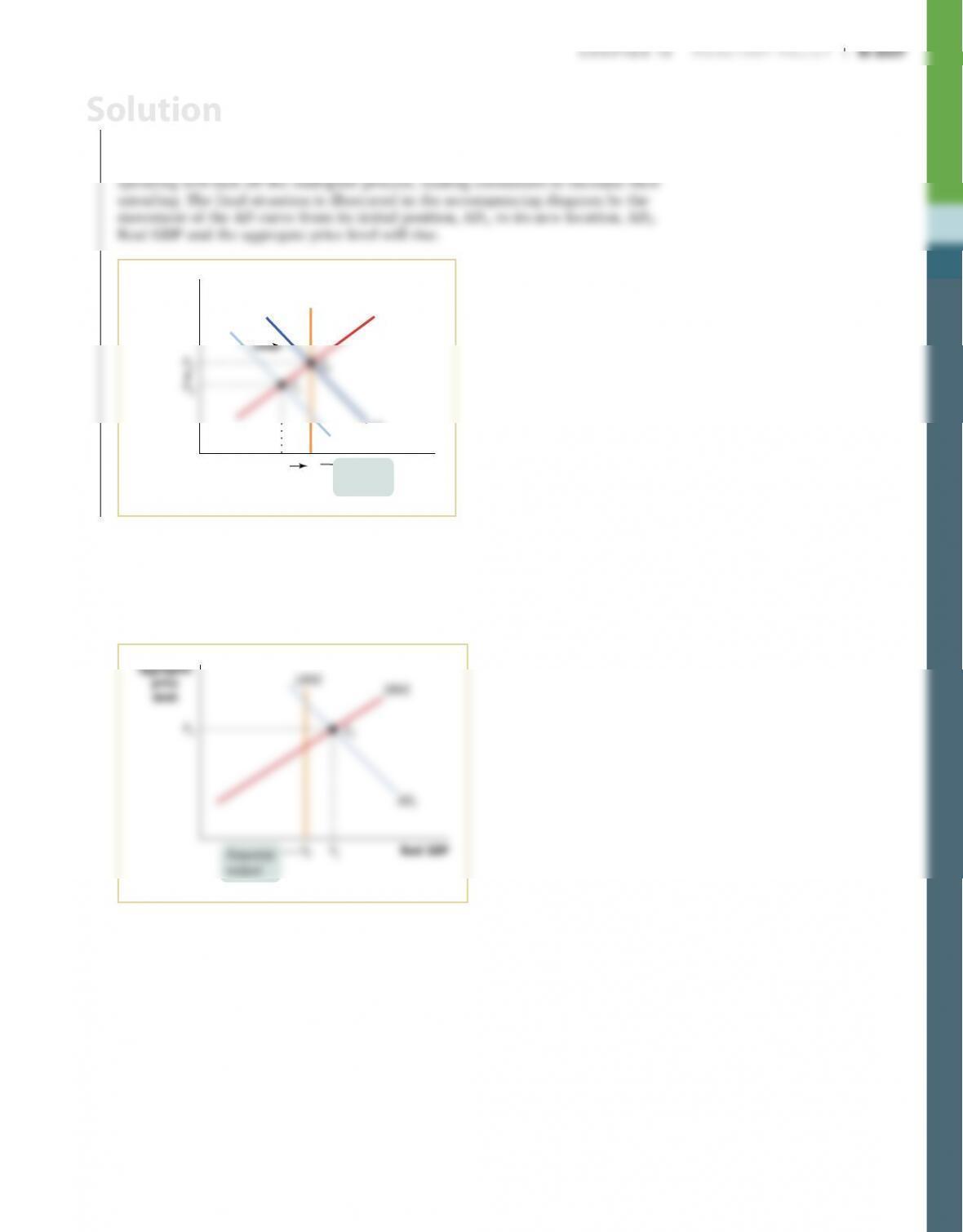
5. The central bank can use expansionary monetary policy to eliminate the reces-
sionary gap. The central bank could engage in an open–market purchase of U.S.
Treasury bills. This would increase the money supply, lower the interest rate,
and encourage an increase in investment spending. The increase in investment
Aggregate
price
level
Real
GDP
YP
Y1
LRAS
AD2
AD1
SRAS
Potential
output
6. An economy is facing the inflationary gap shown in the accompanying diagram.
To eliminate the gap, should the central bank use expansionary or contraction-
ary monetary policy? How will the interest rate, investment spending, consumer
spending, real GDP, and the aggregate price level change as monetary policy
closes the inflationary gap?
SRAS
P1
Aggregate
price
level
E1
LRAS
Solution
S-208 Chapter 15 Monetary Policy
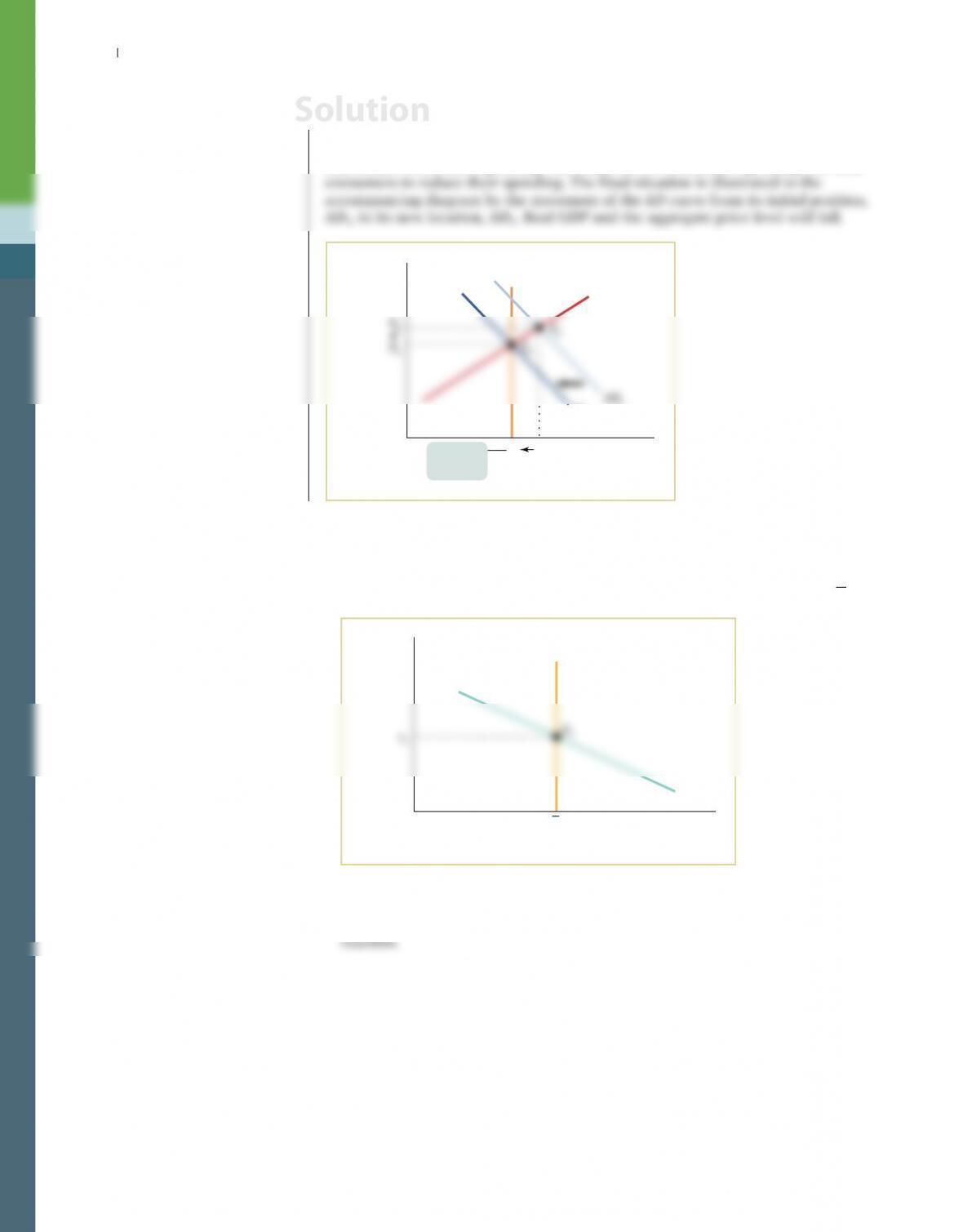
6. The central bank can use contractionary monetary policy to eliminate the
inflationary gap. The central bank could engage in an open–market sale of U.S.
Treasury bills. This would reduce the supply of money, raise the interest rate,
and reduce investment spending. The reduction in investment spending will lead
SRAS
Real GDP
LRAS
Aggregate
price
level
P1
YP Y1
AD2
Potential
output
7. In the economy of Eastlandia, the money market is initially in equilibrium when
the economy begins to slide into a recession.
a. Using the accompanying diagram, explain what will happen to the interest
rate if the central bank of Eastlandia keeps the money supply constant at M1.
Quantity
of money
Interest
rate, r
MD1
MS1
M1
r1
E1
b. If the central bank is instead committed to maintaining an interest rate tar-
get of r1, then as the economy slides into recession, how should the central
bank react? Using your diagram from part a, demonstrate the central bank’s
Solution
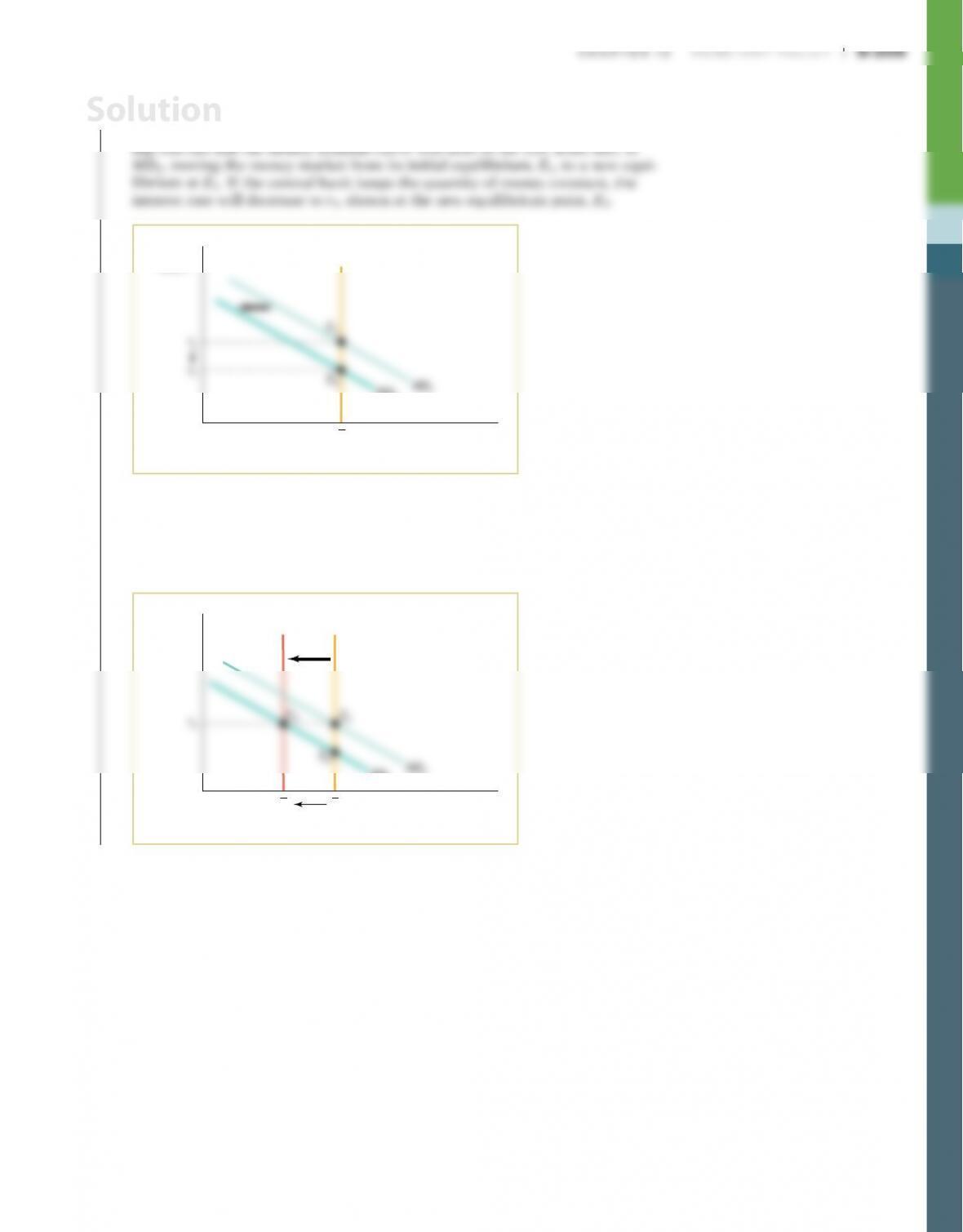
7. a. Beginning at equilibrium point E1 in the accompanying money market dia-
gram, when the economy of Eastlandia goes into recession, aggregate spend–
Quantity
of money
M1
MD2
b. If the central bank is committed to maintaining an interest rate target of r1,
then the central bank will reduce the money supply as the economy goes into
recession, from MS1 to MS2 in the accompanying diagram, eliminating the
potential for interest rates to fall. The new equilibrium in the money market is
at E3, with the interest rate at its target rate, r1.
MS1
MS2
Quantity
of money
MD2
Interest
rate, r
M2M1
8. Suppose that the money market in Westlandia is initially in equilibrium and the
central bank decides to decrease the money supply.
a. Using a diagram like the one in Problem 7, explain what will happen to the
interest rate in the short run.
b. What will happen to the interest rate in the long run?
Solution
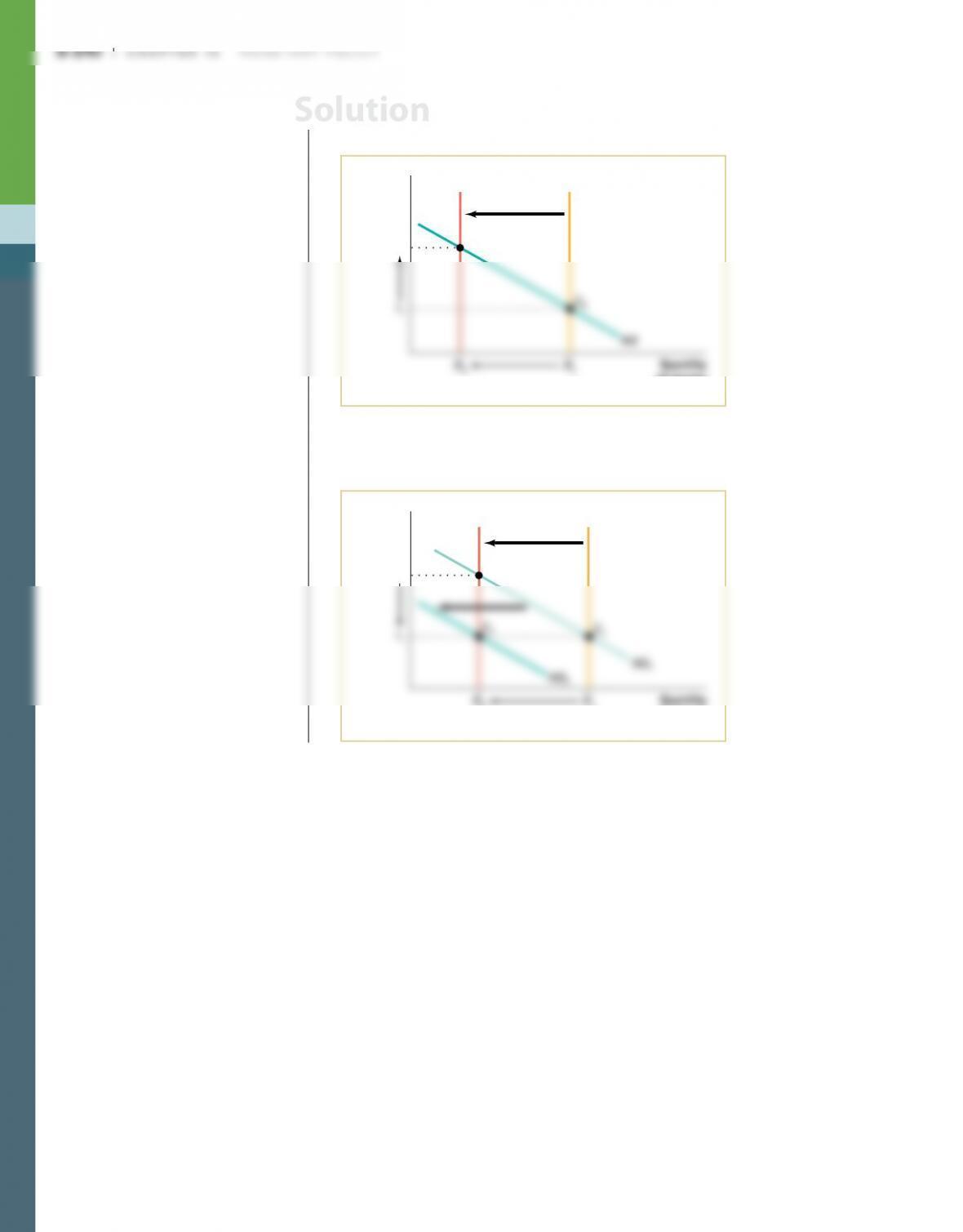
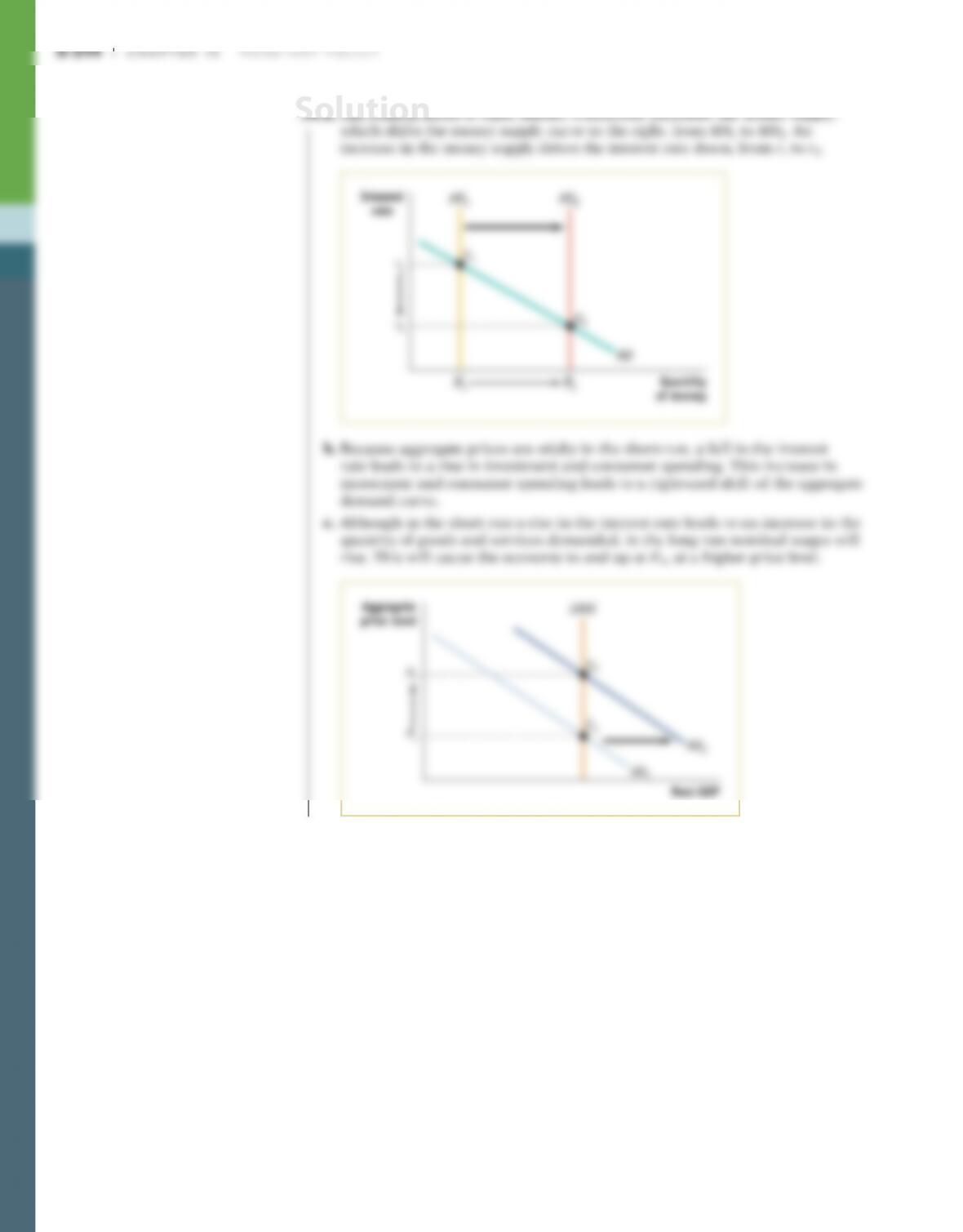
8. a. In the short-run, the money supply curve will shift to the left, to MS2, and the
interest rate will rise from r1 to r2.
MS
2
MS
1
r2
Quantity
of money
Interest
rate
E2
M2M1
b. Over time, the aggregate price level will fall. This will reduce money demand,
shifting the money demand curve left from MD1 to MD2, which causes the
equilibrium interest rate to fall again.
MS
2
MS
1
r2
Quantity
of money
Interest
rate
E2
M2M1
9. An economy is in long–run macroeconomic equilibrium with an unemployment
rate of 5% when the government passes a law requiring the central bank to use
monetary policy to lower the unemployment rate to 3% and keep it there. How
could the central bank achieve this goal in the short run? What would happen in
the long run? Illustrate with a diagram.
Solution
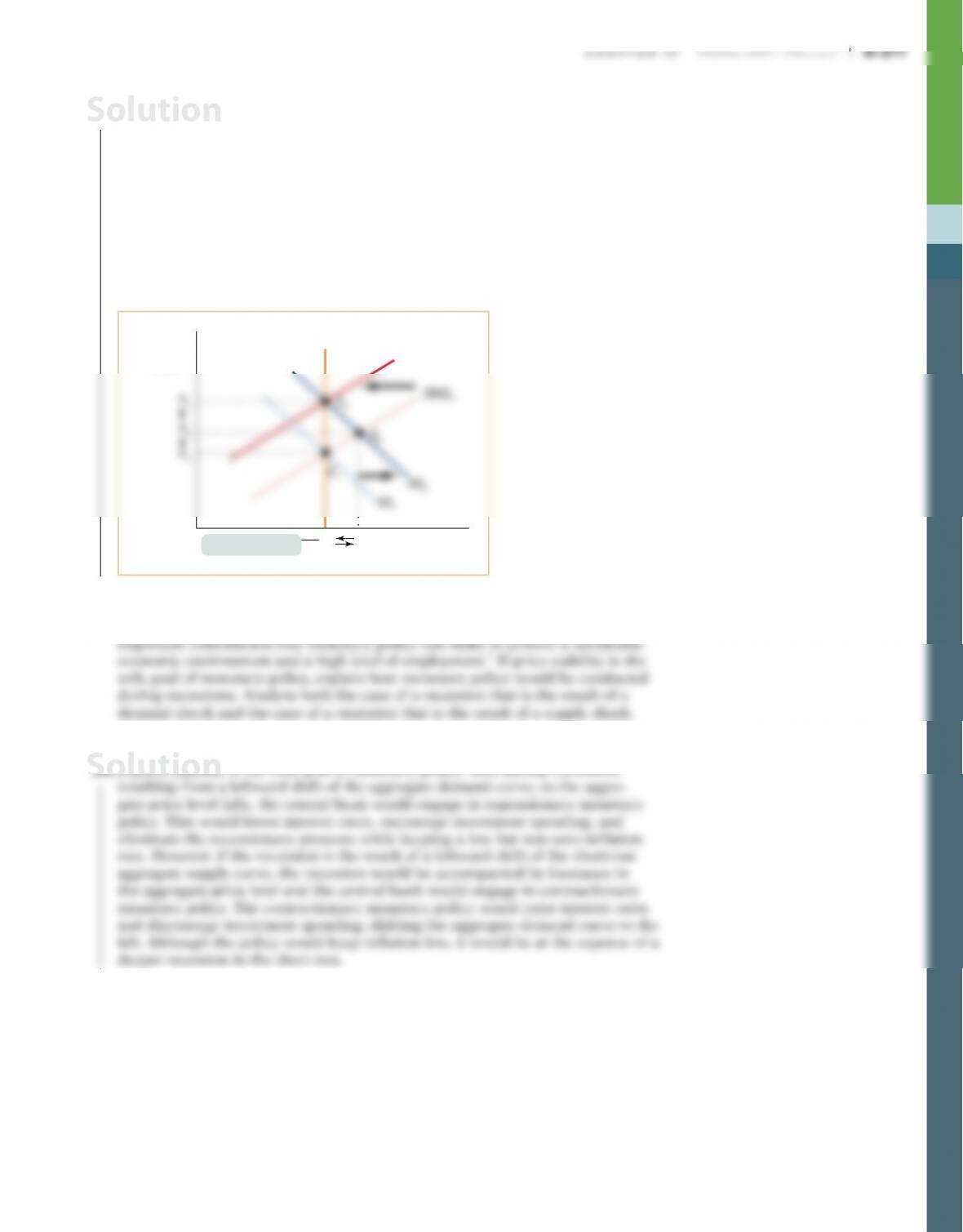
9. If the economy is in long–run macroeconomic equilibrium with an unemploy-
ment rate of 5%, then the long–run aggregate supply curve must be vertical at a
real GDP that is associated with a 5% unemployment rate. This long–run macro–
economic equilibrium is E1 in the accompanying diagram. In the short run, the
central bank can engage in expansionary monetary policy to shift the aggregate
demand curve to the right (from AD1 to AD2) and reduce the unemployment
rate to 3%. Over time, because real GDP exceeds potential output, the short-run
aggregate supply curve will shift to the left (from SRAS1 to SRAS2). However, the
central bank cannot keep the unemployment rate at 3% in the long run, since, in
the long run, money is neutral. In the long run, output will return to its potential
level and the unemployment rate will return to 5%.
Aggregate
price
level
Real GDP
Y1
YP
LRAS
SRAS2
Potential output
10. According to the European Central Bank website, the treaty establishing the
European Community “makes clear that ensuring price stability is the most
Solution
S-212 Chapter 15 Monetary Policy
11. The effectiveness of monetary policy depends on how easy it is for changes in the
money supply to change interest rates. By changing interest rates, monetary pol-
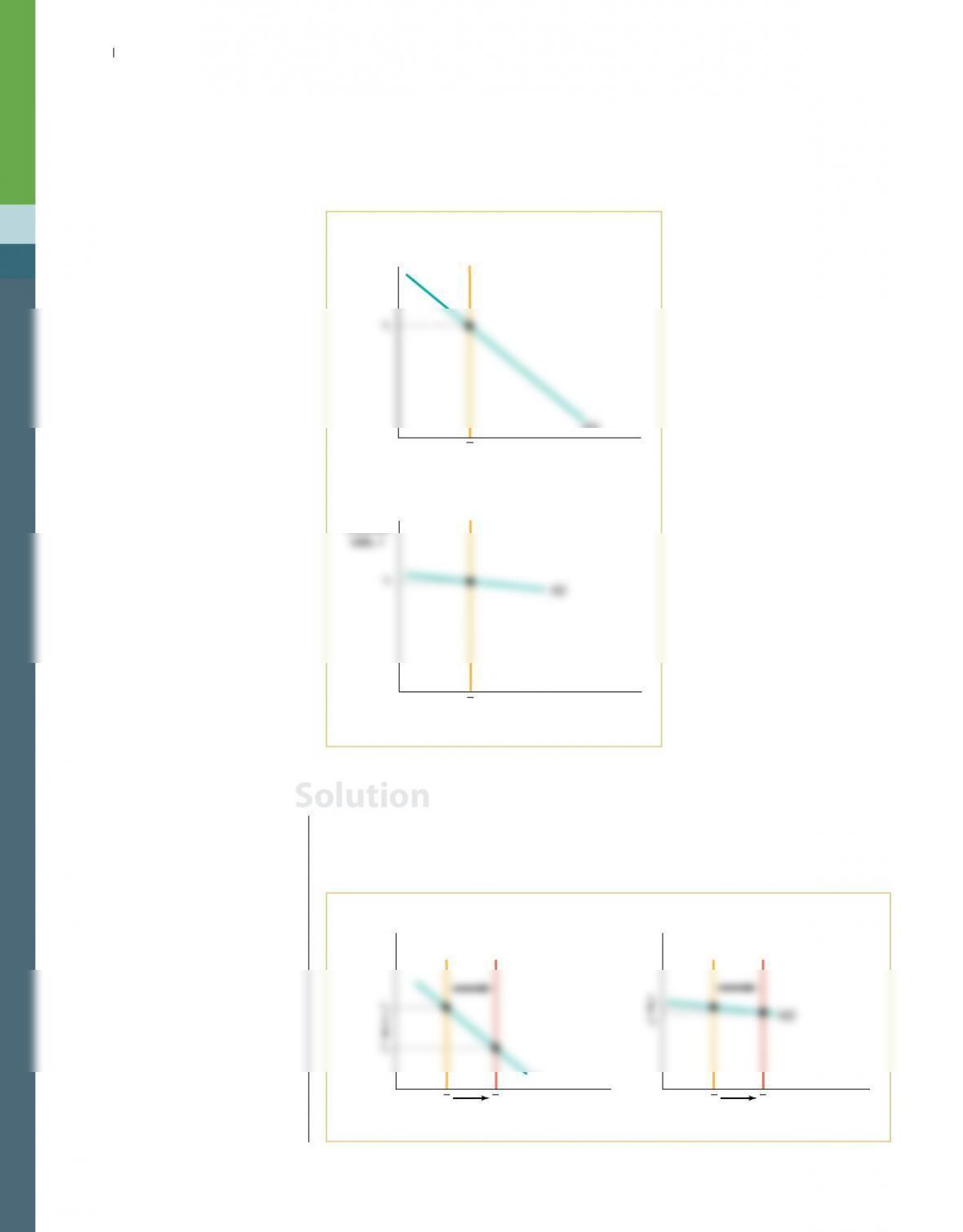
icy affects investment spending and the aggregate demand curve. The economies
of Albernia and Brittania have very different money demand curves, as shown in
the accompanying diagram. In which economy will changes in the money supply
be a more effective policy tool? Why?
Quantity
of mone
y
Interest
rate, r
MS1
(a) Albernia
M1
MD
Quantity
of money
Interest
MS1
(b) Brittania
M1
11. According to the accompanying diagram, monetary policy will be more effective
in Albernia and less effective in Brittania. In Albernia a relatively small change
in the money supply will lead to a large change in the interest rate, but in Britta–
nia a relatively large change in the money supply will lead to only a small change
in the interest rate.
MD
MS2MS2
MS1MS1
Quantity
of money
Interest
rate, r
Interest
rate, r
(a) Albernia (b) Brittania
M1
Quantity
of money
M2
M1M2
Solution
12. During the Great Depression, businesspeople in the United States were very
pessimistic about the future of economic growth and reluctant to increase
investment spending even when interest rates fell. How did this limit the poten–
tial for monetary policy to help alleviate the Depression?
13. Access the Discovering Data exercise for Chapter 15 Problem 13 online
to answer the following questions.
a. How does the relationship between the effective federal funds rate and the
Taylor Rule change throughout the Great Recession?
14. Because of the economic slowdown associated with the 2007–2009 reces–
sion, the Federal Open Market Committee of the Federal Reserve, between
September 18, 2007, and December 16, 2008, lowered the federal funds rate
in a series of steps from a high of 5.25% to a rate between zero and 0.25%.
The idea was to provide a boost to the economy by increasing aggregate