Chapter 15
Money, Banking, and Central Banking
◼ Overview
This chapter introduces the framework for the introduction of money into macroeconomic analysis. The
definitions and uses of money as well as the functions of money and monetary standards are discussed. The
◼ Learning Objectives
After studying this chapter, students should be able to:
• 15.1 Define the functions of money, identify key properties that money must possess, and explain
official definitions of the money supply
◼ Outline
I. Functions and Measures of Money: Money is anything that serves the four functions of money is
money. (See Table 15-1.)
A. Money as a Medium of Exchange: Money serves as a medium of exchange, i.e., an asset that
sellers will accept as payment. A medium of exchange allows people to eliminate the use of barter.
B. Money as a Unit of Accounting: A way of placing a specific price on economic goods and
services. As a unit of accounting, the monetary unit is used to measure the value of goods and
1. Money—The Most Liquid Asset: Money’s attribute as the most readily tradable asset is
called liquidity, which can also be viewed as the degree to which an asset can be acquired
2. Monetary Standards, or What Backs Money: In the United States, coins, paper currency,
and balances in transactions accounts are accepted in exchange for items sold. The
payments arise from a fiduciary monetary system. A fiduciary monetary system is one in
which currency is issued by the government, and its value is based uniquely on the public’s
faith that the currency represents command over goods and services.
a. Acceptability: Transactions accounts and currency are money because they are
F. Defining Money: The money supply is the amount of money in circulation. Changes in the
money supply affect important economic variables in the short run.
1. The Transactions Approach to Measuring Money: M1: The total value of currency plus
checkable deposits (demand deposits in commercial banks and other checking accounts in
thrift institutions) and traveler’s checks not issued by banks. (See Figure 15-2(a).)
2. The Liquidity Approach to Measuring Money: M2: M2 is M1 plus near monies.
(See Figure 15-2(b).)
a. Saving Deposits: Interest-earning funds that can be withdrawn at any time without
b. Small-Denomination Time Deposits: Time deposits are deposits in a financial
c. Money Market Mutual Fund Balances: Deposits held by investment companies
3. Other Money Supply Definitions: Economists and researchers have come up with
even broader definitions of money than M2. More assets are simply added to the definition.
II. Financial Intermediation and Banks: The U.S. banking system is headed by a central bank called
the Federal Reserve System. There are a large number of commercial banks, which are privately
owned, profit-seeking institutions. Other depository institutions are called thrifts or thrift
institutions. They consist of savings and loan associations, mutual savings banks, and credit unions.
A. Direct versus Indirect Financing: Direct finance occurs when people lend to a business by
buying a bond. Indirect finance occurs when people acquire a liability of a financial intermediary
such as a bank, which lends the funds to a business.
B. Financial Intermediation: The process by which financial institutions transfer funds from
savers to investors. (See Figure 15-3.)
1. Asymmetric Information, Adverse Selection, and Moral Hazard: People might wish
to direct their funds through financial intermediaries for three reasons. The problems arising
2. Larger Scale and Lower Management Costs: Intermediaries pool the funds of large
3. Financial Institution Liabilities and Assets: Financial intermediaries’ liabilities are
C. Transmitting Payments via Debit-Card Transactions: A store customer with a bank account
pays for a good with her debit card. The store electronically transmits the purchase information
III. The Federal Reserve System: The U.S. Central Bank
A. The Federal Reserve System: The Federal Reserve System, or the Fed, is the most important
regulatory agency in our entire monetary system and is considered the monetary authority.
1. Organization of the Federal Reserve System: There are 12 regional Federal Reserve
banks, each headed by a president. The main authority of the Fed resides with the Board of
2. Depository Institutions: These are the banks and other financial institutions that accept
Chapter 15 Money, Banking, and Central Banking 223
B. Functions of the Federal Reserve System: The Fed is the nation’s monetary authority.
1. The Fed Supplies the Economy with Fiduciary Currency: The Federal Reserve banks
2. The Fed Holds Depository Institutions’ Reserves and Provides Payment-Clearing
Systems: The 12 Federal Reserve banks hold the reserves (other than vault cash) of
3. The Fed Acts as the Government’s Fiscal Agent: The Federal Reserve is the primary
4. The Fed Supervises Depository Institutions: The Fed, along with the Comptroller of the
5. The Fed Conducts Monetary Policy: The Fed’s most important task is to regulate the
nation’s money supply.
7. The Fed Acts as the “Lender of Last Resort”: The Fed stands ready to bail out any part
institutions.
IV. Fractional Reserve Banking, the Federal Reserve, and the Money Supply: Fractional reserve
banking originated with goldsmiths as far back as 1000 B.C. in Greece. Goldsmiths issued paper
notes indicating the amount of gold or silver that bearers had on deposit with the goldsmith. Later
these notes evolved into paper money. Eventually, goldsmiths issued paper notes that exceeded the
value of the gold and silver on deposit.
A. Depository Institution Reserves: A fractional reserve system of banking is one in which
depository institutions hold reserves that are less than the amount of total deposits. In the United
B. Fractional Reserve Banking and Money Expansion: The Fed can add to the quantity of
money in circulation by bringing about an expansion of deposits within the banking system.
1. Effect on the Money Supply: The money supply and Bank 1’s reserves increase
$100,000. Bank 1 now has $90,000 excess reserves to lend because its reserve requirement
1. Potential versus Actual Money Multiplier: If all loan proceeds are deposited in depository
V. Federal Deposit Insurance: Widespread bank failures create great hardship for individuals and
businesses, which depend on the safety and security of banks.
A. Seeking to Limit Bank Failures with Deposit Insurance: Federal deposit insurance through the
B. The Rationale for Deposit Insurance: Deposit insurance prevents “run” on banks by guaranteeing
that bank depositors will not lose their money up to a certain amount if their bank fails.
C. How Deposit Insurance Causes Increased Risk Taking by Bank Managers:
1. Artificially Low Insurance Premiums: The low price and rates of deposit insurance
2. A Regulatory Solution: The FDIC was given regulatory powers to offset the risk-taking
D. Deposit Insurance, Adverse Selection, and Moral Hazard: Asymmetrical information between
two parties causes problems prior to a transaction and after a transaction has taken place.
1. Adverse Selection in Deposit Insurance: This problem is caused by asymmetric
information before a transaction has taken place. Individuals who are the most undesirable
2. Moral Hazard in Deposit Insurance: Moral hazard arises because of asymmetric
information after a transaction has taken place. In financial markets, lenders face the hazard
Chapter 15 Money, Banking, and Central Banking 225
E. Can Deposit Insurance Be Reformed?
1. A Reform Effort That Came Too Late: The Federal Deposit Insurance Reform Act of
2005 expanded deposit insurance coverage and allowed the FDIC to counter the moral
◼ Points to Emphasize
Money Facilitates Trade
Money transactions are superior to barter transactions because the former frees the people who wish to
engage in exchange from the problems associated with a double coincidence of wants. In a barter system,
a goldsmith who wants fish must find a fisherman who wants the services of a goldsmith before the trade
Why Money Has Value
It is important to stress that the U.S. dollar is not backed by gold. It is surprising how many students
believe that it is backed by “something” and amusing to watch their disbelief when you tell them the
The Value of Money and the Price Level
226 Miller • Economics Today, Nineteenth Edition
Excess Reserves and Money Creation
It should be emphasized strongly that depository institutions can only expand their deposits (and thus
Open Market Operations/Accidental Discovery?
Some experts in the money and banking field believe that the current process of money expansion and
The Mechanics of Open Market Operations
Because open market operations by the Fed account for the bulk of monetary policy actions, it is
important to explain the mechanics of open market operations. The mechanics of Fed bond purchases on
the open market from (a) depository institutions and (b) the nonbank public is shown.
a. When the Fed buys a bond from a depository institution, it merely increases that institution’s
Deposit Insurance
Deposit insurance can result in some depository institution managers increasing the riskiness of their loan
and investment portfolios in an attempt to increase profitability. There is no reason for depositors to be
Chapter 15 Money, Banking, and Central Banking 227
◼ For Those Who Wish to Stress Theory
Definitions of Money
The “liquidity” definition of money (currently M2) is one way to distinguish money from nonmoney.
Liquidity refers to the ability to maintain nominal (not real) value. Money is the most liquid of all assets
because, by definition, it has a fixed nominal value; a $100 bill will always be worth 100 nominal dollars.
The key is that you cannot take a capital loss (or gain) when you hold currency (paper money or coins).
The real value of currency varies with the price level, but that is a different type of risk and one shared
with nonmoney assets. No capital loss (or gain) is associated with the nominal value of money, and
money is therefore safer than other assets.
Financial Intermediation and Economic Activity
Financial intermediation is the process by which financial institutions transfer funds from ultimate
228 Miller • Economics Today, Nineteenth Edition
◼ Further Questions for Class Discussion
1. A checkable account balance is considered money. An interesting way to approach this component
of the money supply is to ask why it is part of the money supply. A checkable account is, after all,
2. In 2008, one of the largest financial crises since the stock market crash along with resulting failures
of several large banks was met with a huge intervention in the financial markets by the Federal
Reserve and the federal government. The problem was associated with a financial innovation in
which large numbers of mortgages were “bundled” into a security and sold in the financial markets
to banks, investors, foreigners, and investment banks. The problem of excessive risk and moral
hazard by home buyers was said to be solved because each of these “securities” represented large
numbers of mortgages so that the default on a few of them would have little effect on the
underlying value of the “security.” How could such a system lead to a problem of moral hazard on
3. Explain how the following transactions affect the money supply: (a) Bank A receives a check
deposited to it, drawn on another bank in the system; (b) Bank A receives an increase in its reserve
account with the Fed, resulting from its sale of a bond to the Fed; (c) the Treasury sells a new bond
(issues new debt) to the Fed; (d) the Treasury sells a new bond (issues new debt) to a foreign central
bank; and (e) Mr. Smith finds $1,000 in paper currency buried in his backyard and deposits it in his
checking account.
Answers:
c. If the U.S. Treasury sells a new bond to the Fed, nothing happens to the money supply
Chapter 15 Money, Banking, and Central Banking 229
d. Assume that the U.S. Treasury gets a foreign central bank to purchase new Treasury bonds.
4. About 50 percent of U.S. currency is held abroad. Indeed, the dollar is a de facto currency in many
developing nations. Foreigners hold lots of our currency. Why don’t we generally hold any of
theirs? In many foreign countries, especially less-developed ones, dollars can be used as money,
5. Why is money said to be perfectly liquid and thus is the most liquid of all assets? Consider a
6. Students often think that when the Federal Reserve buys a security, it must “get the money” from
somewhere. Ask them where they think the money comes from. Point out that conceptually the
7. Some economists argue in favor of abolishing government-sponsored deposit insurance. How could
this change the incentive structure facing depository institutions? If deposit insurance was
◼ Answers to Questions for Critical Analysis
Is Money Really Just for “Record Keeping”? (p. 324)
Which function of money is most closely related to the “record–keeping” idea? Explain your reasoning.
Record keeping relies on a standard of value, so that money functions as a unit of accounting.
230 Miller • Economics Today, Nineteenth Edition
What Does Zimbabwe Now Use as Money, and Why? (pp. 326−327)
Why do you suppose that people first stopped regularly using Zimbabwean dollars as a store of
value before deciding to halt their use as a medium of exchange?
Customers Pay Fees to Hold Hundreds of Billions in Deposits at Banks (p. 330)
If interest rates earned by banks on all of their assets fell close to zero, why might all bank
customers have to pay interest fees on deposits they hold with banks?
Why Bother with a Debit Card When Payments Can Accompany “Tweets”? (p. 332)
Why does a credit-card transaction to buy an item fail to count as part of the M1 measure of
money? (Hint: When you make a credit-card payment, the bank that issued you the credit card
instantaneously extends a loan to you for the amount of the transaction.)
◼ You Are There
In Europe, Some Borrowers Receive Bank Interest Payments on Their Loans (p. 342)
1. How do you suppose that the willingness of European banks to make adjustable-rate
mortgage loans has been affected by the decrease in interest rates that they earn?
2. Why do you suppose that European banks that are issuing new adjustable-rate mortgage
loans now add a larger intermediation charge to the Euribor to determine the loan rate?
◼ Issues & Applications
Why U.S. Taxpayers Are Last-Resort Funders of Much of the Financial Industry
(pp. 343–344)
1. Even though the federal government requires depository institutions to contribute
premiums to the FDIC, who ultimately has to provide sufficient funds if the FDIC runs out
of cash? (Hint: The FDIC borrowed funds from the U.S. Treasury in 1991 and 2009.)
2. Now that FNMA and FHLMC are again privately financed and operated institutions, will
the government’s guarantees to them remain explicit or become implicit once again?
◼ Research Project
1. Read the text of the Dodd-Frank Wall Street Reform and Consumer Protection Act at the Web
◼ Answers to Problems
15-1. Until 1946, residents of the island of Yap used large doughnut-shaped stones as financial
assets. Although prices of goods and services were not quoted in terms of the stones, the
stones were often used in exchange for particularly large purchases, such as livestock. To
make the transaction, several individuals would insert a large stick through a stone’s center
and carry it to its new owner. A stone was difficult for any one person to steal, so an owner
typically would lean it against the side of his or her home as a sign to others of accumulated
purchasing power that would hold value for later use in exchange. Loans would often be
repaid using the stones. In what ways did these stones function as money?
15-2. During the late 1970s, prices quoted in terms of the Israeli currency, the shekel, rose so fast
that grocery stores listed their prices in terms of the U.S. dollar and provided customers
with dollar-shekel conversion tables that they updated daily. Although people continued
to buy goods and services and make loans using shekels, many Israeli citizens converted
shekels to dollars to avoid a reduction in their wealth due to inflation. In what way did the
U.S. dollar function as money in Israel during this period?
15-3. During the 1945–1946 Hungarian hyperinflation, when the rate of inflation reached 41.9
quadrillion percent per month, the Hungarian government discovered that the real value of
its tax receipts was falling dramatically. To keep real tax revenues more stable, it created
a good called a “tax pengö,” in which all bank deposits were denominated for purposes of
taxation. Nevertheless, payments for goods and services were made only in terms of the
regular Hungarian currency, whose value tended to fall rapidly even though the value of
a tax pengö remained stable. Prices were also quoted only in terms of the regular currency.
Lenders, however, began denominating loan payments in terms of tax pengös. In what ways
did the tax pengö function as money in Hungary in 1945 and 1946?
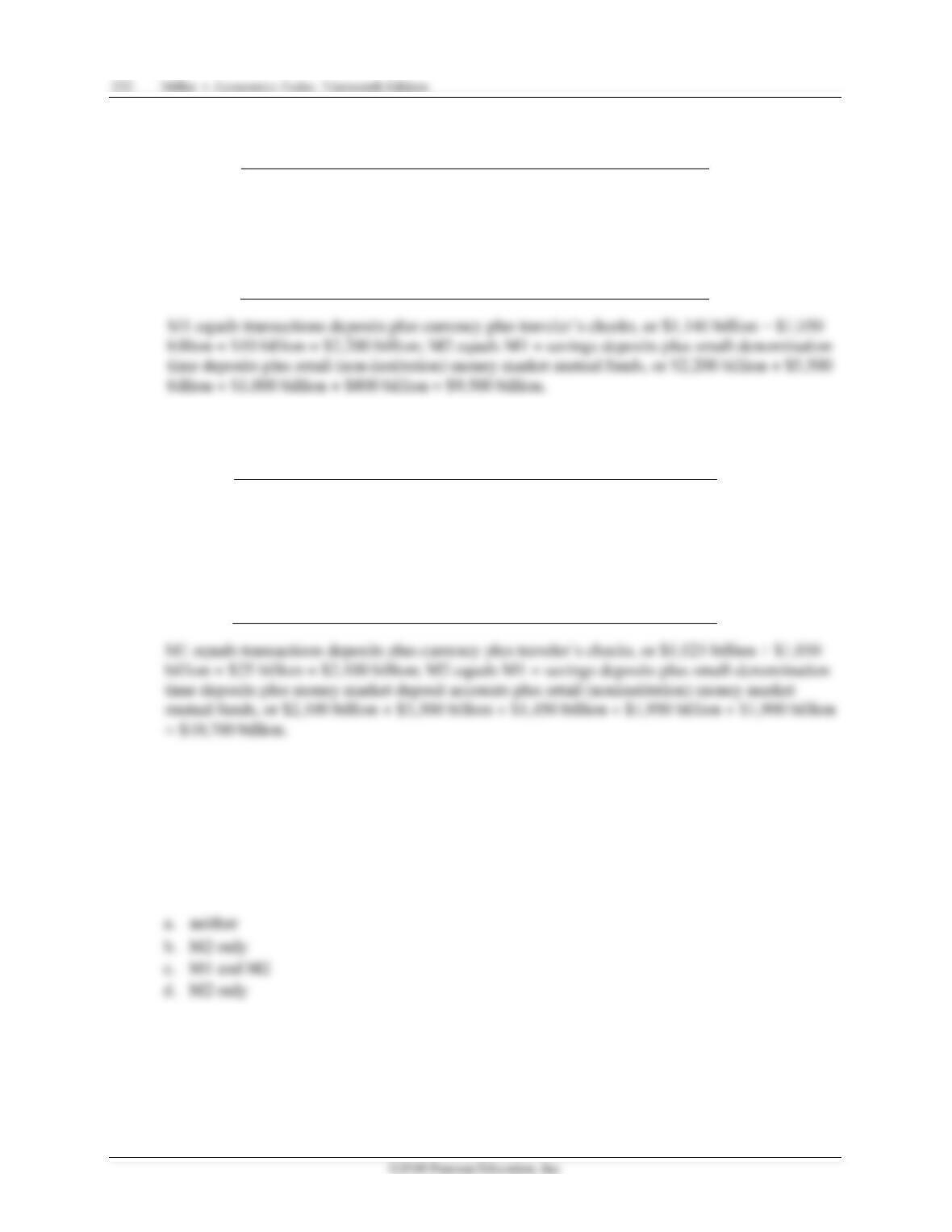
15-4. Considering the following data (expressed in billions of U.S. dollars), calculate Ml and M2.
Currency
1,050
Savings deposits
5,500
Small-denomination time deposits
1,000
Traveler’s checks outside banks and thrifts
10
Total money market mutual funds
800
Institution-only money market mutual funds
1,800
Transactions deposits
1,140
15-5. Considering the following data (expressed in billions of U.S. dollars), calculate Ml and M2.
(See pages 340–341.)
Transactions deposits
1,025
Savings deposits
3,300
Small-denomination time deposits
1,450
Money market deposit accounts
1,950
Noninstitution money market mutual funds
1,900
Traveler’s checks outside banks and thrifts
25
Currency
1,050
Institution-only money market mutual funds
1,250
15-6. Identify whether each of the following amounts is counted in Ml only, M2 only, both Ml and
M2, or neither.
a. $50 billion in U.S. Treasury bills
b. $15 billion in small-denomination time deposits
c. $5 billion in traveler’s checks not issued by a bank
d. $20 billion in money market deposit accounts
15-7. Identify whether each of the following items is counted in Ml only, M2 only, both Ml and
M2, or neither.
a. A $1,000 balance in a transactions deposit at a mutual savings bank
b. A $100,000 time deposit in a New York bank
Chapter 15 Money, Banking, and Central Banking 233
c. A $10,000 time deposit an elderly widow holds at her credit union
d. A $50 traveler’s check not issued by a bank
e. A $50,000 savings deposit
15-8. Match each of the rationales for financial intermediation listed below with at least one of
the following financial intermediaries: insurance company, pension fund, savings bank.
Explain your choices.
a. Adverse selection
b. Moral hazard
c. Lower management costs generated by larger scale
15-9. Identify whether each of the following events poses an adverse selection problem or a moral
hazard problem in financial markets.
a. A manager of a savings and loan association responds to reports of a likely increase in
federal deposit insurance coverage. She directs loan officers to extend mortgage loans to
less creditworthy borrowers.
b. A loan applicant does not mention that a legal judgment in his divorce case will require
him to make alimony payments to his ex-wife.
c. An individual who was recently approved for a loan to start a new business decides to
use some of the funds to take a Hawaiian vacation.
15-10. In what sense is currency a liability of the Federal Reserve System?
15-11. In what respects is the Fed like a private banking institution? In what respects is it more
like a government agency?
15-12. Take a look at the map of the locations of the Federal Reserve districts and their
headquarters in Figure 15-6. Today, the U.S. population is centered just west of the
Mississippi River—that is, about half of the population is either to the west or the east of a
line running roughly just west of this river. Can you reconcile the current locations of Fed
districts and banks with this fact? Why do you suppose the Fed has its current geographic
structure?
15-13. Draw an empty bank balance sheet, with the heading “Assets” on the left and the heading
“Liabilities” on the right. Then place the following items on the proper side of the balance
sheet:
a. Loans to a private company
b. Borrowings from a Federal Reserve district bank
c. Deposits with a Federal Reserve district bank
d. U.S. Treasury bills
e. Vault cash
f. Transactions deposits
15-14. Draw an empty bank balance sheet, with the heading “Assets” on the left and the heading
“Liabilities” on the right. Then place the following items on the proper side of the balance
sheet.
a. Borrowings from another bank in the interbank loans market
b. Deposits this bank holds in an account with another private bank
c. U.S. Treasury bonds
d. Small-denomination time deposits
e. Mortgage loans to household customers
f. Money market deposit accounts
Chapter 15 Money, Banking, and Central Banking 235
15-15. The reserve ratio is 11 percent. What is the value of the potential money multiplier?
15-16. The Federal Reserve purchases $1 million in U.S. Treasury bonds from a bond dealer, and
the dealer’s bank credits the dealer’s account. The reserve ratio is 15 percent. Assuming
that no currency leakage occurs, how much will the bank lend to its customers following the
Fed’s purchase?
15-17. Suppose that the value of the potential money multiplier is equal to 4. What is the reserve
ratio?
15-18. Consider a world in which there is no currency and depository institutions issue only
transactions deposits. The reserve ratio is 20 percent. The central bank sells $1 billion
in government securities. What ultimately happens to the money supply?
15-19. Assume a 1 percent reserve ratio and no currency leakages. What is the potential money
multiplier? How will total deposits in the banking system ultimately change if the Federal
Reserve purchases $5 million in U.S. government securities?
15-20. Consider Figure 15-1, which focuses on liquidity. How might limited acceptability of old
masters paintings in exchange and difficulties in predicting the values of these paintings
from year to year help to explain their relatively low liquidity? How might these
characteristics affect the likelihood that these assets could function as forms of money?
15-21. Does Figure 15-3 depict direct finance or indirect finance? Explain. How could the figure be
revised to illustrate the alternative form of finance?
15-22. Consider Figure 15-4. Explain how Jill Jones’s debit-card transaction affects the assets and
liabilities of Citibank and of Bank of America. Why does this transaction leave unchanged
the total quantity of deposits in the banking system and, consequently, the money supply?
15-23. Take a look at Figure 15–5. Suppose that the Federal Reserve’s focus of monetary
policymaking shifted away from buying and selling U.S. government securities to utilizing
the discount rate or the interest rate paid on bank reserves as the Fed’s main policy
instrument. If so, would the Federal Open Market Committee necessarily remain the Fed’s
key policymaking group?
15-24. Consider Figure 15-7. Describe the basic shape that this figure would take if the Fed had
instead generated a multiple contraction in the money supply by removing $100,000 in
reserves from the banking system via an open market sale?
15-25. In Problem 15-24, what would be the amount of the potential money multiplier that applies
to a $100,000 decrease in reserves caused by a Fed open market sale of that amount? How
much would the money supply potentially decrease as a result of this sale?
Chapter 15 Money, Banking, and Central Banking 237
◼ Selected References
Angell, N., The Story of Money, London: Stokes, 1929.
Campbell, Colin and Rosemary Campbell, An Introduction to Money and Banking, 4th ed., Hinsdale, IL:
Dryden Press, 1984.
Friedman, Milton and Anna Schwartz, A Monetary History of the United States 1867–1960, Princeton,
NJ: Princeton University Press, 1963.