15: Teaching Critical Content in Science and
Social Studies to All Learners
Learning Outcomes
After reading this chapter, students should be able to:
• 15–1 Identify some of the challenges that learners have in science and social
studies.
• 15–2 Explain the big ideas in science and social studies.
• 15–3 Apply UDL principles in designing science and social studies content area
instruction.
• 15–4 Select varying approaches and strategies that differentiate and maximize
INTASC Standards
Standard #2: Learning Differences. The teacher uses understanding of individual differences and
diverse cultures and communicates to ensure inclusive learning environments that enable each
learner to meet high standards.
Standard #3: Learning Environments. The teacher works with others to create environments that
support individual and collaborative learning, and that encourage positive social interaction, active
engagement in learning, and self–motivation.
Council for Exceptional Children
Special educators are to have knowledge of the following:
Standard #5: Instructional Planning and Strategies. Beginning special education professionals
select, adapt, and use a repertoire of evidence–based instructional strategies to advance learning
of individuals with exceptionalities.
Chapter Outline
15–1 Challenges for Diverse Learners in Science and Social Studies
15–2 Learning Goals
15–2b Big Ideas in Social Studies
15–2d Differentiating for Complexity
15–3 Science and Social Studies Content Area Assessment
15–3a Using Rubrics
15–4 Methods, Tools, Materials, and Resources for Science and Social Studies
Instruction
15–4b Working with Vocabulary and Readability
15–4d Multiple Means of Expression
15–5 Academic, Social, and Physical Adaptations
15–5a The Academic Environment
15–6 UDL Lesson Planning with Differentiated Instruction for the Content Areas
15–7 Collaboration in Science and Social Studies Instruction
15–7a Co–teaching
15–7b Building Community Support
Key Concepts and Terms
activities–oriented approach: Instruction that begins with real–life discovery learning
and inquiry in science and social studies. Student knowledge and understanding are
based on these experiences.
anticipation guides: A comprehensive strategy used before accessing new content that
uses teachers–generated questions and comment to activate students’ prior knowledge,
example, political, social, economic, and cultural systems).
constancy, change, measurement: A big idea in science that helps the learner realize
how some things continually occur but may change over time. This change can be
measured (for example, weather, plants, animals).
content enhancements: Instructional methods that help students understand major
concepts, ideas, and vocabulary in a manner that is conducive to knowledge acquisition,
diner menu: A tool for differentiating instruction that uses the analogy of a restaurant
menu in planning a lesson that offers learners some choice and opportunities for more
support or extra challenge.
essential questions: The important basic concepts in a lesson or unit in the form of
questions that are used to focus and guide student learning.
evidence, models, explanations: A big idea in science that helps the learner explain
how things work.
evolution, equilibrium: A big idea in science that considers changes in physical states
inquiry–based instruction: A student–centered teaching method that is
guided/facilitated by the teacher. Students investigate real world problems within a
broader thematic framework.
KWL chart: A visual representation of what students already know (K) about the subject,
what (W) students will learn, what students have learned (L).
mnemonic devices: Evidence–based memory–enhancing techniques that can help
rehearse: To practice responses and expressions ahead of time to enhance academic
performance.
self–monitoring: Tracking one’s own behavior and making choices to discontinue
inappropriate actions.
service learning: A form of community–based instruction that integrates learning
organization is predictable.
thematic teaching: A method of integrating and linking multiple curricular elements
using themes to make learning meaningful, allowing students to see how the parts
connect to a bigger idea; students explore many different aspects of a topic or subject.
Venn diagram: A visual tool used to compare and contrast content material.
Lecture Notes
Planning and implementing content area units around big ideas help teachers identify
critical content and guide students in making learning connections.
There are multiple ways to assess students in science and social studies.
Adaptations in academic, social, and physical environments can foster inclusion.
Collaboration can enhance content area learning for all students.
Suggestions for In–Class or Online Activities
2. Using the state you live in, create a population map to demonstrate why larger
cities are located where they are.
4. Plan a field trip to a local farm. While there have the students ask about the crops
5. Create a Venn Diagram for a science concept of your choice.
Discussion Questions
1. Which style of writing, expository or narrative, is preferable in a science or social
studies textbook? Why?
2. How can essential questions help you plan instruction?
3. Study Figure 15.8. Invent and describe one additional low–tech and/or high–tech
UDL application(s) for extension of representation, engagement, and expression
4. What population(s) of students do you think could be particularly well served by
the use of inquiry–based instruction? Are there any populations for which this
approach could be problematic? Explain you answer.
5. In peer tutoring, how should students be paired with regard to their physical,
cognitive, and social needs? Why? Include specific examples in your answer.
6. Some schools pull students with learning difficulties out of science and social
Field Experiences
1. Visit a local classroom and observe a science or social studies lesson. What
topics were being discussed? What methods did the teacher employ? How
engaged were the students?
Videos
Watch the MindTap video. Assign the questions and the scenario to the class for
reflection on Science and Social Studies.
1. What does UDL look like in a classroom?
2. What do you think of the teacher’s differentiated instruction?
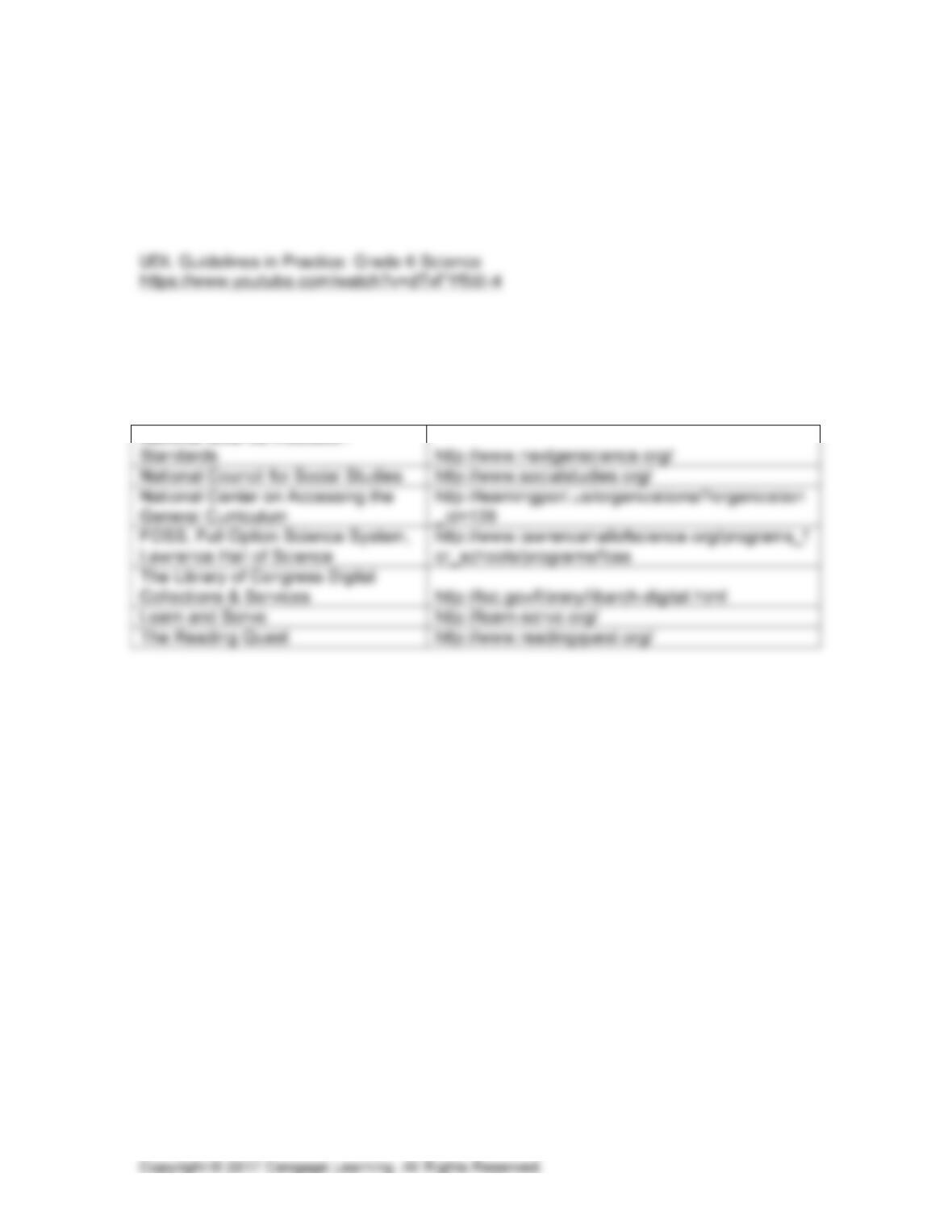
Web Resources
National Center on Accessing the
National Science Education