Chapter 15
Exchange Rates in the Long Run
The relationship between goods prices and exchange rates is developed in this chapter. After introducing
absolute and relative PPP, examples and real world data illustrating deviations from PPP are used to
motivate a deeper understanding of the link between prices and exchange rates. PPP is used to introduce
“overvalued” and “undervalued” exchange rates. It is important to debate the meaning of such terms in
the context of floating exchange rates. However, at this point in the course it is probably wise to forego
the mention of speculative bubbles and bandwagon effects which could theoretically contribute to the
appearance of an overvalued or undervalued currency.
The chapter includes plots of data on inflation differentials and exchange rate changes as found in IMF
International Financial Statistics. International Economic Conditions published by
the Federal Reserve Bank of St. Louis contains a plot of the last six years data on inflation differentials
between the United States and ten other industrial countries. The same publication also contains plots of
the exchange rate between the dollar and the currencies of the same ten countries. These plots can be used
for class handouts or shown on Elmo classroom projector to allow more recent data, as well as a broader
range of countries, to be discussed in class.
◼ Chapter Outline
Introduction
An Introduction to Purchasing Power Parity
Uses of Purchasing Power Parity
Global Insights 15.1: Big Mac PPP
Tests of Purchasing Power Parity
The Monetary Approach to Exchange Rates
Summary
Exercises
References
Chapter 15 Exchange Rates in the Long Run 59
◼ Suggested Answers for the End-of-Chapter Exercises
1. Suppose that you have the following data on exchange rates and prices:
E P PF
2005 .49 100 100
2006 .52 106 102
a. Calculate the percentage change in E, P, and PF for each of the years after 2005.
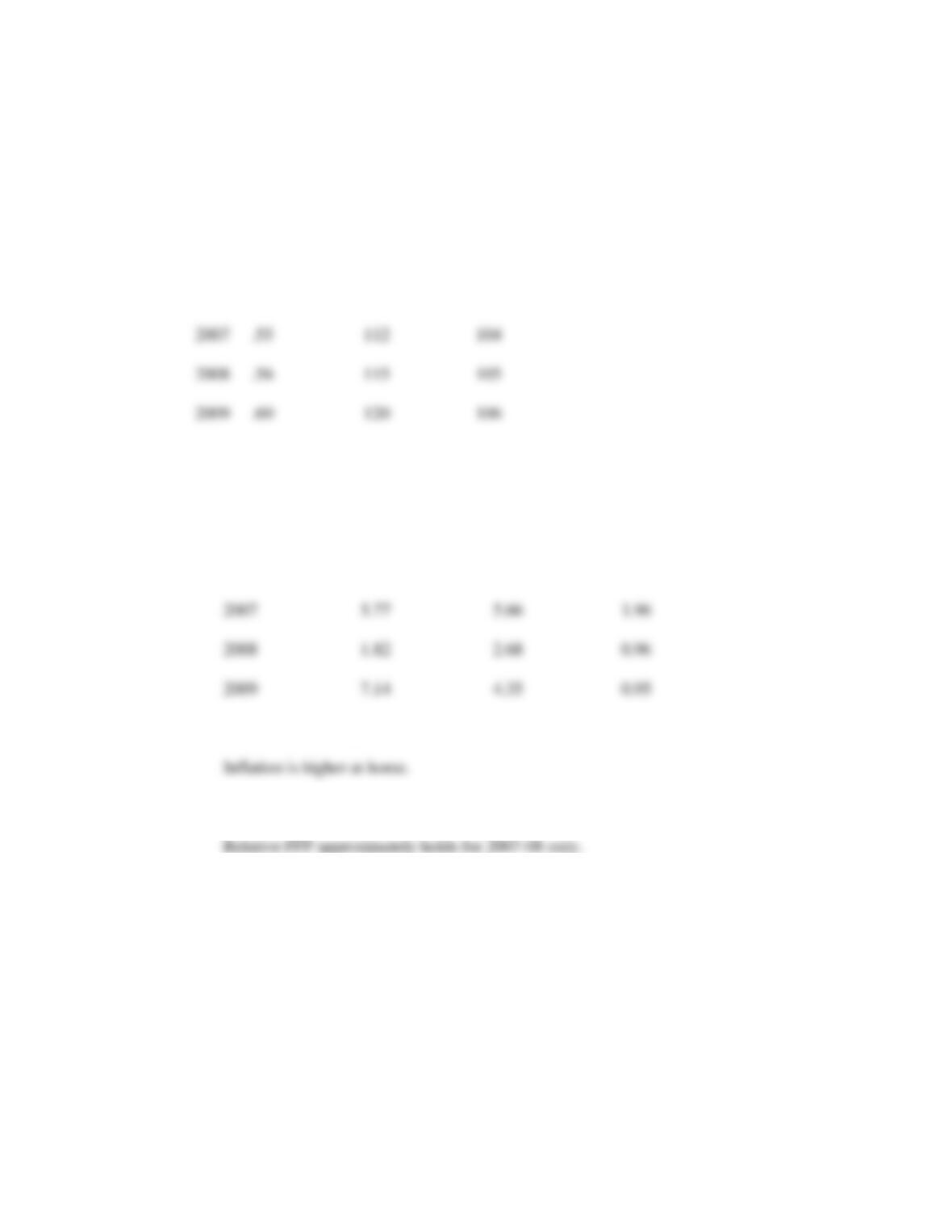
Year %changeE %changeP %changePF
2006 6.12 6 2
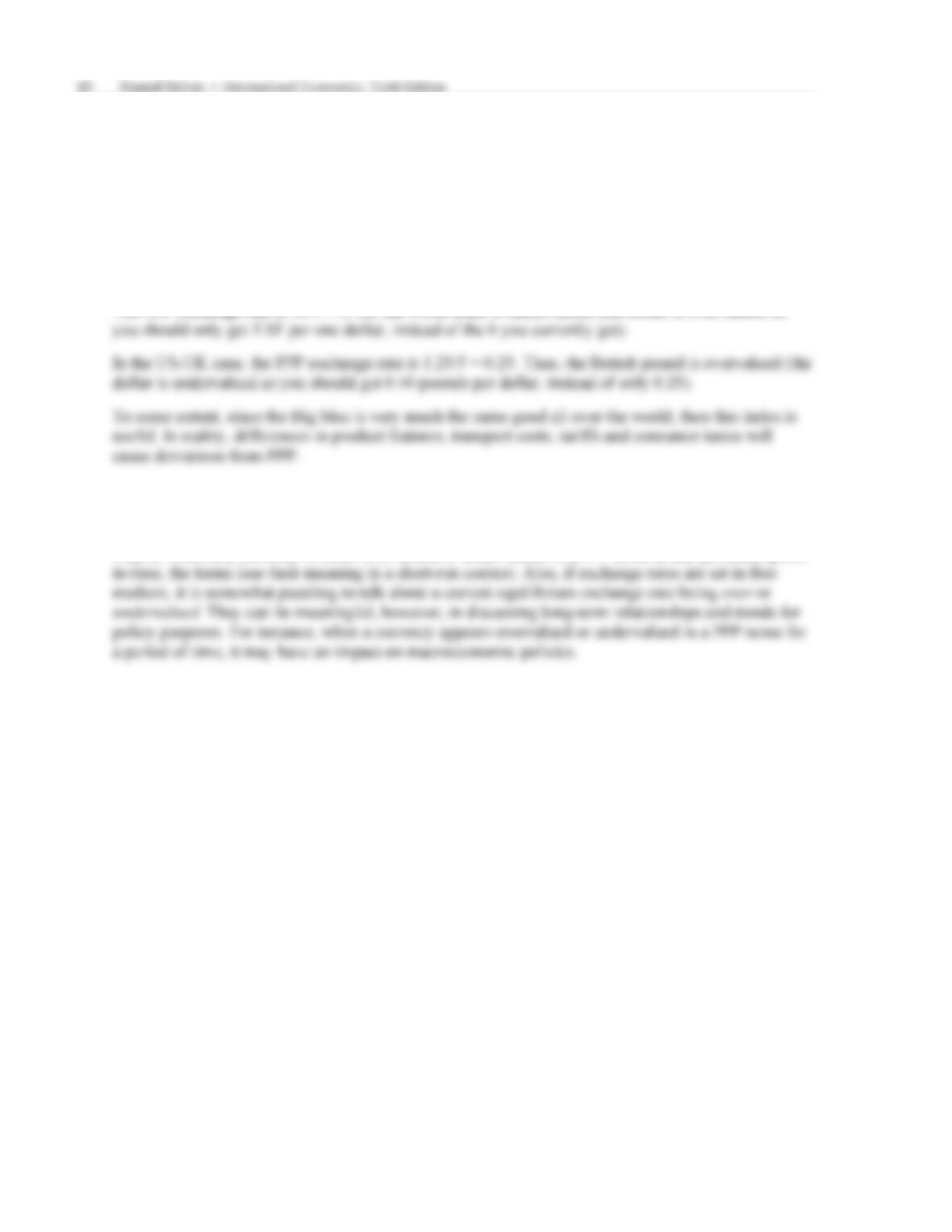
b. Where was inflation higher (home or overseas) over the sample period?
c. How well does relative PPP hold in this example?
2. Suppose that a Big Mac costs $5.00 in New York and SF30 in Geneva. Suppose further that the price
of 1SF on that day is $0.20. Calculate the purchasing power parity exchange rate between the Swiss
franc and the dollar. Based on your calculation, is the SF overvalued or undervalued? Explain.
Suppose now that a Big Mac costs 1.25 pounds in London while the spot rate exchange rate is $2.50.
Is the pound overvalued or undervalued? Explain. Is the Big Mac a good basis for PPP calculations?
Why or why not?
The PPP exchange rate is 30/5 = 6. So, the Swiss franc is undervalued (the dollar is overvalued, as
3. Since PPP rarely holds at any point in time, is there any substantive meaning to the terms overvalued
or undervalued currency?
Maybe. Since any currency is either overvalued or undervalued in a PPP sense at any particular point
4. For what type of goods does the law of one price hold quite well?
5. Suppose that on January 1, the price of one hundred yen was $0.80 and PPP held. Over the year, the
Japanese inflation rate was 5 percent and the U.S. inflation rate was 10 percent. If the exchange rate
at the end of the year was $0.90, does the yen appear to be overvalued, undervalued, or at the PPP
level? Explain your answer.
According to PPP theory, the exchange rate between the yen and dollar will adjust to compensate
6. Suppose at the beginning of the year, a textbook book sells for €60 in Paris, France, and $60 in New
York City, and PPP holds. Over the year, there is an inflation rate of 10 percent in France and no
inflation in the United States. What exchange rate would maintain PPP at the end of the year?
7. What is the real exchange rate? What happens to the value of the real exchange rate over time if
absolute PPP always holds? How do changes in the real exchange rate indicate whether currencies are
changing in ways to make a country’s goods more or less competitive?
8. Suppose that economic growth in Mexico suddenly slows, all other things held constant. According to
the monetary approach to exchange rates model, what should happen to the dollar price of the Mexican
peso? Why does the model make this prediction?
9. Consider the monetary approach to exchange rates (MAER) model given in Equation 15.19.
Suppose that each of the domestic hat variables in that equation is growing at exactly the same rate
as its foreign counterpart. What does the MAER model predict will happen to the exchange rate?
Why does the model make this prediction?
10. Suppose that domestic money demand is falling at 2% per year while the money supply is rising at
6% per year. What is happening to the domestic price level? Explain.