CHAPTER 15
International Trade in Goods and Assets
KEY IDEAS IN THIS CHAPTER
2. In equilibrium, home production and consumption are determined by the conditions
3. The two-good model predicts that an increase in terms of trade increases the
4. In the intertemporal model of an SOE, a current account deficit that finances
investment increases future capital stock, increases future output, and reduces the
NEW IN THE FOURTH EDITION
1. New: “Macroeconomics in Action: The World ‘Savings Glut’
2. All data and graphs have been updated.
TEACHING GOALS
There are two basic aspects to international trade. Trade in goods and services enables a
nation to benefit from comparative advantage. In the absence of trade, competitive
markets allow the economy to reach a Pareto optimum. At this optimum, the marginal
rate of substitution for consumers is equal to the marginal rate of transformation in
The second aspect of trade involves trade in financial assets. A closed economy is
required to exhaust exactly its total output in each period between consumption,
investment, and government spending. An open economy can use either more or less than
the output it produces in each period. Differences between production and absorption can
Chapter 15: International Trade in Goods and Assets
occur when the current account is either in surplus or deficit. A common misconception is
CLASSROOM DISCUSSION TOPICS
Support for protectionist trade policies comes to the forefront from time to time. Ask
students for arguments that they have heard that rationalize tariffs or quotas. Ask them if
they support such policies, or find the reasons given for protectionist sentiment
compelling. What does fair trade as opposed to free trade mean? Guide them in the
direction of finding market failures in international trade. Distinctions between free and
fair trade only have meaning if there is monopoly power in the markets for traded goods,
or if there are externalities that are complicated by the differing rules of different
sovereign nations. Monopoly power may be involved in the steel and automotive
industries. Is this a concern for students? Trade protection is also proposed because other
nations have more lax environmental restrictions. Don’t we benefit from the decision of
other countries to specialize in dirty industries?
Trade policies usually boil down to attempts by those who are hurt by trade to seek
compensation from those who benefit from trade. What are the likely differences in
relative prices between a closed Canada and the rest of the world? Much of recent
Another concern relates to the fact that Canada ran deficits in the current account from
1961 to 1998 (with the exception of 1970, 1982, and 1996, when the current account was
temporarily in surplus). Are students concerned about the balance of payments? Why or
Another interesting discussion topic relates to foreign ownership of Canadian assets. In
recent years, foreigners have purchased a large quantity of Canadian government bonds.
Remind your students that Mexico, Russia, and some countries in East Asia faced severe
economic problems when foreign investors began withdrawing their money. Could
Instructor’s Manual for Macroeconomics, Fourth Canadian Edition
Canada face a similar crisis? What would happen if foreign investors soured on Canada
and sold these government bonds?
To help focus your classroom discussion on this important issue, you might ask your
OUTLINE
1. A Two-Good Model of a Small Open Economy
a) Introduction
i) The Small Open Economy Assumption
ii) Terms of Trade
iii) The Real Exchange Rate
iv) The PPF
b) Competitive Equilibrium without Trade
i) Pareto Optimality: ,,ab ab
M
RS MRT=
M
M
c) Effects of Trade
i) International Price-Taking
ii) Efficiency in Consumption: ,ab ab
M
RS TOT=
iii) Efficiency in Production: ,ab ab
M
RT TOT=
iv) Comparative Advantage
v) Trade and Welfare
d) A Change in the Terms of Trade
2. A Two-Period Small Open Economy
a) The Intertemporal Budget Constraint
b) Response of the Current Account to Disturbances
i) Current-Period Income and the Current Account
ii) Current Government Spending and the Current Account
iii) Taxes and the Current Account
iv) The Real Interest Rate and the Current Account
3. Production, Investment, and the Current Account
a) Output Supply and Output Demand
b) Effects of Disturbances
i) An Increase in the World Interest Rate: ,YCA↑↑
ii) A Temporary Increase in Government Spending: ,YCA↑↓
TEXTBOOK QUESTION SOLUTIONS
Problems
1. The change in preferences cannot change the terms of trade for a small open
economy. Therefore, production of each good is unchanged. The shift in preferences
2. If the marginal rate of transformation increases for every quantity of good a, then
there is a shift in the production possibilities frontier. In particular, there is no change
in the maximum amount of good b that can be produced, so there is no change in the
horizontal intercept. The rest of the PPF becomes steeper and lies everywhere else
above the original PPF. Production of good b increases, but production of good a may
either rise or fall. If the increase in the marginal rate of substitution rotates the
original PPF around the original production point, then production of good a
decreases.
The outward shift in the PPF produces a positive income effect. However, because
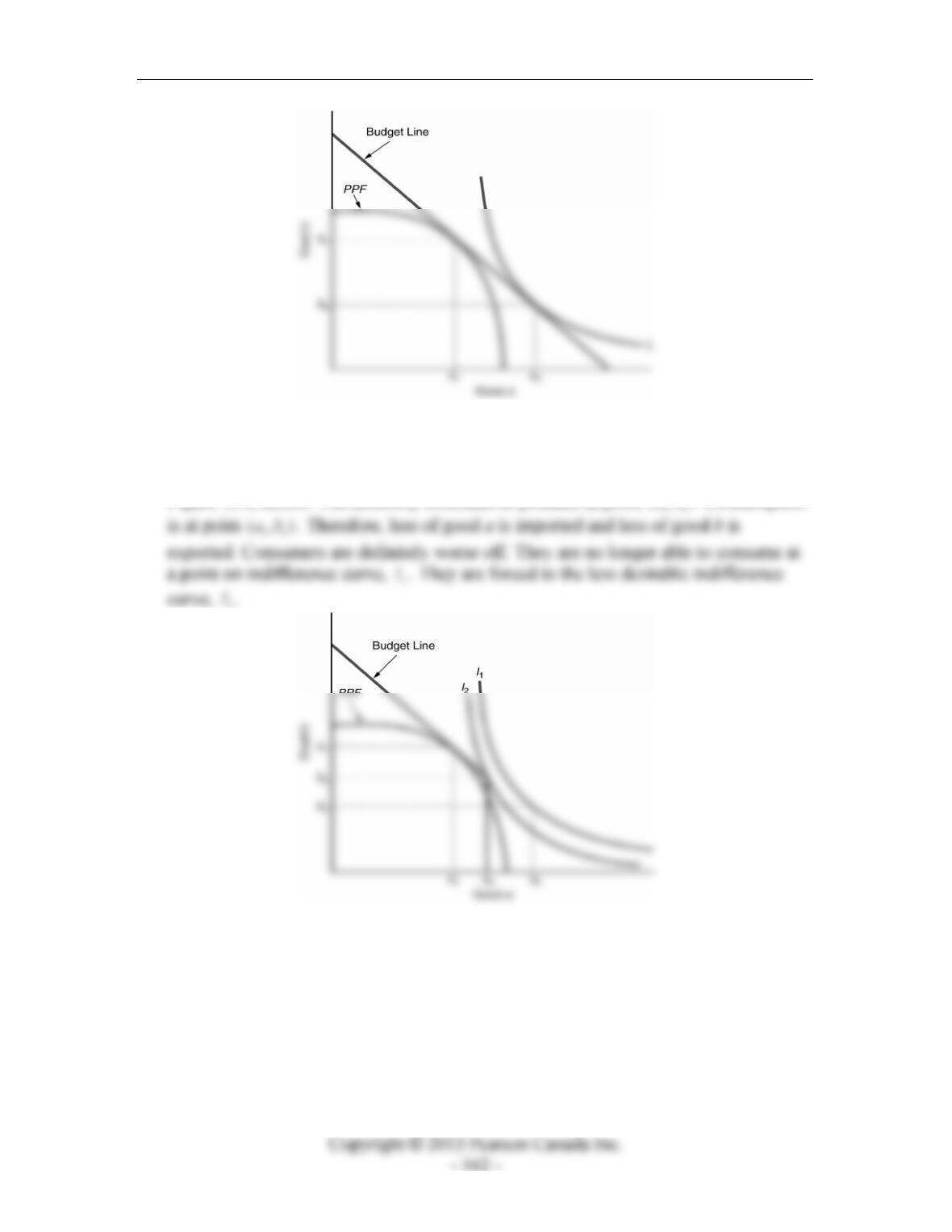
3. Suppose that the economy starts out as in Figure 13.1, below. The economy produces
Instructor’s Manual for Macroeconomics, Fourth Canadian Edition
Figure 13.1
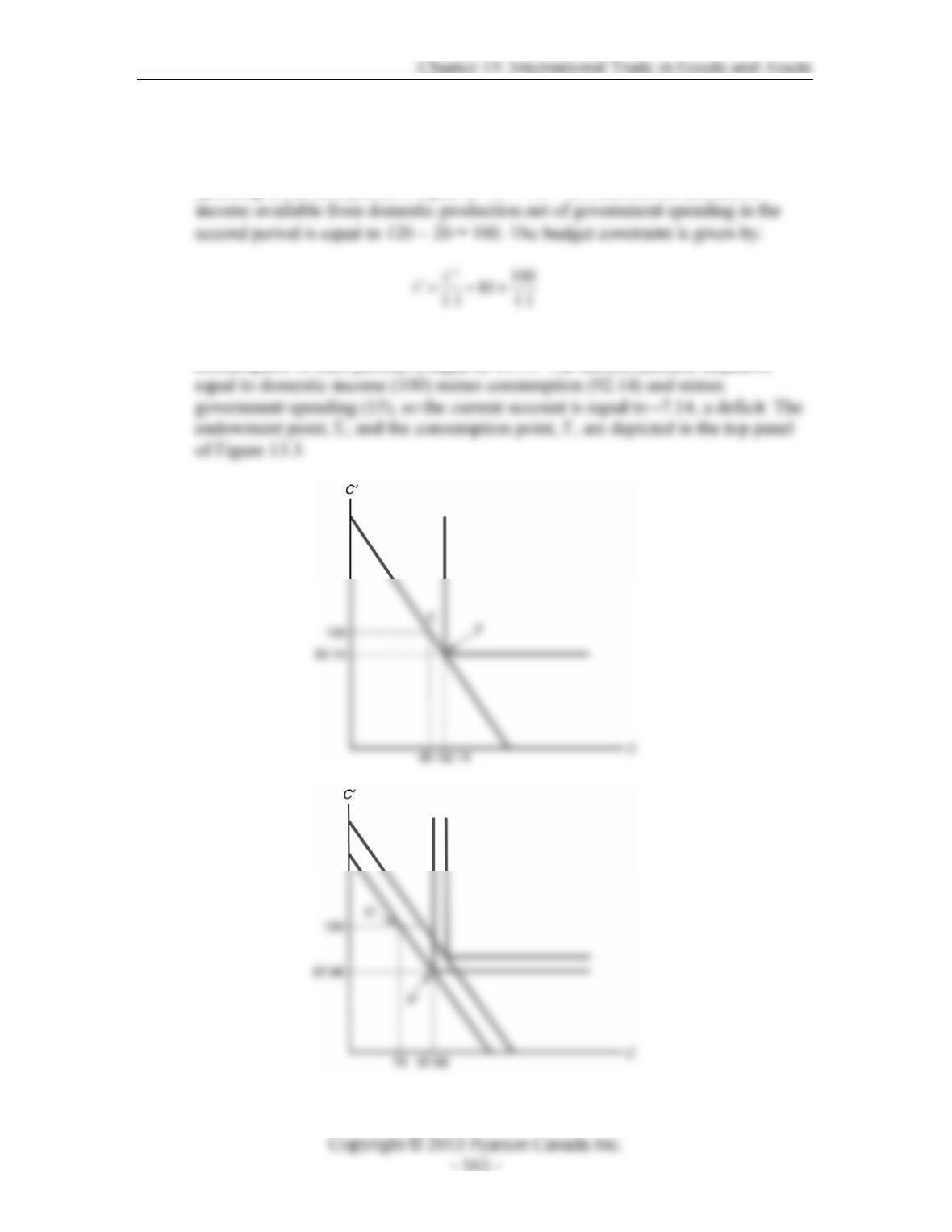
The budget line now becomes vertical at 3
b. The new budget line is depicted in
Figure 13.2, below. The economy continues to produce at point 11
(,)ab . Consumption
Figure 13.2
4. Government spending with perfect-complements preferences.
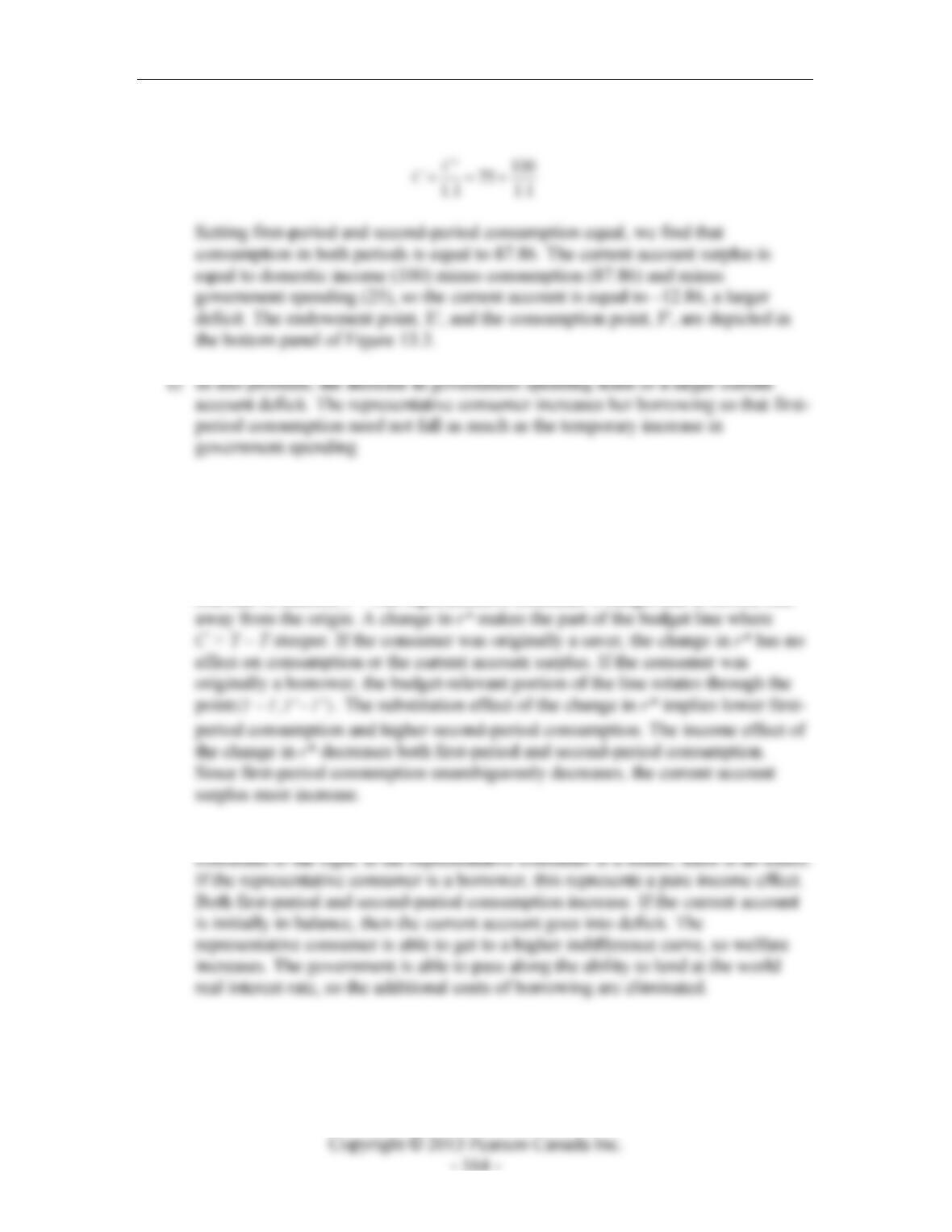
a) The net amount of income available from domestic production net of government
spending in the first period is equal to 100 − 15 = 85, and the net amount of
Setting first-period and second-period consumption equal, we find that
consumption in both periods is equal to 92.14. The current account surplus is
Figure 13.3
Instructor’s Manual for Macroeconomics, Fourth Canadian Edition
b) Net first-period income now falls to 75. The budget constraint is given by:
5. Different borrowing and lending rates.
a) For levels of first-period consumption less than Y – T, the consumer lends his
private savings, and earns the world real rate of interest, r. For levels of first-
period consumption greater than Y – T, the consumer must borrow at the higher
real rate of interest, r*. The representative consumer’s budget line is bowed out,
b) A tax cut financed by government borrowing pushes the kink in the budget
6. This works just as in the case with imperfect credit markets and limited commitment
for an individual consumer in Chapter 8. The reduction in p acts to reduce current
consumption and reduce borrowing, thus increasing the current account surplus.
7. Current account deficit policies.
a) If Ricardian equivalence holds, then the level of lump-sum taxation has no effect
on the current account. The first group of advisors would therefore be wrong. A
b) The concern with the current account deficit is misguided in this instance. The
deficit is being used to finance investment spending. Over time, the increase in
8. A persistent increase in total factor productivity would shift both the output supply
curve and the output demand curve to the right. The supply curve shifts due to higher
employment and higher productivity. Investment demand increases due to the
increase in expected future productivity. Consumption increases due to the increases
9. An increase in investment spending generated by optimism about the future shifts the
output demand curve to the right and reduces the current account surplus, with no
effect on aggregate output. When investment spending falls, this just reverses the