Chapter 15: Working Capital Management
Integrated Case
441
Barnes has long believed that SKI’s working capital situation should be
studied—the company may have the optimal amounts of cash, securities,
receivables, and inventories, but it may also have too much or too little of
these items. In the past, the production manager resisted Barnes’s efforts to
A. Barnes plans to use the ratios in Table IC 15.1 as the starting point
for discussions with SKI’s operating executives. He wants everyone
to think about the pros and cons of changing each type of current
asset and the way changes would interact to affect profits and EVA.
Based on the data in Table IC 15.1, does SKI seem to be following a
relaxed, moderate, or restricted current assets investment policy?
442
Integrated Case
Chapter 15: Working Capital Management
Table IC 15.1. Selected Ratios: SKI and Industry Average
SKI Industry
Current 1.75 2.25
Debt/assets 58.76% 50.00%
Turnover of cash and securities 16.67 22.22
Days sales outstanding (365-day basis) 45.63 32.00
Inventory turnover 4.82 7.00
Fixed assets turnover 11.35 12.00
Total assets turnover 2.08 3.00
Profit margin 2.07% 3.50%
Return on equity (ROE) 10.45% 21.00%
Answer: [Show S15-1 through S15-5 here.] A company with a relaxed
current assets investment policy would carry relatively large
amounts of current assets relative to its sales. It would be
guarding against running out of stock or of running short of cash or
B. How can we distinguish between a relaxed but rational current
assets investment policy and a situation where a firm has a large
amount of current assets due to inefficiency? Does SKI’s current
assets investment policy seem appropriate? Explain.
Answer: [Show S15-6 here.] SKI may choose to hold large amounts of
inventory to avoid the costs of “running short,” and to cater to
Chapter 15: Working Capital Management
Integrated Case
443
C. SKI tries to match the maturity of its assets and liabilities. Describe
how SKI could adopt a more aggressive or a more conservative
financing policy.
Answer: [Show S15-7 through S15-9 here.] With an aggressive financing
policy, some of SKI’s permanent assets would be financed with
short-term debt. Of course, there are different degrees of
aggressiveness. A highly aggressive policy would be one where all
444
Integrated Case
Chapter 15: Working Capital Management
D. Assume that SKI’s payables deferral period is 30 days. Now
calculate the firm’s cash conversion cycle estimating the inventory
conversion period as 365/Inventory turnover.
Answer: [Show S15–10 and S15-11 here.] A firm’s cash conversion cycle is
calculated as:
Cash
Payables
sReceivable
Inventory
From Table IC 15.1, SKI’s inventory turnover is given as 4.82 so we
can estimate its inventory conversion period as:
365
365
SKI’s receivables collection period is equal to its DSO. From Table
IC 15.1, its DSO is given as 45.63 days, or approximately 46 days.
We are given in the problem that its payables deferral period is
Thus, SKI’s cash conversion cycle is approximately 92 days. Note
that the inventory conversion period would normally be calculated
E. What might SKI do to reduce its cash and securities without
harming operations?
Chapter 15: Working Capital Management
Integrated Case
445
Answer: [Show S15-12 here.] To the extent that “cash and securities”
consist of low-yielding securities, they could be sold, and the cash
generated could be used to reduce debt, to repurchase stock, or to
446
Integrated Case
Chapter 15: Working Capital Management
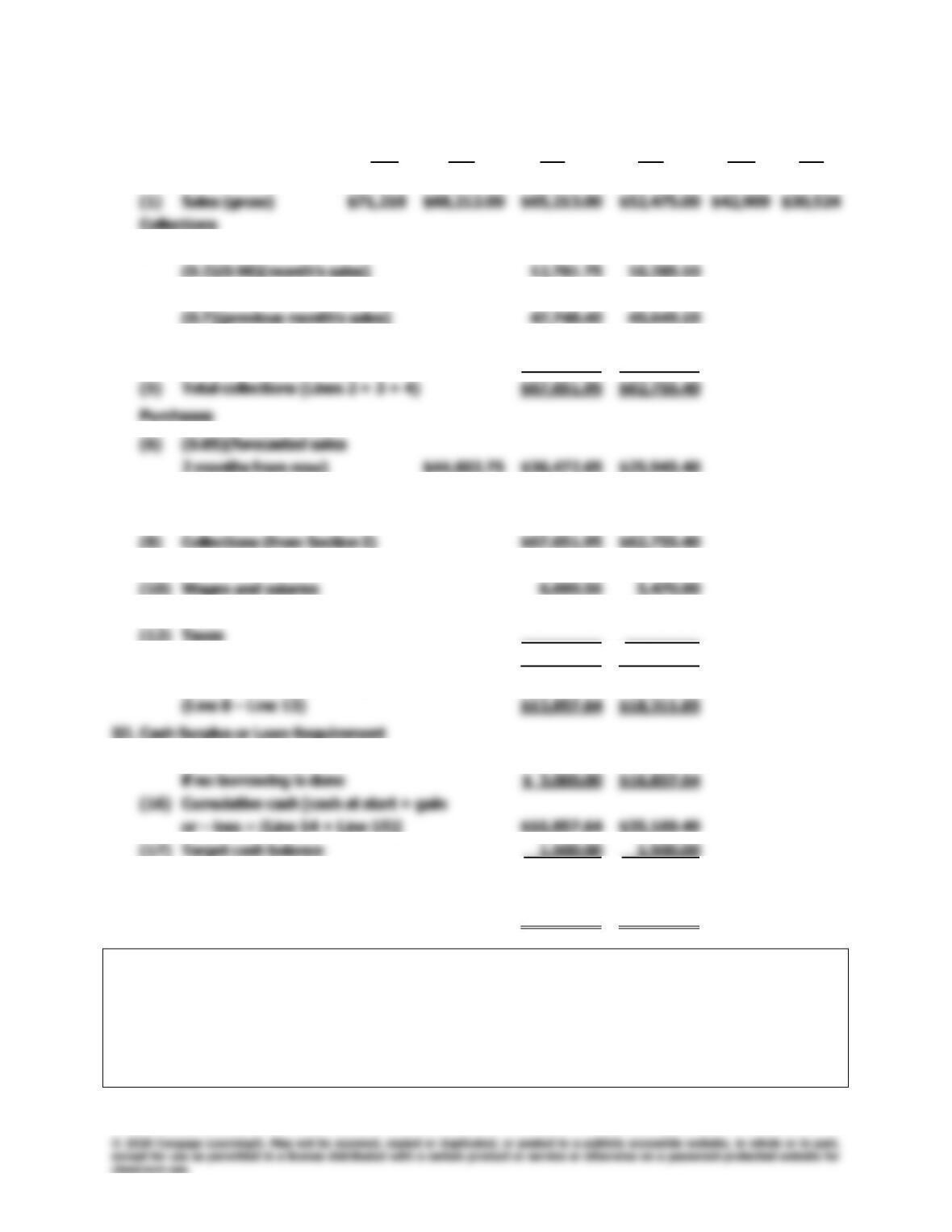
Table IC 15.2. SKI’s Cash Budget for January and February
Nov Dec Jan Feb Mar Apr
I. Collections and Purchases Worksheet
(2) During month of sale
(3) During first month after sale
(4) During second month after sale
(0.1)(sales 2 months ago) 7,121.80 6,821.20
(7) Payments (1–month lag) 44,603.75 36,472.65
II. Cash Gain or Loss for Month
(9) Payments for purchases (from Section I) 44,603.75 36,472.65
(11) Rent 2,500.00 2,500.00
(13) Total payments $53,794.31 $44,443.55
(14) Net cash gain (loss) during month
(15) Cash at beginning of month
(18) Cumulative surplus cash or loans outstanding
to maintain $1,500 target cash balance
(Line 16 – Line 17) $15,357.64 $33,669.49
F. In his preliminary cash budget, Barnes has assumed that all sales
are collected and thus that SKI has no bad debts. Is this realistic?
If not, how would bad debts be dealt with in a cash budgeting
sense? (
Hint:
Bad debts affect collections but not purchases.)

Chapter 15: Working Capital Management
Integrated Case
447
Answer: [Show S15-13 through S15-16 here.] It is not realistic to assume
zero bad debts. When credit is granted, bad debts should be
G. Barnes’s cash budget for the entire year, although not given here, is
based heavily on his forecast for monthly sales. Sales are expected to
be extremely low between May and September but then increase
dramatically in the fall and winter. November is typically the firm’s
best month, when SKI ships equipment to retailers for the holiday
season. Interestingly, Barnes’s forecasted cash budget indicates that
the company’s cash holdings will exceed the targeted cash balance
every month except for October and November, when shipments will
be high but collections will not be coming in until later. Based on the
ratios in Table IC 15.1, does it appear that SKI’s target cash balance is
appropriate? In addition to possibly lowering the target cash balance,
what actions might SKI take to better improve its cash management
policies and how might that affect its EVA?
Answer: [Show S15-17 and S15-18 here.] The company’s turnover of cash
and securities (presented in Table IC 15.1) and its projected cash
budget (presented in Table IC 15.2) suggest that the company is
thereby increasing EVA. On the other hand, if the company chooses
448
Integrated Case
Chapter 15: Working Capital Management
H. Is there any reason to think that SKI may be holding too much
inventory? If so, how would that affect EVA and ROE?
Answer: [Show S15-19 and S15-20 here.] As pointed out in part a, SKI’s
inventory turnover (4.82) is considerably lower than the average
I. If the company reduces its inventory without adversely affecting
sales, what effect should this have on the company’s cash position
(1) in the short run and (2) in the long run? Explain in terms of the
cash budget and the balance sheet.
Answer: [Show S15-21 here.] Reducing inventory purchases will increase the
company’s cash holdings in the short run, thus reducing the amount
Chapter 15: Working Capital Management
Integrated Case
449
J. Barnes knows that SKI sells on the same credit terms as other firms
in the industry. Use the ratios presented in Table IC 15.1 to explain
whether SKI’s customers pay more or less promptly than those of
its competitors. If there are differences, does that suggest that SKI
should restrict or relax its credit policy? What four variables make
up a firm’s credit policy, and in what direction should each be
changed by SKI?
Answer: [Show S15-22 and S15-23 here.] SKI’s DSO is 45.63 days as
compared with 32 days for the average firm in its industry. This
suggests that SKI’s customers are paying less promptly than those
450
Integrated Case
Chapter 15: Working Capital Management
Credit period is the length of time allowed all “qualified”
customers to pay for their purchases. The shorter a firm’s credit
period, the lower the firm’s days sales outstanding, and the lower
the level of receivables held. A shorter credit period might also
tend to decrease sales, especially when a competitor’s credit period
is longer than the firm’s own credit period. The effect of the credit
period on bad debt expense is indeterminate.
Finally, collection policy refers to the procedures that the firm
follows to collect past–due accounts. These can range from a simple
letter or phone call to turning the account over to a collection agency.
A restrictive collection policy would decrease the level of receivables
held, as customers would decrease the length of time they took to pay
Chapter 15: Working Capital Management
Integrated Case
451
K. Does SKI face any risks if it restricts its credit policy? Explain.
Answer: [Show S15-24 here.] A restrictive credit policy may discourage
L. If the company reduces its DSO without seriously affecting sales,
what effect will this have on its cash position (1) in the short run and
(2) in the long run? Answer in terms of the cash budget and the
balance sheet. What effect should this have on EVA in the long run?
Answer: [Show S15-25 here.] If customers pay their bills sooner, this will
increase the company’s cash position in the short run, which would
M. Assume that SKI buys on terms of 1/10, net 30, but that it can get
away with paying on the 40th day if it chooses not to take discounts.
Also, assume that it purchases $3 million of components per year, net
of discounts. How much free trade credit can the company get, how
much costly trade credit can it get, and what is the percentage cost of
the costly credit? Should SKI take discounts? Why or why not?
Answer: [Show S15-26 through S15-31 here.] If SKI’s net purchases are
$3,000,000 annually, then with a 1% discount, its gross purchases
purchases made on Day 2, and so on. Thus, in a steady state, SKI
will on average have 10 days’ worth of purchases in payables, so,
Therefore:
Trade credit if discounts are not taken: $328,767 = Total trade credit
Here is a formula that can be used to find the nominal annual
interest rate of costly trade credit:
In this situation,
Note (1) that the formula gives the same nominal annual interest rate
Chapter 15: Working Capital Management
Integrated Case
453
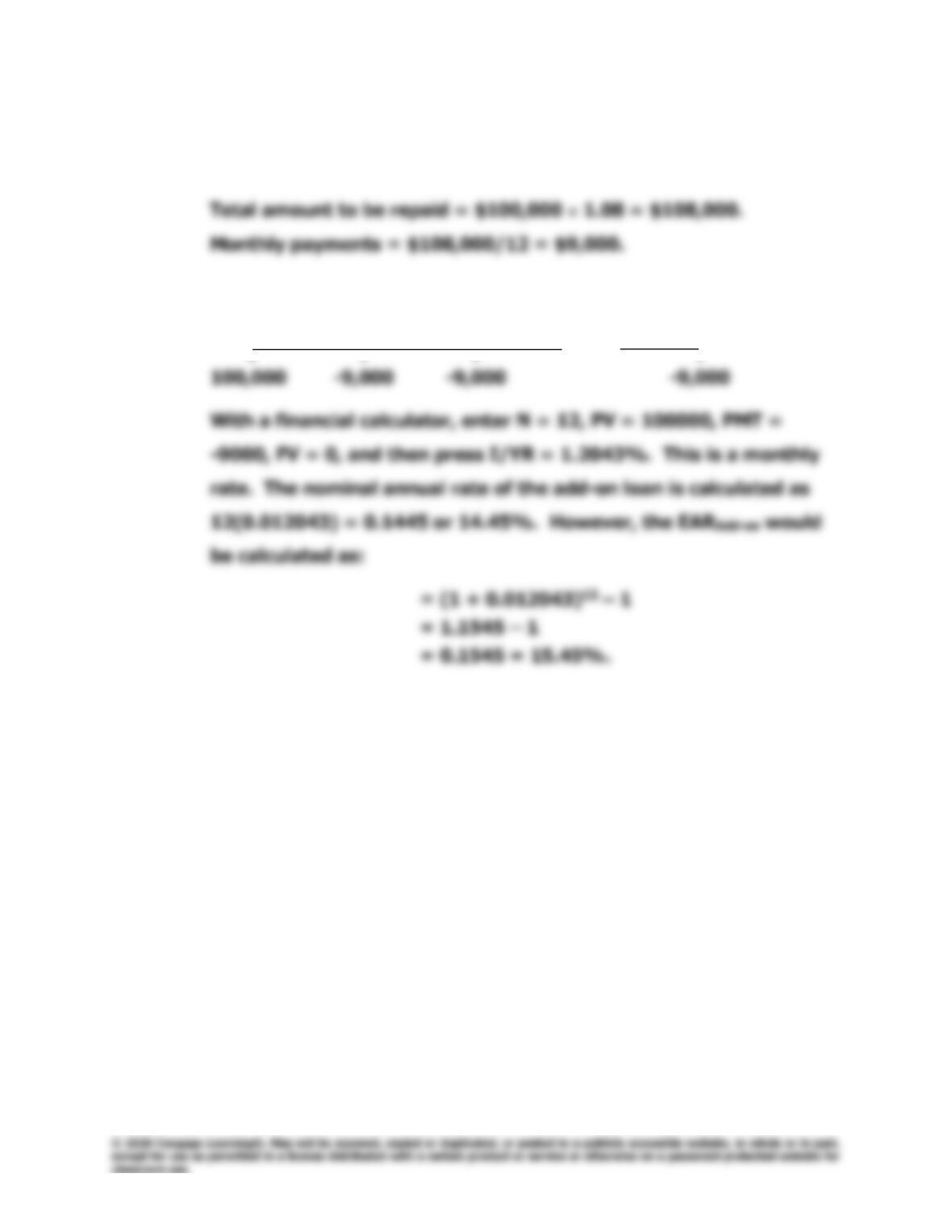
N. Suppose SKI decided to raise an additional $100,000 as a 1-year
loan from its bank, for which it was quoted a rate of 8%. What is
the effective annual cost rate assuming simple interest and add-on
interest on a 12-month installment loan?
Answer: [Show S15-32 through S15-36 here.] For a simple interest loan, the
effective annual cost is the same as the simple interest rate, which
is 8%.
454
Integrated Case
Chapter 15: Working Capital Management
The effective annual cost for an add–on interest, 12-month
installment loan would be calculated as follows:
Time Line:
1 2 12 Months
| | | |
I/YR = ?