Concise10e
THE CASH CONVERSION CYCLE
Cash
conversion
cycle
=
Inventory
conversion
period (ICP)
+
Receivables
collection
period (ACP)
–
Payables
deferral
period (PDP)
EXAMPLE
Sales $1,216,666
COGS $1,013,889
CCC =ICP +ACP –PDP
= Inv / (COGS/365) +AR/(Sales/365) – AP/(COGS/365)
Calculate the cash conversion cycle for the Great Fashions Inc. (GFI). Annual sales are $1,216,666, and the annual cost of goods
sold is $1,013,889. The average levels of inventory, receivables, and accounts payable are $250,000, $300,000, and $150,000,
respectively. GFI uses a 365-day accounting year.
It takes 90 days to make and then sell golf outfits, and another 90 days to collect cash after the sale, or a total of 180 days
between spending money and collecting cash. However, the company can delay payment for supplies and labor for 54 days.
Therefore, the net days the firm must finance its labor and purchases is 180 – 54 = 126 days, which is the cash conversion cycle.
This chapter deals with working capital management. Two useful tools for working capital management are (1) the cash
conversion cycle and (2) the cash budget. This spreadsheet model shows how these tools are used to help manage current
assets.
The cash conversion cycle focuses on the length of time between when the company must make payments and when it receives
cash inflows. The cash conversion cycle is determined by three factors: (1) The inventory conversion period, which is the
average time required to convert materials into finished goods and then to sell those goods. (2) The receivables collection
period, which is the length of time required to convert the firm’s receivables into cash, or how long it takes to collect cash from a
sale. (3) The payables deferral period, which is the average length of time between the purchase of materials and labor and
payment for them. The cash conversion cycle is determined by the following formula:
12/12/2018
Chapter 15. Model for Managing Current Assets
1
2
3
4
5
6
7
8
A B C D E F G H I J K L M N
15 Chapter model 12/12/2018
THE CASH BUDGET
Input Data
Collections during month of sale 20% Assumed constant. Don’t change.
Collections during 1st month after sale 70% Assumed constant. Don’t change.
Collections during 2nd month after sale 10% Equal to 100% – (20% + 70%) – Bad debt %
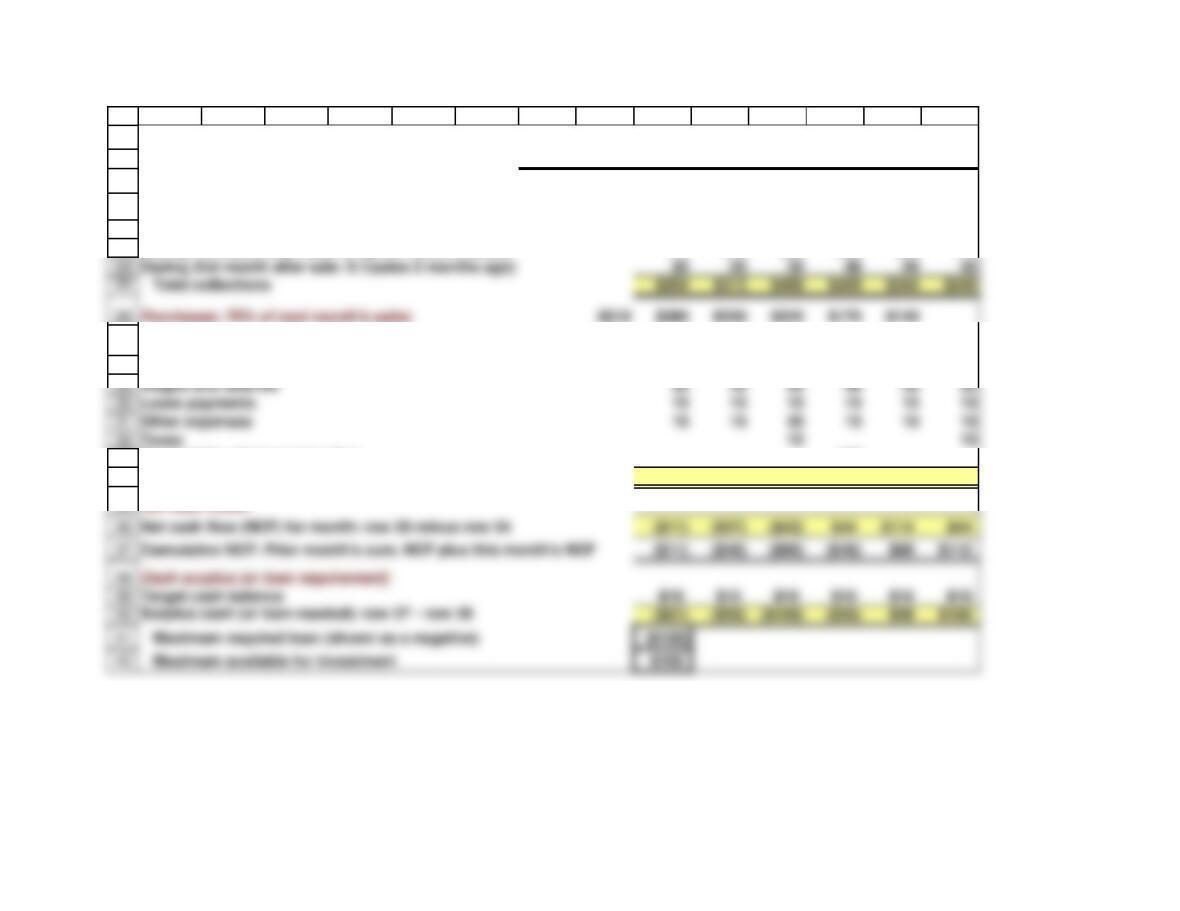
The cash budget is a statement that shows expected cash flows over a specified period of time. Generally, firms use
a monthly cash budget for the coming year, plus a daily cash budget for the coming month. The monthly cash
budgets are used for long-range planning, and the daily budget for actual cash control. The following monthly cash
budget examines Allied Food for the last 6 months of 2020.
Table 15.1 Allied Food Products 2020 Cash Budget (Dollars in Millions)
Percent bad debts 0% Can change to see effects
Discount on first month collections
Purchases as a % of next month’s sales 70% Can change to see effects
Lease payments 15$ Can change to see effects
Construction cost for new plant (Oct) 100$ Can change to see effects
Target cash balance 10$ Can change to see effects
Sales adjustment factor (change from base) 0% % increase or decrease from base to see effects
18
19
20
21
22
23
Lease payments 15 15 15 15 15 15
Other expenses 10 15 20 15 10 10
27
28
33
34
40
42
Target cash balance $10 $10 $10 $10 $10 $10
35
A B C D E F G H I J K L M N
THE CASH BUDGET
May June July August Sept Oct Nov Dec
Sales (gross) $200 $250 $300 $400 $500 $350 $250 $200
Collections
During month of sale: 0.2(Sales)(0.98) $59 $78 $98 $69 $49 $39
During 1st month after sale: 0.7(prior month’s sales) 175 210 280 350 245 175
Payments
Payment for materials: Last month’s purchases $210 $280 $350 $245 $175 $140
Payment for plant construction 100
Total payments
$265 $350 $450 $415 $230 $205
Net cash flows:
25
During 2nd month after sale: 0.1(sales 2 months ago) 20 25 30 40 50 35
43
44
45
46
47
48
2.00% $ 115
4.00% $ 130
6.00% $ 145
7.00% $ 152
9.00% $ 167
50
52
54
57
59
60
61
62
63
65
A B C D E F G H I J K L M N
% bad Max Req’d Loan
debts $ 100
1.00% $ 107
3.00% $ 122
5.00% $ 137
8.00% $ 160
10.00% $ 175
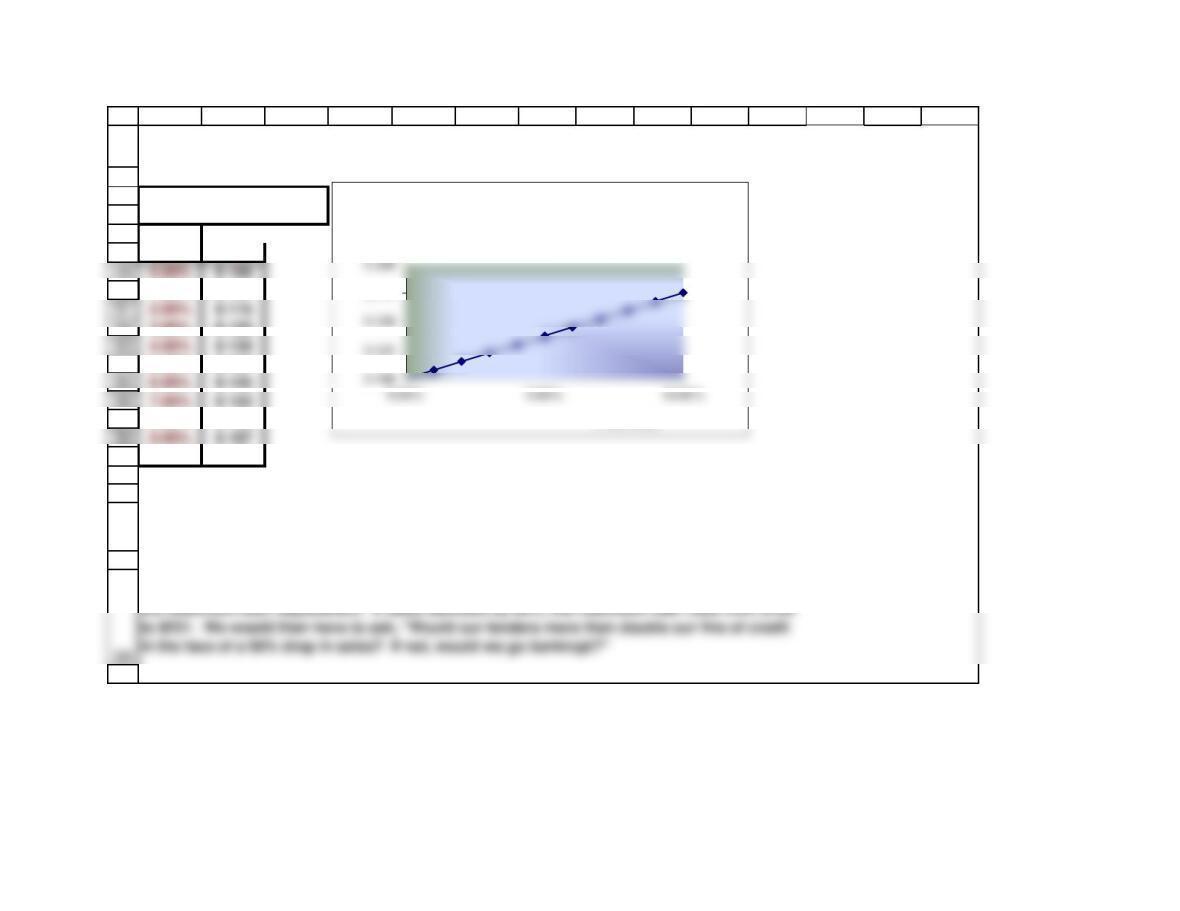
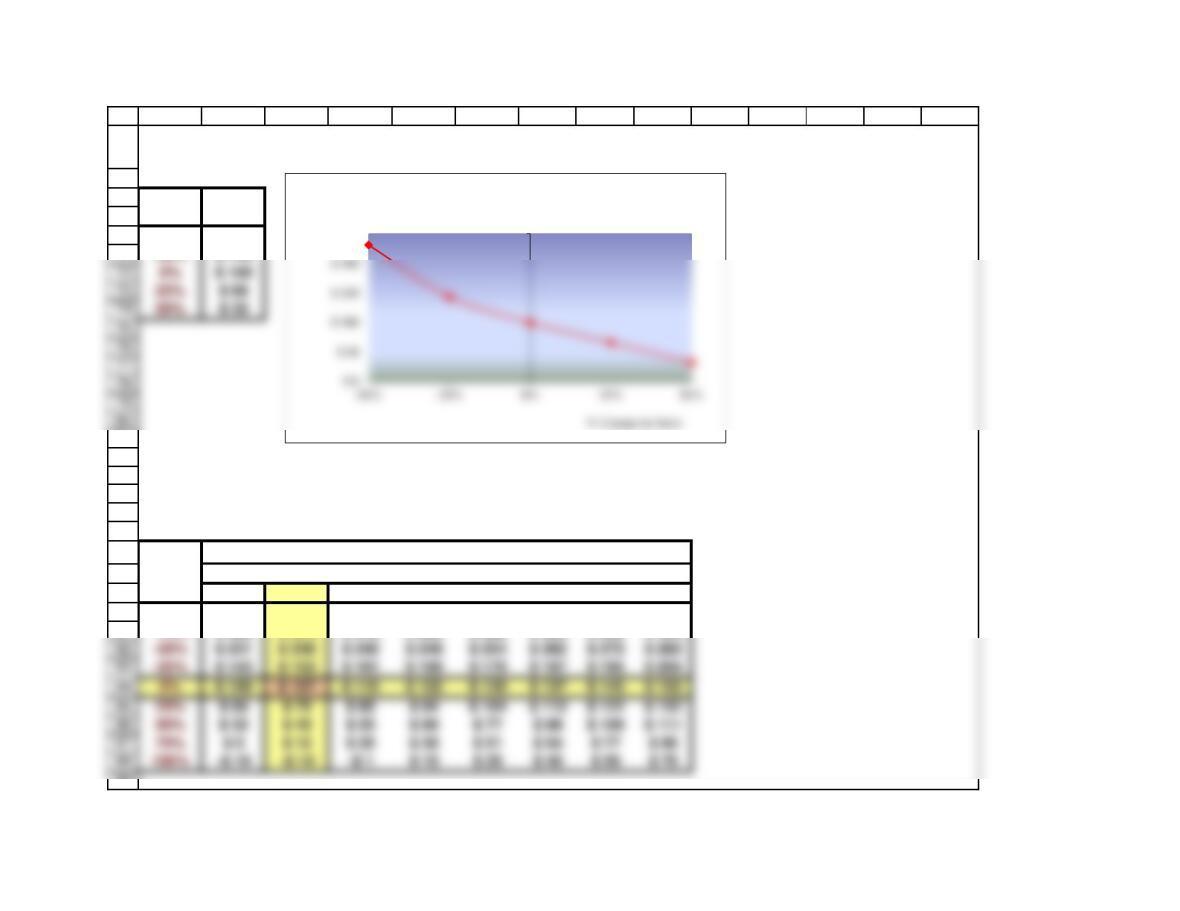
Question: If the percent of customers who end up as bad debts increases, how would this
affect the maximum required loan?
Answer: Do a sensitivity
analysis.
You could do all sorts of “What if” analyses. For example, assume sales declined by 50%.
How would that affect the maximum loan requirement?
Answer: Just change the sales adjustment factor from 0% to -50% and observe the change in
$ 175
Loan
Requirement
% Bad Debts
Effect of Bad Debts on Loan Requirements
0.00% $ 100
66
67
68
69
70
71
81
82
83
84
85
86
87
88
89
94
98
-50% $ 231 $ 236 $ 242 $ 248 $ 254 $ 262 $ 272 $ 282
90
91
99
A B C D E F G H I J K L M N
% Change
Max Loan
in Sales
$ 100
-50% $ 231
-25% $ 143
Q: If both sales and collections change, what will happen to the maximum loan requirement?
Answer: Do a sensitivity analysis.
Change
in Sales
$100 0% 1% 2% 3% 4% 5% 6% 7%
-100% $ 525 $ 525 $ 525 $ 525 $ 525 $ 525 $ 525 $ 525
-75% $ 368 $ 373 $ 378 $ 383 $ 388 $ 393 $ 398 $ 403
Maximum Loan Required
Bad Debt %
Here’s a sensitivity analysis for the effect of changes in sales on the maximum loan
requirement:
$ 250
Max Loan
Required
Max Loan Vs. Change in Sales
74
100
101
102
A B C D E F G H I J K L M N
The model could be used to analyze the effects of other variables, such as changing the
You can see from the table that, from the base case (Bad Debt % = 0, change in sales = 0), an
increase in late payers increases the loan requirement, as does a decline in sales.
15 Chapter model 12/12/2018
Calculation of APR and Effective Interest Rate on Add-on loan (Section 15-10d)
Amount received
$10,000.00
Rate per year
3.000%
Months
12
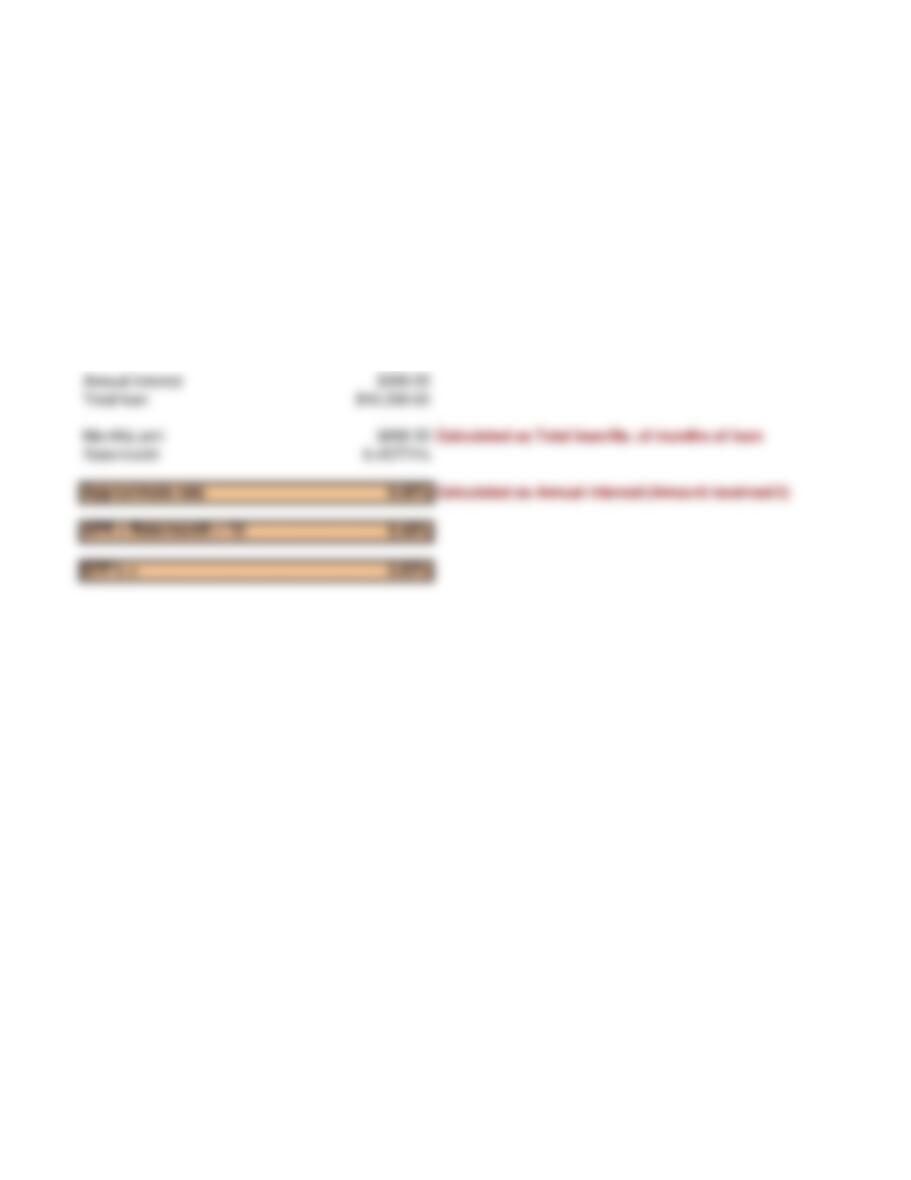
Banks and other lenders typically use add-on interest for automobiles and other types of installment
loans. The term add-on means that the interest is calculated and then added to the amount borrowed
to determine the loan’s face value. Suppose you borrow $10,000 on an add-on basis at a nominal rate
of 3.0% to purchase a car, with the loan to be repaid in 12 monthly installments. What are the
approximate rate of interest, the annual percentage rate, and the effective rate on your loan?
SECTION 15-10 12/12/2018
SOLUTIONS TO SELF-TEST QUESTIONS
4a. If a firm borrowed $500,000 at a rate of 10% simple interest with monthly interest payments
and a 365-day year, what would be the required interest payment for a 30-day month?
Nominal rate
10%
Amount borrowed
$500,000.00
Days/year
365
4b. If interest must be paid monthly, what would be the effective annual rate?
If interest had to be paid daily, the effective rate would be found as follows:
Effective rate = (1 + nom rate/365)^365 –1.0 = 0.10515578 or 10.52%
However, interest must be paid monthly, so the effective rate is lower, found as follows:
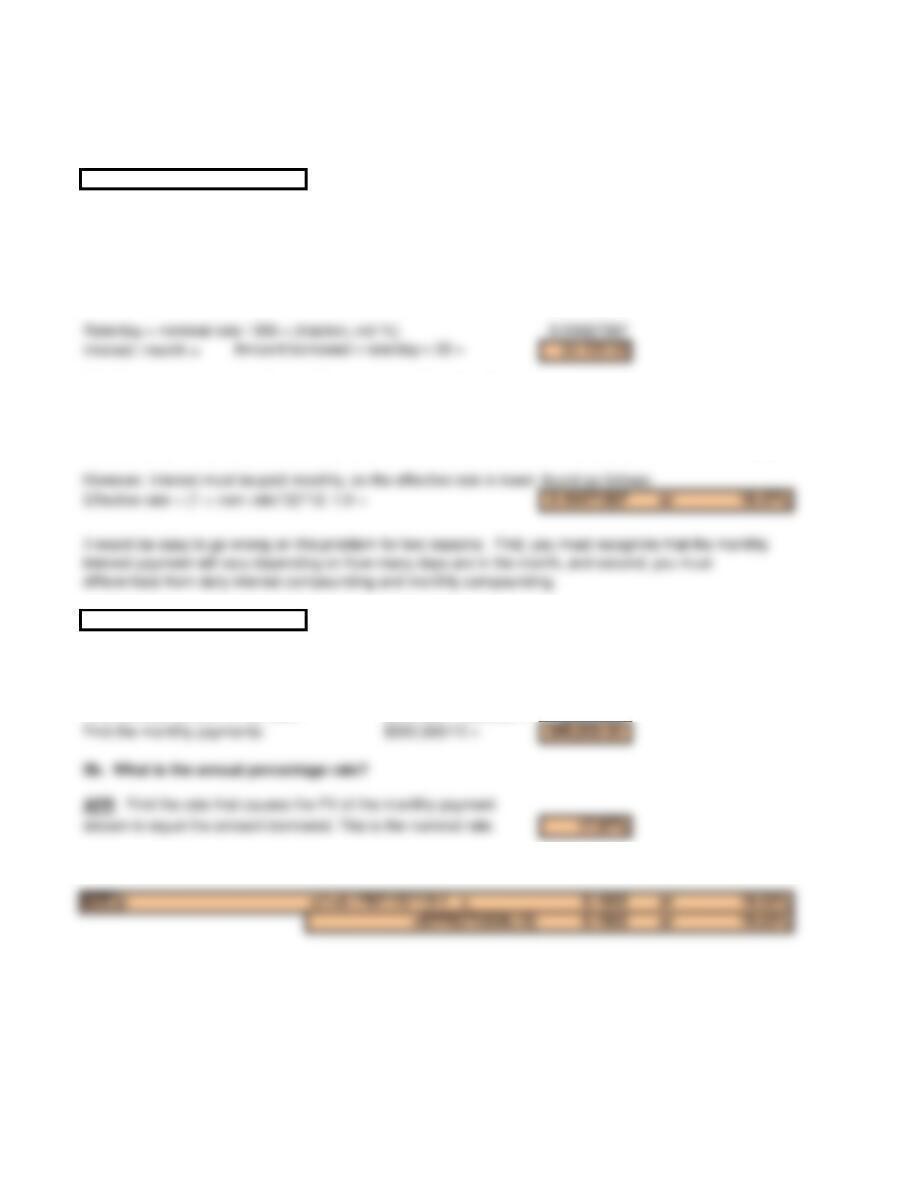
5a. If this loan had been made on a 10% add-on basis payable in 12 end-of-month
installments, what would be the monthly payments?
Find the total interest:
0.1 × $500,000 = $50,000.00
Find the total amount of the loan: $500,000 + $50,000 = $550,000
5b. What is the annual percentage rate?
5c. What is the effective annual rate?
Simple interest loan
Add-on Loan
Rate/day = nominal rate / 365 = (fraction, not %) 0.00027397