Chapter 15 (4)
Money, Interest Rates, and Exchange Rates
◼ Chapter Organization
Money Defined: A Brief Review
Money as a Medium of Exchange
Money as a Unit of Account
Aggregate Money Demand
The Equilibrium Interest Rate: The Interaction of Money Supply and Demand
Equilibrium in the Money Market
Interest Rates and the Money Supply
Output and the Interest Rate
The Money Supply and the Exchange Rate in the Short Run
Linking Money, the Interest Rate, and the Exchange Rate
84 Krugman/Obstfeld/Melitz • International Economics: Theory & Policy, Tenth Edition
Inflation and Exchange Rate Dynamics
Short-Run Price Rigidity versus Long-Run Price Flexibility
Box: Money Supply Growth and Hyperinflation in Zimbabwe
◼ Chapter Overview
This chapter combines the foreign-exchange market model of the previous chapter with an analysis of the
demand for and supply of money to provide a more complete analysis of exchange rate determination in
the short run. The chapter also introduces the concept of the long-run neutrality of money, which allows an
examination of exchange rate dynamics. These elements are brought together at the end of the chapter in a
model of exchange rate overshooting.
The analysis is then extended to incorporate the dynamics of long-run adjustment to monetary changes.
The long run is defined as the equilibrium that would be maintained after all wages and prices fully
adjusted to their market-clearing levels. Thus, the long-run analysis is based on the long-run neutrality
of money: All else being equal, a permanent increase in the money supply affects only the general price
level—and not interest rates, relative prices, or real output—in the long run. Money prices, including,
importantly, the money prices of foreign currencies, move in the long run in proportion to any change in
the money supply’s level. Thus, an increase in the money supply, for example, ultimately results in a
proportional exchange rate depreciation. The link between money supply growth, inflation, and exchange
rates is highlighted with a case study on the recent hyperinflation in Zimbabwe. Rampant money supply
growth led to prices in Zimbabwe doubling nearly every day at the peak of the hyperinflation and only
ended when Zimbabwe legalized the use of foreign currencies for domestic transactions.
Chapter 15 (4) Money, Interest Rates, and Exchange Rates 85
on foreign and domestic bonds. But because the domestic interest rate falls in the short run, the currency
must actually depreciate beyond (and thus overshoot) its new expected long-run level in the short run to
maintain interest parity. As domestic prices rise and M/P falls, the interest rate returns to its previous level
◼ Answers to Textbook Problems
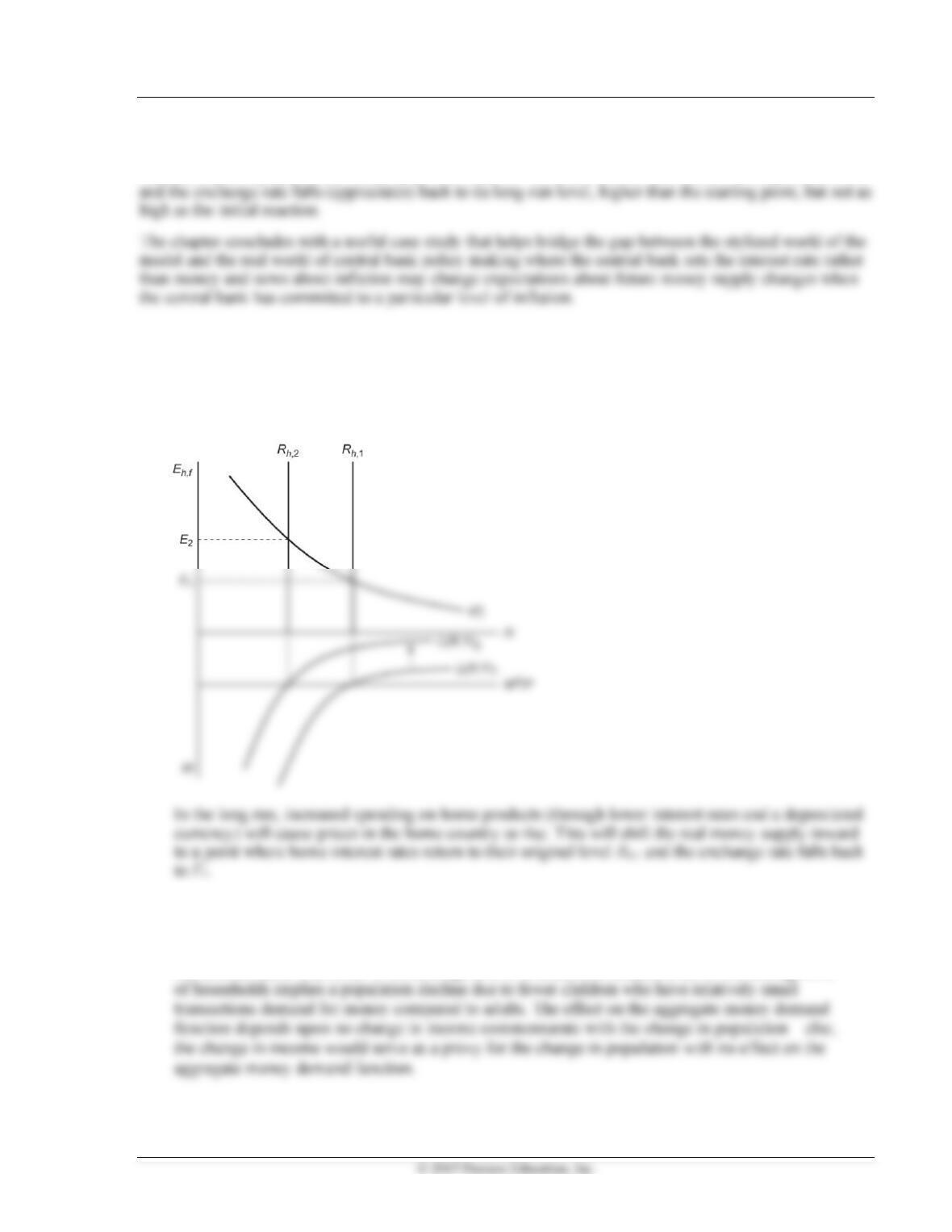
1. A reduction in the home money demand causes interest rates in the home country to fall from Rh,1 to
Rh,2. With no change in expectations, there will be a depreciation of the home currency from E1 to E2
as investors shift their savings into higher-interest-paying foreign assets.
2. A fall in a country’s population would reduce money demand, all else being equal, because a smaller
population would undertake fewer transactions and thus demand less money. This effect would
probably be more pronounced if the fall in the population were due to a fall in the number of
households rather than a fall in the average size of a household because a fall in the average size
86 Krugman/Obstfeld/Melitz • International Economics: Theory & Policy, Tenth Edition
3. Equation 15(4)-4 is Ms/P = L(R, Y). The velocity of money, V = Y/(M/P). Thus, when there is
equilibrium in the money market such that money demand equals money supply, V = Y/L(R, Y). When R
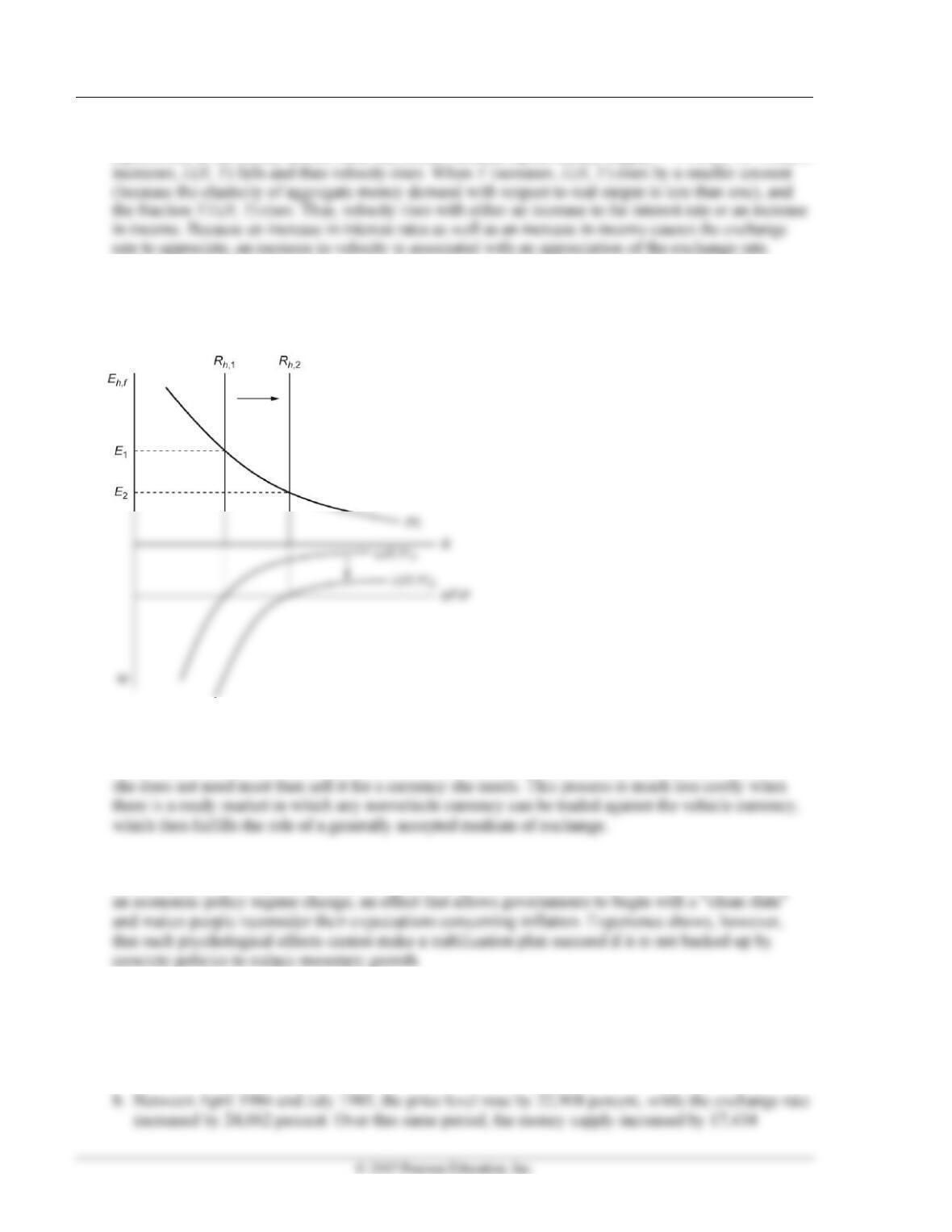
4. An increase in domestic real GNP will cause domestic real money demand to rise. This will cause
domestic real interest rates to rise from Rh,1 to Rh,2 (see graph below). With no change in expectations,
there will be an appreciation of the home currency from E1 to E2 as investors channel their savings
into domestic assets.
5. Just as money simplifies economic calculations within a country, use of a vehicle currency for
international transactions reduces calculation costs. More importantly, the more currencies used in
trade, the closer the trade becomes to barter because someone who receives payment in a currency
6. Currency reforms are often instituted in conjunction with other policies that attempt to bring down the
rate of inflation. There may be a psychological effect of introducing a new currency at the moment of
7. a. As we would expect, the price level rises consistently with the increase in the Bolivian money
supply. The long-run price level is defined as P = MS/L(R,Y), so an increase in the money supply
should cause prices to rise. An increase in the money supply and the price level should in turn
cause the Bolivian peso to depreciate against the dollar. With a few exceptions (March 1985 for
example), this is also occurring.
Chapter 15 (4) Money, Interest Rates, and Exchange Rates 87
percent. We should expect the price level and the exchange rate to move by the same proportion,
as the value of the Bolivian peso is determined by its purchasing power (eroded by inflation). As
the peso becomes less valuable, then its price relative to another currency (the dollar) should
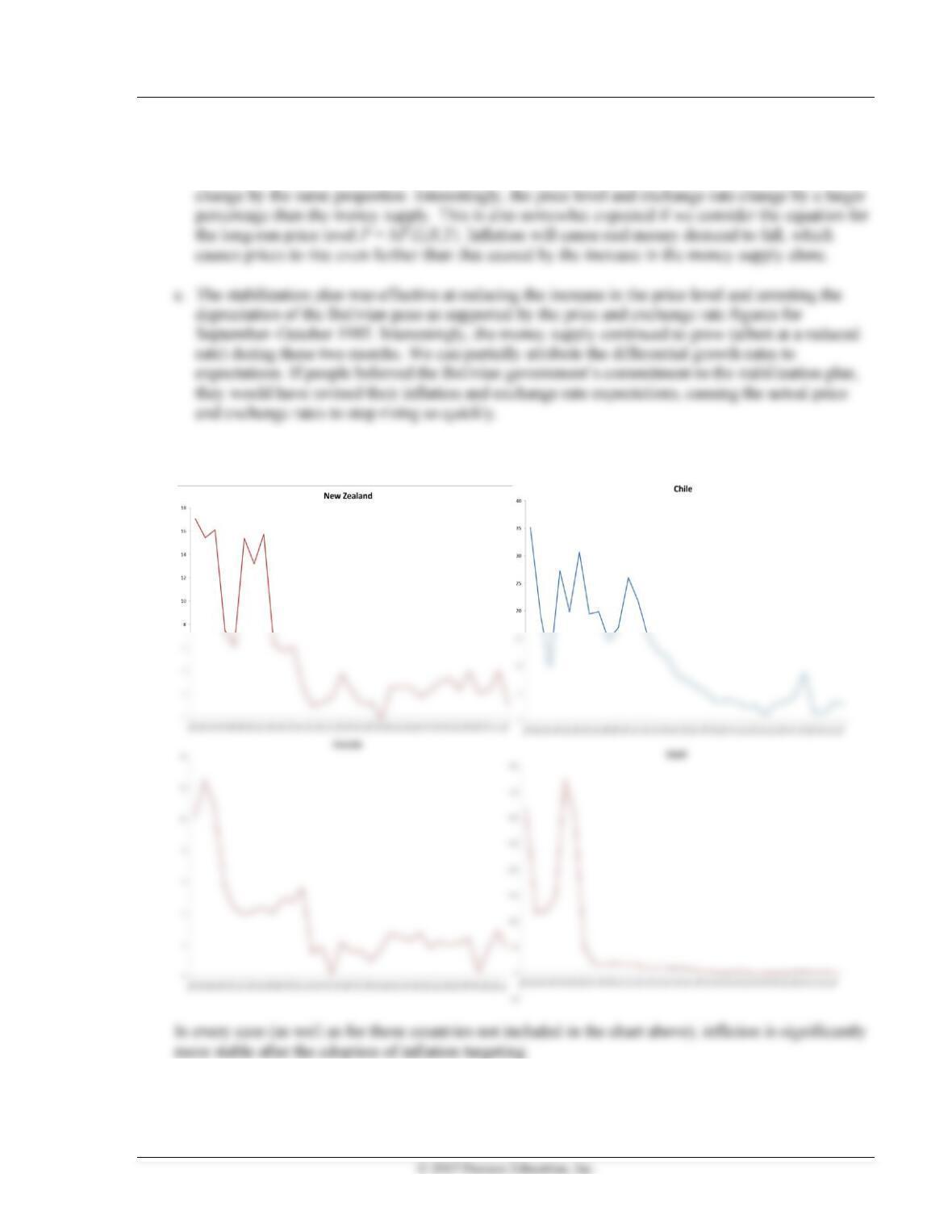
8. The chart below gives inflation rates since 1980 for New Zealand, Chile, Canada, and Israel:
9. If an increase in the money supply induces an increase in real output in the short run, then the short-run
decrease in the real interest rate will not be as pronounced as it was without the increase in real output.
88 Krugman/Obstfeld/Melitz • International Economics: Theory & Policy, Tenth Edition
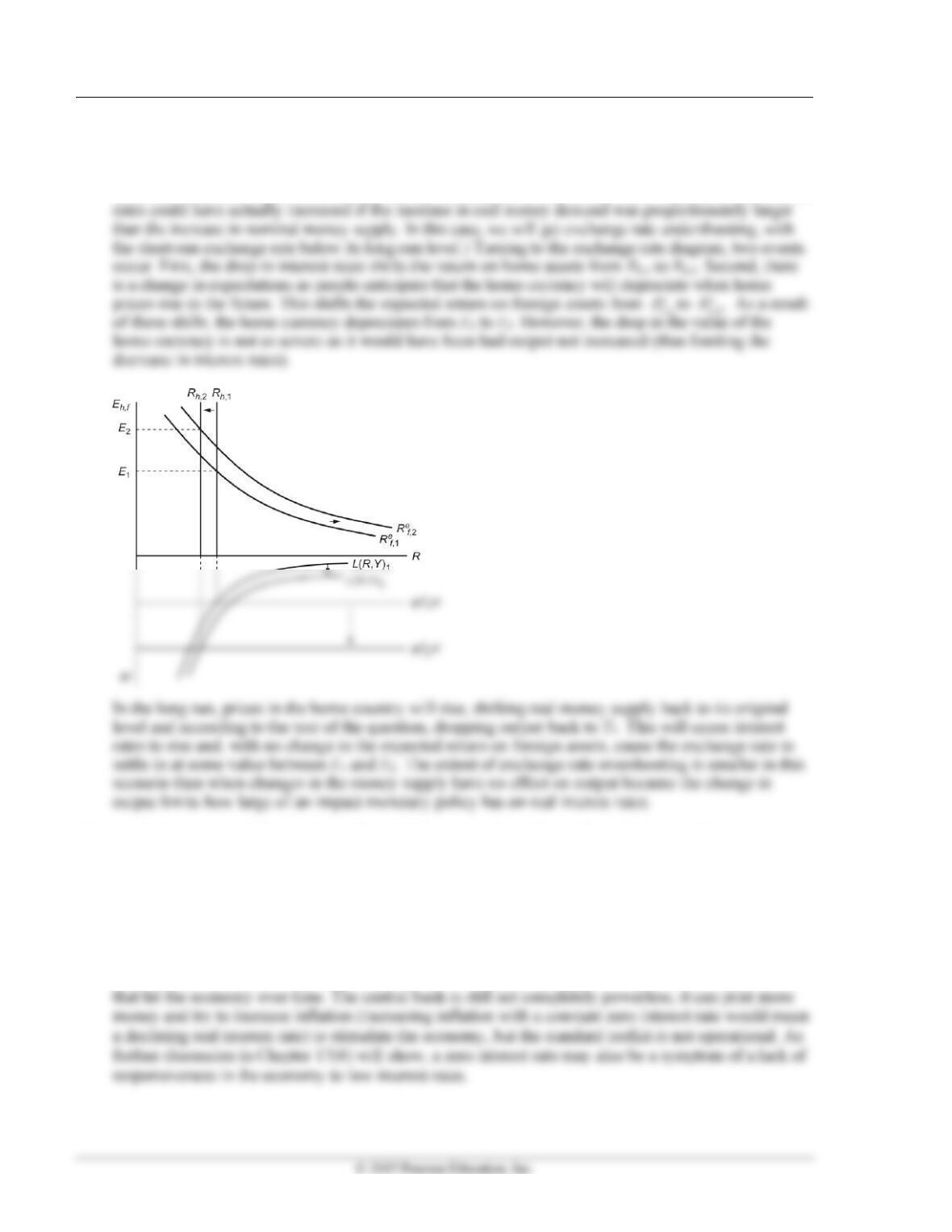
In the diagram below, the money supply rises from Ms,1 to Ms,2. This causes real output to rise from Y1
to Y2 and shifts the real money demand curve out from L(R, Y1) to L(R, Y2). In the diagram below, the
resulting shifts lead to a reduction in interest rates from Rh,1 to Rh,2, which is a smaller drop in interest
rates than would have prevailed had real money demand not shifted. (Note that it is possible that interest
10. As the interest rate falls, people prefer to hold more cash and fewer financial assets. If interest rates
were to fall below zero, people would strictly prefer cash to financial assets as the zero return on cash
would dominate any negative return. Thus, interest rates cannot fall below zero because no one would
hold a financial asset with a negative rate of return when another asset at a zero rate of return (cash)
exists.
11. One clear complication that a zero interest rate introduces is that the central bank is “out of ammunition.”
It literally cannot reduce interest rates any further and thus may struggle to respond to additional shocks
Chapter 15 (4) Money, Interest Rates, and Exchange Rates 89
12. a. If money adjusts automatically to changes in the price level, then any number of combinations of
money and prices could satisfy the money supply/money demand equations. There would be no
unique solution.
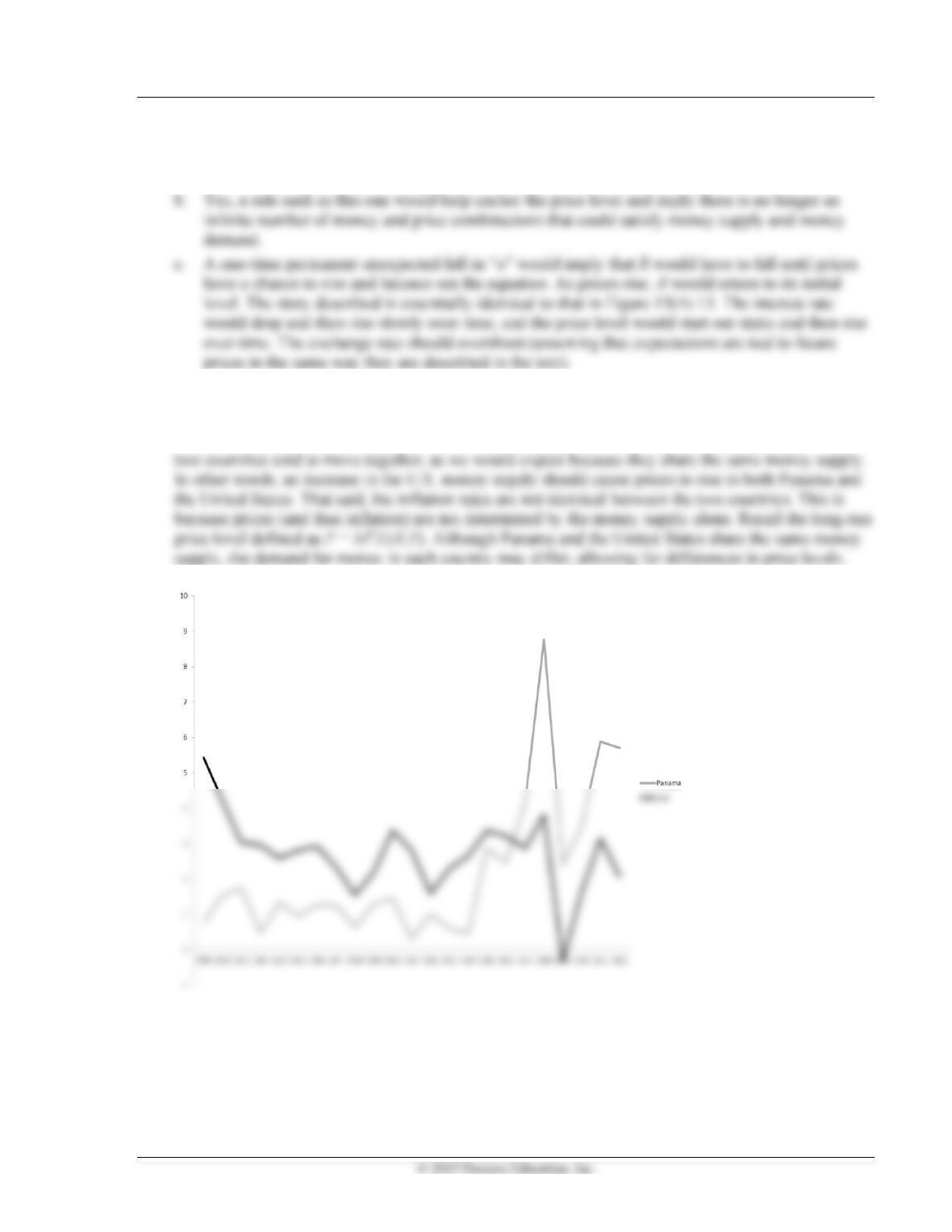
13. Because Panama uses the US dollar as its currency, we would expect that, all else being equal,
inflation in Panama and that in the United States should be identical. The chart below gives inflation
rates in Panama and the United States over the past 20 years. On one hand, the inflation rates in the