Chapter 14
The Financial System and Economic Growth
◼ Chapter Outline, Overview, and Teaching Tips
Chapter Outline
The Role of the Financial System
Direct Finance
Indirect Finance
Information Challenges and the Financial System
Application: The Tyranny of Collateral
Government Regulation and Supervision of the Financial Sector
Financial Development and Economic Growth: The Evidence
Application: Is China a Counter-Example to the Importance of Financial Development to Economic
Growth?
Chapter 14 Web Appendix: Free Trade, Financial Globalization, and Growth
Chapter Overview and Teaching Tips
With the financial crisis that overwhelmed the world economy from 2007–2009, the public has become
more aware of the interaction between finance and economics. This part of the book provides an analytical
Chapter 14 The Financial System and Economic Growth 153
The next part of the chapter discusses why it is not easy to get the financial system to channel funds to
households and businesses with productive investment opportunities. The key barrier to getting this to
happen is asymmetric information, the fact that one party to a financial contract has different information
than the other party. There are three key concepts that students need to master to understand the material in
the rest of the chapter: adverse selection, moral hazard, and the free-rider problem. Because these three
concepts are so important, it is worth asking students in class to come up with examples of these problems
from their daily lives. This not only solidifies understanding of these concepts but also shows them how
relevant these concepts are to real-world issues. The chapter then uses these concepts to explain why
financial intermediaries like banks are so important in a financial system and why collateral is so prevalent
in debt contracts. The application, “The Tyranny of Collateral,” then provides graphic examples of how
barriers to having property serve as collateral helps keep some countries poor.
The final section of the chapter discusses the empirical evidence on the link between financial
development and economic growth. Although the evidence is quite strong that financial development plays
a key role in promoting economic growth, one economy that looks like a counterexample is China’s,
because its financial sector is relatively undeveloped and yet the economy has had very rapid growth in
recent years. Discussing this example in class, which appears as an application at the end of the chapter,
raises not only fascinating issues but also interests students because they want to better understand the rise
of China economically and possible pitfalls that China will face in the future.
◼ Answers to End of Chapter Review Questions and Problems
Answers to Review Questions
The Role of the Financial System
1. The financial system matches savers (those who have surplus funds) with borrowers who may have
good investment opportunities but no savings of their own to invest. Without a well-functioning
154 Mishkin • Macroeconomics: Policy and Practice, Second Edition
2. In direct finance, borrowers get funds from savers by selling them financial instruments (securities)
such as stocks or bonds. These securities give the lenders (savers) a claim to the borrowers’ future
Information Challenges and the Financial System
3. With both direct and indirect finance, the borrower generally has more information than the lender
does about the risk involved. This asymmetric (unequal) information creates two problems for
4. Investors in financial instruments who engage in information collection face a free-rider problem,
which means other investors may be able to benefit from their information without paying for it.
5. To overcome asymmetric information problems, banks screen potential borrowers before making
loans (to lessen adverse selection problems), monitor borrowers’ financial conditions and how they
6. Developing countries likely have weaker accounting and reporting standards, so accurate information
about private firms is more difficult to come by and also more difficult to analyze because of limited
Government Regulation and Supervision of the Financial Sector
7. The government can produce information about borrowers and provide it to investors free of charge,
it can require borrowers to report honest information about themselves to investors, and it can set and
8. Even though banks are well suited to overcome the adverse selection and moral hazard problems
inherent in lending because they make private loans and have incentives to invest in information
production about the borrowers to whom they lend, bank depositors face an asymmetric information
Chapter 14 The Financial System and Economic Growth 155
9. Governments provide safety nets to reduce the likelihood of bank runs and contagions because these
have adverse effects on the financial system and the economy. Deposit insurance and government’s
assurance that it will make funds available to troubled financial institutions are two forms that a
Financial Development and Economic Growth: The Evidence
10. Financial deepening refers to a country developing the institutions necessary to have a well-
functioning financial system. Where it has occurred, the benefits include increasing the rate of
Answers to Problems
The Role of the Financial System
1. A situation in which entrepreneurs cannot get credit to fund their investment projects is not a
desirable one from an efficiency point of view. Although it is true that many ideas will not result in
2. Funds were definitely not allocated to their most productive use. Funds are allocated to their most
productive use when considerations about which individual or firm should receive these funds are
based on risk and expected returns associated with the investment. The situation in which funds are
Information Challenges and the Financial System
3. a. The loan officer is trying to assess your credit risk by gathering information about your income (past
and current employment) and credit history to avoid the adverse selection problem. The loan office
is essentially making sure that you will have the ability and willingness to pay back your car loan.
156 Mishkin • Macroeconomics: Policy and Practice, Second Edition
b. By putting a lien on your car title, the bank solves (or reduces) the moral hazard problem. The bank
wants to make sure you will use your loan to buy a car (a problem that is sometimes solved by
4. During your visit at the bank you will probably realize that your will receive an annual interest rate of
1 percent or 2 percent if you buy a certificate of deposit, while an individual asking for a car loan will
be required to pay an annual interest rate of 7 percent or 8 percent. At the beginning, it seems
tempting for you to offer an interest rate of 4 percent, which would make both of you better off.
However, you would probably like to know that individual better, in particular his net worth (to
assess his ability to pay you back), or his credit history (has he or she defaulted on a loan before?).
5. Information asymmetries are also present in government bond markets. Usually investors resort to
many information sources about the characteristics of particular governments to assess their ability or
6. Financial intermediaries operating in countries with relatively weak property rights and legal systems
usually require a lot of collateral when making loans. The rationale for that behavior is that in the event
that the borrower defaults, the bank knows that it will be quite difficult and expensive to recover its
loan. Therefore, requesting extra collateral might help the bank speed up the process. In practice, a
Government Regulation and Supervision of the Financial Sector
7. In the U. S. financial system, trading in derivatives is concentrated in five large banks and
transactions are kept relatively private, for the same reason that banks do primarily private loans (to
Chapter 14 The Financial System and Economic Growth 157
8. Although it might seem a good idea to “copy and paste” regulatory frameworks that ensure the
soundness of a financial system from one country to the other, this is usually not a good idea.
Financial Development and Economic Growth: The Evidence
9. As more individuals and firms participate in the financial system, monetary policy becomes more
effective. When more firms and borrowers rely on financial intermediaries, monetary policy tools
have a more immediate effect on monetary aggregates. Monetary policy tools affect financial
10. Microcredit programs were very effective in defining a set of incentives that helped to deal with
asymmetric information problems. As a result, microcredit loans usually exhibit higher repayment
rates (the percentage of loans that are actually repaid) than regular loans made by financial intermediaries.
Solving the adverse selection problem was never the intention of microcredit schemes because the
◼ Answers to Data Analysis Problems
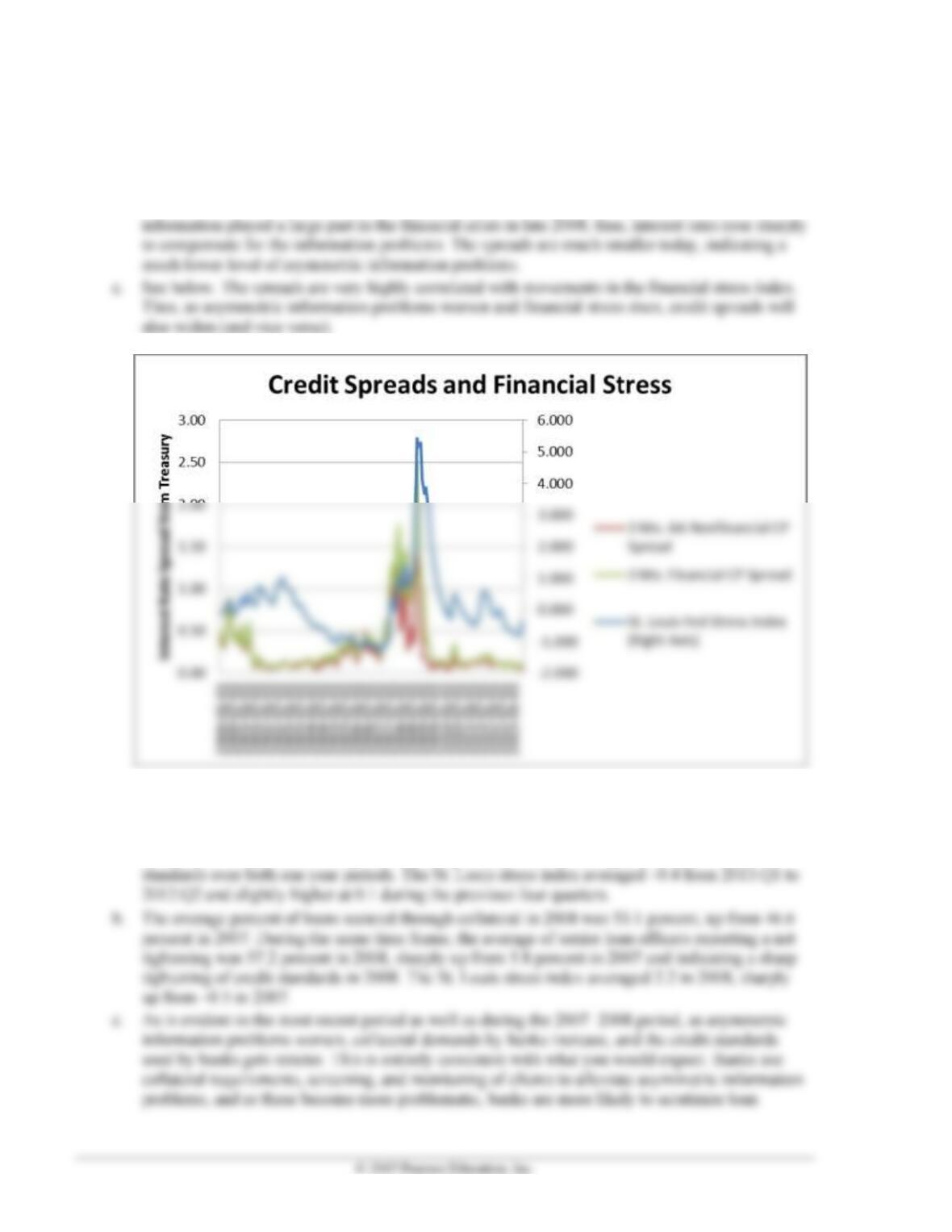
1. a. For June 2013, the AA nonfinancial commercial paper spread was 0.05, and the AA financial
commercial paper spread was 0.09. These are relatively small margins over the treasury rate and
158 Mishkin • Macroeconomics: Policy and Practice, Second Edition
fairly close to each other, indicating relatively low risk between commercial paper and the risk–
free (treasury) rate.
b. In June 2012, both AA nonfinancial commercial and the AA financial commercial paper spread
was 0.12, slightly higher than the most recent reading and indicating slightly higher risk. In
October 2008, these spreads widened significantly to 1.40 and 2.52, respectively. Asymmetric
2. a. From 2013:Q1 to 2012:Q2, the average percent of loans secured through collateral was 51.3
percent, down from 58.4 percent from the previous four quarters. During the same time frame,
the average of senior loan officers reporting a net tightening was –7.9 percent during the recent
period and –9.7 percent in the previous four quarter period, indicating an easing of credit
Chapter 14 The Financial System and Economic Growth 159
3. a. See table below.
b. See table below. There is a clear relationship between financial/investment freedom and per
capita growth in the data: from 1995 to 2005, the top three countries grew by 2.9 percent, while
the bottom three grew by only 1.62 percent. From 2005 to 2011, the top three grew by almost 1
percent, while the bottom three shrank slightly with a –0.12 percent growth rate
to 2011 period than the bottom three.
USA
Italy
France
Czech
Republic
United
Kingdom
Australia
1995 to 2005
2.28
1.05
1.53
3.19
2.99
2.53
2005 to 2011
0.19
1.89
0.98
Top 3
1995 to 2005
2.90
1.62
2005 to 2011
0.94
-0.12
◼ Answers to Review Questions and Problems in Appendix, “Free
Trade, Financial Globalization, and Growth”
1. Financial repression refers to efforts to impede the development of financial markets and institutions
2. Financial repression is supported by government officials and rich elites in developing countries.
Government officials profit from expropriating private property and promoting state-owned banks for
3. Free trade increases competition that reduces the revenues and profits of firms in developing
economies and makes it more likely that they will need to seek external sources of financing. This
4. Financial globalization opens markets to flows of foreign capital and competition from foreign financial
institutions. This gives domestic financial institutions incentives to become more efficient and adopt
160 Mishkin • Macroeconomics: Policy and Practice, Second Edition
◼ Data Sources, Related Articles, and Discussion Questions
A. For Information About Application: The Tyranny of Collateral
Data Source
De Mel, Suresh et al., “Who Are the Microenterprise Owners? Evidence from Sri Lanka on Tokman v. De
Related Article
Darlington, Shasta (CNN), “Rio slum transformed into canvas bursting with color”:
America: Rio de Janeiro. This is mainly a consequence from the lack of collateral needed to get a
mortgage loan (note especially picture 8).
Discussion Question
During the most virulent phase of the 2007–2009 financial crises, the U.S. government enacted measures
to prevent the increase in foreclosures, as many families were losing their homes. Many people criticized
this action, arguing that seizing collateral in the event of default was part of the mortgage contract. Explain
how this situation exemplifies the role played by collateral in solving asymmetric information problems.
Answer: Critics of the government’s actions defended that contracts must be properly enforced. Otherwise,
B. For Information About Application: Is China a Counter-Example to the
Importance of Financial Development to Economic Growth?
Data Source
Federal Reserve Bank of St. Louis data base (FRED):
Related Article
Yin, Y.P. et al., “Decomposition of the Efficiency of the Chinese State-Owned Commercial Banks at the
Chapter 14 The Financial System and Economic Growth 161
Discussion Questions
Assuming China does not reform its financial system and keeps relying on state-owned banks to channel
funds from savers to borrowers, which do you think would be the consequences in term of efficiency? Can
you identify a potential benefit from state-owned banks channeling funds?
Answer: As empirical evidence suggests, a state-owned financial system tends to be less efficient than a