CHAPTER 14
(MACRO CHAPTER 14)
Macroeconomic Policy: Tradeoffs,
Expectations, Credibility, and Sources of
Business Cycles
FUNDAMENTAL QUESTIONS
1. Is there a tradeoff between inflation and the unemployment rate?
2. How does the tradeoff between inflation and the unemployment rate vary from the short to the
long run?
3. What is the relationship between unexpected inflation and the unemployment rate?
OVERVIEW AND OBJECTIVES
The primary purpose of this chapter is to present several issues in macroeconomic policy. These
include the inflation-unemployment tradeoff, the formation of adaptive and rational expectations,
credibility in macroeconomic policy, and the relationship between monetary policy and fiscal policy.
After reading and reviewing this chapter, the student should be able to:
1. Explain the Phillips curve.
2. Explain the differences in the short-run and long-run Phillips curves.
Chapter 14: Macroeconomic Policy 99
KEY TERM REVIEW
Phillips curve
reservation wage
LECTURE OUTLINE AND TEACHING STRATEGIES
I. The Phillips Curve
The Phillips curve shows the inverse relationship between inflation and unemployment.
A. An inflation-unemployment tradeoff? The inflation-unemployment tradeoff is a short-run
phenomenon.
B. Short-run versus long-run tradeoffs
1. In the short run: When aggregate demand increases and thereby pushes output above
II. The Role of Expectations
Teaching Strategy: Be sure to work through the long- and short-run Phillips curves carefully.
This material tends to be difficult for students.
A. Expected versus unexpected inflation
1. Wage expectations and unemployment: When wage offers are unexpectedly high,
workers shorten their job searches; hence, the unemployment rate falls.
B. Forming expectations
1. Adaptive expectations: People form adaptive expectations by using past information
III. Credibility and Time Inconsistency
When the Fed adjusts its policies to new economic conditions, it may pursue policies that are time
inconsistent.
A. The policymaker’s problem: If policymakers announce a policy and conditions change so
that the policy becomes inappropriate, the policymakers are left with the choice of
100 Chapter 14: Macroeconomic Policy
view of monetary policy is a key for establishing credibility. Unlike other countries, the U.S.
Federal Reserve does not announce an official inflation target.
IV. Sources of Business Cycles
A. The political business cycle: Politicians may generate a business cycle by exploiting the
short-run tradeoff between inflation and unemployment.
C. Output volatility: Since the mid-1980s, U.S. output growth had become less volatile prior to
the financial crisis that began in 2007 and the associated global recession. Some economists
refer to the period of relatively low variability of real GDP growth as the “Great
Moderation.”
1. Better inventory management: Improvements in information technology and
communications helped damper fluctuations.
V. The Link Between Monetary and Fiscal Policies
Monetary and fiscal policies are interdependent.
A. The government budget constraint: Government spending can be financed only through
OPPORTUNITIES FOR DISCUSSION
1. Who is responsible for policy making in your family? Are these policymakers credible? Are their
policies time consistent?
2. Given the independence of the Federal Reserve, how likely is a political business cycle?
Chapter 14: Macroeconomic Policy 101
ANSWERS TO EXERCISES
1.
2. If workers receive higher than expected wage offers because of unexpected inflation, they may
accept those offers and shorten their job searches. Thus, the unemployment rate will fall. If prices
are higher than businesses expect, they may view those higher prices as increases in relative
prices. Thus, businesses will increase production and employment, and the unemployment rate
will be reduced.
102 Chapter 14: Macroeconomic Policy
3.
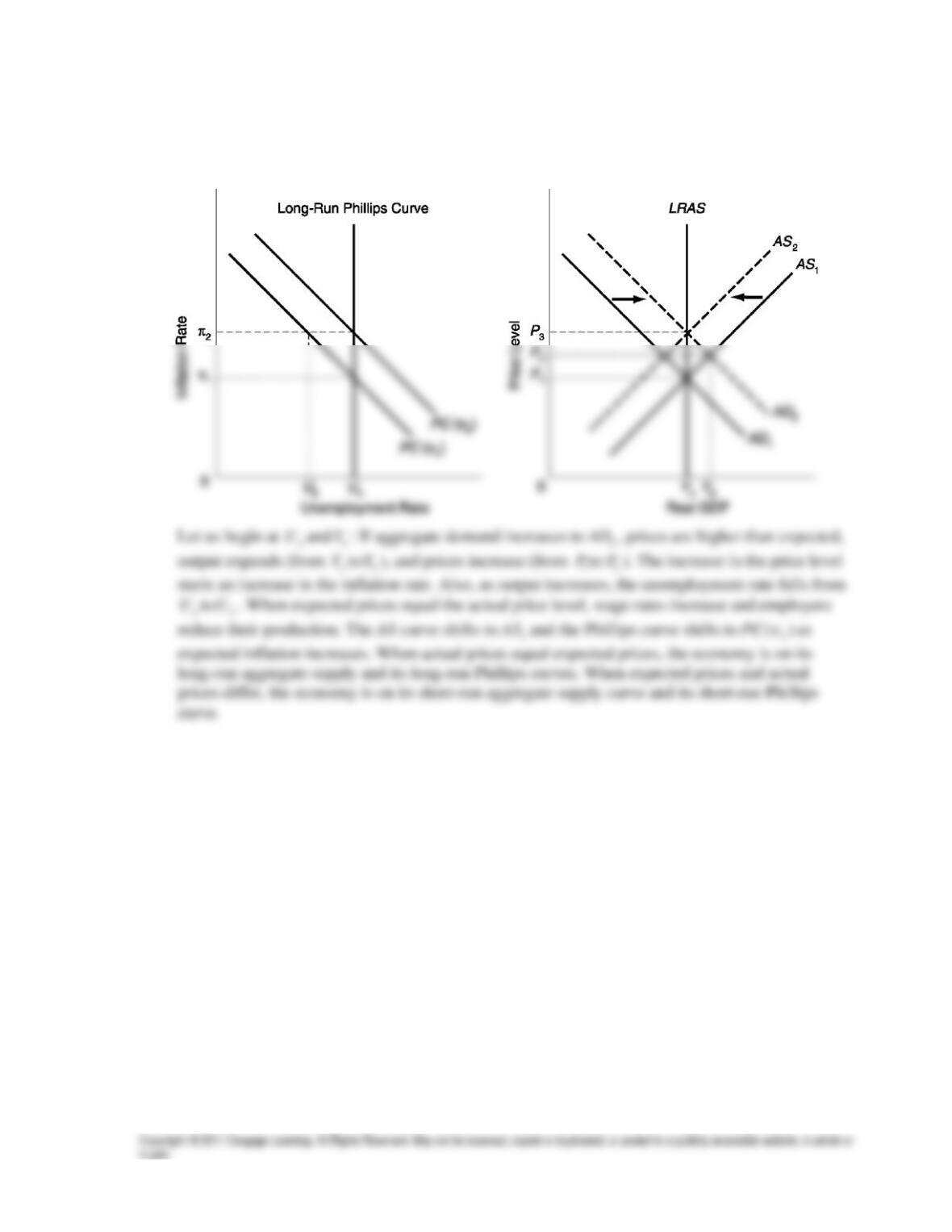
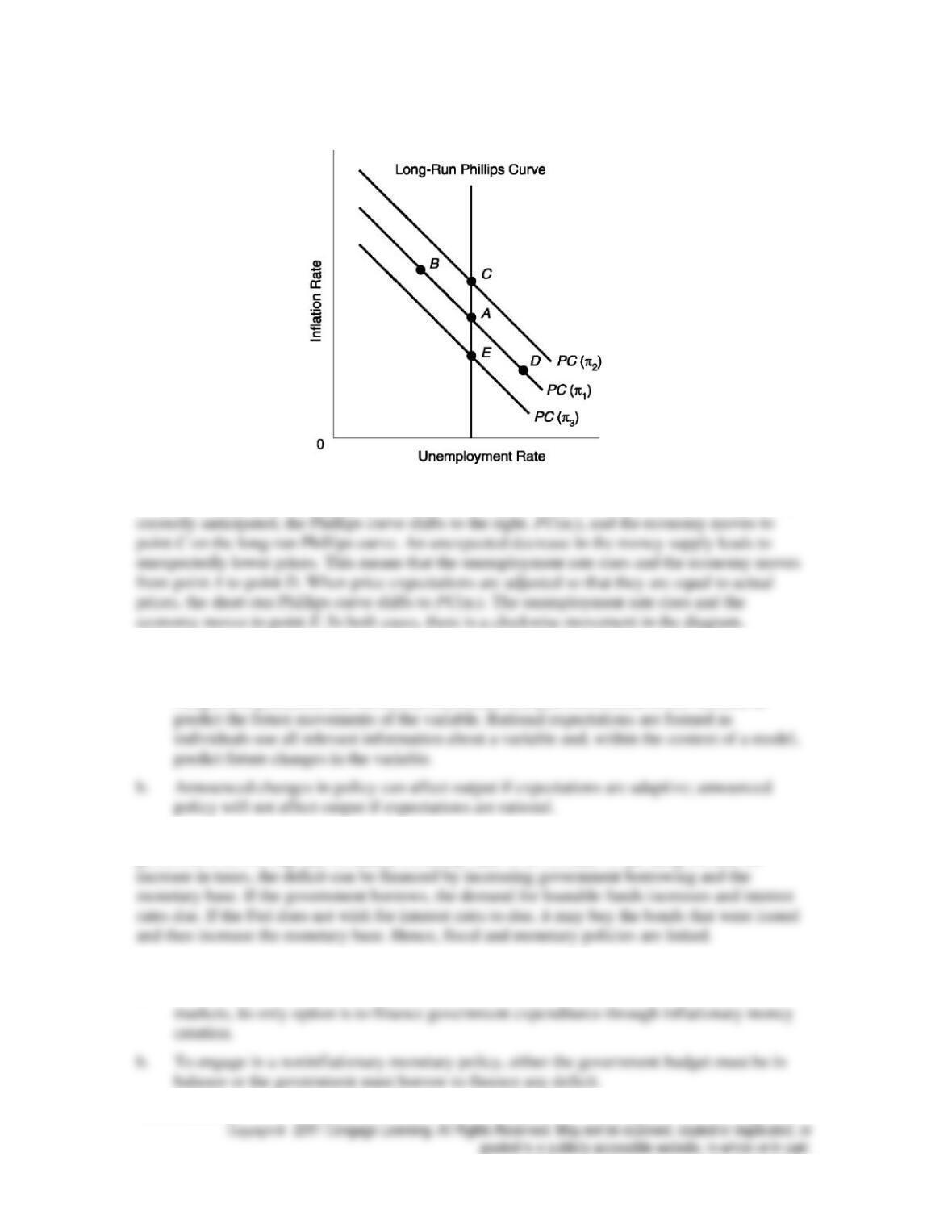
Let us start with point
A
: An unexpected increase in the money supply leads to unexpected
inflation. This moves the economy from point A to point B on the Phillips curve. When prices are
4.
a. Macroeconomic expectations comprise adaptive expectations and rational expectations.
Adaptive expectations are formed as individuals use past movements in the variable to
5.
G T B M= + +
. Government spending can be financed with any combination of taxes,
government borrowing, and increased monetary base. If an increase in spending exceeds an
6.
a. If a country has a limited ability to increase taxes and is unable to borrow in financial
7. All of these “policies” could be time inconsistent if the parent is unwilling to follow through later.
Chapter 14: Macroeconomic Policy 103
8.
9.
10. Without an independent monetary authority, monetary policy would be blatantly political.
11.
$130 billion $100 billion $25 billion $5 billion− − =
14.
104 Chapter 14: Macroeconomic Policy
15.
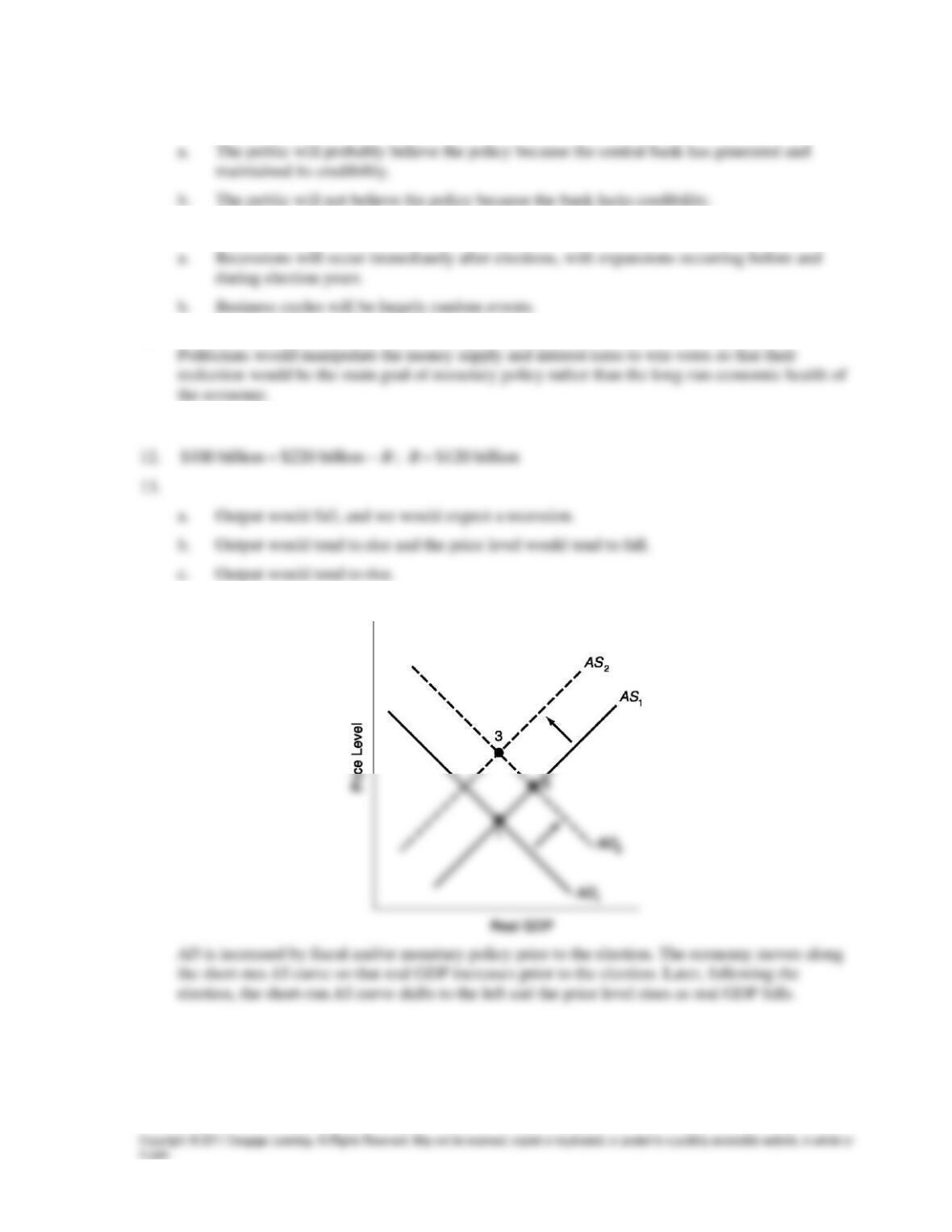
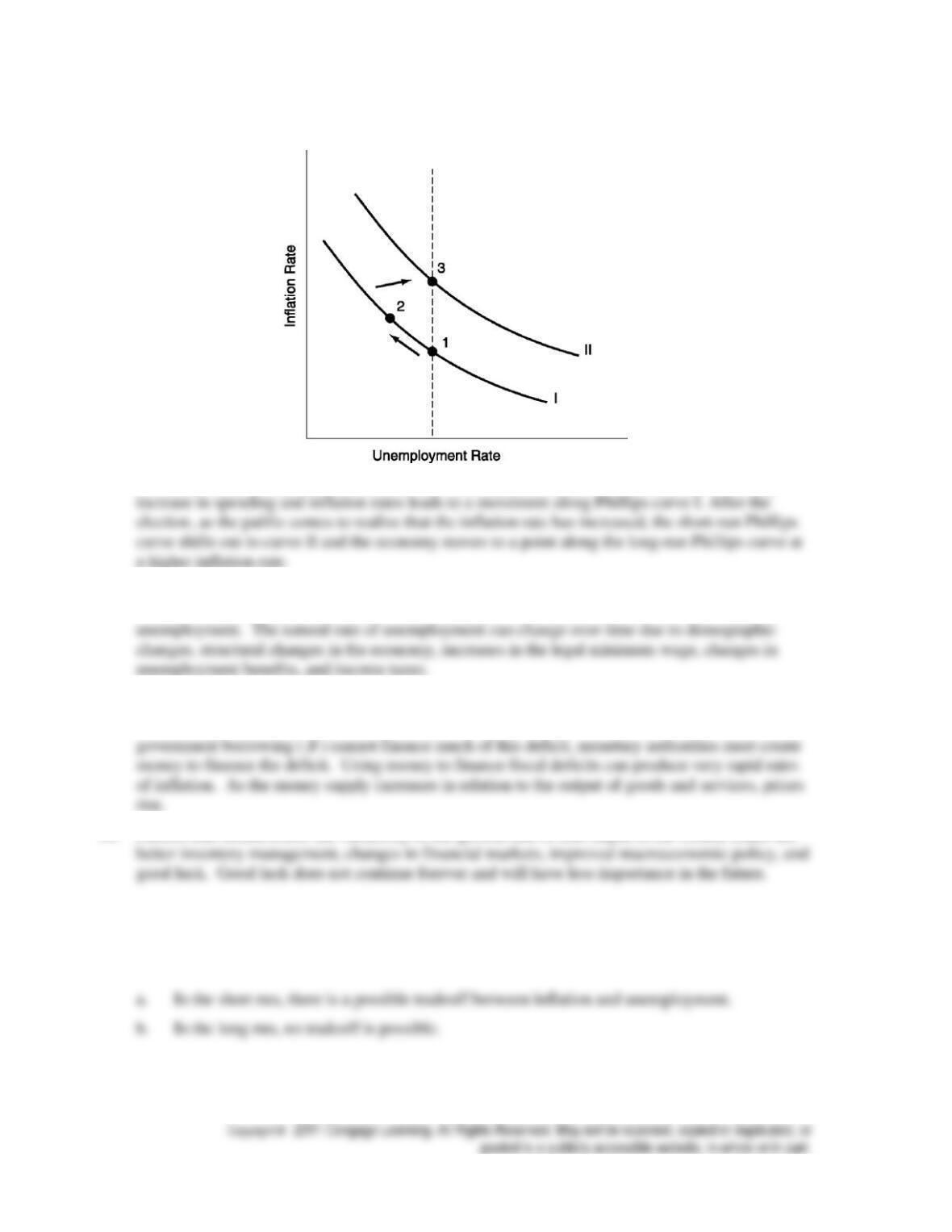
Fiscal and/or monetary policy stimulates the economy prior to the election, and the surprising
16. The natural rate of unemployment is defined as the unemployment rate that exists in the absence
of cyclical unemployment. It reflects the normal amount of frictional, structural, and seasonal
17. The government budget constraint can be rewritten as the following equation:
()M G T B = − −
.
If a country is running a large fiscal deficit
()GT−
due to increased government spending, and
18. Factors that should effect the variability of the growth rate of real output in the United States are
ANSWERS TO STUDY GUIDE HOMEWORK
1. The relationship between the inflation rate and the unemployment rate.
2.
Chapter 14: Macroeconomic Policy 105
3.
a.
M
M
4.
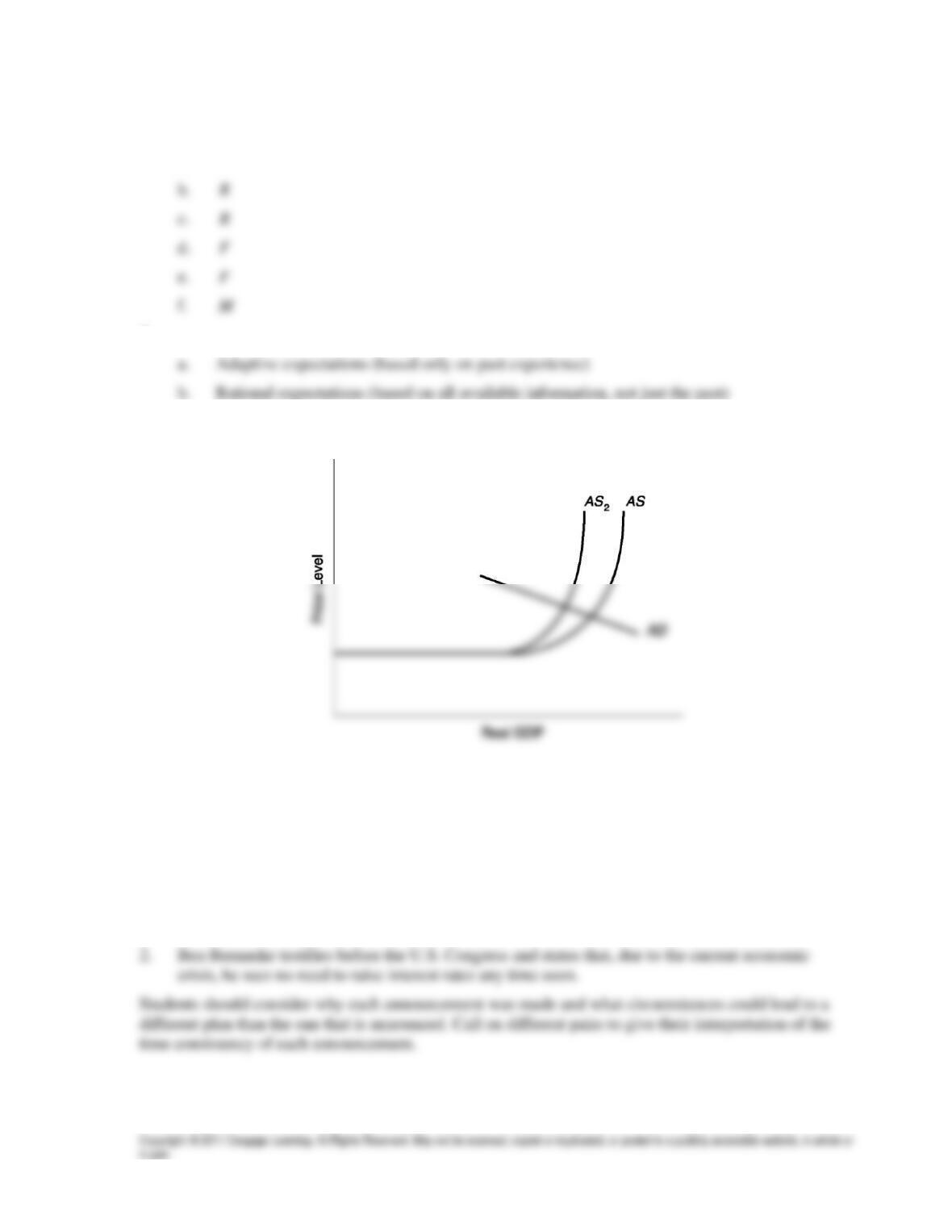
5. Rain causes AS to shift to the left. Equilibrium price level will increase, and real GDP will fall, as
shown below.
ACTIVE LEARNING EXERCISE
This exercise will allow students to explore the concept of time inconsistency as it applies to economic
policies. Be sure to explore the credibility problem that results from time inconsistency and the possible
effects on the economy.
Form pairs of students to consider the time consistency of the following statements:
1. A senator announces his candidacy for president of the United States, claiming that if elected, he
will not run for reelection unless he can balance the federal budget.