Chapter 14 (3)
Exchange Rates and the Foreign Exchange Market:
An Asset Approach
◼ Chapter Organization
Exchange Rates and International Transactions
Domestic and Foreign Prices
Exchange Rates and Relative Prices
The Foreign Exchange Market
The Actors
Box: Exchange Rates, Auto Prices, and Currency Wars
The Demand for Foreign Currency Assets
Assets and Asset Returns
Box: Nondeliverable Forward Exchange Trading in Asia
Risk and Liquidity
Interest Rates
Exchange Rates and Asset Returns
A Simple Rule
76 Krugman/Obstfeld/Melitz • International Economics: Theory & Policy, Tenth Edition
◼ Chapter Overview
The purpose of this chapter is to show the importance of the exchange rate in translating foreign prices
into domestic values as well as to begin the presentation of exchange rate determination. Central to the
treatment of exchange rate determination is the insight that exchange rates are determined in the same way
as other asset prices. The chapter begins by describing how the relative prices of different countries’ goods
are affected by exchange rate changes. This discussion illustrates the central importance of exchange rates
for cross-border economic linkages. The determination of the level of the exchange rate is modeled in
the context of the exchange rate’s role as the relative price of foreign and domestic currencies, using the
uncovered interest parity relationship.
The explanation of exchange rate determination in this chapter emphasizes the modern view that exchange
rates move to equilibrate asset markets. The foreign exchange demand and supply curves that introduce
exchange rate determination in most undergraduate texts are not found here. Instead, there is a discussion
of asset pricing and the determination of expected rates of return on assets denominated in different
currencies.
Chapter 14 Exchange Rates and the Foreign Exchange Market: An Asset Approach 77
The result that a dollar appreciation makes foreign currency assets more attractive may appear counterintuitive
to students—why does a stronger dollar reduce the expected return on dollar assets? The key to explaining
this point is that, under the static expectations and constant interest rates assumptions, a dollar appreciation
today implies a greater future dollar depreciation; so, an American investor can expect to gain not only the
foreign interest payment but also the extra return due to the dollar’s additional future depreciation. The
following diagram illustrates this point. In this diagram, the exchange rate at time t + 1 is expected to be
This pedagogical tool can be employed to provide some further intuition behind the interest parity
relationship. Suppose that the domestic and foreign interest rates are equal. Interest parity then requires
that the expected depreciation is equal to zero and that the exchange rate today and next period is equal
to E. If the domestic interest rate rises, people will want to hold more domestic currency deposits. The
resulting increased demand for domestic currency drives up the price of domestic currency, causing the
exchange rate to appreciate. How long will this continue? The answer is that the appreciation of the
domestic currency continues until the expected depreciation that is a consequence of the domestic
currency’s appreciation today just offsets the interest differential.
The chapter concludes with a case study looking at a situation in which interest rate parity may not hold:
the carry trade. In a carry trade, investors borrow money in low-interest currencies and buy high-interest-
rate currencies, often earning profits over long periods of time. However, this transaction carries an element
of risk as the high-interest-rate currency may experience an abrupt crash in value. The case study discusses
a popular carry trade in which investors borrowed low-interest-rate Japanese yen to purchase high-interest-
rate Australian dollars. Investors earned high returns until 2008, when the Australian dollar abruptly crashed,
78 Krugman/Obstfeld/Melitz • International Economics: Theory & Policy, Tenth Edition
◼ Answers to Textbook Problems
1. At an exchange rate of 1.05 $ per euro, a 5 euro bratwurst costs 1.05$/euro 5 euros = $5.25. Thus,
the bratwurst in Munich is $1.25 more expensive than the hot dog in Boston. The relative price is
2. If it were cheaper to buy Israeli shekels with Swiss francs that were purchased with dollars than to
directly buy shekels with dollars, then people would act upon this arbitrage opportunity. The demand
3. Take for example the exchange rate between the Argentine peso, the US dollar, the euro, and the
British pound. One dollar is worth 5.3015 pesos, while a euro is worth 7.0089 pesos. To rule out
triangular arbitrage, we need to see how many pesos you would get if you first bought euros with
4. When the yen depreciates versus the dollar, costs to a Japanese firm that imports petroleum will rise.
This depresses its profits. On the other hand, that firm will be able to export more to the United States
5. The dollar rates of return are as follows:
Chapter 14 Exchange Rates and the Foreign Exchange Market: An Asset Approach 79
6. Note here that the ordering of the returns of the three assets is the same whether we calculate real or
nominal returns.
a. The real return on the house would be 25 percent − 10 percent = 15 percent. This return could
also be calculated
7. The current equilibrium exchange rate must equal its expected future level since, with equality of
nominal interest rates, there can be no expected increase or decrease in the dollar/pound exchange
8. If market traders learn that the dollar interest rate will soon fall, they also revise upward their expectation
of the dollar’s future depreciation in the foreign exchange market. Given the current exchange rate
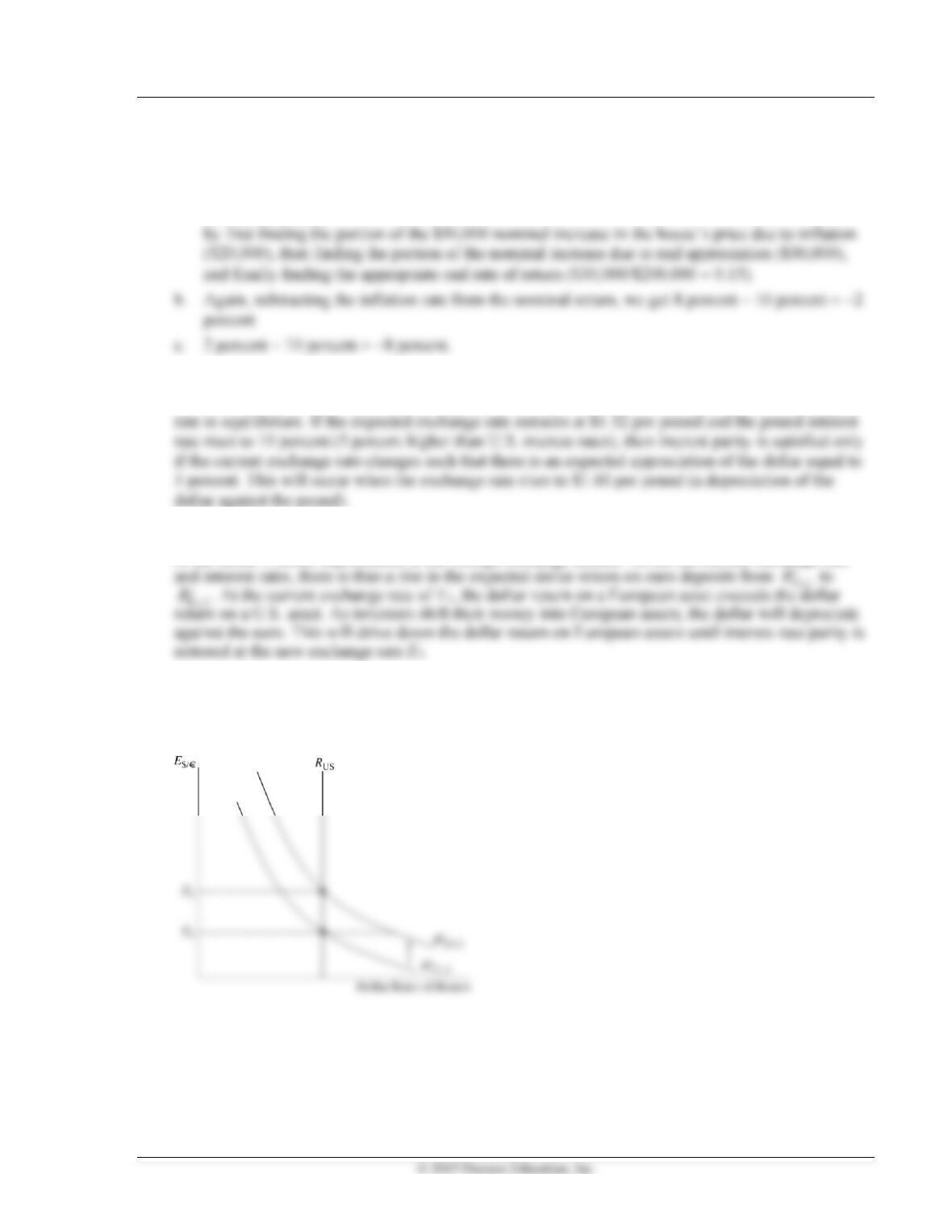
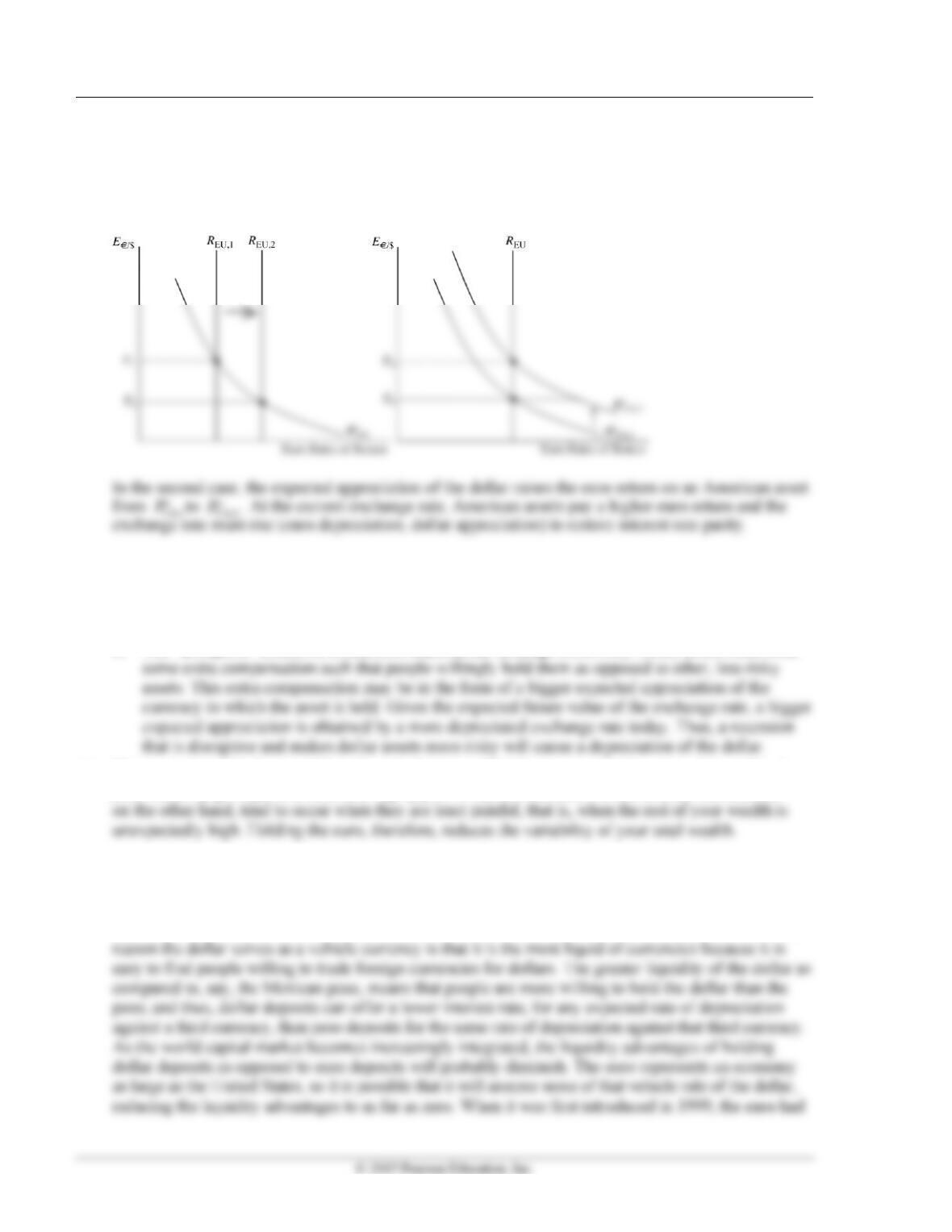
9. The analysis will be parallel to that in the text. As shown in the accompanying diagrams, a movement
down the vertical axis in the new graph, however, is interpreted as a euro appreciation and dollar
depreciation rather than the reverse. Also, the horizontal axis now measures the euro interest rate.
80 Krugman/Obstfeld/Melitz • International Economics: Theory & Policy, Tenth Edition
The two diagrams below show the effects of an increase in European interest rates and an increase in
the expected future exchange rate in terms of euros per dollar. In the first case, an increase in European
interest rates raises the euro return on a European asset above the euro return on an American asset.
This will cause the exchange rate to fall (euro appreciation, dollar depreciation) from E1 to E2.
10. a. If the Federal Reserve pushed interest rates down, with an unchanged expected future exchange
rate, the dollar would depreciate (note that the article uses the term “downward pressure” to mean
pressure for the dollar to depreciate). If there is a “soft landing,” and the Federal Reserve does
not lower interest rates, then this dollar depreciation will not occur.
b. The “disruptive” effects of a recession make dollar holdings more risky. Risky assets must offer
11. The euro is less risky for you. When the rest of your wealth falls, the euro tends to appreciate, cushioning
your losses by giving you a relatively high payoff in terms of dollars. Losses on your euro assets,
12. The chapter states that most foreign exchange transactions between banks (which accounts for the vast
majority of foreign exchange transactions) involve exchanges of foreign currencies for U.S. dollars, even
when the ultimate transaction involves the sale of one nondollar currency for another nondollar
currency. This central role of the dollar makes it a vehicle currency in international transactions. The
Chapter 14 Exchange Rates and the Foreign Exchange Market: An Asset Approach 81
13. The interest rate parity condition tells us that interest rates and exchange rates are directly linked.
As interest rates become more volatile, so too will exchange rates. For example, suppose that the
European Central Bank actively limits fluctuations in euro interest rates while the Federal Reserve
14. A tax on interest earnings and capital gains leaves the interest parity condition the same because all
its components are multiplied by one less the tax rate to obtain after-tax returns. If capital gains are
untaxed, the expected depreciation term in the interest parity condition must be divided by 1 less the
tax rate. The component of the foreign return due to capital gains is now valued more highly than
interest payments because it is untaxed.
15. The forward premium can be calculated as described in the Appendix. In this case, we find the
16. The value should have gone down as there is no more need to engage in intra-EU foreign currency
trading. This represents the predicted transaction cost savings stemming from the euro. At the same
17. If the dollar depreciated, all else being equal, we would expect outsourcing to diminish. If, as the
problem states, much of the outsourcing is an attempt to move production to locations that are relatively
cheaper, then the United States becomes relatively cheap when the dollar depreciates. Although it
82 Krugman/Obstfeld/Melitz • International Economics: Theory & Policy, Tenth Edition
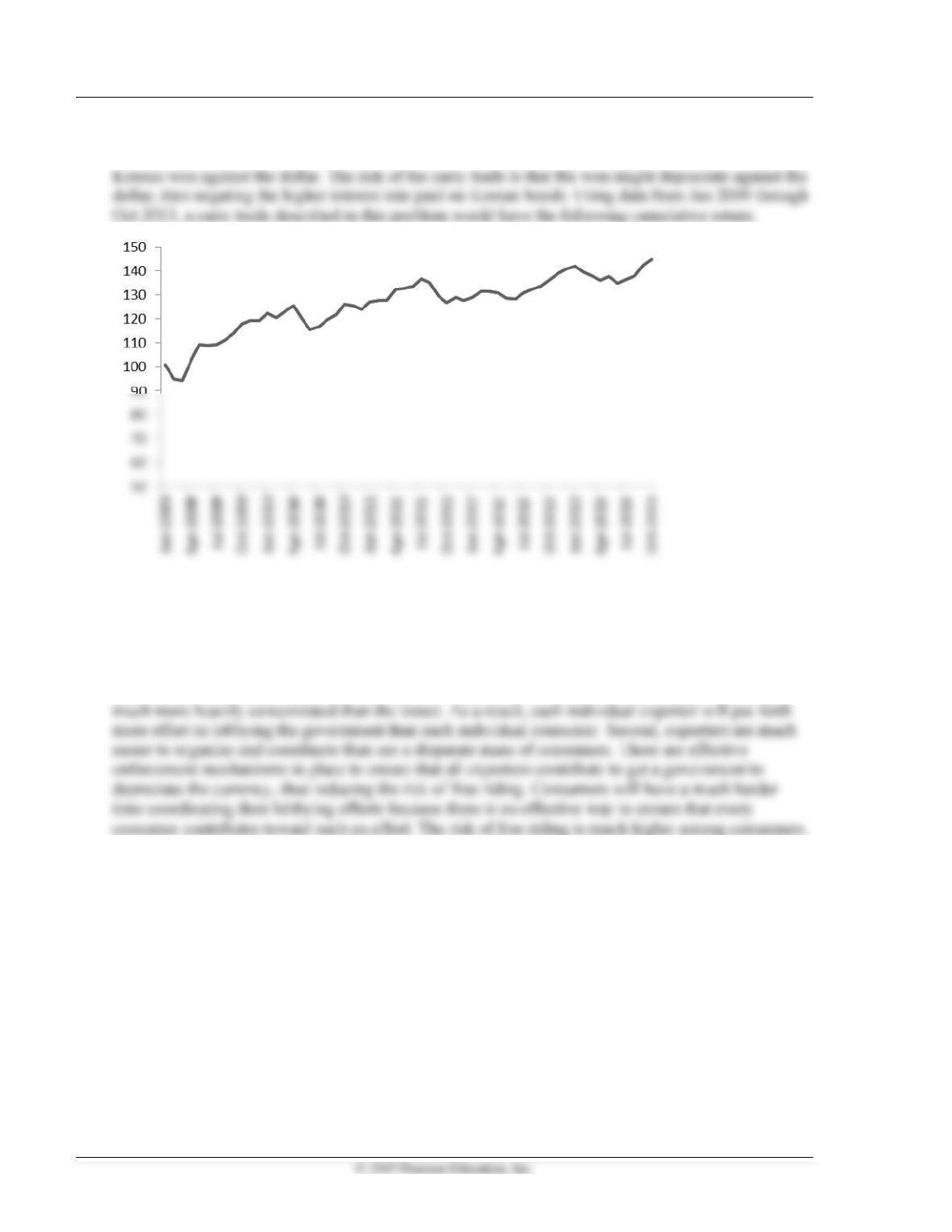
18. They key here is to compute the return on the carry trade by accounting for not only the difference
between Korean and American interest rates, but also the percentage change in the value of the
19. As per the question, a currency depreciation benefits exporters and hurts consumers by raising the
cost of living. Exporters tend to have more influence with the government for two reasons. First,
there are fewer exporters than there are consumers, so the gains from a currency depreciation are