CHAPTER 14
BANKING AND THE MONEY SUPPLY
In this chapter, you will find:
Learning Outcomes
Chapter Outline with PowerPoint Script
Chapter Summary
Teaching Points (as on Prep Card)
Solutions to Problems Appendix
Experiential Assignment
INTRODUCTION
This chapter examines how financial institutions work, first by studying the types of deposits held and then
LEARNING OUTCOMES
14-1 Explain why using a debit card is like using cash, but using a credit card is not.
When you use a debit card, you tap directly into your checking account, paying with electronic mon-
ey—part of M1. Debit cards get their name because they debit, or draw down, your checking account
14-2 Explain why a bank is in a better position to lend your savings than you are.
Banks are unlike other financial intermediaries because they can turn a borrower’s IOU into money—
14-3 Describe how banks create money.
Banks are able to create money by making loans. When a bank makes a loan, it creates a deposit for
the borrower based on excess reserves. Any single bank can expand the money supply by the amount
Chapter 15 Banking and the Money Supply 204
14-4 Summarize the Fed’s tools of monetary policy.
The key to changes in the money supply is the Fed’s impact on excess reserves in the banking system.
To increase excess reserves and thus increase the money supply, the Fed can buy U.S. government
bonds, reduce the discount rate, or lower the reserve requirement. To reduce excess reserves
and thus reduce the money supply, the Fed can sell U.S. government bonds, increase the discount
CHAPTER OUTLINE WITH POWERPOINT SCRIPT
USE POWERPOINT SLIDES 2-4 FOR THE FOLLOWING SECTION
Money Aggregates
USE POWERPOINT SLIDES 5-7 FOR THE FOLLOWING SECTION
Broader Definition of Money: M2: Assets that perform the store of value function and can be converted
into currency or checkable deposits.
• M2: Includes M1 as well as savings deposits, small-denomination time deposits, and money market
mutual fund accounts.
Credit Cards and Debit Cards: What’s the difference?
USE POWERPOINT SLIDES 8-9 FOR THE FOLLOWING SECTION
How Banks Work
• Banks attract deposits from savers to lend to borrowers.
• Earn a profit on the difference between the interest paid depositors and the interest charged borrowers
USE POWERPOINT SLIDES 10-12 FOR THE FOLLOWING SECTION
Chapter 15 Banking and the Money Supply 205
Starting a Bank: To obtain a charter, first owners must apply to the state banking authority. Next, owners
USE POWERPOINT SLIDES 13-14 FOR THE FOLLOWING SECTION
Reserve Accounts:
• Required reserves: The Fed requires banks to hold a minimum percentage of their deposits in
USE POWERPOINT SLIDES 15-17 FOR THE FOLLOWING SECTION
Liquidity Versus Profitability: The bank manager must structure the portfolio of assets with an eye
toward liquidity but must not forget that the banks’ survival depends on profitability.
• Liquidity: The ease with which an asset can be converted into cash without a significant loss of value.
USE POWERPOINT SLIDES 18-26 FOR THE FOLLOWING SECTION
How Banks Create Money
Creating Money Through Excess Reserves: A bank’s lending is limited to the amount of its excess
reserves. The bank, by loaning its excess reserves, creates money.
Round One
• The Fed buys a $1,000 U.S. bond from Home Bank, injecting fresh reserves into the banking
system.
Round Three
• Merchant’s Trust now has $900 more in reserves on deposit at the Fed. After setting aside required
reserves of $90, it can lend the remaining $810, increasing the money supply in the economy to
$2,710.
Chapter 15 Banking and the Money Supply 206
USE POWERPOINT SLIDES 27-29 FOR THE FOLLOWING SECTION
Reserve Requirements and Money Expansion
• Money multiplier: Multiple by which the money supply increases as a result of an increase in the
banking system’s excess reserves.
• Simple money multiplier: Reciprocal of the required reserve ratio (1/ r), where r is the reserve ratio.
USE POWERPOINT SLIDE 30 FOR THE FOLLOWING SECTION
Limitations on Money Expansion: Leakages from the multiple expansion process reduce the size of the
money multiplier. Do the assumptions hold?
• Banks do not let reserves sit idle. Banks do have a profit incentive to make loans or buy other interest-
USE POWERPOINT SLIDE 31 FOR THE FOLLOWING SECTION
Multiple Contraction of the Money Supply: By selling government bonds, the Fed can reduce bank
USE POWERPOINT SLIDES 32-33 FOR THE FOLLOWING SECTION
The Fed’s Tools of Monetary Control
Open-Market Operations and the Federal Funds Rate: Policy decisions are made by the Federal Open
USE POWERPOINT SLIDES 34-35 FOR THE FOLLOWING SECTION
The Discount Rate: The interest rates the Fed charges on loans it makes to banks.
• Changes in the discount rate are a signal to financial markets about the direction of monetary policy.
Chapter 15 Banking and the Money Supply 207
USE POWERPOINT SLIDE 36 FOR THE FOLLOWING SECTION
Reserve Requirements
USE POWERPOINT SLIDES 37-38 FOR THE FOLLOWING SECTION
Coping with Financial Crises
• The Fed, through regulation of financial markets, tries to prevent major disruptions and financial
USE POWERPOINT SLIDES 39-41 FOR THE FOLLOWING SECTION
The Fed Is a Money Machine: The Fed’s main asset, U.S. government bonds, earns interest; its main
liability, Federal Reserve notes in circulation, requires no interest payments.
CHAPTER SUMMARY
The money supply is narrowly defined as M1, which consists of currency held by the nonbanking public,
plus checkable deposits and traveler’s checks. A broader money aggregate, M2, includes M1 plus savings
deposits, small-denomination time deposits, and money market mutual funds.
Any single bank can expand the money supply by the amount of its excess reserves. For the banking
system as a whole, however, the maximum expansion of the money supply equals a multiple of fresh bank
reserves. The simply money multiplier is the reciprocal of the reserve ratio, or 1/r. This multiplier is
reduced to the extent that (a) banks allow excess reserves to remain idle, (b) borrowers sit on their
proceeds, and (c) the public withdraws cash from the banking system and holds it.
TEACHING POINTS
1. The principal purpose of this chapter is to analyze the mechanics of deposit expansion. From this, it
is easy to discuss the different ways in which the Fed can alter the money supply. You may wish
to avoid the complications involved in explaining all of the items found on a bank’s balance sheet.
Chapter 15 Banking and the Money Supply 208
Reserves Deposits
Securities
Loans
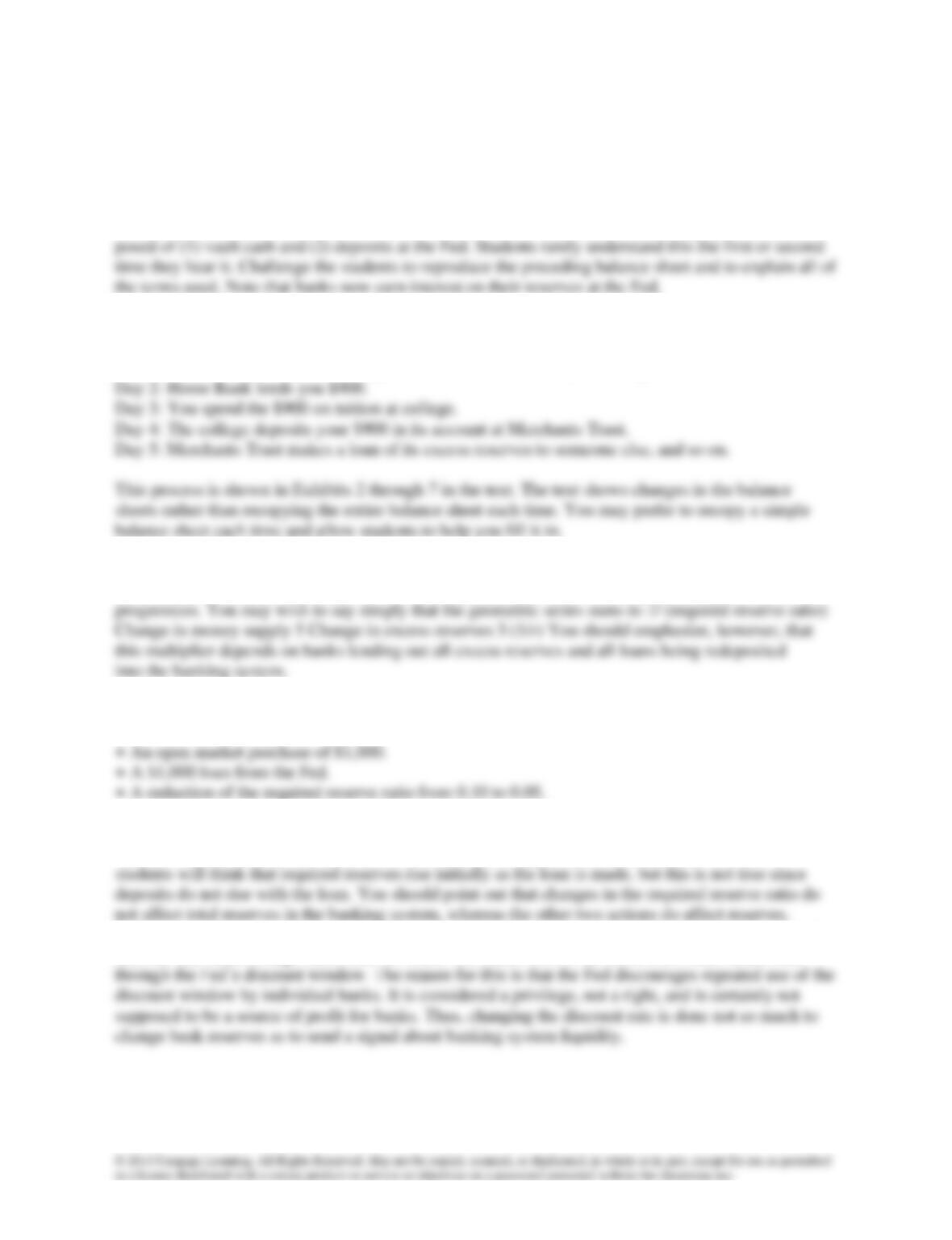
2. Under reserves, you can place excess reserves (ER) and required reserves (RR), explaining to the
students that ER 1 RR 5 Reserves. Reinforce the notion that reserves in the banking system are com-
3. The next real complication comes from discussing the steps involved in the money multiplier pro-
cess. Present it as a day-byday process, as follows.
Day 1: The Fed buys $1,000 in U.S. government securities from, for example, Home Bank.
4. At some point you must make the jump from the step-by-step multiplier process to the multiplier
itself. Usually the students can guess the next step in the process so that they see the geometric
5. You might discuss the effects of the following actions, solving numerically for the answers in
class:
6. Many students will be confused about how to handle the loan from the Fed. The loan should be
shown as both a liability and an asset of the bank, appearing as an increase in reserves. Some
7. Students may be surprised to learn that the Fed’s discount rate is typically below the federal funds
rate, the rate banks charge each other for loans. Yet banks borrow far more from other banks than
SOLUTIONS TO PROBLEMS APPENDIX
Chapter 15 Banking and the Money Supply 209
1. (Credit vs. Debit Cards) Explain why using a debit card is just like using cash, while using a
credit card is different.
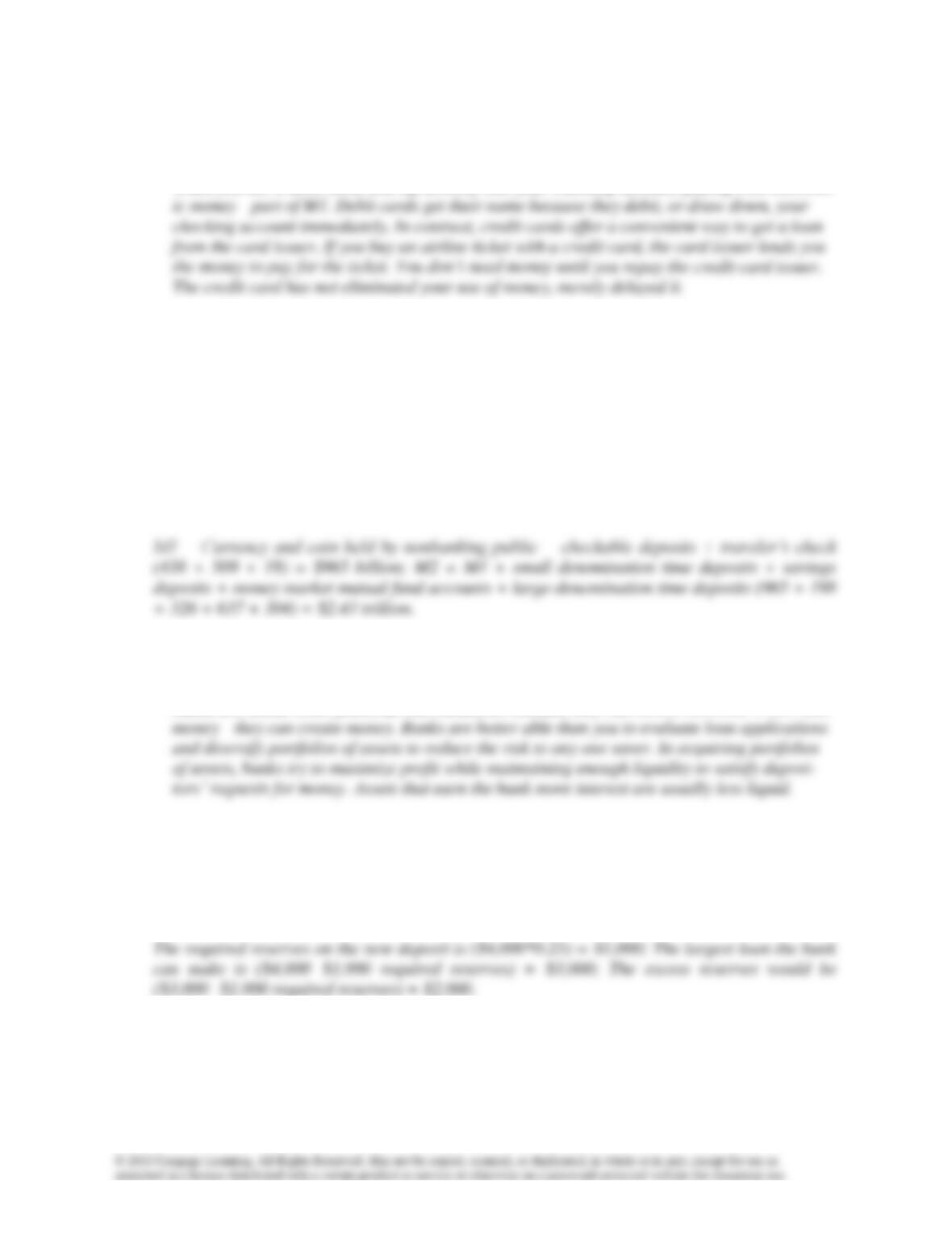
When you use a debit card, you tap directly into your checking account, paying with electron-
2. (Monetary Aggregates) Calculate M1 and M2 using the following information:
Large-denomination time deposits $ 304 billion
Currency and coin held by nonbanking public 438 billion
Checkable deposits 509 billion
Small-denomination time deposits 198 billion
Traveler’s checks 18 billion
Savings deposits 326 billion
Money market mutual fund accounts 637 billion
3. (Bank Expertise) Why are banks in a better position to make loans than would be a typical
saver? Describe a bank’s expertise in this area.
Banks are unlike other financial intermediaries because they can turn a borrower’s IOU into
4. (Reserve Accounts) Suppose that a bank’s customer deposits $4,000 in her checking account.
The required reserve ratio is 0.25. What are the required reserves on this new deposit? What is
the largest loan that the bank can make on the basis of the new deposit? If the bank chooses to
hold reserves of $3,000 on the new deposit, what are the excess reserves on the deposit?
5. (Money Creation) Suppose Bank A, which faces a reserve requirement of 10 percent, receives a
$1,000 deposit from a customer.
Chapter 15 Banking and the Money Supply 210
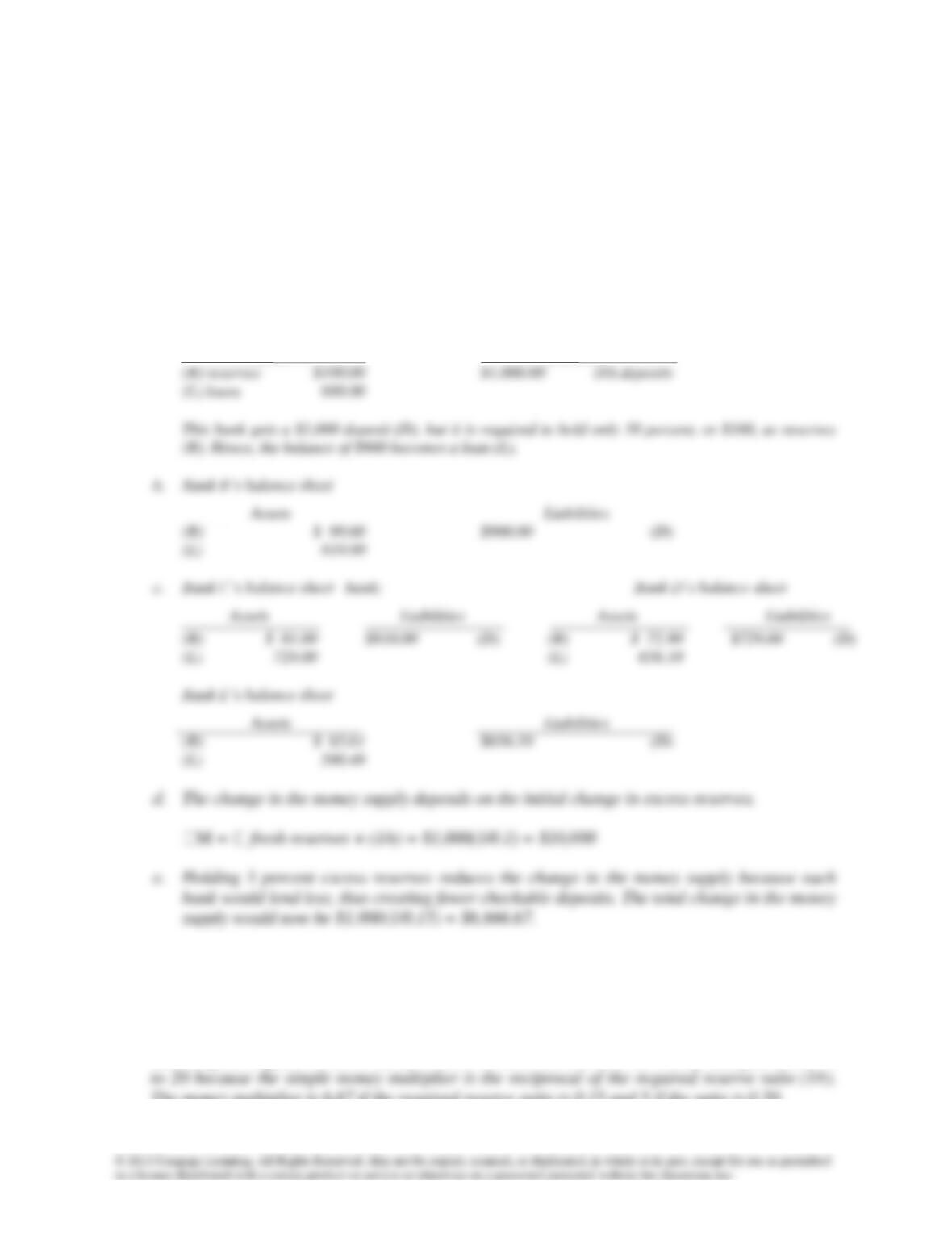
a. Assuming that it wishes to hold no excess reserves, determine how much the bank should
lend. Show your answer on Bank A’s balance sheet.
b. Assuming that the loan shown in Bank A’s balance sheet is redeposited in Bank B, show the
changes in Bank B’s balance sheet if it lends out the maximum possible.
c. Repeat this process for three additional banks: C, D, and E.
d. Using the simple money multiplier, calculate the total change in the money supply resulting
from the $1,000 initial deposit.
e. Assume Banks A, B, C, D, and E each wish to hold 5 percent excess reserves. How would
holding this level of excess reserves affect the total change in the money supply?
a. Bank A’s balance sheet
Assets Liabilities
6. (Money Multiplier) Suppose that the Federal Reserve lowers the required reserve ratio from 0.10
to 0.05. How does this affect the simple money multiplier, assuming that excess reserves are
held to zero and there are no currency leakages? What are the money multipliers for required
reserve ratios of 0.15 and 0.20?
Lowering the required reserve ratio from 0.10 to 0.05 will increase the money multiplier from 10
The money multiplier is 6.67 if the required reserve ratio is 0.15 and 5 if the ratio is 0.20.
7. (Money Creation) Show how each of the following would initially affect a bank’s assets and
liabilities.
a. Someone makes a $10,000 deposit into a checking account.
b. A bank makes a loan of $1,000 by establishing a checking account for $1,000.
c. The loan described in part (b) is spent.
d. A bank must write off a loan because the borrower defaults.
a. Liabilities increase by $10,000 because of the increase in deposits at the bank, and assets
8. (Money Creation) Show how each of the following initially affects bank assets, liabilities, and
reserves. Do not include the results of bank behavior resulting from the Fed’s actions. Assume a
required reserve ratio of 0.05.
a. The Fed purchases $10 million worth of U.S. government bonds from a bank.
b. The Fed loans $5 million to a bank.
c. The Fed raises the required reserve ratio to 0.10.
a. Bank reserves at the Fed and checkable deposits both increase by $10 million.
9. (Monetary Tools) What tools does the Fed have to pursue monetary policy. Which tool does it
use the most?
The key to changes in the money supply is the Fed’s impact on excess reserves in the banking
10. (Monetary Control) Suppose the money supply is currently $500 billion and the Fed wishes to
increase it by $100 billion.
a. Given a required reserve ratio of 0.25, what should it do?
b. If it decided to change the money supply by changing the required reserve ratio, what
change should it make? Why may the Fed be reluctant to change the reserve requirement?
a. With a required reserve ratio of 0.25, the money multiplier is 1/0.25 = 4. Therefore, to in-
crease the money supply by $100 billion, it must increase bank reserves by $100/4 = $25
billion.
Chapter 15 Banking and the Money Supply 212
b. The money supply is currently $500 billion, which means that reserves must be $500/4 =
Experiential Assignment
1. Have students review the Fed’s online brochure on the Federal Open Market Committee (FOMC)