Chapter 14
Monetary Policy and the Federal Reserve System
◼ Learning Objectives
I. Goals of Chapter 14
A. Explain how the nation’s money supply is determined (Sec. 14.1)
II. Notes to Eighth Edition Users
A. We expand our discussion of central banks performing a function as the lender of last resort
Chapter 14 Monetary Policy and the Federal Reserve System 341
◼ Teaching Notes
I. Principles of Money Supply Determination (Sec. 14.1)
A. Three groups affect the money supply
1. The central bank is responsible for monetary policy
2. Depository institutions (banks) accept deposits and make loans
3. The public (people and firms) holds money as currency and coin or as bank deposits
2. Banks hold liquid assets called bank reserves
a. When bank reserves are equal to deposits, the system is called 100% reserve banking
b. But banks lend out some of their deposits, as only a fraction of reserves are needed to
Numerical Problem 1 gives students practice dealing with bank balance sheets.
C. Open-market operations
1. The most direct and frequently used way of changing the money supply is by raising or
Policy Application
Most of the use of open-market operations turns out not to be related to changes in monetary
D. The money multiplier
1. The relationship between the monetary base and the money supply can be shown
algebraically
342 Abel/Bernanke/Croushore • Macroeconomics, Ninth Edition
M/BASE = (CU + DEP)/(CU + RES) (14.3)
6. This can be written as
M/BASE = [(CU/DEP) + 1]/[(CU/DEP) + (RES/DEP)] (14.4)
7. The currency–deposit ratio (CU/DEP, or cu) is determined by the public
Numerical Problems 2 and 3 deal with the money multiplier.
11. The monetary base is called high-powered money because each unit of the base that is issued
leads to the creation of more money
E. Bank runs
1. If people think a bank won’t be able to give them their money, they may panic and rush to
F. Application: The money multiplier during severe financial crises
1. The money multiplier during the Great Depression
a. The money multiplier is usually fairly stable, but it fell sharply in the Great Depression
Chapter 14 Monetary Policy and the Federal Reserve System 343
d. As a result, the price level fell sharply (nearly one-third) and there was a decline in output
(though attributing the drop in output to the decline in the money supply is controversial)
2. The money multiplier during the financial crisis of 2008
a. The worldwide financial panic in fall 2008 caused the money multiplier to decline
II. Monetary Control in the United States (Sec. 14.2)
A. The Federal Reserve System
1. The Fed began operation in 1914 for the purpose of eliminating severe financial crises
Policy Application
What do the twelve Federal Reserve Bank do? First, they clear checks between banks and supply
currency to banks. They also supervise and regulate banks. They collect the raw data that goes
3. The leadership of the Fed is provided by the Board of Governors of the Federal Reserve
System in Washington, D.C.
a. There are seven governors, who are appointed by the president of the United States,
Policy Application
There are a number of features of the setup of the Fed designed to prevent undue political
4. Monetary policy decisions are made by the Federal Open Market Committee (FOMC),
which consists of the seven governors plus five presidents of the Federal Reserve Banks
on a rotating basis (with the New York president always on the committee)
344 Abel/Bernanke/Croushore • Macroeconomics, Ninth Edition
b. It may meet more frequently if economic developments warrant
Policy Application
The policymakers on the FOMC are briefed by economists before each meeting. A typical
B. The Federal Reserve’s balance sheet and open-market operations
1. Balance sheet of Fed (text Table 14.2)
a. Largest asset is holdings of Treasury securities
b. Also owns mortgage-backed securities, federal agency debt, and gold, makes loans to
Analytical Problem 1 looks at various effects on the money supply, some through changes in the
Fed’s balance sheet.
2. The monetary base equals banks’ reserves plus currency held by the nonbank public
(text Figure 14.6)
Policy Application
The FOMC generally votes on three options concerning immediate changes in policy: option A
C. Reserve requirements
1. The Fed forces banks to hold reserves of about 10% of the value of their transactions
deposits (less for small banks)
Chapter 14 Monetary Policy and the Federal Reserve System 345
Policy Application
Changes in reserve requirements are such a powerful tool that they aren’t used much. A small
change in reserve requirements can make a big difference in the reserves a bank holds. So
D. Discount window lending
1. Discount window lending is lending reserves to banks so they can meet depositors’
Policy Application
The formal mechanism by which the discount rate is changed is rather complicated. The board of
directors of each Federal Reserve Bank must vote every two weeks on the discount rate. They
3. The Fed was set up to halt financial panics by acting as a lender of last resort through the
discount window
4. A discount loan increases the monetary base
Policy Application
The Fed has three different categories for lending at the discount window: (1) adjustment credit,
which is a short-term loan to help banks meet temporary liquidity needs; (2) seasonal credit,
E. Application: The lender of last resort
1. Central bankers can reduce the damage to the economy from a financial crisis by acting as a
F. Interest rate on reserves
1. In the financial crisis that began in 2008, the Fed began paying interest to banks on their
reserves held on deposit at the Fed
346 Abel/Bernanke/Croushore • Macroeconomics, Ninth Edition
2. The payment of interest on reserves gives banks the incentive not to spend resources
avoiding holding reserves
G. Summary 19: Factors affecting the monetary base, the money multiplier, and the money supply
1. An increase in res, cu, reserve requirements, or the interest rate on reserves has no effect
Policy Application
The Fed has two other instruments, though they are seldom used. The Fed can set margin
requirements on stock purchases. Currently, the margin requirements is 50%, which means an
III. Setting Monetary Policy Targets (Sec. 14.3)
A. Targeting the federal funds rate
1. The Fed uses intermediate targets to guide policy as a step between its tools or instruments
(such as open-market purchases) and its goals or ultimate targets of price stability and stable
economic growth
2. Intermediate targets are variables the Fed can’t directly control but can influence predictably,
Chapter 14 Monetary Policy and the Federal Reserve System 347
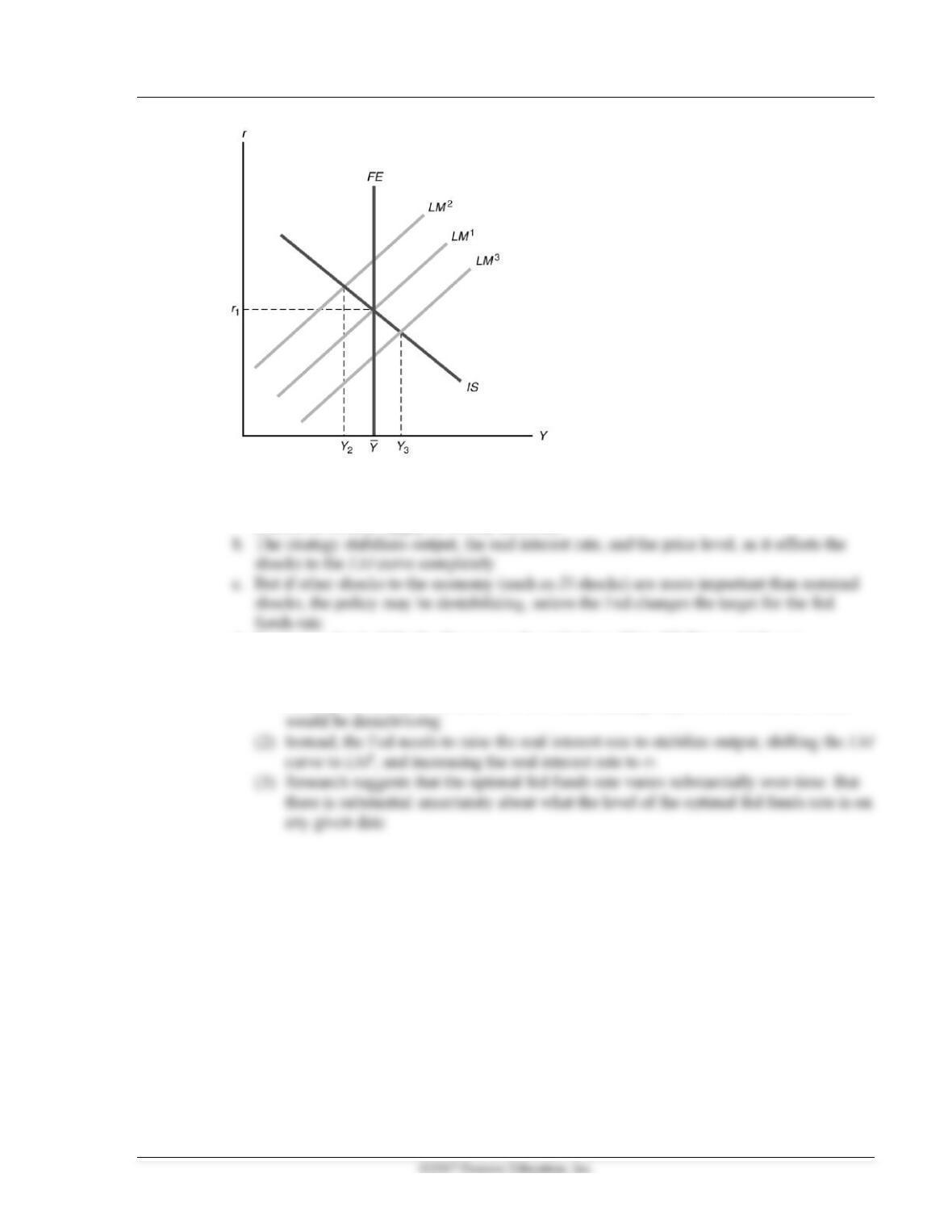
Figure 14.1
a. This strategy works well if the main shocks to the economy are to the LM curve
(shocks to money supply or money demand)
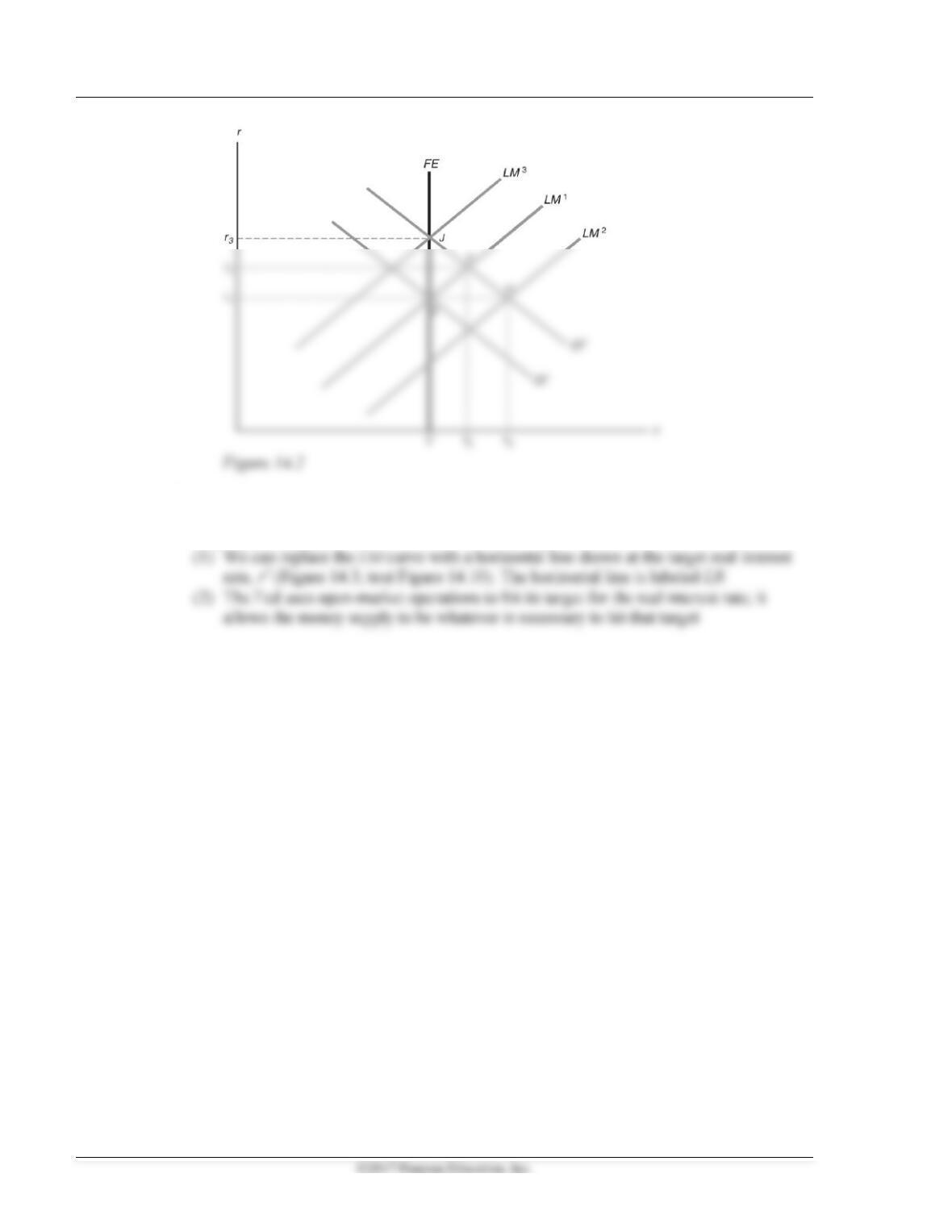
d. Suppose a shock shifts the IS curve to the right from IS1 to IS2 (Figure 14.2; text
Figure 14.9)
(1) If the Fed were to maintain the real interest rate, it would increase the money supply,
shifting the LM curve from LM1 to LM2, thus making output rise even more, which
348 Abel/Bernanke/Croushore • Macroeconomics, Ninth Edition
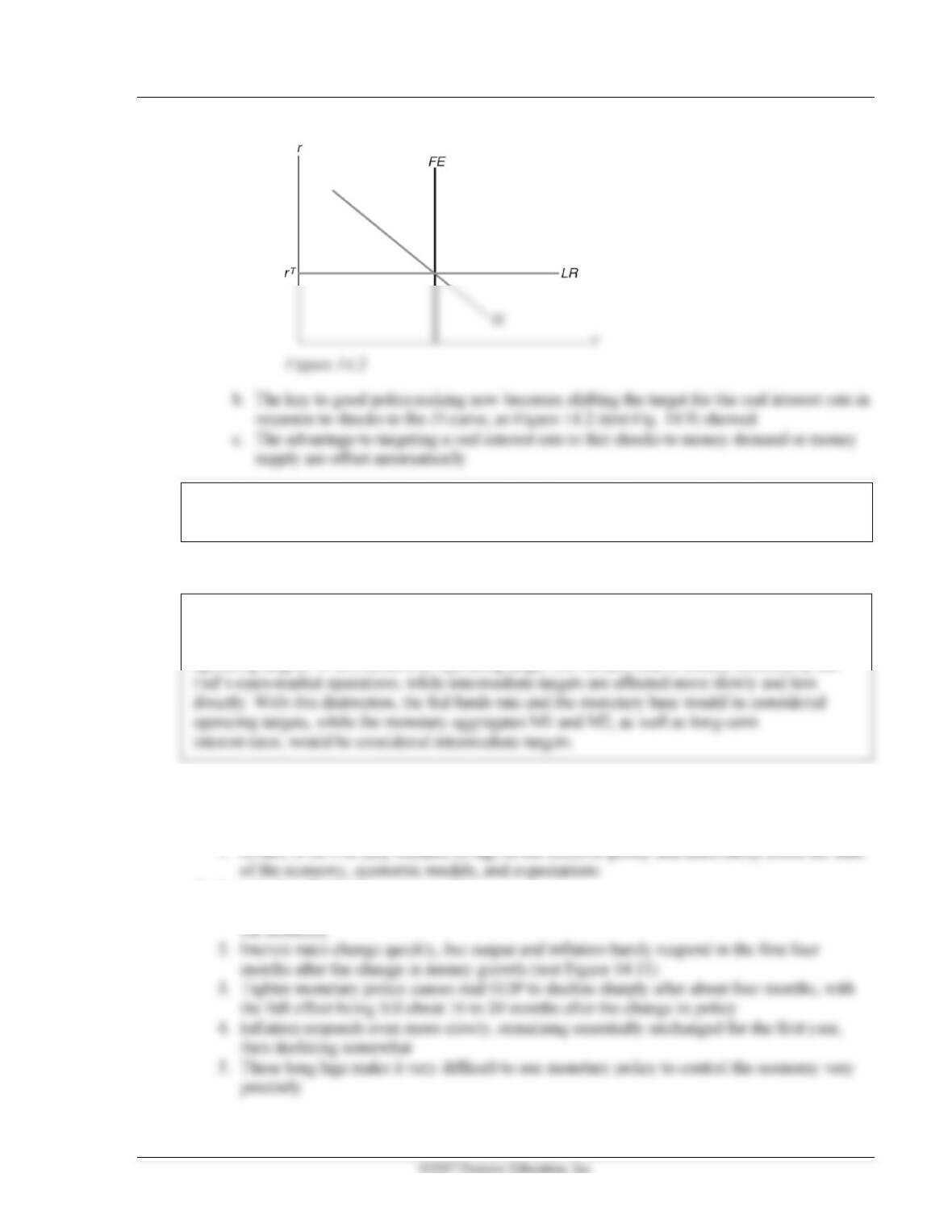
6. The LR curve
a. If the Fed is targeting a real interest rate, then a modification of the LM curve will
simplify our analysis
Chapter 14 Monetary Policy and the Federal Reserve System 349
Analytical Problem 3 examines how various shocks shift the LR curve and how the economy
responds.
Policy Application
Monetary policymakers sometimes distinguish intermediate targets from what are called
operating targets. In this context an operating target is a variable that is closely affected by the
IV. Making Monetary Policy in Practice (Sec. 14.4)
A. The IS–LM model makes monetary policy look easy—just change the money supply to move
the economy to the best point possible
B. Lags in the effects of monetary policy
1. It takes a fairly long time for changes in monetary policy to have an impact on
350 Abel/Bernanke/Croushore • Macroeconomics, Ninth Edition
6. Because of the lags, policy must be made based on forecasts of the future, but forecasts are
often inaccurate
Policy Application
Alan Blinder, an economist from Princeton University who served several years in the Federal
C. Conducting Monetary Policy Under Uncertainty
1. Uncertainty about state of economy
a. Conflicting signals from data
2. Incomplete models of the economy
a. No one knows the best model that describes the economy (classical vs. Keynesian,
slopes and locations of curves, levels of full-employment output and natural rate of
3. Uncertainty about how expectations of public will be affected by shocks and policy
actions
D. Monetary Policy in the Great Recession
1. The housing crisis, which began in 2007, led to losses at financial institutions, but no one
thought it would lead to a major financial crisis
2. In the Great Recession, the economy deteriorated rapidly in late 2008 and early 2009; the
recession rivaled those of 1973–1975 and 1981–1982, and the recovery from the
recession was weak
3. The Zero Lower Bound
Chapter 14 Monetary Policy and the Federal Reserve System 351
(b) Quantitative easing also reduces long-term interest rates
(c) The Fed bought long-term Treasury securities and debt and mortgage-
E. Application: The financial crisis of 2008
1. Financial institution troubles that began in 2007 represented a shock, shifting the IS curve
down and to the left as housing investment declined
2. Banks began to reduce credit availability because of worries that some financial
V. The Conduct of Monetary Policy: Rules Versus Discretion (Sec. 14.5)
A. Monetarists and classical macroeconomists advocate the use of rules
1. Rules make monetary policy automatic, as they require the central bank to set policy based
352 Abel/Bernanke/Croushore • Macroeconomics, Ninth Edition
B. Most Keynesian economists support discretion
1. Discretion means the central bank looks at all the information about the economy and uses its
C. The monetarist case for rules
1. Monetarism is an economic theory emphasizing the importance of monetary factors
in the economy
2. The leading monetarist is Milton Friedman, who has argued for many years (since 1959)
that the central bank should follow rules for setting policy
3. Friedman’s argument for rules comes from four main propositions
a. Proposition 1: Monetary policy has powerful short-run effects on the real economy. In the
longer run, however, changes in the money supply have their primary effect on the price
b. Proposition 2: Despite the powerful short-run effect of money on the economy, there is
little scope for using monetary policy actively to try to smooth business cycles
(1) First, the information lag makes it difficult to know the current state of the economy
c. Proposition 3: Even if there is some scope for using monetary policy to smooth business
cycles, the Fed cannot be relied on to do so effectively
(1) Friedman believes the Fed responds to political pressure and tends to stimulate the
economy in election years
(2) Historically, monetary policy has tended to destabilize, rather than stabilize, the
economy; so eliminating monetary policy as a source of instability would improve
D. Rules and central bank credibility
1. New arguments for rules suggest that rules are valuable even if the central bank has a lot of