interactive activity
Chapter 14
Oligopoly
1. The accompanying table presents market share data for the U.S. breakfast cereal
market.
Company Market share
Kellogg 28%
General Mills 28
PepsiCo (Quaker Oats) 14
Data from: Advertising Age
a. Use the data provided to calculate the Herfindahl-Hirschman Index (HHI) for
the market.
b. Based on this HHI, how would you describe the market structure in the U.S.
breakfast cereal market?
1. a. The HHI is 282 + 282 + 142 + 132 + 112 + 62 = 784 + 784 + 196 + 169 + 121 + 36 =
2,090.
b. Since the HHI is less than 2,500, the industry is somewhat competitive.
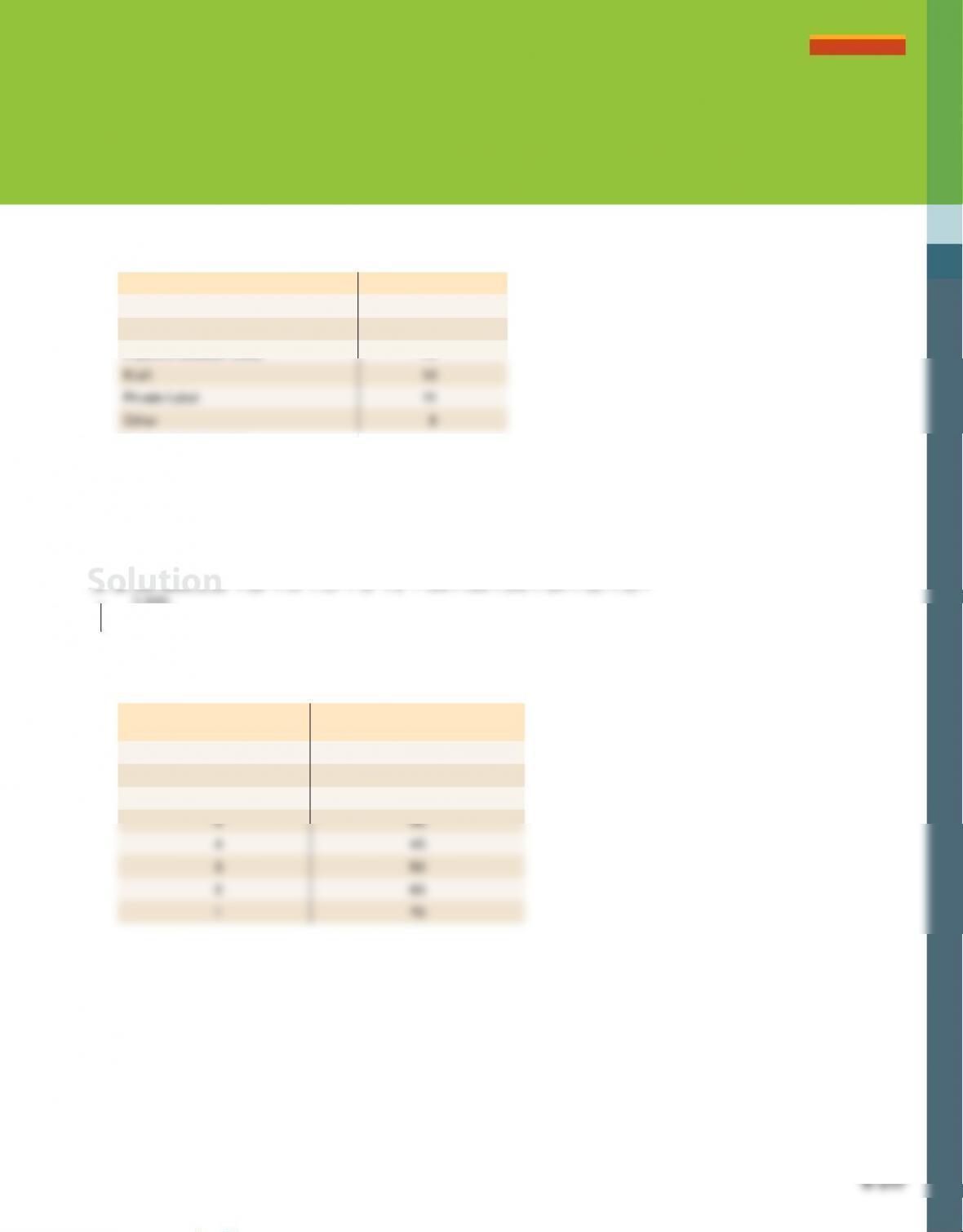
2. The accompanying table shows the demand schedule for vitamin D. Suppose
that the marginal cost of producing vitamin D is zero.
Price of vitamin D
(per ton)
Quantity of vitamin D
demanded (tons)
$8 0
710
620
a. Assume that BASF is the only producer of vitamin D and acts as a monopolist.
It currently produces 40 tons of vitamin D at $4 per ton. If BASF were to
produce 10 more tons, what would be the price effect for BASF? What would
be the quantity effect? Would BASF have an incentive to produce those
10 additional tons?
Solution
S-218 Chapter 14 OligOpOly
b. Now assume that Roche enters the market by also producing vitamin D and
the market is now a duopoly. BASF and Roche agree to produce 40 tons of
vitamin D in total, 20 tons each. BASF cannot be punished for deviating
from the agreement with Roche. If BASF, on its own, were to deviate from
that agreement and produce 10 more tons, what would be the price effect for
BASF? What would be the quantity effect for BASF? Would BASF have an
incentive to produce those 10 additional tons?
2. a. If BASF produces 10 more tons, it now produces 50 tons and the price would
fall to $3 per ton. That is, on each of the 40 tons it was already producing, it
would lose $1. So the price effect is 40 × (−$1) = −$40. Since BASF produces
an additional 10 tons and sells them at $3, the quantity effect is 10 × $3 = $30.
b. If BASF produces 10 more tons, the total produced is now 50 tons and the
price would fall to $3. That is, on each of the 20 tons it was already producing,
it would lose $1. So the price effect is 20 × (−$1) = −$20. Since BASF produces
an additional 10 tons and sells them at $3, the quantity effect is 10 × $3 = $30.
3. The market for olive oil in New York City is controlled by two families, the Sopra–
nos and the Contraltos. Both families will ruthlessly eliminate any other family
that attempts to enter the New York City olive oil market. The marginal cost of
producing olive oil is constant and equal to $40 per gallon. There is no fixed cost.
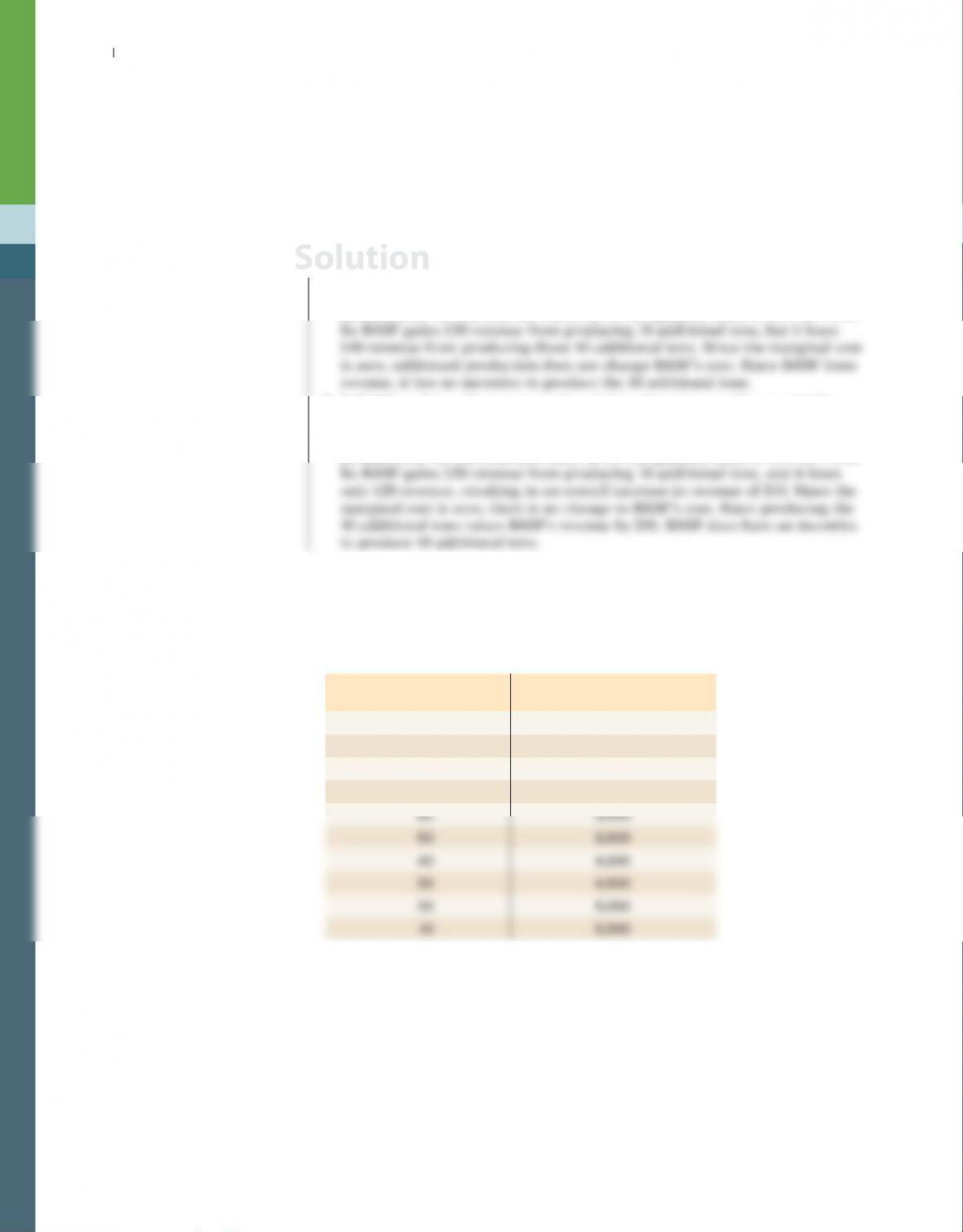
The accompanying table gives the market demand schedule for olive oil.
Price of olive oil
(per gallon)
Quantity of olive oil
demanded (gallons)
$100 1,000
90 1,500
80 2,000
70 2,500
a. Suppose the Sopranos and the Contraltos form a cartel. For each of the quan-
tities given in the table, calculate the total revenue for their cartel and the
marginal revenue for each additional gallon. How many gallons of olive oil
would the cartel sell in total and at what price? The two families share the
market equally (each produces half of the total output of the cartel). How
much profit does each family make?
Solution
Chapter 14 OligOpOly S-219
b. Uncle Junior, the head of the Soprano family, breaks the agreement and sells
500 more gallons of olive oil than under the cartel agreement. Assuming the
Contraltos maintain the agreement, how does this affect the price for olive oil
and the profits earned by each family?
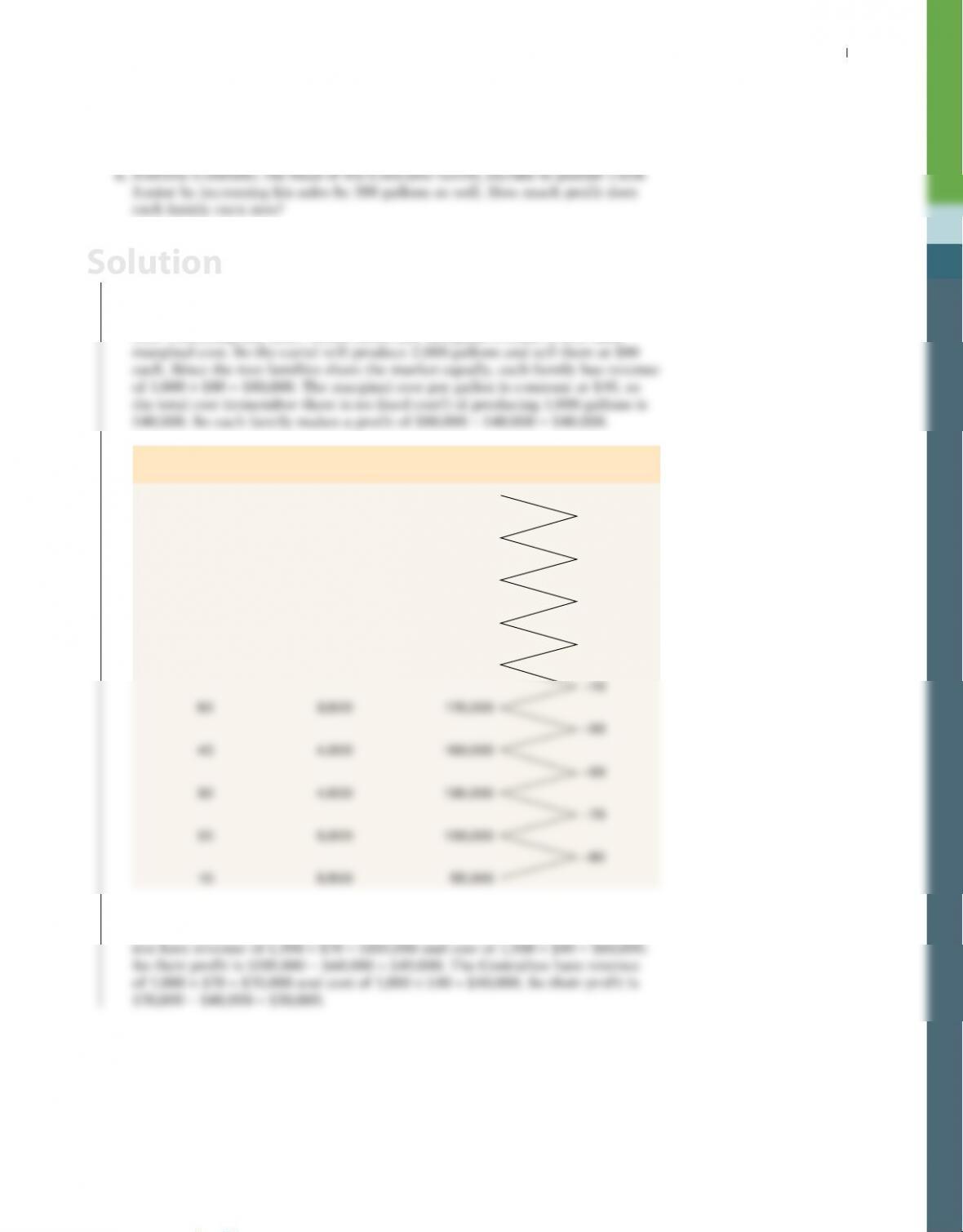
3. a. The accompanying table shows the total revenue and the marginal revenue
for the cartel. Since a cartel acts like a monopolist, it will maximize profit
by producing up to the point where marginal cost equals marginal revenue.
For all gallons up to 2,000 gallons, marginal revenue is greater than marginal
cost. Producing any more would mean that marginal revenue is less than
Price of olive oil
(per gallon)
Quantity of olive oil
demanded (gallons) Total revenue Marginal revenue
$100 1,000 $100,000
$70
90 1,500 135,000
50
80 2,000 160,000
30
70 2,500 175,000
10
60 3,000 180,000
b. Now the Sopranos sell 1,500 gallons and the Contraltos sell 1,000 gallons, for
a total output of 2,500 gallons. So the price falls to $70 per gallon. The Sopra–
Solution
S-220 Chapter 14 OligOpOly
c. If both the Contraltos and the Sopranos sell 1,500 gallons each, the total out-
4. In France, the market for bottled water is controlled by two large firms, Perrier
and Evian. Each firm has a fixed cost of €1 million and a constant marginal cost
of €2 per liter of bottled water (€1 = 1 euro). The following table gives the market
demand schedule for bottled water in France.
Price of bottled water
(per liter)
Quantity of bottled
water demanded
(millions of liters)
€10 0
9 1
8 2
7 3
6 4
a. Suppose the two firms form a cartel and act as a monopolist. Calculate mar-
ginal revenue for the cartel. What will the monopoly price and output be?
Assuming the firms divide the output evenly, how much will each produce and
what will each firm’s profits be?
b. Now suppose Perrier decides to increase production by 1 million liters. Evian
doesn’t change its production. What will the new market price and output be?
What is Perrier’s profit? What is Evian’s profit?
c. What if Perrier increases production by 3 million liters? Evian doesn’t change
its production. What would Perrier’s output and profits be relative to those in
part b?
d. What do your results tell you about the likelihood of cheating on such
agreements?
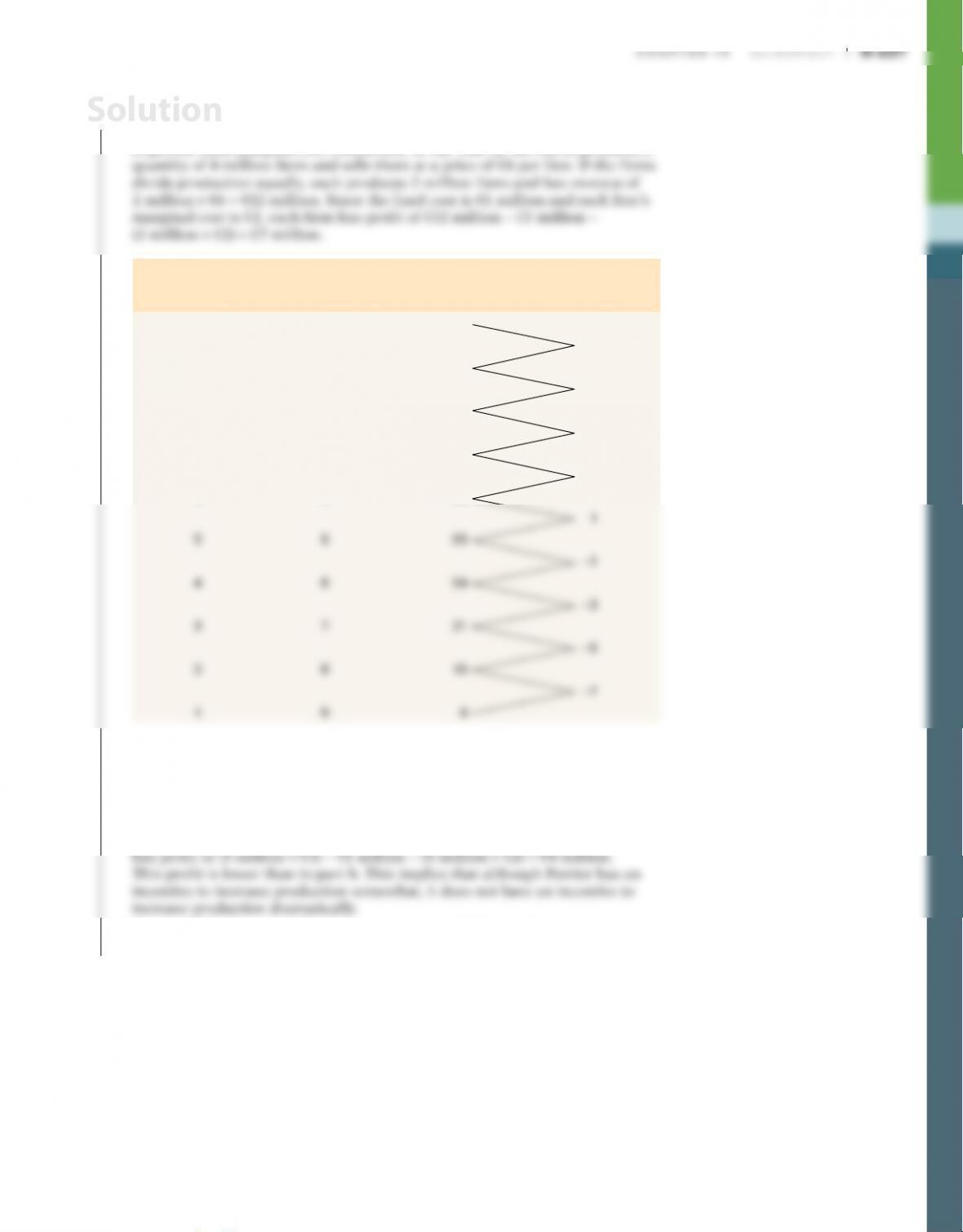
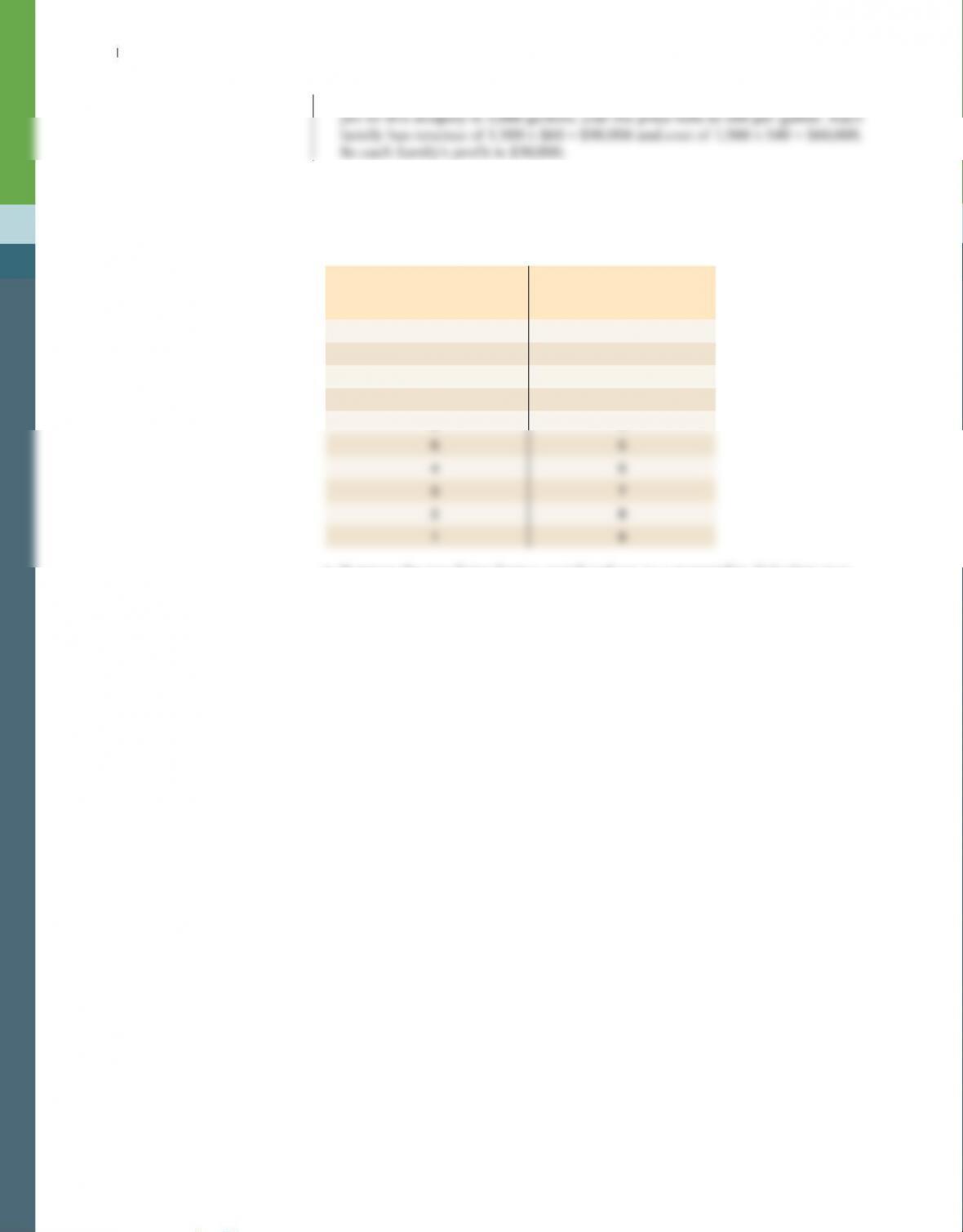
4. a. The accompanying table calculates total revenue and marginal revenue for the
cartel. The cartel maximizes profit by producing whenever marginal revenue
is greater than marginal cost (which here is €2). That is, the cartel produces a
Price of
bottled water
(per liter)
Quantity of bottled
water demanded
(millions of liters)
Total revenue
(millions)
Marginal revenue
(millions)
€10 0€0
€9
9 1 9
7
8 2 16
5
7 3 21
3
6 4 24
b. If Perrier increases production by 1 million liters, the total produced now is
5 million liters and the price is €5. Perrier now produces 3 million liters and
so has profit of (3 million × €5) − €1 − (3 million × €2) = €8 million. Evian’s
profit, however, falls to (2 million × €5) − €1 million − (2 million × €2) = €5.
c. If Perrier increases production by 3 million liters, the total produced is
7 million liters and the price is €3. Perrier produces 5 million liters and so
d. Since each firm can significantly increase its profit by moderately increasing
production, the likelihood of cheating is high.
Solution
S-222 Chapter 14 OligOpOly
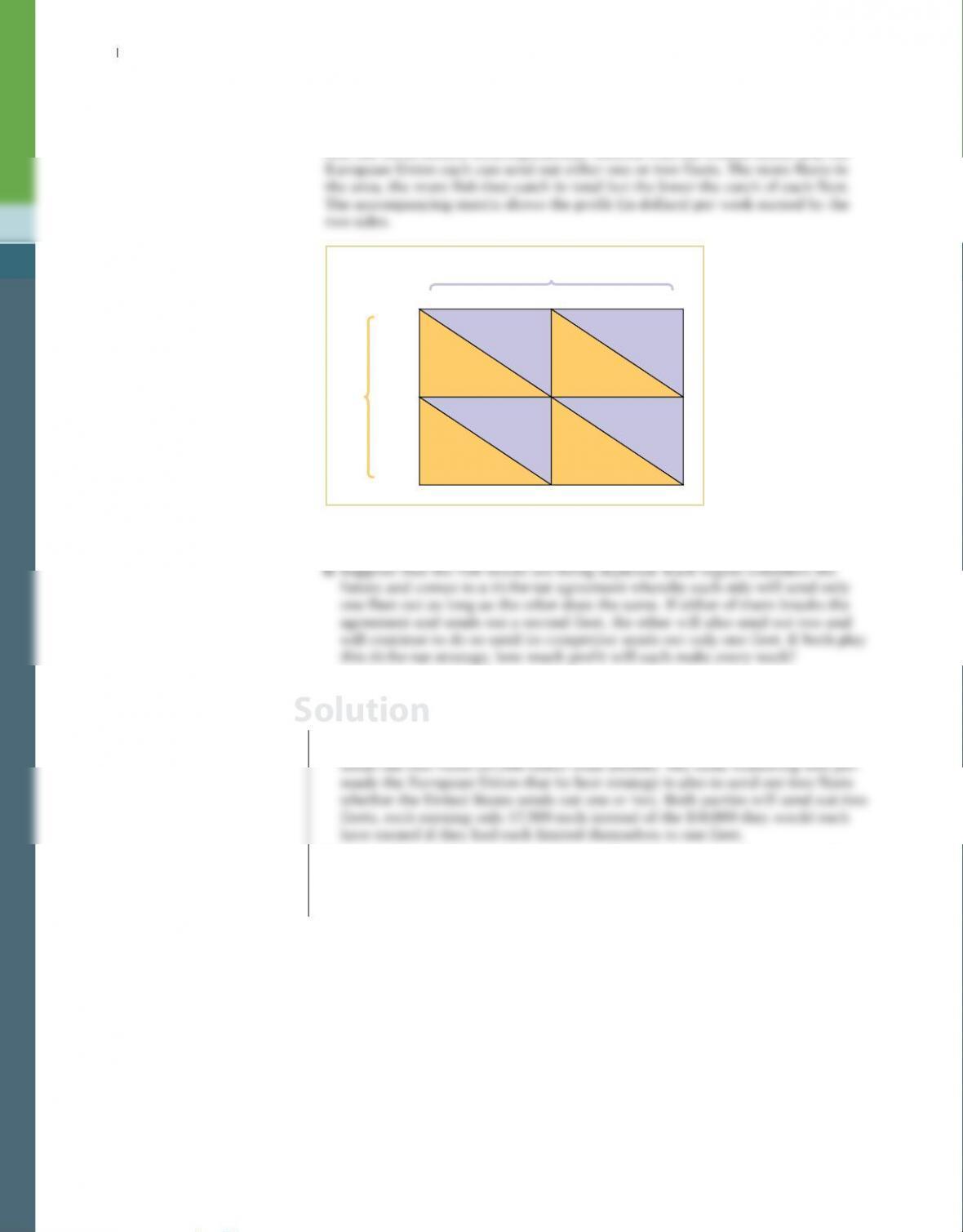
5. To preserve the North Atlantic fish stocks, it is decided that only two fishing
fleets, one from the United States and the other from the European Union,
can fish in those waters. Suppose that the fisheries agreement breaks down, so
that the fleets behave noncooperatively. Assume that the United States and the
1 fleet
1 fleet
European Union
2 fleets
2 fleets
$10,000 profit
$10,000 profit
$4,000 profit
$12,000 profit
$12,000 profit
$4,000 profit
$7,500 profit
$7,500 profit
United States
a. What is the noncooperative Nash equilibrium? Will each side choose to send
out one or two fleets?
5. a. If the European Union has only one fleet, the United States will have a higher
profit if it sends out two fleets ($12,000 rather than $10,000). If the European
Union sends out two fleets, the United States will have a higher profit if it also
b. If both play a tit-for-tat strategy, they each will begin by sending out one fleet.
The week after that, each does what the other one did the week before—that
is, each again sends out one fleet, and so on. As a result, the United States and
the European Union will each have a profit of $10,000 every week.
Solution
6. Untied and Air “R” Us are the only two airlines operating flights between
Collegeville and Bigtown. That is, they operate in a duopoly. Each airline can
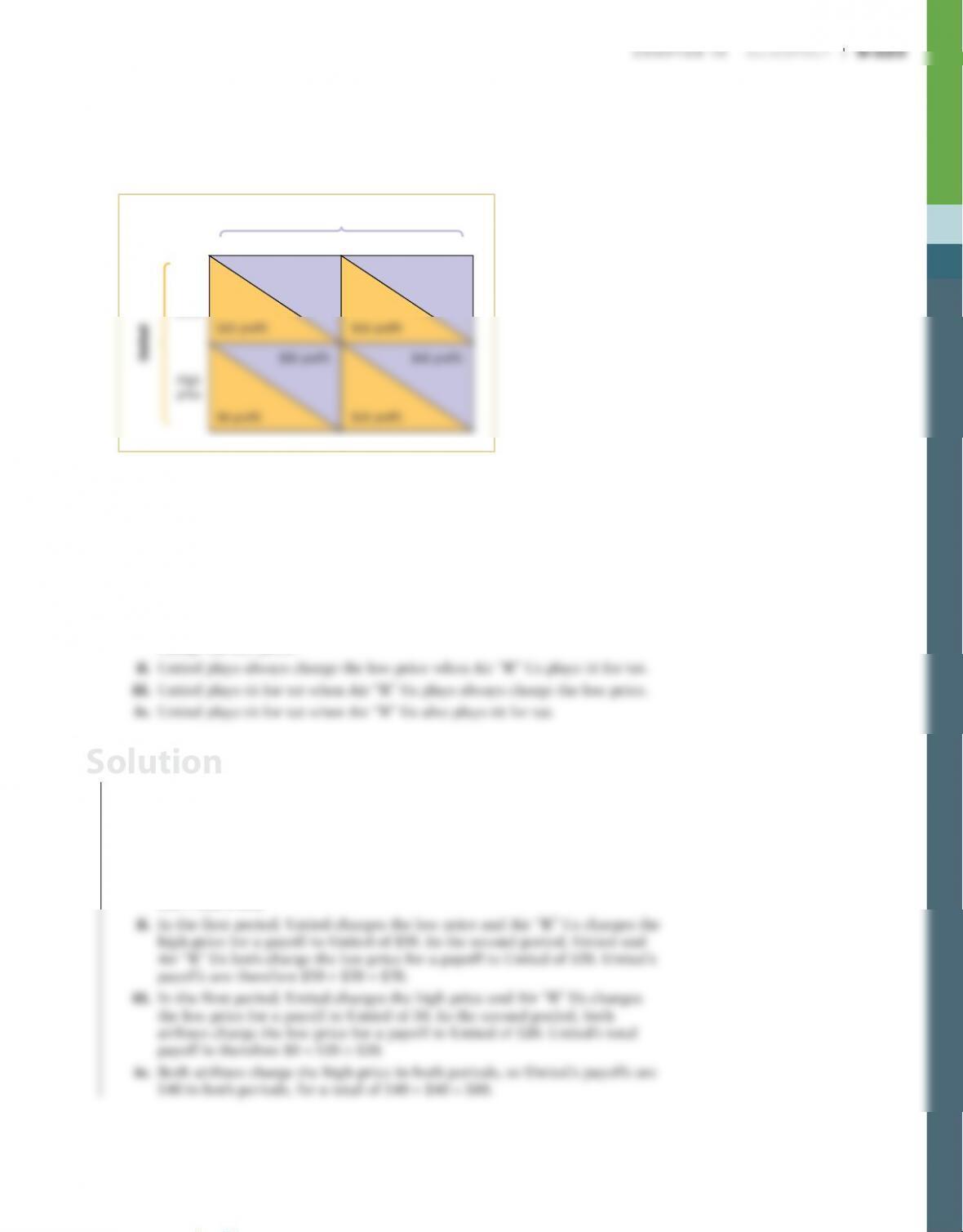
charge either a high price or a low price for a ticket. The accompanying matrix
shows their payoffs, in profits per seat (in dollars), for any choice that the two
airlines can make.
Low
price
Low price
Air “R” Us
High price
$20 profit
$0 profit
a. Suppose the two airlines play a one-shot game—that is, they interact only once
and never again. What will be the Nash (noncooperative) equilibrium in this
one-shot game?
b. Now suppose the two airlines play this game twice. And suppose each airline
can play one of two strategies: it can play either always charge the low price or
tit for tat—that is, it starts off charging the high price in the first period, and
then in the second period it does whatever the other airline did in the previous
period. Write down the payoffs to Untied from the following four possibilities:
i. Untied plays always charge the low price when Air “R” Us also plays always
charge the low price.
6. a. This is a prisoners’ dilemma situation. Whatever Air “R” Us does, it is best for
Untied to charge the low price; whatever Untied does, it is best for Air “R” Us
to charge the low price. So the Nash (noncooperative) equilibrium is for both
airlines to charge the low price.
b. These are Untied’s payoffs:
i. Both airlines charge the low price in both periods, so Untied’s payoffs
are $20 in the first period and $20 in the second period, for a total of
$20 + $20 = $40.
Solution
7. Suppose that Coke and Pepsi are the only two producers of cola drinks, making
them duopolists. Both companies have zero marginal cost and a fixed cost of
$100,000.
a. Assume first that consumers regard Coke and Pepsi as perfect substitutes.
Currently both are sold for $0.20 per can, and at that price each company sells
4 million cans per day.
i. How large is Pepsi’s profit?
ii. If Pepsi were to raise its price to $0.30 per can, and Coke did not respond,
what would happen to Pepsi’s profit?
b. Now suppose that each company advertises to differentiate its product from
the other company’s. As a result of advertising, Pepsi realizes that if it raises or
lowers its price, it will sell less or more of its product, as shown by the demand
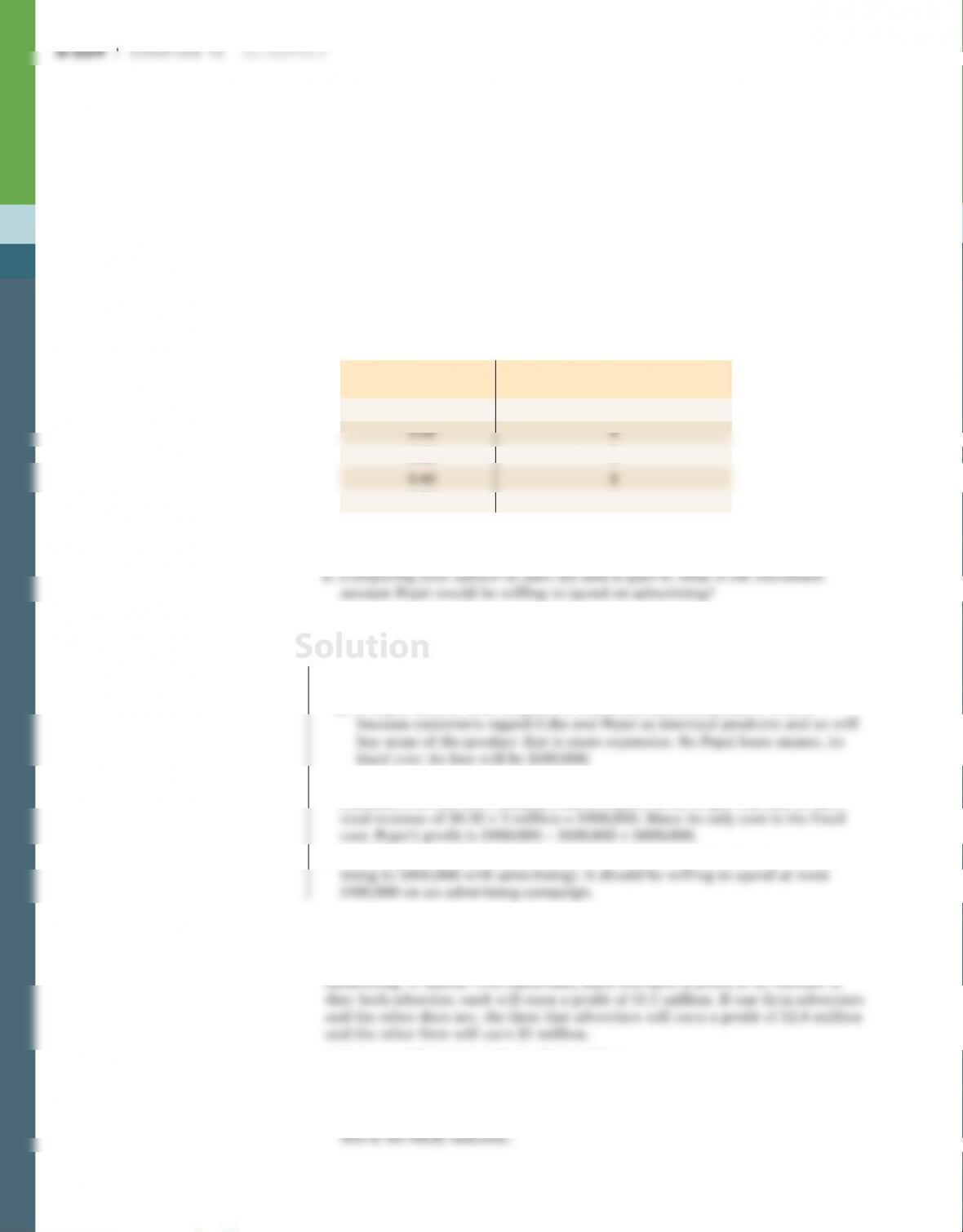
schedule in the accompanying table.
Price of Pepsi
(per can)
Quantity of Pepsi demanded
(millions of cans)
$0.10 5
0.30 3
0.50 1
If Pepsi now were to raise its price to $0.30 per can, what would happen to its
profit?
7. a. i. Pepsi sells 4 million cans at $0.20 for total revenue of $0.20 × 4 million =
$800,000. Its only cost is the fixed cost of $100,000, so its profit is
$800,000 − $100,000 = $700,000.
ii. If Pepsi were to raise its price, it would lose all its customers. This is
b. If Pepsi now raises its price to $0.30, it will lose some customers but not all
customers. It will sell 3 million cans at a price of $0.30 per can and so have
c. Since Pepsi can raise its revenue by $100,000 (from $700,000 without adver-
8. Schick and Gillette spend huge sums of money each year to advertise their
razors in an attempt to steal customers from each other. Suppose each year
Schick and Gillette have to decide whether or not they want to spend money on
a. Use a payoff matrix to depict this problem.
b. Suppose Schick and Gillette can write an enforceable contract about what
they will do. What is the cooperative solution to this game?
c. What is the Nash equilibrium without an enforceable contract? Explain why
Solution
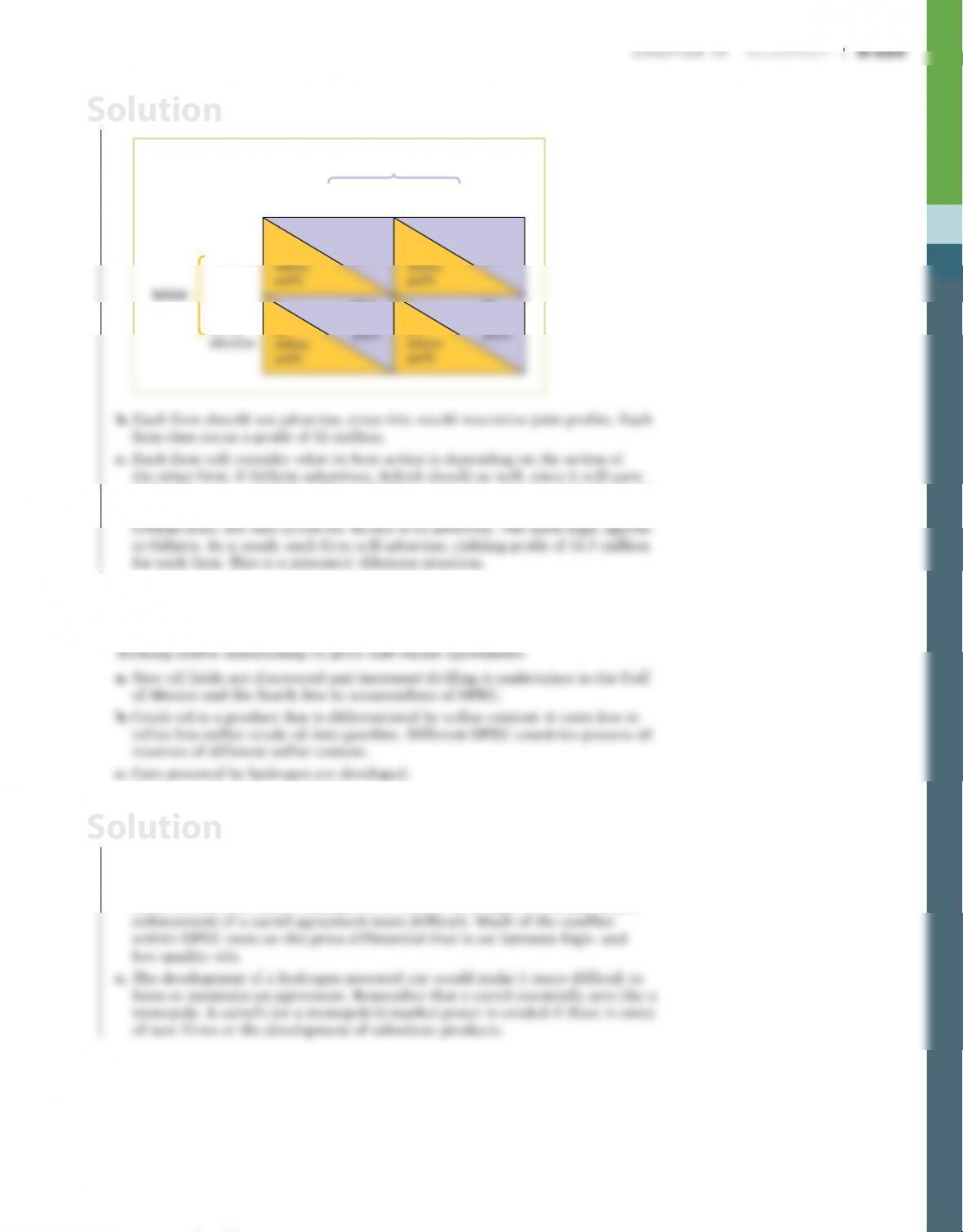
8. a. See the accompanying payoff matrix.
Gillette
Advertise
Advertise
Do not
Do not
advertise
$1.5
million
profit
$1
million
profit
$1.5
$2.8
million
$2.8
$2
million
$2
$1.5 million instead of $1 million. If Gillette does not advertise, Schick should
advertise, since $2.8 million is better than $2 million. So no matter what
9. Over the last 40 years the Organization of Petroleum Exporting Countries
(OPEC) has had varied success in forming and maintaining its cartel agree–
ments. Explain how the following factors may contribute to the difficulty of
9. a. With the discovery of new oil by nonmembers of OPEC, there is increased
competition. This will lead to a fall in market price and make the cartel
agreement harder to maintain.
b. The OPEC countries sell a differentiated and complex product. This compli–
cates the decision about what prices to set for what types of oil and makes
Solution
Solution
10. Suppose you are an economist working for the Antitrust Division of the Justice
Department. In each of the following cases you are given the task of determining
whether the behavior warrants an antitrust investigation for possible illegal acts
or is just an example of undesirable, but not illegal, tacit collusion. Explain your
reasoning.
a. Two companies dominate the industry for industrial lasers. Several people sit
on the boards of directors of both companies.
b. Three banks dominate the market for banking in a given state. Their profits
have been going up recently as they add new fees for customer transactions.
Advertising among the banks is fierce, and new branches are springing up in
many locations.
10. a. This warrants an antitrust investigation because it is likely that having the
same set of people sit on the two boards will facilitate cartel-like behavior.
b. This does not warrant an antitrust investigation. The intensity of advertising
and competition by location indicates that the banks are engaged in nonprice
competition.
11. In 2015, Anheuser-Busch InBev offered $104.2 billion to acquire SABMiller. The
U.S. Justice Department approved the merger, but only after the two beer giants
agreed to sell off a number of brands, including Miller Lite, Peroni, and Snow (the
world’s top selling beer produced in China). Anheuser-Busch InBev sought the
merger to increase its global market share. The accompanying table presents the
global market share before and after the merger for the world’s ten largest brewers.
Market share
Brewers Before merger After merger
AB InBev 21% 29%
SABMiller 10 —
Heineken 911
Carlsberg 6 6
Solution
Chapter 14 OligOpOly S-227
a. Using the table, calculate the HHI for the global beer market both before and
after the merger.
b. Based on the HHI calculated in part a, how has the market structure for the
global beer industry changed?
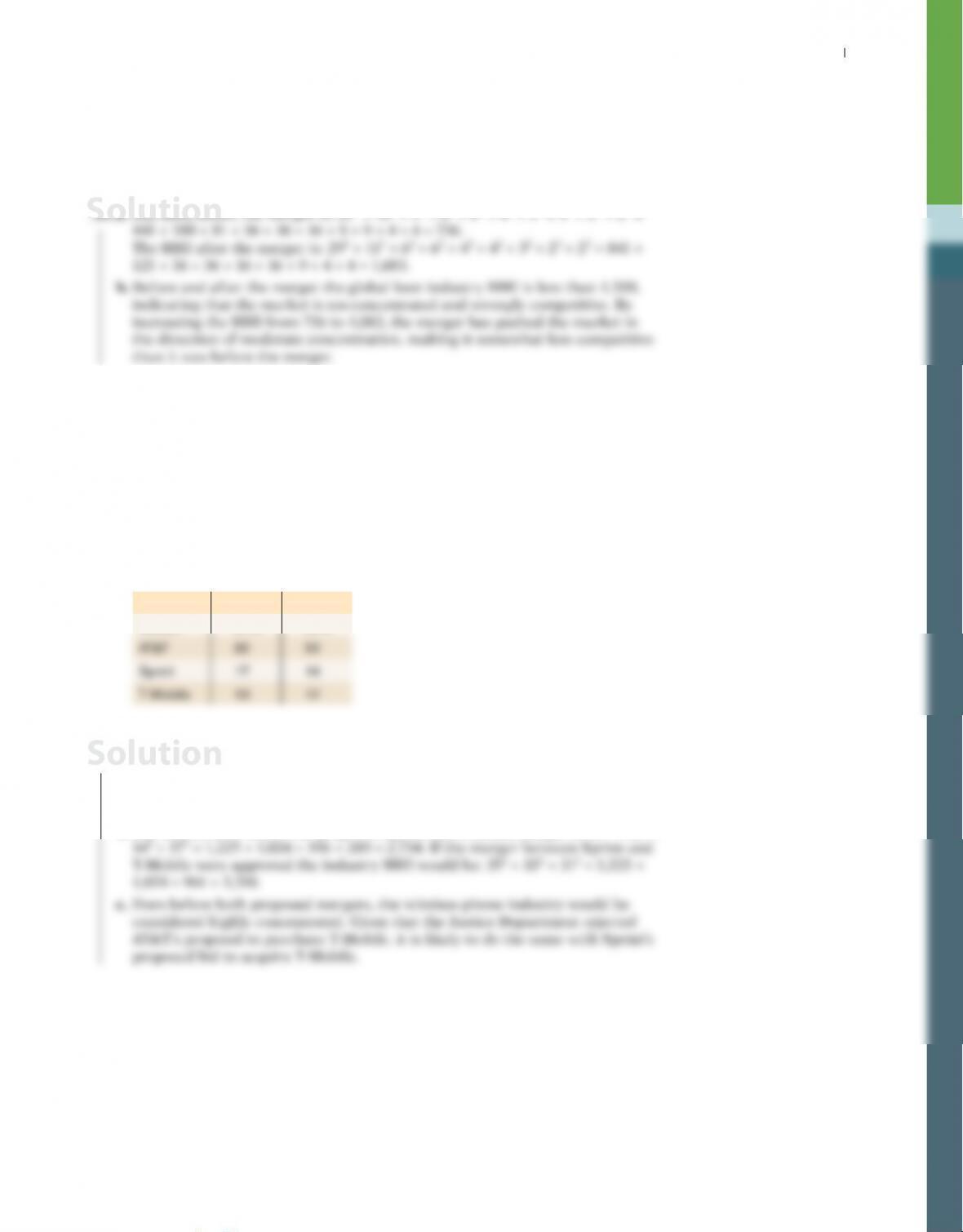
11. a. The HHI before the merger is: 212 + 102 + 92 + 62 + 62 + 42 + 32 + 32 + 22 + 22 =
12. In 2011, the Justice Department rejected AT&T’s proposal to purchase T-Mobile
for $39 billion due to anticompetitive concerns. A few years later, Sprint
launched its own attempt to purchase T-Mobile. In 2016, Sprint’s discussions
with T-Mobile about a potential takeover were still ongoing.
a. Use the accompanying table to calculate the HHI before and after the
proposed 2011 merger of AT&T and T-Mobile.
b. Use the table to calculate the HHI before and after the proposed merger of
Sprint and T-Mobile in 2016.
c. Based on your calculations in parts a and b, do you think the Justice Depart-
ment is likely to approve a merger between Sprint and T-Mobile?
Carrier 2011 2016
Verizon 34% 35%
12. a. The HHI in 2011 before the proposed AT&T and T-Mobile merger is: 342 + 322 +
172 + 102 = 1,156 + 1,024 + 289 + 100 = 2,569. If the merger between AT&T and
T-Mobile were approved, the industry HHI would be: 342 + 422 + 172 = 1,156 +
1,764 + 289 = 3,209.
b. The HHI in 2016 before the proposed Sprint and T-Mobile merger is: 352 + 322 +
Solution
Solution
S-228 Chapter 14 OligOpOly
13. Use these steps to find the antitrust claim made by the Justice Department to
prevent the merger of Anheuser-Busch InBev and Grupo Modelo. Refer to the
v. Scroll to the bottom of the web page and click on “Complaint.” Then click on
“Attachment” to review the case.
a. Prior to the merger, what is the U.S. market share for Anheuser-Busch InBev
and Grupo Modelo? (See the pie chart on page 2.)
b. In part IV, section C (Relevant Geographic Market), how does the Justice
Department define a beer market? Why?
c. Based on the information in part V, in how many markets would the proposed
merger exceed the HHI threshold of 2,500 points and be considered highly
concentrated?
13. a. Prior to the merger, Anheuser-Busch InBev held 39% of the U.S. beer market
Solution
Chapter 14 OligOpOly S-229
WORK IT OUT Interactive step-by-step help with solving this
problem can be found online.
14. Let’s revisit the fisheries agreement introduced in Problem 5 stating that to
preserve the North Atlantic fish stocks, it is decided that only two fishing
fleets, one from the United States (U.S.) and the other from the European
Union (EU), can fish in those waters. The accompanying table shows the
market demand schedule per week for fish from these waters. The only costs
are fixed costs, so fishing fleets maximize profit by maximizing revenue.
Price of fish
(per pound)
Quantity of fish
demanded (pounds)
$17 1,800
16 2,000
15 2,100
14 2,200
12 2,300
c. Suppose the EU fleet cheats by expanding its own catch by 100 pounds
per week. The U.S. fleet doesn’t change its catch. What is the revenue to
the U.S. fleet? To the EU fleet?
14. a. The accompanying table calculates the total revenue for the entire North
Atlantic fishery for different output quantities. The revenue-maximizing out–
put is 2,000 pounds per week, which will fetch a price of $16 per pound.
Price of fish
(per pound)
Quantity of fish
demanded (pounds) Total revenue
$17 1,800 $30,600
16 2,000 32,000
b. If they share the output equally, the U.S. and the EU fleets will each catch
1,000 pounds per week and have revenue of $16,000 per week.
c. If the EU fleet cheats and catches 100 pounds more, the total caught will be
2,100 pounds, which will cause the price to fall to $15. The EU fleet’s revenue
will now be 1,100 × $15 = $16,500, and the U.S. fleet’s revenue will fall to
1,000 × $15 = $15,000.
Solution