CHAPTER 14 | Money, Banks, and the
Federal Reserve System
Brief Chapter Summary
14.1 What Is Money, and Why Do We Need It? (pages 858–861)
Define money and discuss the four functions of money.
▪ Money is anything that people are generally willing to accept in exchange for goods or
14.2 How Is Money Measured in the United States Today? (pages 861–865)
Discuss the definitions of the money supply used in the United States today.
▪ The narrowest definition of the money supply in the United States today is M1, which
14.3 How Do Banks Create Money? (pages 865–874)
Explain how banks create money.
14.4 The Federal Reserve System (pages 874–881)
Compare the three policy tools the Federal Reserve uses to manage the money supply.
14.5 The Quantity Theory of Money (pages 881–885)
Explain the quantity theory of money and use it to explain how high rates of inflation occur.
▪ The quantity theory of money provides insight into the long-run relationship between the
CHAPTER 14 | Money, Banks, and the Federal Reserve System 327
Key Terms
Asset, p. 858. Anything of value owned by a
person or a firm.
Bank panic, p. 874. A situation in which many
banks experience runs at the same time.
Bank run, p. 874. A situation in which many
depositors simultaneously decide to withdraw
money from a bank.
Commodity money, p. 858. A good used as
money that also has value independent of its use
as money.
Federal Reserve, p. 860. The central bank of
the United States.
Fiat money, p. 860. Money, such as paper
currency, that is authorized by a central bank or
governmental body and that does not have to be
exchanged by the central bank for gold or some
other commodity money.
balances in money market deposit accounts in
banks, and noninstitutional money market fund
shares.
Monetary policy, p. 876. The actions the
Federal Reserve takes to manage the money
supply and interest rates to pursue
macroeconomic policy objectives.
Money, p. 858. Assets that people are generally
willing to accept in exchange for goods and
services or for payment of debts.
Open market operations, p. 877. The buying
account deposits.
Reserves, p. 866. Deposits that a bank keeps as
cash in its vault or on deposit with the Federal
Reserve.
Securitization, p. 879. The process of
transforming loans or other financial assets into
securities.
328 CHAPTER 14 | Money, Banks, and the Federal Reserve System
Chapter Outline
Can Greece Function without Banks?
In 2001, Greece and most other European countries abandoned their individual currencies in favor of the
euro. Following the 2007–2009 financial crisis, the Greek government had trouble paying interest on the
14.1
What Is Money, and Why Do We Need It? (pages 858–861)
Learning Objective: Define money and discuss the four functions of money.
Money refers to assets that people are generally willing to accept in exchange for goods and services or
for payment of debts. An asset is anything of value owned by a person or a firm.
A. Barter and the Invention of Money
Economies where goods and services are traded directly for other goods and services are called barter
B. The Functions of Money
Anything used as money must serve four key functions:
1. Medium of exchange: Sellers are willing to accept it in exchange for goods or services.
C. What Can Serve as Money?
There are five criteria that make a good suitable for use as a medium of exchange:
1. It must be acceptable to most people.
Dollar bills meet all of these criteria. Commodity money—gold, for example—has a significant problem:
its value depends on its purity. Another problem with using gold as money is that the money supply is
difficult to control because it depends partly on unpredictable discoveries of new gold fields. Paper
CHAPTER 14 | Money, Banks, and the Federal Reserve System 329
Extra Solved Problem 14.1
Money in the Eighteenth Century
Americans use paper money because it meets the five criteria that make any good suitable as a medium of
exchange. Paper money is
1. Acceptable to most people
Other commodities have served as money, including animal skins. The following is a list of prices for
goods supplied to an Indian tribe in upstate New York in 1703:
Item
Price
One yard of broadcloth
3 beaver skins
Two yards of cotton
1 beaver skin
Five pecks of corn
1 beaver skin
Two pints of powder
1 beaver skin
Ten pounds of pork
1 beaver skin
One hat with hatband
3 beaver skins
One sword blade
1 ½ beaver skins
Six knives
1 beaver skin
Source: Hudson Historical Bureau.
a. What function of money does this list demonstrate?
b. Why were animal skins used as money in the eighteenth century?
Solving the Problem
Step 1: Review the chapter material.
This problem is about the definition and functions of money, so you may want to review the
330 CHAPTER 14 | Money, Banks, and the Federal Reserve System
Individuals developed a system that was suitable to their purposes. Animal skins were
recognized as valuable commodities by both Indians and colonial settlers. Relative to other
Teaching Tips
The end of the chapter in the main text includes a special category of exercises titled Real-Time Data
Exercises. These exercises help students become familiar with a key data source, learn how to locate data,
14.2
How Is Money Measured in the United States Today? (pages 861–865)
Learning Objective: Discuss the definitions of the money supply used in the United States
today.
A. M1: A Narrow Definition of the Money Supply
M1 is a narrow definition of the money supply: the sum of currency in circulation, checking account
deposits in banks, and holdings of traveler’s checks. Checking account deposits are used more often than
currency to make payments.
B. M2: A Broad Definition of Money
M2 is a broader definition of the money supply: It includes M1 plus savings account deposits, small-
Two key points about the money supply are:
1. The narrowest definition of the money supply consists of both currency and checking account
C. What about Credit Cards and Debit Cards?
Credit cards are not included in the definitions of the money supply because they are considered loans
CHAPTER 14 | Money, Banks, and the Federal Reserve System 331
Extra Making
the
Connection
Do We Still Need the Penny?
With small-denomination coins—like pennies or nickels—there is a possibility that the coins will cost
more to produce than their face value. This was true in the early 1980s, when the rising price of copper
meant the federal government was spending more than 1 cent to produce a penny. That led the
government to switch from making pennies from copper to making them from zinc. Unfortunately, by
Some economists, though, have argued that eliminating the penny would subject consumers to a
“rounding tax.” For example, a good that had been priced at $2.99 will cost $3.00 if the penny is
eliminated. Some estimates have put the cost to consumers of the rounding tax as high as $600 million.
But Robert Whaples, an economist at Wake Forest University, after analyzing almost 200,000
transactions from a convenience store chain, concludes that “the ‘rounding tax’ is a myth. In reality, the
number of times consumers’ bills would be rounded upward is almost exactly equal to the number of
times they would be rounded downward.”
Whether or not pennies get turned into nickels, it seems very likely that one way or another, the penny
will eventually disappear from the U.S. money supply.
332 CHAPTER 14 | Money, Banks, and the Federal Reserve System
Question
In the nineteenth century, the Canadian government had difficulty getting banks and the public to accept
the penny, which had been introduced a few years before. As a result, the government offered pennies for
sale at a 20 percent discount. One account of this episode describes what the Canadian government did as
“negative seigniorage.” What is seigniorage? Why might the Canadian government’s selling pennies at a
20 percent discount be considered “negative seigniorage”?
Source: Nicholas Kohler, “A Penny Dropped,” macleans.ca, January 14, 2011.
Answer
Seigniorage is the government’s profit from issuing fiat money, and equals the difference between the
14.3
How Do Banks Create Money? (pages 865–874)
Learning Objective: Explain how banks create money.
The key role that banks play in the economy is to accept deposits and make loans.
A. Bank Balance Sheets
The key assets on a bank’s balance sheet are its reserves, loans, and holdings of securities, such as U.S.
Treasury bills. Reserves are deposits that a bank keeps as cash in its vault or on deposit with the Federal
B. Using T-Accounts to Show How a Bank Can Create Money
A T-account is a stripped-down version of a balance sheet that shows how a transaction changes a bank’s
balance sheet. When a bank accepts a deposit, it keeps only a fraction of the funds as reserves and loans
C. The Simple Deposit Multiplier
The simple deposit multiplier is the ratio of the amount of deposits created by banks to the amount of
new reserves. The formula for the simple deposit multiplier is:
CHAPTER 14 | Money, Banks, and the Federal Reserve System 333
RR
D. The Simple Deposit Multiplier versus the Real-World Deposit Multiplier
The explanation for the way an increase in reserves in the banking system leads to the creation of new
deposits and an increase in the money supply is simplified in two ways. First, we assumed that banks
We can summarize two important conclusions:
1. When banks gain reserves, they make new loans, and the money supply expands.
2. When banks lose reserves, they reduce their loans, and the money supply contracts.
Extra Making
the
Connection
Banks Create Money—Who Prints Money?
When economists describe how “banks create money,” they don’t mean that banks literally print
money—currency—but that by lending reserves, banks create new deposits that become part of the
14.4
The Federal Reserve System (pages 874–881)
Learning Objective: Compare the three policy tools the Federal Reserve uses to
manage the money supply.
In a fractional reserve banking system, banks keep less than 100 percent of deposits as reserves. When
people deposit money in a bank, the bank lends most of the money to someone else. On a typical day,
about as much money is deposited in a bank as is withdrawn. A bank run is a situation in which many
334 CHAPTER 14 | Money, Banks, and the Federal Reserve System
A. The Establishment of the Federal Reserve System
With the intention of putting an end to banking panics, in 1913 Congress passed the Federal Reserve Act,
setting up the Federal Reserve System, (often referred to as “the Fed”). Discount loans are loans the
Federal Reserve makes to banks. The discount rate is the interest rate the Federal Reserve charges on
B. How the Federal Reserve Manages the Money Supply
Monetary policy refers to the actions the Federal Reserve takes to manage the money supply and interest
rates to pursue macroeconomic policy objectives. To manage the money supply, the Fed uses three
monetary policy tools:
1. Open market operations
The Federal Open Market Committee (FOMC) is the Federal Reserve committee responsible for open
market operations and managing the money supply in the United States. The FOMC meets eight times a
year to discuss monetary policy. The committee has twelve members: the seven members of the Board of
Governors, the president of the Federal Reserve Bank of New York, and four presidents from the other
By lowering the discount rate, the Fed can encourage banks to take additional loans and increase their
reserves. Raising the discount rate will have the opposite effect. When the Fed reduces the required
reserve ratio, it converts required reserves into excess reserves. If the Fed raises the reserve requirement,
it will have the opposite effect. The Fed changes reserve requirements much more rarely than it conducts
open market operations or changes the discount rate.
CHAPTER 14 | Money, Banks, and the Federal Reserve System 335
C. The “Shadow Banking System” and the Financial Crisis of 2007–2009
In the past 25 years, two important developments have occurred in the financial system:
The financial system was also transformed in the 1990s and 2000s by the increasing importance of
nonbank financial firms, such as investments banks, money market mutual funds, and hedge funds.
Investment banks concentrate on providing advice to firms issuing stocks and bonds and considering
mergers with other firms. In the 1990s, investment banks began bundling large numbers of their
mortgages and reselling them to investors. Mortgage-backed securities became popular because they
often paid higher interest rates than similar securities. Money market mutual funds sell shares to investors
The Fed, in combination with the U.S. Treasury, took action to deal with the financial panic. In the fall of
2008, under the Troubled Asset Relief Program (TARP), the Fed and Treasury began to stabilize the
commercial banking system by providing funds to banks in exchange for stock. The Fed modified its
discount policy to make it possible to grant loans to financial firms that had not previously been eligible.
Teaching Tips
Extra Solved Problem 14.4
Open Market Operations and Changes in the Supply of Money
Suppose that the Federal Reserve would like to increase the money supply by $500,000. How can the Fed
use open market operations to accomplish this goal? Assume the required reserve ratio is 10 percent.
336 CHAPTER 14 | Money, Banks, and the Federal Reserve System
Solving the Problem
Step 1: Review the chapter material.
This problem is about the Fed’s use of open market operations, so you may want to review
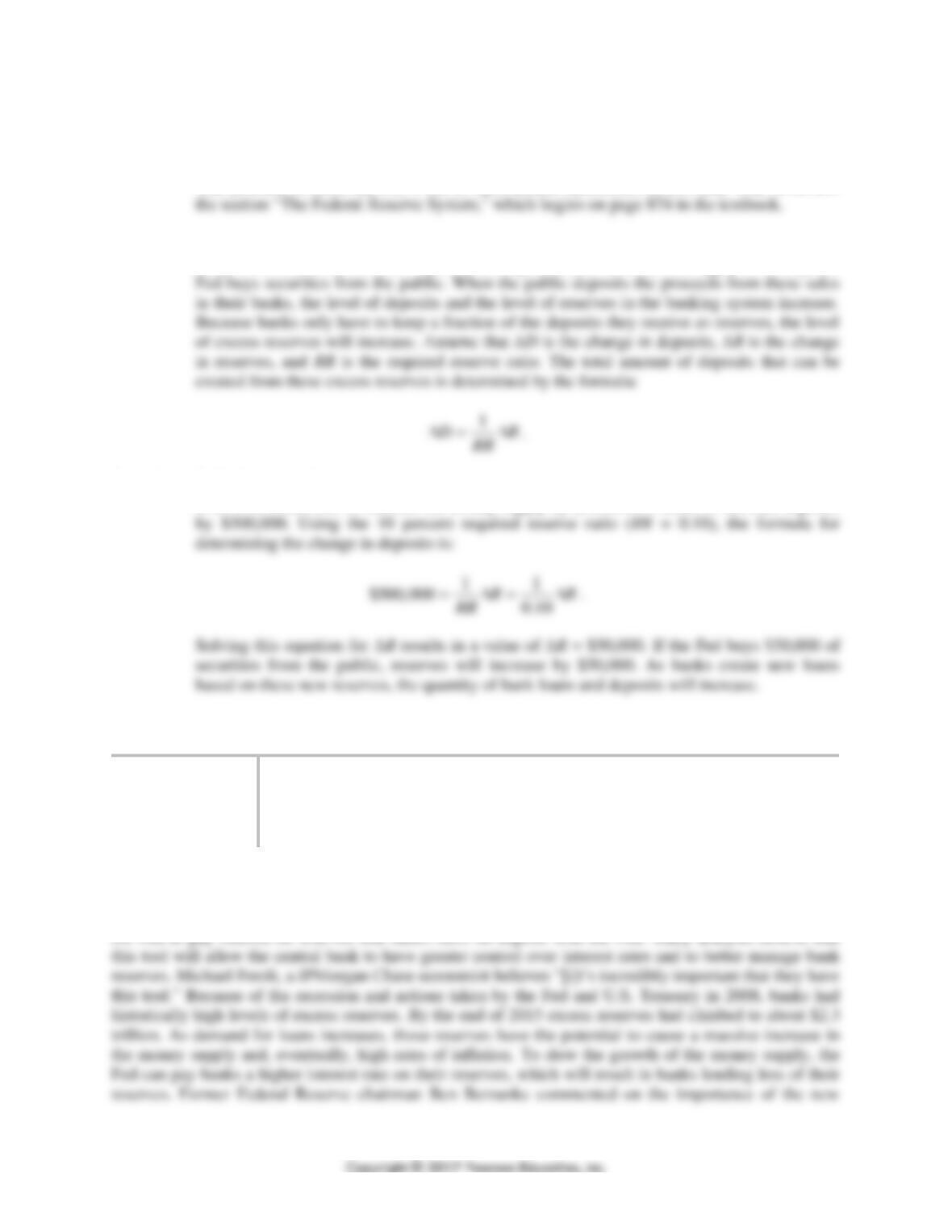
Step 2: Determine the level of deposits that can be created from excess reserves.
When the Federal Reserve uses open market operations to increase the supply of money, the
Step 3: Calculate the change in reserves.
If the Fed would like to increase the money supply by $500,000, it needs to increase deposits
Extra Making
the
Connection
Paying Interest on Reserves Gives the Fed a New Tool
The financial crisis that led to the recession of 2007–2009 caused the Federal Reserve to take extreme
measures to stabilize the U.S. economy. While it did not make headlines, the U.S. Congress gave the Fed
a new tool that may allow the Fed help mitigate the effects of future crises. This new tool is the ability of
CHAPTER 14 | Money, Banks, and the Federal Reserve System 337
policy in a speech he made to Congress. “Raising the rate of interest paid on reserve balances will give us
substantial leverage over the federal funds rate…banks generally will not supply funds to the market at an
Extra Making
the
Connection
The 2001 Bank Panic in Argentina
Argentina suffered a bank panic in 2001. Some unusual aspects of the Argentine banking system made it
very difficult for the Argentine central bank to act as a lender of last resort. As an alternative policy to
stop the bank panic, the Argentine government limited the amount of Argentine currency that depositors
could withdraw to $1,000 per account per month. Consumers cut back on their spending because much of
the money in their bank accounts could not be withdrawn. Firms like McDonald’s experienced declining
sales as the country’s recession worsened.
By 2000, many observers had begun to doubt the ability of the Argentine government to maintain the
one-to-one exchange rate. As a result, Argentine households and firms, as well as foreign investors, began
moving funds out of pesos and into dollars. By late 2001, fully 80 percent of time deposits in Argentine
banks were in dollars rather than in pesos. In addition, many depositors began withdrawing money from
their accounts. Forty-seven of the top fifty Argentine banks experienced major withdrawals by December
2001. In January 2002, the crisis was ended when the government abandoned its commitment to the one–
338 CHAPTER 14 | Money, Banks, and the Federal Reserve System
Question
Argentina suffered a severe bank panic in 2001. The United States has not suffered a bank panic since the
1930s. What differences between the Argentine and U.S. financial systems can account for their differing
vulnerability to bank panics?
Answer
One significant difference between the U.S and Argentine financial systems that accounted for the bank
14.5
The Quantity Theory of Money (pages 881–885)
Learning Objective: Explain the quantity theory of money and use it to explain how
high rates of inflation occur.
A. Connecting Money and Prices: The Quantity Equation
In the early twentieth century, Irving Fisher formalized the connection between money and prices using
the quantity equation. The equation states that the money supply (M) multiplied by the velocity of money
(V) equals the price level (P) multiplied by real output (Y).
B. The Quantity Theory Explanation of Inflation
We can use a mathematical rule that states that an equation where variables are multiplied together is
equal to an equation where the growth rates of the variables are added together. Therefore, the quantity
equation can be transformed to: