S-195
interactive activity
Chapter 14
Money, Banking, and
the Federal Reserve System
1. For each of the following transactions, what is the initial effect (increase or
decrease) on M1? On M2?
1. a. Shares of stock are not a component of either M1 or M2, so holding fewer
shares does not decrease either M1 or M2. However, depositing the money into
b. Shares of stock are not a component of either M1 or M2, so holding fewer
shares does not decrease either M1 or M2. However, depositing the money into
c. Moving money from savings to checking has no effect on M2, since both
d. Depositing cash into a checking account does not change M1 or M2. You are
e. Depositing $0.25 into your savings account has no effect on M2, since both
2. There are three types of money: commodity money, commodity-backed money,
and fiat money. Which type of money is used in each of the following situations?
Solution
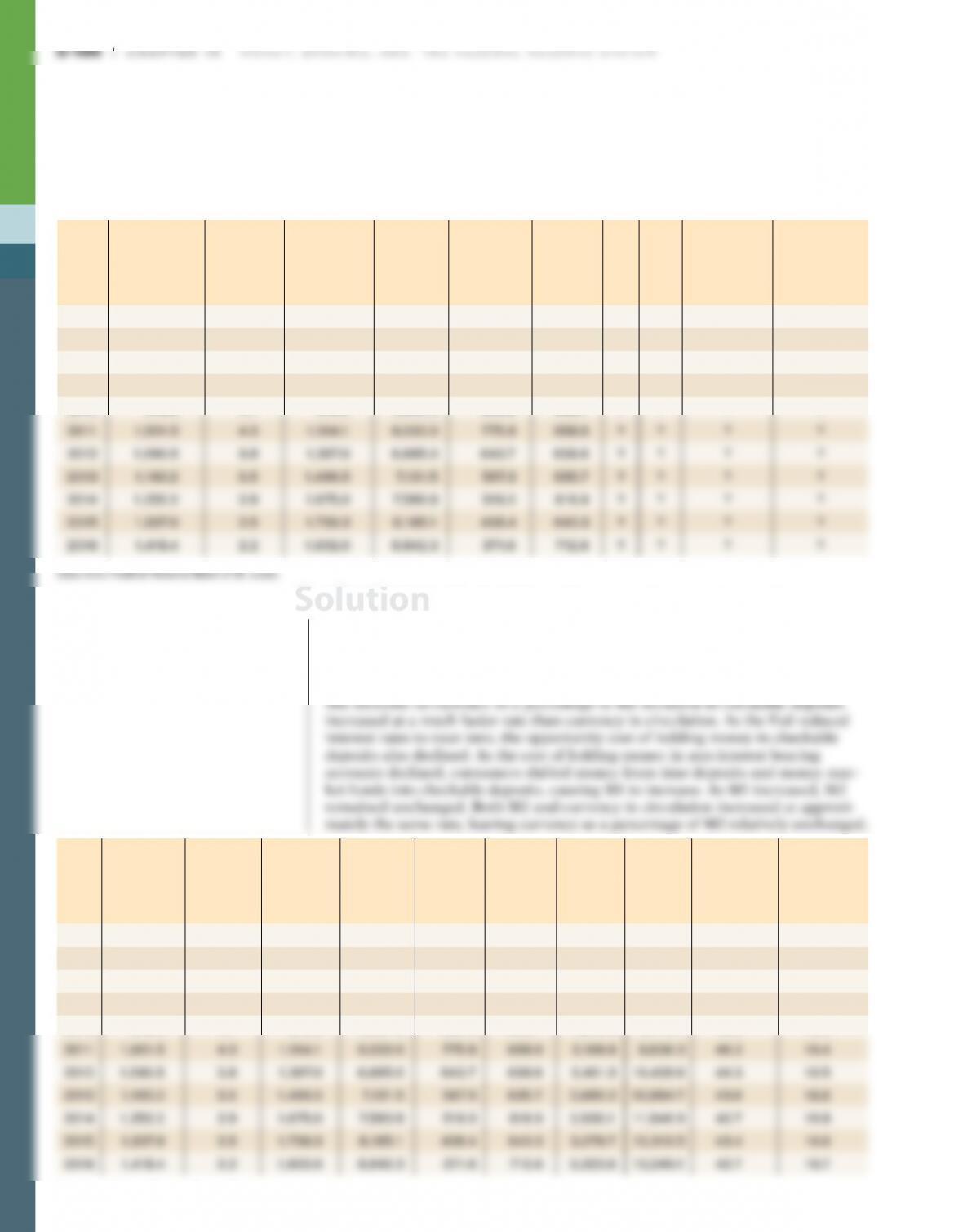
3. The following table shows the components of M1 and M2 in billions of dollars
for the month of December in the years 2006 to 2016 reported by the Federal
Reserve Bank of St. Louis. Complete the table by calculating M1, M2, currency
in circulation as a percentage of M1, and currency in circulation as a percent-
age of M2. What trends or patterns about M1, M2, currency in circulation as a
percentage of M1, and currency in circulation as a percentage of M2 do you see?
What might account for these trends?
Year
Currency in
circulation
Traveler’s
checks
Checkable
deposits
Savings
deposits
Time
deposits
Money
market
funds M1 M2
Currency in
circulation
as a
percentage
of M1
Currency in
circulation
as a
percentage
of M2
2006 $750.2 $6.7 $ 611.3 $3,694.9 $1,206.1 $772.2 ? ? ? ?
2007 760.6 6.3 609.5 3,898.4 1,276.1 923.3 ? ? ? ?
2008 816.3 5.5 785.1 4,089.4 1,457.9 1,012.5 ? ? ? ?
2009 863.7 5.1 829.7 4,813.1 1,188.3 771.1 ? ? ? ?
2010 918.8 4.7 919.0 5,331.3 933.2 668.1 ? ? ? ?
3. In the completed table that follows, M1 consists of currency in circulation, trav–
eler’s checks, and checkable deposits. M2 consists of M1 plus money market funds,
time deposits, and savings deposits. From 2006 to 2016, M1 more than doubled.
M2 almost doubled from 2006 to 2016. Currency as a percentage of M1 was 55%
prior to the Great Recession, but fell below 44% by 2013 where it has remained.
Currency as a percentage of M2 was almost constant at between 10% and 11%.
Year
Currency in
circulation
Traveler’s
checks
Checkable
deposits
Savings
deposits
Time
deposits
Money
market
funds M1 M2
Currency in
circulation
as a
percentage
of M1
Currency in
circulation
as a
percentage
of M2
2006 $750.2 $6.7 $ 611.3 $3,694.9 $1,206.1 $772.2 $1,368.2 $7,041.4 54.8% 10.7%
2007 760.6 6.3 609.5 3,898.4 1,276.1 923.3 1,376.4 7,444.2 55.3 10.2
2008 816.3 5.5 785.1 4,089.4 1,457.9 1,012.5 1,606.90 8,166.7 50.8 10.0
2009 863.7 5.1 829.7 4,813.1 1,188.3 771.1 1,698.5 8,471.0 50.9 10.2
2010 918.8 4.7 919.0 5,331.3 933.2 668.1 1,842.5 8,775.1 49.9 10.5
Data from: Federal Reserve Bank of St. Louis.
Solution
4. Indicate whether each of the following is part of M1, M2, or neither:
a. $95 on your campus meal card
4. a. $95 on your campus meal card is similar to a gift certificate. Because it can
only be used for one purpose, it is not part of either M1 or M2.
b. $0.55 in the change cup of your car is part of currency in circulation; it is part
of both M1 and M2.
5. Tracy Williams deposits $500 that was in her sock drawer into a checking
account at the local bank. The reserve ratio is 10%.
a. How does the deposit initially change the T–account of the local bank? How
does it change the money supply?
b. If the bank maintains a reserve ratio of 10%, how will it respond to the new
deposit?
c. If every time the bank makes a loan, the loan results in a new checkable bank
deposit in a different bank equal to the amount of the loan, by how much
could the total money supply in the economy expand in response to Tracy’s
initial cash deposit of $500?
Solution
6. Ryan Cozzens withdraws $400 from his checking account at the local bank and
keeps it in his wallet.
a. How will the withdrawal change the T-account of the local bank and the
money supply?
b. If the bank maintains a reserve ratio of 10%, how will it respond to the with–
drawal? Assume that the bank responds to insufficient reserves by reducing
the amount of deposits it holds until its level of reserves satisfies its required
reserve ratio. The bank reduces its deposits by calling in some of its loans,
forcing borrowers to pay back these loans by taking cash from their checking
deposits (at the same bank) to make repayment.
c. If every time the bank decreases its loans, checkable bank deposits fall by
the amount of the loan, by how much will the money supply in the economy
contract in response to Ryan’s withdrawal of $400?
6. a. Initially, the bank’s reserves fall by $400, as do its checkable deposits. There
is no initial change in the money supply; currency in circulation has risen by
$400 but checkable deposits have decreased by $400.
Assets Liabilities
Reserves –$400 Checkable deposits –$400
b. Assuming that the bank has other checkable deposits, the bank will be hold-
ing insufficient reserves. The bank was holding $40 of the $400 withdrawal as
required reserves for the $400 deposit; however, the remaining $360 was being
c. The money supply will contract by ($400/0.1) – $400 = $3,600. Checkable
deposits fall by $4,000, but only $3,600 represents a decrease in the money
supply because $400 of the $4,000 fall in checkable deposits has been con-
verted into cash in Ryan’s wallet.
d. The money supply will decrease by ($400/0.2) – $400 = $1,600. Checkable
deposits fall by $2,000, but only $1,600 represents a decrease in the money
supply.
7. The government of Eastlandia uses measures of monetary aggregates similar
to those used by the United States, and the central bank of Eastlandia imposes
a required reserve ratio of 10%. Given the following information, answer the
questions below.
Bank deposits at the central bank = $200 million
a. What is M1?
b. What is the monetary base?
Solution
7. a. M1 equals the sum of currency held by the public ($150 million), checkable
deposits ($500 million), and traveler’s checks ($10 million), or $660 million.
b. The monetary base is the sum of currency held by the public ($150 million)
and the reserves of the commercial banks [currency in bank vaults
($100 million) and bank deposits at the central bank ($200 million)]. The
monetary base is $450 million.
8. In Westlandia, the public holds 50% of M1 in the form of currency, and the
required reserve ratio is 20%. Estimate how much the money supply will
increase in response to a new cash deposit of $500 by completing the accompa-
nying table. (Hint: The first row shows that the bank must hold $100 in mini-
mum reserves—20% of the $500 deposit—against this deposit, leaving $400 in
Round Deposits
Required
reserves
Excess
reserves Loans
Held as
currency
1$500.00 $100.00 $400.00 $400.00 $200.00
2200.00 ? ? ? ?
3 ? ? ? ? ?
4 ? ? ? ? ?
5 ? ? ? ? ?
6 ? ? ? ? ?
7 ? ? ? ? ?
8 ? ? ? ? ?
9 ? ? ? ? ?
10 ? ? ? ? ?
Solution
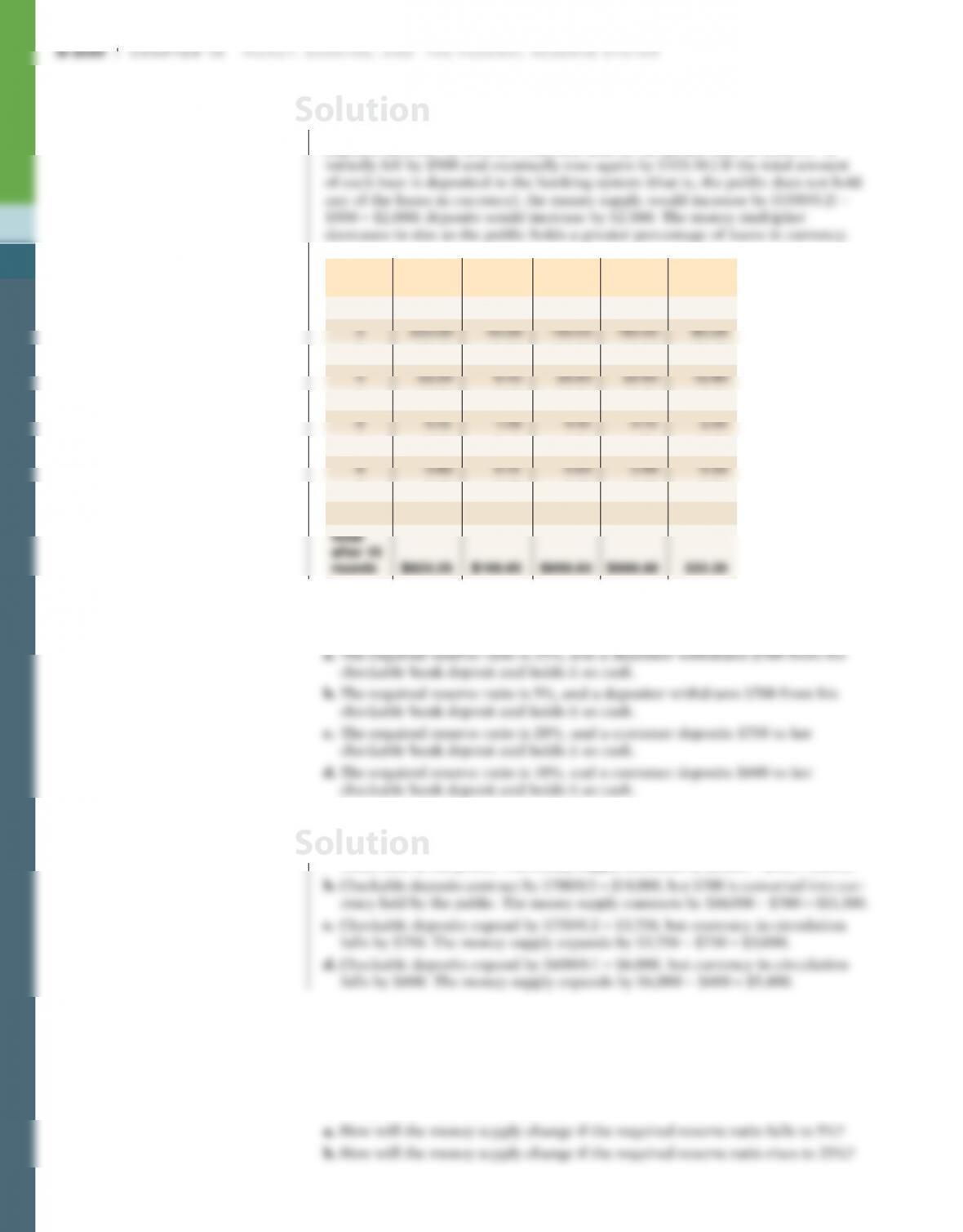
8. As shown in the accompanying table, after 10 rounds, loans can expand by
$666.60; this is also the increase in the money supply at this point. (Although
deposits increase by $833.25, currency held by the public falls by $166.70—it
Round Deposits
Required
reserves
Excess
reserves Loans
Held as
currency
1$500.00 $100.00 $400.00 $400.00 $200.00
380.00 16.00 64.00 64.00 32.00
512.80 2.56 10.24 10.24 5.12
72.05 0.41 1.64 1.64 0.82
90.33 0.07 0.26 0.26 0.13
10 0.13 0.03 0.10 0.10 0.05
9. What will happen to the money supply under the following circumstances in a
checkable-deposits-only system?
9. a. Checkable deposits contract by $700/0.25 = $2,800, but $700 is converted into cur–
rency held by the public. The money supply contracts by $2,800 – $700 = $2,100.
10. Although the U.S. Federal Reserve doesn’t use changes in reserve requirements
to manage the money supply, the central bank of Albernia does. The commercial
banks of Albernia have $100 million in reserves and $1,000 million in checkable
deposits; the initial required reserve ratio is 10%. The commercial banks follow
a policy of holding no excess reserves. The public holds no currency, only check-
able deposits in the banking system.
Solution
Solution
10. a. If the required reserve ratio falls to 5%, the commercial banks of Albernia
b. If the required reserve ratio rises to 25%, the commercial banks of Albernia
11. Using Figure 14–6, find the Federal Reserve district in which you live. Go to
12. Show the changes to the T-accounts for the Federal Reserve and for commercial
banks when the Federal Reserve sells $30 million in U.S. Treasury bills. If the
public holds a fixed amount of currency (so that all new loans create an equal
12. When the Federal Reserve sells $30 million in Treasury bills to commercial
banks, its assets decrease by $30 million (it now owns $30 million less in
Treasury bills), but its liabilities also decrease by $30 million as the banks pay
the Federal Reserve for the Treasury bills from their accounts at the Fed (part of
Initial changes to the T-account of the Federal Reserve immediately after the
Fed sale of $30 million in Treasury bills:
Assets Liabilities
Initial changes to the T-account of commercial banks immediately after the Fed
sale of $30 million in Treasury bills:
Assets Liabilities
Reserves –$30 million
Solution
Solution
S-202 Chapter 14 Money, Banking, and the Federal reserve systeM
After the Federal Reserve sells $30 million in Treasury bills, the banks are no
All changes to the T-account of commercial banks after the Fed sale of
$30 million in Treasury bills:
Assets Liabilities
Reserves –$30 million
Loans –$600 million
13. The Congressional Research Service estimates that at least $45 million of
counterfeit U.S. $100 notes produced by the North Korean government are in
circulation.
a. Why do U.S. taxpayers lose because of North Korea’s counterfeiting?
13. a. When North Korea circulates fake currency, the Federal Reserve does not
hold any assets, and the U.S. government does not get the interest from the
b. The amount of interest forgone per year is 0.87% × $45 million = $391,500.
14. As shown in Figure 14-9, the portion of the Federal Reserve’s assets made up of
U.S. Treasury bills has declined since 2007. Go to www.federalreserve.gov. On
the top of page, under “Data” and “Money Stock and Reserve Balances,” select
the link “Factors Affecting Reserve Balances – H.4.1.” Click on the link for the
current release.
14. a. Answers will vary. As of data released on June 1, 2017, the Fed had $4,420,982
Solution
Solution
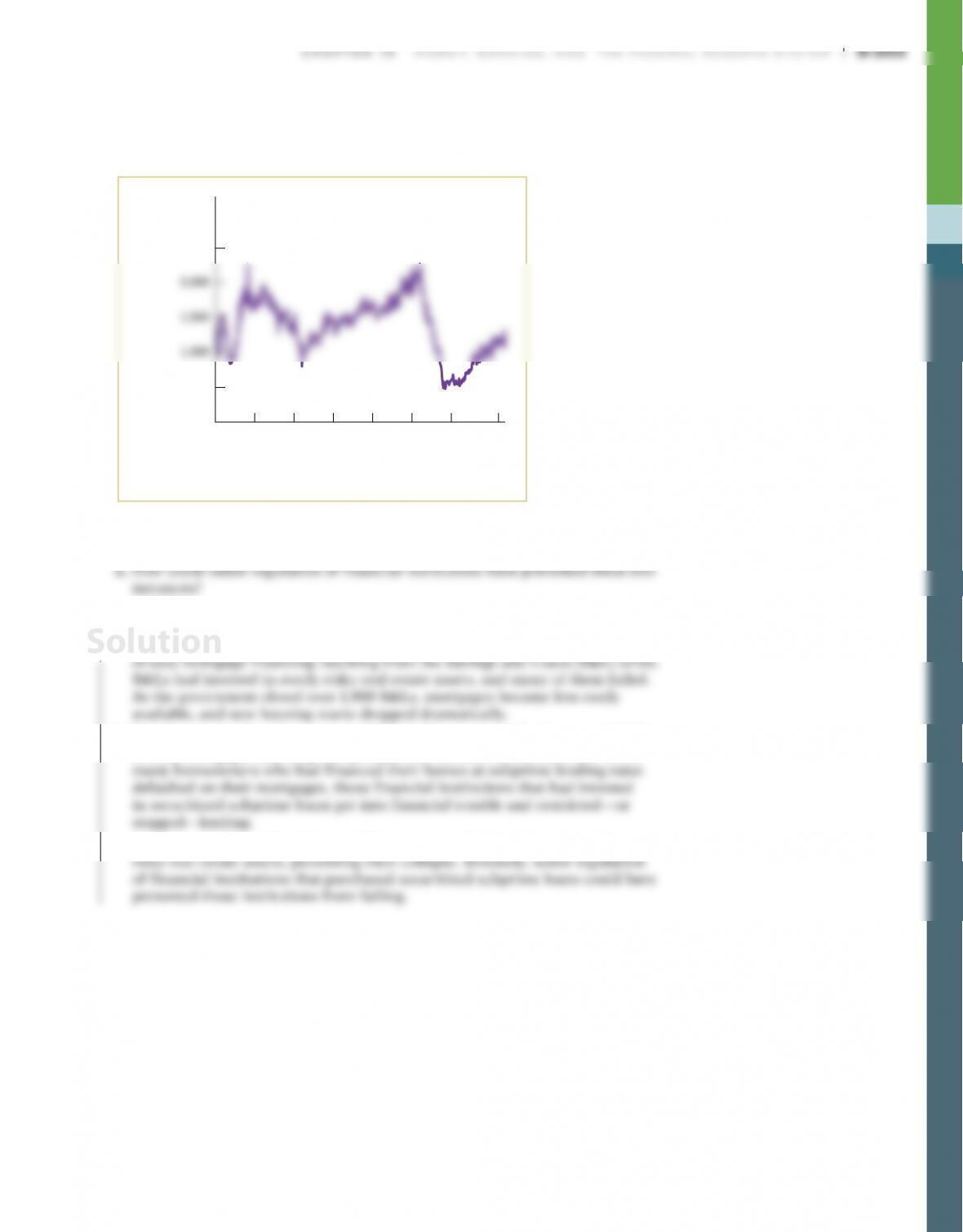
15. The accompanying figure shows new U.S. housing starts, in thousands of units
per month, between January 1980 and December 2016. The graph shows a large
drop in new housing starts in 1984–1991 and 2006–2009. New housing starts are
related to the availability of mortgages.
2,500
500
New housing
starts
(thousands)
Year
1980
Data from: Federal Reserve Bank of St. Louis.
2016
2010
2005
2000
1985
1995
1990
a. What caused the drop in new housing starts in 1984–1991?
b. What caused the drop in new housing starts in 2006–2009?
15. a. The drop in new housing starts in 1984–1991 was caused by the unavailability
b. The drop in new housing starts in 2006–2009 was caused by the unavailability
of easy mortgage financing that precipitated the 2008 financial crisis. When
c. Better regulation of the S&Ls could have prevented them from investing in
Solution
S-204 Chapter 14 Money, Banking, and the Federal reserve systeM
Solution
WORK IT OUT Interactive step-by-step help with solving this
problem can be found online.
16. Show the changes to the T-accounts for the Federal Reserve and for com-
mercial banks when the Federal Reserve buys $50 million in U.S. Treasury
bills. If the public holds a fixed amount of currency (so that all loans create
an equal amount of deposits in the banking system), the minimum reserve
ratio is 10%, and banks hold no excess reserves, by how much will depos–
16. When the Federal Reserve buys $50 million in Treasury bills from commercial
banks, its assets increase by $50 million (it now owns $50 million in Treasury
bills) but its liabilities also increase by $50 million as it credits the banks’
accounts at the Federal Reserve, part of the monetary base. From the perspec-
Initial changes to the T-account of the Federal Reserve immediately after the
Fed purchase of $50 million in Treasury bills:
Assets Liabilities
Initial changes to the T-account of commercial banks immediately after the Fed
purchase of $50 million in Treasury bills:
Assets Liabilities
Reserves +$50 million
After the Federal Reserve buys $50 million from commercial banks, the banks
are holding $50 million in excess reserves. Since the banks do not want to hold
Total changes to the T–account of commercial banks after the Fed purchase of
$50 million in Treasury bills:
Assets Liabilities
Reserves +$50 million
Loans +$500 million