414
Integrated Case
Chapter 14: Distributions to Shareholders
retaining them for reinvestment in the firm. Dividend policy really
involves three key issues: (1) How much should be distributed? (2)
A. (2) Explain briefly the dividend irrelevance theory that was put forward
by Modigliani and Miller. What were the key assumptions underlying
their theory?
Answer: [Show S14-4 here.] Dividend irrelevance refers to the theory that
investors are indifferent between dividends and capital gains, making
dividend policy irrelevant with regard to its effect on the value of the
firm.
The dividend irrelevance theory was proposed by MM, but they
had to make some very restrictive assumptions to “prove” it. These
Chapter 14: Distributions to Shareholders
Integrated Case
415
A. (3) Why do some investors prefer high-dividend-paying stocks, while
other investors prefer stocks that pay low or nonexistent dividends?
Answer: [Show S14-5 and S14-6 here.] Investors might prefer dividends to
capital gains because they may regard dividends as less risky than
potential future capital gains. If this were so, then investors would
B. Discuss (1) the information content, or signaling, hypothesis, (2) the
clientele effect, (3) catering theory, and (4) their effects on dividend
policy.
Answer: [Show S14-7 through S14-9 here.] It has long been recognized that
the announcement of a dividend increase often results in an increase
in the stock price, while an announcement of a dividend cut typically
416
Integrated Case
Chapter 14: Distributions to Shareholders
Different groups, or clienteles, of stockholders prefer different
dividend payout policies. For example, many retirees, pension funds,
and university endowment funds are in a low (or zero) tax bracket,
and they have a need for current cash income. Therefore, this group
of stockholders might prefer high-payout stocks. These investors
could, of course, sell some of their stock, but this would be
inconvenient, transactions costs would be incurred, and the sale
might have to be made in a down market. Conversely, investors in
C. (1) Assume that SSC has an $800,000 capital budget planned for the
coming year. You have determined that its present capital structure
(60% equity and 40% debt) is optimal, and its net income is
forecasted at $600,000. Use the residual dividend model to
determine SSC’s total dollar dividend and payout ratio. In the
process, explain how the residual dividend model works. Then
explain what would happen if expected net income was $400,000 or
$800,000.
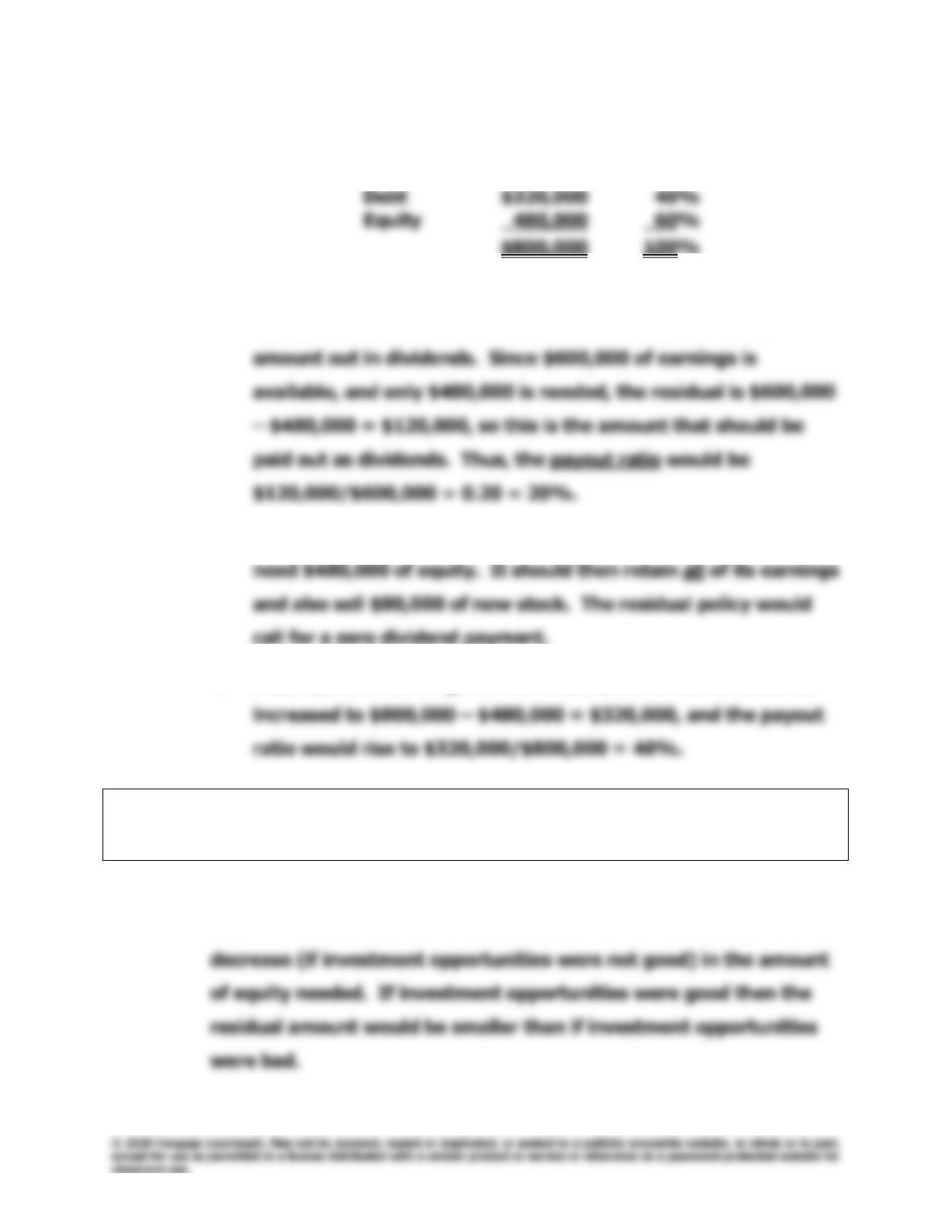
Answer: [Show S14–10 through S14-13 here.] We make the following points:
1. Given the optimal capital budget and the target capital
418
Integrated Case
Chapter 14: Distributions to Shareholders
0.4($800,000) = $320,000 must be raised as debt if we are to
maintain the optimal capital structure:
2. If a residual exists—that is, if net income exceeds the amount of
equity the company needs—then it should pay the residual
3. If only $400,000 of earnings were available, the firm would still
4. If $800,000 of earnings were available, the dividend would be
C. (2) In general terms, how would a change in investment opportunities
affect the payout ratio under the residual dividend model?
Answer: [Show S14-14 here.] A change in investment opportunities would
lead to an increase (if investment opportunities were good) or a
Chapter 14: Distributions to Shareholders
Integrated Case
419
C. (3) What are the advantages and disadvantages of the residual policy?
(
Hint:
Don’t neglect signaling and clientele effects.)
Answer: [Show S14-15 here.] The primary advantage of the residual policy is
that the firm makes maximum use of lower-cost retained earnings,
thus minimizing flotation costs and hence the cost of capital. Also,
whatever negative signals are associated with stock issues would be
avoided.
D. Describe the series of steps that most firms take in setting dividend
policy in practice.
420
Integrated Case
Chapter 14: Distributions to Shareholders
Answer: [Show S14-16 here.] Firms establish dividend policy within the
framework of their overall financial plans. The steps in setting policy
are listed below:
1. The firm forecasts its annual capital budget and its annual sales,
2. The target capital structure, presumably the one that minimizes
3. With its capital structure and investment requirements in mind,
4. A long-term target payout ratio is then determined, based on
the residual model concept. Because of flotation costs and
5. An actual dollar dividend, say $2 per year, will be decided upon.
The size of this dividend will reflect (1) the long-run target
payout ratio and (2) the probability that the dividend, once set,
Chapter 14: Distributions to Shareholders
Integrated Case
421
E. What is a dividend reinvestment plan (DRIP), and how does it work?
Answer: [Show S14-17 through S14-19 here.] Under a dividend reinvestment
plan (DRIP), shareholders have the option of automatically
reinvesting their dividends in shares of the firm’s common stock. In
F. What are stock dividends and stock splits? What are the advantages
and disadvantages of stock dividends and stock splits?
Answer: [Show S14–20 and S14-21 here.] When it uses a stock dividend, a
firm issues new shares in lieu of paying a cash dividend. For
422
Integrated Case
Chapter 14: Distributions to Shareholders
Both stock dividends and stock splits increase the number of
shares outstanding and, in effect, cut the pie into more, but smaller,
pieces. If the dividend or split does not occur at the same time as
some other event that would alter perceptions about future cash
It is hard to come up with a convincing rationale for small stock
dividends, like 5% or 10%. No economic value is being created or
On the other hand, there is a good reason for stock splits or
large stock dividends. Specifically, there is a widespread belief that
an optimal price range exists for stocks. The argument goes as
Chapter 14: Distributions to Shareholders
Integrated Case
423
A recent Bloomberg Businessweek article notes that stock splits
have become a lot less popular in recent years. The article suggests
that one possible reason for this shift is that individual investors
Another factor that may influence stock splits and dividends is
the belief that they signal management’s belief that the future is
bright. If a firm’s management would be inclined to split the stock or
Interestingly, one of the most astute investors of the 20th
Century, Warren Buffett, chairman of Berkshire Hathaway, had long
G. What are stock repurchases? Discuss the advantages and
disadvantages of a firm’s repurchasing its own shares.
Answer: [Show S14–22 through S14-25 here.] A firm may distribute cash to
stockholders by repurchasing its own stock rather than paying out
cash dividends. Stock repurchases can be used (1) somewhat
Advantages of repurchases:
1. A repurchase announcement may be viewed as a positive signal
2. Stockholders have a choice—if they want cash, they can tender
3. If the company raises the dividend to dispose of excess cash,
4. Repurchased stock, called treasury stock, can be used later in
mergers, when employees exercise stock options, when
Chapter 14: Distributions to Shareholders
Integrated Case
425
6. Repurchases can be used to produce large–scale changes in
Disadvantages of repurchases:
1. A repurchase could lower the stock’s price if it is taken as a
signal that the firm has relatively few good investment
2. If the IRS establishes that the repurchase was primarily to avoid
taxes on dividends, then penalties could be imposed. Such
3. Selling shareholders may not be fully informed about the
4. The firm may bid up the stock price resulting in the firm paying
too high a price for the shares. In this situation, the selling

426
Integrated Case
Chapter 14: Distributions to Shareholders