Study Prob lems
1. a . Almost every one has a favorite pizza place,
and the range of quality varies dramatically in
guishes them from each other. Those with
better reputations will be able to set a higher
price. There is also variability in skill. Firms
that are able to complete very difficult jobs
will not have much competition, which gives
handful of companies that serve the entire
United States.
are trying to determine if a firm is a price taker,
think about whether that firm would still be able
to sell its goods if it charged a price higher than
the market price. If the firm could sell its goods at
a higher price, then it is not a price taker. When
thinking about price takers, one good example is
a par tic u lar farm’s produce. In general, one farm’s
soybeans are not distinguishable from another
farm’s soybeans, and one firm’s product is a good
substitute for another. These types of firms are
price takers.
2.
Output TC TR Profit MR MC
0$60 $0$60
6. Sunk costs are costs that have already been paid
and cannot be recouped. They are costs that
should not matter when making a decision,
because there is no way they can be recovered.
a sunk cost and should not matter in your deci-
sion. Instead, your decision about whether to see
the movie should be based on your marginal
cost— the cost of buying a new ticket (and your
next- best alternative).
sense! What you’ve already done is a sunk cost. It
doesn’t directly affect your decision. Only the
an activity usually means that your marginal cost
is lower relative to not having started at all.
But you should never say, “I’ve come this far,
so I may as well finish.” Instead, the better
justification for completing a task is, “What I’ve
done is a sunk cost. However, as I’ve put two
hours into this proj ect, the marginal cost of
completing the proj ect is only two hours. Because
the marginal benefit of completing the proj ect is
more than the marginal cost of two hours, I’ll
finish this proj ect.”
7. Firms can easily enter and exit in competitive
markets. If there are positive economic profits in
a par tic u lar market, potential sellers can easily
enter that market. As sellers enter the market, the
produced. These variable costs are avoidable if the
firm shuts down. So, when a firm decides whether
to shut down, it only considers whether its rev–
enues can cover its variable costs. The fixed costs
will have to be paid either way, so they don’t
down instead. So, as long as a firm would lose less
money by staying open than by shutting down,
that firm should stay open. (This is the same
thing as saying that a firm should stay open if
revenues can cover variable costs.)
4. The difference is that one decision is made in the
revenues can cover variable costs. This is because
the shutdown decision is a short- run decision,
when some costs are fixed. These fixed costs are
The opposite phenomenon occurs when
society does not value a good or ser vice; demand
for that good will fall, and then there will be
economic losses in a specific market. Some sellers
Questions for Review
1. In order for a perfectly competitive market to
exist, there must be homogenous goods and
many participants— both buyers and sellers.
When goods are very similar and there are many
Hints and Common Errors: You can
remember these conditions by thinking about
why they exist. For example, why do goods need
to be homogenous? Suppose that, instead, the
goods are not homogeneous. In Pike Place
Market, suppose one flower stand has higher-
Hints and Common Errors: Why does
producing where MR “ MC mean profit
maximization? Well, as long as MR # MC, this
3. The firm decides whether to operate or shut down
in the short run. In the short run, there are some
costs that are fixed; these fixed costs are unavoid-
able and must be paid no matter what. One good
Solutions to Chapterfi9 Text Prob lems
would include the cost of hourly workers in
addition to the costs mentioned above. Let’s say,
during a busy season, Cold Stone hires one or
two more workers at $10 an hour. They help the
cashier work faster, and each makes 10 addi-
tional ice creams an hour. Then the marginal
cost for Cold Stone ice cream is at least $1
scale, and the sixth unit involves no additional
production cost whatsoever.
This kind of thing might happen with a
First, fill out the total fixed cost column (which
should stay fixed at 500) and the average fixed
cost column (which is just total fixed cost divided
by output). Total fixed cost Total variable
cost “ Total cost. This helps fill out most of the
cells in the total variable cost and total cost
columns. For the row where output “ 5, which
11. The marginal cost of production in this case is
the cost of an additional cup of ice cream or fro–
zen yogurt. At frozen yogurt places, it is the cost
is defined as total revenue minus explicit and
implicit costs. Because the implicit costs factor
into economic profit, it is always less than
accounting profit.
e. False. Total cost divided by output is average
total cost. Marginal cost is the cost of produc–
ing an additional unit of output (e.g., the cost
of producing five units minus the cost of pro-
ducing four units).
6. These products exhibit economies of scale. Long-
run cost is a reflection of scale and the cost of
7. It ’s p os si ble if the airline has a very high fixed
cost. It makes sense to fly the plane in the short
run because the revenue from the passengers is
greater than the variable cost of flying that route.
The variable cost might include things like fuel
and the cost of the flight attendants. However,
when the airline calculates its profits, it has to
topay only an additional $10. This $10 (not
theaverage cost of $25) is what you should
consider when deciding whether to get the
two- daypass.
10.
Output
Total
Fixed
Cost
Total
Variable
Cost
Total
Cost
Average
Fixed
Cost AVC ATC MC
50.
Hints and Common Errors: Be careful
here not to confuse diminishing marginal
product with negative marginal product. Negative
marginal product does not occur until the
seventh worker, but diminishing marginal
product occurs much earlier, at the third worker.
3.
Output
(pizzas/day)
Total Cost
of Output AFC VC AVC ATC MC
0$25 $0
60 205 0.42 180 3.00 3.42 1.50
70 225 0.36 200 2.86 3.21 2.00
80 250 0.31 225 2.81 3.13 2.50
In order to calculate the average fixed cost, divide
5. a. True. The average fixed cost can never rise as
output increases. This is because average fixed
cost is calculated by dividing fixed cost by out-
put. The fixed cost (numerator) never changes,
as it is fixed. However, as output increases, the
denominator of average fixed cost increases,
making the entire number smaller. Intuitively,
you’re spreading the fixed cost out over the
As hotels open even more locations, they may
need to create dif fer ent levels of man ag ers to
oversee operations in their dif fer ent locations.
Diseconomies of scale: law firms. Law
firms would face diseconomies of scale: in order
for a law firm to expand into dif fer ent types of
Study Prob lems
1. Some tips for playing the lemonade game:
■ Keep your eye on the weather. On clear, hot
days, the demand for lemonade is higher,
which means you should buy more supplies
and price your lemonade higher on hot days
than on warm days. (You could also add more
how much additional product each additional
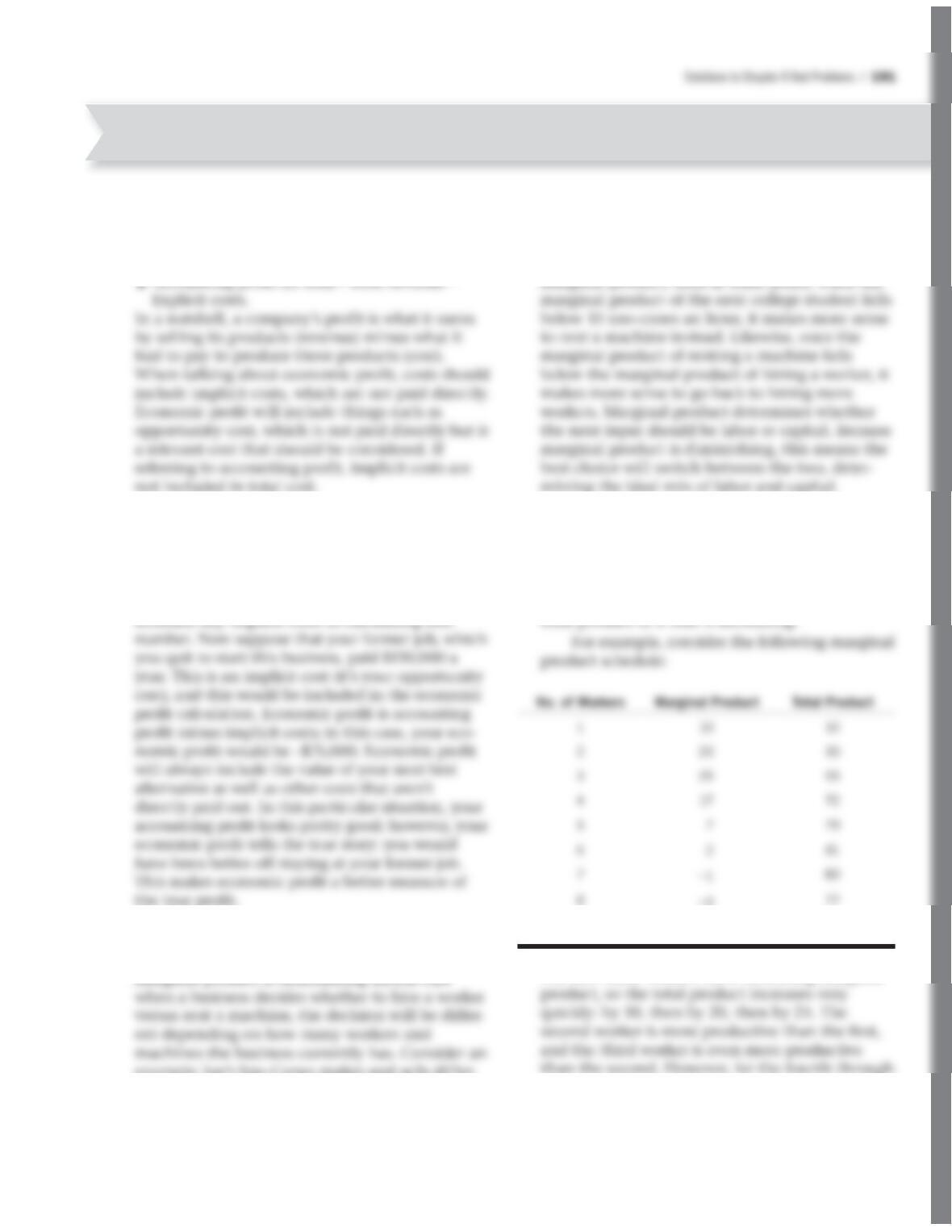
input of labor produces.
Input of Labor
Total Output of
Laptop Computers MP
000
14040
ninth workers, marginal product is negative. This
means that hiring that seventh worker actually
lowers the total product. The same is true for the
eighth and ninth workers.
5. Marginal cost directly determines average vari-
Hints and Common Errors: As long as
marginal cost is below average variable cost—
regardless of whether it is increasing or
decreasing— average variable cost is decreasing.
As soon as marginal cost rises above average
variable cost, average variable cost increases.
Think about this same concept in terms of your
GPA. As long as you are earning grades below
lope of the short- run cost curves; that is, it hugs
the very outside of the set of short- run cost curves.
7. Economies of scale: telephone companies. Tele–
phone companies should face economies of
scale— they lay out hundreds or thousands of
miles of cable, but the cost of servicing one addi-
tional customer is very cheap. If you or I tried to
sno– cone machine, which also costs $15/hour but
makes 15 sno- cones an hour. In this case, it
would make sense to hire the college student first.
However, if additional workers face diminishing
4. When marginal product is positive and increas-
ing, the total product of the firm is increasing at
an increasing rate. When marginal product is
positive but decreasing, the total product of the
firm is increasing (but at a decreasing rate). When
marginal product is negative (and decreasing), the
9671
sixth workers, marginal product is positive but
decreasing. So each new worker increases the
total product, but each one is less productive
than the one before her. For the seventh through
Questions for Review
1. ■ Economic profit (or loss) “ Total revenue Total
cost “ Total revenue Explicit costs Implicit costs.
2. Accounting profit may sometimes be misleading
in indicating how successful a com pany is. Eco–
nomic profit is not. Suppose you quit your job to
start your own business, and, in its first year, the
business pulls in an accounting profit of $75,000.
Sounds pretty good, doesn’t it? But you haven’t
3. Comparing the marginal product of labor with
the marginal product of capital will determine
the ideal mix of labor and capital. The fact that
example: Joe’s Sno- Cones makes and sells dif fer–
ent va ri e ties of sno- cones. Joe can hire a local col-
lege student to make sno- cones, which would cost
Joe $15/hour. The college student could make 20
sno– cones an hour. In contrast, Joe could rent a
Solutions to Chapterfi8 Text Prob lems
cattle having extra land to range over. But no
fence also means $50,000 $20,000 “ $30,000in
liability paid to the wheat farmer.
On balance, then, the lack of a fence makes
By contrast, if the homeowners association
prohibits debris piles, then the first homeowner
has to move the debris, regardless how much or
little stake his neighbor has in seeing that
Under the proposal, the builder faces the addi-
tional cost of procuring the 10 acres of artificial
toad habitat. If this additional cost is enough to
make the proj ect unprofitable, then the developer
will not move forward with the shopping center.
clean water versus the product(s) that this com-
pany produces. Let’s say the com pany is Apple
Inc., which produces iPhones, Apple watches,
iPads, and so on. The high transactions costs
view, choice a, “All parties connected with pollu-
tion should negotiate,” makes the most sense.
Hint and Common Errors: Some students
might be tempted to say “the com pany should be
regulation that prohibits firms from polluting the
water, they are free to dump their waste into the
river, although it makes no sense to do so.
13. a. The way the situation is described, the first
homeowner is within his rights to leave the
debris where it is, but the neighbor has an
incentive to pay to get the pile moved. She can
pay her neighbor, or a contractor, $300 to do the
job, and she can pay her neighbor a little extra
to ensure he goes along with the arrangement.
The outcome will be win- win, because the
$5,000. Realistically, he would instead just
absorb the $300 cost of relocating the debris.
Hints and Common Errors: Technically, a
free rider prob lem could occur with the
environmental benefits of riding bicycles rather
than driving if every one waits around for every-
one else to do the “right” thing, but this is a bit
your campus or community that does not
charge a price, we would expect some people
to ride the bus who other wise would not. In
the case of a college campus, a policy of not
7. If the roommates bargain in order to arrive at a
solution, one of two outcomes will likely occur. If
the roommate who plays Modern Warfare values
his gaming more than the other roommate values
Hints and Common Errors: Instructors
might get a number of unexpected answers to
this question, such as the roommates taking
turns or one roommate buying the other
headphones or something. These answers could
technically be correct and need to be considered
on an individual basis.
9. a. The tax, as taxes generally do, will reduce the
number of leaf blowers sold. In this case, the
quantity of leaf blowers will decrease to the
socially optimal quantity, as the $10 tax com-
10. It is ambiguous whether the proposed solution
will make the builder internalize the externality.
is distracting to another student. Other wise,
there is no externality here.
e. This activity generates a positive externality
b. This is a club good. You must purchase a ticket
to the game, so the event is excludable, but
once you are inside the arena, every fan can
see the game, so the viewing experience is
nonrival.
c. A Fourth of July fireworks show is a public
good because it’s nearly impossible to limit
consumption to paying customers (hence
nonexcludable), and one person watching the
fireworks doesn’t prevent another person from
being able to fully enjoy the same fireworks
(hence nonrival in consumption).
cination (hence rivalry in consumption).
f. Streetlights are a public good because con–
sumption is not limited to paying customers
(hence nonexcludable), and one person using
the streetlights doesn’t prevent another per–
son from being able to use the same street-
lights (hence nonrival in consumption).
4. Making cars safer might cause people to become
overconfident and thus drive more recklessly.
This reckless be hav ior could create negative exter–
account the overall societal effects when deciding
whether to have more children.
6. The four incentives of private property are the
7. Broadcast tele vi sion is nonrival because many
consumers can fully consume the same tele vi sion
broadcast. Broadcast tele vi sion is also nonexclud-
able because it isn’t limited to paying customers.
Economists call goods that share these character–
istics public goods.
Study Prob lems
1. In general, a government can improve societal
welfare by taxing activities that create negative
externalities. More specifically, the government
2. a. This is a negative externality because it
imposes a cost on you, even though you are
neither the producer nor the consumer of the
bridge.
Hints and Common Errors: It is pos si ble
that you are in fact a consumer of the bridge, but
this still counts as an externality because your
cost prob ably wasn’t factored into the cost– benefit
analy sis surrounding the bridge construction.
b. This is a negative externality because it
and the Coase theorem becomes less applicable as
bargaining gets more difficult.
3. Externalities can be internalized in three ways.
First, the government can enact specific rules that
external costs and benefits into their decision-
making pro cesses. Third, the government can
require that producers and consumers pay for the
damage they create, or it can pay producers and
consumers for the benefits they provide.
4. Cost– benefit analy sis does not only apply to pub-
lic goods. People use cost– benefit analy sis all the
time when deciding whether to consume private
goods; in other words, people consume private
5. The tragedy of the commons is a situation that
arises with common- resource goods. Because
these goods are rival in consumption but nonex–
cludable, people can use the goods without pay–
ing for them— and, therefore, without thinking
about what effect their consumption will have on
the ability of others to consume the good. The
tragedy of the commons occurs when this nonex–
cludability causes people to either overuse the
good (i.e., consume the amount that may be opti-
this case, the common- resource good (or
common resource) is Earth, and the ability to
Questions for Review
1. When positive externalities are pre sent, free mar–
kets don’t produce as much of an item as would
be socially optimal, as firms don’t necessarily
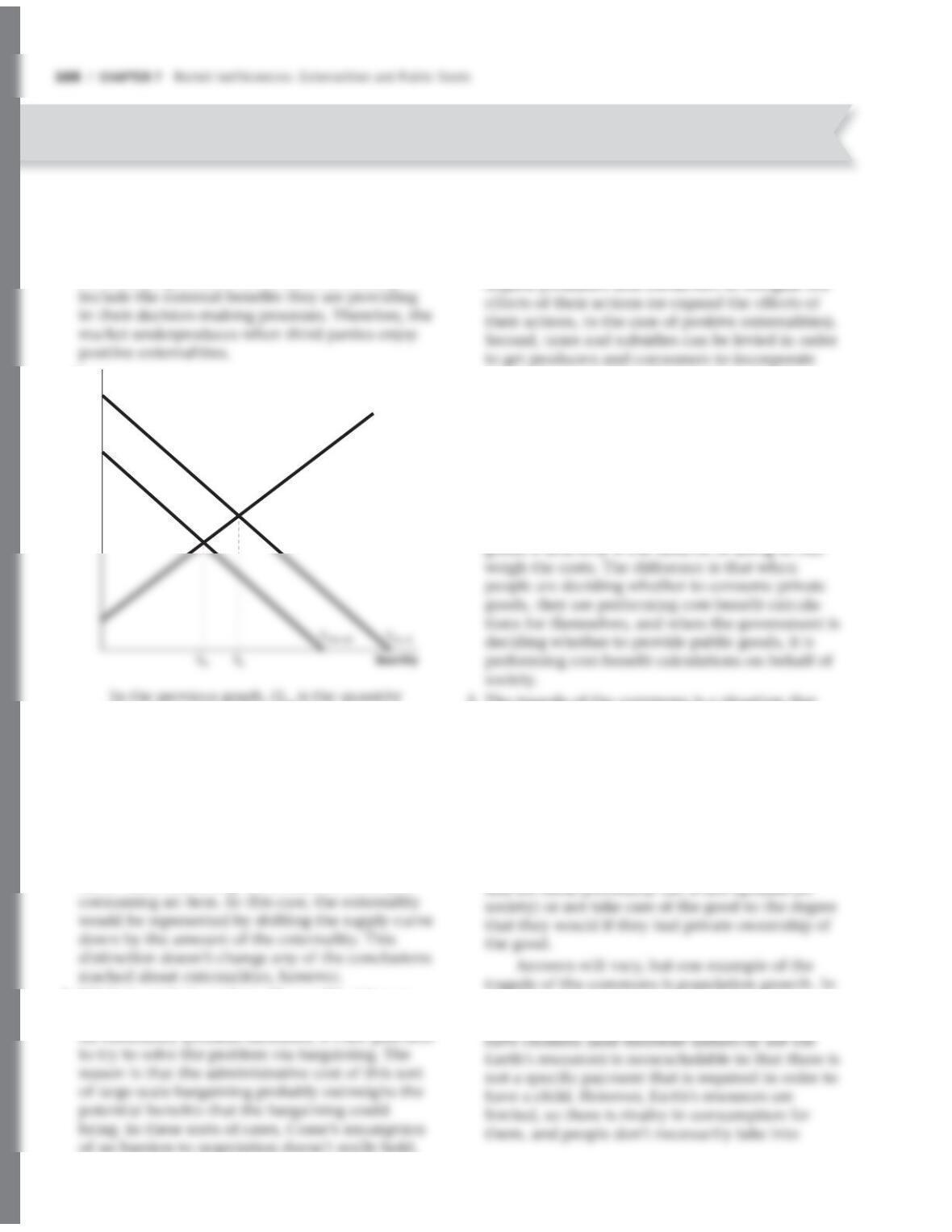
Price
Sinternal
that the market, left to itself, would produce, as it
is the result of the intersection of internal costs
and benefits. Qs is the socially optimal quantity
because it incorporates the external benefits to
society and considers the total social benefits of
consuming.
Hints and Common Errors: Technically,
positive externalities could affect markets by
lowering the cost to society of producing an item
rather than increasing the benefits to society of
2. While it might be technically pos si ble, it’s very
likely that as the number of parties involved in
Solutions to Chapterfi7 Text Prob lems
d. If the minimum wage is $6, the price floor is
nonbinding and therefore has no effect on
the market. So, the equilibrium wage and
prices at concession stands. If the government
were to regulate the prices of popcorn and other
items at movie theater concession stands, the
movie theaters would potentially go out of busi–
ness. Allowing movie theaters to profit from
higher prices on popcorn, drinks, and candies
12. a. Incorrect. Although there will be an increase
in the number of people wanting to rent,
there will be a decrease in the number of units
available, due to some prospective landlords
deciding that $750 per month is not enough
to justify renting out a unit. In other words,
quantity demanded will exceed quantity sup-
plied, and so there will be a shortage of one-
5. When local governments set the price too low,
they essentially create a price ceiling that results
in a shortage of parking spots, as more people
6. Communities lose jobs when a binding mini-
mum wage is enacted because the minimum
wage requirement causes firms to demand less
labor (as labor becomes more expensive), and
demand is the limiting factor when a price floor
8. a.
Q
D “ Q S
53,000,000 3,000,000W “ 10,000,000
6,000,000W
63,000,000 “ 9,000,000W
W
E “ $7
b.
QD “ 53,000,000 3,000,000(7) “ 32,000,000