Chapter 14: Distributions to Shareholders
Learning Objectives
401
Chapter 14
Distributions to Shareholders: Dividends and
Share Repurchases
Learning Objectives
After reading this chapter, students should be able to do the following:
◆ Explain why some investors like the firm to pay more dividends while other investors prefer
reinvestment and the resulting capital gains.
402
Lecture Suggestions
Chapter 14: Distributions to Shareholders
Lecture Suggestions
We like this chapter and generally cover it in its entirety, but it could be omitted in the introductory
course without loss of continuity. Or, sections such as stock dividends or stock repurchases could be
omitted.
DAYS ON CHAPTER: 3 OF 56 DAYS (50-minute periods)
Answers to End-of-Chapter Questions
14-1 The biggest advantage of having an announced dividend policy is that it would reduce investor
uncertainty, and reductions in uncertainty are generally associated with lower capital costs and
14-2 While it is true that the cost of outside equity is higher than that of retained earnings, it is not
necessarily irrational for a firm to pay dividends and sell stock in the same year. If the firm has
14-3 Logic suggests that stockholders like stable dividends—many of them depend on dividend
income, and if dividends were cut, this might cause serious hardship. If a firm’s earnings are
14-4 a. MM argue that dividend policy has no effect on rs, thus no effect on firm value and cost of
capital. On the other hand, GL argue that investors view current dividends as being less
risky than potential future capital gains. Thus, GL claim that rs is inversely related to
dividend payout.
14-5 a. From the stockholders’ point of view, an increase in the personal income tax rate would make
it more desirable for a firm to retain and reinvest earnings. Consequently, an increase in
personal tax rates should lower the aggregate payout ratio.
b. If the depreciation allowances were raised, cash flows would increase. With higher cash
flows, payout ratios would tend to increase. On the other hand, the change in tax-allowed
14-6 a. The residual dividend policy is based on the premise that, since new common stock is costlier
than retained earnings, a firm should use all the retained earnings it can to satisfy its
14-7 It is true that executives’ salaries are more highly correlated with the size of the firm than with
profitability. This being the case, it might be in management’s own best interest (assuming that
management does not have a substantial ownership position in the firm) to see the size of the
firm increase whether or not this is optimal from stockholders’ point of view. The larger the
14-8 The difference is largely one of accounting. In the case of a split, the firm simply increases the
number of shares and simultaneously reduces the par or stated value per share. In the case of a
14-9 It is sometimes argued that there is an optimum price for a stock; that is, a price at which WACC
will be minimized, giving rise to a maximum price for any given earnings. If a firm can use stock
dividends or stock splits to keep its shares selling at this price (or in this price range), then stock
14-10 a. True. When investors sell their stock, they are subject to capital gains taxes.
b. True. If a company’s stock splits 2 for 1, and you own 100 shares, then after the split you
will own 200 shares.
c. True. Dividend reinvestment plans that involve newly issued stock will increase the amount
14-11 Catering theory suggests that investors’ preference for dividends varies over time and that
corporations adapt dividend policy to “cater” to the current desires of investors. Consequently,
Solutions to End-of-Chapter Problems
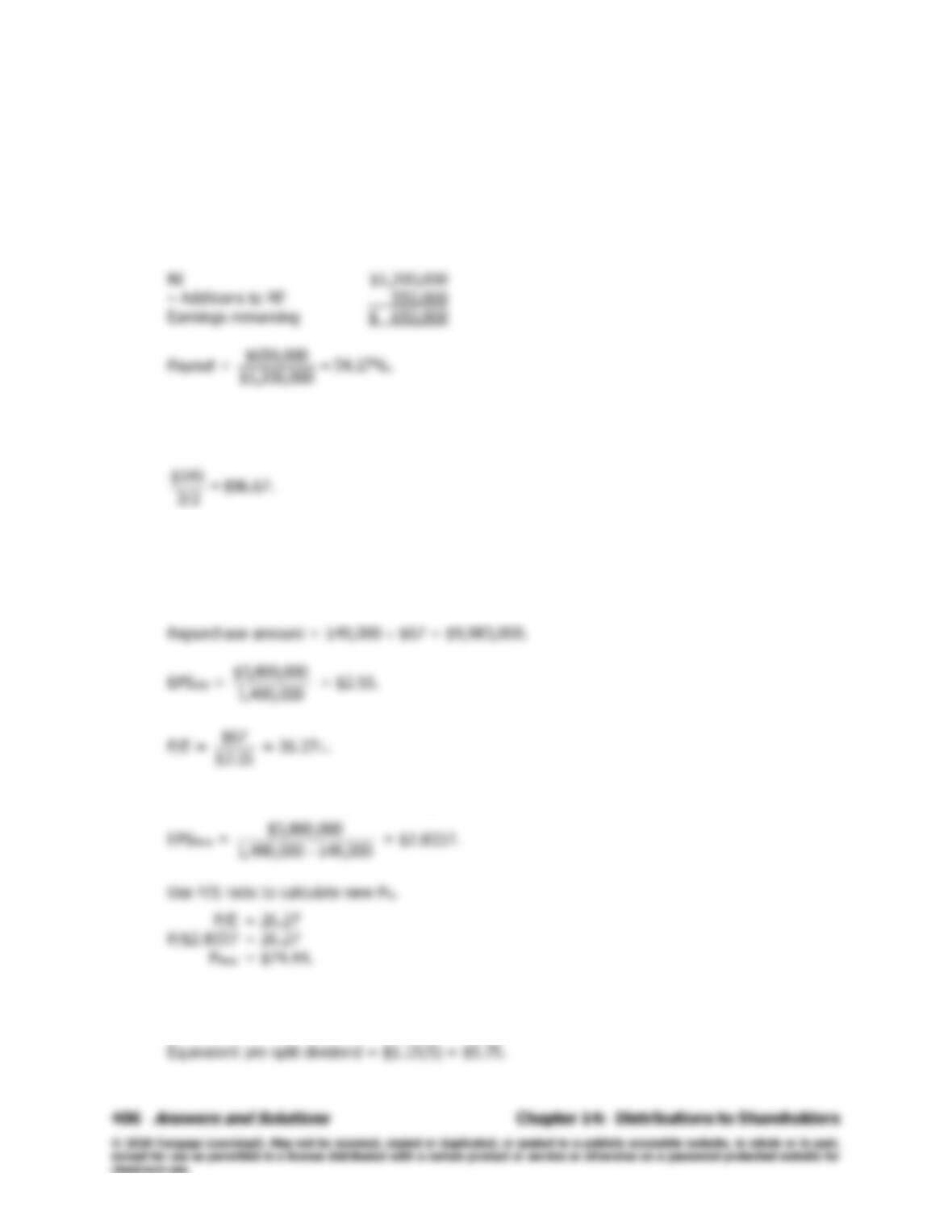
14-1 45% Debt; 55% Equity; Capital budget = $1,000,000; NI = $1,200,000; PO = ?
Equity retained = 0.55($1,000,000) = $550,000.
14-2 P0 = $145; Split = 3 for 2; New P0 = ?
14-3 NI = $3,800,000; Shares outstanding = 1,490,000; P0 = $67; Repurchase = 10%; New P0 = ?
Repurchase = 0.1 1,490,000 = 149,000 shares.
Need to determine stock price after repurchase. P/E remains at 26.27.
14-4 DPS after split = $1.15.
Chapter 14: Distributions to Shareholders
Answers and Solutions
407
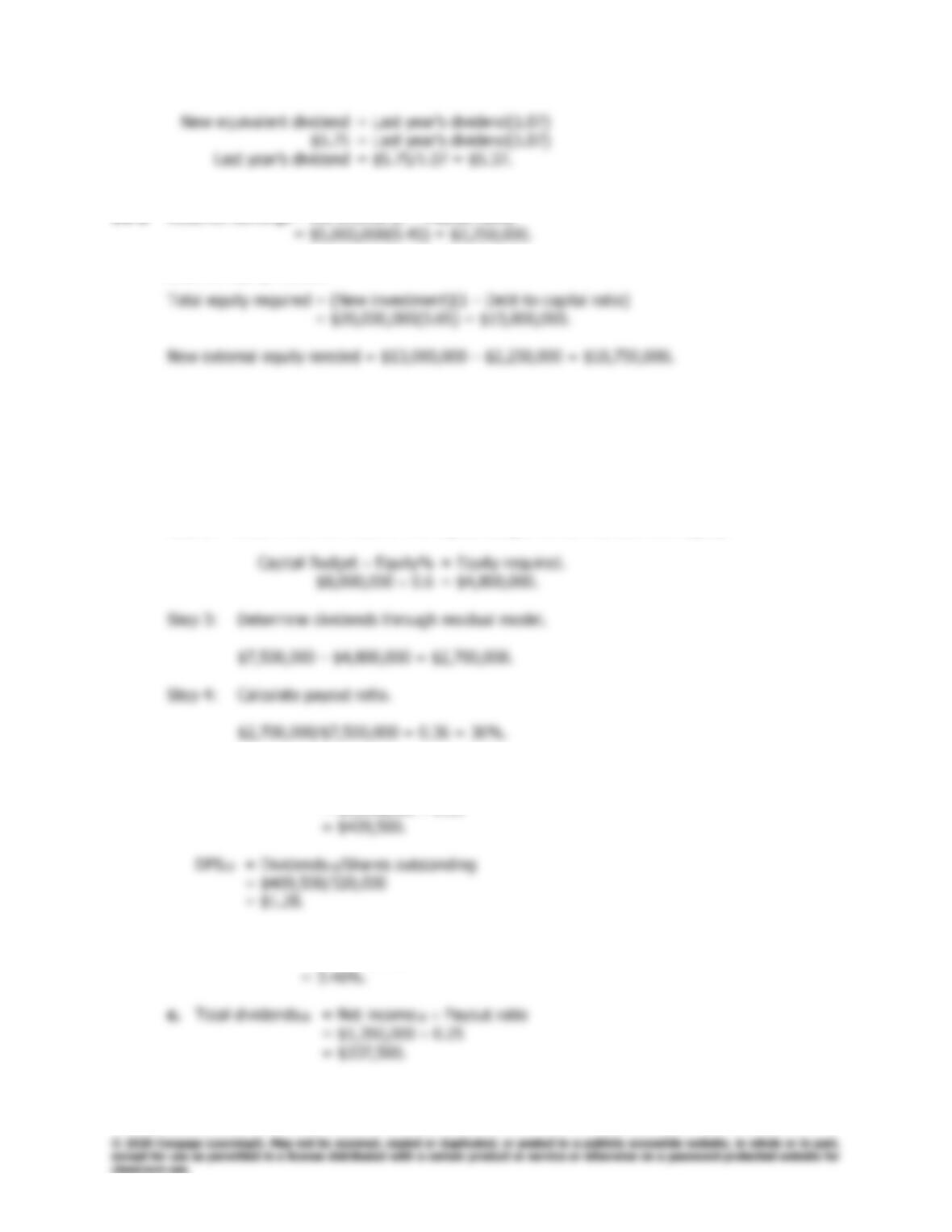
14-5 Retained earnings = Net income (1 – Payout ratio)
External equity needed:
14-6 Step 1: Determine the capital budget by selecting those projects whose returns are greater
than the project’s risk-adjusted cost of capital.
Projects H and M should be chosen because IRR > WACC, so the firm’s capital budget
= 2 × $4 million = $8 million.
Step 2: Determine how much of the capital budget will be financed with equity.
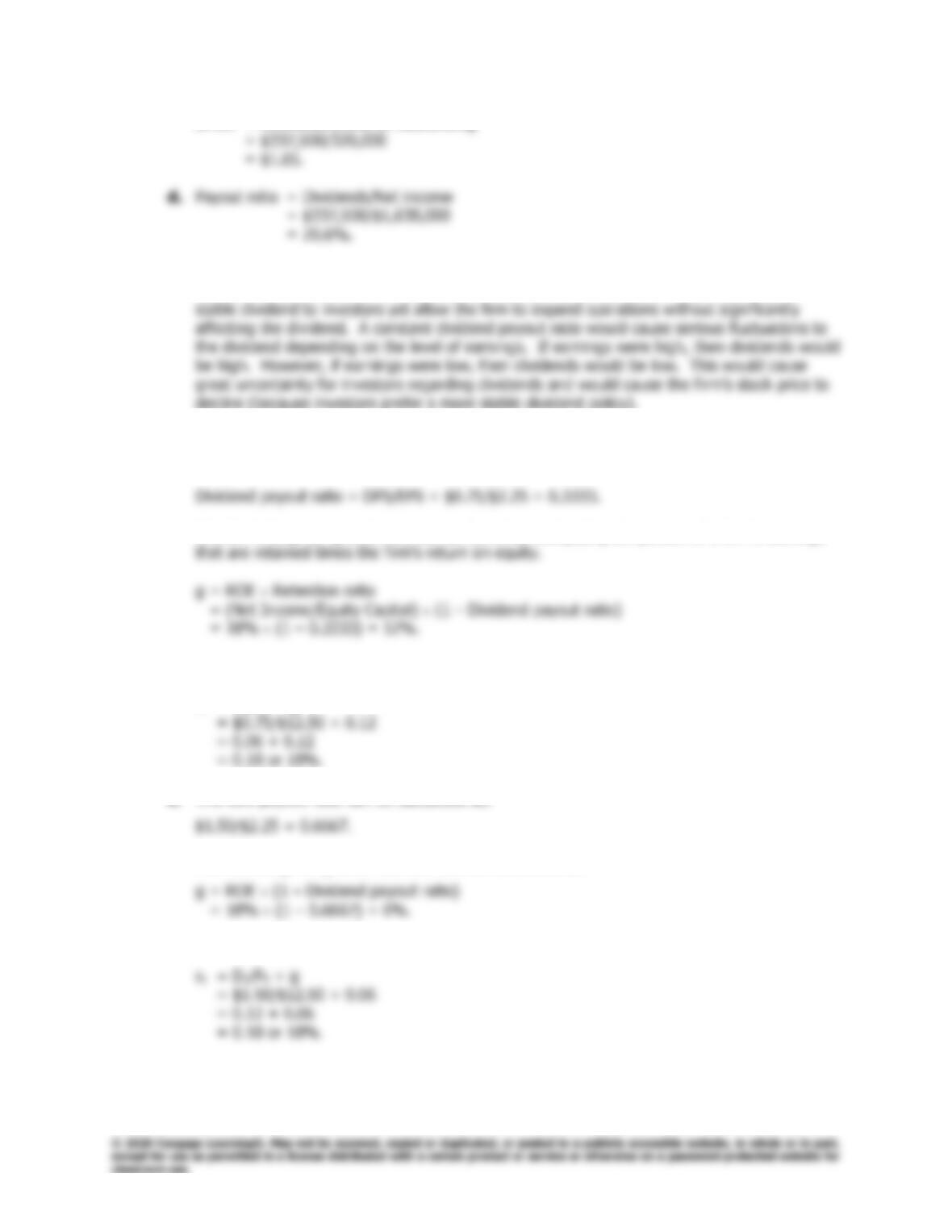
14-7 a. Total dividends19 = Net income19 Payout ratio
= $1,638,000 0.25
b. Dividend yield = DPS/P0
= $1.28/$37.00
408
Answers and Solutions
Chapter 14: Distributions to Shareholders
DPS18 = Dividends18/Shares outstanding
e. Since the company would like to avoid transactions costs involved in issuing new equity, it
would be best for the firm to maintain the same per-share dividend. This will provide a
14-8 a. Before finding the long-run growth rate, the dividend payout ratio must be determined.
The firm’s long-run growth rate can be found by multiplying the portion of a firm’s earnings
b. The required return can be calculated using the DCF approach.
rs = D1/P0 + g
c. The new payout ratio can be calculated as:
The new long-run growth rate can now be calculated as:
The firm’s required return would be:
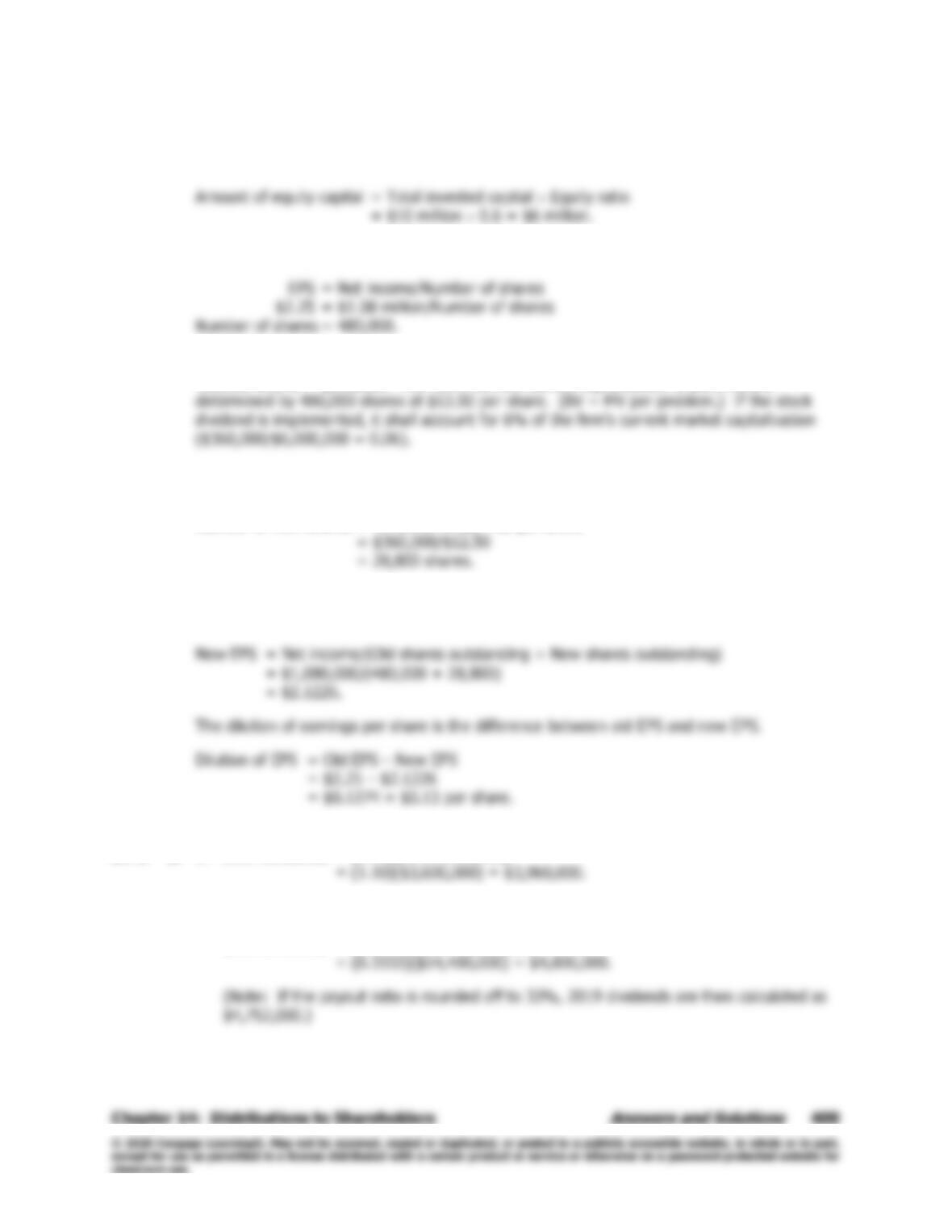
d. The firm’s original plan was to issue a dividend equal to $0.75 per share, which equates to a
total dividend of $0.75 times the number of shares outstanding. So, first the number of
shares outstanding must be determined from the EPS.
Net income = Equity capital ROE = $6 million 0.18 = $1.08 million.
With 480,000 shares outstanding, the total dividend that would be paid would be $0.75
480,000 shares = $360,000. The firm’s current market capitalization is $6.0 million,
e. If the total amount of value to be distributed to shareholders is $360,000, at a price of
$12.50 per share, then the number of new shares issued would be:
Number of new shares = Dividend value/Price per share
The stock dividend will leave the firm’s net income unchanged; therefore, the firm’s new EPS
is its net income divided by the new total number of shares outstanding.
14-9 a. 1. 2019 Dividends = (1.10)(2018 Dividends)
2. 2018 Payout = $3,600,000/$10,800,000 = 0.3333 = 331/3%.
2019 Dividends = (0.3333)(2019 Net income)
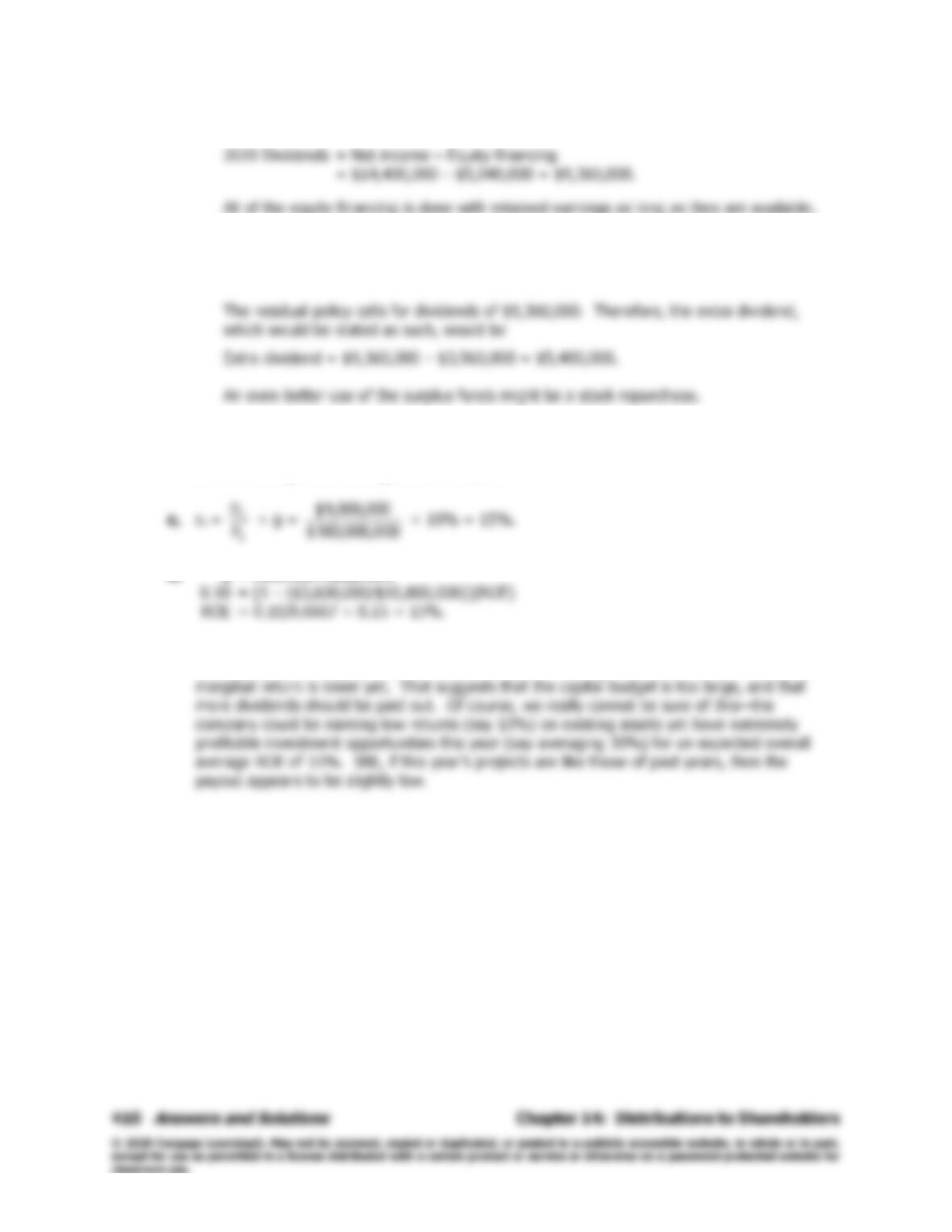
3. Equity financing = $8,400,000(0.60) = $5,040,000.
4. The regular dividends would be 10% above the 2018 dividends:
Regular dividends = (1.10)($3,600,000) = $3,960,000.
b. Policy 4, based on the regular dividend with an extra, seems most logical. Implemented
properly, it would lead to the correct capital budget and the correct financing of that budget,
and it would give correct signals to investors.
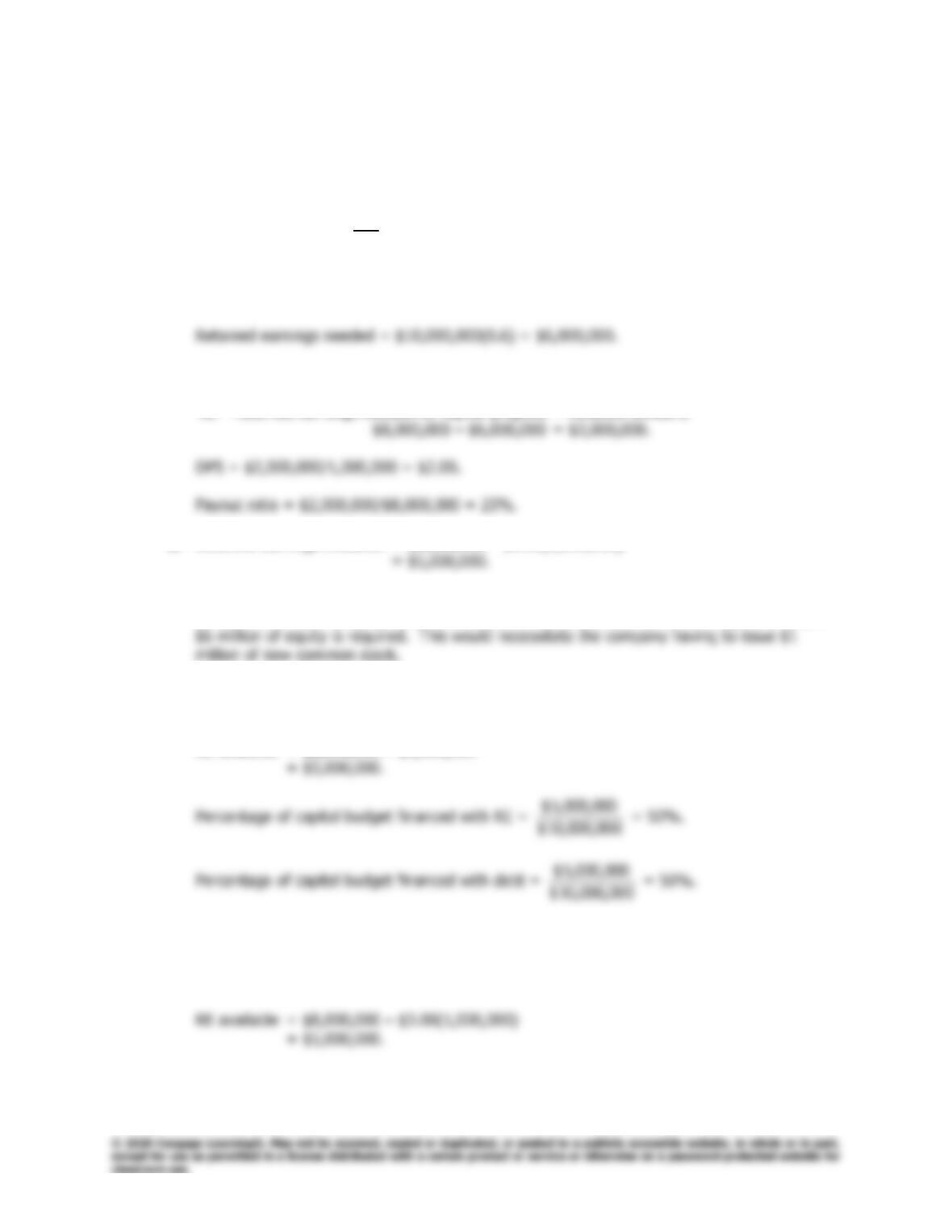
d. g = Retention rate(ROE)
e. A 2019 dividend of $9,000,000 may be a little low. The cost of equity is 15%, and the
average return on equity is 15%. However, with an average return on equity of 15%, the
Chapter 14: Distributions to Shareholders
Comprehensive/Spreadsheet Problem
411
Comprehensive/Spreadsheet Problem
Note to Instructors:
The solution to this problem is not provided to students at the back of their text. Instructors
can access the
Excel
file on the textbook’s website.
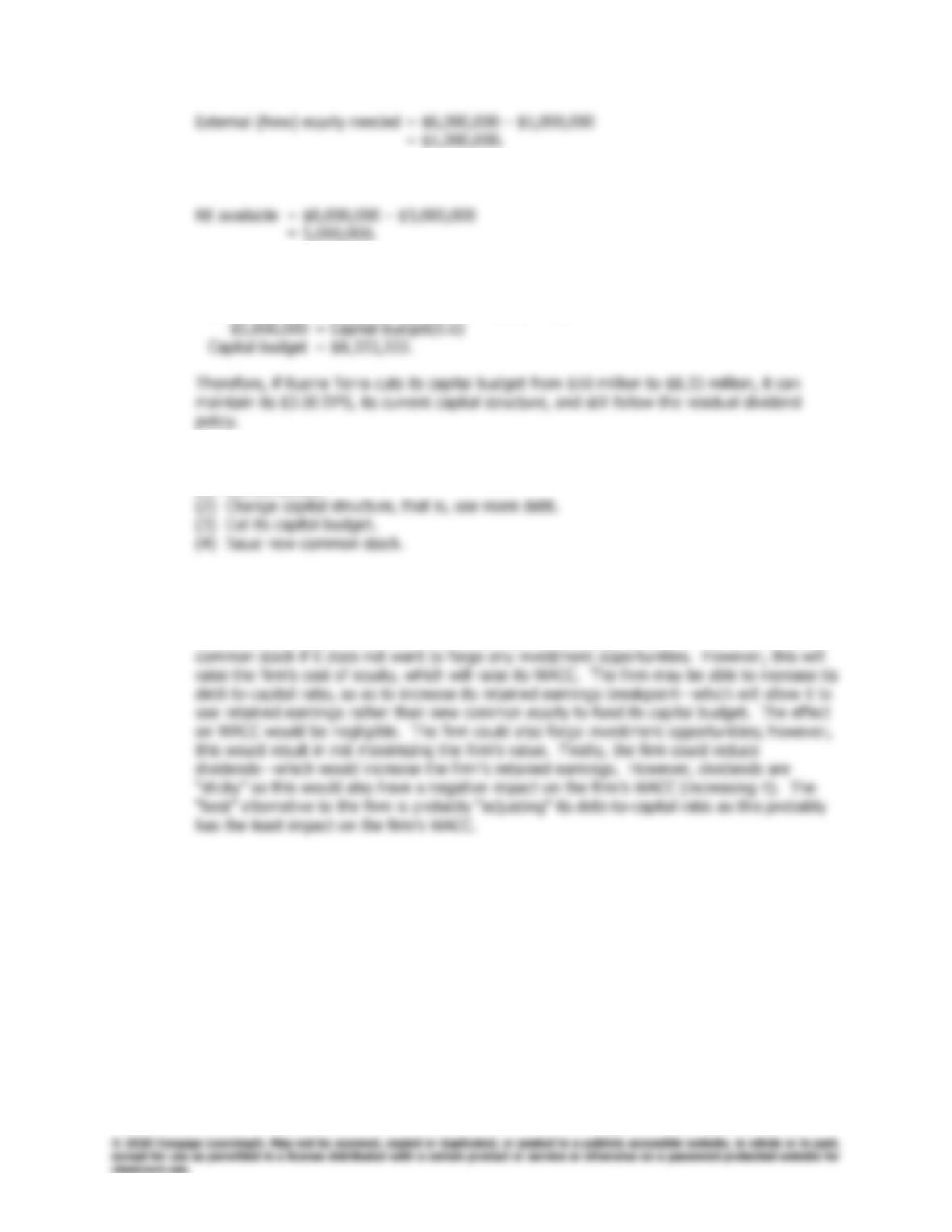
14–10 a. Capital budget = $10,000,000; Capital structure = 60% equity, 40% debt; Common shares
outstanding = 1,000,000.
b. According to the residual dividend model, only $2 million is available for dividends.
NI – Retained earnings needed for capital projects = Residual dividend
c. Retained earnings available = $8,000,000 – $3.00(1,000,000)
d. No. If the company maintains its $3.00 DPS, only $5 million of retained earnings will be
available for capital projects. However, if the firm is to maintain its current capital structure
e. Capital budget = $10 million; Dividends = $3 million; NI = $8 million;
Capital structure = ?
RE available = $8,000,000 – $3,000,000
f. Dividends = $3 million; Capital budget = $10 million; 60% equity, 40% debt; NI = $8
million.
Equity needed = $10,000,000(0.6) = $6,000,000.
412
Comprehensive/Spreadsheet Problem
Chapter 14: Distributions to Shareholders
g. Dividends = $3 million; NI = $8 million; Capital structure = 60% equity, 40% debt.
We’re forcing the RE available = Required equity to fund the new capital budget.
Required equity = Capital budget(Target equity ratio)
h. The firm can do one of four things:
(1) Cut dividends.
Realize that each of these actions is not without consequences to the company’s cost of
capital, stock price, or both.
If retained earnings are not sufficient to fund its capital budget, then the firm must issue new
Integrated Case
14–11
Southeastern Steel Company
Dividend Policy
Southeastern Steel Company (SSC) was formed 5 years ago to exploit a new
continuous casting process. SSC’s founders, Donald Brown and Margo Valencia,
had been employed in the research department of a major integrated-steel
company, but when that company decided against using the new process
(which Brown and Valencia had developed), they decided to strike out on their
A. (1) What is meant by the term dividend policy?
Answer: [Show S14-1 through S14-3 here.] Dividend policy is defined as the
firm’s policy with regard to paying out earnings as dividends versus