Chapter 14 – Rent, Interest, and Profit
14-1
Chapter 14 Rent, Interest, and Profit
QUESTIONS
1. How does the economist’s use of the term “rent” differ from everyday usage? Explain:
“Though rent need not be paid by society to make land available, rental payments are very useful
in guiding land into the most productive uses.” LO1
Answer: In everyday usage, “rent” is the term used to describe the payment that must be
paid for the legal borrowing of some good or service. One pays rent for the use of a
house or apartment; or one rents a tool from the equipment rental company. When
paying this rent one is paying for part of the capital cost of the commodity, plus its
2. Explain why economic rent is a surplus payment when viewed by the economy as a whole but
a cost of production from the standpoint of individual firms and industries. Explain: “Land rent
performs no ‘incentive function’ for the overall economy.” LO1
Answer: Land is completely fixed in total supply. As population expands and the
demand for land increases, rent first appears and then grows. From society’s perspective
this rent is a surplus payment unnecessary for ensuring that the land is available to the
3. In the 1980s land prices in Japan surged upward in a “speculative bubble.” Land prices then
fell for 11 straight years between 1990 and 2001. What can we safely assume happened to land
rent in Japan over those 11 years? Use graphical analysis to illustrate your answer. LO1
Answer: Given that the supply of land is perfectly inelastic, the drop in prices must have
Chapter 14 – Rent, Interest, and Profit
14-2
4. How does Henry George’s proposal for a single tax on land relate to the elasticity of the supply
of land? Why are there so few remaining advocates of George’s proposal? LO3
Answer: The supply of land is perfectly inelastic. Therefore, taxing returns on land (thus
changing its price) will not affect how much is available. Taxing other inputs would
5. If money is not an economic resource, why is interest paid and received for its use? What
considerations account for the fact that interest rates differ greatly on various types of loans? Use
those considerations to explain the relative sizes of the interest rates on the following: LO2
a. A 10‐year $1000 government bond.
b. A $20 pawnshop loan.
c. A 30‐year mortgage loan on a $175,000 house.
d. A 24‐month $12,000 commercial bank loan to finance the purchase of an automobile.
e. A 60‐day $100 loan from a personal finance company.
Answer: Though money is not in itself productive, it is useful for acquiring resources
that are productive. In borrowing money, businesses get the use of it to buy factories,
machines, and equipment that are productive and with which the businesses hope to make
Chapter 14 – Rent, Interest, and Profit
14-3
(d) A 24-month $12,000 commercial bank loan to finance the purchase of an automobile
will certainly have a higher interest rate than a government bond, but its risk is
reduced by the fact that the automobile serves as collateral for the loan. However,
the bank would rather get its money back than a used car, so the bank certainly does
not consider the loan risk-free. The loan is of a relatively large size; this will tend to
lower the interest rate. The outcome of these conflicting considerations is an interest
rate lower than for a straight, unsecured, consumer loan but higher than for a loan to
a well-established business.
6. Why is the supply of loanable funds upsloping? Why is the demand for loanable funds
downsloping? Explain the equilibrium interest rate. List some factors that might cause it to
change. LO2
Answer:
(a) The supply of loanable funds is upsloping because savers will make more funds
available at higher interest rates than lower interest.
Chapter 14 – Rent, Interest, and Profit
14-4
7. Here is the deal: You can pay your college tuition at the beginning of the academic year or the
same amount at the end of the academic year. You either already have the money in an
interest‐bearing account or will have to borrow it. Deal, or no deal? Explain your financial
reasoning. Relate your answer to the time-value of money, present value, and future value. LO4
Answer: The answer is you pay at the end of the academic year in both cases. For
demonstrative purposes consider the following values: Tuition is $10,000 and the interest
rate over the academic year is 10% (not an annual rate). If you already have the $10000
8. What are the major economic functions of the interest rate? How might the fact that many
businesses finance their investment activities internally affect the efficiency with which the
interest rate performs its functions? LO3
Answer: There are two major economic functions of the interest rate. (1) Interest rates
affect the level of domestic output as the monetary authorities deliberately vary them by
Chapter 14 – Rent, Interest, and Profit
14-5
9. Distinguish between nominal and real interest rates. Which is more relevant in making
investment and R&D decisions? If the nominal interest rate is 12 percent and the inflation rate is
8 percent, what is the real rate of interest? LO3
Answer: The nominal interest rate is the interest rate stated in dollars of current value
(unadjusted for inflation). The real interest rate is the nominal interest rate adjusted for
10. Historically, usury laws that put below‐equilibrium ceilings on interest rates have been used
by some states to make credit available to poor people who could not otherwise afford to borrow.
Critics contend that poor people are those most likely to be hurt by such laws. Which view is
correct? LO3
Answer: The critics are probably closer to the truth than the legislators. The relatively
high interest rates charged in a free market to those with little or no collateral to put up as
11. How do the concepts of accounting profit and economic profit differ? Why is economic profit
smaller than accounting profit? What are the three basic sources of economic profit? Classify
each of the following according to those sources: LO4
a. A firm’s profit from developing and patenting a new medication that greatly reduces
cholesterol and thus diminishes the likelihood of heart disease and stroke.
b. A restaurant’s profit that results from the completion of a new highway past its door.
c. The profit received by a firm due to an unanticipated change in consumer tastes.
Chapter 14 – Rent, Interest, and Profit
14-6
Answer: Accounting profit is what remains of a firm’s total revenues after it has paid for
all the factors of production employed by the firm (its explicit costs) but not for the use of
the resources owned by the business itself. Economists also take into consideration
12. Why is the distinction between insurable and uninsurable risks significant for the theory of
profit? Carefully evaluate: “All economic profit can be traced to either uncertainty or the desire to
avoid it.” What are the major functions of economic profit? LO4
Answer: An insurable risk does not fatally affect the profit and loss of a firm. The firm
insures against fire and theft and so on and then goes about its business, secure in the
knowledge that it cannot suffer an irreparable loss if one of the insured-against events
occurs.
Chapter 14 – Rent, Interest, and Profit
14-7
13. What is the combined rent, interest, and profit share of the income earned by Americans in a
typical year if proprietors’ income is included within the labor (wage) share? LO5
Answer: If proprietors’ income is included within the labor share of income, wages
14. LAST WORD Assume that you borrow $5000, and you pay back the $5000 plus $250 in
interest at the end of the year. Assuming no inflation, what is the real interest rate? What would
the interest rate be if the $250 of interest had been discounted at the time the loan was made?
What would the interest rate be if you were required to repay the loan in 12 equal monthly
installments?
Answer: Simple interest in the first case is 5 percent.
( )
1005000$/250$
PROBLEMS
1. Suppose that you own a 10‐acre plot of land that you would like to rent out to wheat farmers.
For them, bringing in a harvest involves $30 per acre for seed, $80 per acre for fertilizer, and $70
per acre for equipment rentals and labor. With these inputs, the land will yield 40 bushels of
wheat per acre. If the price at which wheat can be sold is $5 per bushel and if farmers want to
earn a normal profit of $10 per acre, what is the most that any farmer would pay to rent your 10
acres? What if the price of wheat rose to $6 per bushel? LO1
Chapter 14 – Rent, Interest, and Profit
14-8
Feedback: Consider the following example. You own a 10‐acre plot of land that you
would like to rent out to wheat farmers. For them, bringing in a harvest involves $30 per
acre for seed, $80 per acre for fertilizer, and $70 per acre for equipment rentals and labor.
With these inputs, the land will yield 40 bushels of wheat per acre. If the price at which
wheat can be sold is $5 per bushel and if farmers want to earn a normal profit of $10 per
acre, what is the most that any farmer would pay to rent your 10 acres?
To answer this question we begin by calculating the revenue generated per acre. A bushel
2. Suppose that the demand for loanable funds for car loans in the Milwaukee area is $10 million
per month at an interest rate of 10 percent per year, $11 million at an interest rate of 9 percent per
year, $12 million at an interest rate of 8 percent per year, and so on. If the supply of loanable
funds is fixed at $15 million, what will be the equilibrium interest rate? If the government
imposes a usury law and says that car loans cannot exceed 3 percent per year, how big will the
monthly shortage (or excess demand) for car loans be? What if the usury limit is raised to 7
percent per year? LO2
Chapter 14 – Rent, Interest, and Profit
14-9
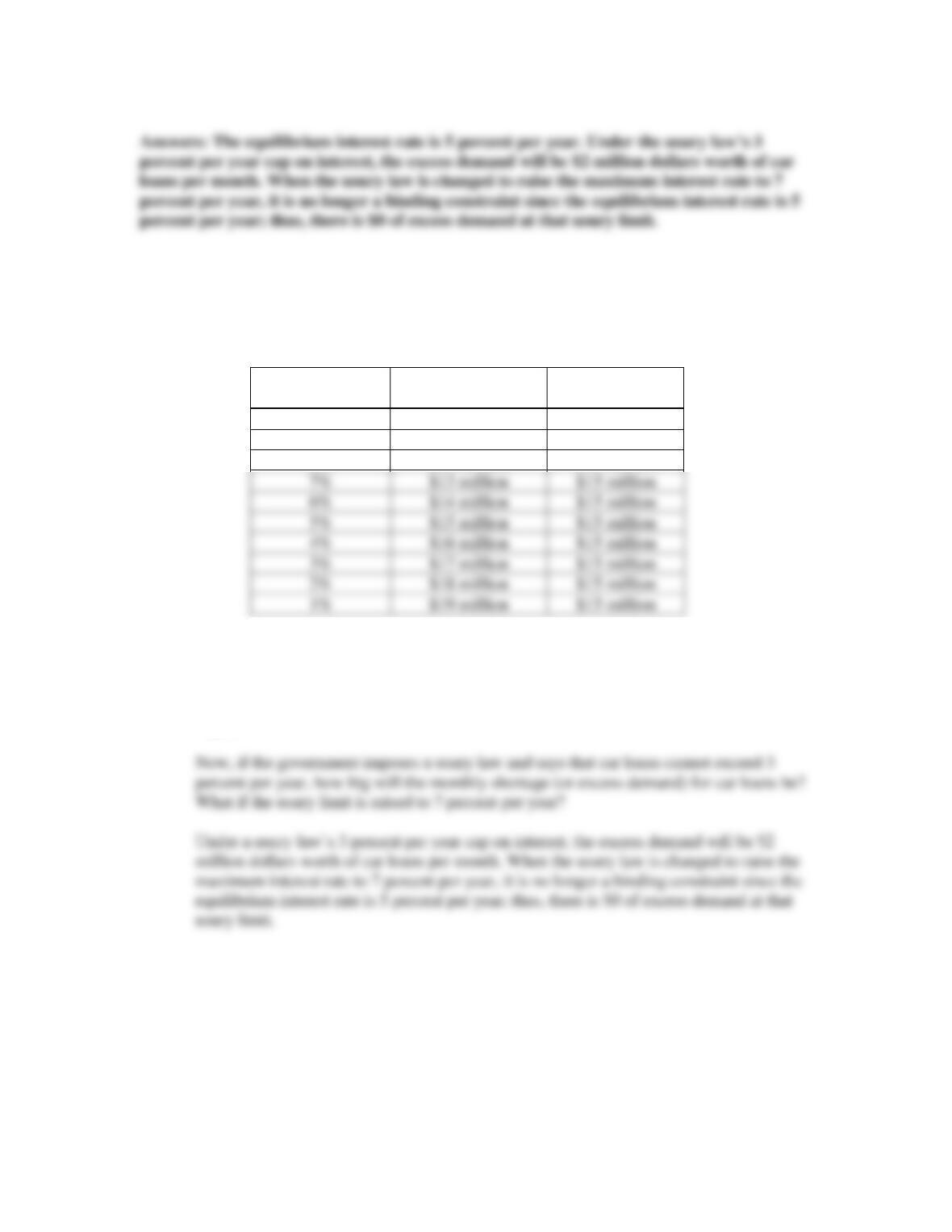
Feedback: Consider the following example. Suppose that the demand for loanable funds
for car loans in the Milwaukee area is $10 million per month at an interest rate of 10
percent per year, $11 million at an interest rate of 9 percent per year, $12 million at an
interest rate of 8 percent per year, and so on. Also assume the supply of loanable funds is
fixed at $15 million.
Interest rate on
Loan
Demand for
Loanable Funds
Supply of
Loanable Funds
10%
$10 million
$15 million
9%
$11 million
$15 million
8%
$12 million
$15 million
7%
$13 million
$15 million
6%
$14 million
$15 million
5%
$15 million
$15 million
4%
$16 million
$15 million
3%
$17 million
$15 million
2%
$18 million
$15 million
1%
$19 million
$15 million
The table above demonstrates that the demand for loanable funds increases by $1 million
for every 1% reduction in the interest rate.
The equilibrium interest rate occurs where the demand for loanable funds equals the
supply of loanable funds. This occurs at the interest rate of 5%.
3. To fund its wars against Napoleon, the British government sold consol bonds. They were
referred to as “perpetuities” because they would pay £3 every year in perpetuity (forever). If a
citizen could purchase a consol for £25, what would its annual interest rate be? What if the price
were £50? £100? Bonds are known as “fixed income” securities because the future payments that
they will make to investors are fixed by the bond agreement in advance. Do the interest rates of
bonds and other investments that offer fixed future payments vary positively or inversely with
their current prices? LO3
Chapter 14 – Rent, Interest, and Profit
14–10
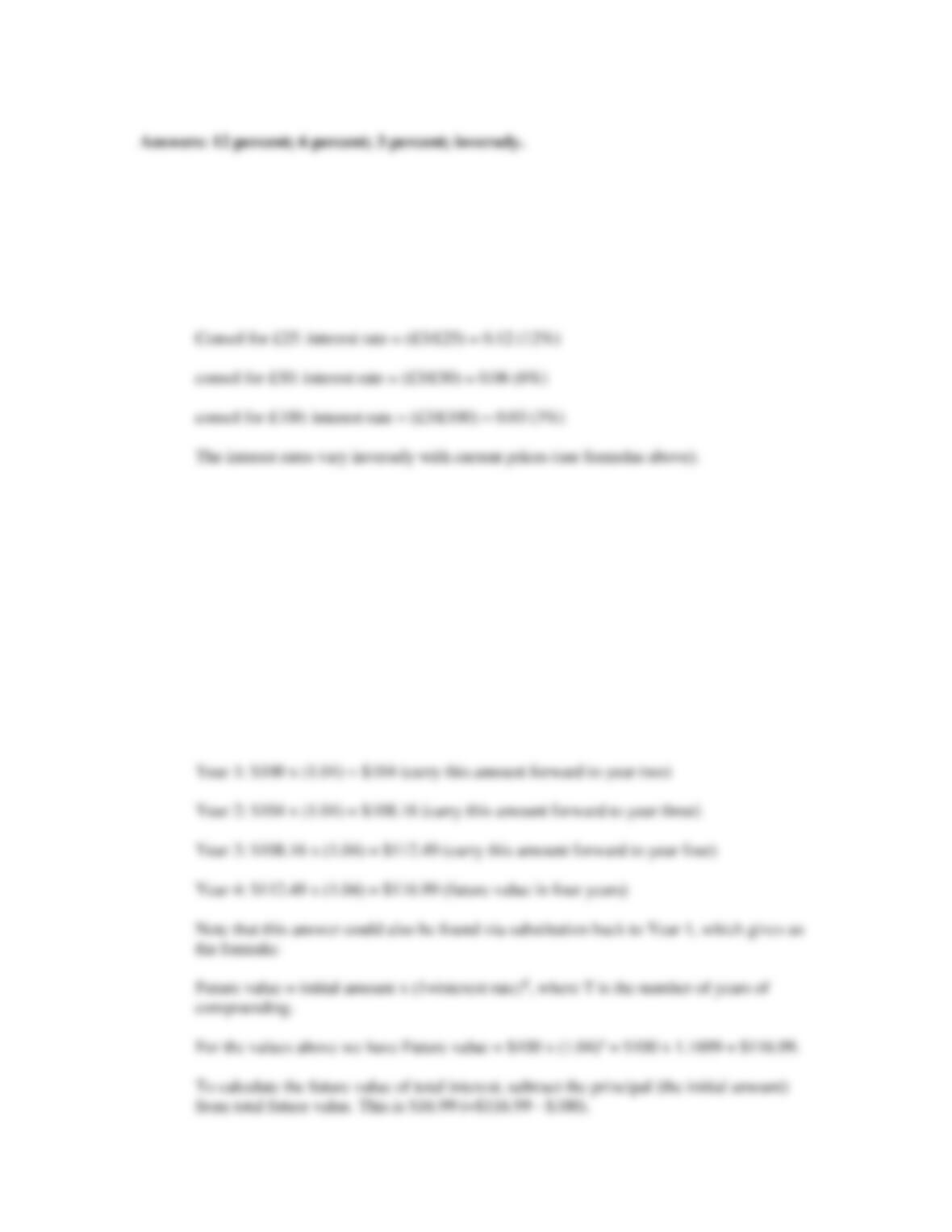
Feedback: To calculate the price of a perpetuity we use the formula, price =
(payment/interest rate), or to calculate the interest rate we use the formula, interest rate =
(payment/price).
Given the following payments (example): If a citizen could purchase a consol for £25,
what would its annual interest rate be? What if the price were £50? £100? Assume a
payment of £3 every year in perpetuity (forever).
4. Suppose that the interest rate is 4 percent. What is the future value of $100 four years from
now? How much of the future value is total interest? By how much would total interest be greater
at a 6 percent interest rate than at a 4 percent interest rate? LO3
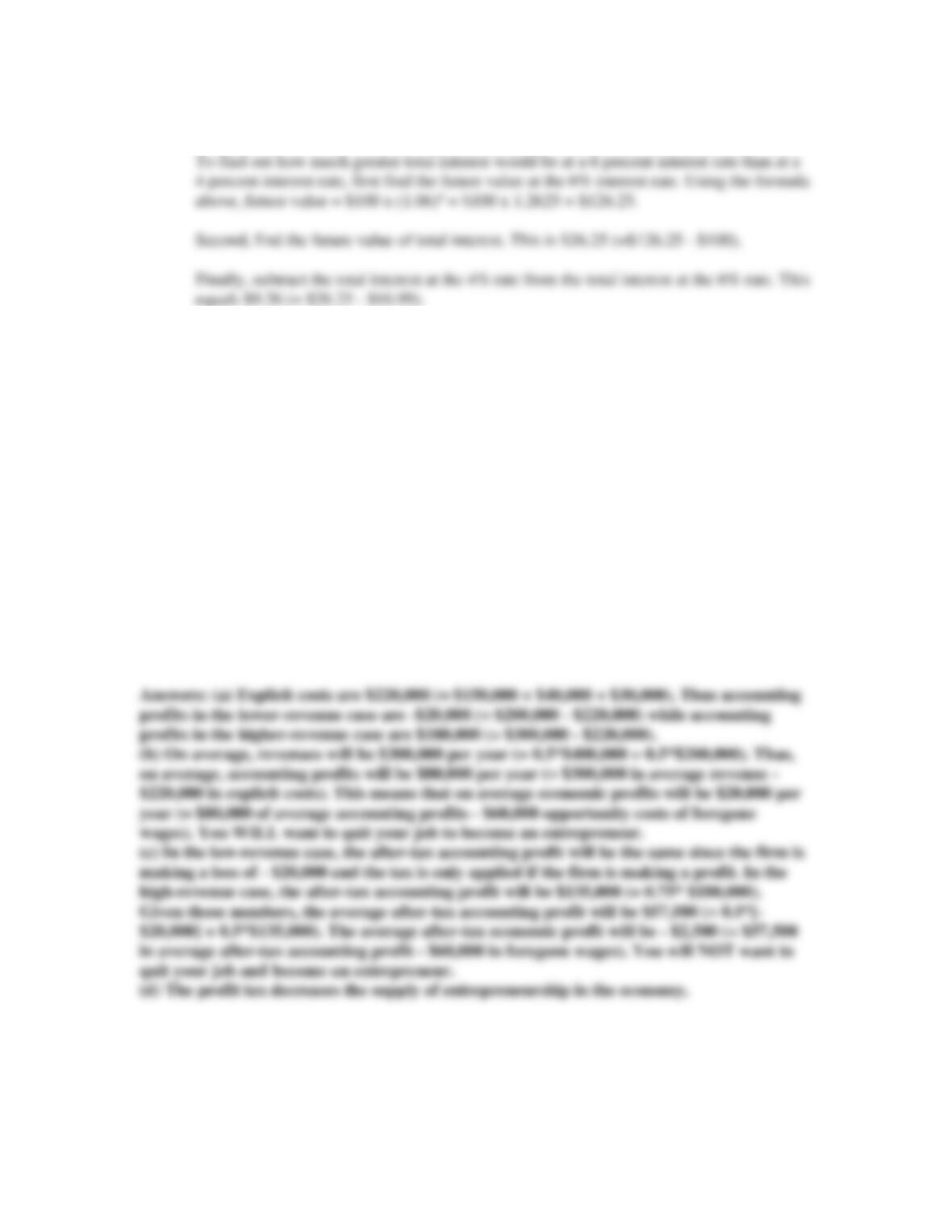
Answers: $116.99; $16.99; $9.26
Feedback: Consider the following example. Assume that the interest rate is 4 percent.
What is the future value of $100 four years from now? How much of the future value is
total interest? By how much would total interest be greater at a 6 percent interest rate than
at a 4 percent interest rate?
To calculate the future value of $100 four years from we compound the interest for the
four years. The future value for each successive year is:
Chapter 14 – Rent, Interest, and Profit
14–11
5. You are currently a worker earning $60,000 per year but are considering becoming an
entrepreneur. You will not switch unless you earn an accounting profit that is on average at least
as great as your current salary. You look into opening a small grocery store. Suppose that the
store has annual costs of $150,000 for labor, $40,000 for rent, and $30,000 for equipment. There
is a one‐half probability that revenues will be $200,000 and a one‐half probability that revenues
will be $400,000. LO4
a. In the low‐revenue situation, what will your accounting profit or loss be? In the high‐revenue
situation?
b. On average, how much do you expect your revenue to be? Your accounting profit? Your
economic profit? Will you quit your job and try your hand at being an entrepreneur?
c. Suppose the government imposes a 25‐percent tax on accounting profits. This tax is only levied
if a firm is earning positive accounting profits. What will your after-tax accounting profit be in
the low‐revenue case? In the high‐revenue case? What will your average after‐tax accounting
profit be? What about your average after‐tax economic profit? Will you now want to quit your
job and try your hand at being an entrepreneur?
d. Other things equal, does the imposition of the 25‐percent profit tax increase or decrease the
supply of entrepreneurship in the economy?
Chapter 14 – Rent, Interest, and Profit
14–12
Feedback: Consider the following example: You are currently a worker earning $60,000
per year but are considering becoming an entrepreneur. You will not switch unless you
can expect to earn a profit that is on average at least as great as your current salary. You
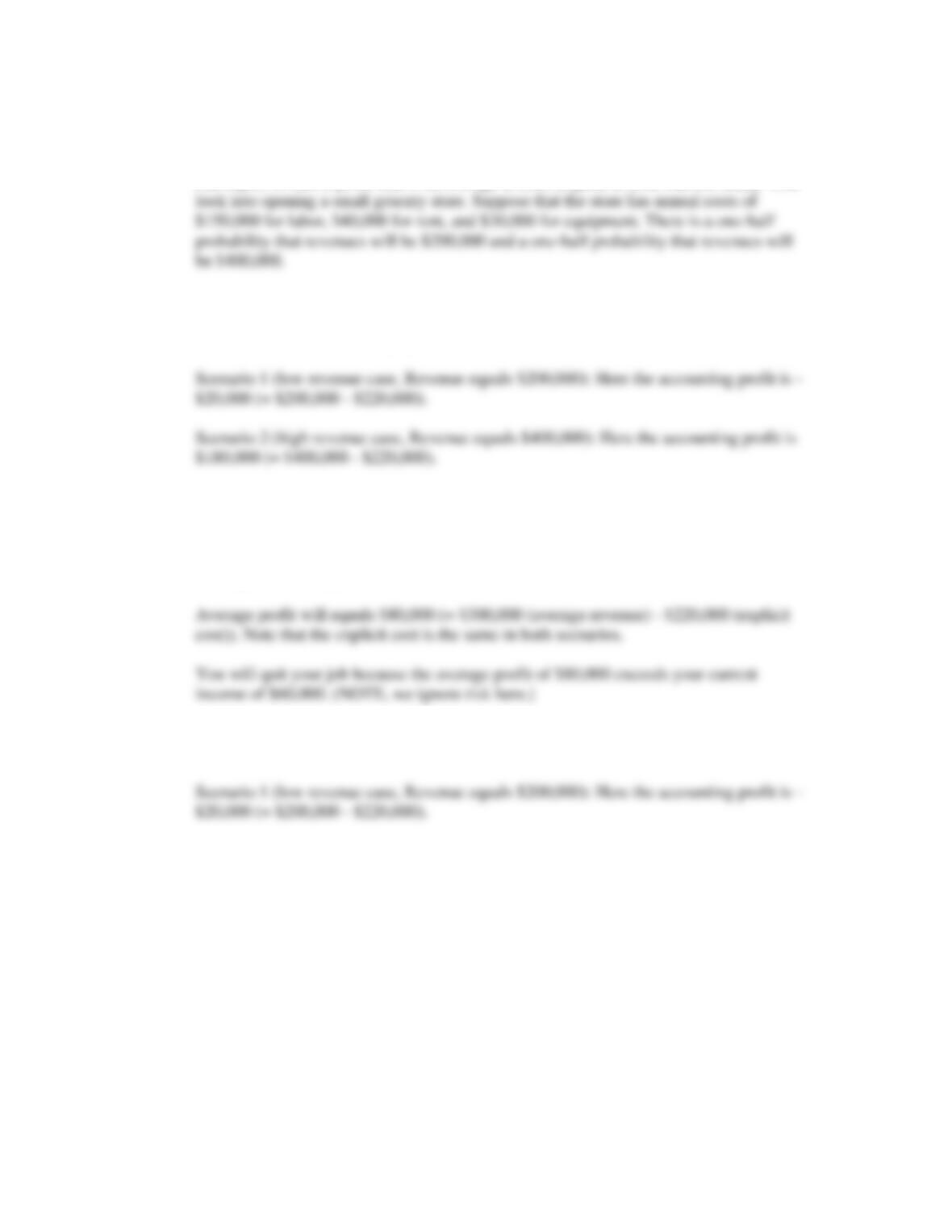
Part a: The accounting profit in each scenario equals revenue minus explicit costs. The
explicit costs in both cases (independent of state) equal $220,000 (= $150,000 (labor) +
$40,000 (rent) + $30,000 (equipment)).
Part b: The average revenue will be a weighted average of the two cases above, where
the weights are the probabilities of each case. Here we assume that each case, or scenario,
is equally likely (probability of 0.5 for each).
Average revenue equals $300,000 (= 0.5x$200,000 + 0.5x$400,000).
Part c: If the government were to impose a 25% tax on all accounting profits this would
only affect scenario 2. The government does not subsidize losses.
Chapter 14 – Rent, Interest, and Profit
14–13
Part d: Yes, the reduction in after-tax profits induces some individuals not to undertake
investments or decisions that are pre-tax profitable.