* * This is Chapter 31 in Economics.
A n s w e r s t o t h e R e v i e w Q u i z z e s
Page 352 (page 760 in Economics)
1. What are the objectives of monetary policy?
2. Are the goals of monetary policy in harmony or in conflict (a) in the long run and (b) in the short
run?
The monetary policy goals are essentially in harmony for the long run. In the long run, stable prices will
bring about maximum employment because firms and households can make the best possible decisions
3. What is the core inflation rate and how does it differ from the overall CPI inflation rate?
Page 354 (page 762 in Economics)
1. What is the Fed’s monetary policy instrument?
2. How is the federal funds rate determined in the market for reserves?
14
MONETARY
POLICY**
C h a p t e r
3. What are the main influences on the FOMC federal funds rate decision?
Though the Federal Reserve does not use an explicit formula to determine changes in its targeted
Page 363 (page 771 in Economics)
1. Describe the channels by which monetary policy ripples through the economy and explain how
each channel operates.
When the Federal Reserve lowers the federal funds rate, other short-term interest rates also fall. As a
result, the exchange rate falls because investors decrease their demand for U.S. dollars since the
2. Do interest rates fluctuate in response to the Fed’s actions?
3. How do the Fed’s actions change the exchange rate?
A change in the U.S. interest rate changes the U.S. interest rate differential. For example, a rise in the
U.S. interest rate, other things remaining the same, means that the U.S. interest rate differential
4. How do the Fed’s actions influence real GDP and how long does it take for real GDP to respond
to the Fed’s policy changes?
5. How do the Fed’s actions influence the inflation rate and how long does it take for inflation to
respond to the Fed’s policy changes?
The Fed’s actions affect the inflation rate and the price level by changing expenditure plans. For
M O N E T A R Y P O L I C Y 1 8 3
Page 367 (page 775 in Economics)
1. What are the three ingredients of a financial and banking crisis?
2. What are the policy actions taken by the Fed and the U.S. Treasury in response to the financial
crisis?
The Fed and the U.S. Treasury have undertaken eight policies designed to combat the financial crisis.
The Fed conducted massive open market operations to provide liquidity to banks. To provide liquidity
3. Why was the recovery from the 2008–2009 recession so slow?
4. How might inflation targeting improve the Fed’s monetary policy?
5. How might using the Taylor rule improve the Fed’s monetary policy?
The Taylor rules is a formula that sets the federal funds rate according to the inflation rate and the
1 8 4 C H A P T E R 1 4
A n s w e rs t o t he S t u dy P l an P ro b l e m s a n d A pp li c at io n s
1. “Unemployment is a more serious economic problem than inflation and it should be the focus of
the Fed’s monetary policy.” Evaluate this statement and explain why the Fed’s primary policy goal
is price stability.
The Fed’s primary goal is price stability because price stability helps the Fed reach all three of its goals
2. “Monetary policy is too important to be left to the Fed. The President should be responsible for
it.” How is responsibility for monetary policy allocated among the Fed, the Congress, and the
President?
The Fed has primary responsibility for the nation’s monetary policy. It is the FOMC that decides upon
3. Fed’s Easing Has Little Impact So Far
The Federal Reserve’s latest easing program may be nicknamed “QE Infinity” on Wall Street, but
it’s having a limited effect on the economy so far.
Source: cnbc.com, October 3, 2012
a. What does the Federal Reserve Act of 2000 say about the Fed’s control of the quantity of
money?
b. How can the massive increase in the monetary base resulting from “quantitative easing” or QE
be reconciled with the Federal Reserve Act of 2000?
4. What are the two possible monetary policy instruments, which one does the Fed use, and how
has its value behaved since 2000?
The Fed could use either the monetary base or the federal funds rate as its monetary policy instrument.
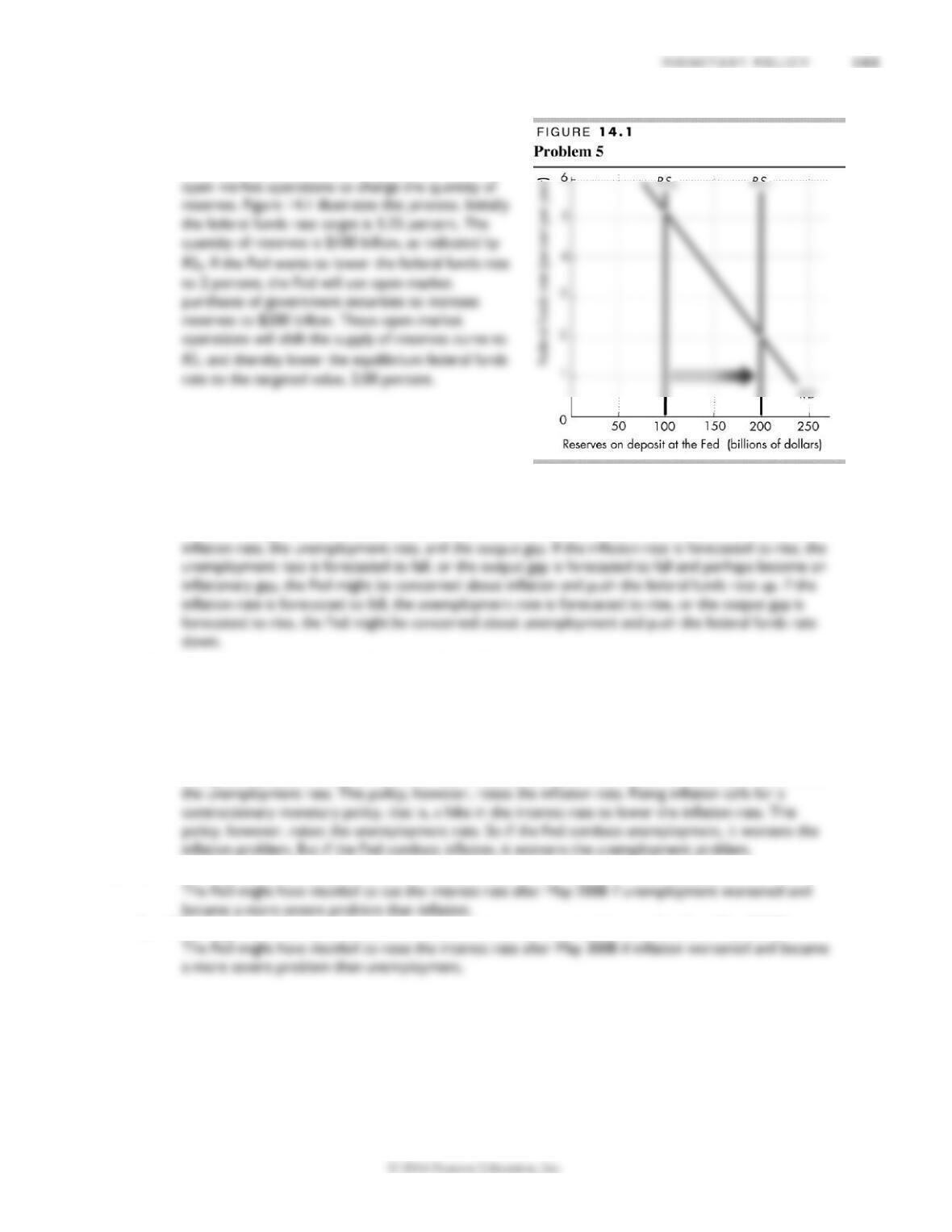
5. How does the Fed hit its federal funds rate target?
Illustrate your answer with an appropriate graph.
To hit its federal funds rate target, the Fed uses
6. What does the Fed do to determine whether the federal funds rate should be raised, lowered, or
left unchanged?
The Fed changes in the federal funds rate based on its forecasts of the three economic variables: the
Use the following news clip to work Problems 7 and 8.
Fed Sees Unemployment and Inflation Rising
It is May 2008 and the Fed is confronted with a rising unemployment rate and rising inflation.
Source: CNN, May 21, 2008
7. Explain the dilemma faced by the Fed in May 2008.
Rising unemployment calls for expansionary monetary policy, that is, a cut in the interest rate to lower
8. a. Why might the Fed decide to cut the interest rate in the months after May 2008?
b. Why might the Fed have decided to raise the interest rate in the months after May 2008?
1 8 6 C H A P T E R 1 4
Use the following data to work Problems 9 to 11.
The Bureau of Economic Analysis reported that
business investment in the second quarter of 2012 was
$1,483 billion, $97 billion less than in 2008.
9. Explain the effects of the Fed’s low interest rates
on business investment and use a graph to
illustrate your explanation.
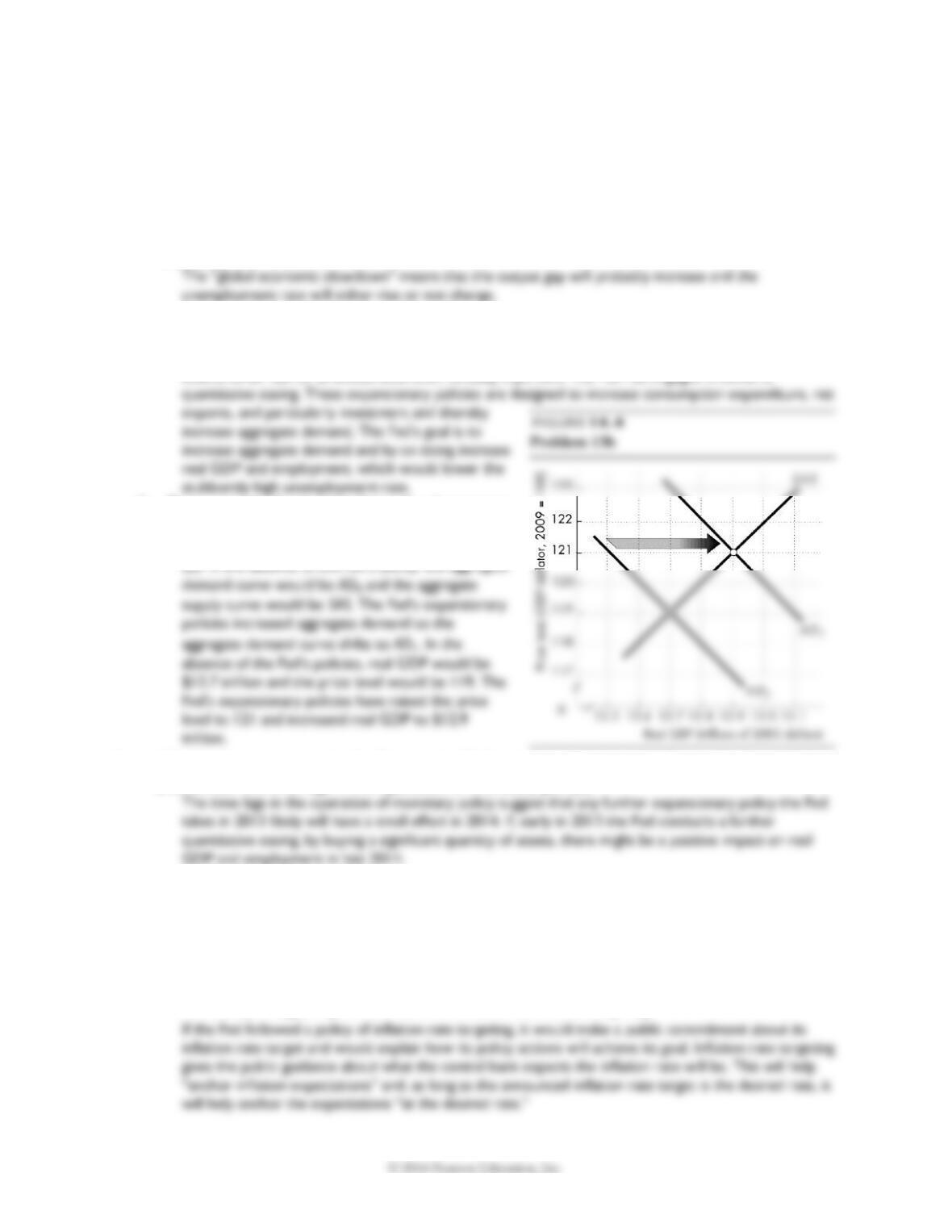
The low interest rates are achieved by increasing
10. Explain the effects of business investment on
aggregate demand. Would you expect it to have a
multiplier effect? Why or why not?
The increase in investment increases aggregate
11. What actions might the Fed take to stimulate
business investment further?
The Fed might commit to keeping the inflation
M O N E T A R Y P O L I C Y 1 8 7
Use the following news clip to work Problems 12 to 14.
IMF Warns Global Economic Slowdown Deepens, Prods U.S., Europe
The IMF said the global economic slowdown is worsening and warned U.S. and European policymakers
that failure to fix their economic ills would prolong the slump.
Source: Reuters, October 9, 2012
12. If the IMF forecasts turn out to be correct, what would most likely happen to the output gap and
unemployment in 2013?
13. a. What actions taken by the Fed in 2011 and 2012 would you expect to have influenced real GDP
growth in 2013? Explain how those policy actions would transmit to real GDP.
The Fed has undertaken monetary stimulus of almost historic proportions. The Fed has driven the
federal funds rate to its lowest level ever, virtually 0 percent. The Fed has engaged in bouts of
b. Draw a graph of aggregate demand and aggregate
supply to illustrate your answer to part (a).
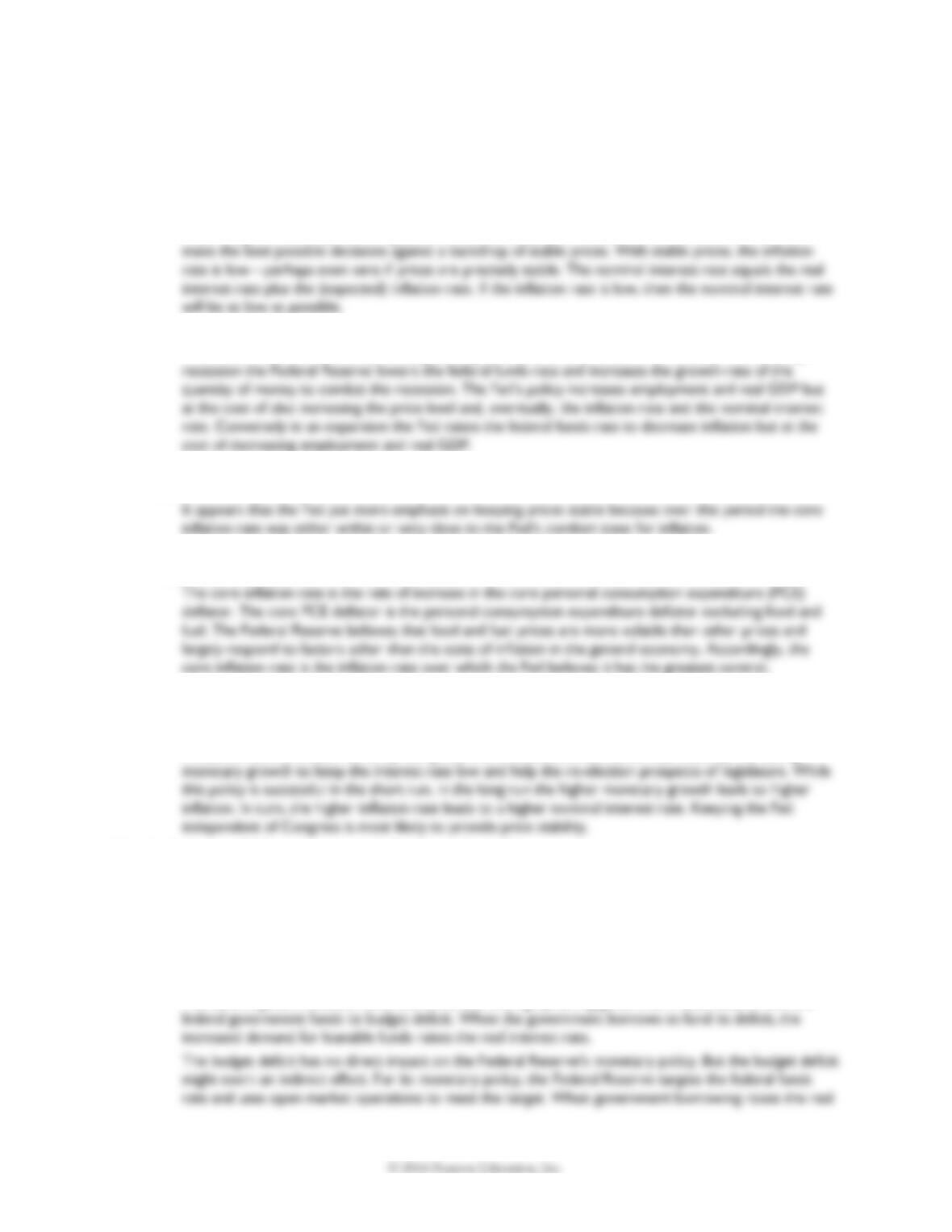
Figurer 14.4 shows the outcome described in part
(b). In the absence of the Fed’s policy, the aggregate
14. What further actions might the Fed take in 2013 to influence the real GDP growth rate in 2014?
(Remember the time lags in the operation of monetary policy.)
15. Prospects Rise for Fed Easing Policy
William Dudley, president of the New York Fed, raised the prospect of the Fed becoming more
explicit about its inflation goal to “help anchor inflation expectations at the desired rate.”
Source: ft.com, October 1, 2010
What monetary policy strategy is Mr. Dudley raising? How does inflation targeting work and
why might it “help anchor inflation expectations at the desired rate”?
Mr. Dudley is suggesting that the Fed move toward inflation rate targeting.
1 8 8 C H A P T E R 1 4
Answers to Additional Problems and Applications
Use the following information to work Problems 16 to 18.
The Fed’s mandated policy goals are “maximum employment, stable prices, and moderate long-term
interest rates.”
16. Explain the harmony among these goals in the long run.
In the long run, stable prices bring about maximum employment because firms and households can
17. Explain the conflict among these goals in the short run.
In the short run, the monetary policy goals might conflict with each other. In the short run, during a
18. Based on the performance of U.S. inflation and unemployment, which of the Fed’s goals appears
to have taken priority since 2000?
19. What is the core inflation rate and why does the Fed regard it as a better measure on which to
focus than the CPI?
20. Suppose Congress decided to strip the Fed of its monetary policy independence and legislate
interest rate changes. How would you expect the policy choices to change? Which arrangement
would most likely provide price stability?
If interest rates are determined by Congress, there would be a bias toward persistently increasing
Use the following CBO report to work Problems 21 to 23.
Fiscal 2012 Deficit: Smaller, But Still Big
The budget deficit was about $1.1 trillion in fiscal year 2012, CBO estimates. That is about $200 billion
smaller than in 2011, but still ranks as the fourth-largest deficit since World War II.
Source: Congressional Budget Office
21. How does the federal government get funds to cover its budget deficit? How does financing the
budget deficit affect the Fed’s monetary policy?
The federal government borrows the funds. Borrowing, by selling government securities, is how the
M O N E T A R Y P O L I C Y 1 8 9
22. How was the budget deficit of 2012 influenced by the Fed’s low interest rate policy?
23. a. How would the budget deficit change in 2013 and 2014 if the Fed moved interest rates up?
b. How would the budget deficit change in 2013 and 2014 if the Fed’s monetary policy led to a
rapid depreciation of the dollar?
A rapid depreciation of the dollar can have two effects on the budget deficit. First it can increase the
U.S. inflation rate. With the increase in the inflation rate, inflation expectations would increase, thereby
24. The Federal Reserve Act of 2000 instructs the Fed to pursue its goals by “maintain[ing] long-run
growth of the monetary and credit aggregates commensurate with the economy’s long-run
potential to increase production.”
a. Has the Fed followed this instruction?
b. Why might the Fed increase money by more than the potential to increase production?
25. Looking at the federal funds rate since 2000, identify periods during which, with the benefit of
hindsight, the rate might have been kept too low. Identify periods during which it might have been
too high.
Some analysts assert that the federal funds rate was too low during the period from 2001 to 2005.
During this period house prices skyrocketed. It was the following rapid fall in house prices, starting in
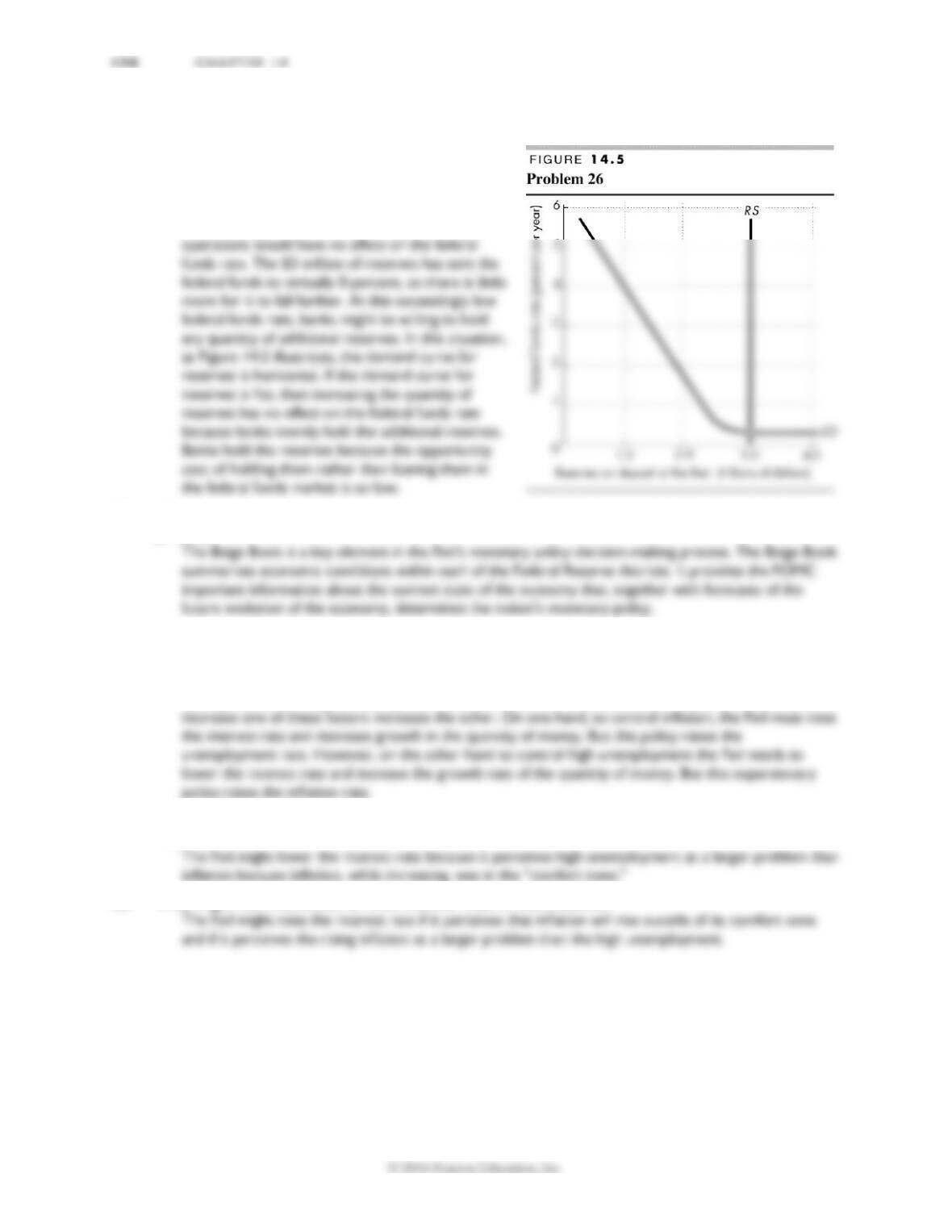
26. Now that the Fed has created $3 trillion of bank reserves, how would you expect a further open
market purchase of securities to influence the
federal funds rate? Why? Illustrate your answer
with an appropriate graph.
The Fed’s immense creation of $3 trillion of bank
reserves might mean that further open market
27. What is the Beige Book and what role does it play in the Fed’s monetary policy decision-making
process?
To work Problems 28 to 30, use the information that during 2012 the inflation rate increased but
remained in the “comfort zone” and the unemployment rate remained high.
28. Explain the dilemma that rising inflation and high unemployment poses for the Fed.
Raising inflation and high unemployment pose a dilemma for the Fed because the policy necessary to
29. Why might the Fed decide to try to lower interest rates (or stimulate in other ways) in this
situation?
30. Why might the Fed decide to raise interest rates in this situation?
M O N E T A R Y P O L I C Y 1 9 1
Use the following information to work Problems 31 to 33.
From 2009 through 2012, the long-term real interest rate paid by the safest U.S. corporations fell from 4
percent to 2 percent. During that same period, the federal funds rate was roughly constant at 0.25
percent a year.
31. What role does the long-term real interest rate play in the monetary policy transmission process?
32. How does the federal funds rate influence the long-term real interest rate?
The long-term interest rate is an expected average of short-term interest rates. People can either
borrow or save by making a long-term commitment or by making successive short-term commitments.
33. What do you think happened to inflation expectations between 2009 and 2012 and why?
34. Dollar Reaches New Low vs. Yen
Traders continued to make bets in favor of the yen, sending the dollar to a record low against the
Japanese currency.
Source: The Wall Street Journal, August 20, 2011
a. How do “bets in favor of the yen” influence the exchange rate?
b. How does the Fed’s monetary policy influence the exchange rate?
The Fed’s monetary policy affects U.S. interest rates, which affect the exchange rate. For example, if
1 9 2 C H A P T E R 1 4
Use the following news clip to work Problems 35 and 36.
Top Economist says America Could Plunge into Recession
Robert Shiller, Professor of Economics at Yale University, predicted that there was a very real possibility
that the United States would be plunged into a Japan-style slump, with house prices declining for years.
Source: timesonline.co.uk, December 31, 2007
35. If the Fed had agreed with Robert Shiller in December 2007, what actions might it have taken
differently from those it did take? How could monetary policy prevent house prices from falling?
By December 2007 the Fed was already starting to respond to what would become the financial crisis
36. Describe the time lags in the response of output and inflation to the policy actions you have
prescribed.
The lags between the Fed’s actions and their effect on the real economy are substantial. Before the
37. Philly Fed’s Plosser Opposes QE3
Federal Reserve Bank of Philadelphia president Charles Plosser does not think that monetary
policy can “do much to speed up the slow progress” in the labor market and opposes the Fed’s
latest round of stimulus, known as QE3, saying he does not think it prudent to risk the Fed’s
hard-won credibility.
Source: Philadelphia Inquirer, September 25, 2012
a. Describe the QE3 asset purchases that are causing Charles Plosser concern.
b. How might asset purchases damage the Fed’s credibility?
38. Suppose that the Reserve Bank of New Zealand is following the Taylor rule. In 2012, it sets the
official cash rate (its equivalent of the federal funds rate) at 4 percent a year. If the inflation rate in
New Zealand is 2 percent a year, what is its output gap?
M O N E T A R Y P O L I C Y 1 9 3
Use the following news clip to work Problems 39 and 40.
Bernanke on Inflation Targeting
Inflation targeting promotes well-anchored inflation expectations, which facilitate more effective
stabilization of output and employment. Thus inflation targeting can deliver good results with respect to
output and employment as well as inflation.
Source: Federal Reserve Board, remarks by Ben Bernanke to the National
Association of Business Economists, March 25, 2003
39. What is inflation targeting and how do “well anchored inflation expectations” help to achieve
more stable output as well as low inflation?
Inflation targeting is a monetary policy strategy in which the central bank makes a public commitment to
40. Explain how inflation targeting as described by Ben Bernanke is consistent with the Fed’s dual
mandate.
The Fed’s dual mandate is to maintain stable prices and maximum employment. By setting a low
Economics in the News
41. After you have studied Economics in the News on pp. 368–369 (776–777 in Economics) answer the
following questions.
a. What was the state of the U.S. economy in the fall of 2014 when the Fed made the decision to
commit to keeping interest rates low for a “considerable time”?
b. What was the FOMC majority expectation about future employment, real GDP, and inflation in
September 2014?
c. How would an earlier and faster rise in interest rates influence aggregate demand?
An earlier and faster rise in interest rates would lead to an earlier and stronger restraint on the growth
d. If the San Francisco Fed view of the output gap is correct, where will interest rates be in 2016
and 2017? Why?
If the San Francisco Fed view of the output gap is correct, the Fed’s policy will lead to an inflationary
42. Fed’s Evans: Offers Full Support for New Stimulus
Federal Reserve Bank of Chicago President Charles Evans expressed strong support for the new
stimulus provided by the central bank saying, “This was the time to act” and adding, “I am
optimistic that we can achieve better outcomes through more monetary policy accommodation.”
Source: The Wall Street Journal, September 18, 2012
a. Why, in the economic conditions of September 2012, was Charles Evans happy to see the Fed
stimulating the economy?
b. What would be the effects of the Fed’s QE3 and other stimulative actions? Explain the
immediate effects and the ripple effects.
If the Fed buys securities, banks’ reserves increase. The federal funds rate falls and along with it other
Real GDP increases and the price level rises.
c. What are the risks arising from greater monetary stimulus?