Chapter 14
Deficit Spending and the Public Debt
◼ Overview
This chapter provides an introduction to deficits and the public debt. It begins by explaining the
distinction between the deficit and public debt in the context of stocks and flows. It then provides an
historical overview of deficits and surpluses over time both in absolute amounts and as a percentage
◼ Learning Objectives
After studying this chapter, students should be able to:
• 14.1 Explain how federal government budget deficits occur and define the public debt
• 14.2 Evaluate circumstances under which the public debt could be a burden to future generations
• 14.3 Analyze the macroeconomic effects of government budget deficits
• 14.4 Describe possible ways to reduce the government budget deficit.
◼ Outline
I. Public Deficits and Debts: The deficit is the excess of government spending over government
revenues during a given period of time. The deficit is financed by the U.S. Treasury borrowing by
selling bonds to U.S. and foreign households, businesses, and governments.
A. Distinguishing between Deficits and Debts: The deficit is a flow and is the negative
difference between tax receipts and total federal spending during a given time period. The
federal spending during a given time period is a balanced budget.
B. The Public Debt: The total accumulated value of all outstanding federal government securities.
Chapter 14 Deficit Spending and the Public Debt 207
C. Government Finance: Spending More Than Tax Collections
1. The Historical Record of Federal Budget Deficits: Surpluses have occurred in only
13 years since 1940. In all of the other years, the federal government has run deficits.
2. The Resurgence of Federal Government Deficits: Since the early 2000s, federal
II. Evaluating the Rising Public Debt: All federal government debt is the gross public debt. The net
public debt is the gross public debt minus the debt held by government agencies.
A. Accumulation of the Net Public Debt: The U.S. net public debt, as a percentage of GDP,
B. Annual Interest Payments on the Public Debt: Around 1975, interest payments on the public
(See Table 14-1.)
C. Burdens of the Public Debt
1. How Today’s Budget Deficits Might Burden Future Generations: Future generations
2. The Crowding-Out Effect: In a full-employment economy, the increased level of
3. Paying Off the Public Debt in the Future: If the debt had to be paid off by raising taxes,
4. Our Debt to Foreign Residents: The percentage of the U.S. public debt owned by
III. Growing U.S. Government Deficits: Implications for U.S. Economic Performance
A. Trade Deficits and Government Budget Deficits: Larger trade deficits tend to accompany
larger fiscal deficits. (See Figure 14-4.)
1. Domestic Deficits Partly Financed Aboard: There is a link between U.S. trade deficits
2. Why the Two Deficits Are Related: Part of the money to finance the federal government
B. The Macroeconomic Consequences of Budget Deficits: The effects of deficits should be
compared to the effects of higher taxes to finance government spending. In addition, the effects
of a deficit when the economy is at full employment and when there is substantial unemployment
should be compared.
1. Short-Run Macroeconomic Effects of Higher Budget Deficits: If there is a recessionary
gap, then deficits due to higher government spending or lower taxes can increase aggregate
2. Long-Run Macroeconomic Effects of Higher Budget Deficits: Increases in aggregate
IV. How Could the Government Reduce All Its Red Ink?
A. Increasing Taxes for Everyone: The Office of Budget and Management estimated the
C. Reducing Expenditures: Reduced spending will reduce the deficit. Entitlements are legislated
(See Figure 14-5.)
D. Is It Time to Begin Whittling Away at Entitlements? In 1960, entitlements represented
20 percent of the federal budget. Today, they make up about 60 percent of total federal spending.
◼ Points to Emphasize
Deficits versus Debts
It is essential for students to be able to understand that the public debt is simply the sum of all of the
deficits that government has run over time (less any repayments during surplus years). Thus a deficit
will increase the debt. This is true because a deficit is financed in the United States and in most other countries
by borrowing. More borrowing means more debt. Make sure that students understand that a deficit is a flow
concept measured over time, while the debt is a stock value measured at a point in time.
Chapter 14 Deficit Spending and the Public Debt 209
Capital Budgeting
A major argument for having a current operations budget and a capital budget concerns the differential
effects of these types of spending. Spending for current operations provides for a flow of government
services in the current year only. The economic effect is similar to personal consumption expenditures.
Foreign-Held Debt
Many people do not see that the foreign-held part of the debt can be either beneficial or a burden to the
economy. It will be a burden to the extent that U.S. citizens will have to pay taxes to make interest and
◼ For Those Who Wish to Stress Theory
Government Finance and Resource Allocation
Generally it does not matter, as far as physical allocation of resources and burden on society are concerned,
whether governments finance their expenditures by taxing or borrowing. The key is that a trade-off exists
between private goods and public goods. If more resources are allocated to the public sector, fewer private
goods will be produced. Consider a full-employment situation in which the government finances increased
government expenditures by one of the two methods mentioned previously.
a. Increasing Taxes: The government taxes households and businesses, which thereby have less money
therefore private consumption do fall.
The Growth of Entitlements and Saving
As noted in the text, entitlements are the fastest growing part of the federal budget. One of the effects of
growth in the income support programs, such as Social Security and unemployment compensation, is a
210 Miller • Economics Today, Nineteenth Edition
The Relationship between Budget Deficits and Inflation
The evidence in the United States and elsewhere is that periods of inflation are consistent with federal
Debt Illusion
Kevin D. Hoover and Joseph R. Bisignano (see Selected References) bring up an interesting idea based on
Ricardo’s analysis of government debt versus taxation as means of public finance. If taxpayers know that
tax liabilities are only postponed when the government borrows, then the effect would be the same as the
use of taxes to finance the same level of expenditure. If taxes were used, then a taxpayer could pay taxes
by borrowing and then paying off the debt. If the government borrowed the money instead, then the
◼ Further Questions for Class Discussion
1. “If an individual continually spends more than his income, he will eventually go bankrupt. The
same must be true for the federal government.” Ask the class what they think of this statement. At
first blush it sounds quite reasonable, but there are some flaws in it. First, the federal government is
theoretically immortal, while an individual is not. Thus, unlike an individual’s debt, the public debt
2. “Not in my district or state.” To illustrate the bias toward deficit spending, ask the class if reducing
the deficit is a good idea. Students usually agree that it is. To reduce the deficit requires an increase
3. What kind of macroeconomic effects would be expected if the United States passed a balanced
budget amendment to the Constitution requiring that the federal budget be balanced every year over
the course of the business cycle? Automatic stabilizers stabilize planned spending by increasing
4. In recent years, the increase in the U.S. federal deficit has been largely financed by foreign
purchases of Treasury bonds by foreigners, especially Japan and China. Would you expect the
crowding-out effect presented in the chapter to have been a problem under these circumstances?
5. The European Union (EU) has a provision in what is called the Stability and Growth Pact that limits
annual budget deficits to 3 percent of GDP and its net public debt to no more than 60 percent of its
GDP. Suppose that a country finds that it has a budget deficit that is currently 3 percent of GDP or a
level of net public debt equal to 60 percent of GDP. Could that country use countercyclical fiscal
policy to stabilize its economy at all? It could use contractionary fiscal policy to counter an inflationary
6. Suppose that the federal government simply cancelled the Treasury bonds currently held by the
Social Security Administration in its trust fund. If Congress decided to otherwise leave the entitlement
◼ Answers to Questions for Critical Analysis
Increasing Costs of Student Loan Forgiveness Are Raising Federal Budget
Deficits (p. 306)
Who ultimately provides the funds to cover the expense of forgiving the qualifying portion of
U.S.-government-provided student loans?
Taxpayers are those who ultimately provide the funds to cover the expense of forgiving the qualifying
portion of U.S. government-provided student loans.
212 Miller • Economics Today, Nineteenth Edition
Will Taxpayers Eventually Force Government Spending Cuts? (p. 307)
How might the fact that many people who vote in national elections pay very low or even no income
taxes affect the capability of the political process to reduce government budget deficits?
What Nations’ Residents Have the Largest Holdings of the U.S. Public Debt?
(p. 311)
Under what circumstance would the transfer of U.S. taxpayers’ funds to holder of U.S. debt
residing in Japan and China constitute a “burden” on future generations of U.S. taxpayers?
Explain briefly.
◼ You Are There
Want A Balanced Budget? Sell Some Government Assets (p. 316)
1. Why do you suppose that governments do not rely on asset sales as a major revenue source
over many years?
2. Why might nations’ governments earn lower-than-anticipated revenues from asset sales if
all governments offered similar assets for sale simultaneously? (Hint: What would happen
to asset supplies and market clearing prices if all governments sought to sell substantial
numbers of the same types of assets?)
◼ Issues & Applications
Is Fiscal Policy Drowning in Accumulated Budgetary Red Ink? (pp. 316-317)
1. To which key set of expenditures do you suppose that “other things being equal” definitely
applies in the government’s projections displayed in panel (b) of Figure 14-6? (Hint: Which
types of expenses does the government often refer to as “noncontrollable”?).
2. If the federal government were to try to borrow more in future years to expand its
capability to boost discretionary spending what would likely happen to its net interest costs?
◼ Research Project
1. To review government budget projections, see the Web Links in MyEconLab.
◼ Answers to Problems
14-1. In 2019, government spending is $4.3 trillion, and taxes collected are $3.9 trillion. What is
the federal government deficit in that year?
14-2. Suppose that the Office of Management and Budget provides the estimates of federal
budget receipts, federal budget spending, and GDP at the right, all expressed in billions of
dollars. Calculate the implied estimates of the federal budget deficit as a percentage of
GDP for each year.
Federal
Federal
Budget
Budget
Year
Receipts
Spending
GDP
2019
4,029.8
4,582.6
19,573.2
2020
4,102.4
4,641.6
20,316.0
2021
4,164.2
4,729.3
21,852.1
2022
4,113.5
4,800.1
22,454.4
14-3. It may be argued that the effects of a higher public debt are the same as the effects of a
higher deficit. Why?
14-4. What happens to the net public debt if the federal government operates next year with the
following:
214 Miller • Economics Today, Nineteenth Edition
a. A budget deficit?
b. A balanced budget?
c. A budget surplus?
14-5. What is the relationship between the gross public debt and the net public debt?
14-6. Explain how each of the following will affect the net public debt, other things being equal.
a. Previously, the government operated with a balanced budget, but recently there has
been a sudden increase in federal tax collections.
b. The government had been operating with a very small annual budget deficit until three
hurricanes hit the Atlantic Coast, and now government spending has risen substantially.
c. The Government National Mortgage Association, a federal government agency that
purchases certain types of home mortgages, buys U.S. Treasury bonds from another
government agency.
14-7. Explain in your own words why there is likely to be a relationship between federal budget
deficits and U.S. international trade deficits.
14-8. Suppose that the share of U.S. GDP going to domestic consumption remains constant.
Initially, the federal government was operating with a balanced budget, but this year it
has increased its spending well above its collections of taxes and other sources of revenues.
To fund its deficit spending, the government has issued bonds. So far, very few foreign
residents have shown any interest in purchasing the bonds.
a. What must happen to induce foreign residents to buy the bonds?
b. If foreign residents desire to purchase the bonds, what is the most important source of
dollars to buy them?
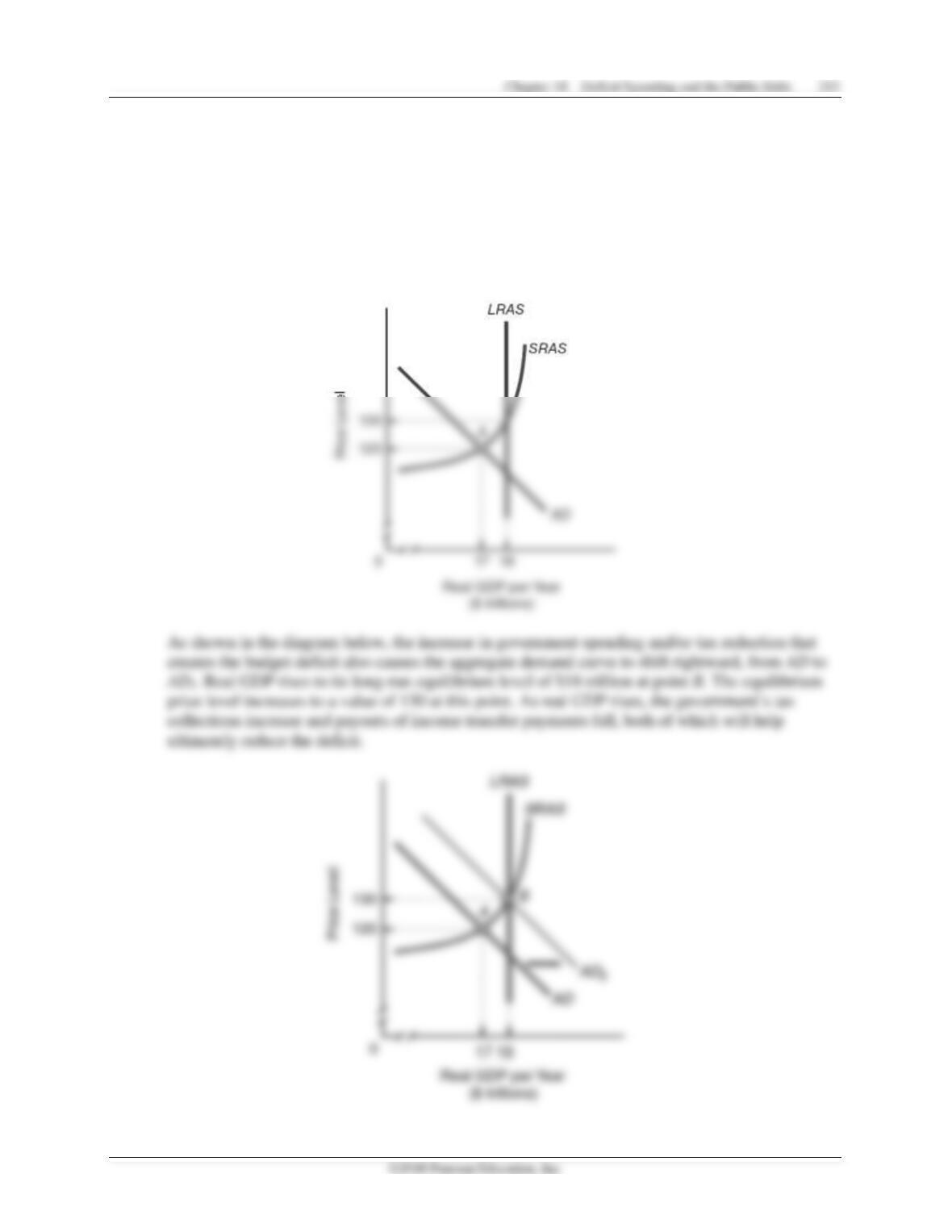
14-9. Suppose that the economy is experiencing the short-run equilibrium position depicted at
point A in the diagram below. Then the government raises its spending and thereby runs a
budget deficit in an effort to boost equilibrium real GDP to its long-run equilibrium level
of $18 trillion (in base-year dollars). Explain the effects of an increase in the government
deficit on equilibrium real GDP and the equilibrium price level. In addition, given that
many taxes and government benefits vary with real GDP, discuss what change we might
expect to see in the budget deficit as a result of the effects on equilibrium real GDP.
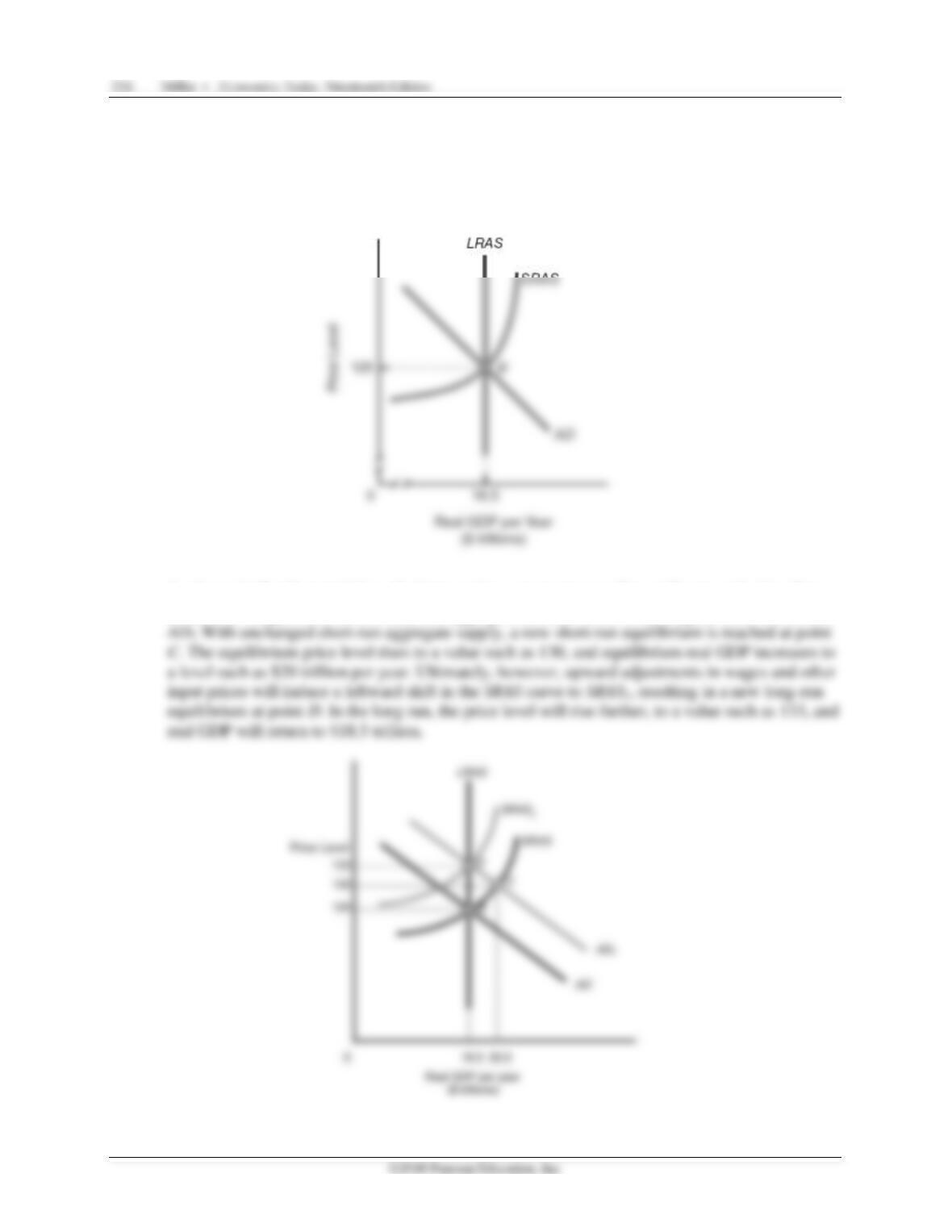
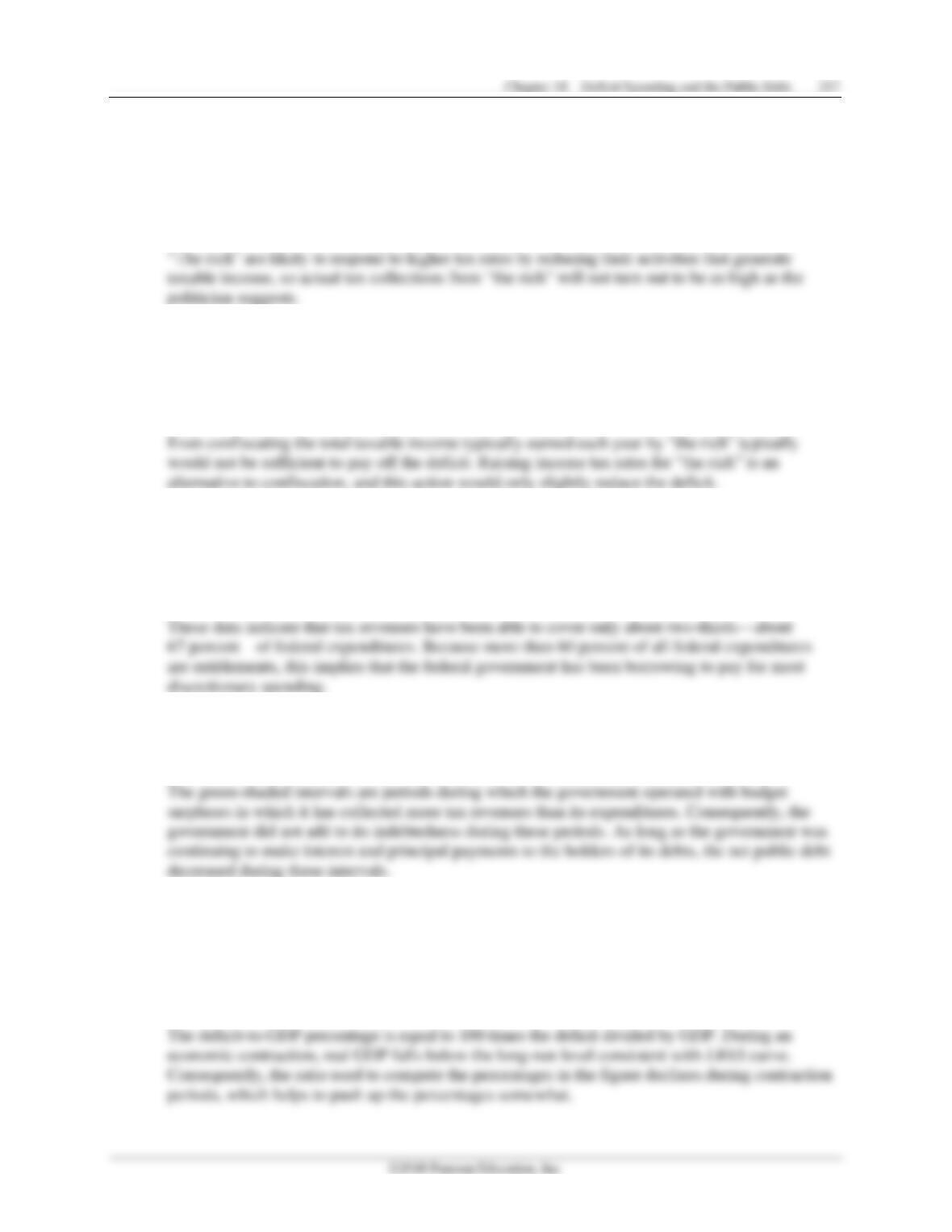
14-10. Suppose that the economy is experiencing the short-run equilibrium position depicted
at point B in the diagram below. Explain the short-run effects of an increase in the
government deficit on equilibrium real GDP and the equilibrium price level. What will be
the long-run effects?
As shown in the diagram below, the increase in government spending and/or tax reduction that
creates the budget deficit also causes the aggregate demand curve to shift rightward, from AD to
14-11. To eliminate the deficit (and halt the growth of the net public debt), a politician suggests
that “we should tax the rich.” The politician makes a simple arithmetic calculation in which
he applies a higher tax rate to the total income reported by “the rich” in a previous year. He
says that the government could thereby solve the deficit problem by taxing “the rich.” What
is the major fallacy in such a claim?
14-12. Refer back to Problem 14-11. If the politician defines “the rich” as people with annual
taxable incomes exceeding $1 million per year, what is another difficulty with the politician’s
reasoning, given that “the rich” rarely earn a combined taxable income exceeding $1 trillion,
yet the federal deficit has regularly exceeded $1 trillion in recent years?
14-13. In each of the past few years, the federal government has regularly borrowed funds to pay
for at least one-third of expenditures that tax revenues were insufficient to cover. More than
60 percent of all federal expenditures now go for entitlement spending. What does this fact
imply about how the government is paying for most of its discretionary expenditures?
14-14. Take a look at Figure 14-1. During the brief green-shaded intervals, is the amount of the
U.S. net public debt more likely to be increasing or decreasing? Explain your reasoning.
14-15. Consider Figure 14-2. The years immediately after 2008 stand out as having the highest
values in the figure. The main reason is that the dollar magnitudes of the federal
government’s deficits were very large during these years. How might the fact that a
significant economic contraction occurred during these years provide another explanation
for why the percentages for these years were so high?
14-16. Take a look at the most recent years of data on the net public debt displayed in Figure 14-3,
and then examine the most recent years of data on federal budget deficits shown in
Figure 14-2. Why do you suppose that the net public debt as a percentage of GDP has
grown more slowly recently than was the case between 2008 and 2015?
14-17. A fraction of the funds borrowed by the federal government between 2008 and 2015
were utilized to fund public investments in a number of solar power companies that
produced little output and halted operations. These concerns provided no repayments
to the government. In what sense might this fraction of deficit spending arguably have
imposed a “burden” on future generations?
14-18. Consider Figure 14-4, which shows that trade deficits usually accompany federal budget
deficits. Explain why we might anticipate that federal budget deficits and trade deficits
would tend to be related?
14-19. The long-run effect of higher government budget deficits on the equilibrium annual flow of
real GDP is zero. Who, therefore, benefits in the long run from higher government deficits?
◼ Selected References
Buchanan, James M. and Richard E. Wagner, Democracy in Deficit, New York: Academic Press,
1977.
Eisner, Robert and Paul Pieper, “A New View of Federal Debt and Budget Deficits,” American Economic
Review, March 1984, pp. 11–29.
Chapter 14 Deficit Spending and the Public Debt 219
Friedman, Milton, Essays in Positive Economics, Chicago: Chicago University Press, 1966.
Gordon, Robert J., Macroeconomics, 9th ed., Boston: Addison-Wesley, 2003.
Hoover, Kevin D. and Joseph R. Bisignano, “Classical Reflections on the Deficit,” in Ben Bernanke, ed.,
Readings and Cases in Macroeconomics, New York: McGraw-Hill, 1987.