shortage of workers. In order to attract more
workers (i.e., increase the quantity supplied of
labor), firms will offer higher wages. The higher
wages will also reduce the quantity of labor that
firms want to hire, and these two effects, taken
together, will relieve the labor shortage.
decrease.
Hints and Common Errors: It’s helpful
toremember that a monopsony is a
marketstructure with many sellers but only one
buyer (in contrast to a mono poly, which is a
market structure with many buyers but only
encourage more labor supply (and decrease the
quantity of labor demanded) in order to relieve
the shortage. At the new equilibrium wage,
more workers are employed than had been
previously.
8. Economic rent refers to the difference between
the rate that a factor of production earns and
what it could earn in its next- best alternative use.
Questions for Review
1. The demand for factor inputs is a derived demand
because the demand doesn’t come from consum-
ers directly but instead is derived from consum-
ers’ demand for the products that the factor
Hints and Common Errors: Technically, a
firm is indifferent between hiring and not hiring
if the marginal profit that that worker brings in is
exactly equal to zero.
3. The two shifters of labor demand are changes in
Hints and Common Errors: Changes in
workers’ marginal products shift the demand for
labor because the productivity changes affect the
cost of producing the product.
4. The relationship between wages and the supply of
labor depends on two effects: the substitution
effect and the income effect. The substitution
effect suggests that as the opportunity cost of
Solutions to Chapterfi14 Text Prob lems
market, and The Pizza Factory will earn only
$20,000. If the Pizza Factory pays Perfect Pies
$15,000 not to enter the market, then the Pizza
Factory can earn $35,000, which is better than
the $20,000 it makes if Perfect Pies enters the
sive features (small, compact machines with faster
brewing technology), then it may gain more mar–
ket share if the consumers think they would ben-
efit from these features. But this is a one- time
gain only! Keurig would use the same or even
price leadership, with the large bank as the price
leader. The large bank is not quite a monopolist,
but it is the dominant firm in the oligopoly. Obvi-
ously, the smaller firms have to follow the large
firm when the larger firm lowers prices, because if
they don’t, their sales will immediately drop to
equally, each firm will produce 2,000 ounces
and charge a price of $700/ounce. They will
each earn a revenue of $1,400,000.
d. If one firm decides to increase production by
1,000 units, this means there will be 5,000
9. a. The dominant strategy of the Pizza Factory is
to set a high price. Regardless of what Perfect
Pies does, the Pizza Factory is better off by set–
ting a high price. If Perfect Pies enters, the
Pizza Factory makes $20,000 instead of $10,000
d. If Perfect Pies enters the market, then the Pizza
Factory loses $30,000in profits. It makes only
$20,000 instead of $50,000. Therefore, if both
pizza places know this, then the Pizza Factory
would be willing to pay Perfect Pies not to
enter the market. The Pizza Factory would be
In this situation, you’re still better off by work–
ing less hard. Therefore, working less hard is
your dominant strategy.
b. Assuming that exactly the same reasoning in
you would have an incentive to change your
decision. Each of you is better off doing that,
regardless of what the other person is doing.
You each play your dominant strategy, and this
is the Nash equilibrium.
d. If you are required to work together
7.
Price Quantity TR MR
(per oz.) (oz.)
$1,000 1,000 1,000,000 1,000
900 2,000 1,800,000 800
800 3,000 2,400,000 600
700 4,000 2,800,000 400
and output should be 8,000 ounces.
b. In order to solve this prob lem, you need to
know the marginal revenue (MR) for a
monopolist. To calculate the total revenue,
multiply price by quantity. The marginal
revenue is the difference in revenue between
each quantity increase divided by the increase
in quantity. A monopolist will keep producing
as long as MR # MC but will stop once MR ! MC
(or MR “ MC). In this par tic u lar situation, the
even for students who are unsure of the answer. If
the average student realizes that other students
are likely to answer the question, it is also in her
best interest (it is her dominant strategy) to
answer the question. Leaving it blank will lead to
Hints and Common Errors: Think about
how your class might be able to collude and skip
the last question. You could all get together
before the exam and agree to skip the last
question. In order to enforce this agreement and
increase the likelihood that every body will skip
5. a. Network externalities aren’t really impor tant
for gas stations. Any car can fill up at any gas
station, so there are no real switching costs.
Also, there’s no bandwagon effect: nobody
knows where you fill up with gas, and even if
they did, they prob ably wouldn’t care.
b. The AARP may have some network
externalities. As the number of members
of partners. If a dating Web site can establish
itself with a large customer base in the
beginning, it will be able to charge a higher
price and still attract customers. People will be
willing to pay in order to be matched with a
larger pool rather than join a free Web site with
only a few members.
6. a. Your dominant strategy is to work less hard.
This is better for you no matter what your part-
ner does. Suppose your partner works hard. If
Establishing a new airline would mean negoti-
ating with airports, buying aircraft, and hiring
pi lots and ight attendants.
fierce. In addition, there are no barriers to
entry in the fast food market: anyone can rent
or lease a building and cook fast food.
d. Wheat is not an oligopoly; it is perfect
competition. Wheat is virtually identical across
farms, there are many buyers and sellers, and
there are no barriers to entry.
reputation as a quality sports equipment firm.
Without this type of reputation, it would be
difficult for other firms to enter this market.
f. The college bookstore on your campus is an
oligopoly with a compelling locational
advantage that gives it significant mono poly
power. There is no other store that provides
exactly what it does— the precise books needed
answer to the last question, it is in their best
interest (it is their dominant strategy) to answer the
last question. If they answer the question cor–
rectly, they will get full credit. If they do not
answer the question at all and somebody else
does, they will get a zero. This reasoning works
7. The Sherman Antitrust Act bans monopolies and
cartels. The Clayton Act is even more restrictive
and penalizes corporations that try to reduce
able to attract consumers and keep its consumers
from switching to rival firms. This matters for an
oligopolist because a firm that can establish a
large customer base may be able to become the
dominant firm in the market.
Hints and Common Errors: Another way
of thinking about network externalities is to
Study Prob lems
1. It is pos si ble that sales restrictions on the hours
alcohol can be sold on Sunday actually help
liquor stores by lowering output and therefore
raising prices for every one. Consider the case
raised in Figure13.2in the text, where each
2. a. Passenger airlines are a good example of an oli-
gopoly. Each airline has some market power on
the routes it ies (e.g., Alaska Airlines has mar–
ket power for routes within Alaska), and there
are very high barriers to entry into this market.
profit only depends on its own output and
pricing decisions and not on the pricing and
output decisions of other firms.
5. The prisoner’s dilemma implies that it is very dif-
ficult to sustain collusion in a short– term agree–
ment. Because the short– run payoff for “cheating”
is so high in the prisoner’s dilemma that it makes
more sense for a firm to cheat and sell at a lower
price, thus stealing output. In order to escape the
unless they can collude. A dominant strategy is
one in which that par tic u lar strategy produces a
better outcome for that person, regardless of what
strategies the other players choose.
When each player in a game has a dominant
or she chose.
It’s pos si ble to have a Nash equilibrium even
when players don’t have a dominant strategy.
Consider the following game: two students, Jo
and James, are trying to coordinate a meeting
(in the days before cell phones). There are two
events that night— one is a tractor pull and the
other is a dance. Neither student knows where
the other might go, so they decide on their own
which event to attend. Each is better off if they
Questions for Review
1. Oligopoly is a type of market that shares key
characteristics with both a mono poly and
monopolistic competition; however, an oligopoly
is more competitive than a mono poly and less
competitive than monopolistic competition. As
in monopolistic competition, products are
slightly differentiated, and competition can be
2. Adding an additional firm makes it more difficult
for an oligopolistic industry to form and main-
tain an effective cartel. This is because as more
firms enter the market, the incentive for each
firm to lower the price and steal output increases.
3. Predatory pricing is the practice of setting price
deliberately below the average variable cost in
order to either drive out rival firms or prevent
rival firms from entering. By doing this, a firm
will be able to act like a monopolist in the
market.
4. Game theory matters for oligopoly because each
firm’s actions affect the pricing and output deci-
sions of the other firms. Therefore, when decid-
Solutions to Chapterfi13 Text Prob lems
c. Titleist has a much stronger incentive to main-
tain quality control in the production pro cess
of its golf balls. Because the Titleist slogan
boasts that it is “The #1 ball in golf,” consum-
ers have high expectations about the quality.
In order to keep its customer base, it is impor–
for a business owner to open a restaurant in a
small town because he or she would evaluate its
competitors before entering the market. This lets
Taste of India act as a mono poly, or gives it more
market power. On the other hand, Indian Cuisine
in a large town faces competition as more and
more restaurants try to tap customers’ dollars. So
8. a.
MC LRATC
Q
Price
(Titleist
golf balls)
Quantity
b.
Price
(generic
golf balls)
MC LRATC
charges the highest price it can, which comes
offof the demand curve. However, because
D # MR, this means P # MC at the profit–
maximizing point.
5. a.
QE
Econo burgers
MR
ATC
MC
Price
b. Because this is a long– run equilibrium, the
firm makes zero economic profit. ATC is tan-
atthis point, the price the firm charges will
be lower than the average cost, which means
the firm will be earning a negative economic
profit.
7. D1 is the demand curve consistent with a
monopolistic competitor making zero economic
profit in the long run. In monopolistic competi-
making positive profits, which is pos si ble for the
firm only in the short run. Though D3 indicates
a firm that makes zero profits, D3 is a perfectly
elastic demand curve. A perfectly elastic
potential firms that this industry is popu lar,
and resources should be devoted here. Firms
enter, pushing down price and driving profits
to zero. This happens in both monopolistic
competition and perfect competition because
there are no barriers to entry.
g. Perfect competition is efficient; monopolistic
competition is not. Remember that an effi-
cient market produces where P “ MC. In the
long run, perfectly competitive markets do
this. In monopolistic competition, firms do
efficient.
Hints and Common Errors: All these
characteristics are easier to see graphically. Take
alook at textbook Figure12.3 to help solidify
these concepts. In this graph, both firms face
4. In both competitive markets and monopolistic
competition, firms maximize profits. They do this
by setting MR “ MC.
For competitive markets, P “ MR “ D for the
firms. This is because there are lots of buyers and
sellers, and the goods are identical. A firm can
sellhowever much it wants to at the market
Now let’s consider monopolistic competition.
A firm in monopolistic competition has some
market power and faces a downward- sloping
demand curve. Like a mono poly, the MR curve is
c. In the long run, a perfectly competitive firm
will be producing at the lowest point of the
ATC curve. This means it has no excess capac–
ity. A firm in monopolistic competition, in
contrast, does not produce at the minimum of
ATC. Because it faces this downward- sloping
demand curve, in the long run, ATC is tan-
gent to the demand curve at a point where
cost is higher than the minimum. This firm
competitive firms. For perfect competition,
because goods are essentially identical, it
doesn’t make much sense for an individual
firm to advertise. (However, it’s pos si ble for an
industry as a whole to advertise in order to
shift the market demand curve; think about
milk, for example, with the famous milk mus-
tache campaign.) If a single firm advertises,
would be very difficult for you to start an elec-
tricity com pany to compete against the TVA.
c. Pizza delivery can be considered monopolistic
competition. There are many dif fer ent firms
that produce slightly differentiated products.
There might be a local pizza joint that serves
higher– quality pizza at a slightly higher price
competing against Domino’s, a national
chain. These pizza delivery businesses might
ent clientele. Stella McCartney’s products
have a dif fer ent style from that of other fash-
ion designers; rather than featuring ashy
colors or a repeated logo pattern, Stella
McCartney handbags usually combine sub–
dued, classic colors such as tan or charcoal
with distinctive metal– chain carry ing
handles and edge trim..
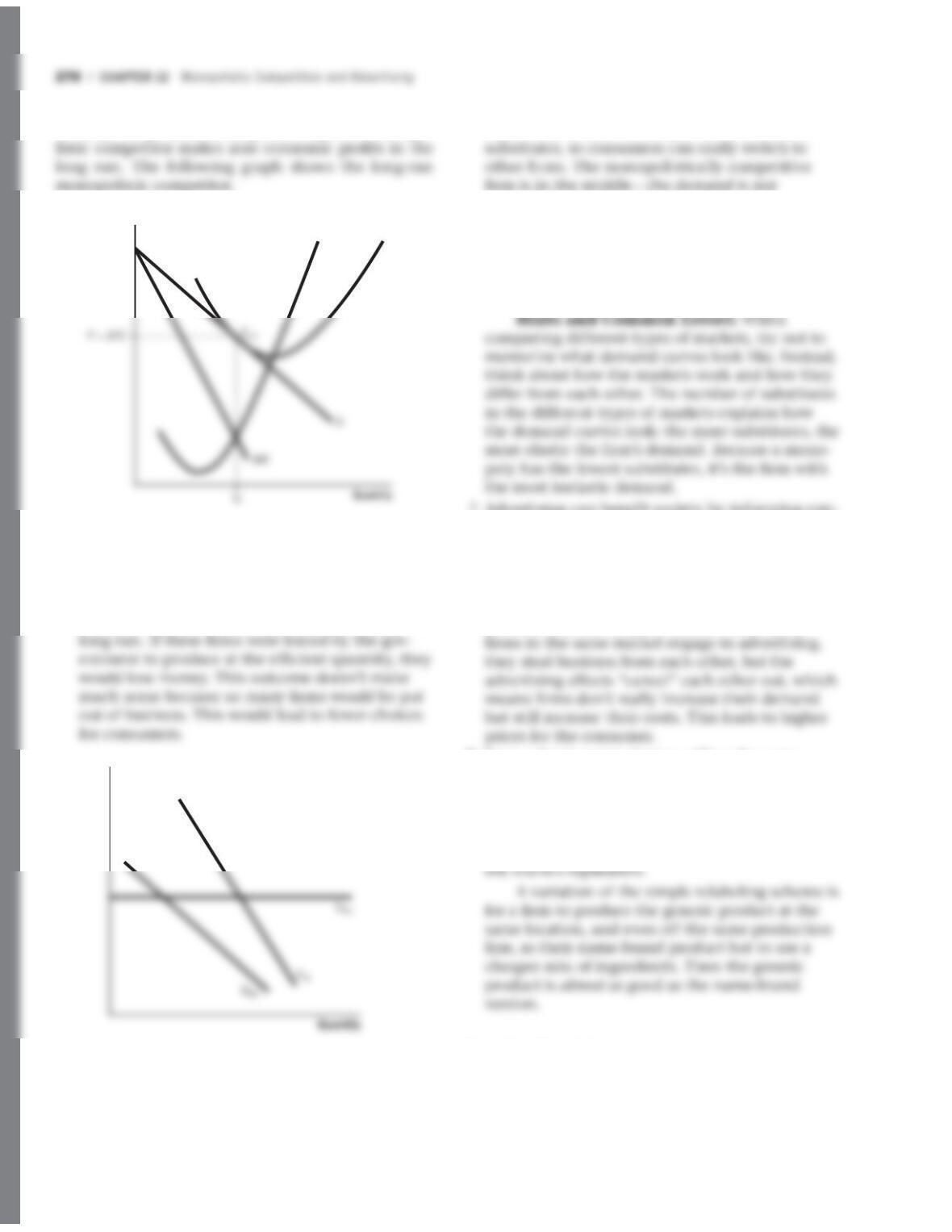
goods are homogeneous, and there are plenty of
buyers and sellers. This means there are lots of
perfectly elastic because there are more limited
substitutes for a firm’s product in comparison to
perfect competition. However, the demand is not
as inelastic as in a mono poly because there are
some substitutes in the market, even though they
aren’t perfect substitutes.
7. Advertising can benefit society by informing con-
sumers about products or product characteristics
that they wouldn’t other wise know about. This
gives consumers more information so they are
better able to make decisions about what to buy.
Advertising can be harmful because it
increases the cost of production. When many
8. From a firm’s point of view, selling the same
product both under its own name and, more
cheaply, as a generic is an opportunity to practice
price discrimination by charging brand- conscious
customers a premium. Of course the firm will
want to keep quiet about this practice to protect
Study Prob lems
2. a. Local corn farmers would be considered a com-
petitive market, not monopolistic competition.
There are lots of sellers of corn, and this good
does not vary much from farm to farm.
However, in the long run, because there are no barriers
to entry, the profits are competed away. The monopo–
Price
ATCMC
5. It’s true that monopolistic competition produces
an inefficient result, and monopolistically com-
petitive firms do not produce at a level where
P “ MC. However, because there are no barriers to
entry, none of these firms can make profits in the
6.
Price
The previous graph shows typical firm demand
curves for the three dif fer ent markets. The mono-
poly faces the most inelastic demand curve
because there are no good substitutes for the
product it produces. The perfectly competitive
firm faces the most elastic demand curve because
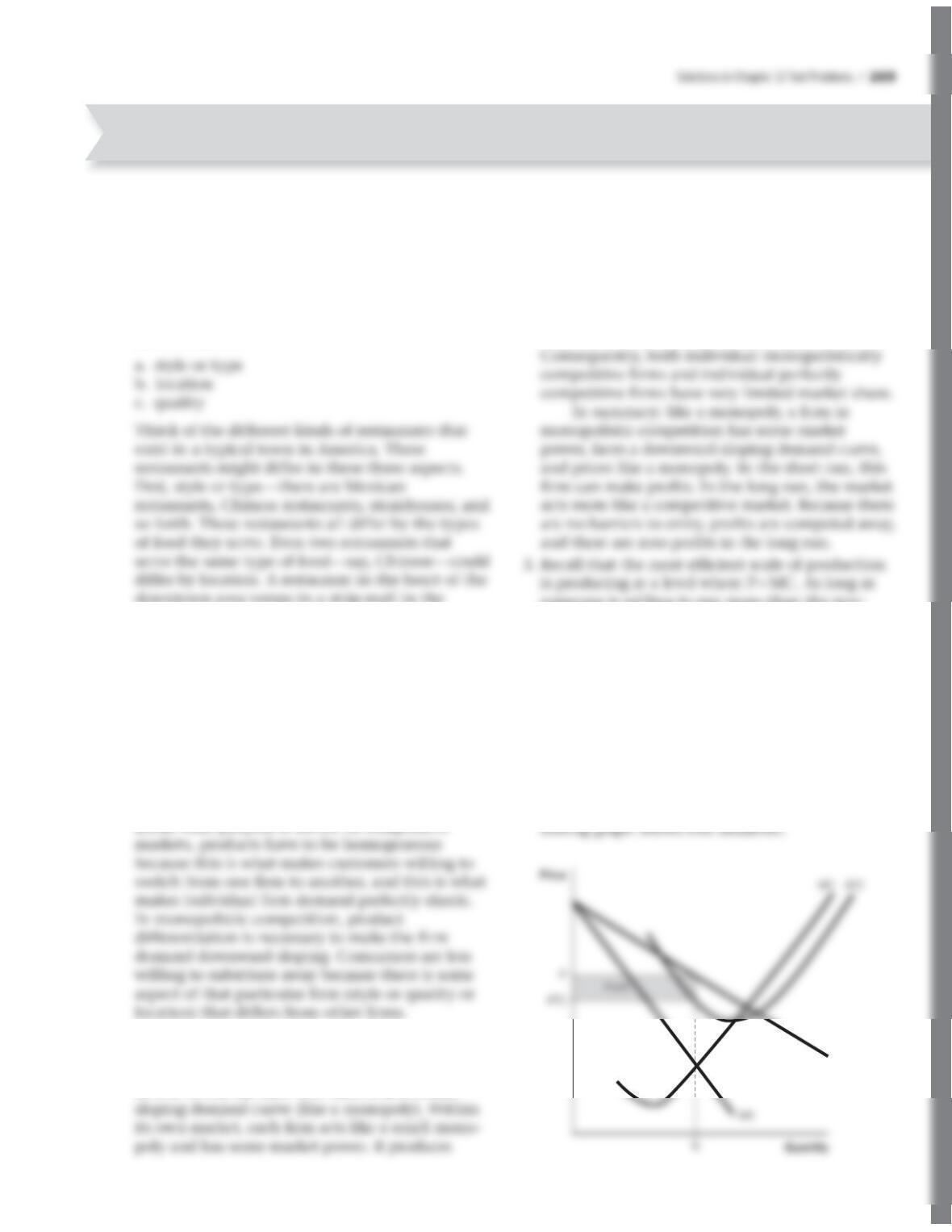
where MR “ MC and charges the highest price on
the demand curve at that quantity. So, the firm
can earn profits in the short run, like a mono poly.
However, because there are no barriers to
entry (as in perfect competition), there are zero
profits in the long run. Also, as under perfect
competition, monopolistically competitive
markets have many buyers and sellers.
someone is willing to pay more than the mar–
ginal cost of producing that unit, that unit
should be produced. However, monopolistically
competitive firms act like monopolies: they pro–
duce at the mono poly output, which is where
MR “ MC. At this point, P # MC, which means
there are still people willing to buy the unit for
more than the cost of production. So, the monop–
olistically competitive firm is producing too little
in terms of efficiency.
4. In the short run, it’s pos si ble for a monopolistic
competitor to make an economic profit. The fol-
Questions for Review
1. Product differentiation is necessary for monopo–
listic competition in order for each firm to have
some market power. This way, each firm faces a
downward- sloping demand curve.
There are three dif fer ent types of product
differentiation:
downtown area versus in a strip mall in the
suburbs would likely appeal to and serve dif fer ent
clientele. These restaurants might also differ by
quality— like an Indian buffet versus a sit– down
Indian restaurant.
Hints and Common Errors: Sometimes,
it’s useful to think about why assumptions exist
for dif fer ent markets and how they come into
play. This can help you keep the dif fer ent markets
straight. For example, to remember why product
differentiation exists in monopolistic competition
but not for a firm in a competitive market, think
2. Monopolistic competition takes some aspects
from perfect competition and some aspects from
mono poly. In monopolistic competition, there are
Solutions to Chapterfi12 Text Prob lems
D
10. Surge pricing is a form of price discrimination.
Charging the higher price all the time could hurt
ridership numbers, because much of the time,
riders will be sensitive to price. But during times
of peak demand, a disproportionate number of
riders will need transportation quickly and will
not be in a position to wait for a cheaper ride.
Their demand for a ride is inelastic. Surge pricing
is a way of capturing the higher price these riders
8. Definitely! One of the ways firms practice price
discrimination is with the ability to charge dif-
fer ent prices for dif fer ent customers according to
their willingness to pay. PC users typically pay
much lower prices for their computers than Apple
users, which reveals their willingness to pay. So
in this case, Apple users may not view slightly
higher– priced hotels that are suggested by Orbitz
as a huge incon ve nience. After all, they under–
e. This is a good example of perfect price
discrimination. The golf instructor can sense
the customer’s willingness to pay and charges a
price just below it. The instructor charges a dif-
fer ent price to each individual.
3. This is a form of price discrimination because it
separates those who are price sensitive and who
who have more elastic demand. These people
wouldn’t normally go to an amusement park but
would be willing to go for a highly discounted
price for an hour or two. By giving a discount on
late entry, the amusement park can lure in those
who would not have been willing to pay full
price while being able to charge full price to
those who really enjoy amusement parks.
4. fi Hardcover books versus paperbacks: Hard-
cover books almost always come out several
weeks or months before a paperback version of
fi Cell phones: When new cell phone models
come out, older versions become much cheaper
(e.g., the iPhone). Those who want the latest
new gadget will pay the full price for a new
model. Those who are more patient can usually
additional revenue of the next consumer.
In this case, MR is always greater than MC,
which is zero. So, the movie theater should
charge $6. This will maximize revenues and,
therefore, profits.
b. First, the theater should decide what group to
one price and every one else for another price.
In order to do this, it should charge $10 for
those between ages 18 and 40 (or 20 and 42, or
any combination that includes Becky and
Franco but excludes every one else) and $6 for
all other customers.
c. If the theater charges one price ($6), as
discussed in part a, the total revenue would be
$42. Instead, if it charges two prices according
to willingness to pay, it will sell two tickets at
$10 and five tickets at $6. This will get the
2. a. Even though this is offered to all customers,
this is still an example of price discrimination.
Those who use the cell phones for mostly per–
sonal use will prob ably not use as many min-
utes during the week. Instead, they will try to
firms to sell to at the higher price. This would be
detrimental for the firm, so a successful price-
discriminating firm must be able to prevent resale.
4. In economics, the most socially desirable level of
output is producing where MC “ D. This means
that the last unit costs exactly as much as the
not some optimal surplus division.
Hints and Common Errors: Because we are
usually consumers long before we are producers,
people generally worry a lot about consumer
Study Prob lems
1. a. First, let’s rearrange these people in order of
willingness to pay. Next, let’s calculate the
price, total revenue (TR), and marginal revenue
(MR) for each customer.
Customer Willingness to Pay Age Price TR MR
Becky 11 34 11 11 11
Questions for Review
1. In order to price discriminate successfully, a firm
must be able to do the following:
fi The firm must be able to distinguish between
groups of consumers that have dif fer ent elas-
moneymaking (or arbitrage) opportunity for
those who can buy at the lower price and resell
those goods for a slightly higher price.
2. When economists think about efficiency, they are
demand is still higher than MC. With price dis-
crimination, a mono poly firm can target dif fer ent
segments of the demand curve; this increases the
amount produced, which gets us closer to the opti-
mal amount (where MC “ D).
3. Imagine a price- discriminating firm that is unable
to prevent resale of the good. Suppose this firm
sells homemade apple pies to students for $5 per
pie and charges a price of $12 per pie for all other
Solutions to Chapterfi11 Text Prob lems
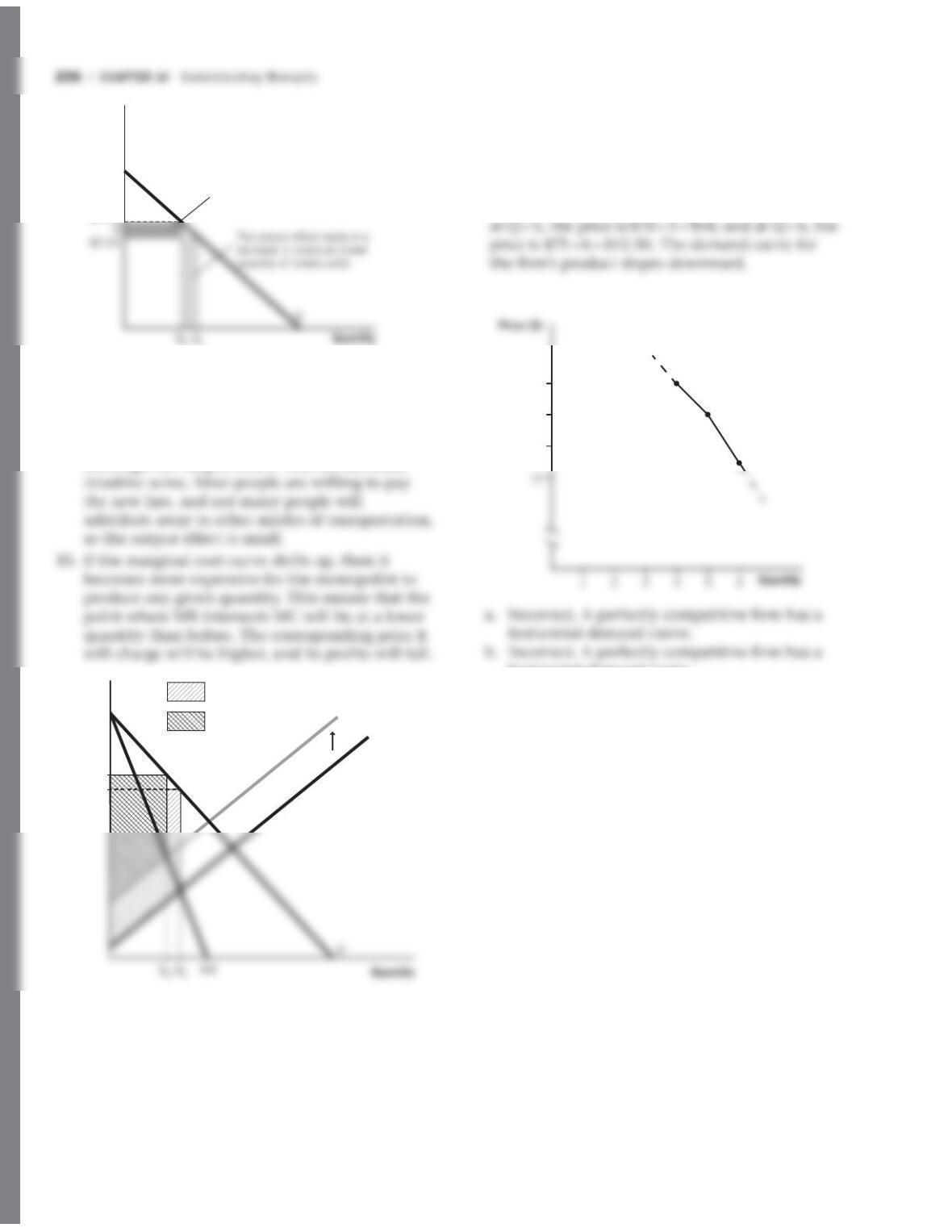
Hints and Common Errors: Though the
price increases, you can still tell graphically that
overall profits will fall. Mathematically, the
increase in costs is greater than the increase in
price; this is why profits fall.
11. At a sales quantity of 4, the price is $60 { 4 “ $15;
13
14
15
horizontal demand curve.
c. Correct. A monopolist has a downward-
sloping demand curve.
Price
The price effect leads to an increase in
revenues (higher price per ticket sold).
Hints and Common Errors: How much
the bus ser vice’s revenues would increase
depends on the elasticity of demand. If demand
is very inelastic (i.e., people are not very
responsive to price), then the price effect will
Price
MC2
Original profit
MC1
P1
P2
New profit
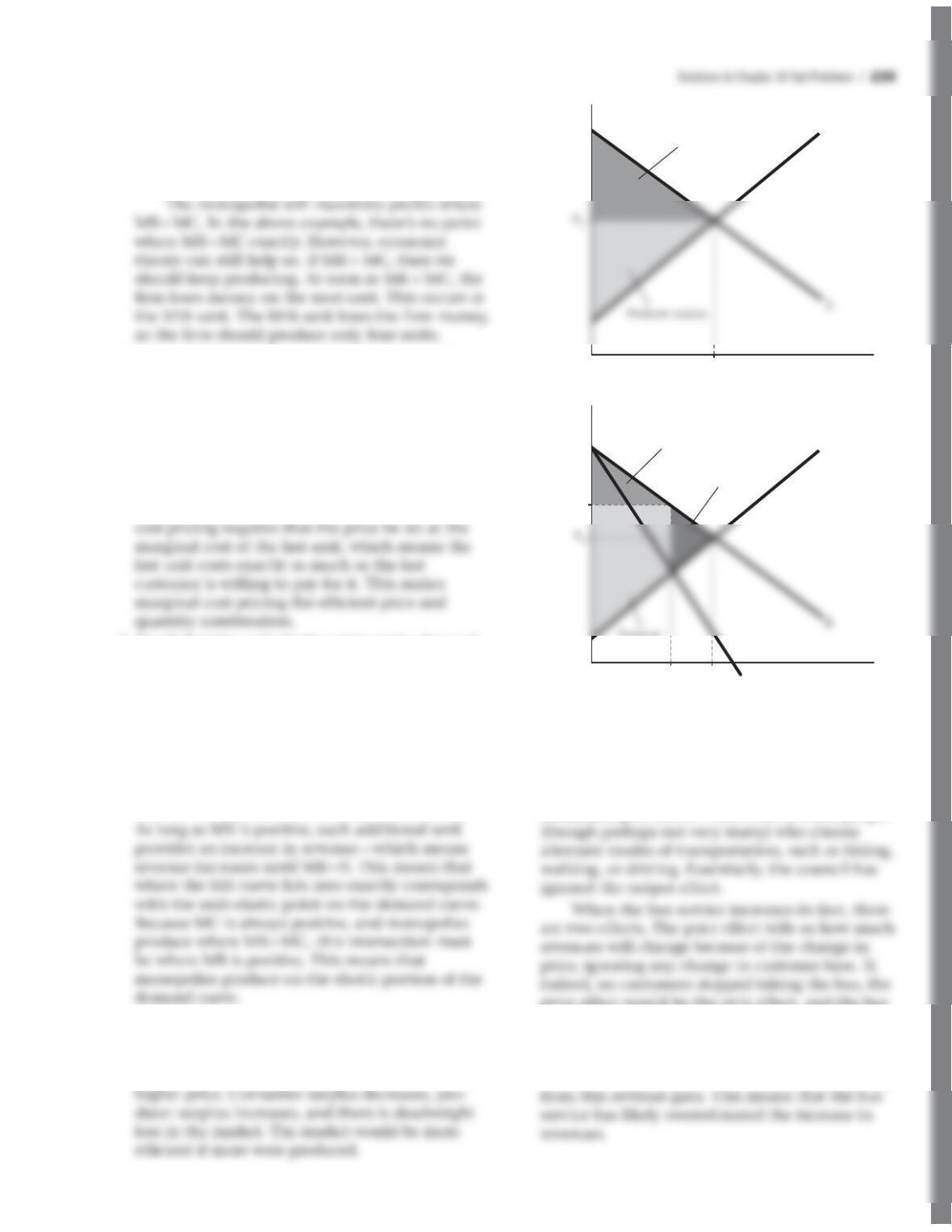
Market
quantity
Price and
cost
Consumer surplus
QC
S
Market
quantity
QC
Price and
cost
PM
MRQM
MC
Producer
surplus
Deadweight loss
Consumer surplus
9. The council’s reasoning is awed because it
assumes that the number of people who use
thebus will be the same before and after the
price hike. However, this can’t be the case: when
the price of something goes up, the quantity
price effect would be the only effect, and the bus
ser vice would be able to generate 25% more
revenue. However, the council should also take
into account the output effect. With the price
raised, fewer people will ride the bus, taking away
To figure out where the monopolist will
choose, we first need to calculate MR and MC. In
order to calculate MR, we need TR (which is just
price times quantity). Also, in order to calculate
MC, we need TC, which is FC VC.
4. If there is only one source of dilithium crystals
and no more are found, then the necessary condi-
tions are met for a mono poly. If one firm or
entity buys up or controls the sole source of crys–
tals, then that firm would have a mono poly on
space- time travel.
If the crystals were government owned or
government regulated, the price should be set
using marginal cost pricing. Recall that marginal
7. Recall that the unit– elastic point on the demand
curve is where total revenue is maximized. The
upper portion of the demand curve above this
unit– elastic point is elastic, while the lower por–
tion of the demand curve is inelastic.
Now, let’s examine the MR curve. The
marginal revenue curve sits exactly halfway
inside the demand curve (for example, if the
demand curve crosses the Q axis at 10 units, the
MR curve crosses the demand curve at 5 units).
8. In a perfectly competitive market, there is no
deadweight loss. Because P “ MC, the market pro-
duces the efficient amount. In a mono poly, how–
ever, less gasoline is produced, and it is sold at a
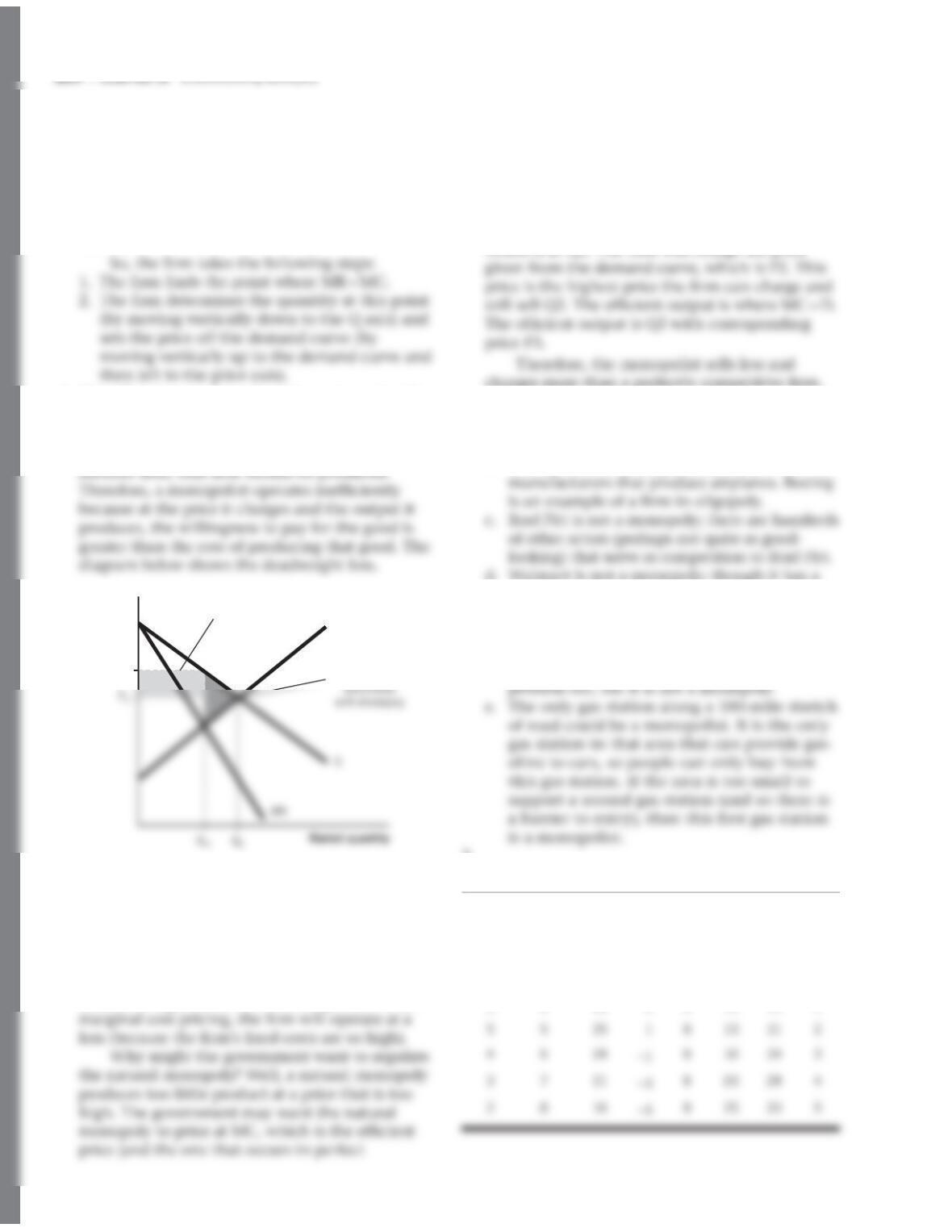
competition). However, this regulation would be
difficult because it would force the firm to operate
at a loss and possibly exit the market.
Study Prob lems
1. The monopolist will produce where MR “ MC,
charges more than a perfectly competitive firm.
2. a. Your local water com pany is a mono poly; it is
the only com pany in the town that provides
water. It is also likely a natu ral mono poly.
b. Boeing is not a mono poly; there are other
d. Walmart is not a mono poly; though it has a
large market share, Walmart does face compe-
tition. You are able to buy toothpaste and
books from Amazon . com or from your local
supermarket and bookstore. Walmart does
have low prices, which might keep some com-
3.
Price Quantity TR MR FC VC TC MC
$10 0 0 8 0 8
91 9985135
8216788163
73215810182
5. The profit– maximizing output for any firm
(monopolist or not) is to produce where MR “ MC.
This is because if MR # MC, the firm can earn
additional profit by producing another unit, so it
should produce more. If MR !MC, then a firm is
losing money on the last unit and should produce
less. Therefore, firms maximize profits when
MR “ MC.
6. The efficient output is where the customer’s will-
ingness to pay is exactly equal to the marginal
cost of the last unit. As long as someone is willing
to pay more than what it costs to produce
Price and
cost
MC
Deadweight loss
Lost consumer
surplus
P
M
7. It is difficult to regulate a natu ral mono poly for a
few reasons. One, it is not practical to try to use
the power of competition to regulate a natu ral
mono poly. Because it is a natu ral mono poly, any
competition would face very high costs in order to
enter the market, which would actually increase
costs for consumers. Two, if the government
decides to regulate the firm and requires it to use
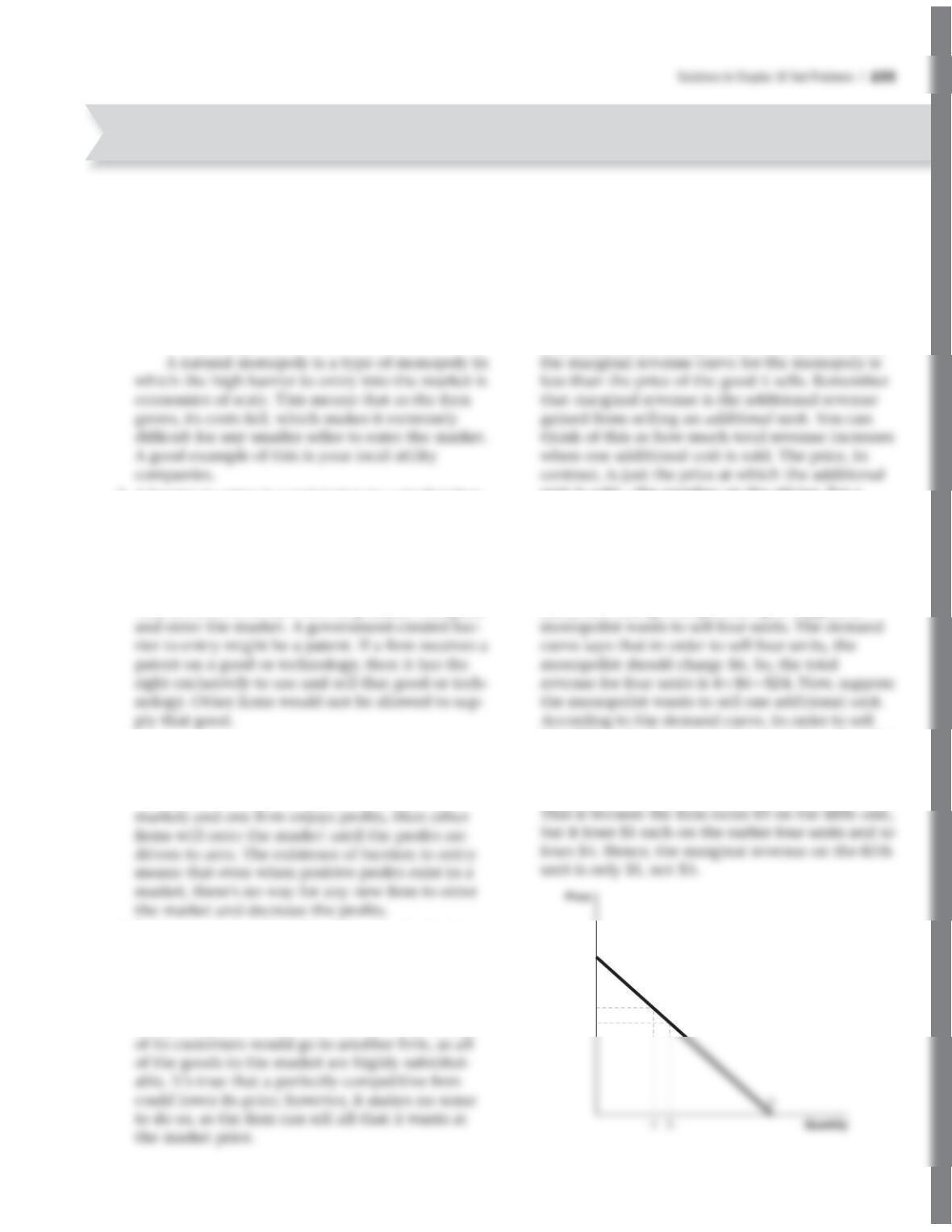
4. A monopolist faces a trade– off when it sets a
price. Because it is the only seller in the market, if
the mono poly wants to sell an additional unit, it
must lower the price because it has sold all it
could sell at the original price. When it lowers
the price on the next unit, it also has to lower the
price of all units. This means that all the units
that came before bring in less revenue; therefore,
unit is sold— the number on the sticker. For a
mono poly, the additional revenue gained from
selling one more unit is actually less than the
price at which the unit sells because it loses
money on all the units that came before it.
Hints and Common Errors: This is most
this fifth unit, the monopolist must drop the price
to $5. So, the monopolist’s total revenue selling
five units is 5 w $5 “ $25. This means that the
marginal revenue of the fifth unit is $25 $24 “ $1.
5
6
For the fifth unit,
P = 5
MR = 1
Questions for Review
1. A mono poly is a type of market in which there is
only a single seller, which produces a well- defined
good that has no good substitutes. Either the
seller itself or the type of market can be referred
to as the mono poly. A mono poly operates in a
market with high barriers to entry.
2. A barrier to entry is a restriction in a market that
makes it very difficult for competitors to enter.
Barriers can be natu ral or government created.
One example of a natu ral barrier is control of
resources. If a single seller has control of all the
input needed to create a good, then it becomes
Barriers to entry are impor tant for
monopolies because they allow for the existence
of potential long- run profits. If there are no
barriers to entry (as in a perfectly competitive
3. Because a mono poly is the only seller in its mar–
ket, it has some control over the price it sets. It
can lower or raise its own price (to a certain
extent) and still sell its goods. In contrast, a per-
fectly competitive firm is a price taker. If a per–
fectly competitive firm were to raise its price, all
Solutions to Chapterfi10 Text Prob lems
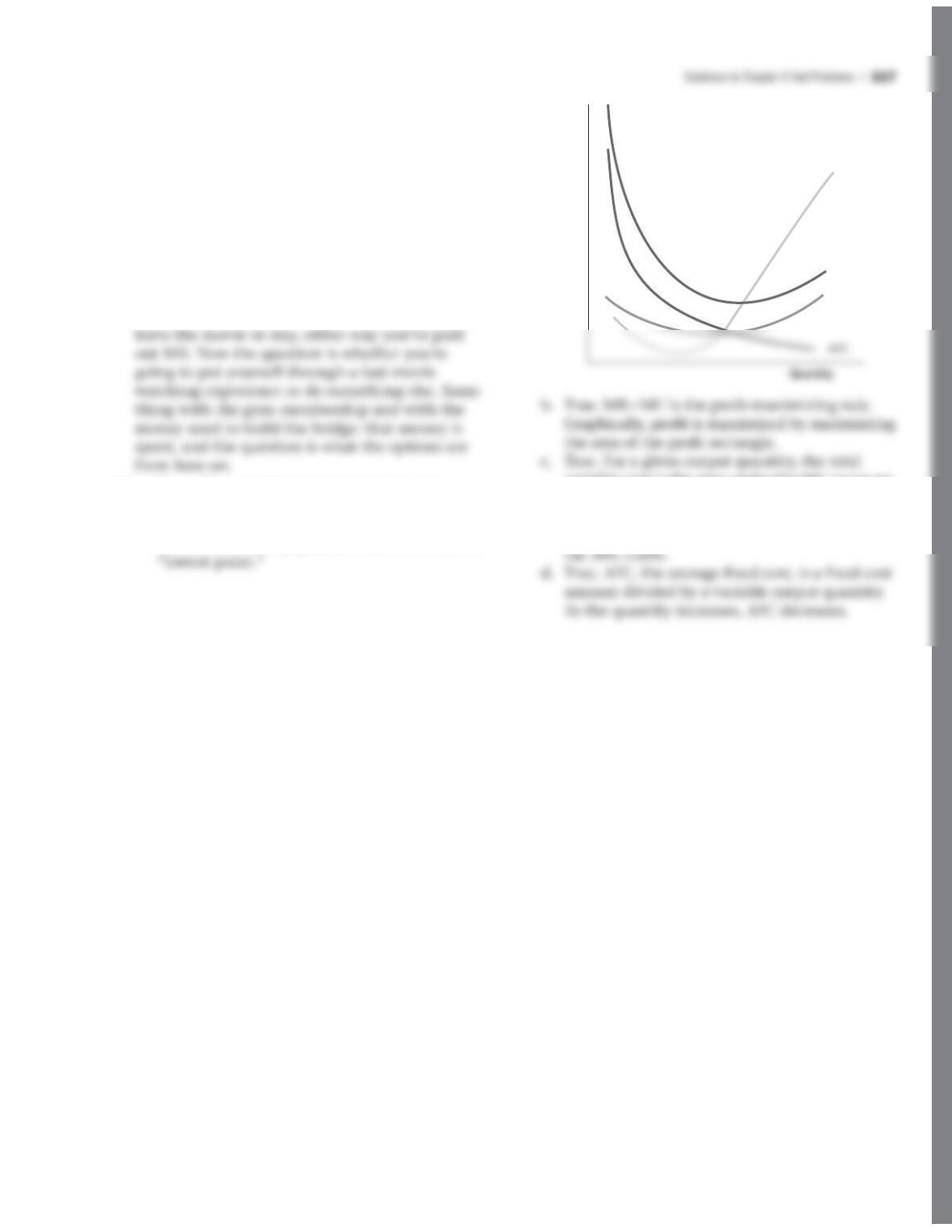
Cost
MC
ATC
AVC
variable cost is the area under the MC curve up
to that quantity. Dividing by the quantity then
gives the average variable cost. Finding the
average variable cost for every quantity gives
that’s water under the bridge (sorry for the
pun!). The situation is what it is. The choice is
between replacing a bridge that’s in good
shape but too small and forcing commuters to
endure another de cade or so of massive con-
gestion in order to justify the bridge’s cost.
Replacing the bridge makes sense; it avoids the
sunk– cost fallacy.
Hint and Common Errors: Any time a
cost is already incurred and no longer inuenced
by the decision you are now making, that cost is
a sunk cost and should be ignored. Whether you
14. a. False. The marginal cost curve does pass
through the lowest points of the ATC and
AVC curves. The AFC curve, however, slopes
downward at every point, as shown. It has no
9. Disagree. A profit– maximizing firm should select
the output level at which the difference between
marginal revenue and marginal cost is the least.
In other words, the firm should produce where
marginal revenue “ marginal cost. Suppose the
Then, the firm can produce one extra unit and
earn the $7.
Hints and Common Errors: You can
think of the difference between MR and MC as
the marginal profit of that next unit. If this is the
case, then as long as that number is positive, you
should keep producing. If the next unit you
To determine whether Barney produces in
the short run, first determine what his revenues
and his variable costs are. His revenues are just
the price he charges multiplied by the quantity of
driveways he clears, which is $10 w 20 “ $200.
Now, find his variable costs. His total cost is $250,
and half of that is fixed. This means the other
$250, and his total revenues are only $200. This
means that Barney is earning economic losses,
which means he should exit in the long run.
12. a. Congratulations on avoiding the sunk- cost
fallacy. The $10 can’t be gotten back, so the
choice is between sitting through an annoy–
ing film and doing something else more
enjoyable. Leaving is the smart move.
Hints and Common Errors: In this prob–
lem, you don’t know the actual revenue or
variable costs of the firm. But even without this
knowledge, you should still be able to solve the
prob lem from the information given. If the firm
8. a.
Price
5
6
Camilo Esra Remzi
b.
QUANTITY SUPPLIED
Delivery
Charge Esra Remzi Camilo
Market
Supply
$1 2 3 611
2 4 6 717
c.
Price
4
5
6
Market
supply
4.
620$1202012035 0
■ The price in a competitive market does not
change because of one firm’s actions, so it is
5. a. The firm makes an economic profit at P5 and
P6, which are the prices above P4. The firm
breaks even at P4, and it makes economic
losses at any price below P4, which in the
graph are P1, P2, and P3.
b. The firm would shut down (in the short run) if
the price is lower than the average variable cost
because its losses are less if it operates
(- $5,000) than if it shuts down (- $8,000).
b. If this situation persists, the firm would go out
of business in the long run. In the long run,
all costs would be variable, and the firm’s rev-
enues would not cover all of its costs.
a. The total revenue (TR) is calculated by multi-
plying the quantity (output) by the price ($3).
d. Marginal revenue (MR) is always $3, as every
sno– cone sells for $3. Marginal cost (MC) is
calculated by taking the difference in cost
between each level of output and dividing
this number by the difference in quantity.
For example, consider how to calculate the
3. a. False. A firm does not necessarily make a
profit even if its revenue exceeds the average
variable cost because there might be fixed
costs to consider. If a firm’s fixed costs are
very large, then it’s pos si ble that the firm will
not make a positive profit, even when the
price it charges exceeds the average variable
c. False. If economic profits are positive, firms
will enter the industry in the long run. The
profits entice firms to enter.
d. False. A firm that receives a price greater than
its average variable costs should not shut down
in the short run. Shutting down would cause