Mishkin • Instructor’s Manual for The Economics of Money, Banking, and Financial Markets, Twelfth Edition 158
Chapter 14
ANSWERS TO QUESTIONS
Unless otherwise noted, the following assumptions are made in all questions: the required
reserve ratio on checkable deposits is 10%, banks do not hold any excess reserves, and the
public’s holdings of currency do not change.
1. Classify each of these transactions as an asset, a liability, or neither for each of the
“players” in the money supply process—the federal reserve, banks, and depositors.
a. You get a $10,000 loan from the bank to buy an automobile.
Public: Assets rise by $10,000 due to automobile purchase, liabilities rise by $10,000 due
b. You deposit $400 into your checking account at the local bank.
Public: Assets are unaffected ($400 increase in checking deposits is offset by a $400
c. The Fed provides an emergency loan to a bank for $1,000,000.
Banks: Assets increase by $1,000,000 in reserves; liabilities increase by the same
d. A bank borrows $500,000 in overnight loans from another bank.
Assets and liabilities of the banking system as a whole are unaffected; however,
e. You use your debit card to purchase a meal at a restaurant for $100.
Public: Assets rise by the value of the meal of $100, and are offset by a fall in assets due
2. The First National Bank receives an extra $100 of reserves but decides not to lend out any of
these reserves. How much deposit creation takes place for the entire banking system?
3. Suppose the Fed buys $1 million of bonds from the First National Bank. If the First National
Bank and all other banks use the resulting increase in reserves to purchase securities only
and not to make loans, what will happen to checkable deposits?
4. If a bank depositor withdraws $1,000 of currency from an account, what happens to
reserves, checkable deposits, and the monetary base?
5. If a bank sells $10 million of bonds to the Fed to pay back $10 million on the loan it owes,
what is the effect on the level of checkable deposits?
6. If you decide to hold $100 less cash than usual and therefore deposit $100 more cash in the
bank, what effect will this have on checkable deposits in the banking system if the rest of the
public keeps its holdings of currency constant?
7. “The Fed can perfectly control the amount of borrowed reserves in the banking system” Is
this statement true, false, or uncertain?
8. “The Fed can perfectly control the amount of the monetary base, but has less control over the
composition of the monetary base.” Is this statement true, false, or uncertain? Explain.
9. If credit risk in the banking system increases, all else equal what effect, if at all, will this
have on the money multiplier?
10. If lending rates that banks can charge increase, all else equal what effect, if at all, will this
have on the money multiplier?
If market lending rates increase relative to the interest rate paid on excess reserves, the
11. “The money multiplier is necessarily greater than 1.” Is this statement true, false, or
uncertain? Explain your answer.
12. What effect might a financial panic have on the money multiplier and the money supply?
Why?
A financial panic would probably decrease the money multiplier and the money supply, for a
given monetary base. In a financial panic, you would expect banks to want to make less risky
13. During the Great Depression years from 1930–1933, both the currency ratio c and the
excess reserves ratio e rose dramatically. What effect did these factors have on the money
multiplier?
14. In October 2008, the Federal Reserve began paying interest on the amount of excess reserves
held by banks. How, if at all, might this affect the multiplier process and the money supply?
15. The money multiplier declined significantly during the period 1930–1933 and also during the
recent financial crisis of 2008–2010. Yet the M1 money supply decreased by 25% in the
Depression period but increased by more than 20% during the recent financial crisis. What
explains the difference in outcomes?
Mishkin • Instructor’s Manual for The Economics of Money, Banking, and Financial Markets, Twelfth Edition 161
ANSWERS TO APPLIED PROBLEMS
Unless otherwise noted, the following assumptions are made in all of the applied problems: the
required reserve ratio on checkable deposits is 10%, banks do not hold any excess reserves, and
the public’s holdings of currency do not change.
16. If the Fed sells $2 million of bonds to the First National Bank, what happens to reserves and
the monetary base? Use T-accounts to explain your answer.
Reserves and the monetary base fall by $2 million, as the following T-accounts indicate:
First National Bank
Assets Liabilities
Federal Reserve System
Assets Liabilities
17. If the Fed sells $2 million of bonds to Irving the Investor, who pays for the bonds with a
briefcase filled with currency, what happens to reserves and the monetary base? Use
T-accounts to explain your answer.
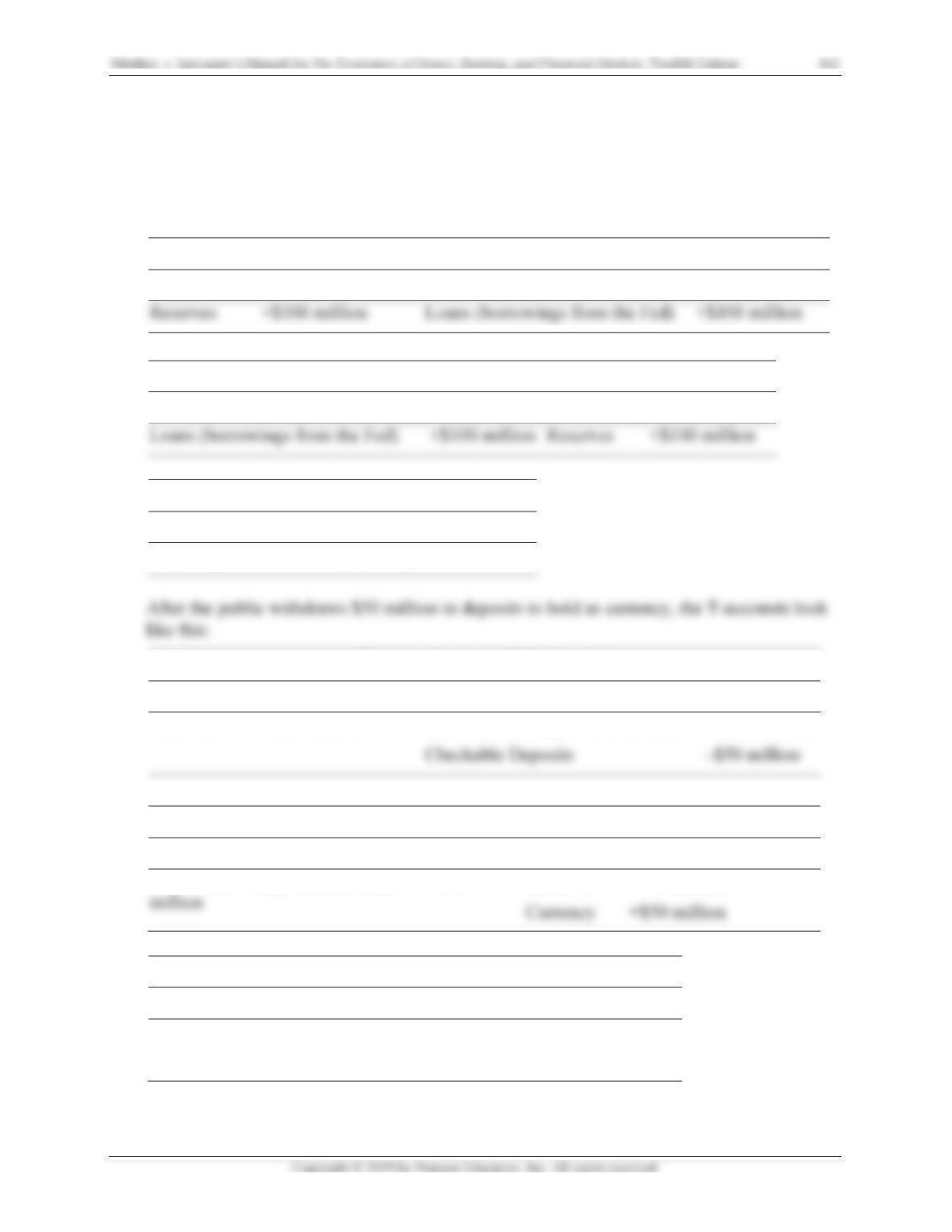
Reserves are unchanged, but the monetary base decreases by $2 million due to the currency
reduction, as the following T-accounts show:
Irving the Investor
Assets Liabilities
Currency –$2 million
18. If the Fed lends five banks a total of $100 million but depositors withdraw $50 million and
hold it as currency, what happens to reserves and the monetary base? Use T-accounts to
explain your answer.
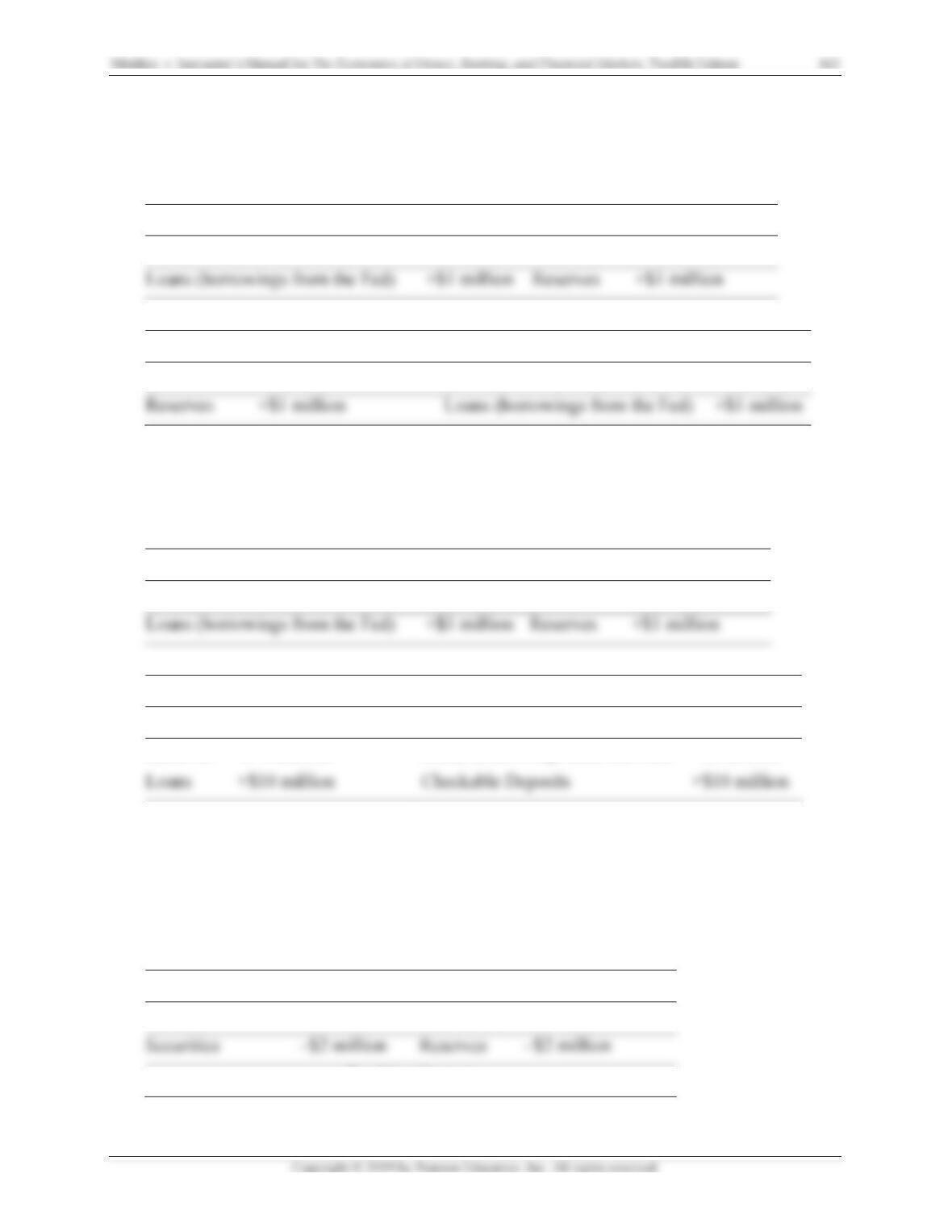
The initial effect of the loans on the banking system, Federal Reserve, and public are shown
below.
Banking System (all five banks)
Assets Liabilities
Federal Reserve System
Assets Liabilities
Public
Assets Liabilities
N
o change No change
Banking System (all five banks)
Assets Liabilities
Reserves +$50 million Loans (borrowings from the Fed) +$100 million
Federal Reserve System
Assets Liabilities
Loans (borrowings from the Fed) +$100
Reserves +$50 million
Public
Assets Liabilities
Checkable Deposits –$50 million
Currency +$50 million
19. Using T-accounts, show what happens to checkable deposits in the banking system when the
Fed lends $1 million to the First National Bank.
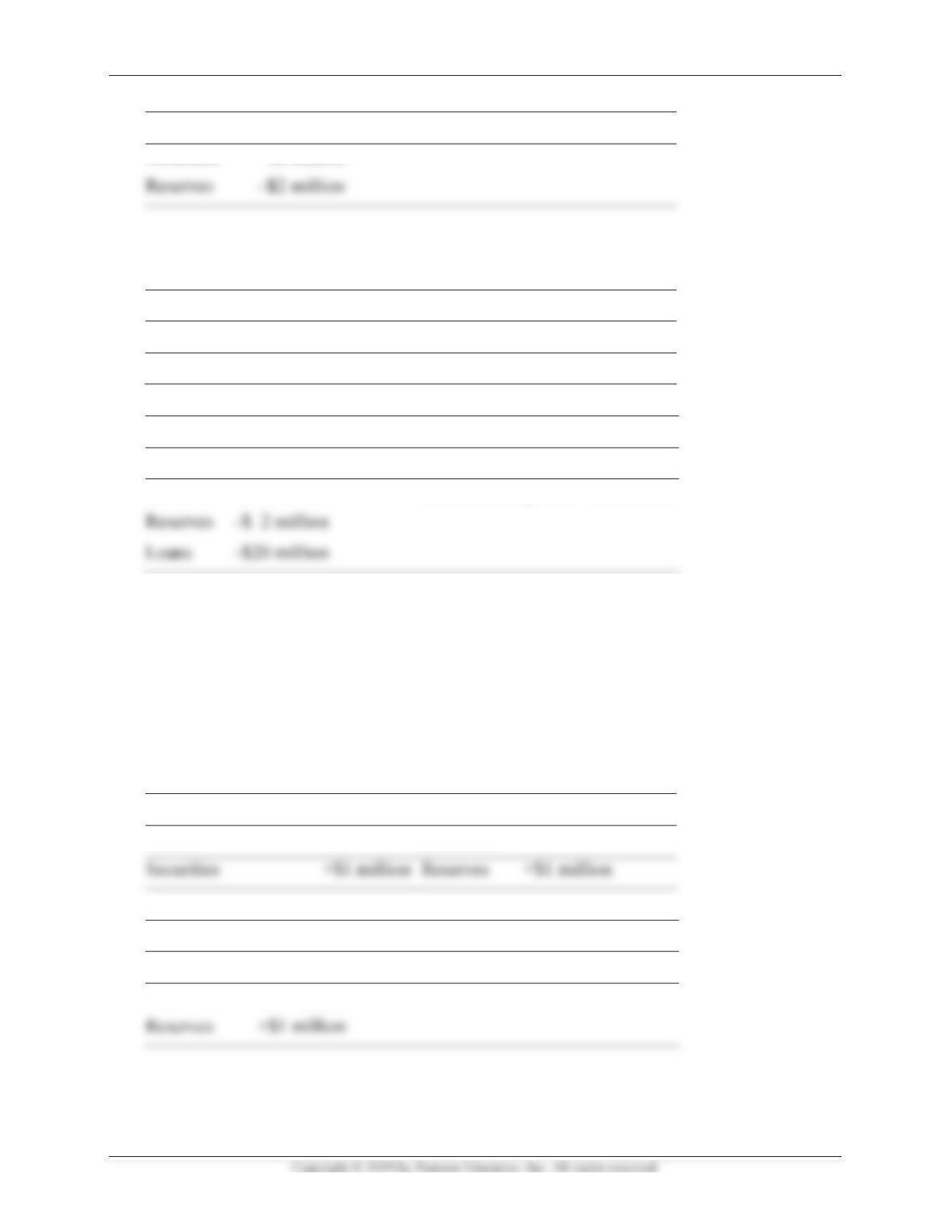
The initial effect of the loans provided by the Fed is shown in the T-accounts below:
Federal Reserve System
Assets Liabilities
Banking System
Assets Liabilities
After the banks receive the reserves, those excess reserves are loaned out; through multiple
deposit creation, the increase in reserves of the banking system will support $10 million in
new loans and checkable deposits, increasing the money supply by $10 million. The final
effect of the multiple deposit creation is shown in the T-accounts below:
Federal Reserve System
Assets Liabilities
Banking System
Assets Liabilities
Reserves +$ 1 million Loans (borrowings from the Fed) +$1 million
20. Using T-accounts, show what happens to checkable deposits in the banking system when the
Fed sells $2 million of bonds to the First National Bank.
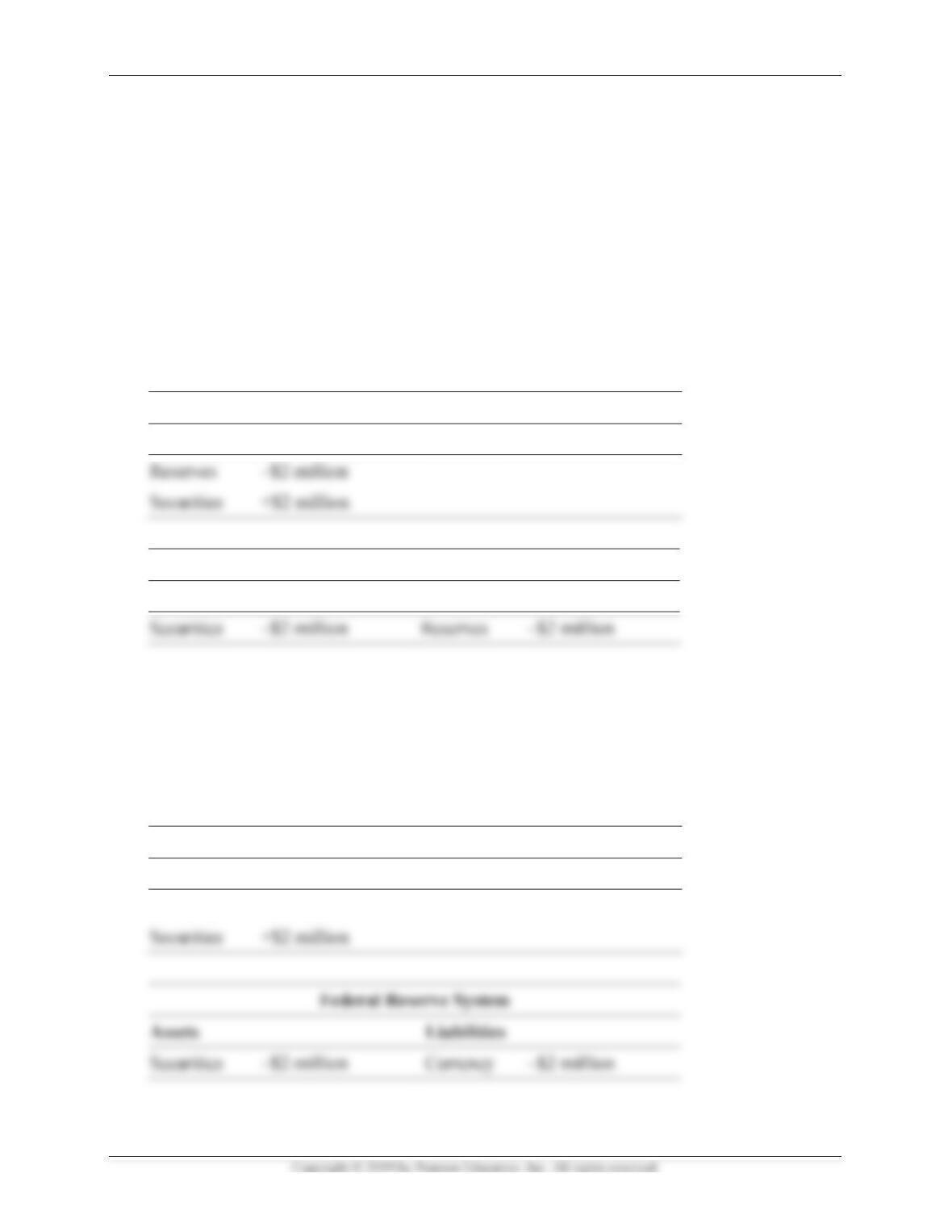
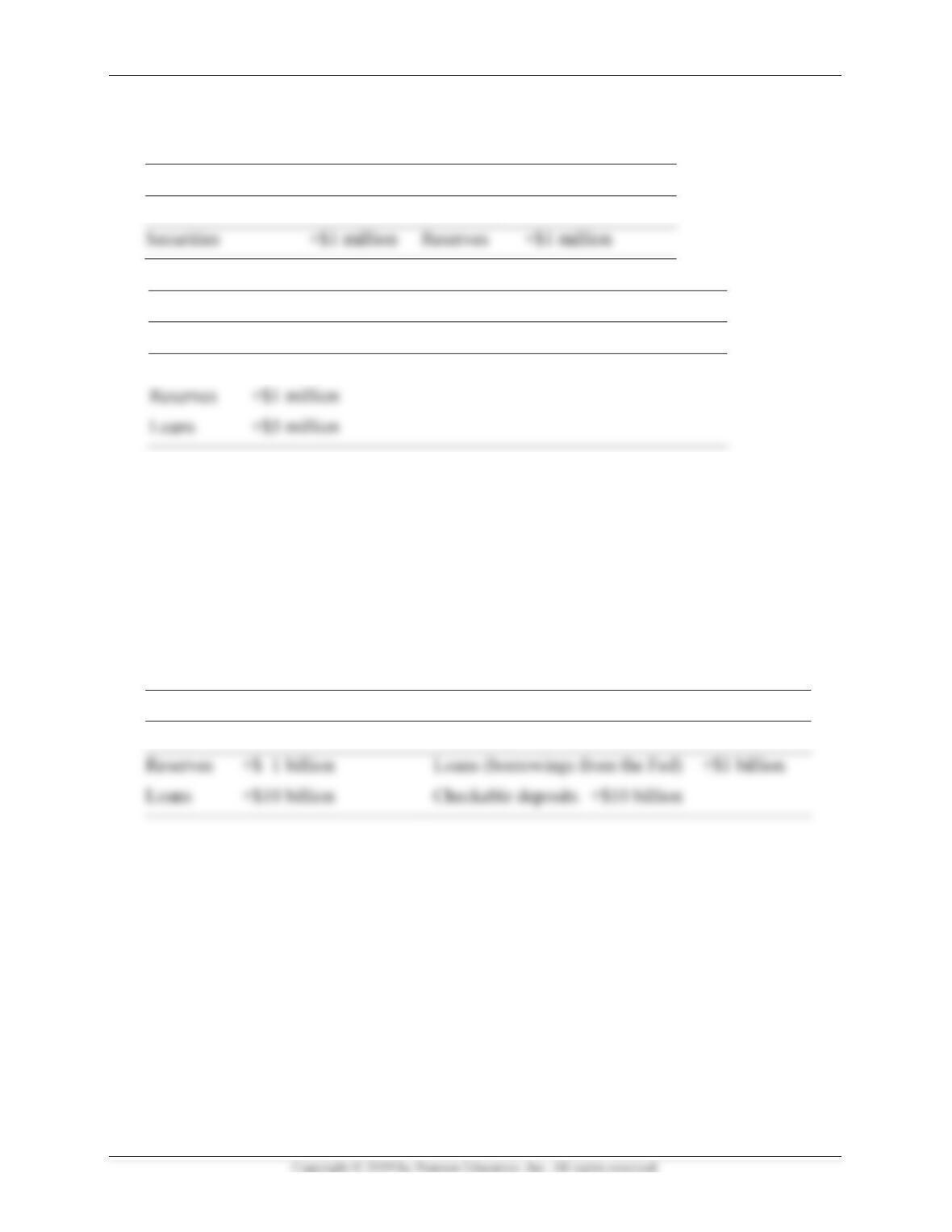
The Fed sale of bonds to the First National Bank reduces reserves by $2 million. The net
result is that checkable deposits in the banking system decline by $20 million. The initial
effect on the Fed and the banking system is shown below:
Federal Reserve System
Assets Liabilities
Banking System
Mishkin • Instructor’s Manual for The Economics of Money, Banking, and Financial Markets, Twelfth Edition 164
Assets Liabilities
Securities +$2 million
After the decline in bank reserves, the multiple deposit creation process works in reverse, so
the final effect on the Fed and banking system balance sheets is shown below:
Federal Reserve System
Assets Liabilities
Securities –$2 million Reserves –$2 million
Banking System
Assets Liabilities
Securities +$ 2 million Checkable Deposits –$20 million
21. If the Fed buys $1 million of bonds from the First National Bank, but an additional 10% of
any deposit is held as excess reserves, what is the total increase in checkable deposits?
(Hint: Use T-accounts to show what happens at each step of the multiple expansion process.)
The total increase in checkable deposits is only $5 million, substantially less than the $10
million that occurs when no excess reserves are held. The reason is that banks now end up
holding 20% of deposits as reserves and only lend out 80%, so that the increase in deposits
found in the T-accounts is $1,000,000 + $800,000 + $640,000 + $512,000 + $409,600 + . . .
= $5 million. The T-accounts below show the effect of the securities purchase:
Federal Reserve System
Assets Liabilities
Banking System
Assets Liabilities
Securities –$1 million
Mishkin • Instructor’s Manual for The Economics of Money, Banking, and Financial Markets, Twelfth Edition 165
After the increase in reserves and the multiple deposit creation process, the Fed and Banking
system balance sheets are as follows:
Federal Reserve System
Assets Liabilities
Banking System
Assets Liabilities
Securities –$1 million Checkable Deposits +$5 million
22. If reserves in the banking system increase by $1 billion because the Fed lends $1 billion to
financial institutions, and checkable deposits increase by $9 billion, why isn’t the banking
system in equilibrium? What will continue to happen in the banking system until equilibrium
is reached? Show the T-account for the banking system in equilibrium.
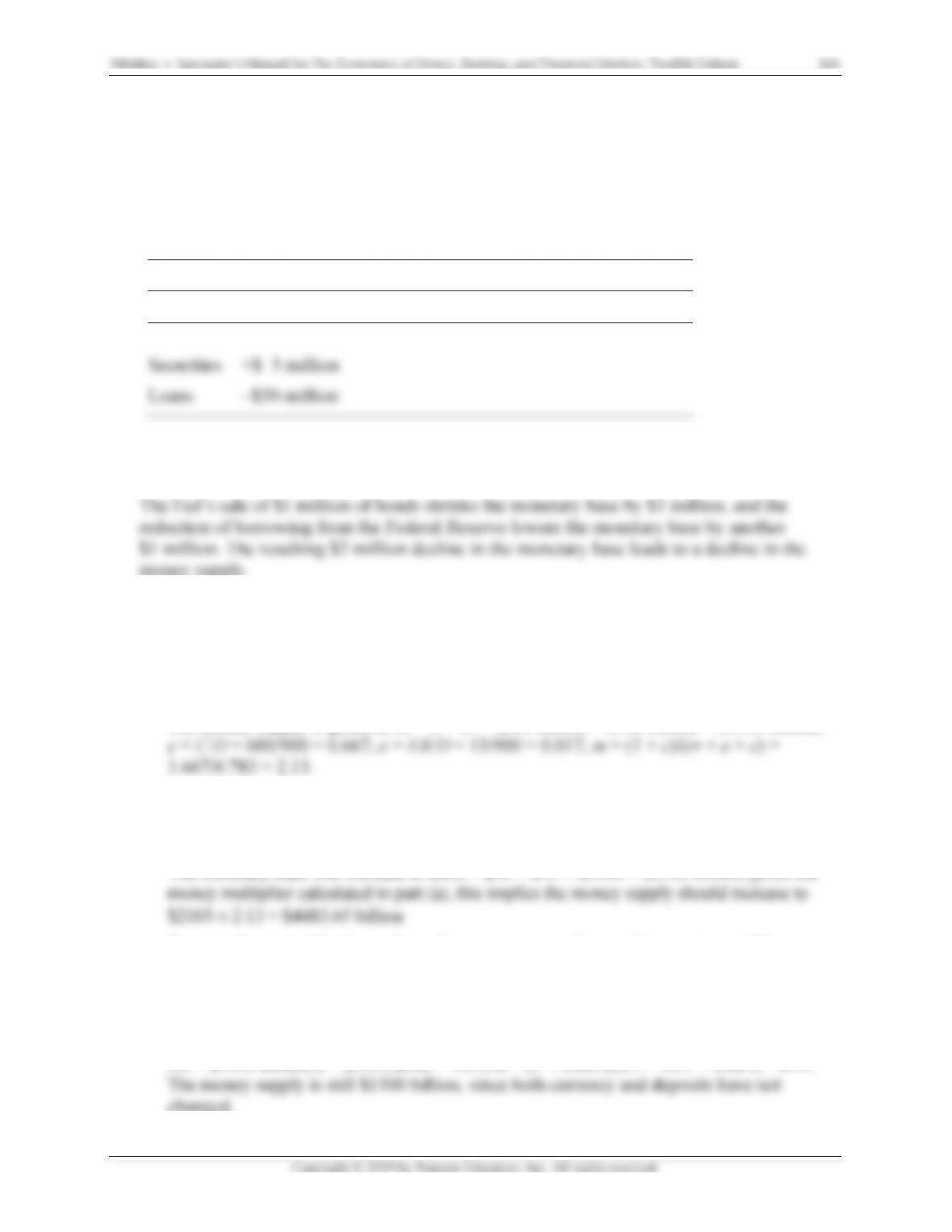
The banking system is still not in equilibrium because there continues to be $100 million of
excess reserves (+$1 billion of reserves minus $900 million of required reserves, 10% of the
$9 billion of deposits). The excess reserves will be lent out until equilibrium is reached with
an additional $1 billion of checkable deposits. The T-account for the banking system when it
is in equilibrium is as follows:
Banking System
Assets Liabilities
23. If the Fed reduces reserves by selling $5 million worth of bonds to the banks, what will the
T-account of the banking system look like when the banking system is in equilibrium? What
will have happened to the level of checkable deposits?
Checkable deposits will decrease by $50 million when the banking system is in equilibrium
(as a result of the $5 million decrease in reserves supporting the money supply). The
T-account is shown below:
Banking System
Assets Liabilities
Reserves –$ 5 million
Checkable deposits –$50 million
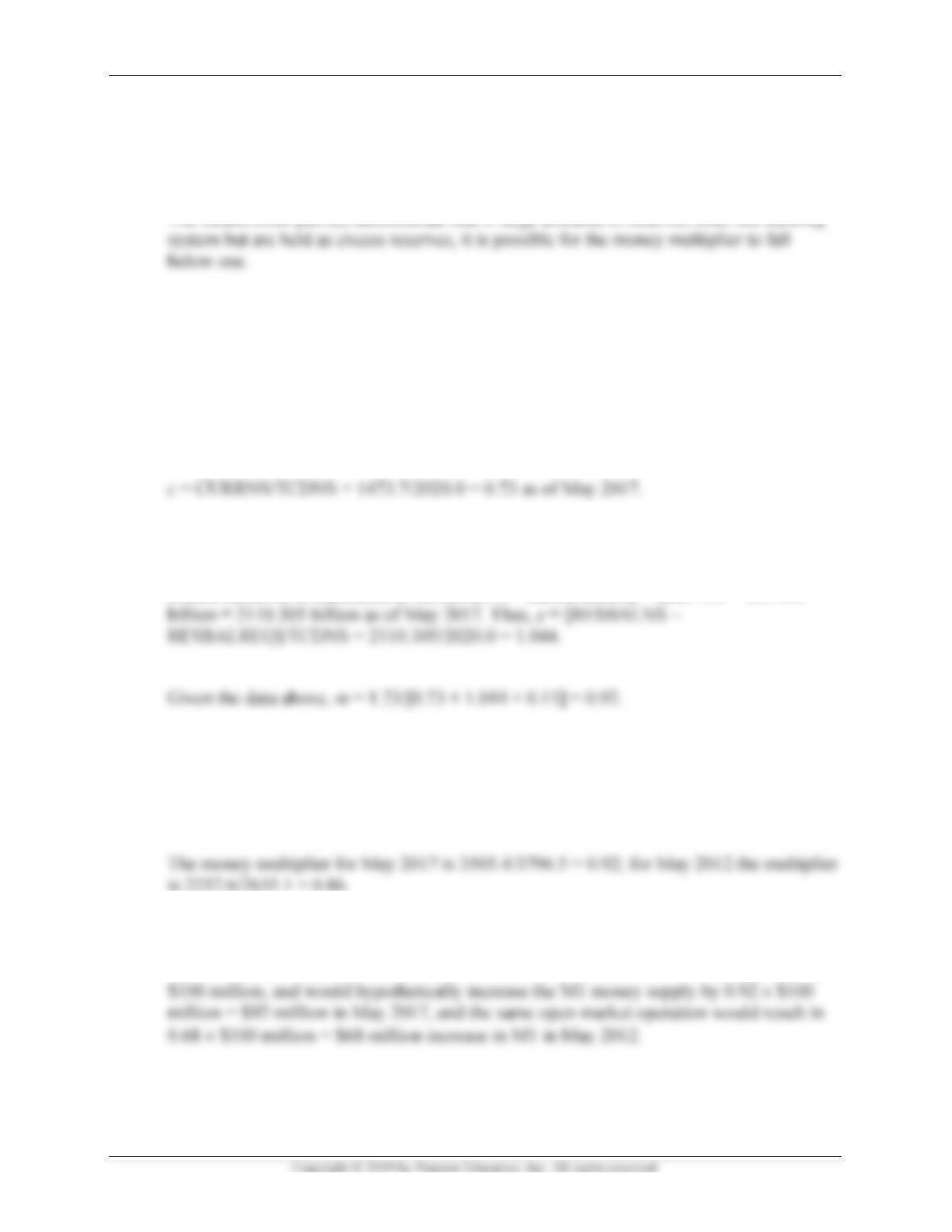
24. If the Fed sells $1 million of bonds and banks reduce their borrowings from the Fed by
$1 million, predict what will happen to the money supply.
25. Suppose that currency in circulation is $600 billion, the amount of checkable deposits is
$900 billion, and excess reserves are $15 billion.
a. Calculate the money supply, the currency deposit ratio, the excess reserve ratio, and the
money multiplier.
The money supply is given as M = C + D = $600 billion + $900 billion = $1500 billion;
b. Suppose the central bank conducts an unusually large open market purchase of bonds
held by banks of $1400 billion due to a sharp contraction in the economy. Assuming the
ratios you calculated in part (a) remain the same, predict the effect on the money supply.
c. Suppose the central bank conducts the same open market purchase as in part (b), except
that banks choose to hold all of these proceeds as excess reserves rather than loan them
out, due to fear of a financial crisis. Assuming that currency and deposits remain the
same, what happens to the amount of excess reserves, the excess reserve ratio, the money
supply, and the money multiplier?
changed.
Mishkin • Instructor’s Manual for The Economics of Money, Banking, and Financial Markets, Twelfth Edition 167
d. During the financial crisis in 2008, the Federal Reserve began injecting the banking
system with massive amounts of liquidity, and at the same time, very little lending
occurred. As a result, the M1 money multiplier was below 1 for most of the time from
October 2008 through 2011. How does this scenario relate to your answer to part (c)?
ANSWERS TO DATA ANALYSIS PROBLEMS
1. Go to the St. Louis Federal Reserve FRED database, and find the most current data
available on Currency (CURRNS), Total Checkable Deposits (TCDNS), Total Reserves
(RESBALNS), and Required Reserves (RESBALREQ).
a. Calculate the value of the currency deposit ratio c.
b. Use RESBALNS and RESBALREQ to calculate the amount of excess reserves, and then
calculate the value of the excess reserve ratio e. Be sure the units of total and required
reserves are the same when you do the calculations.
Excess Reserves is calculated as RESBALNS – RESBALREQ = 2225.769 – 115.464
c. Assuming a required reserve ratio rr of 11%, calculate the value of the money multiplier m.
2. Go to the St. Louis Federal Reserve FRED database and find data on the M1 Money Stock
(M1SL) and the Monetary Base (AMBSL).
a. Calculate the value of the money multiplier using the most recent data available and the
data from five years prior.
is 2257.6/2635.1 = 0.86.
b. Based on your answer to part (a), how much would a $100 million open market purchase
of securities affect the M1 money supply today and five years ago?
The $100 million open market purchase of securities will increase the monetary base by