Chapter 14 Monetary Policy and the Federal Reserve System 353
2. Rules, commitment, and credibility
a. How does a central bank gain credibility?
Analytical Problem 4 looks at rules and commitment applied to a noneconomic situation.
d. Keynesians argue that there may be a trade-off between credibility and flexibility
(1) To be credible, a rule must be nearly impossible to change
(2) But if a rule can’t be changed, what happens in a crisis situation?
E. The Taylor rule
1. John Taylor of Stanford University introduced a rule that allows the Fed to take economic
conditions into account
4. If either y or
increase, the real fed funds rate is increased, causing monetary policy to
tighten (and vice versa)
5. Taylor showed that the rule is similar to what the Fed does in practice
6. The data show that in the 1960s and 1970s when the Fed set the federal funds rate below the
rule’s suggestion, inflation rose; when the Fed set the federal funds rate fairly close to the
Analytical Problem 2 examines the ability of the Taylor rule to stabilize the economy, while
Numerical Problem 4 provides practice for students in calculating the rule and how the target for
the fed funds rate changes in response to a shock.
354 Abel/Bernanke/Croushore • Macroeconomics, Ninth Edition
F. Other ways to achieve central bank credibility besides targeting money growth or inflation
1. Increasing the central bank’s reputation as an inflation fighter
a. The central bank could improve its reputation by establishing inflation goals and meeting
them
b. Appointing someone who has a well-known reputation for being tough in fighting
inflation may help establish credibility for the central bank
G. Application: Inflation targeting
1. Since 1989, some countries have adopted a system of inflation targeting
2. New Zealand was the pioneer, announcing explicit inflation targets that had to be met
a. Canada, the UK, Sweden, Australia, Spain, and others followed with some version of
inflation targeting
b. The European Central Bank uses a modified inflation targeting approach
Policy Application
Many economists within the Fed use the Taylor rule for analyzing policy. Following the financial
crisis in 2008, the Fed began to consider its exit strategy from the extraordinary measures it took
Chapter 14 Monetary Policy and the Federal Reserve System 355
◼ Additional Issues for Classroom Discussion
1. Should the Federal Reserve Be More Responsive to the Public?
Central banks in different countries vary dramatically in both their degree of independence from political
pressure and the degree of accountability for their actions. Is the U.S. Federal Reserve sufficiently
independent and accountable for optimal policymaking?
In discussing this topic, you should note that most power in the Fed resides with the Chairman and the
Board of Governors, who are appointed by the U.S. President and confirmed by the Senate. But the
2. Should the Fed Deliberately Reduce Inflation, or Wait for a Recession?
When the Fed wanted to reduce the inflation rate in the 1980s, some members of the Federal Open Market
Committee discussed how actively the Fed should reduce the inflation rate in moving to its long-run goal
of zero inflation. Should the Fed actively tighten monetary policy, or wait for the right circumstances to
reduce inflation, since inflation generally falls in a recession?
In discussing this issue, you should note that waiting for a recession (a strategy known as “opportunistic
356 Abel/Bernanke/Croushore • Macroeconomics, Ninth Edition
◼ Answers to Textbook Problems
Review Questions
1. The monetary base, or high-powered money, consists of the sum of currency held by the non-bank
2. The money multiplier is the number of dollars of the money supply that can be created from each
dollar of monetary base. Changes in the desire by the public for holding currency affect the currency–
3. An open-market purchase increases the monetary base. The increase in the monetary base leads to an
increase in the money supply through the multiple expansions of loans and deposits.
4. Monetary policy in the United States is determined by the Federal Reserve System. The President
5. Means of controlling the money supply other than open-market operations include:
(1) Reserve requirements. An increase in reserve requirements forces banks to hold more reserves,
6. Intermediate targets are macroeconomic variables that the Fed cannot directly control, but can
influence fairly predictably, and that are related to the ultimate goals of monetary policy. The
ultimate goals of monetary policy are achieving price stability and promoting stable growth of
7. The three main sources of uncertainty that affect monetary policymakers are (1) uncertainty about the
current state of the economy; (2) incompleteness of their models of the economy; and (3) uncertainty
about how the expectations of the public will be affected by economic shocks and policy actions.
Examples of uncertainty about the current state of the economy include the fact that different
8. The main tools the Fed used in the Great Recession to avoid problems caused by the zero lower
bound include forward guidance and quantitative easing. Using forward guidance, the Fed tried to
9. The monetarist response to the argument that discretion is more flexible than following a rule is to
argue that (1) because of information lags, it is difficult for the central bank to tell what the appropriate
policy is at a particular time; (2) there are long and variable lags between monetary policy actions and
10. The Taylor rule sets the fed funds rate target depending on recent inflation, the deviation of output
from the level of full-employment output, and the deviation of recent inflation from its target of 2%.
11. Inflation targeting may improve a central bank’s credibility because the public can easily observe
whether the central bank has achieved its goals. The main disadvantage is the long lag between
358 Abel/Bernanke/Croushore • Macroeconomics, Ninth Edition
Numerical Problems
1. Initial balance sheet of banks (all amounts in dollars):
Assets
Liabilities
Reserves
500,000
Deposits
500,000
Banks want to hold reserves equal to only 20% of deposits. This is 0.20 500,000 = 100,000. So they
have 400,000 they’d like to lend. If they lend 400,000, the public will hold half of it (200,000) in
Loans
400,000
Assets
Liabilities
Reserves
220,000
Deposits
780,000
Loans
560,000
The process continues until banks reach their desired reserve–deposit ratio. Since the public wants
to hold its money in equal amounts of currency and deposits, the currency–deposit ratio is 1. The
money multiplier in this case is (cu + 1)/(cu + res) = (1 + 1)/(1 + 0.20) = 2/1.2 = 1 2/3. Since the
monetary base is 1 million dollars, the money supply is 1 2/3 million dollars. Since half of the money
supply is in currency and half is in deposits, these are each equal to 833 1/3 thousand dollars. With
a reserve–deposit ratio of 0.2, total reserves held by banks are 0.2 833 1/3 = 166 2/3 thousand
dollars. The final balance sheets are:
Central Bank
Assets
Liabilities
Chapter 14 Monetary Policy and the Federal Reserve System 359
2. Dollar amounts are in millions of dollars.
(a) DEP = M − CU = 6 − 2 = 4. RES = res DEP = 0.25 4 = 1.
3. (a) res = 0.4 − 2(0.10) = 0.2.
Multiplier = (cu + 1)/(cu + res) = (0.4 + 1)/(0.4 + 0.2) = 2 1/3.
Y = 241.
(c) In this case the multiplier is unchanged from part (a) at 2 1/3, so the money supply is unchanged
at 140. Setting M/P = L gives 140/1 = 0.5Y − (10 0.05), or 140 + 0.5 = 0.5Y, which has the
solution Y = 281.
(d) If the reserve–deposit ratio is unaffected by the real interest rate, the LM curve is steeper than
when it is affected by the real interest rate. To see why, consider the effect of a decline in the real
interest rate. If the reserve–deposit ratio is affected by the real interest rate, the fall in the real
4. (a) The Taylor rule is i =
+ 0.02 + 0.5y + 0.5 (
− 0.02). The inflation rate over the past year is
[(149.2 − 147.3)/147.3] = 0.013. The percentage deviation of output from potential output is
= 0.6%.
(b) Now the inflation rate over the past year is –0.004 and the percentage deviation of output from
360 Abel/Bernanke/Croushore • Macroeconomics, Ninth Edition
Analytical Problems
1. (a) The increase in banks’ reserve–deposit ratio reduces the money multiplier, causing the money
supply to decline.
(b) The increased holding of cash raises the currency–deposit ratio, reducing the money multiplier
and causing the money supply to decline.
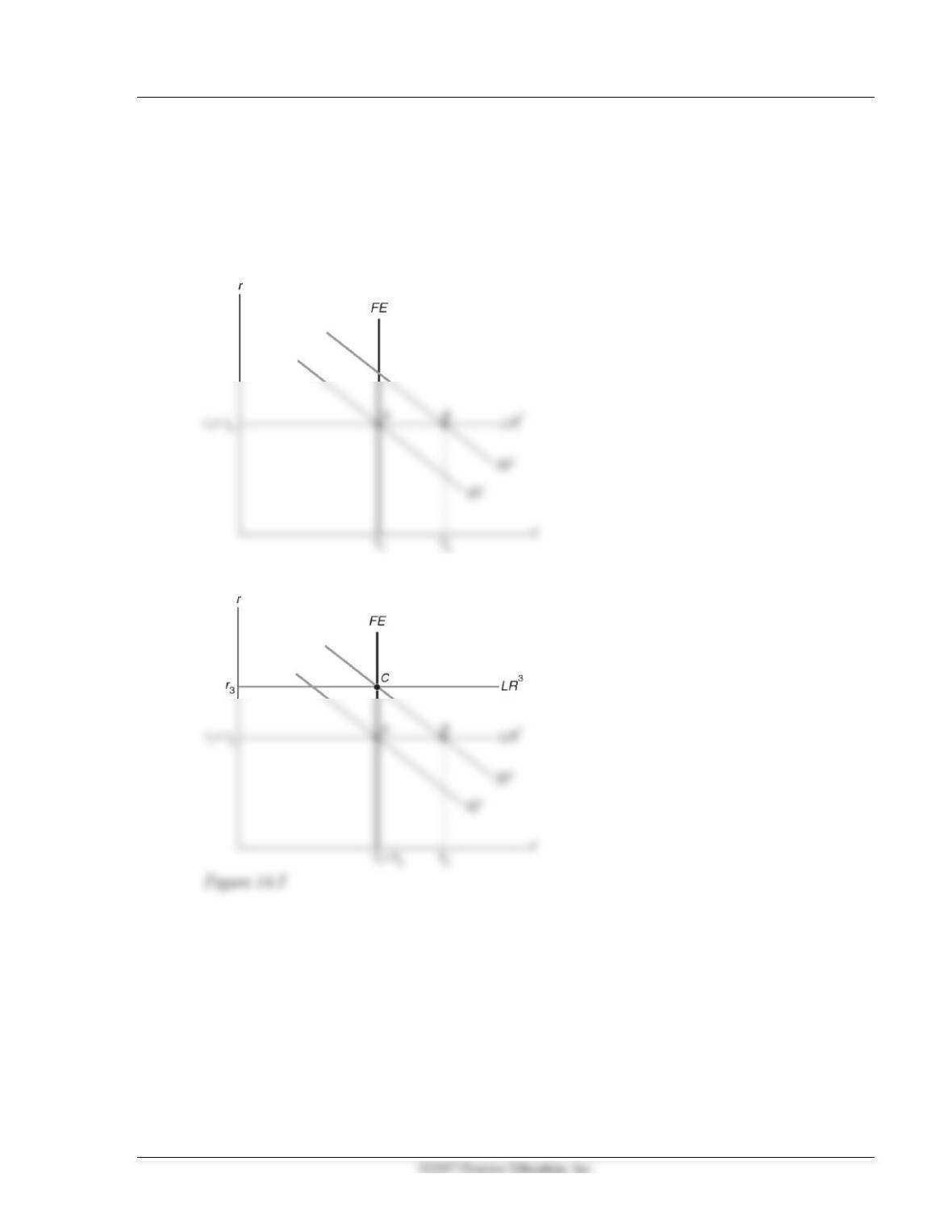
2. To examine the Taylor rule, we’ll use the classical model with misperceptions.
(a) An increase in money demand causes the aggregate demand curve to shift down and to the left,
reducing the price level and inflation and decreasing output, if the money supply is unchanged.
In response to these changes in output and inflation, the Taylor rule decreases the nominal fed
funds rate, which means the money supply is increased. This shifts the aggregate demand curve
Chapter 14 Monetary Policy and the Federal Reserve System 361
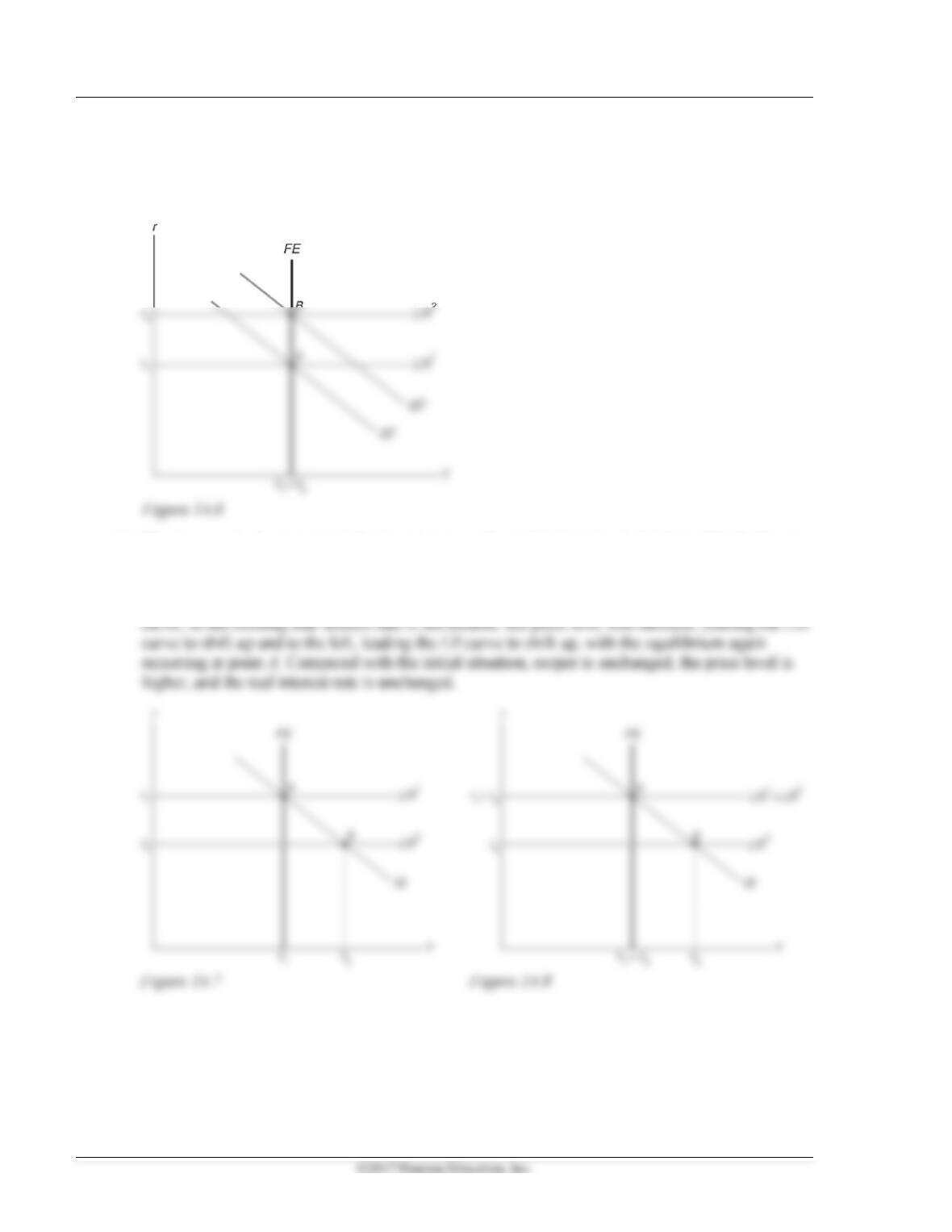
3. (a) The investment tax credit causes desired investment to rise, shifting the IS curve up and to the
right (Figure 14.4). The short-run equilibrium occurs at point B, with a higher level of output and
an unchanged real interest rate. In the long run (Figure 14.5), the equilibrium must occur at the
intersection of the FE line and the IS curve, so the existing real interest rate is not tenable; the
price level will increase, causing the LM curve to shift up and to the left, leading the LR curve to
shift up. Compared with the initial situation, output is unchanged, the price level is higher, and
the real interest rate is higher.
Figure 14.4
362 Abel/Bernanke/Croushore • Macroeconomics, Ninth Edition
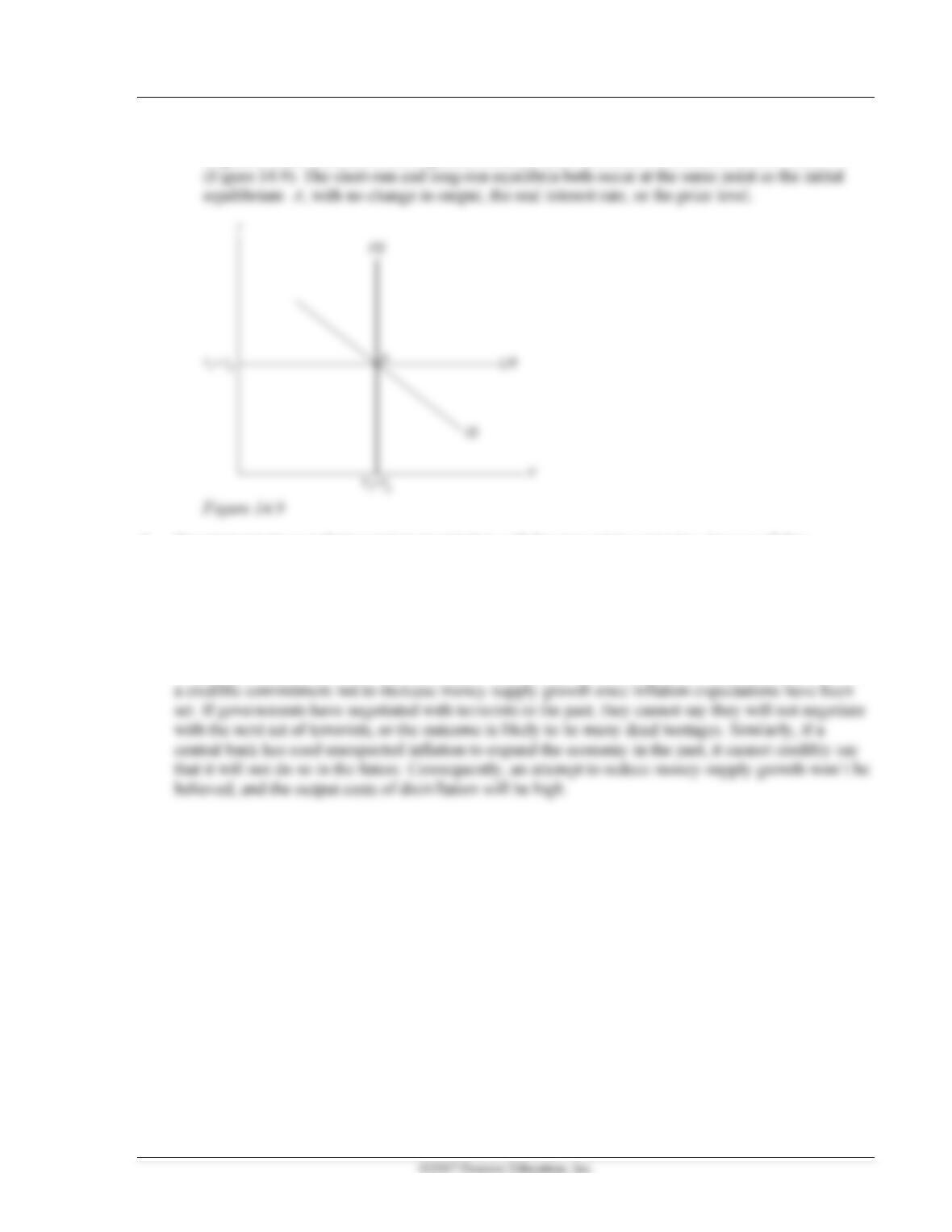
(b) If the Fed raises its target for the real interest rate to keep output stable in response to the shift in
the IS curve, it shifts the LR curve up to LR2 (Figure 14.6) The short-run and long-run equilibria
both occur at the same point B, at which the real interest rate is higher but output and the price
level are unchanged.
(c) The increase in the expected inflation rate causes the real interest rate to decline, if the Fed keeps
the nominal interest rate unchanged, causing the LR curve to shift down (Figure 14.7). The short-
run equilibrium occurs at point B, with a higher level of output and lower real interest rate. In the
long run (Figure 14.8), the equilibrium must occur at the intersection of the FE line and the IS
Chapter 14 Monetary Policy and the Federal Reserve System 363
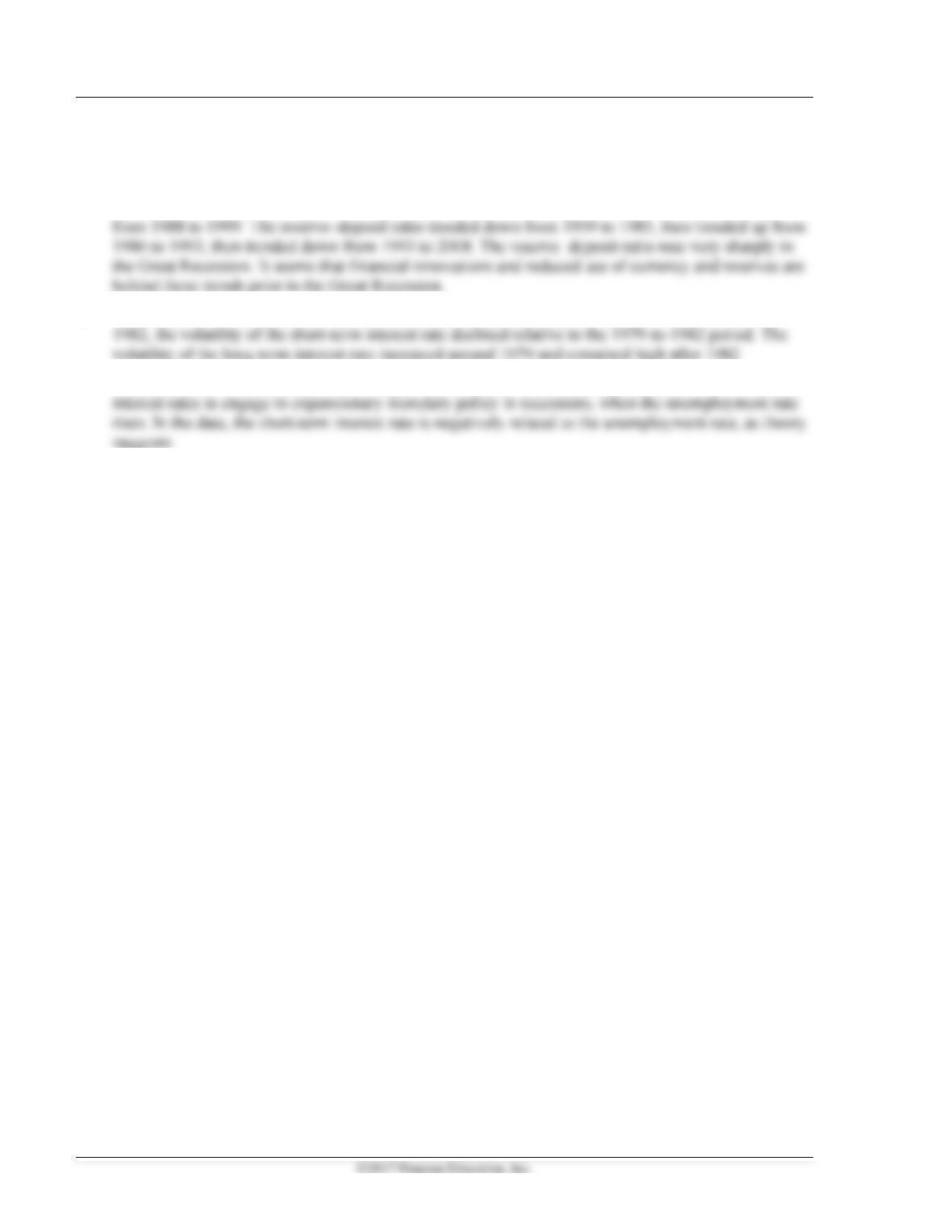
(d) If the Fed raises its target for the nominal interest rate to keep the real interest rate unchanged in
response to the increase in the expected inflation rate, then there is no shift in the LR curve
4. Governments have policies against negotiating with hostage-taking terrorists, because if they
negotiate with some terrorists, more terrorists will take hostages in the future. Then they cannot
credibly say they will not negotiate with the next set of terrorists. If the government commits to never
negotiate with terrorists, then there is no gain to the terrorists for taking hostages, so there will be less
terrorism.
This example is like that of monetary rules. If you want to stop hostage taking, you must have a
credible commitment not to negotiate. Similarly, a central bank that wants to stop inflation must have
364 Abel/Bernanke/Croushore • Macroeconomics, Ninth Edition
Working with Macroeconomic Data
1. The money multiplier was fairly stable from 1995 to 2005, but it declined sharply in the Great
Recession. The currency–deposit ratio generally trended down from 1959 to 1987 but trended up
2. The volatility of the short-term interest rate increased substantially between 1979 and 1982. After
3. The short-term interest rate should be negatively related to the unemployment rate, if the Fed reduces